

ASTM E1618-19
(Test Method)Standard Test Method for Ignitable Liquid Residues in Extracts from Fire Debris Samples by Gas Chromatography-Mass Spectrometry
General Information
- Abstract
SIGNIFICANCE AND USE
4.1 The identification of an ignitable liquid residue in samples from a fire scene can support the field investigator’s opinion regarding the origin, fuel load, and incendiary nature of the fire.
4.1.1 The identification of an ignitable liquid residue in a fire scene does not necessarily lead to the conclusion that a fire was incendiary in nature. Further investigation can reveal a legitimate reason for the presence of ignitable liquid residues.
4.1.2 Because of the volatility of ignitable liquids and variations in sampling techniques, the absence of detectable quantities of ignitable liquid residues does not necessarily lead to the conclusion that ignitable liquids were not present at the fire scene.
4.2 Materials normally found in a building, upon exposure to the heat of a fire, will form pyrolysis and combustion products. Extracted ion profiling and identification of specific compounds or classes of compounds described herein can facilitate the identification of an ignitable liquid in the extract by reducing interference by components generated as products of pyrolysis.
SCOPE
1.1 This test method covers the identification of residues of ignitable liquids in extracts from fire debris samples. Extraction procedures are described in the referenced documents.
1.2 Although this test method is suitable for all samples, it is especially appropriate for extracts that contain high background levels of substrate materials or pyrolysis and combustion products. This test method is also suitable for the identification of single compounds, simple mixtures, or non-petroleum based ignitable liquids.
1.3 The values stated in SI units are to be regarded as standard. No other units of measurement are included in this standard.
1.4 This practice cannot replace knowledge, skill, or ability acquired through appropriate education, training, and experience and should be used in conjunction with sound professional judgment.
1.5 This standard does not purport to address all of the safety concerns, if any, associated with its use. It is the responsibility of the user of this standard to establish appropriate safety, health, and environmental practices and determine the applicability of regulatory limitations prior to use.
1.6 This international standard was developed in accordance with internationally recognized principles on standardization established in the Decision on Principles for the Development of International Standards, Guides and Recommendations issued by the World Trade Organization Technical Barriers to Trade (TBT) Committee.
- Status
- Published
- Publication Date
- 14-Nov-2019
- Technical Committee
- E30 - Forensic Sciences
- Drafting Committee
- E30.01 - Criminalistics
Buy Documents
ASTM E1618-19 - Standard Test Method for Ignitable Liquid Residues in Extracts from Fire Debris Samples by Gas Chromatography-Mass Spectrometry
REDLINE ASTM E1618-19 - Standard Test Method for Ignitable Liquid Residues in Extracts from Fire Debris Samples by Gas Chromatography-Mass Spectrometry
Overview
ASTM E1618-19, issued by ASTM International, provides the standard test method for the identification of ignitable liquid residues in extracts from fire debris samples by gas chromatography-mass spectrometry (GC-MS). This internationally recognized standard is a cornerstone in forensic investigations, fire scene analysis, and laboratory testing, enabling professionals to systematically assess the presence of ignitable liquids in fire debris with high specificity and reliability.
This method is particularly valuable for challenging samples-such as those with significant backgrounds of substrate materials or pyrolysis products-by enhancing the detection and classification of ignitable liquids, including single compounds, simple mixtures, and non-petroleum-based products. ASTM E1618-19 builds confidence in analytical findings by providing a reproducible, evidence-based approach for laboratories and investigators working to determine the presence and possible role of ignitable liquids in fires.
Key Topics
- Scientific Basis: Utilizes advanced GC-MS instrumentation to separate and identify chemical compounds in fire debris extracts.
- Ignitable Liquid Classification: Outlines seven major classes (plus a miscellaneous category) based on chemical characteristics and chromatographic patterns.
- Pattern Analysis: Employs extracted ion profiling and target compound analysis for comparison to reference ignitable liquids, facilitating accurate identification even in complex matrices.
- Quality and Calibration: Emphasizes consistent instrument maintenance, calibration, and documentation to ensure reliable and defendable results.
- Interference Management: Addresses pyrolysis and combustion products that can interfere with analysis, providing guidelines to distinguish between substrate artifacts and true ignitable liquid residues.
- Result Interpretation: Offers guidance for interpreting complex chromatographic and spectral data, including handling “missing” components due to degradation, evaporation, or sampling variance.
- Limitations: Stresses that the detection of ignitable liquid residues alone does not automatically infer incendiary activity; contextual interpretation and professional judgment are essential.
Applications
ASTM E1618-19 is widely applied in:
- Forensic Fire Investigations: Supporting fire origin and cause determinations, and distinguishing between accidental and deliberate fires.
- Legal Proceedings: Providing scientifically robust data and documentation that can be presented in court as part of forensic evidence.
- Insurance Assessments: Assisting claims professionals in evaluating fire claims where ignitable liquids may have been present or used.
- Research and Laboratory Testing: Standardizing procedures for forensic laboratories and researchers analyzing fire debris.
- Training and Education: Serving as a foundational document in training fire investigators and forensic chemists in ignitable liquid residue analysis.
This standard enhances the accuracy and defensibility of ignitable liquid residue identifications, even in the presence of significant background noise or complicated sample matrices.
Related Standards
ASTM E1618-19 works in coordination with several other ASTM standards to cover all aspects of fire debris analysis, from sample collection to preservation and concentration:
- ASTM E1386 - Practice for Separation of Ignitable Liquid Residues from Fire Debris Samples by Solvent Extraction
- ASTM E1388 - Practice for Static Headspace Sampling of Vapors from Fire Debris Samples
- ASTM E1412 - Practice for Passive Headspace Concentration Using Activated Charcoal
- ASTM E1413 - Practice for Dynamic Headspace Concentration onto an Adsorbent Tube
- ASTM E2154 - Practice for Passive Headspace Concentration with Solid Phase Microextraction (SPME)
- ASTM E2451 - Practice for Preserving Ignitable Liquids and Extracts from Fire Debris Samples
By integrating ASTM E1618-19 with these standards, laboratories and investigators can achieve a comprehensive, systematic approach to analyzing fire debris for ignitable liquids, ensuring high-quality, defensible analytical results.
Keywords: ASTM E1618-19, ignitable liquid residues, fire debris analysis, gas chromatography-mass spectrometry, GC-MS, forensic fire investigation, pyrolysis products, fire debris standards.
Relations
- Refers
ASTM E1388-24 - Standard Practice for Static Headspace Sampling of Vapors from Fire Debris Samples - Effective Date
- 01-Mar-2024
- Effective Date
- 15-Jan-2016
- Effective Date
- 01-Mar-2015
- Effective Date
- 15-Aug-2013
- Effective Date
- 01-Jun-2012
- Effective Date
- 01-Feb-2012
- Effective Date
- 01-Feb-2010
- Effective Date
- 01-Nov-2009
- Effective Date
- 01-Mar-2008
- Effective Date
- 01-Feb-2008
- Effective Date
- 15-Apr-2007
- Effective Date
- 15-Apr-2007
- Effective Date
- 01-Jun-2006
- Effective Date
- 01-Sep-2005
- Effective Date
- 01-May-2005
Buy Documents
ASTM E1618-19 - Standard Test Method for Ignitable Liquid Residues in Extracts from Fire Debris Samples by Gas Chromatography-Mass Spectrometry
REDLINE ASTM E1618-19 - Standard Test Method for Ignitable Liquid Residues in Extracts from Fire Debris Samples by Gas Chromatography-Mass Spectrometry
Get Certified
Connect with accredited certification bodies for this standard

CIS Institut d.o.o.
Personal Protective Equipment (PPE) certification body. Notified Body NB-2890 for EU Regulation 2016/425 PPE.

Kiwa BDA Testing
Building and construction product certification.
Kmetijski inštitut Slovenije
Agricultural Institute of Slovenia. Soil testing, plant health, agricultural product analysis.
Sponsored listings
Frequently Asked Questions
ASTM E1618-19 is a standard published by ASTM International. Its full title is "Standard Test Method for Ignitable Liquid Residues in Extracts from Fire Debris Samples by Gas Chromatography-Mass Spectrometry". This standard covers: SIGNIFICANCE AND USE 4.1 The identification of an ignitable liquid residue in samples from a fire scene can support the field investigator’s opinion regarding the origin, fuel load, and incendiary nature of the fire. 4.1.1 The identification of an ignitable liquid residue in a fire scene does not necessarily lead to the conclusion that a fire was incendiary in nature. Further investigation can reveal a legitimate reason for the presence of ignitable liquid residues. 4.1.2 Because of the volatility of ignitable liquids and variations in sampling techniques, the absence of detectable quantities of ignitable liquid residues does not necessarily lead to the conclusion that ignitable liquids were not present at the fire scene. 4.2 Materials normally found in a building, upon exposure to the heat of a fire, will form pyrolysis and combustion products. Extracted ion profiling and identification of specific compounds or classes of compounds described herein can facilitate the identification of an ignitable liquid in the extract by reducing interference by components generated as products of pyrolysis. SCOPE 1.1 This test method covers the identification of residues of ignitable liquids in extracts from fire debris samples. Extraction procedures are described in the referenced documents. 1.2 Although this test method is suitable for all samples, it is especially appropriate for extracts that contain high background levels of substrate materials or pyrolysis and combustion products. This test method is also suitable for the identification of single compounds, simple mixtures, or non-petroleum based ignitable liquids. 1.3 The values stated in SI units are to be regarded as standard. No other units of measurement are included in this standard. 1.4 This practice cannot replace knowledge, skill, or ability acquired through appropriate education, training, and experience and should be used in conjunction with sound professional judgment. 1.5 This standard does not purport to address all of the safety concerns, if any, associated with its use. It is the responsibility of the user of this standard to establish appropriate safety, health, and environmental practices and determine the applicability of regulatory limitations prior to use. 1.6 This international standard was developed in accordance with internationally recognized principles on standardization established in the Decision on Principles for the Development of International Standards, Guides and Recommendations issued by the World Trade Organization Technical Barriers to Trade (TBT) Committee.
SIGNIFICANCE AND USE 4.1 The identification of an ignitable liquid residue in samples from a fire scene can support the field investigator’s opinion regarding the origin, fuel load, and incendiary nature of the fire. 4.1.1 The identification of an ignitable liquid residue in a fire scene does not necessarily lead to the conclusion that a fire was incendiary in nature. Further investigation can reveal a legitimate reason for the presence of ignitable liquid residues. 4.1.2 Because of the volatility of ignitable liquids and variations in sampling techniques, the absence of detectable quantities of ignitable liquid residues does not necessarily lead to the conclusion that ignitable liquids were not present at the fire scene. 4.2 Materials normally found in a building, upon exposure to the heat of a fire, will form pyrolysis and combustion products. Extracted ion profiling and identification of specific compounds or classes of compounds described herein can facilitate the identification of an ignitable liquid in the extract by reducing interference by components generated as products of pyrolysis. SCOPE 1.1 This test method covers the identification of residues of ignitable liquids in extracts from fire debris samples. Extraction procedures are described in the referenced documents. 1.2 Although this test method is suitable for all samples, it is especially appropriate for extracts that contain high background levels of substrate materials or pyrolysis and combustion products. This test method is also suitable for the identification of single compounds, simple mixtures, or non-petroleum based ignitable liquids. 1.3 The values stated in SI units are to be regarded as standard. No other units of measurement are included in this standard. 1.4 This practice cannot replace knowledge, skill, or ability acquired through appropriate education, training, and experience and should be used in conjunction with sound professional judgment. 1.5 This standard does not purport to address all of the safety concerns, if any, associated with its use. It is the responsibility of the user of this standard to establish appropriate safety, health, and environmental practices and determine the applicability of regulatory limitations prior to use. 1.6 This international standard was developed in accordance with internationally recognized principles on standardization established in the Decision on Principles for the Development of International Standards, Guides and Recommendations issued by the World Trade Organization Technical Barriers to Trade (TBT) Committee.
ASTM E1618-19 is classified under the following ICS (International Classification for Standards) categories: 13.220.99 - Other standards related to protection against fire. The ICS classification helps identify the subject area and facilitates finding related standards.
ASTM E1618-19 has the following relationships with other standards: It is inter standard links to ASTM E1388-24, ASTM E1412-16, ASTM E2154-15, ASTM E1413-13, ASTM E1412-12, ASTM E1388-12, ASTM E1386-10, ASTM E1386-09, ASTM E2451-08, ASTM E2154-01(2008), ASTM E1413-07, ASTM E1412-07, ASTM E1413-06, ASTM E1388-05, ASTM E1412-00(2005). Understanding these relationships helps ensure you are using the most current and applicable version of the standard.
ASTM E1618-19 is available in PDF format for immediate download after purchase. The document can be added to your cart and obtained through the secure checkout process. Digital delivery ensures instant access to the complete standard document.
Standards Content (Sample)
This international standard was developed in accordance with internationally recognized principles on standardization established in the Decision on Principles for the
Development of International Standards, Guides and Recommendations issued by the World Trade Organization Technical Barriers to Trade (TBT) Committee.
Designation: E1618 − 19 An American National Standard
Standard Test Method for
Ignitable Liquid Residues in Extracts from Fire Debris
Samples by Gas Chromatography-Mass Spectrometry
This standard is issued under the fixed designation E1618; the number immediately following the designation indicates the year of
original adoption or, in the case of revision, the year of last revision. A number in parentheses indicates the year of last reapproval. A
superscript epsilon (´) indicates an editorial change since the last revision or reapproval.
1. Scope from Fire Debris Samples by Solvent Extraction
E1388 Practice for Static Headspace Sampling of Vapors
1.1 This test method covers the identification of residues of
from Fire Debris Samples
ignitable liquids in extracts from fire debris samples. Extrac-
E1412 Practice for Separation of Ignitable Liquid Residues
tion procedures are described in the referenced documents.
from Fire Debris Samples by Passive Headspace Concen-
1.2 Although this test method is suitable for all samples, it
tration with Activated Charcoal
is especially appropriate for extracts that contain high back-
E1413 Practice for Separation of Ignitable Liquid Residues
ground levels of substrate materials or pyrolysis and combus-
from Fire Debris Samples by Dynamic Headspace Con-
tion products. This test method is also suitable for the identi-
centration onto an Adsorbent Tube
fication of single compounds, simple mixtures, or non-
E2154 Practice for Separation and Concentration of Ignit-
petroleum based ignitable liquids.
able Liquid Residues from Fire Debris Samples by Pas-
sive Headspace Concentration with Solid Phase Microex-
1.3 The values stated in SI units are to be regarded as
standard. No other units of measurement are included in this traction (SPME)
E2451 Practice for Preserving Ignitable Liquids and Ignit-
standard.
able Liquid Residue Extracts from Fire Debris Samples
1.4 This practice cannot replace knowledge, skill, or ability
acquired through appropriate education, training, and experi-
3. Summary of Test Method
ence and should be used in conjunction with sound profes-
3.1 The sample is analyzed with a gas chromatograph (GC)
sional judgment.
which is interfaced to a mass spectrometer (MS) and a data
1.5 This standard does not purport to address all of the
system (DS) capable of storing and manipulating chromato-
safety concerns, if any, associated with its use. It is the
graphic and mass spectral data.
responsibility of the user of this standard to establish appro-
3.2 Post-run data analysis generates extracted ion profiles
priate safety, health, and environmental practices and deter-
(mass chromatograms) characteristic of the chemical com-
mine the applicability of regulatory limitations prior to use.
poundtypescommonlyfoundinignitableliquids.Additionally,
1.6 This international standard was developed in accor-
specific compounds present within a class of ignitable liquid
dance with internationally recognized principles on standard-
can be identified by their mass spectra and retention times.
ization established in the Decision on Principles for the
3.2.1 The total ion chromatogram (TIC), extracted ion
Development of International Standards, Guides and Recom-
profiles (EIP) for the alkane, alkene, alcohol, aromatic,
mendations issued by the World Trade Organization Technical
cycloalkane, ester, ketone, and polynuclear aromatic com-
Barriers to Trade (TBT) Committee.
pound types, or identification of individual compounds, or
combination thereof, are evaluated by visual pattern matching
2. Referenced Documents
against known reference ignitable liquids.
2.1 ASTM Standards:
3.2.2 Ignitable liquids can be grouped into one of seven
E1386 Practice for Separation of Ignitable Liquid Residues
major classifications or one miscellaneous class, as described
in this test method.
ThistestmethodisunderthejurisdictionofASTMCommitteeE30onForensic 4. Significance and Use
Sciences and is the direct responsibility of Subcommittee E30.01 on Criminalistics.
4.1 The identification of an ignitable liquid residue in
Current edition approved Nov. 15, 2019. Published December 2019. Originally
samples from a fire scene can support the field investigator’s
approved in 1994. Last previous edition approved in 2014 as E1618 – 14. DOI:
10.1520/E1618-19.
opinion regarding the origin, fuel load, and incendiary nature
For referenced ASTM standards, visit the ASTM website, www.astm.org, or
of the fire.
contact ASTM Customer Service at service@astm.org. For Annual Book of ASTM
4.1.1 The identification of an ignitable liquid residue in a
Standards volume information, refer to the standard’s Document Summary page on
the ASTM website. fire scene does not necessarily lead to the conclusion that a fire
Copyright © ASTM International, 100 Barr Harbor Drive, PO Box C700, West Conshohocken, PA 19428-2959. United States
E1618 − 19
was incendiary in nature. Further investigation can reveal a 5.4 Syringes:
legitimate reason for the presence of ignitable liquid residues. 5.4.1 For liquid samples, a syringe capable of introducing a
4.1.2 Because of the volatility of ignitable liquids and sample size in the range from 0.1 to 10.0 µL.
variations in sampling techniques, the absence of detectable 5.4.2 For gas samples, a gas-tight syringe capable of
quantities of ignitable liquid residues does not necessarily lead introducing a sample size in the range of 0.5 to 5 mL.
to the conclusion that ignitable liquids were not present at the
6. Chemicals, Reagents, and Reference Materials
fire scene.
6.1 Purity of Reagents—Reagent grade or better chemicals
4.2 Materials normally found in a building, upon exposure
shall be used in all tests. Unless otherwise indicated, it is
to the heat of a fire, will form pyrolysis and combustion
intended that all reagents conform to the specifications of the
products. Extracted ion profiling and identification of specific
Committee on Analytical Reagents of the American Chemical
compounds or classes of compounds described herein can
Society where such specifications are available. Other grades
facilitate the identification of an ignitable liquid in the extract
can be used, provided it is first ascertained that the reagent is
by reducing interference by components generated as products
of sufficiently high purity to permit its use without lessening
of pyrolysis.
the accuracy of the determination.
5. Apparatus
6.2 Solvent/Diluent—Carbon disulfide, diethyl ether,
5.1 Gas Chromatograph—A chromatograph capable of us-
pentane, or other solvent that will not interfere with the
ingcapillarycolumnsandbeinginterfacedtoamassspectrom- analysis. It is generally desirable to use a solvent whose
eter.
volatility greatly exceeds that of the solute to facilitate sample
5.1.1 Sample Inlet System—A sample inlet system that can concentration by evaporation, if necessary.
be operated in either split or splitless mode with capillary
6.2.1 Use of a heavier solvent, such as toluene or
columns; the inlet system can use on-column technology. tetrachloroethylene, is sometimes necessary when the com-
5.1.2 Column—Acapillary,bondedphase,methylsiliconeor pounds of interest have low molecular weights.
phenylmethylsilicone column or equivalent. Any column
6.3 Carrier Gas—Helium or hydrogen of purity 99.995 %
lengthortemperatureprogramconditionscanbeusedprovided
or higher.
that each component of the test mixture (see 6.4) is adequately
6.4 Test Mixture—The test mixture shall consist of a mini-
separated.
mum of the even-numbered normal alkanes (ranging from
5.1.3 GC Oven—A column oven capable of reproducible
n-octane through n-eicosane), methylbenzene (toluene), 1,4-
temperature program operation in the range from 50 to 300°C.
dimethylbenzene (p-xylene), 1-methyl-2-ethylbenzene (o-
5.2 Mass Spectrometer—Capable of acquiring mass spectra
ethyltoluene), 1-methyl-3-ethylbenzene (m-ethyltoluene), and
from m/z 40 to m/z 400 with unit resolution or better, with
1,2,4-trimethylbenzene (pseudocumene). Additional com-
continuousdataoutput.Valuesabove m/z40canbeinsufficient
pounds can be included at the discretion of the analyst. The
to detect or identify some lower molecular weight compounds;
final test solution is prepared by diluting the above mixture
for example, methanol, ethanol, acetone.
such that the concentration of each component is 0.005 %
5.2.1 Sensitivity—The system shall be capable of detecting
volume/volume (0.05 µL/mL) in the chosen solvent (see 6.2).
each component of the test mixture (see 6.4) and providing
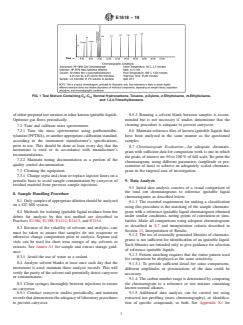
Atypical chromatogram of the test mixture is shown in Fig. 1.
sufficient ion intensity data to identify each component, either
6.5 Reference Ignitable Liquids—Ignitable liquids shall be
by computer library search or by comparison with reference
available for the various ignitable liquids represented in Table
spectra.
1.
5.3 Data Station—A computerized data station, capable of
6.5.1 Typically, reference ignitable liquids are diluted
storing time sequenced mass spectral data from sample runs.
1:1000 in an appropriate solvent. Depending on the column
5.3.1 Data Handling—The data system shall be capable of
capacity and injection technique, ignitable liquid solutions can
performing, either through its operating system or by user
be made somewhat more concentrated to ensure detection of
programming, various data handling functions, including input
minor compounds.
and storage of sample data files, generation of extracted ion
6.5.2 Certified ignitable liquid standards are not necessary.
profiles, searching data files for selected compounds, and
Most reference ignitable liquids can be obtained from com-
qualitative and semi-quantitative compound analysis.
mercial and retail sources.
5.3.2 Mass Spectral Libraries—The system shall be capable
of retrieving a specified mass spectrum from a data file and 7. Equipment Calibration and Maintenance
comparing it against a library of mass spectra available to the
7.1 Verify the consistent performance of the chromato-
data system.This capability is considered an aid to the analyst,
graphic instrument by using blanks and known concentrations
who will use it in conjunction with chromatographic data and
known reference materials to identify unknown components.
ACS Reagent Chemicals, Specifications and Procedures for Reagents and
Standard-Grade Reference Materials, American Chemical Society, Washington,
DC. For suggestions on the testing of reagents not listed by theAmerican Chemical
Society, see Analar Standards for Laboratory Chemicals, BDH Ltd., Poole, Dorset,
U.K., and the United States Pharmacopeia and National Formulary, U.S. Pharma-
copeial Convention, Inc. (USPC), Rockville, MD.
E1618 − 19
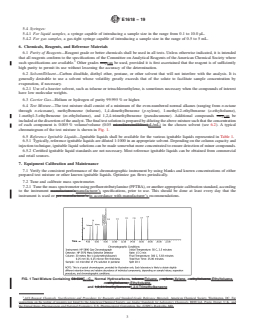
FIG. 1 Test Mixture Containing C –C Normal Hydrocarbons, Toluene,p-Xylene,o-Ethyltoluene,m-Ethyltoluene,
8 20
and 1,2,4-Trimethylbenzene
ofeitherpreparedtestmixtureorotherknownignitableliquids. 8.5.2 Running a solvent blank between samples is recom-
Optimize gas flows periodically. mended but is not necessary if studies demonstrate that the
cleaning procedure is adequate to prevent carryover.
7.2 Tune and calibrate mass spectrometer.
7.2.1 Tune the mass spectrometer using perfluorotribu- 8.6 Maintain reference files of known ignitable liquids that
tylamine(PFTBA),oranotherappropriatecalibrationstandard, have been analyzed in the same manner as the questioned
according to the instrument manufacturer’s specifications,
samples.
prior to use. This should be done at least every day that the
8.7 Chromatogram Evaluation—An adequate chromato-
instrument is used or in accordance with manufacturer’s
gram with sufficient data for comparison work is one in which
recommendations.
the peaks of interest are 50 to 100 % of full scale. Re-print the
7.2.2 Maintain tuning documentation as a portion of the
chromatogram, using different parameters (amplitude or pre-
quality control documentation.
sentation of data) to achieve an adequately scaled chromato-
7.3 Cleaning the equipment.
gram in the targeted area of investigation.
7.3.1 Change septa and clean or replace injector liners on a
periodic basis to avoid sample contamination by carryover of
9. Data Analysis
residual material from previous sample injections.
9.1 Initial data analysis consists of a visual comparison of
the total ion chromatograms to reference ignitable liquid
8. Sample Handling Procedure
chromatograms as described below.
8.1 Onlysamplesofappropriatedilutionshouldbeanalyzed
9.1.1 The essential requirement for making a classification
on a GC-MS system.
using this procedure is the matching of the sample chromato-
gram with a reference ignitable liquid chromatogram obtained
8.2 Methods for isolating ignitable liquid residues from fire
under similar conditions, noting points of correlation or simi-
debris for analysis by this test method are described in
larities. Make all comparisons using adequate chromatograms
Practices E1386, E1388, E1412, E1413, and E2154.
as described in 8.7 and interpretation criteria described in
8.3 Because of the volatility of solvents and analytes, care
Section 11, Interpretation of Results.
must be taken to ensure that samples do not evaporate or
9.1.2 The use of externally generated libraries of chromato-
otherwise change composition prior to analysis. Septum seal
grams is not sufficient for identification of an ignitable liquid.
vials can be used for short term storage of any solvents or
Such libraries are intended only to give guidance for selection
extracts. See Annex A1 for sample and extract storage guid-
of reference ignitable liquids.
ance.
9.1.3 Pattern matching requires that the entire pattern used
8.3.1 Avoid the use of water as a sealant.
for comparison be displayed at the same sensitivity.
8.4 Analyze solvent blanks at least once each day that the
9.1.3.1 To provide sufficient detail for some comparisons,
instrument is used; maintain these analysis records. This will
different amplitudes or presentations of the data could be
verify the purity of the solvent and potentially detect carryover
necessary.
or contamination.
9.1.4 The carbon number range is determined by comparing
8.5 Clean syringes thoroughly between injections to ensure the chromatogram to a reference or test mixture containing
known normal alkanes.
no carryover.
8.5.1 Conduct carryover studies periodically, and maintain 9.1.5 Additional data analysis can be carried out using
recordsthatdemonstratetheadequacyoflaboratoryprocedures extracted ion profiling (mass chromatography), or identifica-
to prevent carryover. tion of specific compounds, or both. See Appendix X1 for
E1618 − 19
A, B, C
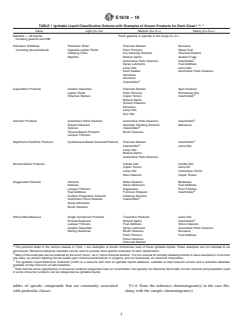
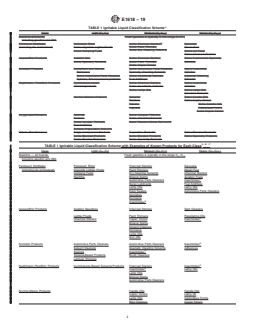
TABLE 1 Ignitable Liquid Classification Scheme with Examples of Known Products for Each Class
Class Light (C –C ) Medium (C –C ) Heavy (C –C )
4 9 8 13 9 20+
Gasoline — all brands, Fresh gasoline is typically in the range C –C
4 12
including gasohol and E85
Petroleum Distillates Petroleum Ether Charcoal Starters Kerosene
(including de-aromatized) Cigarette Lighter Fluids Paint Thinners Diesel Fuel
Camping Fuels Dry Cleaning Solvents Charcoal Starters
Naphtha Mineral Spirits Aviation Fuels
D
Automotive Parts Cleaners Insecticides
Spray Lubricants Fuel Additives
Lamp Oils Lamp Oils
Deck Sealers Automotive Parts Cleaners
Varnishes
Kerosene
D
Insecticides
Isoparaffinic Products Aviation Gasolines Charcoal Starters Spot Cleaners
Lighter Fluids Paint Thinners Penetrating Oils
D
Charcoal Starters Copier Toners Insecticides
Mineral Spirits
Solvent Cleaners
Kerosene
Lamp Oils
Gun Oils
D
Aromatic Products Automotive Parts Cleaners Automotive Parts Cleaners Insecticides
Solvent Cleaners Specialty Cleaning Solvents Adhesives
D
Xylenes Insecticides
Toluene-Based Products Brush Cleaners
Lacquer Thinners
D
Naphthenic-Paraffinic Products Cyclohexane-Based Solvents/Products Charcoal Starters Insecticides
D
Insecticides Lamp Oils
Lamp Oils
Mineral Spirits
Automotive Parts Cleaners
Normal Alkane Products Candle Oils Candle Oils
Copier Toners Lamp Oil
Lamp Oils Carbonless Forms
Wax Cleaners Copier Toners
Oxygenated Solvents Alcohols Metal Cleaners Biodiesels
Ketones Gloss Removers Fuel Additives
Lacquer Thinners Degreasers Floor Finishes
D
Fuel Additives Furniture Strippers Insecticides
Surface Preparation Solvents Cleaning Solvents
D
Automotive Parts Cleaners Insecticides
Spray Adhesives
Brush Cleaners
Others-Miscellaneous Single Component Products Turpentine Products Lamp Oils
D
Enamel Reducers Mineral Spirits Insecticides
Lacquer Thinners Fuel Additives Citrus Cleaners
Aviation Gasolines Spray Lubricants Automotive Parts Cleaners
Racing Gasolines Brush Cleaners Kerosene
Paint Thinners Fuel Additives
Citrus Cleaners
Charcoal Starters
A
The products listed in the various classes of Table 1 are examples of known commercial uses of these ignitable liquids. These examples are not intended to be
all-inclusive. Reference literature materials can be used to provide more specific examples of each classification.
B
Many of the examples can be prefaced by the word “some,” as in “some charcoal starters.” It is not unusual for similarly labeled products to have examples in more than
one class, as product labeling can be based upon chemical performance or property, and not necessarily on chemical composition.
C
The Ignitable Liquid Reference Collection (ILRC) is a resource with both an ignitable liquids database, available at http://www.ilrc.ucf.edu and a substrate database
available at http://www.ilrc.ucf.edu/substrate.
D
Note that the active ingredient(s) in consumer products categorized here as “insecticides” are typically not inherently flammable, but the solvents and propellants used
in some consumer products can be categorized as ignitable liquids.
tables of specific compounds that are commonly associated 9.1.6 Store the reference chromatogram(s) in the case file,
with particular classes. along with the sample chromatogram(s).
E1618 − 19
9.1.7 Thecompoundsthatcompriseignitableliquidsconsist 9.2.4 Extracted ion profiles can also be useful to distinguish
of six major types: normal alkane, branched alkane, compounds specific to individual classes of ignitable liquids as
cycloalkane, aromatic, polynuclear aromatic, and oxygenates. well as interfering compounds related to products of combus-
Other compounds could be present, but are not considered tion and pyrolysis.
significant for the purposes of this test method.
9.1.8 Compounds of each type produce characteristic major 10. Ignitable Liquid Classification Scheme
ion fragments. These ions are listed in Table 2.
10.1 Seven major classes of ignitable liquids can be identi-
9.2 Extracted Ion Profiling (EIP): fied by gas chromatography, mass spectrometry, extracted ion
9.2.1 Adatastationisusedtoextractanddrawextractedion
profiling (or extracted ion profile analysis), or a combination
profiles (mass chromatograms) for major ions characteristic of thereof, when recovered from fire debris. These classes are
each compound type. Individual extracted ion profiles for two
outlined in 10.2. Typical total ion chromatograms of many of
or more characteristic ions of the same functional groups or of these classes are shown in Figs. 2-10.
similar magnitude can be summed to enhance the signal-to-
10.1.1 This test method is intended to allow identified
noise ratio and to decrease interference by extraneous com- ignitable liquids to be characterized as belonging to one of the
pounds that contain only one of the ions or to create summed classifications. Distinguishing between examples within any
profiles characteristic of specific classes of hydrocarbons.
class could be possible, but such further characterization is not
9.2.1.1 Many data stations scale chromatograms so that the within the scope of this test method.
tallest peak is 100 % of full scale. It can be misleading to use
10.1.2 Amiscellaneous category is included for those ignit-
a relative intensity display for ions of significantly different able liquids that do not fall into one of the first seven major
abundance. It is best to overlay these mass chromatograms or
ignitable liquid classifications.
use an absolute intensity output. 10.1.3 With the exception of the gasoline class, the major
9.2.2 Extracted ion profiles for an unknown sample are
ignitable liquid classes can be divided into three subclasses
comparedagainstthecorrespondingextractedionprofilesfrom based on boiling (n-alkane) range: light, medium and heavy.
reference ignitable liquids. This is generally done by visual
10.1.3.1 Light Product Range—n-C –n-C ; the majority of
4 9
pattern recognition as described in 9.1. Computerized pattern the pattern occurs in the range n-C –n-C , no major peaks
4 9
recognition techniques are also acceptable, provided the ana-
associated with the ignitable liquid exist above n–C .
lyst visually verifies the results.
10.1.3.2 Medium Product Range—n-C –n-C ; narrow
8 13
9.2.3 Major peaks in the extracted ion profiles should be
range products, the majority of the pattern occurs in the range
identified by searching their mass spectra against a suitable of n-C –n-C , no major peaks associated with the ignitable
8 13
library. The final identification shall be made by the analyst on
liquid below n-C or above n-C .
7 14
the basis of the mass spectra and relative retention times of the
10.1.3.3 Heavy Product Range—n-C –n-C , typically
9 20+
components in question by comparison to reference ignitable
broad range products, the majority of the pattern occurs in the
liquids. range C –C , with a continuous pattern spanning at least 5
9 23
consecutive n-alkanes. Also included in the subclass are
narrow range (encompassing less than five n-alkanes) ignitable
TABLE 2 Major Ions Present in Mass Spectra of Common
liquid products starting above n-C .
A,B,C,D,E
Ignitable Liquids
10.1.3.4 It could be necessary to characterize a product as
Compound Type m/z
“light to medium,” or “medium to heavy,” when the carbon
Alkane 43, 57, 71, 85, 99
number range does not fit neatly into one of the above
Cycloalkane and alkene 55, 69
categories. In such instances, the carbon number range should
n-Alkylcyclohexanes 82, 83
Aromatic—alkylbenzenes 91, 105, 119, 92, 106, 120, 134 be reported.
Indanes 117, 118, 131, 132
10.2 Inorderforanextracttobecharacterizedascontaining
Alkylnaphthalenes (Condensed Ring 128, 142, 156, 170
Aromatics)
a particular class, the following minimum criteria shall be met:
Alkylstyrenes 104, 117, 118, 132, 146
10.2.1 Criteria for the Identification of Gasoline:
Alkylanthracenes 178, 192, 206
Alkylbiphenyls/acenaphthenes 154, 168, 182, 196 10.2.1.1 General—All brands of gasoline including gasohol
Monoterpenes 93, 136
and E85. Pattern characterized by abundant aromatics in a
Ketones 43, 58, 72, 86
specific pattern.
Alcohols 31, 45
10.2.1.2 Alkanes—Present. Pattern can vary by brand,
A
Smith, R. M., “Arson Analysis by Mass Chromatography,” Analytical Chemistry,
grade, and lot.
Vol 54, No. 13, November 1982, pp. 1399A–1409A.
B
Kelly, R. L., and Martz, R. M., “Accelerant Identification in Fire Debris by Gas
10.2.1.3 Cycoloalkanes—Not present in significant
Chromatography/Mass Spectrometry Techniques,” Journal of Forensic Sciences,
amounts.
Vol 29, No. 3, 1984, pp. 714–722.
C
10.2.1.4 Aromatics—Petroleum pattern comparable to that
Keto, R. O., and Wineman, P. L., “Detection of Petroleum-Based Accelerants in
Fire Debris by Target Compound Gas Chromatography/Mass Spectrometry,”
of the reference ignitable liquids; 1-methyl-3-ethylbenzene
Analytical Chemistry, Vol 63, No. 18, September 15, 1991, pp. 1964–1971.
(m-ethyltoluene), 1-methyl-4-ethylbenzene (p-ethyltoluene),
D
Keto, R. O., “GC/MS Data Interpretation for Petroleum Distillate Identification in
Contaminated Arson Debris,” Journal of Forensic Sciences, Vol 40, No. 3, 1995, 1,3,5-trimethylbenzene, 1-methyl-2-ethylbenzene (o-
pp. 412–423.
ethyltoluene), and 1,2,4-trimethylbenzene shall be present;
E
McLafferty, F. W., and Turecek, F., Interpretation of Mass Spectra, 4th edition,
above n-C , the aromatic concentration is generally substan-
University Science Books, Sausalito, California, 1993, pp. 233 and 247.
tially higher than the alkane concentration.
E1618 − 19
FIG. 2 Example of a Gasoline Pattern; 50 % Evaporated Gasoline
FIG. 3 Example of a Light Petroleum Distillate; Cigarette Lighter Fluid
FIG. 4 Example of a Medium Petroleum Distillate Pattern; 50 % Evaporated Mineral Spirits
10.2.1.5 Condensed Ring Aromatics—Patterncomparableto tions as are observed in samples of known gasoline. Many
known standard is usually present, including naphthalene, 1- carpet samples that have been exposed to fire conditions
and 2-methylnaphthalenes. These compounds could be absent contain these compounds in some concentrations. Benzene,
in some gasolines. Indan (dihydroindene) and methyl indans toluene, ethylbenzene, xylenes, cumenes, ethyltoluenes, and
are usually present. naphthalenes, which are present in gasoline, are also some-
10.2.1.6 Warning—The mere presence of alkylbenzenes times found in fire debris samples containing no foreign
doesnotjustifyanidentificationofgasoline.Thesecompounds ignitableliquidresidues.Thepresenceofhighlevelsofalkenes
shall be present at approximately the same relative concentra- and oxygenates can indicate significant pyrolysis of the matrix
E1618 − 19
FIG. 5 Example of Heavy Petroleum Distillate; Diesel Fuel
FIG. 6 Example of a Medium Aromatic Solvent; Fuel Additive
FIG. 7 Example of Light Isoparaffinic Product; Aviation Gas
and should make the recovery suspect. The presence of high series of n-alkanes in a Gaussian distribution of peaks. It is
levels of aromatics without the appropriate levels of alkanes possible that light distillates will not exhibit a recognizable
can indicate an aromatic product.
pattern and can contain only one or two of the n-alkanes.
10.2.2 Criteria for the Identification of Distillates:
10.2.2.2 Alkanes—Abundant. Predominant normal alkanes
10.2.2.1 General—Traditional distillates and de-aromatized
present with isoparaffinic compounds present.
distillates; Predominant pattern associated with a homologous
E1618 − 19
FIG. 8 Example of Medium Isoparaffinic Product; Charcoal Starter
FIG. 9 Example of Medium De-aromatized Distillate; Odorless Paint Thinner
FIG. 10 Example of a Heavy Naphthenic Paraffinic Product; Lamp Oil
10.2.2.3 Cycoloalkanes—Present, less abundant than al- present in light distillates. In some products, the aromatic
kanes. Pattern varies by boiling range and peak spread. composition could be significantly reduced or completely
10.2.2.4 Aromatics—Always present in traditional medium absent (de-aromatized).
and heavy distillates; less abundant than alkanes; pattern and 10.2.2.5 Condensed Ring Aromatics—Can be present based
abundance varies by boiling range and peak spread; could be on boiling range and peak spread.
E1618 − 19
10.2.3 Criteria for the Identification of Isoparaffınic Prod- 10.2.6 Criteria for the Identification of Normal Alkane
ucts: Products:
10.2.3.1 General—Product comprised almost exclusively of
10.2.6.1 General—Products comprised exclusively of
branchedchainaliphaticcompounds(isoparaffins).Theboiling n-alkanes. The boiling range and pattern are dependent on the
range and pattern are dependent on the specific formulation.
specific formulation.
10.2.3.2 Alkanes—Abundant. Pattern comparable to known 10.2.6.2 Alkanes—Normal alkane product pattern present
isoparaffinic formulation. Characteristic isoparaffin product
with no isoparaffins or only minor levels of isoparaffins. The
patterns present with no or insignificant levels of n-alkanes. boiling range and pattern are dependent on the specific
The boiling range and component pattern are dependent on the
formulation.
specific formulation.
10.2.6.3 Cycloalkanes—Not present in significant amounts.
10.2.3.3 Aromatics—Absent, or not present in significant
10.2.6.4 Aromatics—Not present in significant amounts.
concentrations.
10.2.6.5 Condensed Ring Aromatics—Not present in signifi-
10.2.3.4 Cycloalkanes—Absent,ornotpresentinsignificant
cant amounts.
concentrations. Note: Ions indicative of cycloparaffins are also
NOTE 2—All major chromatographic peaks for this class shall be
present in smaller amounts in isoparaffinic compounds. “Cy-
identified by both GC retention times and mass spectral characteristics.
cloalkane” pattern representing isoparaffins could be present,
10.2.7 Criteria for the Identification of Oxygenated Sol-
but significantly less abundant than the alkane pattern.
vents:
10.2.3.5 Condensed Ring Aromatics—Not present.
10.2.7.1 General—Products containing major oxygenated
10.2.4 Criteria for the Identification of Aromatic Products:
components can include mixtures of oxygenated compounds
10.2.4.1 General—Products comprised almost exclusively
and other compounds or products. Major oxygenated com-
of aromatic or condensed ring aromatic compounds, or both.
pounds typically present before C8; major compound(s) could
The boiling range and pattern are dependent on the specific
include alcohols, esters, and ketones. Other major compounds
formulation.
including toluene, xylene, and distillate formulations could
10.2.4.2 Alkanes—Not present in significant amounts.
also be present.
10.2.4.3 Cycloalkanes—Not present in significant amounts.
10.2.7.2 Alkanes—If in a mixture, could contain character-
10.2.4.4 Aromatics—Abundant. Pattern comparable to
istic petroleum distillate pattern; pattern depends on formula-
known aromatic products. Pattern depends on formulation.
tion.
10.2.4.5 Condensed Ring Aromatics—Can be present, pat-
10.2.7.3 Cycloalkanes—Pattern depends on formulation.
tern depends on formulation. Pattern comparable to known
10.2.7.4 Aromatics—Pattern depends on formulation.
aromatic product.
10.2.7.5 Condensed Ring Aromatics—Not significant.
NOTE 1—Light aromatic products can consist of single or few compo-
nents.These compounds shall be identified by both GC retention time and NOTE 3—All major oxygenated compounds shall be identified by GC
mass spectral identification. retention times and mass spectral characteristics.
10.2.4.6 Warning—The relative intragroup ratios of the
10.2.7.6 Warning—The mere presence of oxygenated sol-
isomers of xylenes and C -alkylbenzenes do not vary signifi-
vents such as alcohols or acetone does not necessarily indicate
cantlyamongpetroleumproducts.Therefore,therelativeratios
that a foreign ignitable liquid is present in the sample. There
of these compounds should match, or n
...
This document is not an ASTM standard and is intended only to provide the user of an ASTM standard an indication of what changes have been made to the previous version. Because
it may not be technically possible to adequately depict all changes accurately, ASTM recommends that users consult prior editions as appropriate. In all cases only the current version
of the standard as published by ASTM is to be considered the official document.
Designation: E1618 − 14 E1618 − 19
Standard Test Method for
Ignitable Liquid Residues in Extracts from Fire Debris
Samples by Gas Chromatography-Mass Spectrometry
This standard is issued under the fixed designation E1618; the number immediately following the designation indicates the year of
original adoption or, in the case of revision, the year of last revision. A number in parentheses indicates the year of last reapproval. A
superscript epsilon (´) indicates an editorial change since the last revision or reapproval.
1. Scope
1.1 This test method covers the identification of residues of ignitable liquids in extracts from fire debris samples. Extraction
procedures are described in the referenced documents.
1.2 Although this test method is suitable for all samples, it is especially appropriate for extracts that contain high background
levels of substrate materials or pyrolysis and combustion products. This test method is also suitable for the identification of single
compounds, simple mixtures, or non-petroleum based ignitable liquids.
1.3 The values stated in SI units are to be regarded as standard. No other units of measurement are included in this standard.
1.4 This practice cannot replace knowledge, skill, or ability acquired through appropriate education, training, and experience
and should be used in conjunction with sound professional judgment.
1.5 This standard does not purport to address all of the safety concerns, if any, associated with its use. It is the responsibility
of the user of this standard to establish appropriate safety safety, health, and healthenvironmental practices and determine the
applicability of regulatory limitations prior to use.
1.6 This international standard was developed in accordance with internationally recognized principles on standardization
established in the Decision on Principles for the Development of International Standards, Guides and Recommendations issued
by the World Trade Organization Technical Barriers to Trade (TBT) Committee.
2. Referenced Documents
2.1 ASTM Standards:
E1386 Practice for Separation of Ignitable Liquid Residues from Fire Debris Samples by Solvent Extraction
E1388 Practice for Static Headspace Sampling of Vapors from Fire Debris Samples
E1412 Practice for Separation of Ignitable Liquid Residues from Fire Debris Samples by Passive Headspace Concentration With
Activated Charcoal
E1413 Practice for Separation of Ignitable Liquid Residues from Fire Debris Samples by Dynamic Headspace Concentration
onto an Adsorbent Tube
E2154 Practice for Separation and Concentration of Ignitable Liquid Residues from Fire Debris Samples by Passive Headspace
Concentration with Solid Phase Microextraction (SPME)
E2451 Practice for Preserving Ignitable Liquids and Ignitable Liquid Residue Extracts from Fire Debris Samples
3. Summary of Test Method
3.1 The sample is analyzed with a gas chromatograph (GC) which is interfaced to a mass spectrometer (MS) and a data system
(DS) capable of storing and manipulating chromatographic and mass spectral data.
3.2 Post-run data analysis generates extracted ion profiles (mass chromatograms) characteristic of the chemical compound types
commonly found in ignitable liquids. Additionally, specific chemical components (target compounds) may compounds present
within a class of ignitable liquid can be identified by their mass spectra and retention times. Semi-quantitative determination of
target compounds which are identified by mass spectra and retention time may be used to develop target compound chromatograms
(TCCs).
This test method is under the jurisdiction of ASTM Committee E30 on Forensic Sciences and is the direct responsibility of Subcommittee E30.01 on Criminalistics.
Current edition approved July 1, 2014Nov. 15, 2019. Published July 2014December 2019. Originally approved in 1994. Last previous edition approved in 20112014 as
E1618 – 11.E1618 – 14. DOI: 10.1520/E1618-14.10.1520/E1618-19.
For referenced ASTM standards, visit the ASTM website, www.astm.org, or contact ASTM Customer Service at service@astm.org. For Annual Book of ASTM Standards
volume information, refer to the standard’sstandard’s Document Summary page on the ASTM website.
Copyright © ASTM International, 100 Barr Harbor Drive, PO Box C700, West Conshohocken, PA 19428-2959. United States
E1618 − 19
3.2.1 The total ion chromatogram (TIC), extracted ion profiles (EIP) for the alkane, alkene, alcohol, aromatic, cycloalkane,
ester, ketone, and polynuclear aromatic compound types, or TCCs, identification of individual compounds, or combination thereof,
are evaluated by visual pattern matching against known reference ignitable liquids.
3.2.2 Ignitable liquids maycan be grouped into one of seven major classifications or one miscellaneous class, as described in
this test method.
4. Significance and Use
4.1 The identification of an ignitable liquid residue in samples from a fire scene can support the field investigator’sinvestigator’s
opinion regarding the origin, fuel load, and incendiary nature of the fire.
4.1.1 The identification of an ignitable liquid residue in a fire scene does not necessarily lead to the conclusion that a fire was
incendiary in nature. Further investigation maycan reveal a legitimate reason for the presence of ignitable liquid residues.
4.1.2 Because of the volatility of ignitable liquids and variations in sampling techniques, the absence of detectable quantities
of ignitable liquid residues does not necessarily lead to the conclusion that ignitable liquids were not present at the fire scene.
4.2 Materials normally found in a building, upon exposure to the heat of a fire, will form pyrolysis and combustion products.
Extracted ion profiling and target compound identification techniques described herein mayidentification of specific compounds or
classes of compounds described herein can facilitate the identification of an ignitable liquid in the extract by reducing interference
by components generated as products of pyrolysis.
5. Apparatus
5.1 Gas Chromatograph—A chromatograph capable of using capillary columns and being interfaced to a mass spectrometer.
5.1.1 Sample Inlet System—A sample inlet system that can be operated in either split or splitless mode with capillary columns;
the inlet system maycan use on-column technology.
5.1.2 Column—A capillary, bonded phase, methylsilicone or phenylmethylsilicone column or equivalent. Any column length or
temperature program conditions maycan be used provided that each component of the test mixture (see 6.4) is adequately
separated.
5.1.3 GC Oven—A column oven capable of reproducible temperature program operation in the range from 50 to 300°C.
5.2 Mass Spectrometer—Capable of acquiring mass spectra from m/z 40 to m/z 400 with unit resolution or better, with
continuous data output. Values above m/z 40 may not can be sufficientinsufficient to detect or identify some lower molecular weight
compounds; for example, methanol, ethanol, acetone.
5.2.1 Sensitivity—The system shall be capable of detecting each component of the test mixture (see 6.4) and providing sufficient
ion intensity data to identify each component, either by computer library search or by comparison with reference spectra.
5.3 Data Station—A computerized data station, capable of storing time sequenced mass spectral data from sample runs.
5.3.1 Data Handling—The data system shall be capable of performing, either through its operating system or by user
programming, various data handling functions, including input and storage of sample data files, generation of extracted ion profiles,
searching data files for selected compounds, and qualitative and semi-quantitative compound analysis.
5.3.2 Mass Spectral Libraries—The system shall be capable of retrieving a specified mass spectrum from a data file and
comparing it against a library of mass spectra available to the data system. This capability is considered an aid to the analyst, who
will use it in conjunction with chromatographic data and known reference materials to identify unknown components.
E1618 − 19
5.4 Syringes:
5.4.1 For liquid samples, a syringe capable of introducing a sample size in the range from 0.1 to 10.0 μL.
5.4.2 For gas samples, a gas-tight syringe capable of introducing a sample size in the range of 0.5 to 5 mL.
6. Chemicals, Reagents, and Reference Materials
6.1 Purity of Reagents—Reagent grade or better chemicals shall be used in all tests. Unless otherwise indicated, it is intended
that all reagents conform to the specifications of the Committee on Analytical Reagents of the American Chemical Society where
such specifications are available. Other grades maycan be used, provided it is first ascertained that the reagent is of sufficiently
high purity to permit its use without lessening the accuracy of the determination.
6.2 Solvent/Diluent—Carbon disulfide, diethyl ether, pentane, or other solvent that will not interfere with the analysis. It is
generally desirable to use a solvent whose volatility greatly exceeds that of the solute to facilitate sample concentration by
evaporation, if necessary.
6.2.1 Use of a heavier solvent, such as toluene or tetrachloroethylene, is sometimes necessary when the compounds of interest
have low molecular weights.
6.3 Carrier Gas—Helium or hydrogen of purity 99.995 % or higher.
6.4 Test Mixture—The test mixture shall consist of a minimum of the even-numbered normal alkanes (ranging from n-octane
through n-eicosane), methylbenzene (toluene), 1,4-dimethylbenzene (p-xylene), 1-methyl-2-ethylbenzene (o-ethyltoluene),
1-methyl-3-ethylbenzene (m-ethyltoluene), and 1,2,4-trimethylbenzene (pseudocumene). Additional compounds maycan be
included at the discretion of the analyst. The final test solution is prepared by diluting the above mixture such that the concentration
of each component is 0.005 % volume/volume (0.05 microliters/milliliter)μL/mL) in the chosen solvent (see 6.2). A typical
chromatogram of the test mixture is shown in Fig. 1.
6.5 Reference Ignitable Liquids—Ignitable liquids shall be available for the various ignitable liquids represented in Table 1.
6.5.1 Typically, reference ignitable liquids are diluted 1:1000 in an appropriate solvent. Depending on the column capacity and
injection technique, ignitable liquid solutions can be made somewhat more concentrated to ensure detection of minor compounds.
6.5.2 Certified ignitable liquid standards are not necessary. Most reference ignitable liquids can be obtained from commercial
and retail sources.
7. Equipment Calibration and Maintenance
7.1 Verify the consistent performance of the chromatographic instrument by using blanks and known concentrations of either
prepared test mixture or other known ignitable liquids. Optimize gas flows periodically.
7.2 Tune and calibrate mass spectrometer.
7.2.1 Tune the mass spectrometer using perfluorotributylamine (PFTBA), or another appropriate calibration standard, according
to the instrument manufacturer’smanufacturer’s specifications, prior to use. This should be done at least every day that the
instrument is used or per manufacturer’s in accordance with manufacturer’s recommendations.
FIG. 1 Test Mixture Containing C8-C20C –C Normal Hydrocarbons, toluene,Toluene, p-xylene,-Xylene, o-ethyltoluene,-Ethyltoluene,
8 20
m-ethyltoluene, -Ethyltoluene,
and 1,2,4-trimethylbenzene1,2,4-Trimethylbenzene
ACS Reagent Chemicals, Specifications and Procedures for Reagents and Standard-Grade Reference Materials, American Chemical Society, Washington, DC. For
suggestions on the testing of reagents not listed by the American Chemical Society, see Analar Standards for Laboratory Chemicals, BDH Ltd., Poole, Dorset, U.K., and
the United States Pharmacopeia and National Formulary, U.S. Pharmacopeial Convention, Inc. (USPC), Rockville, MD.
E1618 − 19
A
TABLE 1 Ignitable Liquid Classification Scheme
Class Light (C -C ) Medium (C -C ) Heavy (C -C )
4 9 8 13 9 20+
Gasoline-all brands, Fresh gasoline is typically in the range C -C
4 12
including gasohol and E85
B
Petroleum Distillates Petroleum Ether Some Charcoal Starters Kerosene
Some Paint Thinners
(including De-Aromatized) Some Cigarette Lighter Fluids Diesel Fuel
Some Dry Cleaning Solvents
Some Camping Fuels Some Jet Fuels
Some Charcoal Starters
Isoparaffinic Products Aviation Gas Some Charcoal Starters Some Commercial Specialty
Some Specialty Solvents Some Paint Thinners Solvents
Some Copier Toners
Aromatic Products SomePaint and Varnish Some Automotive Parts Cleaners Some Insecticide
Removers Specialty Cleaning Solvents Vehicles
Some Automotive Parts Cleaners Some Insecticide Vehicles Industrial Cleaning
Xylenes, Toluene-based products. Fuel Additives Solvents
Naphthenic- Paraffinic Products Cyclohexane based Some Charcoal Starters Some Insecticide
solvents/products Some Insecticide Vehicles Vehicles
Some Lamp Oils Some Lamp Oils
Industrial Solvents
Normal-Alkanes Products Solvents Some Candle Oils
Pentane Some Copier Toners
Hexane Some Candle Oils
Heptane Carbonless Forms
Some Copier Toners
Oxygenated Solvents Alcohols Some Lacquer Thinners
Ketones Some Industrial Solvents
Some Lacquer Thinners Metal Cleaners/Gloss Removers
Fuel Additives
Surface Preparation Solvents
Others-Miscellaneous Single Component Products Turpentine Products Some Blended Products
Some Blended Products Some Blended Products Some Specialty Products
Some Enamel Reducers Some Specialty Products
A, B, C
TABLE 1 Ignitable Liquid Classification Scheme with Examples of Known Products for Each Class
Class Light (C –C ) Medium (C –C ) Heavy (C –C )
4 9 8 13 9 20+
Gasoline — all brands, Fresh gasoline is typically in the range C –C
4 12
including gasohol and E85
Petroleum Distillates Petroleum Ether Charcoal Starters Kerosene
(including de-aromatized) Cigarette Lighter Fluids Paint Thinners Diesel Fuel
Camping Fuels Dry Cleaning Solvents Charcoal Starters
Naphtha Mineral Spirits Aviation Fuels
D
Automotive Parts Cleaners Insecticides
Spray Lubricants Fuel Additives
Lamp Oils Lamp Oils
Deck Sealers Automotive Parts Cleaners
Varnishes
Kerosene
D
Insecticides
Isoparaffinic Products Aviation Gasolines Charcoal Starters Spot Cleaners
Lighter Fluids Paint Thinners Penetrating Oils
D
Charcoal Starters Copier Toners Insecticides
Mineral Spirits
Solvent Cleaners
Kerosene
Lamp Oils
Gun Oils
D
Aromatic Products Automotive Parts Cleaners Automotive Parts Cleaners Insecticides
Solvent Cleaners Specialty Cleaning Solvents Adhesives
D
Xylenes Insecticides
Toluene-Based Products Brush Cleaners
Lacquer Thinners
D
Naphthenic-Paraffinic Products Cyclohexane-Based Solvents/Products Charcoal Starters Insecticides
D
Insecticides Lamp Oils
Lamp Oils
Mineral Spirits
Automotive Parts Cleaners
Normal Alkane Products Candle Oils Candle Oils
Copier Toners Lamp Oil
Lamp Oils Carbonless Forms
Wax Cleaners Copier Toners
E1618 − 19
Class Light (C –C ) Medium (C –C ) Heavy (C –C )
4 9 8 13 9 20+
Oxygenated Solvents Alcohols Metal Cleaners Biodiesels
Ketones Gloss Removers Fuel Additives
Lacquer Thinners Degreasers Floor Finishes
D
Fuel Additives Furniture Strippers Insecticides
Surface Preparation Solvents Cleaning Solvents
D
Automotive Parts Insecticides
Cleaners
Spray Adhesives
Brush Cleaners
Others-Miscellaneous Single Component Products Turpentine Lamp Oils
Products
D
Enamel Reducers Mineral Spirits Insecticides
Lacquer Thinners Fuel Additives Citrus Cleaners
Aviation Gasolines Spray Lubricants Automotive Parts Cleaners
Racing Gasolines Brush Cleaners Kerosene
Paint Thinners Fuel Additives
Citrus Cleaners
Charcoal Starters
A
The products listed in the various classes of Table 1 are examples of known commercial uses of these ignitable liquids. These examples are not intended to be
all-inclusive. Reference literature materials maycan be used to provide more specific examples of each classification.
B
Many of the examples can be prefaced by the word “some,” as in “some charcoal starters.” It is not unusual for similarly labeled products to have examples in more than
one class, as product labeling can be based upon chemical performance or property, and not necessarily on chemical composition.
C
The Ignitable Liquid Reference Collection (ILRC) is a resource with both an ignitable liquids database, available at http://www.ilrc.ucf.edu and a substrate database
available at http://www.ilrc.ucf.edu/substrate.
D
Note that the active ingredient(s) in consumer products categorized here as “insecticides” are typically not inherently flammable, but the solvents and propellants used
in some consumer products can be categorized as ignitable liquids.
7.2.2 Maintain tuning documentation as a portion of the quality control documentation.
7.3 Cleaning the equipment.
7.3.1 Change septa and clean or replace injector liners on a periodic basis to avoid sample contamination by carryover of
residual material from previous sample injections.
8. Sample Handling Procedure
8.1 Only samples of appropriate dilution should be analyzed on a GC-MS system.
8.2 Methods for isolating ignitable liquid residues from fire debris for analysis by this test method are described in Practices
E1386, E1388, E1412, E1413, and E2154.
8.3 Because of the volatility of solvents and analytes, care must be taken to ensure that samples do not evaporate or otherwise
change composition prior to analysis. Septum seal vials maycan be used for short term storage of any solvents or extracts. See
Annex A1 for sample and extract storage guidance.
8.3.1 Avoid the use of water as a sealant.
8.4 Analyze solvent blanks at least once each day that the instrument is used; maintain these analysis records. This will verify
the purity of the solvent and potentially detect carryover or contamination.
8.5 Clean syringes thoroughly between injections to ensure no carryover.
8.5.1 Conduct carryover studies periodically, and maintain records that demonstrate the adequacy of laboratory procedures to
prevent carryover.
8.5.2 Running a solvent blank between samples is recommended but is not necessary if studies demonstrate that the cleaning
procedure is adequate to prevent carryover.
8.6 Maintain reference files of known ignitable liquids that have been analyzed in the same manner as the questioned samples.
8.7 Chromatogram Evaluation—An adequate chromatogram with sufficient data for comparison work is one in which the peaks
of interest are 50 to 100 % of full scale. Re-print the chromatogram, using different parameters (amplitude or presentation of data)
to achieve an adequately scaled chromatogram in the targeted area of investigation.
9. Data Analysis
9.1 Initial data analysis consists of a visual comparison of the total ion chromatograms to reference ignitable liquid
chromatograms as described below.
E1618 − 19
9.1.1 The essential requirement for making a classification using this procedure is the matching of the sample chromatogram
with a reference ignitable liquid chromatogram obtained under similar conditions, noting points of correlation or similarities. Make
all comparisons using adequate chromatograms as described in 8.7 and interpretation criteria described in Section 11, Interpretation
of Results.
9.1.2 The use of externally generated libraries of chromatograms is not sufficient for identification of an ignitable liquid. Such
libraries are intended only to give guidance for selection of reference ignitable liquids.
9.1.3 Pattern matching requires that the entire pattern used for comparison be displayed at the same sensitivity.
9.1.3.1 To provide sufficient detail for some comparisons, different amplitudes or presentations of the data maycould be
necessary.
9.1.4 The carbon number range is determined by comparing the chromatogram to a reference or test mixture containing known
normal alkanes.
9.1.5 Additional data analysis maycan be carried out using extracted ion profiling (mass chromatography), target compound
analysis, or both.or identification of specific compounds, or both. See Appendix X1 for tables of specific compounds that are
commonly associated with particular classes.
9.1.6 Store the reference chromatogram(s) in the case file, along with the sample chromatogram(s).
9.1.7 The compounds that comprise ignitable liquids consist of six major types: normal alkane, branched alkane, cycloalkane,
aromatic, polynuclear aromatic, and oxygenates. Other compounds maycould be present, but are not considered significant for the
purposes of this test method.
9.1.8 Compounds of each type produce characteristic major ion fragments. These ions are listed in Table 2.
9.2 Extracted ionIon Profiling (EIP):
9.2.1 A data station is used to extract and draw extracted ion profiles (mass chromatograms) for major ions characteristic of each
compound type. Individual extracted ion profiles for two or more characteristic ions of the same functional groups or of similar
magnitude maycan be summed to enhance the signal-to-noise ratio and to decrease interference by extraneous compounds that
contain only one of the ions or to create summed profiles characteristic of specific classes of hydrocarbons.
9.2.1.1 Many data stations scale chromatograms so that the tallest peak is 100 % of full scale. It maycan be misleading to use
a relative intensity display for ions of significantly different abundance. It is best to overlay these mass chromatograms or use an
absolute intensity output.
9.2.2 Extracted ion profiles for an unknown sample are compared against the corresponding extracted ion profiles from
reference ignitable liquids. This is generally done by visual pattern recognition as described in 9.1. Computerized pattern
recognition techniques are also acceptable, provided the analyst visually verifies the results.
TABLE 2 Major Ions Present in Mass Spectra of Common
A,B,C,D,E
Ignitable Liquids
Compound Type m/z
Alkane 43, 57, 71, 85, 99
Cycloalkane and alkene 55, 69
n-Alkylcyclohexanes 82, 83
Aromatic—alkylbenzenes 91, 105, 119, 92, 106, 120, 134
Indanes 117, 118, 131, 132
Alkylnaphthalenes (Condensed Ring 128, 142, 156, 170
Aromatics)
Alkylstyrenes 104, 117, 118, 132, 146
Alkylanthracenes 178, 192, 206
Alkylbiphenyls/acenaphthenes 154, 168, 182, 196
Monoterpenes 93, 136
Ketones 43, 58, 72, 86
Alcohols 31, 45
A
Smith, R.M., R. M., “Arson Analysis by Mass
Chromatography”Chromatography,” Analytical Chemistry, Vol 54, No. 13, Novem-
ber 1982, pp. 1399A–1409A.
B
Kelly, R.L., R. L., and Martz, R.M., R. M., “Accelerant Identification in Fire Debris
by Gas Chromatography/Mass Spectrometry Techniques”,Techniques,” Journal of
Forensic Sciences, Vol 29, No. 3, 1984, pp. 714–722.
C
Keto, R.O., R. O., and Wineman, P.L., P. L., “Detection of Petroleum-Based
Accelerants in Fire Debris by Target Compound Gas Chromatography/Mass
Spectrometry”,Spectrometry,” Analytical Chemistry, Vol 63, No. 18, September 15,
1991, pp. 1964–1971.
D
Keto, R.O., R. O., “GC/MS Data Interpretation for Petroleum Distillate Identifi-
cation in Contaminated Arson Debris”,Debris,” Journal of Forensic Sciences, Vol
40, No. 3, 1995, pp. 412–423.
E
McLafferty, F.W., F. W., and Turecek, F., Interpretation of Mass Spectra, 4th
Edition,edition, University Science Books, Sausalito, California, 1993, pp. 233 and
247.
E1618 − 19
9.2.3 Major peaks in the extracted ion profiles should be identified by searching their mass spectra against a suitable library.
The final identification shall be made by the analyst on the basis of the mass spectra and relative retention times of the components
in question by comparison to reference ignitable liquids.
9.2.4 Extracted ion profiles can also be useful to distinguish compounds specific to individual classes of ignitable liquids as well
as interfering compounds related to products of combustion and pyrolysis.
9.3 Target Compound Analysis (TCA):
9.3.1 Target compound analysis uses key specific compounds to characterize an ignitable liquid. These target compounds are
listed in Table 3, Table 4, and Table 5.
9.3.2 Semi-quantitative ratios for the target compounds shall be derived and compared against standards to ensure not only their
presence but also that their chromatographic patterns match. Computerized pattern matching techniques are acceptable, provided
the analyst visually verifies results.
9.3.2.1 Target compound pattern recognition may be improved by the production of target compound chromatograms, which
are graphical representations of semi-quantitative peak areas for the target compounds. Target compound data may be plotted as
a bar graph, with the x-axis representing retention time and the y-axis representing peak area. A single bar on the graph depicts
each target compound.
9.3.2.2 Target compound chromatograms for unknown samples are compared to those generated for reference samples. The
same pattern matching criteria for mass chromatography apply to target compound chromatography.
9.3.2.3 Major peaks in the TIC that are not accounted for by one of the target compound types may be identified by searching
their mass spectra against a suitable library. The final identification shall be made by the analyst on the basis of the mass spectra
and relative retention times of the components in question by comparison to reference materials.
9.3.2.4 While TCCs provide much useful information, a TCA should not be the sole basis for the identification of an ignitable
liquid residue.
10. Ignitable Liquid Classification Scheme
10.1 Seven major classes of ignitable liquids maycan be identified by gas chromatography, mass spectrometry, extracted ion
profiling (or extracted ion profile analysis), or a combination thereof, when recovered from fire debris. These classes are outlined
in 10.2. Typical total ion chromatograms of many of these classes are shown in Figs. 2-10.
10.1.1 This test method is intended to allow identified ignitable liquids to be characterized as belonging to one of the
classifications. Distinguishing between examples within any class maycould be possible, but such further characterization is not
within the scope of this test method.
10.1.2 A miscellaneous category is included for those ignitable liquids that do not fall into one of the first seven major ignitable
liquid classifications.
10.1.3 With the exception of the gasoline class, the major ignitable liquid classes maycan be divided into three subclasses based
on boiling (n-alkane) range: light, medium and heavy.
10.1.3.1 Light product range—Product Range—n-C -–n-C ; the majority of the pattern occurs in the range n-C -–n-C , no
4 9 4 9
major peaks associated with the ignitable liquid exist above n-C–C .
10.1.3.2 Medium product range—Product Range—n-C -–n-C ; narrow range products, the majority of the pattern occurs in the
8 13
range of n-C -–n-C , no major peaks associated with the ignitable liquid below n-C or above n-C .
8 13 7 14
10.1.3.3 Heavy product range—Product Range—n-C -–n-C , typically broad range products, the majority of the pattern
9 20+
occurs in the range C –C , with a continuous pattern spanning at least 5 consecutive n-alkanes. Also included in the subclass are
9 23
narrow range (encompassing less than five n-alkanes) ignitable liquid products starting above n-C .
FIG. 2 Example of a Gasoline Pattern; 50 % Evaporated Gasoline
E1618 − 19
FIG. 3 Example of a Light Petroleum Distillate; Cigarette Lighter Fluid
FIG. 4 Example of a Medium Petroleum Distillate Pattern; 50 % Evaporated Mineral Spirits
FIG. 5 Example of Heavy Petroleum Distillate; Diesel Fuel
10.1.3.4 It maycould be necessary to characterize a product as “light to medium,” or “medium to heavy,” when the carbon
number range does not fit neatly into one of the above categories. In such instances, the carbon number range should be reported.
10.2 In order for an extract to be characterized as containing a particular class, the following minimum criteria shall be met:
10.2.1 Criteria for the Identification of Gasoline:
10.2.1.1 General—All brands of gasoline including gasohol and E85. Pattern characterized by abundant aromatics in a specific
pattern.
E1618 − 19
FIG. 6 Example of a Medium Aromatic Solvent; Fuel Additive
FIG. 7 Example of Light Isoparaffinic Product; Aviation Gas
FIG. 8 Example of Medium Isoparaffinic Product; Charcoal Starter
10.2.1.2 Alkanes—Present. Pattern maycan vary by brand, grade, and lot.
10.2.1.3 Cycoloalkanes—Not present in significant amounts.
10.2.1.4 Aromatics—Petroleum pattern comparable to that of the reference ignitable liquids; 1-methyl-3-ethylbenzene
(m-ethyltoluene), 1-methyl-4-ethylbenzene (p-ethyltoluene), 1,3,5-trimethylbenzene, 1-methyl-2-ethylbenzene (o-ethyltoluene),
and 1,2,4-trimethylbenzene shall be present; above n-C , the aromatic concentration is generally substantially higher than the
alkane concentration.
10.2.1.5 Condensed Ring Aromatics—Pattern comparable to known standard is usually present, including naphthalene, 1- and
2-methylnaphthalenes. These compounds maycould be absent in some gasolines. Indan (dihydroindene) and methyl indans are
usually present.
E1618 − 19
FIG. 9 Example of Medium De-aromatized Distillate; Odorless Paint Thinner
FIG. 10 Example of a Heavy Naphthenic Paraffinic Product; Lamp Oil
10.2.1.6 Warning—The mere presence of alkylbenzenes does not justify an identification of gasoline. These compounds shall
be present at approximately the same relative concentrations as are observed in samples of known gasoline. Many carpet samples
that have been exposed to fire conditions contain these compounds in some concentrations. Benzene, toluene, ethylbenzene,
xylenes, cumenes, ethyltoluenes, and naphthalenes, which are present in gasoline, are also sometimes found in fire debris samples
containing no foreign ignitable liquid residues. The presence of high levels of alkenes and oxygenates maycan indicate significant
pyrolysis of the matrix and should make the recovery suspect. The presence of high levels of aromatics without the appropriate
levels of alkanes maycan indicate an aromatic product.
10.2.2 Criteria for the Identification of Distillates:
10.2.2.1 General—Traditional distillates and de-aromatized distillates; Predominant pattern associated with a homologous
series of n-alkanes in a Gaussian distribution of peaks. Light distillates mayIt is possible that light distillates will not exhibit a
recognizable pattern and maycan contain only one or two of the n-alkanes.
10.2.2.2 Alkanes—Abundant. Predominant normal alkanes present with isoparaffinic compounds present.
10.2.2.3 Cycoloalkanes—Present, less abundant than alkanes. Pattern varies by boiling range and peak spread.
10.2.2.4 Aromatics—Always present in traditional medium and heavy distillates; less abundant than alkanes; pattern and
abundance varies by boiling range and peak spread; maycould be present in light distillates. In some products, the aromatic
composition maycould be significantly reduced or completely absent (de-aromatized).
10.2.2.5 Condensed Ring Aromatics—MayCan be present based on boiling range and peak spread.
E1618 − 19
10.2.3 Criteria for the Identification of Isoparaffınic Products:
10.2.3.1 General—Product comprised almost exclusively of branched chain aliphatic compounds (isoparaffins). The boiling
range and pattern are dependent on the specific formulation.
10.2.3.2 Alkanes—Abundant. Pattern comparable to known isoparaffinic formulation. Characteristic isoparaffin product patterns
present with no or insignificant levels of n-alkanes. The boiling range and component pattern are dependent on the specific
formulation.
10.2.3.3 Aromatics—Absent, or not present in significant concentrations.
10.2.3.4 Cycloalkanes—Absent, or not present in significant concentrations. Note: Ions indicative of cycloparaffins are also
present in smaller amounts in isoparaffinic compounds. “Cycloalkane” pattern representing isoparaffins maybecould be present, but
significantly less abundant than the alkane pattern.
10.2.3.5 Condensed Ring Aromatics—Not present.
10.2.4 Criteria for the Identification of Aromatic Products:
10.2.4.1 General—Products comprised almost exclusively of aromatic or condensed ring aromatic compounds, or both. The
boiling range and pattern are dependent on the specific formulation.
10.2.4.2 Alkanes—Not present in significant amounts.
10.2.4.3 Cycloalkanes—Not present in significant amounts.
10.2.4.4 Aromatics—Abundant. Pattern comparable to known aromatic products. Pattern depends on formulation.
10.2.4.5 Condensed Ring Aromatics—MayCan be present, pattern depends on formulation. Pattern comparable to known
aromatic product.
NOTE 1—Light aromatic products maycan consist of single or few components. These compounds shall be identified by both GC retention time and
mass spectral identification.
10.2.4.6 Warning—The relative intragroup ratios of the isomers of xylenes and C -alkylbenzenes do not vary significantly
among petroleum products. Therefore, the relative ratios of these compounds should match, or nearly match, the ratios found in
petroleum products, if they are to be reported. Further, in the presence of styrene at a concentration significantly higher than that
of toluene or xylenes, the finding of toluene or xylenes should not be considered significant.
10.2.5 Criteria for the Identification of Naphthenic-Paraffınic Products:
10.2.5.1 General—Products comprised mainly of branched chain (isoparaffinic) and cyclic (naphthenic) alkanes. The boiling
range and pattern are dependent on the specific formulation.
10.2.5.2 Alkanes—Abundant. Branched alkanes present while normal alkanes maycan be notably absent or at diminished levels
compared to distillate products. Pattern comparable to known naphthenic-paraffinic products.
10.2.5.3 Cycloalkanes—Abundant. Pattern comparable to known naphthenic-paraffinic products.
10.2.5.4 Aromatics—Not present in significant amounts.
10.2.5.5 Condensed Ring Aromatics—Not present in significant amounts.
E1618 − 19
10.2.6 Criteria for the Identification of Normal Alkane Products:
10.2.6.1 General—Products comprised exclusively of n-alkanes. The boiling range and pattern are dependent on the specific
formulation.
10.2.6.2 Alkanes—Normal alkane product pattern present with no isoparaffins or only minor levels of isoparaffins. The boiling
range and pattern are dependent on the specific formulation.
10.2.6.3 Cycloalkanes—Not present in significant amounts.
10.2.6.4 Aromatics—Not present in significant amounts.
10.2.6.5 Condensed Ring Aromatics—Not present in significant amounts.
NOTE 2—All major chromatographic peaks for this class shall be identified by both GC retention times and mass spectral characteristics.
10.2.7 Criteria for the Identification of Oxygenated Solvents:
10.2.7.1 General—Products containing major oxygenated components maycan include mixtures of oxygenated compounds and
other compounds or products. Major oxygenated compounds typically present before C8; major compound(s) maycould include
alcohols, esters, and ketones. Other major compounds including toluene, xylene, and distillate formulations maycould also be
present.
10.2.7.2 Alkanes—If in a mixture, maycould contain characteristic petroleum distillate pattern; pattern depends on formulation.
10.2.7.3 Cycloalkanes—Pattern depends on formulation.
10.2.7.4 Aromatics—Pattern depends on formulation.
10.2.7.5 Condensed Ring Aromatics—Not significant.
NOTE 3—All major oxygenated compounds shall be identified by GC retention times and mass spectral characteristics.
10.2.7.6 Warning—The mere presence of oxygenated solvents such as alcohols or acetone does not necessarily indicate that
a foreign ignitable liquid is present in the sample. There should be a large excess of the compound (at least one order of magnitude
above the matrix peaks in the chromatogram) before the analyst should consider the finding of an oxygenated product significant.
10.2.8 Miscellaneous/Other—No classification system is likely to describe all possible ignitable liquids. There are numerous
commercial and industrial products which are ignitable but which fall into more than one category or do not fall into any of the
above categories other than miscellaneous. Many of these are synthetic mixtures consisting of only a few compounds, rather than
distillation fractions; GC retention times and mass spectra of the components are required in order to achieve identification.
11. Interpretation of Results
11.1 Pattern matching of extracted ion profiles or target compound chromatograms rarely gives perfect correlation with
reference ignitable liquids. In general, the unknown pattern (if positive) will be skewed towardstoward less volatile compounds
for weathered samples or skewed towardstoward more volatile compounds for incompletely recovered samples. Compounds
maycould be missing from either the light end, the heavy end, or both. Under certain conditions, selective loss of classes of
compounds maycould result from microbiological degradation. Compounds maycould also be added to the pattern when the
pyrolysis or combustion of materials at the fire scene yields target compounds or compounds of the same type as those being
compared. All of these circumstances shall be taken into account by the analyst during visual pattern evaluation. Therefore, it is
imperative that the analyst has a sufficient library of reference ignitable liquids, in successive stages of evaporation. A library of
extracts from common substrate materials containing no foreign ignitable liquids should also be maintained.
11.2 Interferences:
11.2.1 Extraneous Components—Burned material from which the sample has been extracted usually contributes extraneous
components to the extract. The amount and type of pyrolysis and combustion products formed during a fire depend on the substrate
material and its fire history. They can consist of oxygenated compounds, paraffinic, cycloparaffinic, aromatic, or condensed ring
aromatic hydrocarbons, all of which will appear in the extracted ion profiles. Only those pyrolysis products that are themselves
target compounds listed in Tables 3-5 will appear on the target compound chromatograms. The presence of these extraneous
product components is acceptable when sufficient ignitable liquid product compounds remain to allow proper classification of the
sample. When the pattern becomes overwhelmed by extraneous components, identification is not possible by this test method.
11.2.2 Extracts that meet the criteria for heavy petroleum distillates should be reviewed carefully for “extraneous components”
that elute near n-alkanes and are the result of polyolefin or high molecular weight hydrocarbon (asphalt) decomposition. Peaks
representing the corresponding 1-alkene or 1, (n-1) diene, and having an abundance near the concentration (within one-half an
order of magnitude when viewed in the alkene profile) of the alkane, should be considered as indicating the presence of polyolefin
or asphalt decomposition products rather than fuel oil products. Polyolefin decomposition products typically do not exhibit the
same pattern of branched alkanes as fuel oils.
11.3 Missing Components—Exposure of the ignitable liquid to heat usually results in the preferential loss of lighter components,
thereby enhancing the chromatographic pattern at the heavy end. Some sample preparation techniques maycould result in the
preferential recovery of either the lighter or heavier components, resulting in the “loss” in the opposite end. Neither of these factors
will cause the selective loss of intermediate components. The unexplainable absence of components from the middle of a pattern
is generally sufficient grounds for a negative finding. Possible explanations for missing intermediate compounds include low
E1618 − 19
sample concentration (compound below detection limit), compound did not meet target compound identification criteria (due to
distortion of mass spectrum by co-eluting extraneous compound), and, in rare cases, selective loss due to digestion by microbes.
Any such explanation for loss of compounds in the middle of a pattern shall be scientifically supportable, and efforts should be
made, if possible, to retrieve evidence of their existence from the data file or by reanalyzing the sample.
11.4 The presence of small quantities of some components common to a particular class of ignitable liquid product does not
necessarily indicate the presence of that liquid in the debris at the time of the fire.
11.4.1 For example, the pyrolyzates of some polymers maycan include toluene and xylenes. The pyrolyzates of polyolefin
plastic maycan include a homologous series of normal alkanes.
11.5 Certain ignitable liquid components maycan be found in some substrates common to fire scenes.
11.5.1 Examples include: normal alkane products found in linoleum and in carbonless paper forms; distillates found in some
printed materials; and solvents used in some adhesives and coatings.
11.5.2 If there is suspicion that an ignitable liquid found might be indigenous to the substrate, the testing of an appropriate
comparison sample, if available, maycan aid in determining whether an ignitable liquid is foreign to the substrate.
12. Report
12.1 This test method does not require a specific format for a forensic laboratory report for fire debris samples, but does indicate
what specific information to include in a report.
12.1.1 Regardless of the format, a report shall include the following information:
(1) Unique case reference number.
(2) Identity of the laboratory issuing the report and the report date.
(3) Submitting agency’s (requestor’s) information.
(4) Date of submission to the laboratory.
(5) Itemized list of the submitted items.
(6) Description of the separation/extraction technique(s) employed.
(7) Description of the analytical technique(s) employed.
(8) Conclusion stating the result(s) of the laboratory examination(s).
(9) Name and signature of the individual(s) responsible for the analysis.
12.1.2 A report maycan include the following information:
(1) Statement of the analysis performed.
(2) Incident summary.
(3) Manner of submission to the laboratory.
(4) Disposition of the submitted items.
(5) Qualifying statements.
(6) Additional information or remarks.
NOTE 4—A sample report is provided as Annex A2.
12.2 Criteria for Report Contents:
12.2.1 Unique Case Reference Number—Unique Case Reference NumberThe —The report shall contain a case identifying
number, such as a laboratory case number or agency case file number, which is unique to the submitted items.
12.2.1.1 In a report that contains multiple submissions (multiple case reference numbers), items shall be referenced by their item
number and unique case reference number.
12.2.2 Identity of the Laboratory Issuing the Report and the Report Date—Identity of the Laboratory Issuing the Report and
the Report DateThe —The report shall contain the name of the laboratory responsible for issuing the report and the date of the
report. The report maycan also include the address and phone number of the issuing laboratory. The information maycan appear
in the letterhead.
12.2.3 Submitting Agency’s (or Requestor’s) Information—Submitting Agency’s (or Requestor’s) InformationThe —The report
shall contain the submitting agency’s (or requestor’s) name and maycan also include the agency’s (or requestor’s) case identifier,
address, and investigator information.
12.2.4 Date of Submission to the Laboratory—Date of Submission to the LaboratoryThe —The report shall contain the date the
evidence was received by the laboratory.
12.2.5 Itemized List of the Submitted Items—Itemized List of the Submitted ItemsThe —The report shall include an itemized
list describing the items received.
12.2.5.1 Each item shall be uniquely identified and include a brief description of the container type and its contents.
12.2.5.2 Each item shall be described as observed by the analyst, not simply as it appears on container labels or within the
submitting paperwork.
12.2.5.3 The report shall describe the contents of each container as observed by the analyst or as the contents would appear to
the cour
...