

ASTM E3189-19
(Practice)Standard Practice for Separation of Ignitable Liquid Residues from Fire Debris Samples by Static Headspace Concentration onto an Adsorbent Tube
General Information
- Abstract
SIGNIFICANCE AND USE
5.1 This practice is useful for preparing extracts from fire debris for subsequent qualitative analysis by gas chromatography-mass spectrometry, see Test Method E1618.
5.2 This practice is capable of removing a portion of the headspace vapors, containing quantities smaller than 0.1 µL/L of ignitable liquid residues, from a sample container and concentrating the ignitable liquid residues onto an adsorbent medium (1).
5.2.1 Recovery from fire debris samples will vary, depending on factors including debris temperature, adsorbent temperature, container size, adsorptive material, headspace volume, sampling volume or sampling time and flow rate, and adsorptive competition from the sample matrix (2).
5.3 The principal concepts of static headspace concentration are similar to those of static headspace (Practice E1388) and dynamic headspace concentration (Practice E1413). The static headspace concentration technique can be more sensitive than the static headspace technique and less sensitive than the dynamic. The static techniques do however leave the sample in a condition suitable for resampling, as only a portion, typically less than 10 %, of the headspace is withdrawn from a sample container (3).
5.3.1 Re-sampling and analysis is possible with static headspace concentration onto an adsorbent tube, because only a portion of the headspace from the container is removed (3). Taking multiple headspace samples will continuously reduce the concentration of ignitable liquid vapors present, which can result in a change in relative composition of components and eventually non-recovery when the questioned headspace originally contained very low quantities of ignitable liquid residues (less than 0.1 µL/L).
5.4 Common solid adsorbent/desorption procedure combinations in use are activated carbon/solvent elution and Tenax4 TA/thermal desorption.
5.5 Solid adsorbent/desorption procedures not specifically described in this standard can be used as long as the practice has...
SCOPE
1.1 This practice describes the procedure for separation of ignitable liquid residues from fire debris samples using static headspace concentration onto an adsorbent tube, for subsequent solvent elution or thermal desorption.
1.2 Static headspace concentration onto an adsorbent tube involves removal of a headspace extract from a sample container (typically a jar, can, or bag), through a small hole punctured in the container, using a syringe or pump.
1.3 Static headspace concentration systems for adsorption onto an adsorbent tube are illustrated and described.
1.4 This practice is suitable for preparing extracts from fire debris samples containing a range of volumes (µL to mL) of ignitable liquid residues, with sufficient recovery for subsequent qualitative analysis (1).2
1.5 Alternative headspace concentration methods are listed in Section 2 (see Practices E1388, E1412, E1413, and E2154).
1.6 The values stated in SI units are to be regarded as standard. No other units of measurement are included in this standard.
1.7 This standard cannot replace knowledge, skills, or abilities acquired through education, training, and experience (Practice E2917) and is to be used in conjunction with professional judgment by individuals with such discipline-specific knowledge, skills, and abilities.
1.8 This standard does not purport to address all of the safety concerns, if any, associated with its use. It is the responsibility of the user of this standard to establish appropriate safety, health, and environmental practices and determine the applicability of regulatory limitations prior to use.
1.9 This international standard was developed in accordance with internationally recognized principles on standardization established in the Decision on Principles for the Development of International Standards, Guides and Recommendations issued by the World Trade Organization Technical Barriers to Trade (TBT) Committee.
- Status
- Published
- Publication Date
- 31-May-2019
- Technical Committee
- E30 - Forensic Sciences
- Drafting Committee
- E30.01 - Criminalistics
Overview
ASTM E3189-19 is the internationally recognized standard for the separation of ignitable liquid residues from fire debris samples using static headspace concentration onto an adsorbent tube. Published by ASTM International, this practice outlines procedures for forensic and analytical laboratories to efficiently extract and concentrate volatile compounds from fire debris for subsequent analysis-primarily by gas chromatography-mass spectrometry (GC-MS). Its methods enable the sensitive detection of small quantities of ignitable liquids, supporting accurate investigation and identification in forensic science.
Key Topics
- Static Headspace Concentration: This method involves removing a portion of headspace vapor from a sealed fire debris container, such as a jar or can, through a small punctured hole using a syringe or pump. The extracted vapor is directed through an adsorbent tube, which traps ignitable liquid residues for further analysis.
- Adsorbent Tubes & Media: Typical adsorbents include activated carbon and Tenax TA, paired with solvent elution or thermal desorption. These materials effectively capture volatile residues without significant sample loss.
- Sensitivity & Sample Integrity: The technique can detect residues below 0.1 µL/L and preserves the sample for possible re-sampling, as only a small portion (less than 10%) of the headspace is removed at each extraction.
- Quality Assurance: The practice emphasizes method verification, control samples, and regular checks of adsorbent materials to ensure reliable results and minimize contamination risks.
Applications
The methods described in ASTM E3189-19 have significant practical value across forensic and analytical sectors:
- Forensic Investigation: Supports the identification of accelerants in arson cases by extracting ignitable liquid residues from fire debris, crucial for criminal investigations and legal proceedings.
- Analytical Chemistry: Enables the detection and classification of volatile organic compounds from complex matrices, extending applications to chemical safety, industrial hygiene, and environmental monitoring.
- Sample Preservation: As the static headspace technique is minimally invasive, original fire debris samples remain suitable for repeated testing, which is essential for confirmatory or follow-up analyses.
- Flexible Methodology: The practice allows for both solvent elution and thermal desorption, providing adaptability depending on available instrumentation and desired sensitivity.
Related Standards
For comprehensive fire debris and ignitable liquid residue analysis, ASTM E3189-19 is frequently used alongside these related ASTM standards:
- ASTM E1618: Test Method for Ignitable Liquid Residues in Extracts from Fire Debris Samples by Gas Chromatography-Mass Spectrometry
- ASTM E1388: Practice for Static Headspace Sampling of Vapors from Fire Debris Samples
- ASTM E1412: Practice for Separation of Ignitable Liquid Residues from Fire Debris Samples by Passive Headspace Concentration with Activated Charcoal
- ASTM E1413: Separation of Ignitable Liquid Residues from Fire Debris Samples by Dynamic Headspace Concentration onto an Adsorbent Tube
- ASTM E2154: Practice for Passive Headspace Concentration with Solid Phase Microextraction (SPME)
- ASTM E2917: Practice for Forensic Science Practitioner Training, Continuing Education, and Professional Development Programs
Conclusion
ASTM E3189-19 provides a standardized, sensitive, and practical approach for extracting and concentrating ignitable liquid residues from fire debris. Its use underpins accurate detection and qualitative analysis in forensic fire investigations, contributing significantly to public safety and legal integrity. By adhering to this standard-supported by robust quality control and reference to related methods-laboratories can ensure reliable, reproducible, and defensible results in fire debris analysis.
Keywords: ignitable liquid residues, fire debris, static headspace concentration, adsorbent tube, forensic science, ASTM E3189-19, GC-MS, activated carbon, Tenax TA, arson investigation.
Relations
- Refers
ASTM E1388-24 - Standard Practice for Static Headspace Sampling of Vapors from Fire Debris Samples - Effective Date
- 01-Mar-2024
- Effective Date
- 01-Feb-2024
- Effective Date
- 01-Feb-2024
- Effective Date
- 15-Feb-2019
- Effective Date
- 15-Jan-2019
- Effective Date
- 01-Nov-2018
- Effective Date
- 01-Jun-2018
- Effective Date
- 15-May-2018
- Effective Date
- 01-Sep-2017
- Effective Date
- 15-Jan-2016
- Effective Date
- 01-Mar-2015
- Effective Date
- 01-Jul-2014
- Effective Date
- 15-Aug-2013
- Effective Date
- 15-Feb-2013
- Effective Date
- 15-Jun-2012
Get Certified
Connect with accredited certification bodies for this standard

CIS Institut d.o.o.
Personal Protective Equipment (PPE) certification body. Notified Body NB-2890 for EU Regulation 2016/425 PPE.

Kiwa BDA Testing
Building and construction product certification.
Kmetijski inštitut Slovenije
Agricultural Institute of Slovenia. Soil testing, plant health, agricultural product analysis.
Sponsored listings
Frequently Asked Questions
ASTM E3189-19 is a standard published by ASTM International. Its full title is "Standard Practice for Separation of Ignitable Liquid Residues from Fire Debris Samples by Static Headspace Concentration onto an Adsorbent Tube". This standard covers: SIGNIFICANCE AND USE 5.1 This practice is useful for preparing extracts from fire debris for subsequent qualitative analysis by gas chromatography-mass spectrometry, see Test Method E1618. 5.2 This practice is capable of removing a portion of the headspace vapors, containing quantities smaller than 0.1 µL/L of ignitable liquid residues, from a sample container and concentrating the ignitable liquid residues onto an adsorbent medium (1). 5.2.1 Recovery from fire debris samples will vary, depending on factors including debris temperature, adsorbent temperature, container size, adsorptive material, headspace volume, sampling volume or sampling time and flow rate, and adsorptive competition from the sample matrix (2). 5.3 The principal concepts of static headspace concentration are similar to those of static headspace (Practice E1388) and dynamic headspace concentration (Practice E1413). The static headspace concentration technique can be more sensitive than the static headspace technique and less sensitive than the dynamic. The static techniques do however leave the sample in a condition suitable for resampling, as only a portion, typically less than 10 %, of the headspace is withdrawn from a sample container (3). 5.3.1 Re-sampling and analysis is possible with static headspace concentration onto an adsorbent tube, because only a portion of the headspace from the container is removed (3). Taking multiple headspace samples will continuously reduce the concentration of ignitable liquid vapors present, which can result in a change in relative composition of components and eventually non-recovery when the questioned headspace originally contained very low quantities of ignitable liquid residues (less than 0.1 µL/L). 5.4 Common solid adsorbent/desorption procedure combinations in use are activated carbon/solvent elution and Tenax4 TA/thermal desorption. 5.5 Solid adsorbent/desorption procedures not specifically described in this standard can be used as long as the practice has... SCOPE 1.1 This practice describes the procedure for separation of ignitable liquid residues from fire debris samples using static headspace concentration onto an adsorbent tube, for subsequent solvent elution or thermal desorption. 1.2 Static headspace concentration onto an adsorbent tube involves removal of a headspace extract from a sample container (typically a jar, can, or bag), through a small hole punctured in the container, using a syringe or pump. 1.3 Static headspace concentration systems for adsorption onto an adsorbent tube are illustrated and described. 1.4 This practice is suitable for preparing extracts from fire debris samples containing a range of volumes (µL to mL) of ignitable liquid residues, with sufficient recovery for subsequent qualitative analysis (1).2 1.5 Alternative headspace concentration methods are listed in Section 2 (see Practices E1388, E1412, E1413, and E2154). 1.6 The values stated in SI units are to be regarded as standard. No other units of measurement are included in this standard. 1.7 This standard cannot replace knowledge, skills, or abilities acquired through education, training, and experience (Practice E2917) and is to be used in conjunction with professional judgment by individuals with such discipline-specific knowledge, skills, and abilities. 1.8 This standard does not purport to address all of the safety concerns, if any, associated with its use. It is the responsibility of the user of this standard to establish appropriate safety, health, and environmental practices and determine the applicability of regulatory limitations prior to use. 1.9 This international standard was developed in accordance with internationally recognized principles on standardization established in the Decision on Principles for the Development of International Standards, Guides and Recommendations issued by the World Trade Organization Technical Barriers to Trade (TBT) Committee.
SIGNIFICANCE AND USE 5.1 This practice is useful for preparing extracts from fire debris for subsequent qualitative analysis by gas chromatography-mass spectrometry, see Test Method E1618. 5.2 This practice is capable of removing a portion of the headspace vapors, containing quantities smaller than 0.1 µL/L of ignitable liquid residues, from a sample container and concentrating the ignitable liquid residues onto an adsorbent medium (1). 5.2.1 Recovery from fire debris samples will vary, depending on factors including debris temperature, adsorbent temperature, container size, adsorptive material, headspace volume, sampling volume or sampling time and flow rate, and adsorptive competition from the sample matrix (2). 5.3 The principal concepts of static headspace concentration are similar to those of static headspace (Practice E1388) and dynamic headspace concentration (Practice E1413). The static headspace concentration technique can be more sensitive than the static headspace technique and less sensitive than the dynamic. The static techniques do however leave the sample in a condition suitable for resampling, as only a portion, typically less than 10 %, of the headspace is withdrawn from a sample container (3). 5.3.1 Re-sampling and analysis is possible with static headspace concentration onto an adsorbent tube, because only a portion of the headspace from the container is removed (3). Taking multiple headspace samples will continuously reduce the concentration of ignitable liquid vapors present, which can result in a change in relative composition of components and eventually non-recovery when the questioned headspace originally contained very low quantities of ignitable liquid residues (less than 0.1 µL/L). 5.4 Common solid adsorbent/desorption procedure combinations in use are activated carbon/solvent elution and Tenax4 TA/thermal desorption. 5.5 Solid adsorbent/desorption procedures not specifically described in this standard can be used as long as the practice has... SCOPE 1.1 This practice describes the procedure for separation of ignitable liquid residues from fire debris samples using static headspace concentration onto an adsorbent tube, for subsequent solvent elution or thermal desorption. 1.2 Static headspace concentration onto an adsorbent tube involves removal of a headspace extract from a sample container (typically a jar, can, or bag), through a small hole punctured in the container, using a syringe or pump. 1.3 Static headspace concentration systems for adsorption onto an adsorbent tube are illustrated and described. 1.4 This practice is suitable for preparing extracts from fire debris samples containing a range of volumes (µL to mL) of ignitable liquid residues, with sufficient recovery for subsequent qualitative analysis (1).2 1.5 Alternative headspace concentration methods are listed in Section 2 (see Practices E1388, E1412, E1413, and E2154). 1.6 The values stated in SI units are to be regarded as standard. No other units of measurement are included in this standard. 1.7 This standard cannot replace knowledge, skills, or abilities acquired through education, training, and experience (Practice E2917) and is to be used in conjunction with professional judgment by individuals with such discipline-specific knowledge, skills, and abilities. 1.8 This standard does not purport to address all of the safety concerns, if any, associated with its use. It is the responsibility of the user of this standard to establish appropriate safety, health, and environmental practices and determine the applicability of regulatory limitations prior to use. 1.9 This international standard was developed in accordance with internationally recognized principles on standardization established in the Decision on Principles for the Development of International Standards, Guides and Recommendations issued by the World Trade Organization Technical Barriers to Trade (TBT) Committee.
ASTM E3189-19 is classified under the following ICS (International Classification for Standards) categories: 13.220.99 - Other standards related to protection against fire. The ICS classification helps identify the subject area and facilitates finding related standards.
ASTM E3189-19 has the following relationships with other standards: It is inter standard links to ASTM E1388-24, ASTM E2917-24, ASTM E1732-24, ASTM E2917-19, ASTM E1732-19, ASTM E1732-18b, ASTM E1732-18a, ASTM E1732-18, ASTM E1732-17, ASTM E1412-16, ASTM E2154-15, ASTM E1618-14, ASTM E1413-13, ASTM E1459-13, ASTM E1732-12. Understanding these relationships helps ensure you are using the most current and applicable version of the standard.
ASTM E3189-19 is available in PDF format for immediate download after purchase. The document can be added to your cart and obtained through the secure checkout process. Digital delivery ensures instant access to the complete standard document.
Standards Content (Sample)
This international standard was developed in accordance with internationally recognized principles on standardization established in the Decision on Principles for the
Development of International Standards, Guides and Recommendations issued by the World Trade Organization Technical Barriers to Trade (TBT) Committee.
Designation: E3189 − 19 An American National Standard
Standard Practice for
Separation of Ignitable Liquid Residues from Fire Debris
Samples by Static Headspace Concentration onto an
Adsorbent Tube
This standard is issued under the fixed designation E3189; the number immediately following the designation indicates the year of
original adoption or, in the case of revision, the year of last revision. A number in parentheses indicates the year of last reapproval. A
superscript epsilon (´) indicates an editorial change since the last revision or reapproval.
1. Scope ization established in the Decision on Principles for the
Development of International Standards, Guides and Recom-
1.1 This practice describes the procedure for separation of
mendations issued by the World Trade Organization Technical
ignitable liquid residues from fire debris samples using static
Barriers to Trade (TBT) Committee.
headspace concentration onto an adsorbent tube, for subse-
quent solvent elution or thermal desorption.
2. Referenced Documents
1.2 Static headspace concentration onto an adsorbent tube
2.1 ASTM Standards:
involves removal of a headspace extract from a sample
E1388 Practice for Static Headspace Sampling of Vapors
container (typically a jar, can, or bag), through a small hole
from Fire Debris Samples
punctured in the container, using a syringe or pump.
E1412 Practice for Separation of Ignitable Liquid Residues
1.3 Static headspace concentration systems for adsorption
from Fire Debris Samples by Passive Headspace Concen-
onto an adsorbent tube are illustrated and described.
tration with Activated Charcoal
E1413 Separation of Ignitable Liquid Residues from Fire
1.4 This practice is suitable for preparing extracts from fire
Debris Samples by Dynamic Headspace Concentration
debris samples containing a range of volumes (µL to mL) of
onto an Adsorbent Tube
ignitable liquid residues, with sufficient recovery for subse-
E1459 Guide for Physical Evidence Labeling and Related
quent qualitative analysis (1).
Documentation
1.5 Alternative headspace concentration methods are listed
E1492 Practice for Receiving, Documenting, Storing, and
in Section 2 (see Practices E1388, E1412, E1413, and E2154).
Retrieving Evidence in a Forensic Science Laboratory
1.6 The values stated in SI units are to be regarded as
E1618 TestMethodforIgnitableLiquidResiduesinExtracts
standard. No other units of measurement are included in this
from Fire Debris Samples by Gas Chromatography-Mass
standard.
Spectrometry
E1732 Terminology Relating to Forensic Science
1.7 This standard cannot replace knowledge, skills, or
E2154 Practice for Separation and Concentration of Ignit-
abilities acquired through education, training, and experience
able Liquid Residues from Fire Debris Samples by Pas-
(Practice E2917) and is to be used in conjunction with
sive Headspace Concentration with Solid Phase Microex-
professional judgment by individuals with such discipline-
traction (SPME)
specific knowledge, skills, and abilities.
E2451 Practice for Preserving Ignitable Liquids and Ignit-
1.8 This standard does not purport to address all of the
able Liquid Residue Extracts from Fire Debris Samples
safety concerns, if any, associated with its use. It is the
E2917 Practice for Forensic Science Practitioner Training,
responsibility of the user of this standard to establish appro-
Continuing Education, and Professional Development
priate safety, health, and environmental practices and deter-
Programs
mine the applicability of regulatory limitations prior to use.
1.9 This international standard was developed in accor-
3. Terminology
dance with internationally recognized principles on standard-
3.1 Definitions—For definitions of terms used in this
practice, refer to Terminology E1732.
This practice is under the jurisdiction of ASTM Committee E30 on Forensic
Sciences and is the direct responsibility of Subcommittee E30.01 on Criminalistics.
Current edition approved June 1, 2019. Published June 2019. DOI: 10.1520/ For referenced ASTM standards, visit the ASTM website, www.astm.org, or
E3189-19. contact ASTM Customer Service at service@astm.org. For Annual Book of ASTM
The boldface numbers in parentheses refer to a list of references at the end of Standards volume information, refer to the standard’s Document Summary page on
this standard. the ASTM website.
Copyright © ASTM International, 100 Barr Harbor Drive, PO Box C700, West Conshohocken, PA 19428-2959. United States
E3189 − 19
3.2 Definitions of Terms Specific to This Standard: 5.2.1 Recovery from fire debris samples will vary, depend-
3.2.1 dynamic headspace concentration, n—an extraction ing on factors including debris temperature, adsorbent
technique in which a portion of the headspace vapors is temperature, container size, adsorptive material, headspace
exchangedfromthesamplecontainerandconcentratedontoan volume, sampling volume or sampling time and flow rate, and
adsorbent medium through applied positive or negative pres- adsorptive competition from the sample matrix (2).
sure.
5.3 Theprincipalconceptsofstaticheadspaceconcentration
3.2.2 static headspace, n—an extraction technique in which
are similar to those of static headspace (Practice E1388) and
a portion of the headspace vapors is removed from the sample
dynamic headspace concentration (Practice E1413). The static
container.
headspace concentration technique can be more sensitive than
the static headspace technique and less sensitive than the
3.2.3 static headspace concentration, n—an extraction tech-
dynamic.The static techniques do however leave the sample in
nique in which a portion of the headspace vapors is removed
a condition suitable for resampling, as only a portion, typically
from the sample container and concentrated onto an adsorbent
less than 10 %, of the headspace is withdrawn from a sample
medium.
container (3).
4. Summary of Practice
5.3.1 Re-sampling and analysis is possible with static head-
space concentration onto an adsorbent tube, because only a
4.1 Headspace vapors from the sample container are col-
portion of the headspace from the container is removed (3).
lected and concentrated onto an adsorbent tube through a
Taking multiple headspace samples will continuously reduce
needleorplastictipconnectedtotheinletoftheadsorbenttube
the concentration of ignitable liquid vapors present, which can
and inserted into the container by means of a small hole
result in a change in relative composition of components and
punctured in the container, and using a syringe or pump
eventually non-recovery when the questioned headspace origi-
connected to the outlet of the adsorbent tube. The adsorbent
nally contained very low quantities of ignitable liquid residues
tube is subsequently desorbed thermally or eluted with solvent
(less than 0.1 µL/L).
prior to instrumental analysis (typically by gas
chromatography-mass spectrometry (GC-MS)).
5.4 Common solid adsorbent/desorption procedure combi-
nations in use are activated carbon/solvent elution and Tenax
4.2 The technique of static headspace concentration onto an
TA/thermal desorption.
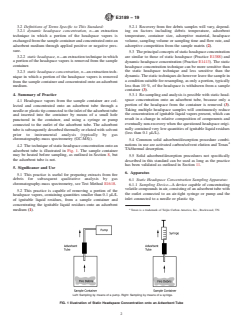
adsorbent tube is illustrated in Fig. 1. The sample container
may be heated before sampling, as outlined in Section 8, but
5.5 Solid adsorbent/desorption procedures not specifically
the adsorbent tube is not.
described in this standard can be used as long as the practice
has been validated as outlined in Section 11.
5. Significance and Use
6. Apparatus
5.1 This practice is useful for preparing extracts from fire
debris for subsequent qualitative analysis by gas 6.1 Static Headspace Concentration Sampling Apparatus:
chromatography-mass spectrometry, see Test Method E1618.
6.1.1 Sampling Device—A device capable of concentrating
volatile compounds in air, consisting of an adsorbent tube with
5.2 This practice is capable of removing a portion of the
the outlet connected to an air-tight syringe or pump and the
headspace vapors, containing quantities smaller than 0.1 µL/L
inlet connected to a needle or plastic tip.
of ignitable liquid residues, from a sample container and
concentrating the ignitable liquid residues onto an adsorbent
medium (1).
Tenax is a trademark of Teijin Carbon America, Inc., Rockwood, TN.
Left: Sampling by means of a pump. Right: Sampling by means of a syringe.
FIG. 1 Illustration of Static Headspace Concentration onto an Adsorbent Tube
E3189 − 19
6.1.2 Puncturing Device—A device such as a pin or a nail 7.5.1.1 Activated carbon tubes and equivalent for solvent
that is capable of puncturing a small hole in the sample elution can be made by inserting a filter into the bottom of a
container. The size of the hole is such that a syringe needle or samplingtube(approximately5-mmdiameter),thenadding2.5
plastic pipette tip can fit (loosely) into the opening. cm to 5 cm of activated carbon or equivalent, which is held in
6.1.3 Sampling System—A system that consists of a sam- place with a second filter.
pling and puncturing device, capable of withdrawing a portion
7.5.1.2 Tenax TA tubes and equivalent for thermal desorp-
of headspace through a hole in the container and concentrating
tioncanbemadebyinsertingafilterintooneendofasampling
volatile compounds from this headspace portion onto an
tube, adding approximately 80-mg pre-conditioned Tenax TA
adsorbent tube.
or equivalent, and then packing tightly with a second filter.
6.1.3.1 The sampling system must be designed and used in
NOTE 1—Tenax TA or equivalent is conditioned by heating, in accor-
a manner that prevents the loss of volatile compounds from the
dance with instrument manufacturer or supplier instructions.
container and contamination of the sample from the apparatus
7.6 Screw cap or crimp-top glass vials with polytetrafluo-
itself or the laboratory environment.
roethylene (PTFE) lined seals.
6.2 Thermal Desorption System—A system capable of des-
7.7 Disposable Syringes—1 mL to 100 mL.
orbing the trapped volatile compounds from an adsorbent tube
by means of elevated temperature, refocusing them on a
7.8 Disposable syringe needles, tips, or equivalent.
cold-trap and subsequently introducing them to a capillary GC
7.9 Tape, rubber sleeve stopper, or equivalent.
column by flash heating. The desorption apparatus is directly
coupled to a GC-MS.
7.10 Elution Solvent—Suitable elution solvents include car-
bon disulfide, n-pentane, dichloromethane and diethyl ether.
6.3 Pump—Avacuum or hand pump capable of drawing air
at a flow rate of at least 2 mL/min to 80 mL/min.
8. Sample Preparation
6.4 Oven—An oven large enough to accommodate the
8.1 Observe the appropriate procedures for handling and
sample container, and capable of maintaining the required
temperature uniformly throughout. documentation of all submitted samples (see Guide E1459 and
Practice E1492).
6.5 Temperature Measuring Device—A thermometer or
thermocouple capable of measuring oven temperatures in the
8.2 Prepare the fire debris sample container for static
required range of operation, to within approximately 5°C. headspace concentration onto an adsorbent tube.
8.2.1 Thesamplingsystemisdesignedsothattheheadspace
7. Reagents and Materials
sample can be extracted from the container in which it was
7.1 Purity of Reagents—Reagent grade or better chemicals
received at the laboratory.
shall be used in all tests. Unless otherwise indicated, it is
8.2.1.1 Alternatively, the fire debris sample, or a portion of
intended that all reagents conform to the specifications of the
it, can be transferred to a clean sample container such as a jar,
Committee on Analytical Reagents of the American Chemical
can, or bag suitable for static headspace concentration onto an
Society where such specifications are available. Other grades
adsorbent tube.
may be used, provided it is first ascertained that the reagent is
8.2.1.2 Verify the cleanliness of the transfer container prior
of sufficient high purity through evaluation of appropriate
to sample transfer. Cleanliness is determined by means of
blank(s) to permit its use without lessening the accuracy of the
analysis of a static headspace concentration sample obtained
determination.
from the empty transfer container using the same conditions as
7.2 Filter—Permeablematerialsuchassilanizedglasswool, will be used for the questioned sample.
wire mesh or cotton held in place with a frit.
8.2.1.3 Allow the transfer container with sample to equili-
brate for at least one hour before sampling.
7.3 Solid Adsorbent—Activated carbon, Tenax TA, or
8.2.2 Create a hole in the container with the puncturing
equivalent.
device such that a syringe needle or plastic tip can be
7.4 Sampling Tubes—Glass Pasteur pipettes or equivalent
introduced. The hole is created in the lid of a can or jar, or in
glasstubesforsolventelution,andstainlesssteelorglasstubes
the headspace area of a bag.
for thermal desorption.
8.2.2.1 Seal the hole with tape, rubber sleeve stopper, or
7.5 Adsorbent Tubes—Sampling tubes packed with a solid
equivalent.
adsorbent.
NOTE 2—Cans that are designed for fire debris samples, with a hole
7.5.1 Pre-packed adsorbent tubes are commercially avail-
pre-fitted with a rubber sleeve stopper, are commercially available.
able. Empty sampling tubes that can be packed by the
purchaser are also available. 8.3 When necessary, heat the container of fire debris sample
at the selected temperature prior to the headspace sampling, in
5 ordertoreleaseanyignitableliquidresiduesasavaporintothe
Reagent Chemicals, American Chemical Society Specifications, American
Chemical Society, Washington, DC. For suggestions on the testing of reagents not
headspace.
listed by the American Chemical Society, see Analar Standards for Laboratory
8.3.1 Heating is not recommended if there are other eviden-
Chemicals, BDH Ltd., Poole, Dorset, U.K., and the United States Pharmacopeia
tiary considerations such as preservation of DNA or latent
and National Formulary, U.S. Pharmacopeial Convention, Inc. (USPC), Rockville,
MD. fingerprints.
...