

ASTM F2315-18
(Guide)Standard Guide for Immobilization or Encapsulation of Living Cells or Tissue in Alginate Gels
General Information
- Abstract
SIGNIFICANCE AND USE
4.1 The main use is to immobilize, support, or suspend living cells or tissue in a matrix. The use of an encapsulation/immobilization system may protect cells or tissues from immune rejection. When immobilizing biological material in alginate gels, there are numerous parameters that must be controlled. This guide contains a list of these parameters and describes the methods and types of testing necessary to properly characterize, assess, and ensure consistency in the performance of an encapsulation system using alginate. This guide only covers single gelled beads, coated or not, and not double capsules or other constructs.
4.2 The alginate gelation technology covered by this guide may allow the formulation of cells and tissues into biomedical devices for use as tissue engineered medical products or drug delivery devices. These products may be appropriate for implantation based on supporting biocompatibility and physical test data. Recommendations in this guide should not be interpreted as a guarantee of clinical success in any tissue engineered medical product or drug delivery application.
SCOPE
1.1 This guide discusses information relevant to the immobilization or encapsulation of living cells or tissue in alginate gels. Immobilized or encapsulated cells are suitable for use in biomedical and pharmaceutical applications, or both, including, but not limited to, Tissue Engineered Medical Products (TEMPs).
1.2 This guide addresses key parameters relevant for successful immobilization and encapsulation in alginate gels.
1.3 The values stated in SI units are to be regarded as standard. No other units of measurement are included in this standard.
1.4 This standard does not purport to address all of the safety concerns, if any, associated with its use. It is the responsibility of the user of this standard to establish appropriate safety, health, and environmental practices and determine the applicability of regulatory limitations prior to use.
1.5 This international standard was developed in accordance with internationally recognized principles on standardization established in the Decision on Principles for the Development of International Standards, Guides and Recommendations issued by the World Trade Organization Technical Barriers to Trade (TBT) Committee.
- Status
- Published
- Publication Date
- 31-Oct-2018
- Technical Committee
- F04 - Medical and Surgical Materials and Devices
- Drafting Committee
- F04.43 - Cells and Tissue Engineered Constructs for TEMPs
Buy Documents
ASTM F2315-18 - Standard Guide for Immobilization or Encapsulation of Living Cells or Tissue in Alginate Gels
REDLINE ASTM F2315-18 - Standard Guide for Immobilization or Encapsulation of Living Cells or Tissue in Alginate Gels
Overview
ASTM F2315-18 is the Standard Guide for Immobilization or Encapsulation of Living Cells or Tissue in Alginate Gels, developed by ASTM International. This standard provides comprehensive guidance for the encapsulation and immobilization of living cells or tissues in single, gelled alginate beads, which may be coated or uncoated. It outlines the critical factors, methods, and testing necessary to ensure safe and reliable performance when using alginate gels as a matrix for biological material.
Encapsulation in alginate gels is widely used in biomedical, pharmaceutical, and tissue engineering applications. This process helps protect cells from host immune rejection and supports their viability and function in both research and practical medical applications. ASTM F2315-18 focuses on ensuring product consistency and safety but does not guarantee clinical success for any particular medical or pharmaceutical application.
Key Topics
Alginate Gelation Techniques
- Procedures for forming beads or capsules through ion-induced gelation
- Commonly used cross-linking ions include calcium, strontium, and barium
- Effects of ion concentration and type of solvent on gel formation and bead properties
Encapsulation Parameters
- Importance of controlling bead size, cell concentration, and homogeneity
- Influence of alginate purity, molecular weight, and composition on gel behavior
- Role of coating materials such as poly-L-lysine or chitosan in modifying bead properties
Testing and Characterization
- Assessment methods for gel strength, porosity, and diffusion characteristics
- Testing to determine homogeneity, mechanical stability, and biocompatibility
- Consideration of sterilization techniques and their impacts on the final gel properties
Biocompatibility and Safety
- Guidance on evaluating biological interactions
- Considerations for host immune response in implantation scenarios
- Recommendations for preclinical safety and toxicity testing per international standards
Applications
Alginate gel immobilization and encapsulation are essential in several advanced biotechnological and medical sectors, including:
Tissue Engineered Medical Products (TEMPs)
- Used for developing artificial organs, such as encapsulated islets of Langerhans for diabetes management (bioartificial pancreas)
- Engineering of functional tissues and cell-based implants
Drug Delivery Devices
- Controlled release systems for therapeutic proteins, drugs, or other biological agents
- Encapsulation of cells engineered to secrete specific substances in situ
Biomedical Research
- In vitro studies requiring isolated cell populations supported by a protective matrix
- Development of 3D cell culture models and bioinks for 3D bioprinting
Pharmaceutical Testing
- Screening of encapsulated cell systems for response to drugs or biologics
- Encapsulation techniques to enhance cell viability during transport and storage
Related Standards
When employing ASTM F2315-18 for immobilizing or encapsulating cells or tissues in alginate gels, the following related standards may also be useful:
- ASTM F748 – Practice for Selecting Generic Biological Test Methods for Materials and Devices
- ASTM F1903 – Practice for Testing for Cellular Responses to Particles in Vitro
- ASTM F1904 – Practice for Testing the Biological Responses to Particles in Vivo
- ASTM F2064 – Guide for Characterization and Testing of Alginates for Biomedical Use
- EN ISO 10993 – Biological Evaluation of Medical Devices
- USP Monograph for Sodium Alginate
- 21 CFR Part 312 – Investigational New Drug Applications (FDA regulations)
These standards, along with ASTM F2315-18, help ensure a robust framework for the safe and effective immobilization of living cells in alginate gels-facilitating innovation in medical, biomedical, and pharmaceutical industries while upholding quality and regulatory compliance.
Relations
- Effective Date
- 01-Feb-2020
- Effective Date
- 01-Oct-2018
- Effective Date
- 01-Mar-2017
- Effective Date
- 01-Apr-2016
- Effective Date
- 01-Oct-2014
- Effective Date
- 01-Apr-2011
- Effective Date
- 01-Jun-2010
- Refers
ASTM F1903-10 - Standard Practice for Testing For Biological Responses to Particles <i>In Vitro</i> - Effective Date
- 01-Jun-2010
- Effective Date
- 01-Jun-2010
- Effective Date
- 01-Aug-2008
- Effective Date
- 01-Dec-2006
- Effective Date
- 01-Mar-2006
- Effective Date
- 01-Mar-2006
- Effective Date
- 01-Nov-2004
- Effective Date
- 01-May-2004
Buy Documents
ASTM F2315-18 - Standard Guide for Immobilization or Encapsulation of Living Cells or Tissue in Alginate Gels
REDLINE ASTM F2315-18 - Standard Guide for Immobilization or Encapsulation of Living Cells or Tissue in Alginate Gels
Get Certified
Connect with accredited certification bodies for this standard

BSI Group
BSI (British Standards Institution) is the business standards company that helps organizations make excellence a habit.

TÜV Rheinland
TÜV Rheinland is a leading international provider of technical services.

TÜV SÜD
TÜV SÜD is a trusted partner of choice for safety, security and sustainability solutions.
Sponsored listings
Frequently Asked Questions
ASTM F2315-18 is a guide published by ASTM International. Its full title is "Standard Guide for Immobilization or Encapsulation of Living Cells or Tissue in Alginate Gels". This standard covers: SIGNIFICANCE AND USE 4.1 The main use is to immobilize, support, or suspend living cells or tissue in a matrix. The use of an encapsulation/immobilization system may protect cells or tissues from immune rejection. When immobilizing biological material in alginate gels, there are numerous parameters that must be controlled. This guide contains a list of these parameters and describes the methods and types of testing necessary to properly characterize, assess, and ensure consistency in the performance of an encapsulation system using alginate. This guide only covers single gelled beads, coated or not, and not double capsules or other constructs. 4.2 The alginate gelation technology covered by this guide may allow the formulation of cells and tissues into biomedical devices for use as tissue engineered medical products or drug delivery devices. These products may be appropriate for implantation based on supporting biocompatibility and physical test data. Recommendations in this guide should not be interpreted as a guarantee of clinical success in any tissue engineered medical product or drug delivery application. SCOPE 1.1 This guide discusses information relevant to the immobilization or encapsulation of living cells or tissue in alginate gels. Immobilized or encapsulated cells are suitable for use in biomedical and pharmaceutical applications, or both, including, but not limited to, Tissue Engineered Medical Products (TEMPs). 1.2 This guide addresses key parameters relevant for successful immobilization and encapsulation in alginate gels. 1.3 The values stated in SI units are to be regarded as standard. No other units of measurement are included in this standard. 1.4 This standard does not purport to address all of the safety concerns, if any, associated with its use. It is the responsibility of the user of this standard to establish appropriate safety, health, and environmental practices and determine the applicability of regulatory limitations prior to use. 1.5 This international standard was developed in accordance with internationally recognized principles on standardization established in the Decision on Principles for the Development of International Standards, Guides and Recommendations issued by the World Trade Organization Technical Barriers to Trade (TBT) Committee.
SIGNIFICANCE AND USE 4.1 The main use is to immobilize, support, or suspend living cells or tissue in a matrix. The use of an encapsulation/immobilization system may protect cells or tissues from immune rejection. When immobilizing biological material in alginate gels, there are numerous parameters that must be controlled. This guide contains a list of these parameters and describes the methods and types of testing necessary to properly characterize, assess, and ensure consistency in the performance of an encapsulation system using alginate. This guide only covers single gelled beads, coated or not, and not double capsules or other constructs. 4.2 The alginate gelation technology covered by this guide may allow the formulation of cells and tissues into biomedical devices for use as tissue engineered medical products or drug delivery devices. These products may be appropriate for implantation based on supporting biocompatibility and physical test data. Recommendations in this guide should not be interpreted as a guarantee of clinical success in any tissue engineered medical product or drug delivery application. SCOPE 1.1 This guide discusses information relevant to the immobilization or encapsulation of living cells or tissue in alginate gels. Immobilized or encapsulated cells are suitable for use in biomedical and pharmaceutical applications, or both, including, but not limited to, Tissue Engineered Medical Products (TEMPs). 1.2 This guide addresses key parameters relevant for successful immobilization and encapsulation in alginate gels. 1.3 The values stated in SI units are to be regarded as standard. No other units of measurement are included in this standard. 1.4 This standard does not purport to address all of the safety concerns, if any, associated with its use. It is the responsibility of the user of this standard to establish appropriate safety, health, and environmental practices and determine the applicability of regulatory limitations prior to use. 1.5 This international standard was developed in accordance with internationally recognized principles on standardization established in the Decision on Principles for the Development of International Standards, Guides and Recommendations issued by the World Trade Organization Technical Barriers to Trade (TBT) Committee.
ASTM F2315-18 is classified under the following ICS (International Classification for Standards) categories: 11.120.99 - Other standards related to pharmaceutics. The ICS classification helps identify the subject area and facilitates finding related standards.
ASTM F2315-18 has the following relationships with other standards: It is inter standard links to ASTM F2312-11(2020), ASTM F1903-18, ASTM F2064-17, ASTM F748-16, ASTM F2064-14, ASTM F2312-11, ASTM F748-06(2010), ASTM F1903-10, ASTM F2312-10, ASTM F1904-98(2008), ASTM F748-06, ASTM F2064-00(2006)e1, ASTM F2064-00(2006), ASTM F2312-04, ASTM F748-04. Understanding these relationships helps ensure you are using the most current and applicable version of the standard.
ASTM F2315-18 is available in PDF format for immediate download after purchase. The document can be added to your cart and obtained through the secure checkout process. Digital delivery ensures instant access to the complete standard document.
Standards Content (Sample)
This international standard was developed in accordance with internationally recognized principles on standardization established in the Decision on Principles for the
Development of International Standards, Guides and Recommendations issued by the World Trade Organization Technical Barriers to Trade (TBT) Committee.
Designation: F2315 − 18
Standard Guide for
Immobilization or Encapsulation of Living Cells or Tissue in
Alginate Gels
This standard is issued under the fixed designation F2315; the number immediately following the designation indicates the year of
original adoption or, in the case of revision, the year of last revision.Anumber in parentheses indicates the year of last reapproval.A
superscript epsilon (´) indicates an editorial change since the last revision or reapproval.
INTRODUCTION
Encapsulationininsolublealginategelisrecognizedasarapid,non-toxic,andversatilemethodfor
immobilization of macromolecules and cells. Microencapsulated cells or tissue as artificial organs are
under study for treatment of a variety of diseases such as Parkinson’s disease, chronic pain, liver
failure, hypocalcemia, and, perhaps the most well-known example, immobilization of islets of
Langerhans utilized as an artificial pancreas in the treatment of diabetes. Since alginates are a
heterogeneous group of polymers with a wide range of functional properties, the success of an
immobilization or encapsulation procedure will rely on an appropriate choice of materials and
methodology. This must be based on knowledge of the chemical composition of alginate and the
correlation between the structure, composition, and functional properties of the polymer, as well as
differencesingelationtechnologies.Itisalsoimportanttorecognizetheneedforworkingwithhighly
purifiedandwell-characterizedalginatesinordertoobtaingelswithreproducibleproperties.Theaim
of this guide is to provide information relevant to the immobilization or encapsulation of living cells
and tissue in alginate gels.
1. Scope ization established in the Decision on Principles for the
Development of International Standards, Guides and Recom-
1.1 This guide discusses information relevant to the immo-
mendations issued by the World Trade Organization Technical
bilization or encapsulation of living cells or tissue in alginate
Barriers to Trade (TBT) Committee.
gels. Immobilized or encapsulated cells are suitable for use in
biomedical and pharmaceutical applications, or both,
2. Referenced Documents
including, but not limited to, Tissue Engineered Medical
2.1 ASTM Standards:
Products (TEMPs).
F748PracticeforSelectingGenericBiologicalTestMethods
1.2 This guide addresses key parameters relevant for suc-
for Materials and Devices
cessful immobilization and encapsulation in alginate gels.
F1903Practice for Testing for Cellular Responses to Par-
1.3 The values stated in SI units are to be regarded as
ticles in vitro
standard. No other units of measurement are included in this
F1904Practice for Testing the Biological Responses to
standard.
Particles in vivo
F1905Practice For Selecting Tests for Determining the
1.4 This standard does not purport to address all of the
Propensity of Materials to Cause Immunotoxicity (With-
safety concerns, if any, associated with its use. It is the
drawn 2011)
responsibility of the user of this standard to establish appro-
F1906Practice for Evaluation of Immune Responses In
priate safety, health, and environmental practices and deter-
BiocompatibilityTestingUsingELISATests,Lymphocyte
mine the applicability of regulatory limitations prior to use.
Proliferation, and Cell Migration (Withdrawn 2011)
1.5 This international standard was developed in accor-
F2064Guide for Characterization and Testing of Alginates
dance with internationally recognized principles on standard-
1 2
This guide is under the jurisdiction ofASTM Committee F04 on Medical and For referenced ASTM standards, visit the ASTM website, www.astm.org, or
Surgical Materials and Devicesand is the direct responsibility of Subcommittee contact ASTM Customer Service at service@astm.org. For Annual Book of ASTM
F04.43 on Cells and Tissue Engineered Constructs for TEMPs. Standards volume information, refer to the standard’s Document Summary page on
Current edition approved Nov. 1, 2018. Published December 2018. Originally the ASTM website.
approved in 2003. Last previous edition approved in 2011 as F2315–11. DOI: The last approved version of this historical standard is referenced on
10.1520/F2315-18. www.astm.org.
Copyright © ASTM International, 100 Barr Harbor Drive, PO Box C700, West Conshohocken, PA 19428-2959. United States
F2315 − 18
as Starting Materials Intended for Use in Biomedical and 3.1.6 immobilization, n—the entrapment of materials, such
Tissue Engineered Medical Product Applications as cells, tissues, or proteins within, or bound to, a matrix.
F2312Terminology Relating to Tissue Engineered Medical
3.1.7 pyrogen, n—anysubstancethatproducesfever. F2312
Products
3.2 Additional definitions regarding alginate may be found
2.2 USP Document:
4 in Guide F2064. Additional definitions regarding biomaterials
USP Monograph USP 40/NF35 Sodium Alginate
may be found in Terminology F2312.
2.3 Other Referenced Documents:
ISO 10993Biological Evaluation of Medical Devices—Part
4. Significance and Use
1: Evaluation and Testing Within a Risk Management
4.1 The main use is to immobilize, support, or suspend
Process
living cells or tissue in a matrix. The use of an encapsulation/
International Conference on Harmonization (ICH) S2B
immobilization system may protect cells or tissues from
Genotoxicity: A Standard Battery for Genotoxicity Test-
immune rejection. When immobilizing biological material in
ing of Pharmaceuticals (July 1997)
alginate gels, there are numerous parameters that must be
21 CFR Part 312Code of Federal Regulations Title 21, Part
controlled. This guide contains a list of these parameters and
312 Investigational New Drug Application
describes the methods and types of testing necessary to
3. Terminology
properly characterize, assess, and ensure consistency in the
performance of an encapsulation system using alginate. This
3.1 Definitions:
guide only covers single gelled beads, coated or not, and not
3.1.1 alginate, n—polysaccharide obtained from some of
double capsules or other constructs.
the more common species of marine algae, consisting of an
insoluble mix of calcium, magnesium, sodium, and potassium
4.2 The alginate gelation technology covered by this guide
salts. F2312
may allow the formulation of cells and tissues into biomedical
3.1.1.1 Discussion—Alginate exists in brown algae as its
devices for use as tissue engineered medical products or drug
most abundant polysaccharide, mainly occurring in the cell
delivery devices. These products may be appropriate for
walls and intercellular spaces of brown seaweed and kelp.
implantation based on supporting biocompatibility and physi-
Alginate’s main function is to contribute to the strength and
cal test data. Recommendations in this guide should not be
flexibility of the seaweed plant. Alginate is classified as a
interpreted as a guarantee of clinical success in any tissue
hydrocolloid. The most commonly used alginate is sodium
engineered medical product or drug delivery application.
alginate. Sodium alginate and, in particular, calcium cross-
linked alginate gels are used in Tissue Engineered Medical
5. Gelation Techniques
Products (TEMPs) as biomedical matrices, controlled drug
5.1 Most methods for encapsulation of cells or tissue in
delivery systems, and for immobilizing living cells.
alginate gels (see USP Monograph USP 40/NF35) basically
3.1.2 APA bead, n—alginate-poly-L-lysine-alginate bead.
involve two main steps. The first step is the formation of an
F2312
internalphasewherethealginatesolutioncontainingbiological
materials is dispersed into small droplets. In the second step,
3.1.3 encapsulation, n—a procedure by which biological
dropletsaresolidifiedbygellingorformingamembraneatthe
materials,suchascells,tissues,orproteins,areenclosedwithin
droplet surface.
a microscopic or macroscopic semipermeable barrier. F2312
3.1.4 endotoxin,n—pyrogenichighmolarmasslipopolysac- 5.2 The most simple and common way to produce small
charide (LPS) complex associated with the cell wall of beads or capsules is by forming droplets of a solution of
gram-negative bacteria. F2312 sodium alginate containing the desired biological material
3.1.4.1 Discussion—Though endotoxins are pyrogens, not (cells, tissues, or other macromolecules) and then exposing
all pyrogens are endotoxins. Endotoxins are specifically de- them to a gelling bath. A gelling bath may be a solution
2+ 2+
tected through a Limulus Amebocyte Lysate (LAL) test. containingdivalentcross-linkingcationssuchasCa ,Sr ,or
2+ 2+
Ba . Monovalent cations and Mg ions do not induce
3.1.5 gel, n—the three-dimensional network structure aris-
gelation of alginates (1).
ingfromintermolecularpolymerchaininteractions.Suchchain
interactions may be covalent, ionic, hydrogen bond, or hydro-
5.3 Concentration of Ions:
phobic in nature.
5.3.1 The concentration of gelling ions used must be deter-
mined based upon factors such as desired gel strength, type of
alginate used (G- or M-rich (see X2.1), and isotonicity of the
AvailablefromU.S.Pharmacopeia(USP),12601TwinbrookPkwy.,Rockville,
MD 20852-1790, http://www.usp.org.
gelling solutions. Calcium ion concentrations of 50 mmol/Lto
Available fromAmerican National Standards Institute (ANSI), 25 W. 43rd St.,
150 mmol/L are often used.
4th Floor, New York, NY 10036, http://www.ansi.org.
2+ 2+
5.3.2 Othergellingions,(suchasBa orSr )maybeused.
Available from https://www.fda.gov/downloads/drugs/
2+
guidancecomplianceregulatoryinformation/guidances/ucm074929.pdf or http:// The concentration of Ba in the gelling solution must be
www.ich.org/products/guidelines/safety/safety-single/article/guidance-on-
determined based upon the desired characteristics of the final
genotoxicity-testing-and-data-interpretation-for-pharmaceuticals-intended-for-
human-use.html
Available from U.S. Government Printing Office, Superintendent of
Documents, 732 N. Capitol St., NW, Washington, DC 20401-0001, http:// Theboldfacenumbersinparenthesesrefertothelistofreferencesattheendof
www.access.gpo.gov. this standard.
F2315 − 18
2+
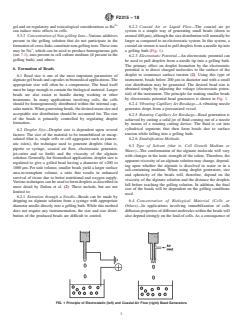
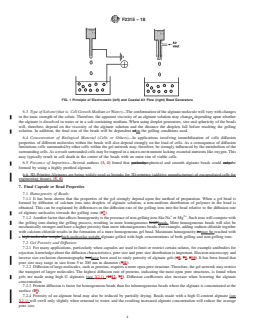
gel and on regulatory and toxicological considerations as Ba 6.2.2 Coaxial Air or Liquid Flow—The coaxial air jet
can induce toxic effects in cells. system is a simple way of generating small beads (down to
5.3.3 Concentration of Non-gelling Ions—Various additives around400µm),althoughthesizedistributionwillnormallybe
present in the gelling solution that do not participate in the larger as compared to an electrostatic system. In this system, a
formationofcross-linksconstitutenon-gellingions.Theseions coaxialairstreamisusedtopulldropletsfromaneedletipinto
+
may be Na , which can be used to produce homogeneous gels a gelling bath (Fig. 1).
(see 7.1), ions present in cell culture medium (if present in the
6.2.3 Electrostatic Potential—An electrostatic potential can
gelling bath), and others.
be used to pull droplets from a needle tip into a gelling bath.
The primary effect on droplet formation by the electrostatic
6. Formation of Beads
potential is to direct charged molecules to the surface of the
droplet to counteract surface tension (2). Using this type of
6.1 Bead size is one of the most important parameters of
instrument, beads below 200 µm in diameter and with a small
alginategelbeadsandcapsulesinbiomedicalapplications.The
size distribution may be generated. The desired bead size is
appropriate size will often be a compromise. The bead itself
obtained simply by adjusting the voltage (electrostatic poten-
mustbelargeenoughtocontainthebiologicalmaterial.Larger
tial) of the instrument.The principle for making smaller beads
beads are also easier to handle during washing or other
by electrostatic potential bead generators is shown in Fig. 1.
treatments. In many applications involving cells, the cells
should be homogeneously distributed within the internal cap- 6.2.4 Vibrating Capillary Jet Breakage—Avibrating nozzle
sularmatrix.Whengeneratingbeads,thedesiredmeansizeand
generates drops from a pressurized vessel.
acceptable size distribution should be accounted for. The size
6.2.5 Rotating Capillary Jet Breakage—Bead generation is
of the beads is primarily controlled by regulating droplet
achieved by cutting a solid jet of fluid coming out of a nozzle
formation.
by means of a rotating cutting device. The fluid is cut into
cylindrical segments that then form beads due to surface
6.2 Droplet Size—Droplet size is dependent upon several
tension while falling into a gelling bath.
factors: The size of the material to be immobilized or encap-
sulated (that is, single cells or cell aggregates such as pancre- 6.2.6 Emulsification Methods.
atic islets), the technique used to generate droplets (that is,
6.3 Type of Solvent (that is, Cell Growth Medium or
pipette or syringe, coaxial air flow, electrostatic generator,
Water)—The conformation of the alginate molecule will vary
jet-cutter and so forth) and the viscosity of the alginate
with changes in the ionic strength of the solute. Therefore, the
solution.Generally,forbiomedicalapplications,dropletsizeis
apparentviscosityofanalginatesolutionmaychange,depend-
regulated to give a gelled bead having a diameter of <200 to
ing upon whether the alginate is dissolved in water or in a
1000 µm. Per unit volume, smaller beads yield a larger surface
salt-containing medium. When using droplet generators, size
area-to-transplant volume, a ratio that results in enhanced
and sphericity of the beads will, therefore, depend on the
survival of tissue due to better nutritional and oxygen supply.
viscosity of the alginate solution and the distance the droplets
Varioustechniquescanbeusedtoformdropletsasdescribedin
fall before reaching the gelling solution. In addition, the final
more detail by Dulieu et al. (2). These include, but are not
size of the beads will be dependent on the gelling conditions
limited to:
used.
6.2.1 Extrusion through a Needle—Beads can be made by
dripping an alginate solution from a syringe with appropriate 6.4 Concentration of Biological Material (Cells or
diameter needle directly into a gelling bath.While this method Others)—In applications involving immobilization of cells
does not require any instrumentation, the size and size distri- diffusionpropertiesofdifferentmoleculeswithinthebeadswill
bution of the produced beads are difficult to control. also depend strongly on the load of cells.As a consequence of
FIG. 1 Principle of Electrostatic (left) and Coaxial Air Flow (right) Bead Generators
F2315 − 18
diffusion limitations cells surrounded by other cells within the 7.2.5 The gel network to a lesser extent influences diffusion
gel network may, therefore, be strongly influenced by the properties of smaller molecules. Diffusion coefficients of
metabolism of the surrounding cells. As a result surrounded molecules such as glucose and ethanol are typically as high as
cells may be trapped in a micro-environment lacking essential about 90% of the diffusion coefficient in water. Tanaka et al.
nutrientslikeoxygen.Thismaytypicallyresultincelldeathin (13) found no reduction in diffusion coefficients for solutes
the center of the beads with an outer rim of viable cells. with moleular weight<2×10 in calcium alginate gel beads
as compared with free diffusion in water.
6.5 Presence of Impurities—Several authors (3, 4) found
7.2.6 Diffusion within the gel network is not solely depen-
that spherical and smooth alginate beads could be formed by
dent upon porosity. Since the gel matrix is negatively charged,
using a highly purified alginate.
electrostatic forces between the gel network and ionic sub-
6.6 3D-Printing-Alginates are being widely used as bioinks
stratesshouldalsobeconsidered (14).Forexample,theratefor
for 3D-printing (additive manufacturing) of encapsulated cells
BSA (bovine serum albumin) diffusion out of alginate beads
for engineering tissues. (5, 6)
increased with increasing pH (9), presumably due to the
negative charge on the protein as the pH increased. The
7. Final Capsule or Bead Properties
negative charge of the alginate matrix is also responsible for a
7.1 Homogeneity of Beads:
difference between influx and efflux of molecules. At pH 7,
7.1.1 It has been shown that the properties of the gel
most proteins are negatively charged and will therefore not
strongly depend upon the method of preparation. When a gel
easily diffuse into the matrix. When such proteins are immo-
bead is formed by diffusion of calcium ions into droplets of
bilized in a gel, the repulsive forces result in an efflux that is
alginate solution, a non-uniform distribution of polymer in the
greater than their free molecular diffusion rate (15).
bead is obtained. This can be explained by differences in the
7.2.7 Theremaybeothercontributingfactorstodiffusionof
diffusion rate of the gelling ions into the bead relative to the
molecules through, into, or out of, the gel. Diffusion of drugs,
diffusion rate of alginate molecules towards the gelling zone
or other molecules of interest, or the molecular weight cut-off
(7).
of the gel network itself, needs to be experimentally
7.1.2 Another factor that affects homogeneity is the pres-
determined, if important for the functionality of the TEMP.
+ 2+
ence of non-gelling ions like Na or Mg . Such ions will
7.3 Gel Strength and Stability:
compete with the gelling ions during the gelling process,
7.3.1 Mechanicalpropertiesofalginatebeadswilltoalarge
resulting in more homogeneous beads. More homogeneous
extent vary with the alginate composition (12). The highest
beads will also be mechanically stronger and have a higher
mechanical strength is found when the G-content is more than
porositythanmoreinhomogeneousbeads.Forexample,adding
about 70% and average length of G blocks (NG > 1) of about
sodium chloride together with calcium chloride results in the
15. For molecular weights above a certain value, the mechani-
formation of a more homogeneous gel bead. Maximum homo-
calstrengthisdeterminedmainlybychemicalcompositionand
geneity may be reached with a high-molecular-weight alginate
block structure, and is therefore independent of the molecular
gelledwithhighconcentrationsofbothgellingandnon-gelling
weight. However, low molecular weight alginates are often
ions.
preferred in biomedical applications because they are easier to
7.2 Gel Porosity and Diffusion:
sterilize by membrane filtration. Below a certain critical
7.2.1 For many applications, particularly when capsules are
molecular weight, the gel forming ability is reduced. This
used to limit or restrict certain solutes, for example antibodies
effect will be dependent of the alginate concentration because
for rejection, knowledge about the diffusion characteristics,
of polymer coil overlap.
pore size and pore size distribution is important. Electron
7.3.2 The alginate gel as an immobilization matrix is
microscopy and inverse size exclusion chromatography have
sensitive to chelating compounds such as phosphate, lactate,
been used to study porosity of alginate gels (8, 9, 10).Ithas
citrate and ethylenediaminetetraacetic acid (EDTA), and the
been found that pore size may range in size from 5 to 200 nm
+ 2+
presence of anti-gelling cations such as Na or Mg .To avoid
in diameter (11).
this, gel beads may be kept in a medium containing a few
7.2.2 Diffusion of large molecules, such as proteins, re-
+ 2+
millimoles of free calcium ions and by keeping the Na :Ca
quires a more open pore structure. Therefore, the gel network
ratio less than 25:1 for high G alginates and 3:1 for low G
may restrict the transport of larger molecules. The highest
2+
alginates (12).An alternative is also to replace Ca with other
diffusion rate of proteins, indicating the most open pore
divalent cations with a higher affinity for alginate. There has
structures, is found when gels are made using high G alginates
been found a correlation between mechanical gel strength and
(see X2.1) (12, 9). Diffusion coefficients also increase when
affinity for cations (10). It was found that gel strength de-
lowering the alginate concentration.
2+ 2+ 2+ 2+
creased in the following orders: Pb >Cu =Ba >Sr >
7.2.3 Proteindiffusionisfasterforhomogeneousbeadsthan
2+ 2+ 2+ 2+ 2+
Cd >Ca >Zn >Co >Ni . However, in applications
forinhomogeneousbeadswherethealginateisconcentratedat
2+ 2+
involving immobilization of living cells only Sr ,Ba , and
the surface (9).
2+
Ca are considered non-toxic enough for these purposes (15).
7.2.4 Porosity of an alginate bead may also be reduced by
7.4 Coating of Alginate Gel Beads:
partially drying. Beads made with a high G-content alginate
(see X2.1) will swell only slightly when returned to water, and 7.4.1 As alginates may form strong complexes with poly-
the resulting increased alginate concentration will reduce the cationssuchaschitosanorpolypeptides,orsyntheticpolymers
average pore size. suchas
...
This document is not an ASTM standard and is intended only to provide the user of an ASTM standard an indication of what changes have been made to the previous version. Because
it may not be technically possible to adequately depict all changes accurately, ASTM recommends that users consult prior editions as appropriate. In all cases only the current version
of the standard as published by ASTM is to be considered the official document.
Designation: F2315 − 11 F2315 − 18
Standard Guide for
Immobilization or Encapsulation of Living Cells or Tissue in
Alginate Gels
This standard is issued under the fixed designation F2315; the number immediately following the designation indicates the year of
original adoption or, in the case of revision, the year of last revision. A number in parentheses indicates the year of last reapproval. A
superscript epsilon (´) indicates an editorial change since the last revision or reapproval.
INTRODUCTION
Encapsulation in insoluble alginate gel is recognized as a rapid, non-toxic, and versatile method for
immobilization of macromolecules and cells. Microencapsulated cells or tissue as artificial organs are
under study for treatment of a variety of diseases such as Parkinson’s disease, chronic pain, liver
failure, hypocalcemia, and, perhaps the most well-known example, immobilization of islets of
Langerhans utilized as an artificial pancreas in the treatment of diabetes. Since alginates are a
heterogeneous group of polymers with a wide range of functional properties, the success of an
immobilization or encapsulation procedure will rely on an appropriate choice of materials and
methodology. This must be based on knowledge of the chemical composition of alginate and the
correlation between the structure, composition, and functional properties of the polymer, as well as
differences in gelation technologies. It is also important to recognize the need for working with highly
purified and well-characterized alginates in order to obtain gels with reproducible properties. The aim
of this guide is to provide information relevant to the immobilization or encapsulation of living cells
and tissue in alginate gels.
1. Scope
1.1 This guide discusses information relevant to the immobilization or encapsulation of living cells or tissue in alginate gels.
Immobilized or encapsulated cells are suitable for use in biomedical and pharmaceutical applications, or both, including, but not
limited to, Tissue Engineered Medical Products (TEMPs).
1.2 This guide addresses key parameters relevant for successful immobilization and encapsulation in alginate gels.
1.3 The values stated in SI units are to be regarded as standard. No other units of measurement are included in this standard.
1.4 This standard does not purport to address all of the safety concerns, if any, associated with its use. It is the responsibility
of the user of this standard to establish appropriate safety safety, health, and healthenvironmental practices and determine the
applicability of regulatory requirementslimitations prior to use.
1.5 This international standard was developed in accordance with internationally recognized principles on standardization
established in the Decision on Principles for the Development of International Standards, Guides and Recommendations issued
by the World Trade Organization Technical Barriers to Trade (TBT) Committee.
2. Referenced Documents
2.1 ASTM Standards:
F748 Practice for Selecting Generic Biological Test Methods for Materials and Devices
F1251 Terminology Relating to Polymeric Biomaterials in Medical and Surgical Devices (Withdrawn 2012)
F1903 Practice for Testing for Cellular Responses to Particles in vitro
F1904 Practice for Testing the Biological Responses to Particles in vivo
This guide is under the jurisdiction of ASTM Committee F04 on Medical and Surgical Materials and Devicesand is the direct responsibility of Subcommittee F04.43
on Cells and Tissue Engineered Constructs for TEMPs.
Current edition approved March 1, 2011Nov. 1, 2018. Published March 2011December 2018. Originally approved in 2003. Last previous edition approved in 20102011
as F2315 – 10.F2315 – 11. DOI: 10.1520/F2315-11.10.1520/F2315-18.
For referenced ASTM standards, visit the ASTM website, www.astm.org, or contact ASTM Customer Service at service@astm.org. For Annual Book of ASTM Standards
volume information, refer to the standard’s Document Summary page on the ASTM website.
Copyright © ASTM International, 100 Barr Harbor Drive, PO Box C700, West Conshohocken, PA 19428-2959. United States
F2315 − 18
F1905 Practice For Selecting Tests for Determining the Propensity of Materials to Cause Immunotoxicity (Withdrawn 2011)
F1906 Practice for Evaluation of Immune Responses In Biocompatibility Testing Using ELISA Tests, Lymphocyte Proliferation,
and Cell Migration (Withdrawn 2011)
F2064 Guide for Characterization and Testing of Alginates as Starting Materials Intended for Use in Biomedical and Tissue
Engineered Medical Product Applications
F2312 Terminology Relating to Tissue Engineered Medical Products
2.2 USP Document:
USP Monograph USP 24/NF1940/NF35 Sodium Alginate
2.3 Other Referenced Documents:
EN-ISOISO 10993 Biological Evaluation of Medical DevicesDevices—Part 1: Evaluation and Testing Within a Risk
Management Process
International Conference on Harmonization (ICH) S2B Genotoxicity: A Standard Battery for Genotoxicity Testing of
Pharmaceuticals (July 1997)
21 CFR Part 312 Code of Federal Regulations Title 21, Part 312 Investigational New Drug Application
3. Terminology
3.1 Definitions:
3.1.1 alginate, n—polysaccharide obtained from some of the more common species of marine algae, consisting of an insoluble
mix of calcium, magnesium, sodium, and potassium salts. F2312
3.1.1.1 Discussion—
Alginate exists in brown algae as its most abundant polysaccharide, mainly occurring in the cell walls and intercellular spaces of
brown seaweed and kelp. Alginate’s main function is to contribute to the strength and flexibility of the seaweed plant. Alginate
is classified as a hydrocolloid. The most commonly used alginate is sodium alginate. Sodium alginate and, in particular, calcium
cross-linked alginate gels are used in Tissue Engineered Medical Products (TEMPs) as biomedical matrices, controlled drug
delivery systems, and for immobilizing living cells.
3.1.2 APA bead, n—alginate-poly-L-lysine-alginate bead. F2312
3.1.3 encapsulation, n—a procedure by which biological materials, such as cells, tissues, or proteins, are enclosed within a
microscopic or macroscopic semipermeable barrier. F2312
3.1.4 endotoxin, n—pyrogenic high molar mass lipopolysaccharide (LPS) complex associated with the cell wall of
gram-negative bacteria. F2312
3.1.4.1 Discussion—
Though endotoxins are pyrogens, not all pyrogens are endotoxins. Endotoxins are specifically detected through a Limulus
Amebocyte Lysate (LAL) test.
3.1.5 gel, n—the three-dimensional network structure arising from intermolecular polymer chain interactions. Such chain
interactions may be covalent, ionic, hydrogen bond, or hydrophobic in nature. See also Terminology F1251.
3.1.6 immobilization, n—the entrapment of materials, such as cells, tissues, or proteins within, or bound to, a matrix.
3.1.7 pyrogen, n—any substance that produces fever. F2312
3.2 Additional definitions regarding alginate may be found in Guide F2064. Additional definitions regarding polymeric
biomaterials may be found in Terminology F1251F2312.
4. Significance and Use
4.1 The main use is to immobilize, support, or suspend living cells or tissue in a matrix. The use of an encapsulation/
immobilization system may protect cells or tissues from immune rejection. When immobilizing biological material in alginate gels,
there are numerous parameters that must be controlled. This guide contains a list of these parameters and describes the methods
The last approved version of this historical standard is referenced on www.astm.org.
Available from U.S. Pharmacopeia (USP), 12601 Twinbrook Pkwy., Rockville, MD 20852-1790, http://www.usp.org.
Available from American National Standards Institute (ANSI), 25 W. 43rd St., 4th Floor, New York, NY 10036, http://www.ansi.org.
Available from ICH Secretariat, c/o IFPMA, 30 rue de St-Jean, P.O. Box 758, 1211 Geneva 13, Switzerland.https://www.fda.gov/downloads/drugs/
guidancecomplianceregulatoryinformation/guidances/ucm074929.pdf or http://www.ich.org/products/guidelines/safety/safety-single/article/guidance-on-genotoxicity-
testing-and-data-interpretation-for-pharmaceuticals-intended-for-human-use.html
Available from U.S. Government Printing Office, Superintendent of Documents, 732 N. Capitol St., NW, Washington, DC 20401-0001, http://www.access.gpo.gov.
F2315 − 18
and types of testing necessary to properly characterize, assess, and ensure consistency in the performance of an encapsulation
system using alginate. This guide only covers single gelled beads, coated or not, and not double capsules or other constructs.
4.2 The alginate gelation technology covered by this guide may allow the formulation of cells and tissues into biomedical
devices for use as tissue engineered medical products or drug delivery devices. These products may be appropriate for implantation
based on supporting biocompatibility and physical test data. Recommendations in this guide should not be interpreted as a
guarantee of clinical success in any tissue engineered medical product or drug delivery application.
5. Gelation Techniques
5.1 Most methods for encapsulation of cells or tissue in alginate gels (see USP Monograph USP 40/NF35) basically involve two
main steps. The first step is the formation of an internal phase where the alginate solution containing biological materials is
dispersed into small droplets. In the second step, droplets are solidified by gelling or forming a membrane at the droplet surface.
5.2 The most simple and common way to produce small beads or capsules is by forming droplets of a solution of sodium
alginate containing the desired biological material (cells, tissues, or other macromolecules) and then exposing them to a gelling
2+ 2+ 2+
bath. A gelling bath may be a solution containing divalent cross-linking cations such as Ca , Sr , or Ba . Monovalent cations
2+ 8
and Mg ions do not induce gelation of alginates (1).
5.3 Concentration of Ions:
5.3.1 The concentration of gelling ions used must be determined based upon factors such as desired gel strength, type of alginate
used (G- or M-rich), M-rich (see X2.1), and isotonicity of the gelling solutions. Calcium ion concentrations of from 50 mmol/L
to 150 mmmmol/L are often used.
2+ 2+ 2+
5.3.2 Other gelling ions may be used, such ions, (such as Ba or Sr . ) may be used. The concentration of Ba in the gelling
solution must be determined based upon the desired characteristics of the final gel and on regulatory and toxicological
2+
considerations as Ba can induce toxic effects in cells.
5.3.3 Concentration of Non-gelling Ions—Various additives present in the gelling solution that do not participate in the
+
formation of cross-links constitute non-gelling ions. These ions may be Na , which can be used to produce homogeneous gels (see
7.1), ions present in cell culture medium (if present in the gelling bath), and others.
6. Formation of Beads
6.1 Bead size is one of the most important parameters of alginate gel beads and capsules in biomedical applications. The
appropriate size will often be a compromise. The bead itself must be large enough to contain the biological material. Larger beads
are also easier to handle during washing or other treatments. In many applications involving cells, the cells should be
homogeneously distributed within the internal capsular matrix. When generating beads, the desired mean size and acceptable size
distribution should be accounted for. The size of the beads is primarily controlled by regulating droplet formation.
6.2 Droplet Size—Droplet size is dependent upon several factors: The size of the material to be immobilized or encapsulated
(that is, single cells or cell aggregates such as pancreatic islets), the technique used to generate droplets (that is, pipette or syringe,
coaxial air flow, electrostatic generator, jet-cutter,jet-cutter and so forth) and the viscosity of the alginate solution. Generally, for
biomedical applications, droplet size is regulated to give a gelled bead having a diameter of <200 to 1000 μm. Per unit volume,
smaller beads yield a larger surface area to transplant area-to-transplant volume, a ratio that results in enhanced survival of tissue
due to better nutritional and oxygen supply. Various techniques can be used to form droplets as described in more detail by Dulieu
et al. (2). These include, but are not limited to:
6.2.1 Extrusion through a Needle—Beads can be made by dripping an alginate solution from a syringe with appropriate diameter
needle directly into a gelling bath. While this method does not require any instrumentation, the size and size distribution of the
produced beads are difficult to control.
6.2.2 Coaxial Air or Liquid Flow—The coaxial air jet system is a simple way of generating small beads (down to around 400
μm), although the size distribution will normally be larger as compared to an electrostatic system. In this system, a coaxial air
stream is used to pull droplets from a needle tip into a gelling bath (Fig. 1).
6.2.3 Electrostatic Potential—An electrostatic potential can be used to pull droplets from a needle tip into a gelling bath. The
primary effect on droplet formation by the electrostatic potential is to direct charged molecules to the surface of the droplet to
counteract surface tension (2). Using this type of instrument, beads below 200 μm in diameter and with a small size distribution
may be generated. The desired bead size is obtained simply by adjusting the voltage (electrostatic potential) of the instrument. The
principle for making smaller beads by electrostatic potential bead generators is shown in Fig. 1.
6.2.4 Vibrating Capillary Jet Breakage—A vibrating nozzle generates drops from a pressurized vessel.
6.2.5 Rotating Capillary Jet Breakage—Bead generation is achieved by cutting a solid jet of fluid coming out of a nozzle by
means of a rotating cutting device. The fluid is cut into cylindrical segments that then form beads due to surface tension while
falling into a gelling bath.
6.2.6 Emulsification Methods.
The boldface numbers in parentheses refer to the list of references at the end of this standard.
F2315 − 18
FIG. 1 Principle of Electrostatic (left) and Coaxial Air Flow (right) Bead Generators
6.3 Type of Solvent (that is, Cell Growth Medium or Water)—The conformation of the alginate molecule will vary with changes
in the ionic strength of the solute. Therefore, the apparent viscosity of an alginate solution may change, depending upon whether
the alginate is dissolved in water or in a salt-containing medium. When using droplet generators, size and sphericity of the beads
will, therefore, depend on the viscosity of the alginate solution and the distance the droplets fall before reaching the gelling
solution. In addition, the final size of the beads will be dependent ofon the gelling conditions used.
6.4 Concentration of Biological Material (Cells or Others)—In applications involving immobilization of cells diffusion
properties of different molecules within the beads will also depend strongly on the load of cells. As a consequence of diffusion
limitations cells surrounded by other cells within the gel network may, therefore, be strongly influenced by the metabolism of the
surrounding cells. As a result surrounded cells may be trapped in a micro-environment lacking essential nutrients like oxygen. This
may typically result in cell death in the center of the beads with an outer rim of viable cells.
6.5 Presence of Impurities—Several authors (3, 4) found that perfectly spherical and smooth alginate beads could only be
formed by using a highly purified alginate.
6.6 3D-Printing-Alginates are being widely used as bioinks for 3D-printing (additive manufacturing) of encapsulated cells for
engineering tissues. (5, 6)
7. Final Capsule or Bead Properties
7.1 Homogeneity of Beads:
7.1.1 It has been shown that the properties of the gel strongly depend upon the method of preparation. When a gel bead is
formed by diffusion of calcium ions into droplets of alginate solution, a non-uniform distribution of polymer in the bead is
obtained. This can be explained by differences in the diffusion rate of the gelling ions into the bead relative to the diffusion rate
of alginate molecules towards the gelling zone (57).
+ 2+
7.1.2 Another factor that affects homogeneity is the presence of non-gelling ions like Na or Mg . Such ions will compete with
the gelling ions during the gelling process, resulting in more homogeneous bead.beads. More homogeneous beads will also be
mechanically stronger and have a higher porosity than more inhomogeneous beads. For example, adding sodium chloride together
with calcium chloride results in the formation of a more homogeneous gel bead. Maximum homogeneity is may be reached with
a high molecular weight high-molecular-weight alginate gelled with high concentrations of both gelling and non-gelling ions.
7.2 Gel Porosity and Diffusion:
7.2.1 For many applications, particularly when capsules are used to limit or restrict certain solutes, for example antibodies for
rejection, knowledge about the diffusion characteristics, pore size and pore size distribution is important. Electron microscopy and
inverse size exclusion chromatography hashave been used to study porosity of alginate gels (68, 79, 810). It has been found that
pore size may range in size from 5 to 200 nm in diameter (911).
7.2.2 Diffusion of large molecules, such as proteins, requires a more open pore structure. Therefore, the gel network may restrict
the transport of larger molecules. The highest diffusion rate of proteins, indicating the most open pore structures, is found when
gels are made using high G alginates (see X2.1) (1012, 79). Diffusion coefficients also increase when lowering the alginate
concentration.
7.2.3 Protein diffusion is faster for homogeneous beads than for inhomogeneous beads where the alginate is concentrated at the
surface (79).
7.2.4 Porosity of an alginate bead may also be reduced by partially drying. Beads made with a high G-content alginate (see
X2.1) will swell only slightly when returned to water, and the resulting increased alginate concentration will reduce the average
pore size.
F2315 − 18
7.2.5 The gel network to a lesser extent influences diffusion properties of smaller molecules. Diffusion coefficients of molecules
such as glucose and ethanol are typically as high as about 90 % of the diffusion coefficient in water. Tanaka et al. (1113) found
no reduction in diffusion coefficients for solutes with Mw moleular weight < 2 × 10 in calcium alginate gel beads as compared
with free diffusion in water.
7.2.6 Diffusion within the gel network is not solely dependent upon porosity. Since the gel matrix is negatively charged,
electrostatic forces between the gel network and ionic substrates should also be considered (1214). For example, the rate for BSA
(bovine serum albumin) diffusion out of alginate beads increased with increasing pH (79), presumably due to the negative charge
on the protein as the pH increased. The negative chargedcharge of the alginate matrix is also responsible for a difference between
influx and efflux of molecules. At pH 7, most proteins are negatively charged and will therefore not easily diffuse into the matrix.
When such proteins are immobilized in a gel, the repulsive forces result in an efflux that is greater than their free molecular
diffusion rate (1315).
7.2.7 There may be other contributing factors to diffusion of molecules through, into, or out of, the gel. Diffusion of drugs, or
other molecules of interest, or the molecular weight cut-off of the gel network itself, needs to be experimentally determined, if
important for the functionality of the TEMP.
7.3 Gel Strength and Stability:
7.3.1 Mechanical properties of alginate beads will to a large extent vary with the alginate composition (1012). The highest
mechanical strength is found when the G-content is more than about 70 % and average length of G blocks (NG > 1) of about 15.
For molecular weights above a certain value, the mechanical strength is determined mainly by chemical composition and block
structure, and is therefore independent of the molecular weight. However, low molecular weight alginates are often preferred in
biomedical applications because they are easier to sterilize by membrane filtration. Below a certain critical molecular weight, the
gel forming ability is reduced. This effect will also be dependent of the alginate concentration because of polymer coil overlap.
7.3.2 The alginate gel as an immobilization matrix is sensitive to chelating compounds such as phosphate, lactate and citrate,
+ 2+
lactate, citrate and ethylenediaminetetraacetic acid (EDTA), and the presence of anti-gelling cations such as Na or Mg . To avoid
+
this, gel beads may be kept in a medium containing a few millimolar millimoles of free calcium ions and by keeping the Na :
2+ 2+
Ca ratio less than 25:1 for high G alginates and 3:1 for low G alginates (1012). An alternative is also to replace Ca with other
divalent cations with a higher affinity for alginate. There has been found a correlation between mechanical gel strength and affinity
2+ 2+ 2+ 2+ 2+ 2+
for cations (810). It was found that gel strength decreased in the following orders: Pb > Cu = Ba > Sr > Cd > Ca >
2+ 2+ 2+ 2+ 2+ 2+
Zn > Co > Ni . However, in applications involving immobilization of living cells only Sr , Ba , and Ca are considered
non-toxic enough for these purposes (1315).
7.4 Coating of Alginate Gel Beads:
7.4.1 As alginates may form strong complexes with polycations such as chitosan or polypeptides, or synthetic polymers such
as polyethylenimine they may be used to stabilize the gel. When used as coating materials, such complexes may also be used to
reduce the porosity. Alginate gels have been found to be stable in a r
...