

ASTM D8105-18
(Guide)Standard Guide for Use and Application of Geosynthetic Reinforcement Reduction Factor Test Results
General Information
- Abstract
SIGNIFICANCE AND USE
4.1 The long-term material strength of geosynthetic reinforcement material is a critical design parameter for many civil engineering projects including, but not limited to, reinforced wall structures and reinforced slopes. Geosynthetic reinforcement products are produced using a variety of polymeric materials and using a variety of manufacturing procedures. Accordingly, product-specific testing using representative produced products is recommended for establishment of long-term material strength for products used as reinforcement in structures.
4.2 The primary use of the test results obtained from a reinforcement testing program is to determine the available long-term (that is, end of design life, typically 75 years) material strength, Tal, of the reinforcement. The available long-term strength, Tal, is calculated as follows:
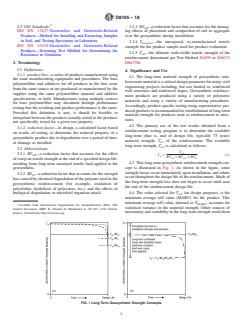
4.3 This long-term geosynthetic reinforcement strength concept is illustrated in Fig. 1. As shown in the figure, some strength losses occur immediately upon installation, and others occur throughout the design life of the reinforcement. Much of the long-term strength loss does not begin to occur until near the end of the reinforcement design life.
FIG. 1 Long-Term Geosynthetic Strength Concepts
4.4 The value selected for Tult, for design purposes, is the minimum average roll value (MARV) for the product. This minimum average roll value, denoted as TMARV, accounts for statistical variance in the material strength. Other sources of uncertainty and variability in the long-term strength result from installation damage, creep extrapolation, and the chemical degradation process. It is assumed that the observed variability in the creep rupture envelope is 100 % correlated with the short-term tensile strength, as the creep strength is typically directly proportional to the short-term tensile strength within a product line. Therefore, the MARV of Tult adequately takes into account variability in the creep strength.
4.5 In accordanc...
SCOPE
1.1 This guide presents a description of how to use test results from reduction factor test reports for reinforcement geosynthetics. It is based solely on testing and reporting requirements as established in American Association of State Highway and Transportation Officials (AASHTO) standard AASHTO R 69-15, Standard Practice for Determination of Long-Term Strength for Geosynthetic Reinforcement. AASHTO R 69-15 is used to determine the long-term allowable material strength, Tal, that is solely product property performance dependant.
1.2 This guide is intended to assist designers and users of reinforcement geosynthetics when reviewing reports of reduction factor testing efforts. This guide is not intended to replace education or experience, or other alternative design procedures. This guide is not intended to represent or replace the standard of care by which the adequacy of a given professional service must be judged, nor should this document be applied without consideration of a project’s many unique aspects. Not all aspects of this guide may be applicable in all circumstances. The word “standard” in the title of this document means only that the document has been approved through the ASTM consensus process.
1.3 The values stated in either SI units or inch-pound units are to be regarded separately as standard. The values stated in each system may not be exact equivalents; therefore, each system shall be used independently of the other. Combining values from the two systems may result in nonconformance with the standard.
1.4 This standard does not purport to address all of the safety concerns, if any, associated with its use. It is the responsibility of the user of this standard to establish appropriate safety, health, and environmental practices and determine the applicability of regulatory limitations prior to use.
1.5 This international standard was developed in accordance with internationally recognized pr...
- Status
- Published
- Publication Date
- 30-Jun-2018
- Technical Committee
- D35 - Geosynthetics
- Drafting Committee
- D35.01 - Mechanical Properties
Overview
ASTM D8105-18: Standard Guide for Use and Application of Geosynthetic Reinforcement Reduction Factor Test Results provides guidance on interpreting and applying reduction factor test data for geosynthetic reinforcement products. Developed by ASTM International, this guide is essential for civil engineering professionals involved in the design and evaluation of reinforced structures such as retaining walls and slopes, where geosynthetics are used as reinforcement. The document is aligned with AASHTO R 69-15, which establishes long-term material strength assessment practices based on product-specific performance testing.
Key Topics
- Reduction Factors: Defines and explains key reduction factors affecting geosynthetic reinforcement strength, such as installation damage, creep, and chemical or biological degradation.
- Long-Term Material Strength: Emphasizes the importance of determining long-term allowable strength (Tal) for geosynthetic products, a critical safety and design metric in infrastructure projects.
- Testing and Reporting Practices: Outlines procedures for developing comprehensive test reports, including laboratory and in-situ measurements, in line with AASHTO R 69-15 requirements.
- Variability and Statistical Evaluation: Details the need to use the minimum average roll value (MARV) for assessing product consistency and for accommodating statistical variance in material strength.
Applications
ASTM D8105-18 is used to guide the application of geosynthetic reinforcement in a variety of civil engineering and geotechnical projects, especially where accurate long-term performance predictions are required. Typical practical applications include:
- Reinforced Soil Structures: Ensuring stability and durability in retaining walls, embankments, and reinforced slopes by accurately accounting for geosynthetic performance over extended periods (up to 75 years or more).
- Infrastructure Project Design: Assisting designers and engineers in interpreting reduction factor testing results to inform material selection and product suitability for specific environmental or load conditions.
- Quality Control and Assurance: Providing a standardized framework to verify product performance, enabling manufacturers and specifiers to benchmark against industry-accepted reduction factors and durability criteria.
- Project-Specific Evaluation: Allowing the use of product-specific test data for unique or critical applications, especially where site soils, backfill characteristics, or environmental exposure might pose additional risks to geosynthetic performance.
Related Standards
Implementation of ASTM D8105-18 often involves reference to several related standards and practices, including:
- AASHTO R 69-15: Primary basis for long-term geosynthetic strength evaluation, governing the determination and use of reduction factors in design.
- ASTM D4355/D4355M: Test method for light, moisture, and heat-induced deterioration of geotextiles.
- ASTM D4595, D6637/D6637M: Methods for tensile property evaluation of geotextiles and geogrids.
- ASTM D5262, D6992: Standards for evaluating tensile creep, creep rupture, and accelerated predictive testing for geosynthetic materials.
- ISO EN 13437, ISO EN 13438: International standards for geosynthetic sample installation, extraction, and resistance to oxidation.
Practical Value
Adoption of ASTM D8105-18 supports:
- Risk Management: By systemically addressing material degradation and damage, the guide aids engineers in mitigating failure risks in geosynthetic-reinforced structures.
- Consistency in Specification: Ensures a uniform approach to the interpretation of reduction factor data, facilitating communication between product suppliers, designers, and project owners.
- Long-Term Performance Assurance: Helps secure infrastructure investments by providing scientifically grounded guidance for achieving required geosynthetic durability and reliability.
For civil engineers, geotechnical designers, and materials specifiers, understanding and utilizing the principles set forth in ASTM D8105-18 is essential for effective and safe geosynthetic reinforcement design.
Keywords: ASTM D8105-18, geosynthetic reinforcement, reduction factor, long-term strength, civil engineering standards, AASHTO R 69-15, infrastructure durability, quality assurance.
Relations
- Effective Date
- 15-Nov-2023
- Effective Date
- 01-May-2018
- Effective Date
- 15-Jul-2015
- Effective Date
- 01-May-2015
- Effective Date
- 15-Jul-2014
- Effective Date
- 01-May-2013
- Effective Date
- 01-Jul-2012
- Effective Date
- 15-Nov-2011
- Effective Date
- 01-Oct-2011
- Effective Date
- 01-Feb-2011
- Effective Date
- 01-Jun-2009
- Effective Date
- 15-Jan-2009
- Effective Date
- 01-Jul-2008
- Effective Date
- 01-Dec-2007
- Effective Date
- 01-Jun-2007
Get Certified
Connect with accredited certification bodies for this standard

Control Union Certifications
Global certification for agriculture and sustainability.

Hohenstein Institut
Textile testing and certification.

Bureau Veritas Bangladesh
Bureau Veritas certification services in Bangladesh.
Sponsored listings
Frequently Asked Questions
ASTM D8105-18 is a guide published by ASTM International. Its full title is "Standard Guide for Use and Application of Geosynthetic Reinforcement Reduction Factor Test Results". This standard covers: SIGNIFICANCE AND USE 4.1 The long-term material strength of geosynthetic reinforcement material is a critical design parameter for many civil engineering projects including, but not limited to, reinforced wall structures and reinforced slopes. Geosynthetic reinforcement products are produced using a variety of polymeric materials and using a variety of manufacturing procedures. Accordingly, product-specific testing using representative produced products is recommended for establishment of long-term material strength for products used as reinforcement in structures. 4.2 The primary use of the test results obtained from a reinforcement testing program is to determine the available long-term (that is, end of design life, typically 75 years) material strength, Tal, of the reinforcement. The available long-term strength, Tal, is calculated as follows: 4.3 This long-term geosynthetic reinforcement strength concept is illustrated in Fig. 1. As shown in the figure, some strength losses occur immediately upon installation, and others occur throughout the design life of the reinforcement. Much of the long-term strength loss does not begin to occur until near the end of the reinforcement design life. FIG. 1 Long-Term Geosynthetic Strength Concepts 4.4 The value selected for Tult, for design purposes, is the minimum average roll value (MARV) for the product. This minimum average roll value, denoted as TMARV, accounts for statistical variance in the material strength. Other sources of uncertainty and variability in the long-term strength result from installation damage, creep extrapolation, and the chemical degradation process. It is assumed that the observed variability in the creep rupture envelope is 100 % correlated with the short-term tensile strength, as the creep strength is typically directly proportional to the short-term tensile strength within a product line. Therefore, the MARV of Tult adequately takes into account variability in the creep strength. 4.5 In accordanc... SCOPE 1.1 This guide presents a description of how to use test results from reduction factor test reports for reinforcement geosynthetics. It is based solely on testing and reporting requirements as established in American Association of State Highway and Transportation Officials (AASHTO) standard AASHTO R 69-15, Standard Practice for Determination of Long-Term Strength for Geosynthetic Reinforcement. AASHTO R 69-15 is used to determine the long-term allowable material strength, Tal, that is solely product property performance dependant. 1.2 This guide is intended to assist designers and users of reinforcement geosynthetics when reviewing reports of reduction factor testing efforts. This guide is not intended to replace education or experience, or other alternative design procedures. This guide is not intended to represent or replace the standard of care by which the adequacy of a given professional service must be judged, nor should this document be applied without consideration of a project’s many unique aspects. Not all aspects of this guide may be applicable in all circumstances. The word “standard” in the title of this document means only that the document has been approved through the ASTM consensus process. 1.3 The values stated in either SI units or inch-pound units are to be regarded separately as standard. The values stated in each system may not be exact equivalents; therefore, each system shall be used independently of the other. Combining values from the two systems may result in nonconformance with the standard. 1.4 This standard does not purport to address all of the safety concerns, if any, associated with its use. It is the responsibility of the user of this standard to establish appropriate safety, health, and environmental practices and determine the applicability of regulatory limitations prior to use. 1.5 This international standard was developed in accordance with internationally recognized pr...
SIGNIFICANCE AND USE 4.1 The long-term material strength of geosynthetic reinforcement material is a critical design parameter for many civil engineering projects including, but not limited to, reinforced wall structures and reinforced slopes. Geosynthetic reinforcement products are produced using a variety of polymeric materials and using a variety of manufacturing procedures. Accordingly, product-specific testing using representative produced products is recommended for establishment of long-term material strength for products used as reinforcement in structures. 4.2 The primary use of the test results obtained from a reinforcement testing program is to determine the available long-term (that is, end of design life, typically 75 years) material strength, Tal, of the reinforcement. The available long-term strength, Tal, is calculated as follows: 4.3 This long-term geosynthetic reinforcement strength concept is illustrated in Fig. 1. As shown in the figure, some strength losses occur immediately upon installation, and others occur throughout the design life of the reinforcement. Much of the long-term strength loss does not begin to occur until near the end of the reinforcement design life. FIG. 1 Long-Term Geosynthetic Strength Concepts 4.4 The value selected for Tult, for design purposes, is the minimum average roll value (MARV) for the product. This minimum average roll value, denoted as TMARV, accounts for statistical variance in the material strength. Other sources of uncertainty and variability in the long-term strength result from installation damage, creep extrapolation, and the chemical degradation process. It is assumed that the observed variability in the creep rupture envelope is 100 % correlated with the short-term tensile strength, as the creep strength is typically directly proportional to the short-term tensile strength within a product line. Therefore, the MARV of Tult adequately takes into account variability in the creep strength. 4.5 In accordanc... SCOPE 1.1 This guide presents a description of how to use test results from reduction factor test reports for reinforcement geosynthetics. It is based solely on testing and reporting requirements as established in American Association of State Highway and Transportation Officials (AASHTO) standard AASHTO R 69-15, Standard Practice for Determination of Long-Term Strength for Geosynthetic Reinforcement. AASHTO R 69-15 is used to determine the long-term allowable material strength, Tal, that is solely product property performance dependant. 1.2 This guide is intended to assist designers and users of reinforcement geosynthetics when reviewing reports of reduction factor testing efforts. This guide is not intended to replace education or experience, or other alternative design procedures. This guide is not intended to represent or replace the standard of care by which the adequacy of a given professional service must be judged, nor should this document be applied without consideration of a project’s many unique aspects. Not all aspects of this guide may be applicable in all circumstances. The word “standard” in the title of this document means only that the document has been approved through the ASTM consensus process. 1.3 The values stated in either SI units or inch-pound units are to be regarded separately as standard. The values stated in each system may not be exact equivalents; therefore, each system shall be used independently of the other. Combining values from the two systems may result in nonconformance with the standard. 1.4 This standard does not purport to address all of the safety concerns, if any, associated with its use. It is the responsibility of the user of this standard to establish appropriate safety, health, and environmental practices and determine the applicability of regulatory limitations prior to use. 1.5 This international standard was developed in accordance with internationally recognized pr...
ASTM D8105-18 is classified under the following ICS (International Classification for Standards) categories: 59.080.70 - Geotextiles. The ICS classification helps identify the subject area and facilitates finding related standards.
ASTM D8105-18 has the following relationships with other standards: It is inter standard links to ASTM D6637/D6637M-15(2023), ASTM D4603-18, ASTM D6637/D6637M-15, ASTM D6992-03(2015), ASTM D4355/D4355M-14, ASTM D5721-08(2013), ASTM D5262-07(2012), ASTM D4603-03(2011)e1, ASTM D4595-11, ASTM D5818-11, ASTM D6992-03(2009), ASTM D4595-09, ASTM D5721-08, ASTM D7409-07e1, ASTM D5262-07. Understanding these relationships helps ensure you are using the most current and applicable version of the standard.
ASTM D8105-18 is available in PDF format for immediate download after purchase. The document can be added to your cart and obtained through the secure checkout process. Digital delivery ensures instant access to the complete standard document.
Standards Content (Sample)
This international standard was developed in accordance with internationally recognized principles on standardization established in the Decision on Principles for the
Development of International Standards, Guides and Recommendations issued by the World Trade Organization Technical Barriers to Trade (TBT) Committee.
Designation: D8105 − 18
Standard Guide for
Use and Application of Geosynthetic Reinforcement
Reduction Factor Test Results
This standard is issued under the fixed designation D8105; the number immediately following the designation indicates the year of
original adoption or, in the case of revision, the year of last revision. A number in parentheses indicates the year of last reapproval. A
superscript epsilon (´) indicates an editorial change since the last revision or reapproval.
1. Scope ization established in the Decision on Principles for the
Development of International Standards, Guides and Recom-
1.1 This guide presents a description of how to use test
mendations issued by the World Trade Organization Technical
results from reduction factor test reports for reinforcement
Barriers to Trade (TBT) Committee.
geosynthetics. It is based solely on testing and reporting
requirements as established in American Association of State
2. Referenced Documents
Highway and Transportation Officials (AASHTO) standard
AASHTO R 69-15, Standard Practice for Determination of 2
2.1 ASTM Standards:
Long-Term Strength for Geosynthetic Reinforcement.
D4355/D4355M Test Method for Deterioration of Geotex-
AASHTO R 69-15 is used to determine the long-term allow-
tiles by Exposure to Light, Moisture and Heat in a Xenon
able material strength, T , that is solely product property
al
Arc-Type Apparatus
performance dependant.
D4595 Test Method for Tensile Properties of Geotextiles by
1.2 This guide is intended to assist designers and users of
the Wide-Width Strip Method
reinforcement geosynthetics when reviewing reports of reduc-
D4603 Test Method for Determining Inherent Viscosity of
tion factor testing efforts. This guide is not intended to replace
Poly(Ethylene Terephthalate) (PET) by Glass Capillary
educationorexperience,orotheralternativedesignprocedures.
Viscometer
This guide is not intended to represent or replace the standard
D5262 Test Method for Evaluating the Unconfined Tension
of care by which the adequacy of a given professional service
Creep and Creep Rupture Behavior of Geosynthetics
must be judged, nor should this document be applied without
D5721 Practice forAir-OvenAging of Polyolefin Geomem-
consideration of a project’s many unique aspects. Not all
branes
aspects of this guide may be applicable in all circumstances.
D5818 Practice for Exposure and Retrieval of Samples to
The word “standard” in the title of this document means only
Evaluate Installation Damage of Geosynthetics
that the document has been approved through the ASTM
D6637/D6637M Test Method for Determining Tensile Prop-
consensus process.
erties of Geogrids by the Single or Multi-Rib Tensile
1.3 The values stated in either SI units or inch-pound units
Method
are to be regarded separately as standard. The values stated in
D6992 Test Method for Accelerated Tensile Creep and
each system may not be exact equivalents; therefore, each
Creep-Rupture of Geosynthetic Materials Based on Time-
system shall be used independently of the other. Combining
Temperature Superposition Using the Stepped Isothermal
values from the two systems may result in nonconformance
Method
with the standard.
D7409 Test Method for Carboxyl End Group Content of
1.4 This standard does not purport to address all of the
Polyethylene Terephthalate (PET) Yarns
safety concerns, if any, associated with its use. It is the
2.2 AASHTO Standard:
responsibility of the user of this standard to establish appro-
AASHTO R 69-15 Standard Practice for Determination of
priate safety, health, and environmental practices and deter-
Long-Term Strength for Geosynthetic Reinforcement
mine the applicability of regulatory limitations prior to use.
1.5 This international standard was developed in accor-
dance with internationally recognized principles on standard-
For referenced ASTM standards, visit the ASTM website, www.astm.org, or
contact ASTM Customer Service at service@astm.org. For Annual Book of ASTM
Standards volume information, refer to the standard’s Document Summary page on
This guide is under the jurisdiction ofASTM Committee D35 on Geosynthetics the ASTM website.
and is the direct responsibility of Subcommittee D35.01 on Mechanical Properties. Available from American Association of State Highway and Transportation
Current edition approved July 1, 2018. Published August 2018. Originally Officials (AASHTO), 444 N. Capitol St., NW, Suite 249, Washington, DC 20001,
approved in 2018. DOI: 10.1520/D8105-18. http://www.transportation.org.
Copyright © ASTM International, 100 Barr Harbor Drive, PO Box C700, West Conshohocken, PA 19428-2959. United States
D8105 − 18
2.3 ISO Standards: 3.2.3 RF —a reduction factor that accounts for the damag-
ID
ISO EN 13437 Geotextiles and Geotextile-Related ing effects of placement and compaction of soil or aggregate
Products—Method for Installing and Extracting Samples over the geosynthetic during installation.
in Soil, and Testing Specimens in Laboratory
3.2.4 T —the unexposed, as-manufactured tensile
baseline
ISO EN 13438 Geotextiles and Geotextile-Related
strength for the product sample used for product evaluation.
Products—Screening Test Method for Determining the
3.2.5 T —the ultimate wide-width tensile strength of the
ult
Resistance to Oxidation
reinforcement determined per Test Method D4595 or D6637/
D6637M.
3. Terminology
3.1 Definitions:
4. Significance and Use
3.1.1 product line—a series of products manufactured using
4.1 The long-term material strength of geosynthetic rein-
the same manufacturing equipment and procedures. The base
forcement material is a critical design parameter for many civil
polymer/fiber and additives for all products in the line come
engineering projects including, but not limited to, reinforced
from the same source or are purchased or manufactured by the
wall structures and reinforced slopes. Geosynthetic reinforce-
supplier using the same polymer/fiber material and additive
ment products are produced using a variety of polymeric
specifications, or both. Manufacturers using multiple sources
materials and using a variety of manufacturing procedures.
for base polymer/fiber may document through performance
Accordingly, product-specific testing using representative pro-
testing that the resulting end-product performance is the same.
ducedproductsisrecommendedforestablishmentoflong-term
Provided this definition is met, it should be feasible to
material strength for products used as reinforcement in struc-
interpolate between the products actually tested to the products
tures.
not specifically tested for a given test property.
4.2 The primary use of the test results obtained from a
3.1.2 reduction factor—in design, a calculated factor based
reinforcement testing program is to determine the available
on results of testing, to determine the reduced property of a
long-term (that is, end of design life, typically 75 years)
geosynthetic product due to degradation over a period of time,
material strength, T , of the reinforcement. The available
al
or damage as installed.
long-term strength, T , is calculated as follows:
al
3.2 Abbreviations:
T
ult
3.2.1 RF —a reduction factor that accounts for the effect
T 5 (1)
CR
al
RF 3RF 3RF
ID CR D
of creep on tensile strength at the end of a specified design life,
4.3 Thislong-termgeosyntheticreinforcementstrengthcon-
resulting from long-term sustained tensile load applied to the
cept is illustrated in Fig. 1. As shown in the figure, some
geosynthetic.
strength losses occur immediately upon installation, and others
3.2.2 RF —a reduction factor that accounts for the strength
D
occur throughout the design life of the reinforcement. Much of
losscausedbychemicaldegradationofthepolymerusedinthe
the long-term strength loss does not begin to occur until near
geosynthetic reinforcement (for example, oxidation of
the end of the reinforcement design life.
polyolefins, hydrolysis of polyesters, etc.), and the effects of
biological degradation or microbial organism attack. 4.4 The value selected for T , for design purposes, is the
ult
minimum average roll value (MARV) for the product. This
minimum average roll value, denoted as T , accounts for
MARV
Available from International Organization for Standardization (ISO), ISO
statistical variance in the material strength. Other sources of
Central Secretariat, BIBC II, Chemin de Blandonnet 8, CP 401, 1214 Vernier,
uncertaintyandvariabilityinthelong-termstrengthresultfrom
Geneva, Switzerland, http://www.iso.org.
FIG. 1 Long-Term Geosynthetic Strength Concepts
D8105 − 18
installation damage, creep extrapolation, and the chemical has been installed) to the roll-specific tensile virgin (that is,
degradation process. It is assumed that the observed variability undamaged) strength of the product sample used for this
in the creep rupture envelope is 100 % correlated with the
installation damage evaluation. This undamaged tensile
short-term tensile strength, as the creep strength is typically strengthmeasuredpriortoinstallationistermed T ,andis
baseline
directly proportional to the short-term tensile strength within a
considered the baseline tensile strength for the product sample
product line. Therefore, the MARV of T adequately takes
used for this evaluation in the test program.
ult
into account variability in the creep strength.
5.2.3 The degree of installation damage is quantified in
AASHTO R 69-15 using the following equation:
4.5 In accordance withAASHTO R 69-15, the test program
results provided in geosynthetic reinforcement design reduc-
T
dam
P 5 3100 (2)
tion factor test reports are focused on characterization of the
T
baseline
product line, specifically testing representative products within
where:
the product line to accomplish that characterization.
P = the percentage of strength retained after exposure
4.6 The guidelines provided in this document explain how
to installation (that is, installation damage),
to use the test data to characterize the entire product line with
T = the tensile strength of the material after exposure
dam
regard to long-term strength and durability properties.
to installation (that is, in a damaged condition),
and
5. Use of Geosynthetic Reinforcement Reduction Factor
T = the roll-specific tensile strength of the material
baseline
Test Data
used in the installation damage tests. This “base-
5.1 A comprehensive test report for geosynthetic reinforce-
line” strength is the strength prior to exposing the
ment reduction factors, developed in accordance with
material to installation.
AASHTO R 69-15, provides both index test and performance
5.2.4 All three values for each product and condition tested,
test results. A summary of specific guidelines in AASHTO R
and associated statistics, are provided in a test report. Example
69-15fortheapplicationofthetestresultstodevelopreduction
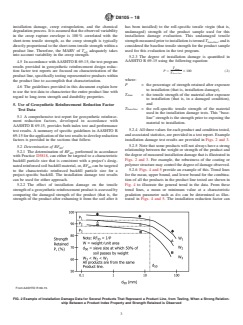
installation damage test results are provided in Figs. 2 and 3.
factors is provided in the sections that follow.
5.2.5 Note that some products will not always have a strong
5.2 Determination of RF :
ID
relationship between the weight or strength of the product and
5.2.1 The determination of RF , performed in accordance
ID
the degree of measured installation damage that is illustrated in
with Practice D5818, can either be targeted to a characteristic
Figs. 2 and 3. For example, the robustness of the coating or
backfill particle size that is consistent with a project’s desig-
polymer structure may control the degree of damage observed.
nated reinforced soil backfill material, or, RF can be targeted
ID
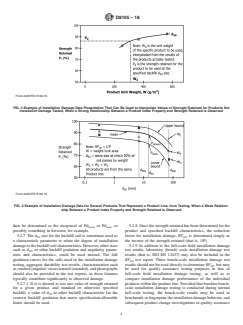
to the characteristic reinforced backfill particle size for a 5.2.6 Figs. 4 and 5 provide an example of this. Trend lines
for the mean, upper bound, and lower bound for the combina-
project-specific backfill. The installation damage test results
ca
...