

ASTM E1945-21
(Test Method)Standard Test Method for Percent Dispersibility
General Information
- Abstract
SIGNIFICANCE AND USE
4.1 This test method is designed specifically for dry formulations.
4.2 This test method may not be applicable to all dry formulations such as those containing water soluble or liquid technicals/pesticides or ingredients that rise to the top upon separation.
4.3 This test method may not be applicable to those technicals that decompose below the drying temperature.
4.4 This test method should be run in duplicate.
4.5 Products containing water soluble or volatile components may result in errors.
SCOPE
1.1 This test method is used to determine the percent dispersibility of dry pesticide formulations.
1.2 The values stated in SI units are to be regarded as standard. No other units of measurement are included in this standard.
1.3 This standard does not purport to address all of the safety concerns, if any, associated with its use. It is the responsibility of the user of this standard to establish appropriate safety, health, and environmental practices and determine the applicability of regulatory limitations prior to use. For specific precautionary statements see Section 7.
1.4 This international standard was developed in accordance with internationally recognized principles on standardization established in the Decision on Principles for the Development of International Standards, Guides and Recommendations issued by the World Trade Organization Technical Barriers to Trade (TBT) Committee.
- Status
- Published
- Publication Date
- 30-Sep-2021
- Technical Committee
- E35 - Pesticides, Antimicrobials, and Alternative Control Agents
- Drafting Committee
- E35.22 - Pesticide Formulations and Delivery Systems


Overview
ASTM E1945-21, Standard Test Method for Percent Dispersibility, is a key international standard developed by ASTM International. This test method outlines the procedure to determine the percent dispersibility of dry pesticide formulations-an essential metric for evaluating the performance and applicability of products such as water dispersible granules. This method ensures consistency, reliability, and comparability in results when testing how well dry pesticide formulations disperse in water under controlled laboratory conditions.
Key Topics
- Applicability: Designed specifically for dry pesticide formulations, particularly water dispersible granules (WG), dry flowables (DF), and wettable granules.
- Limitations: May not be suitable for all formulations, especially those containing water-soluble or volatile components, or those that decompose at test drying temperatures.
- Test Procedure Highlights:
- A known weight of the dry formulation is introduced into a standard mixing cylinder with measured water.
- The cylinder is agitated in a controlled manner, allowed to settle, and the dispersibility is determined by measuring residue after drying.
- SI Units: All measurements are recorded in SI units to ensure consistency and international comparability.
- Precision and Bias:
- Duplicate testing is required for accuracy.
- Specific guidelines are provided regarding the repeatability and reproducibility of results.
- Safety & Environmental Compliance: The method emphasizes the need for appropriate safety procedures and regulatory compliance, given the nature of pesticide testing.
Applications
The ASTM E1945-21 standard is widely used in multiple sectors of the chemical and agricultural industries. Primary applications include:
- Product Development: Manufacturers use this method to formulate and improve the dispersibility characteristics of new dry pesticide products, enhancing field performance and user safety.
- Quality Control: Producers and third-party laboratories apply this method to ensure batch-to-batch consistency and compliance with regulatory standards.
- Regulatory Compliance: Testing according to ASTM E1945-21 is critical for product registration and environmental safety evaluations, meeting both domestic and international requirements.
- Comparative Benchmarking: The method allows users to benchmark and compare various dry pesticide formulations to select the most appropriate product for specific agricultural or industrial needs.
Related Standards
For those working with dry formulations and water quality in a laboratory setting, the following ASTM standards are commonly referenced alongside ASTM E1945-21:
- ASTM D1126: Test Method for Hardness in Water-used for verifying water hardness, a key test parameter in the dispersibility method.
- ASTM D1193: Specification for Reagent Water-defines the types and purity levels of water suitable for precise laboratory testing.
Professionals seeking to ensure best practices in pesticide formulation and water dispersibility analysis should become familiar with these related methods for comprehensive laboratory quality assurance.
Keywords: percent dispersibility, ASTM E1945-21, dry pesticide formulations, water dispersible granules, standard test method, pesticide dispersibility test, agricultural chemicals testing, quality control, laboratory standards, ASTM International.
Relations
- Effective Date
- 01-Mar-2012
- Effective Date
- 01-Aug-2007
- Effective Date
- 01-Mar-2006
- Effective Date
- 10-May-2002
- Effective Date
- 10-Feb-1999
- Effective Date
- 10-Feb-1999
Get Certified
Connect with accredited certification bodies for this standard

CIS Institut d.o.o.
Personal Protective Equipment (PPE) certification body. Notified Body NB-2890 for EU Regulation 2016/425 PPE.

Kiwa BDA Testing
Building and construction product certification.
Kmetijski inštitut Slovenije
Agricultural Institute of Slovenia. Soil testing, plant health, agricultural product analysis.
Sponsored listings
Frequently Asked Questions
ASTM E1945-21 is a standard published by ASTM International. Its full title is "Standard Test Method for Percent Dispersibility". This standard covers: SIGNIFICANCE AND USE 4.1 This test method is designed specifically for dry formulations. 4.2 This test method may not be applicable to all dry formulations such as those containing water soluble or liquid technicals/pesticides or ingredients that rise to the top upon separation. 4.3 This test method may not be applicable to those technicals that decompose below the drying temperature. 4.4 This test method should be run in duplicate. 4.5 Products containing water soluble or volatile components may result in errors. SCOPE 1.1 This test method is used to determine the percent dispersibility of dry pesticide formulations. 1.2 The values stated in SI units are to be regarded as standard. No other units of measurement are included in this standard. 1.3 This standard does not purport to address all of the safety concerns, if any, associated with its use. It is the responsibility of the user of this standard to establish appropriate safety, health, and environmental practices and determine the applicability of regulatory limitations prior to use. For specific precautionary statements see Section 7. 1.4 This international standard was developed in accordance with internationally recognized principles on standardization established in the Decision on Principles for the Development of International Standards, Guides and Recommendations issued by the World Trade Organization Technical Barriers to Trade (TBT) Committee.
SIGNIFICANCE AND USE 4.1 This test method is designed specifically for dry formulations. 4.2 This test method may not be applicable to all dry formulations such as those containing water soluble or liquid technicals/pesticides or ingredients that rise to the top upon separation. 4.3 This test method may not be applicable to those technicals that decompose below the drying temperature. 4.4 This test method should be run in duplicate. 4.5 Products containing water soluble or volatile components may result in errors. SCOPE 1.1 This test method is used to determine the percent dispersibility of dry pesticide formulations. 1.2 The values stated in SI units are to be regarded as standard. No other units of measurement are included in this standard. 1.3 This standard does not purport to address all of the safety concerns, if any, associated with its use. It is the responsibility of the user of this standard to establish appropriate safety, health, and environmental practices and determine the applicability of regulatory limitations prior to use. For specific precautionary statements see Section 7. 1.4 This international standard was developed in accordance with internationally recognized principles on standardization established in the Decision on Principles for the Development of International Standards, Guides and Recommendations issued by the World Trade Organization Technical Barriers to Trade (TBT) Committee.
ASTM E1945-21 is classified under the following ICS (International Classification for Standards) categories: 13.080.01 - Soil quality and pedology in general. The ICS classification helps identify the subject area and facilitates finding related standards.
ASTM E1945-21 has the following relationships with other standards: It is inter standard links to ASTM D1126-12, ASTM D1126-02(2007)e1, ASTM D1193-06, ASTM D1126-02, ASTM D1193-99e1, ASTM D1193-99. Understanding these relationships helps ensure you are using the most current and applicable version of the standard.
ASTM E1945-21 is available in PDF format for immediate download after purchase. The document can be added to your cart and obtained through the secure checkout process. Digital delivery ensures instant access to the complete standard document.
Standards Content (Sample)
This international standard was developed in accordance with internationally recognized principles on standardization established in the Decision on Principles for the
Development of International Standards, Guides and Recommendations issued by the World Trade Organization Technical Barriers to Trade (TBT) Committee.
Designation: E1945 − 21
Standard Test Method for
Percent Dispersibility
This standard is issued under the fixed designation E1945; the number immediately following the designation indicates the year of
original adoption or, in the case of revision, the year of last revision.Anumber in parentheses indicates the year of last reapproval.A
superscript epsilon (´) indicates an editorial change since the last revision or reapproval.
1. Scope 4. Significance and Use
1.1 This test method is used to determine the percent 4.1 This test method is designed specifically for dry formu-
dispersibility of dry pesticide formulations. lations.
4.2 This test method may not be applicable to all dry
1.2 The values stated in SI units are to be regarded as
formulations such as those containing water soluble or liquid
standard. No other units of measurement are included in this
technicals/pesticides or ingredients that rise to the top upon
standard.
separation.
1.3 This standard does not purport to address all of the
safety concerns, if any, associated with its use. It is the 4.3 This test method may not be applicable to those tech-
responsibility of the user of this standard to establish appro- nicals that decompose below the drying temperature.
priate safety, health, and environmental practices and deter-
4.4 This test method should be run in duplicate.
mine the applicability of regulatory limitations prior to use.
4.5 Products containing water soluble or volatile compo-
For specific precautionary statements see Section 7.
nents may result in errors.
1.4 This international standard was developed in accor-
dance with internationally recognized principles on standard-
5. Apparatus
ization established in the Decision on Principles for the
Development of International Standards, Guides and Recom-
5.1 Balance, top loading, with an accuracy of 60.01 g or
mendations issued by the World Trade Organization Technical
better.
Barriers to Trade (TBT) Committee.
5.2 Gravity Oven.
5.3 Weighing Dish, 150 mL capacity or greater.
2. Referenced Documents
5.4 Vacuum Apparatus, see Fig. 1, equipped with a vented
2.1 ASTM Standards:
stopper.
D1126Test Method for Hardness in Water
D1193Specification for Reagent Water
5.5 Mixing Cylinder, stoppered, 250mL, flat bottom.
5.6 Timer, adjustable, with an accuracy of 61s.
3. Summary of Test Method
5.7 Weighing Dish, aluminum (57 × 18 mm) or petri dish or
3.1 A known amount of dry pesticide formulation is added
equivalent.
toa250mLmixingcylinderthathasbeenfilledtovolumewith
5.8 Filtering Flask, heavy wall, 500 mL.
standard water. The mixing cylinder is then stoppered and
inverted 30 times in 2 min. The mixing cylinder is allowed to
6. Reagents (Test Water)
stand for 1 min.After 1 min, the top 225 mL is drawn off and
the remaining suspension is dried. The residue weight will
6.1 Purity of Reagents—Reagent grade chemicals shall be
determine percent dispersibility.
used in all tests. Unless otherwise indicated, it is intended that
all reagents shall conform to the specifications of the Commit-
tee onAnalytical Reagents of theAmerican Chemical Society
where such specifications are available.
This test method is under the jurisdiction of ASTM Committee E35 on
Pesticides, Antimicrobials, and Alternative Control Agents and is direct responsi-
bility of Subcommittee E35.22 on Pesticide Formulations and Delivery Systems
Current edition approved Oct. 1, 2021. Published November 2021. Originally
approved in 1998. Last previous edition approved in 2016 as E1945–02(2016). Reagent Chemicals, American Chemical Society Specifications, American
DOI: 10.1520/E1945-21. Chemical Society, Washington, DC. For Suggestions on the testing of reagents not
For referenced ASTM standards, visit the ASTM website, www.astm.org, or listed by the American Chemical Society, see Annual Standards for Laboratory
contact ASTM Customer Service at service@astm.org. For Annual Book of ASTM Chemicals, BDH Ltd., Poole, Dorset, U.K., and the United States Pharmacopeia
Standards volume information, refer to the standard’s Document Summary page on and National Formulary, U.S. Pharmacopeial Convention, Inc. (USPC), Rockville,
the ASTM website. MD.
Copyright © ASTM International, 100 Barr Harbor Drive, PO Box C700, West Conshohocken, PA 19428-2959. United States
E1945 − 21
method is provided in Test Method D1126 where the value is represented
as CaCO . A value within 65% of the nominal hardness value is
acceptable.
6.3.2 Hard Water, equivalent to a total hardness of 342 ppm
as calcium carbonate (CaCO ). Transfer 25.0 mL of synthetic
hardwaterstockbyburettoa1000mLvolumetricflask.Dilute
to the 1000 mL mark with water at 20°C. Mix this solution
thoroughly (see Note 2).
6.3.3 Extra-hard Water, equivalent to a total hardness of
1000 ppm as calcium carbonate (CaCO ).Transfer 73.1 mLof
synthetic hard water stock by buret to a 1000mL volumetric
flask.Dilutetothe1000mLmarkwithwaterat20°C.Mixthis
solution thoroughly (see Note 2).
6.3.4 Other Test Waters—Other synthetic waters can be
prepared by using the following calculation:
DesiredWaterHardness÷13.6805 (1)
@millilitersofsynthetic
hardwaterstockat20°Ctobe
dilutedvolumetricallyto1000mL
withwaterat20 °C].
6.4 Other Carriers—Carriers other than water may be used
when appropriate.
7. Safety Precautions
7.1 Before testing, read the precautionary statements on the
product label or the Safety Data Sheet (SD
...
This document is not an ASTM standard and is intended only to provide the user of an ASTM standard an indication of what changes have been made to the previous version. Because
it may not be technically possible to adequately depict all changes accurately, ASTM recommends that users consult prior editions as appropriate. In all cases only the current version
of the standard as published by ASTM is to be considered the official document.
Designation: E1945 − 02 (Reapproved 2016) E1945 − 21
Standard Test Method for
Percent Dispersibility
This standard is issued under the fixed designation E1945; the number immediately following the designation indicates the year of
original adoption or, in the case of revision, the year of last revision. A number in parentheses indicates the year of last reapproval. A
superscript epsilon (´) indicates an editorial change since the last revision or reapproval.
1. Scope
1.1 This test method is used to determine the percent dispersibility of dry pesticide formulations.
1.2 The values stated in SI units are to be regarded as standard. No other units of measurement are included in this standard.
1.3 This standard does not purport to address all of the safety concerns, if any, associated with its use. It is the responsibility
of the user of this standard to establish appropriate safety safety, health, and healthenvironmental practices and determine the
applicability of regulatory limitations prior to use. For specific precautionary statements see Section 7.
1.4 This international standard was developed in accordance with internationally recognized principles on standardization
established in the Decision on Principles for the Development of International Standards, Guides and Recommendations issued
by the World Trade Organization Technical Barriers to Trade (TBT) Committee.
2. Referenced Documents
2.1 ASTM Standards:
D1126 Test Method for Hardness in Water
D1193 Specification for Reagent Water
3. Summary of Test Method
3.1 A known amount of dry pesticide formulation is added to a 250-mL250 mL mixing cylinder that has been filled to volume with
standard water. The mixing cylinder is then stoppered and inverted 30 times in 2 min. The mixing cylinder is allowed to stand for
1 min. After 1 min, the top 225 mL is drawn off and the remaining suspension is dried. The residue weight will determine percent
dispersibility.
4. Significance and Use
4.1 This test method is designed specifically for dry formulations.
4.2 This test method may not be applicable to all dry formulations such as those containing either liquid technicalswater soluble
or liquid technicals/pesticides or ingredients that rise to the top upon separation.
This test method is under the jurisdiction of ASTM Committee E35 on Pesticides, Antimicrobials, and Alternative Control Agents and is direct responsibility of
Subcommittee E35.22 on Pesticide Formulations and Delivery Systems
Current edition approved Nov. 1, 2016Oct. 1, 2021. Published November 2016November 2021. Originally approved in 1998. Last previous edition approved in 20082016
as E1945 – 02(2008).(2016). DOI: 10.1520/E1945-02R16.10.1520/E1945-21.
For referenced ASTM standards, visit the ASTM website, www.astm.org, or contact ASTM Customer Service at service@astm.org. For Annual Book of ASTM Standards
volume information, refer to the standard’s Document Summary page on the ASTM website.
Copyright © ASTM International, 100 Barr Harbor Drive, PO Box C700, West Conshohocken, PA 19428-2959. United States
E1945 − 21
4.3 This test method may not be applicable to those technicals that decompose below the drying temperature.
4.4 This test method should be run in duplicate.
4.5 Products containing water soluble or volatile components may result in errors.
5. Apparatus
5.1 Balance, top loading, with an accuracy of 60.01 g or better.
5.2 Gravity Oven.
5.3 Weighing Dish, 150 mL capacity or greater.
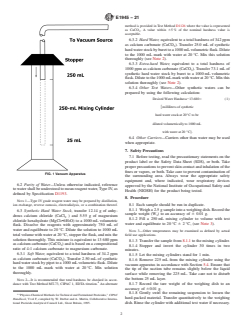
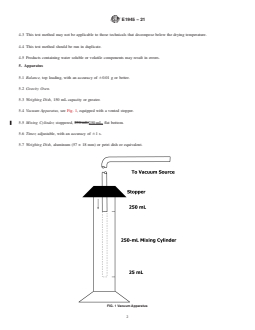
5.4 Vacuum Apparatus, see Fig. 1, equipped with a vented stopper.
5.5 Mixing Cylinder, stoppered, 250-mL,250 mL, flat bottom.
5.6 Timer, adjustable, with an accuracy of 61 s.
5.7 Weighing Dish, aluminum (57 × 18 mm) or petri dish or equivalent.
FIG. 1 Vacuum Apparatus
E1945 − 21
5.8 Filtering Flask, heavy wall, 500 mL.
6. Reagents (Test Water)
6.1 Purity of Reagents—Reagent grade chemicals shall be used in all tests. Unless otherwise indicated, it is intended that all
reagents shall conform to the specifications of the Committee on Analytical Reagents of the American Chemical Society where
such specifications are available.
6.2 Purity of Water—Unless otherwise indicated, reference to water shall be understood to mean reagent water, Type IV, as defined
by Specification D1193.
NOTE 1—Type IV grade reagent water may be prepared by distillation, ion exchange, reverse osmosis, electrodialysis, or a combination thereof.
6.3 Synthetic Hard Water Stock, transfer 12.14 g of anhydrous calcium chloride (CaCl ) and 5.55 g of magnesium chloride
hexahydrate (MgCl •6H O) to a 1000-mL1000 mL volumetric flask. Dissolve the reagents with approximately 750 mL of water
2 2
and equilibrate to 20°C.20 °C. Dilute the solution to 1000 mL total volume with water at 20°C,20 °C, stopper the flask, and mix
the solution thoroughly. This mixture is equivalent to 13 680 ppm as calcium carbonate (CaCO ) and is based on a compositional
ratio of 4:1 calcium carbonate to magnesium carbonate.
6.3.1 Soft Water, equivalent to a total hardness of 34.2 ppm as calcium carbonate (CaCO ). Transfer 2.50 mL of synthetic hard
water stock by pipet to a 1000-mL volumetric flask and dilute to volume 1000 mL volumetric flask. Dilute to the 1000 mL mark
with water at 20°C.20 °C. Mix solution thoroughly.
NOTE 2—It is recommended that total hardness be checked in accordance with Test Method MT-73, CIPAC 1, EDTA titration. An alternate method is
provided in Test MethodsMethod D1126 where the value is represented as CaCO . A value within 65 % of the nominal hardness value is acceptable.
6.3.2 Hard Water, equivalent to a total hardness of 342 ppm as calcium carbonate (CaCO ). Transfer 25.0 mL of synthetic hard
water stock by
...