

ASTM A66-21
(Specification)Standard Specification for Steel Screw Spikes
General Information
- Abstract
ABSTRACT
This specification deals with steel screw spikes used as fastenings between railroad rails, tie plates, and ties. The steel shall be made by electric-furnace or basic-oxygen, may be cast by continuous process or in ingots, and the heads and threads of the spikes may be formed by hot- or cold-forming methods. Tension and bend tests of the material shall be made. Inspection, certification, and product marking are also covered.
SCOPE
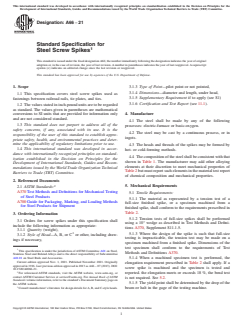
1.1 This specification covers steel screw spikes used as fastenings between railroad rails, tie plates, and ties.
1.2 The values stated in inch-pound units are to be regarded as standard. The values given in parentheses are mathematical conversions to SI units that are provided for information only and are not considered standard.
1.3 This standard does not purport to address all of the safety concerns, if any, associated with its use. It is the responsibility of the user of this standard to establish appropriate safety, health, and environmental practices and determine the applicability of regulatory limitations prior to use.
1.4 This international standard was developed in accordance with internationally recognized principles on standardization established in the Decision on Principles for the Development of International Standards, Guides and Recommendations issued by the World Trade Organization Technical Barriers to Trade (TBT) Committee.
- Status
- Published
- Publication Date
- 31-Oct-2021
- Technical Committee
- A01 - Steel, Stainless Steel and Related Alloys
- Drafting Committee
- A01.01 - Steel Rails and Accessories


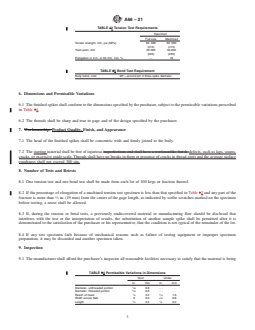
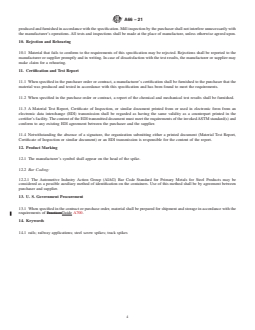
Overview
ASTM A66-21: Standard Specification for Steel Screw Spikes provides requirements for the manufacture, testing, and application of steel screw spikes, which are essential components used as fastenings between railroad rails, tie plates, and ties. Developed by ASTM International, this standard outlines procedures for material selection, manufacturing processes, mechanical testing, inspection, certification, and product marking. Adhering to the requirements of ASTM A66-21 ensures reliable rail fastening systems, critical for the safety and durability of railway infrastructure.
Key Topics
- Scope of Application
- Covers steel screw spikes for fastening rails, tie plates, and ties in railway applications.
- Applies to products measured in inch-pound units, with SI unit conversions provided for informational purposes.
- Material and Manufacture
- Steel must be produced by either electric-furnace or basic-oxygen processes.
- Steel may be cast using a continuous process or by ingot casting.
- Heads and threads of spikes can be formed by hot- or cold-forming methods.
- Chemical and Mechanical Requirements
- Specifies acceptable ranges for elements like carbon, manganese, phosphorous, and sulfur.
- Requires minimum tensile strength and yield point, with additional elongation requirements for machined specimens.
- Spikes must pass cold bend tests to verify ductility.
- Dimensions and Tolerances
- Includes guidelines for diameter, length, and thread standards, allowing specific sizing per purchaser requirements.
- Outlines permissible variations for manufactured spike dimensions.
- Inspection, Certification, and Marking
- Mandates manufacturer marking and optional bar coding for traceability.
- Requires testing and certification documentation, which can be delivered in print or electronic form.
- Includes procedures for inspection, rejection, retesting, and procurement for U.S. government contracts.
Applications
Steel screw spikes specified by ASTM A66-21 are used across railway networks for secure and reliable fastening of rails to ties, supporting both freight and passenger rail operations. Key applications include:
- Railway construction and maintenance
Ensures stable, vibration-resistant fastening of rails, improving safety and track longevity. - Upgrading and retrofitting tracks
Standardized spikes facilitate compatibility with various rail tie and plate designs, easing maintenance. - Industrial tracks and sidings
Provides robust solutions for tracks in demanding environments such as mining, ports, and heavy industrial facilities. - Quality assurance and procurement
Enables railway operators and suppliers to specify, purchase, and verify spike quality according to an internationally recognized standard. - Government and private sector projects
Approved for U.S. Department of Defense use, illustrating its acceptance across high-integrity procurement processes.
Related Standards
- ASTM A370 – Test Methods and Definitions for Mechanical Testing of Steel Products
Describes mechanical testing procedures referenced in ASTM A66-21 for verifying steel properties. - ASTM A700 – Guide for Packaging, Marking, and Loading Methods for Steel Products for Shipment
Outlines recommended practices for packaging and shipping steel products, ensuring material integrity upon delivery. - International Standardization Principles
Developed in alignment with the WTO Technical Barriers to Trade (TBT) Committee principles, promoting global interoperability. - Railway Fasteners and Accessories Standards
Complements other standards covering rail joints, plates, and fastening systems, supporting comprehensive rail infrastructure specifications.
Relevant Keywords: ASTM A66-21, steel screw spikes, railway fasteners, rail track spikes, rail fastening, railroad construction standards, ASTM railroad standards, track maintenance, mechanical testing of steel, rail infrastructure quality.
For further information or to access the official document, visit the ASTM International website.
Relations
- Effective Date
- 01-Mar-2024
- Effective Date
- 01-Nov-2019
- Effective Date
- 01-Jul-2019
- Refers
ASTM A370-17a - Standard Test Methods and Definitions for Mechanical Testing of Steel Products - Effective Date
- 15-Nov-2017
- Effective Date
- 01-Jan-2017
- Effective Date
- 01-Nov-2015
- Effective Date
- 01-Nov-2014
- Effective Date
- 15-May-2014
- Effective Date
- 15-Nov-2013
- Refers
ASTM A370-12a - Standard Test Methods and Definitions for Mechanical Testing of Steel Products - Effective Date
- 15-Oct-2012
- Effective Date
- 15-Mar-2012
- Refers
ASTM A370-11a - Standard Test Methods and Definitions for Mechanical Testing of Steel Products - Effective Date
- 15-Nov-2011
- Effective Date
- 15-Jun-2010
- Refers
ASTM A370-09a - Standard Test Methods and Definitions for Mechanical Testing of Steel Products - Effective Date
- 01-Jun-2009
- Refers
ASTM A370-09ae1 - Standard Test Methods and Definitions for Mechanical Testing of Steel Products - Effective Date
- 01-Jun-2009
Frequently Asked Questions
ASTM A66-21 is a technical specification published by ASTM International. Its full title is "Standard Specification for Steel Screw Spikes". This standard covers: ABSTRACT This specification deals with steel screw spikes used as fastenings between railroad rails, tie plates, and ties. The steel shall be made by electric-furnace or basic-oxygen, may be cast by continuous process or in ingots, and the heads and threads of the spikes may be formed by hot- or cold-forming methods. Tension and bend tests of the material shall be made. Inspection, certification, and product marking are also covered. SCOPE 1.1 This specification covers steel screw spikes used as fastenings between railroad rails, tie plates, and ties. 1.2 The values stated in inch-pound units are to be regarded as standard. The values given in parentheses are mathematical conversions to SI units that are provided for information only and are not considered standard. 1.3 This standard does not purport to address all of the safety concerns, if any, associated with its use. It is the responsibility of the user of this standard to establish appropriate safety, health, and environmental practices and determine the applicability of regulatory limitations prior to use. 1.4 This international standard was developed in accordance with internationally recognized principles on standardization established in the Decision on Principles for the Development of International Standards, Guides and Recommendations issued by the World Trade Organization Technical Barriers to Trade (TBT) Committee.
ABSTRACT This specification deals with steel screw spikes used as fastenings between railroad rails, tie plates, and ties. The steel shall be made by electric-furnace or basic-oxygen, may be cast by continuous process or in ingots, and the heads and threads of the spikes may be formed by hot- or cold-forming methods. Tension and bend tests of the material shall be made. Inspection, certification, and product marking are also covered. SCOPE 1.1 This specification covers steel screw spikes used as fastenings between railroad rails, tie plates, and ties. 1.2 The values stated in inch-pound units are to be regarded as standard. The values given in parentheses are mathematical conversions to SI units that are provided for information only and are not considered standard. 1.3 This standard does not purport to address all of the safety concerns, if any, associated with its use. It is the responsibility of the user of this standard to establish appropriate safety, health, and environmental practices and determine the applicability of regulatory limitations prior to use. 1.4 This international standard was developed in accordance with internationally recognized principles on standardization established in the Decision on Principles for the Development of International Standards, Guides and Recommendations issued by the World Trade Organization Technical Barriers to Trade (TBT) Committee.
ASTM A66-21 is classified under the following ICS (International Classification for Standards) categories: 21.060.10 - Bolts, screws, studs. The ICS classification helps identify the subject area and facilitates finding related standards.
ASTM A66-21 has the following relationships with other standards: It is inter standard links to ASTM A370-24, ASTM A700-14(2019), ASTM A370-19, ASTM A370-17a, ASTM A370-17, ASTM A370-15, ASTM A700-14, ASTM A370-14, ASTM A370-13, ASTM A370-12a, ASTM A370-12, ASTM A370-11a, ASTM A370-10, ASTM A370-09a, ASTM A370-09ae1. Understanding these relationships helps ensure you are using the most current and applicable version of the standard.
ASTM A66-21 is available in PDF format for immediate download after purchase. The document can be added to your cart and obtained through the secure checkout process. Digital delivery ensures instant access to the complete standard document.
Standards Content (Sample)
This international standard was developed in accordance with internationally recognized principles on standardization established in the Decision on Principles for the
Development of International Standards, Guides and Recommendations issued by the World Trade Organization Technical Barriers to Trade (TBT) Committee.
Designation:A66 −21
Standard Specification for
Steel Screw Spikes
This standard is issued under the fixed designationA66; the number immediately following the designation indicates the year of original
adoption or, in the case of revision, the year of last revision.Anumber in parentheses indicates the year of last reapproval.Asuperscript
epsilon (´) indicates an editorial change since the last revision or reapproval.
This standard has been approved for use by agencies of the U.S. Department of Defense.
1. Scope 3.1.3 Type of Point—pilot point or not pointed,
3.1.4 Dimensions—diameter and length, under head,
1.1 This specification covers steel screw spikes used as
fastenings between railroad rails, tie plates, and ties. 3.1.5 Supplementary Requirement if to apply (see S1)
3.1.6 Certification and Test Report (see 11.1).
1.2 The values stated in inch-pound units are to be regarded
as standard. The values given in parentheses are mathematical
4. Manufacture
conversions to SI units that are provided for information only
and are not considered standard.
4.1 The steel shall be made by any of the following
1.3 This standard does not purport to address all of the
processes: electric-furnace or basic-oxygen.
safety concerns, if any, associated with its use. It is the
4.2 The steel may be cast by a continuous process, or in
responsibility of the user of this standard to establish appro-
ingots.
priate safety, health, and environmental practices and deter-
mine the applicability of regulatory limitations prior to use.
4.3 The heads and threads of the spikes may be formed by
1.4 This international standard was developed in accor-
hot- or cold-forming methods.
dance with internationally recognized principles on standard-
4.4 Thecompositionofthesteelshallbeconsistentwiththat
ization established in the Decision on Principles for the
shown in Table 1. The manufacturer may add other alloying
Development of International Standards, Guides and Recom-
elements at their discretion to meet mechanical properties of
mendations issued by the World Trade Organization Technical
Table2butmustreportsuchelementsinthematerialtestreport
Barriers to Trade (TBT) Committee.
of chemical composition and mechanical properties.
2. Referenced Documents
5. Mechanical Requirements
2.1 ASTM Standards:
A370 Test Methods and Definitions for Mechanical Testing
5.1 Tensile Requirements:
of Steel Products
5.1.1 The material as represented by a tension test of a
A700 Guide for Packaging, Marking, and Loading Methods
full-size finished spike, or a specimen machined from a
for Steel Products for Shipment
finished spike, shall conform to the requirements prescribed in
Table 2.
3. Ordering Information
5.1.2 Tension tests of full-size spikes shall be performed
3.1 Orders for screw spikes under this specification shall
using a 10° wedge as described in Test Methods and Defini-
include the following information as appropriate:
tions A370, Supplement S11.1.5.
3.1.1 Quantity (weight),
5.1.3 Where the design of the spike is such that full-size
3.1.2 Style of Head—A, B, or C or other, including draw-
testing is impracticable, the tension test may be made on a
ings if necessary,
specimen machined from a finished spike. Dimensions of the
test specimen shall conform to the requirements of Test
This specification is under the jurisdiction of ASTM Committee A01 on Steel,
Methods and Definitions A370.
Stainless Steel and Related Alloys and is the direct responsibility of Subcommittee
A01.01 on Steel Rails and Accessories.
5.1.4 When a machined specimen test is performed, the
Current edition approved Nov. 1, 2021. Published November 2021. Originally
elongation requirement prescribed in Table 2 shall apply. If a
approved in 1916. Last previous edition approved in 2013 as A66 – 07 (2013). DOI:
screw spike is machined and the specimen is tested and
10.1520/A0066-21.
For referenced ASTM standards, visit the ASTM website, www.astm.org, or reported. the elongation meets or exceeds 18 %, the bend test
contact ASTM Customer Service at service@astm.org. For Annual Book of ASTM
is not required. See 5.2.
Standards volume information, refer to the standard’s Document Summary page on
5.1.5 The yield point shall be determined by the drop of the
the ASTM website.
Consult manufacturer’s literature for design details forA, B, and C-style heads. beam or halt in the gage of the testing machine.
Copyright © ASTM International, 100 Barr Harbor Drive, PO Box C700, West Conshohocken, PA 19428-2959. United States
A66−21
A
TABLE 1 Chemical Requirements TABLE 4 Permissible Variations in Dimensions
Over Under
NOTE 1—All alloy contents shown are in weight percent unless
otherwise stated. in. mm in. mm
Element Content Diameter, unthreaded portion ⁄32 0.8 . .
Diameter, threaded portion ⁄32 0.8 . .
Carbon 0.18 to 0.23
1 1
Reach of head ⁄8 3.2 ⁄16 1.6
Manganese 0.60 to 0.90
Width across flats 0 0.0 ⁄32 0.8
Phosphorous 0.04 max
1 1
Length ⁄8 3.2 ⁄8 3.2
Sulfur 0.05 max
B
Silicon .
C
Copper
Chromium .
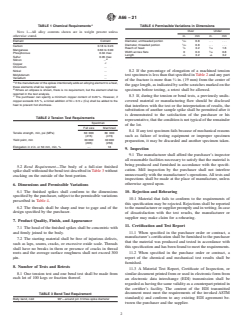
8.2 If the percentage of elongation of a machined tension
Nickel .
Molybdenum .
test specimen is less than that specified in Table 2 and any part
Vanadium .
of the fracture is more than ⁄4 in. (19 mm) from the center of
A
If the manufacturer of the spikes intentionally adds an alloying element to a heat,
the gage length, as indicated by scribe scratches marked on the
these elements shall be reported.
B
specimen before testing, a retest shall be allowed.
Where an ellipses is shown, there is no requirement, but the element shall be
reported in the test analysis.
8.3 If, during the tension or bend tests, a previously undis-
C
The purchaser can specify a minimum copper content of 0.20 %. However, if
copper exceeds 0.5 %, a nickel addition of Ni = 0.5 × (Cu) shall be added to the c
...
This document is not an ASTM standard and is intended only to provide the user of an ASTM standard an indication of what changes have been made to the previous version. Because
it may not be technically possible to adequately depict all changes accurately, ASTM recommends that users consult prior editions as appropriate. In all cases only the current version
of the standard as published by ASTM is to be considered the official document.
Designation: A66 − 07 (Reapproved 2013) A66 − 21
Standard Specification for
Steel Screw Spikes
This standard is issued under the fixed designation A66; the number immediately following the designation indicates the year of original
adoption or, in the case of revision, the year of last revision. A number in parentheses indicates the year of last reapproval. A superscript
epsilon (´) indicates an editorial change since the last revision or reapproval.
This standard has been approved for use by agencies of the U.S. Department of Defense.
1. Scope
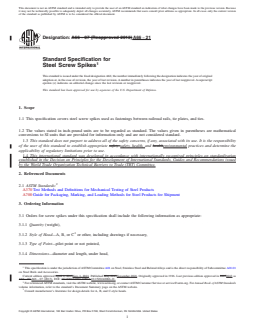
1.1 This specification covers steel screw spikes used as fastenings between railroad rails, tie plates, and ties.
1.2 The values stated in inch-pound units are to be regarded as standard. The values given in parentheses are mathematical
conversions to SI units that are provided for information only and are not considered standard.
1.3 This standard does not purport to address all of the safety concerns, if any, associated with its use. It is the responsibility
of the user of this standard to establish appropriate safety safety, health, and healthenvironmental practices and determine the
applicability of regulatory limitations prior to use.
1.4 This international standard was developed in accordance with internationally recognized principles on standardization
established in the Decision on Principles for the Development of International Standards, Guides and Recommendations issued
by the World Trade Organization Technical Barriers to Trade (TBT) Committee.
2. Referenced Documents
2.1 ASTM Standards:
A370 Test Methods and Definitions for Mechanical Testing of Steel Products
A700 Guide for Packaging, Marking, and Loading Methods for Steel Products for Shipment
3. Ordering Information
3.1 Orders for screw spikes under this specification shall include the following information as appropriate:
3.1.1 Quantity (weight),
3.1.2 Style of Head—A, B, or C or other, including drawings if necessary,
3.1.3 Type of Point—pilot point or not pointed,
3.1.4 Dimensions—diameter and length, under head,
This specification is under the jurisdiction of ASTM Committee A01 on Steel, Stainless Steel and Related Alloys and is the direct responsibility of Subcommittee A01.01
on Steel Rails and Accessories.
Current edition approved April 1, 2013Nov. 1, 2021. Published May 2013November 2021. Originally approved in 1916. Last previous edition approved in 20072013 as
A66 – 07.A66 – 07 (2013). DOI: 10.1520/A0066-07R13.10.1520/A0066-21.
For referenced ASTM standards, visit the ASTM website, www.astm.org, or contact ASTM Customer Service at service@astm.org. For Annual Book of ASTM Standards
volume information, refer to the standard’s Document Summary page on the ASTM website.
Consult manufacturer’s literature for design details for A, B, and C-style heads.
Copyright © ASTM International, 100 Barr Harbor Drive, PO Box C700, West Conshohocken, PA 19428-2959. United States
A66 − 21
3.1.5 Supplementary Requirement if to apply (see S1)
3.1.6 Certification and Test Report (see 11.1).
4. Manufacture
4.1 The steel shall be made by any of the following processes: electric-furnace or basic-oxygen.
4.2 The steel may be cast by a continuous process, or in ingots.
4.3 The heads and threads of the spikes may be formed by hot- or cold-forming methods.
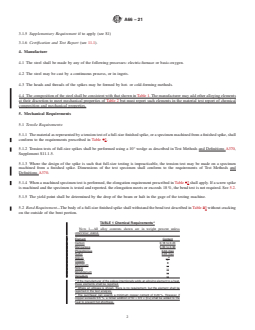
4.4 The composition of the steel shall be consistent with that shown in Table 1. The manufacturer may add other alloying elements
at their discretion to meet mechanical properties of Table 2 but must report such elements in the material test report of chemical
composition and mechanical properties.
5. Mechanical Requirements
5.1 Tensile Requirements:
5.1.1 The material as represented by a tension test of a full-size finished spike, or a specimen machined from a finished spike, shall
conform to the requirements prescribed in Table 12.
5.1.2 Tension tests of full-size spikes shall be performed using a 10° wedge as described in Test Methods and Definitions A370,
Supplement S11.1.5.
5.1.3 Where the design of the spike is such that full-size testing is impracticable, the tension test may be made on a specimen
machined from a finished spike. Dimensions of the test specimen shall conform to the requirements of Test Methods and
Definitions A370.
5.1.4 When a machined specimen test is performed, the elongation requirement prescribed in Table 12 shall apply. If a screw spike
is machined and the specimen is tested and reported. the elongation meets or exceeds 18 %, the bend test is not required. See 5.2.
5.1.5 The yield point shall be determined by the drop of the beam or halt in the gage of the testing machine.
5.2 Bend Requirement—The body of a full-size finished spike shall withstand the bend test described in Table 23 without cracking
on the outside of the bent portion.
A
TABLE 1 Chemical Requirements
NOTE 1—All alloy contents shown are in weight percent unless
otherwise stated.
Element Content
Carbon 0.18 to 0.23
Manganese 0.60 to 0.90
Phosphorous 0.04 max
Sulfur 0.05 max
B
Silicon .
C
Copper
Chromium .
Nickel .
Molybdenum .
Vanadium .
A
If the manufacturer of the spikes intentionally adds an alloying element to a heat,
these elements shall be reported.
B
Where an ellipses is shown, there is no requirement, but the element shall be
reported in the test analysis.
C
The purchaser can specify a minimum copper content of 0.20 %. However, if
copper exceeds 0.5 %, a nickel addition of Ni = 0.5 × (Cu) shall be added to the
heat to prevent hot shortness.
A66 − 21
TABLE 12 Tension Test Requirements
Specimen
Full size Machined
Tensile strength, min, psi (MPa) 60 000 60 000
(415) (415)
Yield point, min 30 000 30 000
(205) (250)
Elongation in 2 in. or 50 mm, min, % . 18
TABLE 23 Bend Test Requirement
Body bend, cold 90°—around pin 3 times spike diameter
6. Dimensions and Permissible Variations
6.1 The finished spikes shall conf
...