

ASTM C149-14(2020)
(Test Method)Standard Test Method for Thermal Shock Resistance of Glass Containers
General Information
- Abstract
ABSTRACT
This test method covers the determination of the relative thermal shock resistance of commercial bottles and jars and is intended to apply to all types of glass containers that are required to withstand sudden changes in temperature in service. The test apparatus consists essentially of a basket for holding the glassware upright, a hot water tank, a cold water tank, and a timed means for immersing and transferring the basket from the hot to the cold bath. Indicating controllers or dial thermometers should be used to maintain the temperatures of the baths. Test procedures included in this specification include pass tests, progressive tests to a predetermined percent of breakage, total progressive tests, and high-level tests.
SCOPE
1.1 This test method covers the determination of the relative resistance of commercial glass containers (bottles and jars) to thermal shock and is intended to apply to all types of glass containers that are required to withstand sudden temperature changes (thermal shock) in service such as in washing, pasteurization, or hot pack processes, or in being transferred from a warm to a colder medium or vice versa.
1.2 The values stated in SI units are to be regarded as the standard. The values given in parentheses are for information only.
1.3 This standard does not purport to address all of the safety concerns, if any, associated with its use. It is the responsibility of the user of this standard to establish appropriate safety, health, and environmental practices and determine the applicability of regulatory limitations prior to use.
1.4 This international standard was developed in accordance with internationally recognized principles on standardization established in the Decision on Principles for the Development of International Standards, Guides and Recommendations issued by the World Trade Organization Technical Barriers to Trade (TBT) Committee.
- Status
- Published
- Publication Date
- 31-Jul-2020
- Technical Committee
- C14 - Glass and Glass Products
- Drafting Committee
- C14.07 - Glass Containers


Overview
ASTM C149-14(2020), the Standard Test Method for Thermal Shock Resistance of Glass Containers, defines a consistent procedure for assessing the ability of commercial glass containers-such as bottles and jars-to withstand rapid temperature changes. This standard is vital for manufacturers and quality assurance teams in the glass packaging industry, as glass containers are often exposed to quick temperature shifts during processes like washing, pasteurization, hot packing, or transfer between hot and cold environments.
Utilizing an automatic thermal shock testing apparatus, this standardized method ensures reproducibility in testing the thermal shock resistance of various glass container types. The standard supports global trade by aligning with internationally recognized principles outlined in the WTO Technical Barriers to Trade (TBT) Committee guidance.
Key Topics
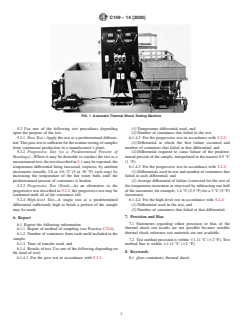
- Test Apparatus: The standard specifies a testing system consisting of a basket for upright glassware, tanks of hot and cold water, precise temperature control via indicating controllers or thermometers, and an automated timing mechanism for immersing and transferring the basket.
- Test Procedures: Several validated testing approaches are included:
- Pass Test: Assess if samples can withstand a defined temperature differential, suitable for routine production checks.
- Progressive Tests: Gradually increase the differential and measure the breakage rate at each step, used for in-depth material quality analysis.
- High-level Test: A single high-differential exposure identifies critical failure points within a sample batch.
- Sampling and Reporting:
- Clear sampling practices are recommended, referencing ASTM Practice C224, to ensure that test results are statistically valid and representative.
- Detailed guidelines for recording and reporting test parameters, outcomes, and the number of failures for robust quality documentation.
Applications
Thermal shock testing as defined in ASTM C149-14(2020) provides essential quality insights for:
- Glass Packaging Manufacturers: Ensuring bottles and jars meet customer and regulatory requirements for durability during filling, sterilization, or reuse.
- Food and Beverage Industry: Verifying that glass containers will resist cracking or breaking when transitioning between hot and cold processes, protecting product safety and shelf life.
- Quality Control Labs: Establishing consistent, reliable criteria for batch acceptance or rejection based on quantifiable thermal shock resistance.
- Product Development: Supporting improvements in glass composition and design by providing clear benchmarks for thermal endurance.
This methodology is particularly relevant when containers are subject to repeated cleaning and sterilization cycles, or when hot packing contents-making this standard critical for risk mitigation and consumer safety in packaging.
Related Standards
- ASTM C224 – Practice for Sampling Glass Containers: Provides guidance on sampling methods to ensure representative testing of glass container batches.
- ASTM C148 – Standard Test Methods for Thermal Shock Resistance of Glazed Ceramic Tile: Related procedures for non-glass items.
- ISO 4802 – Laboratory Glassware: Establishes methods for testing resistance to thermal shock, with procedures similar in intent to ASTM C149 but adapted for laboratory glassware.
Keywords: ASTM C149, thermal shock resistance, glass containers, glass bottle testing, glass jar quality, thermal shock test, standard test method, glass packaging durability, pass test, progressive test, hot pack process, glass manufacturing standards, food packaging safety.
Relations
- Effective Date
- 01-Aug-2020
- Effective Date
- 01-Aug-2020
- Effective Date
- 01-Oct-2014
- Effective Date
- 01-May-2009
- Effective Date
- 01-Apr-2004
- Effective Date
- 10-Apr-1999
- Effective Date
- 01-Aug-2020
Frequently Asked Questions
ASTM C149-14(2020) is a standard published by ASTM International. Its full title is "Standard Test Method for Thermal Shock Resistance of Glass Containers". This standard covers: ABSTRACT This test method covers the determination of the relative thermal shock resistance of commercial bottles and jars and is intended to apply to all types of glass containers that are required to withstand sudden changes in temperature in service. The test apparatus consists essentially of a basket for holding the glassware upright, a hot water tank, a cold water tank, and a timed means for immersing and transferring the basket from the hot to the cold bath. Indicating controllers or dial thermometers should be used to maintain the temperatures of the baths. Test procedures included in this specification include pass tests, progressive tests to a predetermined percent of breakage, total progressive tests, and high-level tests. SCOPE 1.1 This test method covers the determination of the relative resistance of commercial glass containers (bottles and jars) to thermal shock and is intended to apply to all types of glass containers that are required to withstand sudden temperature changes (thermal shock) in service such as in washing, pasteurization, or hot pack processes, or in being transferred from a warm to a colder medium or vice versa. 1.2 The values stated in SI units are to be regarded as the standard. The values given in parentheses are for information only. 1.3 This standard does not purport to address all of the safety concerns, if any, associated with its use. It is the responsibility of the user of this standard to establish appropriate safety, health, and environmental practices and determine the applicability of regulatory limitations prior to use. 1.4 This international standard was developed in accordance with internationally recognized principles on standardization established in the Decision on Principles for the Development of International Standards, Guides and Recommendations issued by the World Trade Organization Technical Barriers to Trade (TBT) Committee.
ABSTRACT This test method covers the determination of the relative thermal shock resistance of commercial bottles and jars and is intended to apply to all types of glass containers that are required to withstand sudden changes in temperature in service. The test apparatus consists essentially of a basket for holding the glassware upright, a hot water tank, a cold water tank, and a timed means for immersing and transferring the basket from the hot to the cold bath. Indicating controllers or dial thermometers should be used to maintain the temperatures of the baths. Test procedures included in this specification include pass tests, progressive tests to a predetermined percent of breakage, total progressive tests, and high-level tests. SCOPE 1.1 This test method covers the determination of the relative resistance of commercial glass containers (bottles and jars) to thermal shock and is intended to apply to all types of glass containers that are required to withstand sudden temperature changes (thermal shock) in service such as in washing, pasteurization, or hot pack processes, or in being transferred from a warm to a colder medium or vice versa. 1.2 The values stated in SI units are to be regarded as the standard. The values given in parentheses are for information only. 1.3 This standard does not purport to address all of the safety concerns, if any, associated with its use. It is the responsibility of the user of this standard to establish appropriate safety, health, and environmental practices and determine the applicability of regulatory limitations prior to use. 1.4 This international standard was developed in accordance with internationally recognized principles on standardization established in the Decision on Principles for the Development of International Standards, Guides and Recommendations issued by the World Trade Organization Technical Barriers to Trade (TBT) Committee.
ASTM C149-14(2020) is classified under the following ICS (International Classification for Standards) categories: 81.040.30 - Glass products. The ICS classification helps identify the subject area and facilitates finding related standards.
ASTM C149-14(2020) has the following relationships with other standards: It is inter standard links to ASTM C149-14, ASTM C224-78(2020), ASTM C224-78(2014), ASTM C224-78(2009), ASTM C224-78(2004)e1, ASTM C224-78(1999), ASTM F2179-20. Understanding these relationships helps ensure you are using the most current and applicable version of the standard.
ASTM C149-14(2020) is available in PDF format for immediate download after purchase. The document can be added to your cart and obtained through the secure checkout process. Digital delivery ensures instant access to the complete standard document.
Standards Content (Sample)
This international standard was developed in accordance with internationally recognized principles on standardization established in the Decision on Principles for the
Development of International Standards, Guides and Recommendations issued by the World Trade Organization Technical Barriers to Trade (TBT) Committee.
Designation: C149 − 14 (Reapproved 2020)
Standard Test Method for
Thermal Shock Resistance of Glass Containers
This standard is issued under the fixed designation C149; the number immediately following the designation indicates the year of
original adoption or, in the case of revision, the year of last revision. A number in parentheses indicates the year of last reapproval. A
superscript epsilon (´) indicates an editorial change since the last revision or reapproval.
This standard has been approved for use by agencies of the U.S. Department of Defense.
1. Scope 3. Apparatus
3.1 The apparatus shall consist essentially of a basket for
1.1 This test method covers the determination of the relative
holding the glassware upright, two tanks, one containing hot
resistance of commercial glass containers (bottles and jars) to
water and one containing cold water, and an automatically
thermal shock and is intended to apply to all types of glass
timed means for immersing and transferring the basket of
containers that are required to withstand sudden temperature
bottles from the hot to the cold bath. A suitable type of
changes (thermal shock) in service such as in washing,
apparatus is illustrated in Fig. 1.
pasteurization, or hot pack processes, or in being transferred
from a warm to a colder medium or vice versa.
3.2 A device shall be provided to maintain the temperature
of the baths within 61.1 °C (2 °F) of the specified tempera-
1.2 The values stated in SI units are to be regarded as the
tures. Indicating controllers that control the heating of the hot
standard. The values given in parentheses are for information
water and the cooling of the cold water are recommended.
only.
Otherwise dial thermometers should be attached and the
1.3 This standard does not purport to address all of the
temperatures controlled manually.
safety concerns, if any, associated with its use. It is the
3.3 The capacity of each tank shall be at least 3.8 L (1 gal)
responsibility of the user of this standard to establish appro-
for each 0.45 kg (1 lb) of glass tested.
priate safety, health, and environmental practices and deter-
mine the applicability of regulatory limitations prior to use.
4. Sampling
1.4 This international standard was developed in accor-
4.1 Methods of sampling a minimum lot from a group of
dance with internationally recognized principles on standard-
containers of a given type are given in Practice C224, for the
ization established in the Decision on Principles for the
various situations to which it may apply.
Development of International Standards, Guides and Recom-
mendations issued by the World Trade Organization Technical
5. Procedure
Barriers to Trade (TBT) Committee.
5.1 Adjust the temperatures of the baths so that the cold
bath is at 21 °C (70 °F) and the hot bath is at a temperature
2. Referenced Documents
hotter than the cold bath by a specified differential, preferably
2.1 ASTM Standard:
42 °C. As a result, the first immersion temperature will be
C224 Practice for Sampling Glass Containers
63 °C (145 °F, or a differential of approximately 75°F) (Note
2.2 ASTM Adjunct:
1). Fill, or partially fill, the basket, with empty bottles, and
Apparatus for thermal shock test of glass containers (6
when the temperatures of the baths are within 61.1 °C (2 °F)
Drawings)
of those specified immerse the basket in the hot bath in such a
manner that the bottles become completely filled with hot
water, allow to soak for 5 min, transfer to the cold bath, and
immerse for 30 s, and then remove from the cold bath. Control
This test method is under the jurisdiction of ASTM Committee C14 on Glass
the 5-min immersion in the hot bath within 10 s, and the time
and Glass Products and is the direct responsibility of Subcommittee C14.07 on
Glass Containers.
of transfer from the hot to the cold bath shall be 15 61s.
Current edition approved Aug. 1, 2020. Published August 2020. Originally
During the test, protect the apparatus from drafts in a sheltered
approved in 1939. Last previous edition approved in 2014 as C149 – 14. DOI:
area. Observe the number of containers failing in the test by
10.1520/C0149-14R20.
For referenced ASTM standards, visit the ASTM website, www.astm.org, or individual inspection of each.
contact ASTM Customer Service at service@astm.org. For Annual Book of ASTM
NOTE1—Ifacoldbathtemperatureotherthan21°C(70°F)isused,the
Standards volume information, re
...