


ASTM D7765-18a
(Practice)Standard Practice for Use of Foundry Sand in Structural Fill and Embankments
Standard Practice for Use of Foundry Sand in Structural Fill and Embankments
SIGNIFICANCE AND USE
4.1 Earthwork associated with highway construction provides an opportunity for high volume reuse of green foundry sands discarded by the foundry industry. This practice covers methods and recommendations to use of foundry sand as embankment and structural fill.
4.2 This practice describes the unique construction considerations that may apply to foundry sands. The behavior may vary due to specific composition of the material and local conditions.
4.3 The use of foundry sand in embankment and structural fill may be regulated by local, state/provincial/regional, or national/federal regulations. These regulations should be consulted.
SCOPE
1.1 This practice covers methods to use foundry sand as embankment and structural fill.
1.2 This practice includes recommended construction (Section 5), compaction control (Section 6), and freeze-thaw durability (Section 7) practices.
1.3 The engineer should be aware that foundry sand is a by-product of metal casting industries. Various local, state/provincial/regional, or national/federal environmental laws and regulations may apply if foundry sand is used as an alternative embankment or fill material. It is advised that foundry sand users contact appropriate environmental regulators to determine what requirements or limitations may exist.
1.4 This standard primarily applies to green foundry sand and also generally to chemically bonded foundry sand.
1.5 The values stated in SI units are to be regarded as standard. No other units of measurement are included in this standard.
1.6 This standard does not purport to address all of the safety concerns, if any, associated with its use. It is the responsibility of the user of this standard to establish appropriate safety, health, and environmental practices and determine the applicability of regulatory limitations prior to use.
1.7 This practice offers a set of instructions for performing one or more specific operations. This document cannot replace education or experience and should be used in conjunction with professional judgment. Not all aspects of this guide may be applicable in all circumstances. This ASTM standard is not intended to represent or replace the standard of care by which the adequacy of a given professional service must be judged, nor should this document be applied without consideration of a project’s many unique aspects. The word “Standard” in the title of this document means only that the document has been approved through the ASTM consensus process.
1.8 This international standard was developed in accordance with internationally recognized principles on standardization established in the Decision on Principles for the Development of International Standards, Guides and Recommendations issued by the World Trade Organization Technical Barriers to Trade (TBT) Committee.
General Information
- Status
- Published
- Publication Date
- 30-Apr-2018
- Technical Committee
- D18 - Soil and Rock
- Drafting Committee
- D18.14 - Geotechnics of Sustainable Construction
Relations
- Replaces
ASTM D7765-18 - Standard Practice for Use of Foundry Sand in Structural Fill and Embankments - Effective Date
- 01-May-2018
- Effective Date
- 01-Nov-2023
- Effective Date
- 01-Nov-2023
- Effective Date
- 15-Jan-2020
- Effective Date
- 15-Jan-2020
- Effective Date
- 01-Oct-2019
- Effective Date
- 01-Mar-2019
- Effective Date
- 01-May-2018
- Effective Date
- 01-Mar-2017
- Effective Date
- 01-Feb-2017
- Effective Date
- 01-Aug-2015
- Effective Date
- 01-Dec-2014
- Effective Date
- 01-Dec-2014
- Effective Date
- 01-Nov-2014
- Effective Date
- 01-Aug-2014
Overview
ASTM D7765-18a, titled Standard Practice for Use of Foundry Sand in Structural Fill and Embankments, provides essential guidance on the reuse of foundry sand, particularly green foundry sand, as a sustainable alternative for embankment and structural fill applications. With significant relevance to highway construction and earthwork projects, this ASTM standard addresses practical recommendations for construction, compaction, and freeze-thaw durability specific to foundry sand material. Its application offers a responsible method of by-product reuse from the metal casting industry, promoting waste minimization and resource efficiency.
Key Topics
Material Types
The practice focuses primarily on green foundry sand, typically a by-product from metal casting, containing bentonite clay and carbonaceous additives. The standard also offers guidance for chemically bonded foundry sands.Construction Considerations
The standard outlines recommended methods for handling, conditioning, and placing foundry sand, including:- Moisture conditioning at the source site to control dust and minimize erosion.
- Storage and delivery best practices, such as maintaining required moisture levels and using covered transport.
- Layering (lift thickness) and compaction techniques using pneumatic-tired equipment.
Compaction Control
Compaction of foundry sand can vary from traditional sandy materials due to differences in moisture-density relationships.
Key recommendations address:- Allowing proper hydration time for laboratory testing.
- Achieving and verifying required dry density in the field.
- Employing suitable test methods and accepting compaction based on in-place density relative to standard laboratory maximums.
Freeze-Thaw Durability & Electrochemical Limits
The standard offers methods for evaluating frost heave, freeze-thaw resistance, and electrochemical properties to ensure the long-term durability of structures and compatibility with steel reinforcements.Regulatory Compliance
The use of foundry sand in embankment or fill applications may be subject to regional or national environmental regulations. Users are advised to consult relevant authorities to ensure compliance with all applicable laws.Safety & Professional Judgment
Users are reminded of the necessity to implement proper safety, health, and environmental practices, and to exercise engineering judgment for site-specific applications.
Applications
ASTM D7765-18a is particularly valuable for:
Highway Construction
The standard encourages the use of foundry sand for large-volume embankments, promoting sustainable construction practices and reducing disposal pressures on landfills.Structural Fill in Infrastructure Projects
Besides roads, foundry sand can be utilized in the construction of structural fills for industrial, commercial, and municipal projects where appropriate fill material is required.Sustainable Material Management
By fostering the high-volume reuse of foundry sand, this practice supports circular economy goals and responsible material resource management in construction industries.Engineering Design
The guidance assists geotechnical engineers in evaluating foundry sand’s suitability, conducting required compaction and performance tests, and ensuring proper construction quality control.
Related Standards
For additional context and testing procedures, the following ASTM standards are directly referenced in ASTM D7765-18a:
- ASTM D653 - Terminology Relating to Soil, Rock, and Contained Fluids
- ASTM D698 & D1557 - Laboratory Compaction Characteristics of Soil
- ASTM D1556 & D6938 - In-Place Density and Water Content of Soil Methods
- ASTM D1883 - California Bearing Ratio (CBR) of Laboratory-Compacted Soils
- ASTM D5918 - Frost Heave and Thaw Weakening Susceptibility of Soils
- ASTM C837 - Methylene Blue Index of Clay
- ASTM D5080 - Rapid Determination of Percent Compaction
These standards support accurate testing, terminology, and procedures for the effective and compliant use of foundry sand in structural fill and embankment projects.
Keywords: ASTM D7765, foundry sand reuse, structural fill, embankments, highway construction, compaction, green foundry sand, sustainable construction, earthwork, by-product reuse, freeze-thaw durability, material management.
Buy Documents
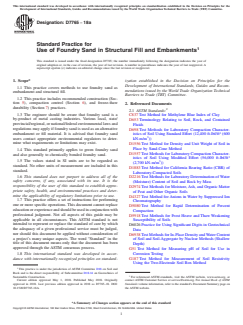
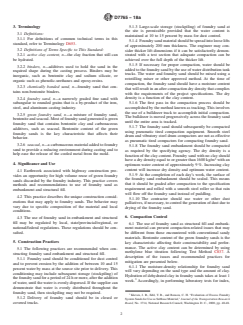
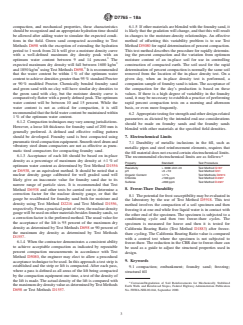

ASTM D7765-18a - Standard Practice for Use of Foundry Sand in Structural Fill and Embankments
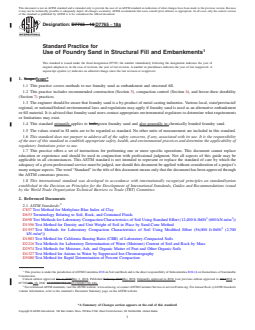

REDLINE ASTM D7765-18a - Standard Practice for Use of Foundry Sand in Structural Fill and Embankments
Get Certified
Connect with accredited certification bodies for this standard

Element Materials Technology
Materials testing and product certification.

Inštitut za kovinske materiale in tehnologije
Institute of Metals and Technology. Materials testing, metallurgical analysis, NDT.
Sponsored listings
Frequently Asked Questions
ASTM D7765-18a is a standard published by ASTM International. Its full title is "Standard Practice for Use of Foundry Sand in Structural Fill and Embankments". This standard covers: SIGNIFICANCE AND USE 4.1 Earthwork associated with highway construction provides an opportunity for high volume reuse of green foundry sands discarded by the foundry industry. This practice covers methods and recommendations to use of foundry sand as embankment and structural fill. 4.2 This practice describes the unique construction considerations that may apply to foundry sands. The behavior may vary due to specific composition of the material and local conditions. 4.3 The use of foundry sand in embankment and structural fill may be regulated by local, state/provincial/regional, or national/federal regulations. These regulations should be consulted. SCOPE 1.1 This practice covers methods to use foundry sand as embankment and structural fill. 1.2 This practice includes recommended construction (Section 5), compaction control (Section 6), and freeze-thaw durability (Section 7) practices. 1.3 The engineer should be aware that foundry sand is a by-product of metal casting industries. Various local, state/provincial/regional, or national/federal environmental laws and regulations may apply if foundry sand is used as an alternative embankment or fill material. It is advised that foundry sand users contact appropriate environmental regulators to determine what requirements or limitations may exist. 1.4 This standard primarily applies to green foundry sand and also generally to chemically bonded foundry sand. 1.5 The values stated in SI units are to be regarded as standard. No other units of measurement are included in this standard. 1.6 This standard does not purport to address all of the safety concerns, if any, associated with its use. It is the responsibility of the user of this standard to establish appropriate safety, health, and environmental practices and determine the applicability of regulatory limitations prior to use. 1.7 This practice offers a set of instructions for performing one or more specific operations. This document cannot replace education or experience and should be used in conjunction with professional judgment. Not all aspects of this guide may be applicable in all circumstances. This ASTM standard is not intended to represent or replace the standard of care by which the adequacy of a given professional service must be judged, nor should this document be applied without consideration of a project’s many unique aspects. The word “Standard” in the title of this document means only that the document has been approved through the ASTM consensus process. 1.8 This international standard was developed in accordance with internationally recognized principles on standardization established in the Decision on Principles for the Development of International Standards, Guides and Recommendations issued by the World Trade Organization Technical Barriers to Trade (TBT) Committee.
SIGNIFICANCE AND USE 4.1 Earthwork associated with highway construction provides an opportunity for high volume reuse of green foundry sands discarded by the foundry industry. This practice covers methods and recommendations to use of foundry sand as embankment and structural fill. 4.2 This practice describes the unique construction considerations that may apply to foundry sands. The behavior may vary due to specific composition of the material and local conditions. 4.3 The use of foundry sand in embankment and structural fill may be regulated by local, state/provincial/regional, or national/federal regulations. These regulations should be consulted. SCOPE 1.1 This practice covers methods to use foundry sand as embankment and structural fill. 1.2 This practice includes recommended construction (Section 5), compaction control (Section 6), and freeze-thaw durability (Section 7) practices. 1.3 The engineer should be aware that foundry sand is a by-product of metal casting industries. Various local, state/provincial/regional, or national/federal environmental laws and regulations may apply if foundry sand is used as an alternative embankment or fill material. It is advised that foundry sand users contact appropriate environmental regulators to determine what requirements or limitations may exist. 1.4 This standard primarily applies to green foundry sand and also generally to chemically bonded foundry sand. 1.5 The values stated in SI units are to be regarded as standard. No other units of measurement are included in this standard. 1.6 This standard does not purport to address all of the safety concerns, if any, associated with its use. It is the responsibility of the user of this standard to establish appropriate safety, health, and environmental practices and determine the applicability of regulatory limitations prior to use. 1.7 This practice offers a set of instructions for performing one or more specific operations. This document cannot replace education or experience and should be used in conjunction with professional judgment. Not all aspects of this guide may be applicable in all circumstances. This ASTM standard is not intended to represent or replace the standard of care by which the adequacy of a given professional service must be judged, nor should this document be applied without consideration of a project’s many unique aspects. The word “Standard” in the title of this document means only that the document has been approved through the ASTM consensus process. 1.8 This international standard was developed in accordance with internationally recognized principles on standardization established in the Decision on Principles for the Development of International Standards, Guides and Recommendations issued by the World Trade Organization Technical Barriers to Trade (TBT) Committee.
ASTM D7765-18a is classified under the following ICS (International Classification for Standards) categories: 77.180 - Equipment for the metallurgical industry. The ICS classification helps identify the subject area and facilitates finding related standards.
ASTM D7765-18a has the following relationships with other standards: It is inter standard links to ASTM D7765-18, ASTM G51-23, ASTM G187-23, ASTM D2974-20e1, ASTM D2974-20, ASTM C837-09(2019), ASTM D2216-19, ASTM G187-18, ASTM D6938-17, ASTM D5080-17, ASTM D6938-15, ASTM D1883-14, ASTM C837-09(2014), ASTM D2974-14, ASTM D653-14. Understanding these relationships helps ensure you are using the most current and applicable version of the standard.
ASTM D7765-18a is available in PDF format for immediate download after purchase. The document can be added to your cart and obtained through the secure checkout process. Digital delivery ensures instant access to the complete standard document.
Standards Content (Sample)
This international standard was developed in accordance with internationally recognized principles on standardization established in the Decision on Principles for the
Development of International Standards, Guides and Recommendations issued by the World Trade Organization Technical Barriers to Trade (TBT) Committee.
Designation: D7765 − 18a
Standard Practice for
Use of Foundry Sand in Structural Fill and Embankments
This standard is issued under the fixed designation D7765; the number immediately following the designation indicates the year of
original adoption or, in the case of revision, the year of last revision. A number in parentheses indicates the year of last reapproval. A
superscript epsilon (´) indicates an editorial change since the last revision or reapproval.
1. Scope* ization established in the Decision on Principles for the
Development of International Standards, Guides and Recom-
1.1 This practice covers methods to use foundry sand as
mendations issued by the World Trade Organization Technical
embankment and structural fill.
Barriers to Trade (TBT) Committee.
1.2 This practice includes recommended construction (Sec-
tion 5), compaction control (Section 6), and freeze-thaw
2. Referenced Documents
durability (Section 7) practices.
2.1 ASTM Standards:
1.3 The engineer should be aware that foundry sand is a
C837 Test Method for Methylene Blue Index of Clay
by-product of metal casting industries. Various local, state/
D653 Terminology Relating to Soil, Rock, and Contained
provincial/regional, or national/federal environmental laws and
Fluids
regulations may apply if foundry sand is used as an alternative
D698 Test Methods for Laboratory Compaction Character-
embankment or fill material. It is advised that foundry sand
istics of Soil Using Standard Effort (12,400 ft-lbf/ft (600
users contact appropriate environmental regulators to deter-
kN-m/m ))
mine what requirements or limitations may exist.
D1556 Test Method for Density and Unit Weight of Soil in
Place by Sand-Cone Method
1.4 This standard primarily applies to green foundry sand
D1557 Test Methods for Laboratory Compaction Character-
and also generally to chemically bonded foundry sand.
istics of Soil Using Modified Effort (56,000 ft-lbf/ft
1.5 The values stated in SI units are to be regarded as
(2,700 kN-m/m ))
standard. No other units of measurement are included in this
D1883 Test Method for California Bearing Ratio (CBR) of
standard.
Laboratory-Compacted Soils
1.6 This standard does not purport to address all of the
D2216 Test Methods for Laboratory Determination of Water
safety concerns, if any, associated with its use. It is the
(Moisture) Content of Soil and Rock by Mass
responsibility of the user of this standard to establish appro-
D2974 Test Methods for Moisture,Ash, and Organic Matter
priate safety, health, and environmental practices and deter-
of Peat and Other Organic Soils
mine the applicability of regulatory limitations prior to use.
D4327 Test Method for Anions in Water by Suppressed Ion
1.7 This practice offers a set of instructions for performing
Chromatography
one or more specific operations. This document cannot replace
D5080 Test Method for Rapid Determination of Percent
educationorexperienceandshouldbeusedinconjunctionwith
Compaction
professional judgment. Not all aspects of this guide may be
D5918 Test Methods for Frost Heave and Thaw Weakening
applicable in all circumstances. This ASTM standard is not
Susceptibility of Soils
intended to represent or replace the standard of care by which
D6026 Practice for Using Significant Digits in Geotechnical
the adequacy of a given professional service must be judged,
Data
nor should this document be applied without consideration of
D6938 TestMethodsforIn-PlaceDensityandWaterContent
a project’s many unique aspects. The word “Standard” in the
of Soil and Soil-Aggregate by Nuclear Methods (Shallow
title of this document means only that the document has been
Depth)
approved through the ASTM consensus process.
G51 Test Method for Measuring pH of Soil for Use in
Corrosion Testing
1.8 This international standard was developed in accor-
G187 Test Method for Measurement of Soil Resistivity
dance with internationally recognized principles on standard-
Using the Two-Electrode Soil Box Method
This practice is under the jurisdiction of ASTM Committee D18 on Soil and
Rock and is the direct responsibility of Subcommittee D18.14 on Geotechnics of
Sustainable Construction. For referenced ASTM standards, visit the ASTM website, www.astm.org, or
Current edition approved May 1, 2018. Published May 2018. Originally contact ASTM Customer Service at service@astm.org. For Annual Book of ASTM
approved in 2018. Last previous edition approved in 2018 as D7765–18. DOI: Standards volume information, refer to the standard’s Document Summary page on
10.1520/D7765-18A. the ASTM website.
*A Summary of Changes section appears at the end of this standard
Copyright © ASTM International, 100 Barr Harbor Drive, PO Box C700, West Conshohocken, PA 19428-2959. United States
D7765 − 18a
3. Terminology 5.1.3 Large-scale storage (stockpiling) of foundry sand at
the site is permissible provided that the water content is
3.1 Definitions:
maintained at 10 to 15 percent by mass for dust control.
3.1.1 For definitions of common technical terms in this
5.1.4 Foundrysandmaterialshouldbespreadintolooselifts
standard, refer to Terminology D653.
of approximately 200 mm thickness. The engineer may con-
3.2 Definitions of Terms Specific to This Standard:
sider thicker lift dimensions if it can be satisfactorily demon-
3.2.1 active clay content, n—the clay fraction that still can strated with a test section that adequate compaction can be
be hydrated.
achieved over the full depth of the thicker lift.
5.1.5 If necessary for proper compaction, water should be
3.2.2 binders, n—additives used to hold the sand in the
added to the foundry sand by the use of water distribution tank
required shape during the casting process. Binders may be
trucks. The water and foundry sand should be mixed using a
inorganic, such as bentonite clay and sodium silicate, or
rototilling mixer or other approved method. At the time of
organic such as phenolic-urethanes and epoxy-resins.
compaction, the foundry sand should have a moisture content
3.2.3 chemically bonded sand, n—foundry sand that con-
that will result in an after compaction dry density that complies
tains non-bentonite binders.
with the requirements of the project specifications. The dry
density is a function of the clay content.
3.2.4 foundry sand, n—a narrowly graded fine sand with
subangular to rounded grains that is a by-product of the iron, 5.1.6 The first pass in the compaction process should be
accomplished by the method known as tracking. This involves
steel, and aluminum casting industry.
the use of a bulldozer track to accomplish initial compaction.
3.2.5 green foundry sand, n—a mixture of foundry sand,
The bulldozer is moved progressively across the foundry sand
bentonite and seacoal. Most of foundry sand generated is green
until the entire area is tracked.
foundry sand that contains bentonite clay and carbonaceous
5.1.7 The foundry sand should subsequently be compacted
additives, such as seacoal. Bentonite content of the green
using pneumatic tired compaction equipment. Smooth steel
foundry sands is the key characteristic that affects their
drum and vibratory steel drum compactors are not as effective
behavior.
as pneumatic tired compactors for compacting foundry sand.
3.2.6 seacoal, n—a carbonaceous material added to foundry
5.1.8 The foundry sand embankment should be compacted
sand to provide a reducing environment during casting and to
as required by the specifying agency. The dry density is a
help ease the release of the cooled metal from the mold.
function of the clay content. Foundry sand with no clay should
have a dry density equal to or greater than 1600 kg/m with an
4. Significance and Use
optimum water content of approximately 9 %. Increasing clay
content will increase dry density and optimum water content.
4.1 Earthwork associated with highway construction pro-
5.1.9 At the completion of each day’s work, the surface of
vides an opportunity for high volume reuse of green foundry
the foundry sand embankment should be sealed. This means
sands discarded by the foundry industry. This practice covers
that it should be graded after compaction to the specification
methods and recommendations to use of foundry sand as
requirement and rolled with a smooth steel roller so that rain
embankment and structural fill.
will flow off the foundry sand instead of puddling.
4.2 This practice describes the unique construction consid-
5.1.10 The contractor should use water or other dust
erations that may apply to foundry sands. The behavior may
palliatives, if necessary, to control the generation of dust due to
vary due to specific composition of the material and local
drying of the foundry sand.
conditions.
6. Compaction Control
4.3 The use of foundry sand in embankment and structural
fill may be regulated by local, state/provincial/regional, or
6.1 The use of foundry sand as structural fill and embank-
national/federal regulations. These regulations should be con-
ment material can present compaction-related issues that may
sulted.
be different from those encountered with conventional sandy
materials.
...
This document is not an ASTM standard and is intended only to provide the user of an ASTM standard an indication of what changes have been made to the previous version. Because
it may not be technically possible to adequately depict all changes accurately, ASTM recommends that users consult prior editions as appropriate. In all cases only the current version
of the standard as published by ASTM is to be considered the official document.
Designation: D7765 − 18 D7765 − 18a
Standard Practice for
Use of Foundry Sand in Structural Fill and Embankments
This standard is issued under the fixed designation D7765; the number immediately following the designation indicates the year of
original adoption or, in the case of revision, the year of last revision. A number in parentheses indicates the year of last reapproval. A
superscript epsilon (´) indicates an editorial change since the last revision or reapproval.
1. Scope Scope*
1.1 This practice covers methods to use foundry sand as embankment and structural fill.
1.2 This practice includes recommended construction (Section 5), compaction control (Section 6), and freeze-thaw durability
(Section 7) practices.
1.3 The engineer should be aware that foundry sand is a by-product of metal casting industries. Various local, state/provincial/
regional, or national/federal environmental laws and regulations may apply if foundry sand is used as an alternative embankment
or fill material. It is advised that foundry sand users contact appropriate environmental regulators to determine what requirements
or limitations may exist.
1.4 This standard primarily applies to both green foundry sand and also generally to chemically bonded foundry sand.
1.5 The values stated in SI units are to be regarded as standard. No other units of measurement are included in this standard.
1.6 This standard does not purport to address all of the safety concerns, if any, associated with its use. It is the responsibility
of the user of this standard to establish appropriate safety, health, and environmental practices and determine the applicability of
regulatory limitations prior to use.
1.7 This practice offers a set of instructions for performing one or more specific operations. This document cannot replace
education or experience and should be used in conjunction with professional judgment. Not all aspects of this guide may be
applicable in all circumstances. This ASTM standard is not intended to represent or replace the standard of care by which the
adequacy of a given professional service must be judged, nor should this document be applied without consideration of a project’s
many unique aspects. The word “Standard” in the title of this document means only that the document has been approved through
the ASTM consensus process.
1.8 This international standard was developed in accordance with internationally recognized principles on standardization
established in the Decision on Principles for the Development of International Standards, Guides and Recommendations issued
by the World Trade Organization Technical Barriers to Trade (TBT) Committee.
2. Referenced Documents
2.1 ASTM Standards:
C837 Test Method for Methylene Blue Index of Clay
D653 Terminology Relating to Soil, Rock, and Contained Fluids
3 3
D698 Test Methods for Laboratory Compaction Characteristics of Soil Using Standard Effort (12,400 ft-lbf/ft (600 kN-m/m ))
D1556 Test Method for Density and Unit Weight of Soil in Place by Sand-Cone Method
D1557 Test Methods for Laboratory Compaction Characteristics of Soil Using Modified Effort (56,000 ft-lbf/ft (2,700
kN-m/m ))
D1883 Test Method for California Bearing Ratio (CBR) of Laboratory-Compacted Soils
D2216 Test Methods for Laboratory Determination of Water (Moisture) Content of Soil and Rock by Mass
D2974 Test Methods for Moisture, Ash, and Organic Matter of Peat and Other Organic Soils
D4327 Test Method for Anions in Water by Suppressed Ion Chromatography
D5080 Test Method for Rapid Determination of Percent Compaction
This practice is under the jurisdiction of ASTM Committee D18 on Soil and Rock and is the direct responsibility of Subcommittee D18.14 on Geotechnics of Sustainable
Construction.
Current edition approved Jan. 1, 2018May 1, 2018. Published February 2018May 2018. Originally approved in 2018. Last previous edition approved in 20122018 as
D7765–12.–18. DOI: 10.1520/D7765-18.10.1520/D7765-18A.
For referenced ASTM standards, visit the ASTM website, www.astm.org, or contact ASTM Customer Service at service@astm.org. For Annual Book of ASTM Standards
volume information, refer to the standard’s Document Summary page on the ASTM website.
*A Summary of Changes section appears at the end of this standard
Copyright © ASTM International, 100 Barr Harbor Drive, PO Box C700, West Conshohocken, PA 19428-2959. United States
D7765 − 18a
D5918 Test Methods for Frost Heave and Thaw Weakening Susceptibility of Soils
D6026 Practice for Using Significant Digits in Geotechnical Data
D6938 Test Methods for In-Place Density and Water Content of Soil and Soil-Aggregate by Nuclear Methods (Shallow Depth)
G51 Test Method for Measuring pH of Soil for Use in Corrosion Testing
G187 Test Method for Measurement of Soil Resistivity Using the Two-Electrode Soil Box Method
3. Terminology
3.1 Definitions:
3.1.1 For definitions of common technical terms in this standard, refer to Terminology D653.
3.2 Definitions of Terms Specific to This Standard:
3.2.1 active clay content, n—the clay fraction that still can be hydrated.
3.2.2 binders, n—additives used to hold the sand in the required shape during the casting process. Binders may be inorganic,
such as bentonite clay and sodium silicate, or organic such as phenolic-urethanes and epoxy-resins.
3.2.3 chemically bonded sand, n—foundry sand that contains non-bentonite binders.
3.2.4 foundry sand, n—a narrowly graded fine sand with subangular to rounded grains that is a by-product of the steel iron, steel,
and aluminum casting industry.
3.2.5 green foundry sand, n—a mixture of foundry sand, bentonite and seacoal. Most of foundry sand generated is green foundry
sand that contains bentonite clay and carbonaceous additives, such as seacoal. Bentonite content of the green foundry sands is the
key characteristic that affects their behavior.
3.2.6 seacoal, n—a carbonaceous material added to foundry sand to provide a reducing environment during casting and to help
ease the release of the cooled metal from the mold.
4. Significance and Use
4.1 Earthwork associated with highway construction provides an opportunity for high volume reuse of green foundry sands
discarded by the foundry industry. This practice covers methods and recommendations to use of foundry sand as embankment and
structural fill.
4.2 This practice describes the unique construction considerations that may apply to foundry sands. The behavior may vary due
to specific composition of the material and local conditions.
4.3 The use of foundry sand in embankment and structural fill may be regulated by local, state/provincial/regional, or
national/federal regulations. These regulations should be consulted.
4.4 This practice is intended for use with green foundry sands where bentonite is used as the binder. It may not be applicable
for chemically bonded foundry sands.
5. Construction Practices
5.1 The following practices are recommended when constructing foundry sand embankment and structural fill.
5.1.1 Foundry sand should be conditioned for dust control and to prevent erosion by the addition of between 10 and 15 percent
water by mass at the source site prior to delivery. This conditioning may include subsequent storage (stockpiling) of the foundry
sand for a period of 24 h or more, after the addition of water, until the water is evenly dispersed. If the supplier can demonstrate
that water is evenly distributed throughout the foundry sand, then stockpiling may not be required.
5.1.2 Delivery of foundry sand should be in closed or covered trucks.
5.1.3 Large-scale storage (stockpiling) of foundry sand at the site is permissible provided that the water content is maintained
at 10 to 15 percent by mass for dust control.
5.1.4 Foundry sand material should be spread into loose lifts of approximately 200 mm thickness. The engineer may consider
thicker lift dimensions if it can be satisfactorily demonstrated with a test section that adequate compaction can be achieved over
the full depth of the thicker lift.
5.1.5 If necessary for proper compaction, water should be added to the foundry sand by the use of water distribution tank trucks.
The water and foundry sand should be mixed using a rototilling mixer or other approved method. At the time of compaction, the
foundry sand should have a moisture content that will result in an after compaction dry density that complies with the requirements
of the project specifications. The dry density is a function of the clay content.
5.1.6 The first pass in the compaction process should be accomplished by the method known as tracking. This involves the use
of a bulldozer track to accomplish initial compaction. The bulldozer is moved progressively across the foundry sand until the entire
area is tracked.
5.1.7 The foundry sand should subsequently be compacted using pneumatic tired compaction equipment. Smooth steel drum
and vibratory steel drum compactors are not as effective as pneumatic tired compactors for compacting foundry sand.
D7765 − 18a
5.1.8 The foundry sand embankment should be compacted as required by the specifying agency. The dry density is a function
of the clay content. Foundry sand with no clay should have a dry density e
...
Questions, Comments and Discussion
Ask us and Technical Secretary will try to provide an answer. You can facilitate discussion about the standard in here.
Loading comments...