


ASTM C837-09(2019)
(Test Method)Standard Test Method for Methylene Blue Index of Clay
Standard Test Method for Methylene Blue Index of Clay
SIGNIFICANCE AND USE
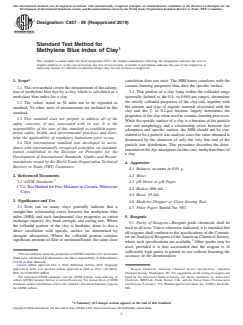
3.1 Tests run on many clays generally indicate that a straight-line relationship exists between the methylene blue index (MBI) and such fundamental clay properties as cation exchange capacity, dry bond strength, and casting rate. Where the colloidal portion of the clay is kaolinite, there is also a direct correlation with specific surface (as determined by nitrogen adsorption). Where the colloidal portion contains significant amounts of illite or montmorillonite, the same close correlation does not exist. The MBI better correlates with the ceramic-forming properties than does the specific surface.
3.2 That portion of a clay lying within the colloidal range (generally defined as the 0.5- to 0.001-μm range), determines the strictly colloidal properties of the clay and, together with the amount and type of organic material associated with the clay and the 2- to 0.2-μm fraction, largely determines the properties of the clay when used in ceramic-forming processes. While the specific surface of a clay is a function of the particle size and morphology and a relationship exists between dye adsorption and specific surface, the MBI should not be considered to be a particle size analysis since the value obtained is dominated by the character of only the very fine end of the particle size distribution. This procedure describes the determination of the dye adsorption (in this case, methylene blue) of a clay.
SCOPE
1.1 This test method covers the measurement of the adsorption of methylene blue dye by a clay, which is calculated as a methylene blue index for a clay.
1.2 The values stated in SI units are to be regarded as standard. No other units of measurement are included in this standard.
1.3 This standard does not purport to address all of the safety concerns, if any, associated with its use. It is the responsibility of the user of this standard to establish appropriate safety, health, and environmental practices and determine the applicability of regulatory limitations prior to use.
1.4 This international standard was developed in accordance with internationally recognized principles on standardization established in the Decision on Principles for the Development of International Standards, Guides and Recommendations issued by the World Trade Organization Technical Barriers to Trade (TBT) Committee.
General Information
- Status
- Published
- Publication Date
- 30-Sep-2019
- Technical Committee
- C21 - Ceramic Whitewares and Related Products
- Drafting Committee
- C21.04 - Raw Materials
Relations
- Effective Date
- 01-Oct-2019
- Effective Date
- 01-May-2007
- Effective Date
- 10-Oct-2001
- Effective Date
- 25-Jun-1982
- Referred By
ASTM D7765-18a - Standard Practice for Use of Foundry Sand in Structural Fill and Embankments - Effective Date
- 01-Oct-2019
Overview
ASTM C837-09(2019): Standard Test Method for Methylene Blue Index of Clay is an internationally recognized test method developed by ASTM. This standard specifies procedures for measuring the methylene blue index (MBI) of clay through the adsorption of methylene blue dye. The MBI helps assess key properties of clay relevant to ceramic-forming processes, providing valuable data on the clay’s colloidal characteristics, cation exchange capacity, dry bond strength, and casting rate. By following this test method, manufacturers, laboratories, and other stakeholders can evaluate the performance and suitability of clays for various industrial applications.
Key Topics
- Methylene Blue Index (MBI): The MBI quantifies the amount of methylene blue dye adsorbed per 100 grams of dry clay, serving as an indicator of the clay's colloidal and ceramic-forming properties.
- Colloidal Portion of Clay: The property of clays within the colloidal range (0.5 to 0.001 μm particles) directly impacts MBI and the overall behavior of the clay in industrial processes.
- Correlation with Clay Properties: For many clays, particularly kaolinite-rich types, the MBI shows a strong correlation with fundamental properties like cation exchange capacity and dry bond strength. However, the correlation with specific surface area is less pronounced in clays containing significant amounts of illite or montmorillonite.
- Standardized Testing Procedure: The method uses reagent-grade chemicals and precise laboratory apparatus to ensure repeatable and accurate measurement. Results are expressed using SI units as the standard.
- Test Precision: The standard describes the expected precision of the test, emphasizing that the MBI value is most representative of the very fine end of the particle-size distribution, rather than a general particle size analysis.
Applications
The ASTM C837-09(2019) test method is essential for:
- Ceramic and Porcelain Manufacturing: Determining MBI is crucial for selecting suitable raw materials for ceramic-forming, optimizing product strength and casting rate.
- Quality Control in Clay Mining and Processing: Regular measurement of MBI enables producers to monitor and maintain the desired quality for varied clay products.
- Research and Development: Laboratories use MBI data to characterize clay samples and develop new blends for enhanced bonding or specialized ceramic applications.
- Comparative Analysis: The MBI provides a benchmark for comparing different clay sources and assessing their capability for specific industrial uses.
- Geological and Environmental Studies: The method aids in identifying clay types and understanding their behavior in natural processes, which is relevant for soil science and remediation projects.
Related Standards
For comprehensive clay evaluation, ASTM C837-09(2019) is frequently used alongside related ASTM standards, such as:
- ASTM C324 - Test Method for Free Moisture in Ceramic Whiteware Clays: Assesses moisture content as part of sample preparation.
- Other ASTM Clay and Ceramic Standards: Additional methods exist for particle size analysis, mineral composition determination, and other physical and chemical property measurements.
These standards together constitute a robust framework for the quality assessment and classification of clays used in ceramics, construction, and environmental applications.
Conclusion
The ASTM C837-09(2019) Standard Test Method for Methylene Blue Index of Clay is a vital tool in the clay and ceramics industry. It provides a reliable, standardized approach for evaluating the colloidal and ceramic-forming properties of clays, supporting quality control, material selection, and process optimization. By incorporating this method, stakeholders can ensure that clay materials meet the rigorous demands of modern industrial applications.


Get Certified
Connect with accredited certification bodies for this standard

ICC Evaluation Service
Building products evaluation and certification.

QAI Laboratories
Building and construction product testing and certification.

Aboma Certification B.V.
Specialized in construction, metal, and transport sectors.
Sponsored listings
Frequently Asked Questions
ASTM C837-09(2019) is a standard published by ASTM International. Its full title is "Standard Test Method for Methylene Blue Index of Clay". This standard covers: SIGNIFICANCE AND USE 3.1 Tests run on many clays generally indicate that a straight-line relationship exists between the methylene blue index (MBI) and such fundamental clay properties as cation exchange capacity, dry bond strength, and casting rate. Where the colloidal portion of the clay is kaolinite, there is also a direct correlation with specific surface (as determined by nitrogen adsorption). Where the colloidal portion contains significant amounts of illite or montmorillonite, the same close correlation does not exist. The MBI better correlates with the ceramic-forming properties than does the specific surface. 3.2 That portion of a clay lying within the colloidal range (generally defined as the 0.5- to 0.001-μm range), determines the strictly colloidal properties of the clay and, together with the amount and type of organic material associated with the clay and the 2- to 0.2-μm fraction, largely determines the properties of the clay when used in ceramic-forming processes. While the specific surface of a clay is a function of the particle size and morphology and a relationship exists between dye adsorption and specific surface, the MBI should not be considered to be a particle size analysis since the value obtained is dominated by the character of only the very fine end of the particle size distribution. This procedure describes the determination of the dye adsorption (in this case, methylene blue) of a clay. SCOPE 1.1 This test method covers the measurement of the adsorption of methylene blue dye by a clay, which is calculated as a methylene blue index for a clay. 1.2 The values stated in SI units are to be regarded as standard. No other units of measurement are included in this standard. 1.3 This standard does not purport to address all of the safety concerns, if any, associated with its use. It is the responsibility of the user of this standard to establish appropriate safety, health, and environmental practices and determine the applicability of regulatory limitations prior to use. 1.4 This international standard was developed in accordance with internationally recognized principles on standardization established in the Decision on Principles for the Development of International Standards, Guides and Recommendations issued by the World Trade Organization Technical Barriers to Trade (TBT) Committee.
SIGNIFICANCE AND USE 3.1 Tests run on many clays generally indicate that a straight-line relationship exists between the methylene blue index (MBI) and such fundamental clay properties as cation exchange capacity, dry bond strength, and casting rate. Where the colloidal portion of the clay is kaolinite, there is also a direct correlation with specific surface (as determined by nitrogen adsorption). Where the colloidal portion contains significant amounts of illite or montmorillonite, the same close correlation does not exist. The MBI better correlates with the ceramic-forming properties than does the specific surface. 3.2 That portion of a clay lying within the colloidal range (generally defined as the 0.5- to 0.001-μm range), determines the strictly colloidal properties of the clay and, together with the amount and type of organic material associated with the clay and the 2- to 0.2-μm fraction, largely determines the properties of the clay when used in ceramic-forming processes. While the specific surface of a clay is a function of the particle size and morphology and a relationship exists between dye adsorption and specific surface, the MBI should not be considered to be a particle size analysis since the value obtained is dominated by the character of only the very fine end of the particle size distribution. This procedure describes the determination of the dye adsorption (in this case, methylene blue) of a clay. SCOPE 1.1 This test method covers the measurement of the adsorption of methylene blue dye by a clay, which is calculated as a methylene blue index for a clay. 1.2 The values stated in SI units are to be regarded as standard. No other units of measurement are included in this standard. 1.3 This standard does not purport to address all of the safety concerns, if any, associated with its use. It is the responsibility of the user of this standard to establish appropriate safety, health, and environmental practices and determine the applicability of regulatory limitations prior to use. 1.4 This international standard was developed in accordance with internationally recognized principles on standardization established in the Decision on Principles for the Development of International Standards, Guides and Recommendations issued by the World Trade Organization Technical Barriers to Trade (TBT) Committee.
ASTM C837-09(2019) is classified under the following ICS (International Classification for Standards) categories: 91.100.15 - Mineral materials and products. The ICS classification helps identify the subject area and facilitates finding related standards.
ASTM C837-09(2019) has the following relationships with other standards: It is inter standard links to ASTM C837-09(2014), ASTM C324-01(2007), ASTM C324-01e1, ASTM C324-82(1999), ASTM D7765-18a. Understanding these relationships helps ensure you are using the most current and applicable version of the standard.
ASTM C837-09(2019) is available in PDF format for immediate download after purchase. The document can be added to your cart and obtained through the secure checkout process. Digital delivery ensures instant access to the complete standard document.
Standards Content (Sample)
This international standard was developed in accordance with internationally recognized principles on standardization established in the Decision on Principles for the
Development of International Standards, Guides and Recommendations issued by the World Trade Organization Technical Barriers to Trade (TBT) Committee.
Designation: C837 − 09 (Reapproved 2019)
Standard Test Method for
Methylene Blue Index of Clay
This standard is issued under the fixed designation C837; the number immediately following the designation indicates the year of
original adoption or, in the case of revision, the year of last revision. A number in parentheses indicates the year of last reapproval. A
superscript epsilon (´) indicates an editorial change since the last revision or reapproval.
1. Scope* correlation does not exist. The MBI better correlates with the
ceramic-forming properties than does the specific surface.
1.1 This test method covers the measurement of the adsorp-
tion of methylene blue dye by a clay, which is calculated as a 3.2 That portion of a clay lying within the colloidal range
methylene blue index for a clay. (generally defined as the 0.5- to 0.001-µm range), determines
the strictly colloidal properties of the clay and, together with
1.2 The values stated in SI units are to be regarded as
the amount and type of organic material associated with the
standard. No other units of measurement are included in this
clay and the 2- to 0.2-µm fraction, largely determines the
standard.
properties of the clay when used in ceramic-forming processes.
1.3 This standard does not purport to address all of the
While the specific surface of a clay is a function of the particle
safety concerns, if any, associated with its use. It is the
size and morphology and a relationship exists between dye
responsibility of the user of this standard to establish appro-
adsorption and specific surface, the MBI should not be con-
priate safety, health, and environmental practices and deter-
sidered to be a particle size analysis since the value obtained is
mine the applicability of regulatory limitations prior to use.
dominated by the character of only the very fine end of the
1.4 This international standard was developed in accor-
particle size distribution. This procedure describes the deter-
dance with internationally recognized principles on standard-
minationofthedyeadsorption(inthiscase,methyleneblue)of
ization established in the Decision on Principles for the
a clay.
Development of International Standards, Guides and Recom-
mendations issued by the World Trade Organization Technical
4. Apparatus
Barriers to Trade (TBT) Committee.
4.1 Balance, accurate to 0.01 g.
2. Referenced Documents 4.2 Mixer.
2.1 ASTM Standards: 4.3 pH Meter or pH Paper.
C324 Test Method for Free Moisture in Ceramic Whiteware
4.4 Beaker, 600 mL.
Clays
4.5 Buret, 25 mL.
3. Significance and Use
4.6 Medicine Dropper or Glass Stirring Rod.
3.1 Tests run on many clays generally indicate that a
4.7 Filter Paper. Baroid No. 987.
straight-line relationship exists between the methylene blue
index (MBI) and such fundamental clay properties as cation 5. Reagents
exchange capacity, dry bond strength, and casting rate. Where
5.1 Purity of Reagents—Reagent grade chemicals shall be
the colloidal portion of the clay is kaolinite, there is also a
used in all tests. Unless otherwise indicated, it is intended that
direct correlation with specific surface (as determined by
all reagents shall conform to the specifications of the Commit-
nitrogen adsorption). Where the colloidal portion contains
tee onAnalytical Reagents of theAmerican Chemical Society,
significant amounts of illite or montmorillonite, the same close 3
where such specifications are available. Other grades may be
used, provided it is first ascertained that the reagent is of
sufficiently high purity to permit its use without lessening the
ThistestmethodisunderthejurisdictionofASTMCommitteeC21onCeramic
accuracy of the determination.
Whitewares and Related Productsand is the direct responsibility of Subcommittee
C21.04 on Raw Materials.
Current edition approved Oct. 1, 2019. Published October 2019. Originally
approved in 1976. Last previous edition approved in 2014 as C837 – 09 (2014). Reagent Chemicals, American Chemical Society Specifications, American
DOI: 10.1520/C0837-09R19. Chemical Society, Washington, DC. For suggestions on the testing of reagents not
For referenced ASTM standards, visit the ASTM website, www.astm.org, or listed by the American Chemical Society, see Analar Standards for Laboratory
contact ASTM Customer Service at service@astm.org. For Annual Book of ASTM Chemicals, BDH Ltd., Poole, Dorset, U.K., and the United States Pharmacopeia
Standards volume information, refer to the standard’s Document Summary page on and National Formulary, U.S. Pharmacopeial Convention, Inc. (USPC), Rockville,
the ASTM website. MD.
*A Summary of Changes section appears at the end of this stan
...
Questions, Comments and Discussion
Ask us and Technical Secretary will try to provide an answer. You can facilitate discussion about the standard in here.
Loading comments...