

ASTM F1625-00(2018)
(Specification)Standard Specification and Test Method for Rear-Mounted Bicycle Child Carriers
General Information
- Abstract
ABSTRACT
This specification covers rear-mounted bicycle child carriers. It does not cover child carriers mounted in front of handlebars or to the top tube, head tube, or behind the handlebars in front of the rider. The carrier shall be manufactured free of burrs, sharp edges, and sharp points; when present, these shall be properly covered with protective coatings to prevent injuries. In addition, the carrier shall be equipped with a rear reflector, footrests, backrest, armrests, protective devices to prevent contact of hands and feet with moving or movable components of the bicycle, and belt or capturing devices to keep the child from standing in or leaving the carrier. The carrier shall be protected against corrosion, with any plastic or synthetic components stabilized against ultraviolet radiation and resistant to ozone. Tests for high and low temperature resistance, high and low temperature drop, and strength shall be performed and shall conform to the requirements specified. Additional tests for flammability, sharp points, sharp edges, ambient drop, retention system pull, and retention system security may be performed as well.
SCOPE
1.1 This specification covers child carriers that mount to the rear of bicycles in order to transport children or accessory loads with a maximum weight of 18 kg (40 lb). This specification does not apply to child carriers that mount in front of the handlebars, or to the top tube, head tube, or behind the handlebars in front of the rider.
Note 1: In the instructions, the manufacturer must warn the rider that a load added to the bicycle will lessen the stability and alter the riding characteristics of the bicycle. This complication is particularly important when riding with children who are near the high end of the weight range.
1.2 The following safety hazards caveat pertains only to the test method portions, Sections 5, 6, and 7, of this specification: This standard does not purport to address all of the safety concerns, if any, associated with its use. It is the responsibility of the user of this standard to establish appropriate safety, health, and environmental practices and determine the applicability of regulatory limitations prior to use.
1.3 This international standard was developed in accordance with internationally recognized principles on standardization established in the Decision on Principles for the Development of International Standards, Guides and Recommendations issued by the World Trade Organization Technical Barriers to Trade (TBT) Committee.
- Status
- Published
- Publication Date
- 31-Mar-2018
- Technical Committee
- F08 - Sports Equipment, Playing Surfaces, and Facilities
- Drafting Committee
- F08.10 - Bicycles
Overview
ASTM F1625-00(2018), Standard Specification and Test Method for Rear-Mounted Bicycle Child Carriers, published by ASTM International, specifies the safety and performance requirements for child carriers designed to be mounted on the rear of bicycles. This standard ensures that rear-mounted bicycle child carriers-used for safely transporting children up to 18 kg (40 lb)-meet stringent criteria for structural integrity, child safety, and usability.
The standard covers aspects such as materials, construction, safety features, labeling, instructions, and testing methods. It does not apply to carriers mounted in front of the handlebars, on the top tube, head tube, or in positions in front of the rider.
Key Topics
- Scope: Applies specifically to rear-mounted bicycle child carriers for children up to 18 kg (40 lb). Excludes carriers in any front position.
- Safety Requirements:
- Surfaces in contact with the child must be free from burrs, sharp edges, and points, or be covered with protective coatings.
- Carriers must include a rear reflector, footrests, backrest, armrests, and protective guards to prevent hand and foot contact with moving bicycle components.
- Must use belts or retaining devices to prevent a child from standing up or leaving the carrier.
- Material Protection: Plastic or synthetic components must be UV-stabilized and ozone-resistant. Carriers must demonstrate resistance to corrosion.
- Testing Procedures:
- High and low temperature resistance and associated drop tests.
- Vibration and dynamic load tests to ensure fastener integrity and component resilience.
- Tests for flammability, sharp points, sharp edges, ambient drop, and retention system strength and security.
- Labeling and Instructions: Clear markings for maximum permissible weight, manufacturer details, and warnings about the impact on bicycle stability. Instructions must emphasize helmet use, proper installation, load limitations, and safe riding practices.
Applications
ASTM F1625-00(2018) is essential for manufacturers, distributors, retailers, and regulatory bodies involved in the design, sale, and certification of rear-mounted bicycle child carriers. Key applications include:
- Product Development & Quality Assurance: Manufacturers use the standard for designing and testing products that comply with recognized safety requirements, helping to minimize the risk of injury to child passengers.
- Procurement & Supply Chain: Retailers and purchasers use compliance with ASTM F1625 as a benchmark for selecting safe and reliable rear-mounted child carriers for bicycles.
- Certification & Regulatory Compliance: Testing laboratories and certification agencies reference this standard to verify that products meet necessary safety criteria before entering the market.
- Consumer Safety & Awareness: Clear labeling and comprehensive user instructions as mandated by the standard help parents/caregivers use rear-mounted child carriers safely and responsibly.
Related Standards
Professionals working with bicycle child carriers or involved in product certification may also reference the following related standards:
- ASTM B117 - Practice for Operating Salt Spray (Fog) Apparatus (for corrosion resistance testing)
- 16 CFR 1500.44 - Flammability
- 16 CFR 1500.48 - Sharp Points
- 16 CFR 1500.49 - Sharp Edges
- ISO/TC149/SC1 N369 - Child Seats for Bicycles: Concepts, Safety Requirements, and Testing
- ISO/TC149/SC1 N368 - Luggage Carriers for Bicycles
By conforming to ASTM F1625-00(2018), stakeholders ensure that rear-mounted bicycle child carriers are safe, robust, and suitable for both international and domestic markets, promoting child safety and product reliability.
Keywords: bicycle child carrier, rear-mounted, ASTM F1625, bicycle safety, child seat, bicycle accessories, product specification, safety testing, product labeling, compliance
Relations
- Replaces
ASTM F1625-00(2012) - Standard Specification and Test Method for Rear-Mounted Bicycle Child Carriers - Effective Date
- 01-Apr-2018
- Effective Date
- 01-Oct-2011
- Effective Date
- 01-Jul-2009
- Effective Date
- 15-Dec-2007
- Effective Date
- 01-Mar-2007
- Effective Date
- 01-Oct-2003
- Effective Date
- 10-Oct-2002
- Effective Date
- 10-Apr-1997
Get Certified
Connect with accredited certification bodies for this standard

TÜV Rheinland
TÜV Rheinland is a leading international provider of technical services.

TÜV SÜD
TÜV SÜD is a trusted partner of choice for safety, security and sustainability solutions.

DEKRA Certification Inc.
DEKRA US certification services.
Sponsored listings
Frequently Asked Questions
ASTM F1625-00(2018) is a technical specification published by ASTM International. Its full title is "Standard Specification and Test Method for Rear-Mounted Bicycle Child Carriers". This standard covers: ABSTRACT This specification covers rear-mounted bicycle child carriers. It does not cover child carriers mounted in front of handlebars or to the top tube, head tube, or behind the handlebars in front of the rider. The carrier shall be manufactured free of burrs, sharp edges, and sharp points; when present, these shall be properly covered with protective coatings to prevent injuries. In addition, the carrier shall be equipped with a rear reflector, footrests, backrest, armrests, protective devices to prevent contact of hands and feet with moving or movable components of the bicycle, and belt or capturing devices to keep the child from standing in or leaving the carrier. The carrier shall be protected against corrosion, with any plastic or synthetic components stabilized against ultraviolet radiation and resistant to ozone. Tests for high and low temperature resistance, high and low temperature drop, and strength shall be performed and shall conform to the requirements specified. Additional tests for flammability, sharp points, sharp edges, ambient drop, retention system pull, and retention system security may be performed as well. SCOPE 1.1 This specification covers child carriers that mount to the rear of bicycles in order to transport children or accessory loads with a maximum weight of 18 kg (40 lb). This specification does not apply to child carriers that mount in front of the handlebars, or to the top tube, head tube, or behind the handlebars in front of the rider. Note 1: In the instructions, the manufacturer must warn the rider that a load added to the bicycle will lessen the stability and alter the riding characteristics of the bicycle. This complication is particularly important when riding with children who are near the high end of the weight range. 1.2 The following safety hazards caveat pertains only to the test method portions, Sections 5, 6, and 7, of this specification: This standard does not purport to address all of the safety concerns, if any, associated with its use. It is the responsibility of the user of this standard to establish appropriate safety, health, and environmental practices and determine the applicability of regulatory limitations prior to use. 1.3 This international standard was developed in accordance with internationally recognized principles on standardization established in the Decision on Principles for the Development of International Standards, Guides and Recommendations issued by the World Trade Organization Technical Barriers to Trade (TBT) Committee.
ABSTRACT This specification covers rear-mounted bicycle child carriers. It does not cover child carriers mounted in front of handlebars or to the top tube, head tube, or behind the handlebars in front of the rider. The carrier shall be manufactured free of burrs, sharp edges, and sharp points; when present, these shall be properly covered with protective coatings to prevent injuries. In addition, the carrier shall be equipped with a rear reflector, footrests, backrest, armrests, protective devices to prevent contact of hands and feet with moving or movable components of the bicycle, and belt or capturing devices to keep the child from standing in or leaving the carrier. The carrier shall be protected against corrosion, with any plastic or synthetic components stabilized against ultraviolet radiation and resistant to ozone. Tests for high and low temperature resistance, high and low temperature drop, and strength shall be performed and shall conform to the requirements specified. Additional tests for flammability, sharp points, sharp edges, ambient drop, retention system pull, and retention system security may be performed as well. SCOPE 1.1 This specification covers child carriers that mount to the rear of bicycles in order to transport children or accessory loads with a maximum weight of 18 kg (40 lb). This specification does not apply to child carriers that mount in front of the handlebars, or to the top tube, head tube, or behind the handlebars in front of the rider. Note 1: In the instructions, the manufacturer must warn the rider that a load added to the bicycle will lessen the stability and alter the riding characteristics of the bicycle. This complication is particularly important when riding with children who are near the high end of the weight range. 1.2 The following safety hazards caveat pertains only to the test method portions, Sections 5, 6, and 7, of this specification: This standard does not purport to address all of the safety concerns, if any, associated with its use. It is the responsibility of the user of this standard to establish appropriate safety, health, and environmental practices and determine the applicability of regulatory limitations prior to use. 1.3 This international standard was developed in accordance with internationally recognized principles on standardization established in the Decision on Principles for the Development of International Standards, Guides and Recommendations issued by the World Trade Organization Technical Barriers to Trade (TBT) Committee.
ASTM F1625-00(2018) is classified under the following ICS (International Classification for Standards) categories: 43.150 - Cycles; 97.190 - Equipment for children. The ICS classification helps identify the subject area and facilitates finding related standards.
ASTM F1625-00(2018) has the following relationships with other standards: It is inter standard links to ASTM F1625-00(2012), ASTM B117-11, ASTM B117-09, ASTM B117-07a, ASTM B117-07, ASTM B117-03, ASTM B117-02, ASTM B117-97. Understanding these relationships helps ensure you are using the most current and applicable version of the standard.
ASTM F1625-00(2018) is available in PDF format for immediate download after purchase. The document can be added to your cart and obtained through the secure checkout process. Digital delivery ensures instant access to the complete standard document.
Standards Content (Sample)
This international standard was developed in accordance with internationally recognized principles on standardization established in the Decision on Principles for the
Development of International Standards, Guides and Recommendations issued by the World Trade Organization Technical Barriers to Trade (TBT) Committee.
Designation: F1625 −00 (Reapproved 2018) An American National Standard
Standard Specification and Test Method for
Rear-Mounted Bicycle Child Carriers
This standard is issued under the fixed designation F1625; the number immediately following the designation indicates the year of
original adoption or, in the case of revision, the year of last revision.Anumber in parentheses indicates the year of last reapproval.A
superscript epsilon (´) indicates an editorial change since the last revision or reapproval.
1. Scope 2.3 Government Standards:
Title 16,Code of Federal Regulations, Part 1500.44, Flam-
1.1 Thisspecificationcoverschildcarriersthatmounttothe
mability
rearofbicyclesinordertotransportchildrenoraccessoryloads
Title 16,Code of Federal Regulations, Part 1500.48, Sharp
with a maximum weight of 18 kg (40 lb). This specification
Points
does not apply to child carriers that mount in front of the
Title 16,Code of Federal Regulations, Part 1500.49, Sharp
handlebars, or to the top tube, head tube, or behind the
Edges
handlebars in front of the rider.
16CFR 1501, Small Parts
NOTE 1—In the instructions, the manufacturer must warn the rider that
16CFR 1303, Lead in Coatings
a load added to the bicycle will lessen the stability and alter the riding
characteristics of the bicycle. This complication is particularly important
3. Terminology
when riding with children who are near the high end of the weight range.
3.1 Definitions:
1.2 The following safety hazards caveat pertains only to the
3.1.1 bicycle child carrier—a seating device, the shape of
test method portions, Sections 5, 6, and 7, of this specification:
which is adapted to the seated position of a child and mounts
This standard does not purport to address all of the safety
to the rear of the bicycle, which keeps the child in a
concerns, if any, associated with its use. It is the responsibility
comfortable position during the ride.
of the user of this standard to establish appropriate safety,
health, and environmental practices and determine the appli-
4. Requirements
cability of regulatory limitations prior to use.
4.1 General—Childcarriersshallbedesignedandmanufac-
1.3 This international standard was developed in accor-
tured in such a way that components with which the child or
dance with internationally recognized principles on standard-
rider come into contact do not cause injuries during normal
ization established in the Decision on Principles for the
use, or when used in accordance with the manufacturer’s
Development of International Standards, Guides and Recom-
instructions.Surfacesmustbefreefromburrs,sharpedges,and
mendations issued by the World Trade Organization Technical
points; if such are present they must be covered by protective
Barriers to Trade (TBT) Committee.
coverings.Noopeningswithwhichthechild’shandscancome
in contact shall have dimensions larger than 6 mm (0.236 in.)
2. Referenced Documents
but also smaller than 13 mm (0.512 in.), that is, holes with
2.1 ASTM Standards:
dimensions between 0.236 and 0.512 in. (6 and 13 mm) are
B117Practice for Operating Salt Spray (Fog) Apparatus
forbidden.Childcarriersmustbeequippedwitharearreflector.
2.2 ISO Standards:
The manufacturer must warn the rider that a load added to the
ISO/TC149/SC1N368, Luggage Carriers for Bicycles
bicycle will lessen the stability and alter the riding character-
ISO/TC149/SC1 N369, Child Seats for Bicycles, Concepts,
istics of the bicycle.
Safety Requirements and Testing
4.2 Structure:
4.2.1 Assembly—When assembled in accordance with the
instructionsprovidedbythemanufacturer,theseatcomponents
This specification is under the jurisdiction ofASTM Committee F08 on Sports
must be firmly joined and fixed.
Equipment, Playing Surfaces, and Facilities and is the direct responsibility of
Subcommittee F08.10 on Bicycles.
4.2.2 Equipment—Child carriers shall be equipped with the
Current edition approved April 1, 2018. Published May 2018. Originally
following equipment:
approved in 1995. Last previous edition approved in 2012 as F1625–00 (2012).
4.2.2.1 Footrests,
DOI: 10.1520/F1625-00R18.
For referenced ASTM standards, visit the ASTM website, www.astm.org, or 4.2.2.2 Backrest,
contact ASTM Customer Service at service@astm.org. For Annual Book of ASTM
Standards volume information, refer to the standard’s Document Summary page on
the ASTM website. AvailablefromU.S.GovernmentPrintingOfficeSuperintendentofDocuments,
Available fromAmerican National Standards Institute (ANSI), 25 W. 43rd St., 732 N. Capitol St., NW, Mail Stop: SDE, Washington, DC 20401, http://
4th Floor, New York, NY 10036, http://www.ansi.org. www.access.gpo.gov.
Copyright © ASTM International, 100 Barr Harbor Drive, PO Box C700, West Conshohocken, PA 19428-2959. United States
F1625 − 00 (2018)
4.2.2.3 Armrests (that may be extensions of the sides of the 5. Environmental Temperature Tests
seat surface),
5.1 General—Performthetestsinthissectiononallcarriers
4.2.2.4 Protective devices that prevent contact of hands and
to determine whether there are any adverse affects on the
feet with moving or movable components of the bicycle which strength and function of the carrier under conditioned environ-
ments.
could cause injury, and
5.1.1 Conduct these environmental temperature tests prior
4.2.2.5 Belt or other capturing devices designed to restrain
to the dynamic load tests that follow.
the child from standing in or leaving the carrier. Buckles, if
used, must be difficult for the child passenger to open. 5.2 Resistance to High Temperatures:
5.2.1 Store the carrier for at least 4 h, but not more than 24
4.2.3 Attachment—The attachment process for connecting
h at a temperature of 50 6 3°C (122 6 5°F).
the seat portion of the carrier either to dedicated mounting
5.2.2 Examine the carrier for damage or distortion that
hardware or to a luggage carrier, and attachment of the
could affect the safety or function of the carrier.
mounting hardware or the luggage carrier to the bicycle frame,
5.2.3 Damage or distortion that could affect the safety or
shall be of a simple and secure procedure. If tools are required
function of the carrier constitutes failure of the test.
for mounting, mounting must be accomplished with common
5.3 High-Temperature Drop Test:
household tools, and must offer no reasonable opportunity of
5.3.1 Store the carrier for at least 4 h, but not more than 24
incorrect mounting.
h, at a temperature of 50 6 3°C (122 6 5°F).
4.2.4 Test Criteria—After testing in accordance with Sec-
5.3.2 Remove the carrier from the hot environment and
tions 5 and 6 of this specification the child carrier shall show
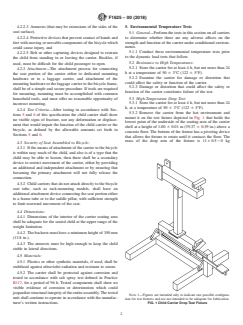
mount it on the test fixture depicted in Fig. 1 that holds the
no visible signs of fracture, nor any deformation or displace-
lowest point of the underside of the seating area of the carrier
ment that would impair the function of the child carrier or the
shell at a height of 1.00 6 0.01 m (39.37 6 0.39 in.) above a
bicycle, as defined by the allowable amounts set forth in
concrete floor. The bottom of the fixture has a pivoting device
Sections 5 and 6.
that allows the fixture to rotate until it contacts the floor. The
mass of the drop arm of the fixture is 11+0.5−0 kg
4.3 Security of Seat Assembled to Bicycle:
4.3.1 Ifthemeansofattachmentofthecarriertothebicycle
is within easy reach of the child, and also is of a type that the
child may be able to loosen, then there shall be a secondary
device to restrict movement of the carrier, either by providing
an additional and independent attachment or by ensuring that
loosening the primary attachment will not fully release the
connection.
4.3.2 Child carriers that do not attach directly to the bicycle
seat tube, such as rack-mounting models, shall have an
additional attachment device connecting the seat portion either
to a frame tube or to the saddle pillar, with sufficient strength
to limit rearward movement of the seat.
4.4 Dimensions:
4.4.1 Dimensions of the interior of the carrier seating area
shall be adequate for the seated child at the upper range of the
weight limitation.
4.4.2 Thebackrestmusthaveaminimumheightof350mm
(13.8 in.).
4.4.3 The armrests must be high enough to keep the child
stable in lateral directions.
4.5 Materials:
4.5.1 Plastics or other synthetic materials, if used, shall be
stabilized against ultraviolet radiation and resistant to ozone.
4.5.2 The carrier shall be protected against corrosion and
tested in accordance with salt spray test defined in Practice
B117, for a period of 96 h. Tested components shall show no
visible evidence of corrosion or deterioration which could
jeopardizestructuralintegrityoftheentireassembly.Thetested
NOTE 1—Figures are intended only to indicate one possible configura-
unit shall continue to operate in accordance with the manufac-
tion for test fixtures and are not intended to be adequate for fabrication.
turer’s written instructions. FIG. 1 Child Carrier Drop Test Fixture
F1625 − 00 (2018)
(24+1.0−0 lb). Within 1 min after removal from the condi-
tioned environment, release the carrier under gravity from rest
to one side or the other onto a flat concrete surface, as if the
bicycle to which it was mounted fell over.
5.3.3 Examine the carrier for damage or distortion that
could affect the safety or function of the carrier.
5.3.4 Damage or distortion that could affect the safety or
function of the carrier constitutes failure of the test.
5.4 Low-Temperature Resistance:
5.4.1 Store the carrier for at least 4 h, but not more than 24
h, at a temperature of−7 6 3°C (20 6 5°F).
5.4.2 Examine the carrier for damage or distortion that
could affect the safety or function of the carrier.
5.4.3 Damage or distortion that could affect the safety or
function of the carrier constitutes failure of the test.
5.5 Low-Temperature Drop Test:
5.5.1 Store the carrier for at least 4 h, but not more than 24
h, at a temperature of−7 6 3°C (20 6 5°F).
5.5.2 Remove the carrier from the cold environment and
mount it on the test fixture depicted in Fig. 1 that holds the
lowest point of the underside of the seating area of the carrier
shell at a height of 1.00 6 0.01 m (39.37 6 0.39 in.) above a
concrete floor. The bottom of the fixture has a pivoting device
that allows the fixture to rotate until it contacts the floor. The
mass of the drop arm is 11+0.5−0 kg (24+1.0−0 lb).
Within 1 min after removal from the conditioned environment,
release the carrier under gravity from rest to one side or the
other onto a flat concrete surface, as if the bicycle to which it
NOTE 1—Figures are intended only to indicate one possible configura-
was mounted fell over.
tion for test fixtures and are not intended to be adequate for fabrication.
5.5.3 Examine the carrier for damage or distortion that
FIG. 2 Child Carrier Vibration and Lateral Sway Test Fixture
could affect the safety or function of the carrier.
5.5.4 Damage or distortion that could affect the safety or
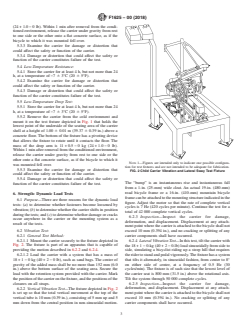
The “bump” is an instantaneous rise and instantaneous fall
function of the carrier constitutes failure of the test.
from a 1-in. (25-mm) wide cleat. An ac
...