


ASTM D3591-22
(Test Method)Standard Test Method for Determining Logarithmic Viscosity Number of Poly(Vinyl Chloride) (PVC) in Formulated Compounds
Standard Test Method for Determining Logarithmic Viscosity Number of Poly(Vinyl Chloride) (PVC) in Formulated Compounds
SIGNIFICANCE AND USE
5.1 The logarithmic viscosity number provides information on the effect of compounding or processing of PVC.
5.2 Exposure of PVC compositions to shear or to high temperatures can result in a change in the logarithmic viscosity number of the resin.
SCOPE
1.1 This test method covers the determination of the logarithmic viscosity number of poly(vinyl chloride) (PVC) homopolymers after compounding or processing.
1.2 It is the basic assumption of this technique that the formulation of the compounded resin is known and that any additives present can be separated from the resin by extraction with diethyl ether. This is necessary to permit adjustment of the amount of sample used in the test to give a resin concentration in cyclohexanone of 0.2 ± 0.002 g/100 mL.
1.3 This standard does not purport to address all of the safety concerns, if any, associated with its use. It is the responsibility of the user of this standard to establish appropriate safety, health, and environmental practices and determine the applicability of regulatory limitations prior to use. Specific precautionary statements are given in 7.3 and 8.4.1.
Note 1: This test method and ISO 1628-2 are not equivalent.
1.4 This international standard was developed in accordance with internationally recognized principles on standardization established in the Decision on Principles for the Development of International Standards, Guides and Recommendations issued by the World Trade Organization Technical Barriers to Trade (TBT) Committee.
General Information
- Status
- Published
- Publication Date
- 31-Aug-2022
- Technical Committee
- D20 - Plastics
- Drafting Committee
- D20.70 - Analytical Methods
Relations
- Effective Date
- 01-Apr-2024
- Effective Date
- 01-Feb-2024
- Effective Date
- 01-Nov-2023
- Effective Date
- 01-Nov-2023
- Refers
ASTM D1243-22e1 - Standard Test Method for Dilute Solution Viscosity of Vinyl Chloride Polymers - Effective Date
- 01-May-2022
- Effective Date
- 01-Apr-2022
- Effective Date
- 01-Jan-2020
- Effective Date
- 01-Aug-2019
- Effective Date
- 15-Apr-2019
- Effective Date
- 01-Feb-2019
- Effective Date
- 01-Dec-2018
- Effective Date
- 01-Nov-2018
- Refers
ASTM D1600-18 - Standard Terminology for Abbreviated Terms Relating to Plastics (Withdrawn 2024) - Effective Date
- 01-Jan-2018
- Effective Date
- 01-Oct-2017
- Effective Date
- 01-Oct-2017
Overview
ASTM D3591-22, titled Standard Test Method for Determining Logarithmic Viscosity Number of Poly(Vinyl Chloride) (PVC) in Formulated Compounds, is a key international standard developed by ASTM for assessing the quality of compounded or processed PVC materials. This method provides a precise procedure to measure the logarithmic viscosity number of poly(vinyl chloride) resins, offering insights into the impact of compounding, processing, and exposure to heat or shear on PVC. This testing standard is essential for manufacturers, processors, and quality control laboratories involved in PVC product development and assessment.
Key Topics
Purpose of the Test Method
The main objective of ASTM D3591-22 is to determine the logarithmic viscosity number of PVC homopolymers in formulated compounds, accounting for any effects of formulation, compounding, or processing.Sample Preparation
- The PVC sample is pressed into film form and subjected to solvent extraction to remove additives or plasticizers.
- The extracted, plasticizer-free PVC is dissolved in cyclohexanone at a specified concentration for viscosity measurement.
Viscosity Measurement
- The viscosity of the PVC solution is determined using capillary viscometers.
- The logarithmic viscosity number is calculated based on the ratio of efflux times (solution vs. solvent) and the sample concentration.
Significance and Use
- This method quantifies changes in the logarithmic viscosity number resulting from processing conditions or exposure to high shear and temperature, serving as a critical quality indicator.
Safety Considerations
- The procedure involves handling hazardous solvents such as diethyl ether and cyclohexanone. Users must implement appropriate safety, health, and environmental practices.
Applications
ASTM D3591-22 is widely used in various sectors of the PVC industry, including:
Quality Control in PVC Manufacturing
- Ensures the consistency and integrity of PVC resin after compounding or processing.
- Detects undesirable changes, such as degradation due to excessive heat or shear.
Product Development and Formulation
- Assists in optimizing formulations to achieve desired properties in end-use products.
- Allows comparison of processing effects on different PVC batches.
Material Specification and Compliance
- Provides a standardized measure used in supplier-customer agreements.
- Supports compliance with material performance specifications for PVC compounds.
Interlaboratory Comparisons
- Enables benchmarking across different laboratories by employing a reproducible and internationally recognized procedure.
Related Standards
ASTM D3591-22 references several related standards and terminology to ensure broad applicability and comparability:
- ASTM D445 - Test Method for Kinematic Viscosity of Transparent and Opaque Liquids
- ASTM D446 - Specifications for Glass Capillary Kinematic Viscometers
- ASTM D1243 - Test Method for Dilute Solution Viscosity of Vinyl Chloride Polymers
- IEEE/ASTM SI-10 - Standard for the Use of International System of Units (SI)
- ISO 1628-2 - Plastics - Determination of Viscosity Number and Limiting Viscosity Number - Part 2: Poly (Vinyl Chloride) Resins (Note: This standard and ISO 1628-2 are not considered equivalent.)
Key Benefits
- Ensures Material Consistency: Reliable determination of the viscosity number helps maintain high product quality.
- Aids Troubleshooting: Identifies the effect of processing conditions on PVC resin, supporting process optimization.
- Facilitates Communication: Establishes a common language and method for PVC quality across the supply chain.
- Supports Regulatory Compliance: Aligns with internationally recognized standardization principles.
For professionals involved in the formulation, processing, and quality assurance of poly(vinyl chloride) compounds, ASTM D3591-22 provides a robust framework for evaluating and documenting the impact of manufacturing processes on the material’s key properties.
Buy Documents

ASTM D3591-22 - Standard Test Method for Determining Logarithmic Viscosity Number of Poly(Vinyl Chloride) (PVC) in Formulated Compounds
REDLINE ASTM D3591-22 - Standard Test Method for Determining Logarithmic Viscosity Number of Poly(Vinyl Chloride) (PVC) in Formulated Compounds
Get Certified
Connect with accredited certification bodies for this standard

Smithers Quality Assessments
US management systems and product certification.

DIN CERTCO
DIN Group product certification.
Sponsored listings
Frequently Asked Questions
ASTM D3591-22 is a standard published by ASTM International. Its full title is "Standard Test Method for Determining Logarithmic Viscosity Number of Poly(Vinyl Chloride) (PVC) in Formulated Compounds". This standard covers: SIGNIFICANCE AND USE 5.1 The logarithmic viscosity number provides information on the effect of compounding or processing of PVC. 5.2 Exposure of PVC compositions to shear or to high temperatures can result in a change in the logarithmic viscosity number of the resin. SCOPE 1.1 This test method covers the determination of the logarithmic viscosity number of poly(vinyl chloride) (PVC) homopolymers after compounding or processing. 1.2 It is the basic assumption of this technique that the formulation of the compounded resin is known and that any additives present can be separated from the resin by extraction with diethyl ether. This is necessary to permit adjustment of the amount of sample used in the test to give a resin concentration in cyclohexanone of 0.2 ± 0.002 g/100 mL. 1.3 This standard does not purport to address all of the safety concerns, if any, associated with its use. It is the responsibility of the user of this standard to establish appropriate safety, health, and environmental practices and determine the applicability of regulatory limitations prior to use. Specific precautionary statements are given in 7.3 and 8.4.1. Note 1: This test method and ISO 1628-2 are not equivalent. 1.4 This international standard was developed in accordance with internationally recognized principles on standardization established in the Decision on Principles for the Development of International Standards, Guides and Recommendations issued by the World Trade Organization Technical Barriers to Trade (TBT) Committee.
SIGNIFICANCE AND USE 5.1 The logarithmic viscosity number provides information on the effect of compounding or processing of PVC. 5.2 Exposure of PVC compositions to shear or to high temperatures can result in a change in the logarithmic viscosity number of the resin. SCOPE 1.1 This test method covers the determination of the logarithmic viscosity number of poly(vinyl chloride) (PVC) homopolymers after compounding or processing. 1.2 It is the basic assumption of this technique that the formulation of the compounded resin is known and that any additives present can be separated from the resin by extraction with diethyl ether. This is necessary to permit adjustment of the amount of sample used in the test to give a resin concentration in cyclohexanone of 0.2 ± 0.002 g/100 mL. 1.3 This standard does not purport to address all of the safety concerns, if any, associated with its use. It is the responsibility of the user of this standard to establish appropriate safety, health, and environmental practices and determine the applicability of regulatory limitations prior to use. Specific precautionary statements are given in 7.3 and 8.4.1. Note 1: This test method and ISO 1628-2 are not equivalent. 1.4 This international standard was developed in accordance with internationally recognized principles on standardization established in the Decision on Principles for the Development of International Standards, Guides and Recommendations issued by the World Trade Organization Technical Barriers to Trade (TBT) Committee.
ASTM D3591-22 is classified under the following ICS (International Classification for Standards) categories: 83.080.20 - Thermoplastic materials. The ICS classification helps identify the subject area and facilitates finding related standards.
ASTM D3591-22 has the following relationships with other standards: It is inter standard links to ASTM D445-24, ASTM D883-24, ASTM D883-23, ASTM D445-23, ASTM D1243-22e1, ASTM E456-13a(2022)e1, ASTM D883-20, ASTM D883-19c, ASTM D883-19a, ASTM D883-19, ASTM D883-18a, ASTM D883-18, ASTM D1600-18, ASTM E456-13A(2017)e3, ASTM E456-13A(2017)e1. Understanding these relationships helps ensure you are using the most current and applicable version of the standard.
ASTM D3591-22 is available in PDF format for immediate download after purchase. The document can be added to your cart and obtained through the secure checkout process. Digital delivery ensures instant access to the complete standard document.
Standards Content (Sample)
This international standard was developed in accordance with internationally recognized principles on standardization established in the Decision on Principles for the
Development of International Standards, Guides and Recommendations issued by the World Trade Organization Technical Barriers to Trade (TBT) Committee.
Designation: D3591 − 22
Standard Test Method for
Determining Logarithmic Viscosity Number of Poly(Vinyl
Chloride) (PVC) in Formulated Compounds
This standard is issued under the fixed designation D3591; the number immediately following the designation indicates the year of
original adoption or, in the case of revision, the year of last revision. A number in parentheses indicates the year of last reapproval. A
superscript epsilon (´) indicates an editorial change since the last revision or reapproval.
1. Scope* D1243 Test Method for Dilute Solution Viscosity of Vinyl
Chloride Polymers
1.1 This test method covers the determination of the loga-
D1600 TerminologyforAbbreviatedTermsRelatingtoPlas-
rithmic viscosity number of poly(vinyl chloride) (PVC) ho-
tics
mopolymers after compounding or processing.
E456 Terminology Relating to Quality and Statistics
1.2 It is the basic assumption of this technique that the
E691 Practice for Conducting an Interlaboratory Study to
formulation of the compounded resin is known and that any
Determine the Precision of a Test Method
additives present can be separated from the resin by extraction
E2251 Specification for Liquid-in-Glass ASTM Thermom-
withdiethylether.Thisisnecessarytopermitadjustmentofthe
eters with Low-Hazard Precision Liquids
amount of sample used in the test to give a resin concentration
IEEE/ASTM SI-10 Standard for the Use of International
in cyclohexanone of 0.2 6 0.002 g/100 mL.
System of Units (SI)
1.3 This standard does not purport to address all of the 2.2 ISO Standard:
safety concerns, if any, associated with its use. It is the
1628-2 Plastics—Determination of Viscosity Number and
responsibility of the user of this standard to establish appro- Limiting Viscosity Number—Part 2: Poly (Vinyl Chlo-
priate safety, health, and environmental practices and deter-
ride) Resins
mine the applicability of regulatory limitations prior to use.
3. Terminology
Specific precautionary statements are given in 7.3 and 8.4.1.
3.1 Units and symbols used in this test method are those
NOTE 1—This test method and ISO 1628-2 are not equivalent.
recommended in IEEE/ASTM SI-10.
1.4 This international standard was developed in accor-
3.2 Definitions—For definitions of terms pertaining to plas-
dance with internationally recognized principles on standard-
tics used in this test method, refer to Terminology D883. For
ization established in the Decision on Principles for the
definitions of abbreviations used in this test method, refer to
Development of International Standards, Guides and Recom-
Terminology D1600, unless otherwise indicated. For defini-
mendations issued by the World Trade Organization Technical
tions of terms that appear in this test method relating to quality
Barriers to Trade (TBT) Committee.
and statistics, refer to Terminology E456.
3.2.1 The term logarithmic viscosity number is defined by
2. Referenced Documents
the equation is 9.1.
2.1 ASTM Standards:
D445 Test Method for Kinematic Viscosity of Transparent
4. Summary of Test Method
and Opaque Liquids (and Calculation of Dynamic Viscos-
4.1 The sample is pressed into a thin film and extracted to
ity)
remove the plasticizer.
D446 Specifications and Operating Instructions for Glass
4.2 The plasticizer-free film is dissolved in cyclohexanone
Capillary Kinematic Viscometers
and centrifuged to remove insoluble matter.
D883 Terminology Relating to Plastics
4.3 Theviscosityofthecyclohexanonesolutionismeasured
in accordance with Test Method D1243.
This test method is under the jurisdiction ofASTM Committee D20 on Plastics
and is the direct responsibility of Subcommittee D20.70 on Analytical Methods.
5. Significance and Use
Current edition approved Sept. 1, 2022. Published September 2022. Originally
approved in 1977. Last previous edition approved in 2017 as D3591 – 17. DOI: 5.1 The logarithmic viscosity number provides information
10.1520/D3591-22.
on the effect of compounding or processing of PVC.
For referenced ASTM standards, visit the ASTM website, www.astm.org, or
contact ASTM Customer Service at service@astm.org. For Annual Book of ASTM
Standards volume information, refer to the standard’s Document Summary page on Available fromAmerican National Standards Institute (ANSI), 25 W. 43rd St.,
the ASTM website. 4th Floor, New York, NY 10036, http://www.ansi.org.
*A Summary of Changes section appears at the end of this standard
Copyright © ASTM International, 100 Barr Harbor Drive, PO Box C700, West Conshohocken, PA 19428-2959. United States
D3591 − 22
5.2 Exposure of PVC compositions to shear or to high 8.5 Place the flask in an evacuated desiccator for a mini-
temperatures can result in a change in the logarithmic viscosity mumof1hto remove the last traces of ether.
number of the resin.
8.6 Weigh, to 60.2 mg, the flask containing the extracted
plasticizer.
6. Apparatus
8.7 Calculate the percentage plasticizer as follows:
6.1 Centrifuge, capable of 2500 rpm with 100-mL sample
Plasticizer,% 5 A 3100 /B (1)
~ !
container.
where:
6.2 Heated Hydraulic Press, capable of 620-kN ram force
and a temperature of 165°C.
A = weight of extracted plasticizer (7.6), and
B = sample weight (7.2).
6.3 Soxhlet Extraction Apparatus with a 150-mLflask and a
27 by 100-mm thimble. 8.8 Dry the film to remove all solvent.
8.8.1 Theextractedfilmmustbefreeofplasticizer.Errorsin
6.4 Volumetric Flasks, 100-mL.
excess of 10 % will result from small residual amounts of
6.5 Viscometers.
plasticizer. Examine the extracted film by infrared spectros-
copytoascertainthattheplasticizerlevelislessthan0.05 %in
6.6 Infrared Spectrophotometer.
order to obtain satisfactory results. An example for a carbonyl
6.7 Filter Funnel, funnel, Hirsch-Type; borosilicate glass;
containing plasticizer is shown in Fig. 1 and Fig. 2.
with coarse fritted disc, pore size: 40–60 µm.
6.8 Thermometer, standard, in accordance withTest Method
E2251.
7. Reagents
7.1 Cyclohexanone, high-purity (see Annex A1).
7.2 Diethyl Ether, anhydrous, reagent grade.
7.3 (Warning—Safety precautions should be taken to avoid
personal contact, to eliminate toxic vapors, and to guard
against explosive hazards in accordance with the hazardous
nature of the particular reagent being used.)
8. Procedure
8.1 Prepare the PVC sample for extraction by pressing a
film. The film should be 0.02 to 0.5 mm (1 to 2 mil) thick.
Prepare two films in order to make duplicate runs.
8.1.1 Heat the hydraulic press to 165°C (330°F).
8.1.2 Place2gof sample between two sheets of aluminum
foil and insert into the press.
8.1.3 Allow the sample to come to temperature for 2.5 min.
During the next 0.5 min, increase the force on the sample to
620 kN. Maintain the force for 3 min, then cool while
maintaining the force.
FIG. 1 Calibration Curve, 1 % Plasticizer in PVC Resin at 5.8 µm
8.2 Weigh, to 60.2 mg, approximately1gof pressed film
into a 27 by 100-mm extraction thimble. 8.9 Determine the sample size of the extracted film that will
yield 0.02 6 0.002 g of PVC resin as follows:
8.3 PlacethethimbleinaSoxhletextractionapparatusfitted
100 2 P
with a tared 150-mL flask, and extract with 120 mL of diethyl
F 5 30.2 (2)
R
ether for 20 h.
8.4 Remove the tared 150-mL flask containing the diethyl
where:
ether and extracted plasticizer from the extraction apparatus,
F = weight of extracted film, g,
and gently heat to boil off the ether.
P = pl
...
This document is not an ASTM standard and is intended only to provide the user of an ASTM standard an indication of what changes have been made to the previous version. Because
it may not be technically possible to adequately depict all changes accurately, ASTM recommends that users consult prior editions as appropriate. In all cases only the current version
of the standard as published by ASTM is to be considered the official document.
Designation: D3591 − 17 D3591 − 22
Standard Test Method for
Determining Logarithmic Viscosity Number of Poly(Vinyl
Chloride) (PVC) in Formulated Compounds
This standard is issued under the fixed designation D3591; the number immediately following the designation indicates the year of
original adoption or, in the case of revision, the year of last revision. A number in parentheses indicates the year of last reapproval. A
superscript epsilon (´) indicates an editorial change since the last revision or reapproval.
1. Scope*
1.1 This test method covers the determination of the logarithmic viscosity number of poly(vinyl chloride) (PVC) homopolymers
after compounding or processing.
1.2 It is the basic assumption of this technique that the formulation of the compounded resin is known and that any additives
present can be separated from the resin by extraction with diethyl ether. This is necessary to permit adjustment of the amount of
sample used in the test to give a resin concentration in cyclohexanone of 0.2 6 0.002 g/100 mL.
1.3 This standard does not purport to address all of the safety concerns, if any, associated with its use. It is the responsibility
of the user of this standard to establish appropriate safety, health, and environmental practices and determine the applicability of
regulatory limitations prior to use. Specific precautionary statements are given in 7.3 and 8.4.1.
NOTE 1—This test method and ISO 1628-2 are not equivalent.
1.4 This international standard was developed in accordance with internationally recognized principles on standardization
established in the Decision on Principles for the Development of International Standards, Guides and Recommendations issued
by the World Trade Organization Technical Barriers to Trade (TBT) Committee.
2. Referenced Documents
2.1 ASTM Standards:
D445 Test Method for Kinematic Viscosity of Transparent and Opaque Liquids (and Calculation of Dynamic Viscosity)
D446 Specifications and Operating Instructions for Glass Capillary Kinematic Viscometers
D883 Terminology Relating to Plastics
D1243 Test Method for Dilute Solution Viscosity of Vinyl Chloride Polymers
D2124D1600 Test Method for Analysis of Components in Poly(Vinyl Chloride) Compounds Using an Infrared Spectrophoto-
metric TechniqueTerminology for Abbreviated Terms Relating to Plastics (Withdrawn 2020)
E456 Terminology Relating to Quality and Statistics
E691 Practice for Conducting an Interlaboratory Study to Determine the Precision of a Test Method
E2251 Specification for Liquid-in-Glass ASTM Thermometers with Low-Hazard Precision Liquids
E2935 Practice for Evaluating Equivalence of Two Testing Processes
IEEE/ASTM SI-10 Standard for the Use of International System of Units (SI)
This test method is under the jurisdiction of ASTM Committee D20 on Plastics and is the direct responsibility of Subcommittee D20.70 on Analytical Methods.
Current edition approved Dec. 1, 2017Sept. 1, 2022. Published January 2018September 2022. Originally approved in 1977. Last previous edition approved in 20112017
as D3591 – 97D3591 – 17.(2011). DOI: 10.1520/D3591-17.10.1520/D3591-22.
For referenced ASTM standards, visit the ASTM website, www.astm.org, or contact ASTM Customer Service at service@astm.org. For Annual Book of ASTM Standards
volume information, refer to the standard’s Document Summary page on the ASTM website.
*A Summary of Changes section appears at the end of this standard
Copyright © ASTM International, 100 Barr Harbor Drive, PO Box C700, West Conshohocken, PA 19428-2959. United States
D3591 − 22
2.2 ISO Standard:
1628-2 Plastics—Determination of Viscosity Number and Limiting Viscosity Number—Part 2: Poly (Vinyl Chloride) Resins
3. Terminology
3.1 Units and symbols used in this test method are those recommended in IEEE/ASTM SI-10.
3.2 Definitions of Terms Specific to This Standard:
3.2.1 The term logarithmic viscosity number is defined by the equation is 9.1.
3.2 Definitions—For definitions of terms pertaining to plastics used in this test method, refer to Terminology D883. For definitions
of abbreviations used in this test method, refer to Terminology D1600, unless otherwise indicated. For definitions of terms that
appear in this test method relating to quality and statistics, refer to Terminology E456.
3.2.1 The term logarithmic viscosity number is defined by the equation is 9.1.
4. Summary of Test Method
4.1 The sample is pressed into a thin film and extracted to remove the plasticizer.
4.2 The plasticizer-free film is dissolved in cyclohexanone and centrifuged to remove insoluble matter.
4.3 The viscosity of the cyclohexanone solution is measured in accordance with Test Method D1243.
5. Significance and Use
5.1 The logarithmic viscosity number provides information on the effect of compounding or processing of PVC.
5.2 Exposure of PVC compositions to shear or to high temperatures can result in a change in the logarithmic viscosity number
of the resin.
6. Apparatus
6.1 Centrifuge, capable of 2500 rpm with 100-mL sample container.
6.2 Heated Hydraulic Press, capable of 620-kN ram force and a temperature of 165°C.
6.3 Soxhlet Extraction Apparatus with a 150-mL flask and a 27 by 100-mm thimble.
6.4 Volumetric Flasks, 100-mL.
6.5 Viscometers.
6.6 Infrared Spectrophotometer,Spectrophotometer. see 5.4 of Method D2124.
6.7 Filter Funnel, funnel, Hirsch-Type; borosilicate glass; with coarse fritted disc, pore size: 40–60 μm.
6.8 Thermometer, standard, in accordance with Test Method E2251.
7. Reagents
7.1 Cyclohexanone, high-purity (see Annex A1).
Available from American National Standards Institute (ANSI), 25 W. 43rd St., 4th Floor, New York, NY 10036, http://www.ansi.org.
ASTM Ubbelohde Size 1 or Cannon-Ubbelohde No. 75 have been found satisfactory for this purpose.
D3591 − 22
7.2 Diethyl Ether, anhydrous, reagent grade.
7.3 (Warning—Safety precautions should be taken to avoid personal contact, to eliminate toxic vapors, and to guard against
explosive hazards in accordance with the hazardous nature of the particular reagent being used.)
8. Procedure
8.1 Prepare the PVC sample for extraction by pressing a film. The film should be 0.02 to 0.5 mm (1 to 2 mil) thick. Prepare two
films in order to make duplicate runs.
8.1.1 Heat the hydraulic press to 165°C (330°F).
8.1.2 Place 2 g of sample between two sheets of aluminum foil and insert into the press.
8.1.3 Allow the sample to come to temperature for 2.5 min. During the next 0.5 min, increase the force on the sample to 620 kN.
Maintain the force for 3 min, then cool while maintaining the force.
8.2 Weigh, to 60.2 mg, approximately 1 g of pressed film into a 27 by 100-mm extraction thimble.
8.3 Place the thimble in a Soxhlet extraction apparatus fitted with a tared 150-mL flask, and extract with 120 mL of diethyl ether
for 20 h.
8.4 Remove the tared 150-mL flask containing the diethyl ether and extracted plasticizer from the extraction apparatus, and gently
heat to boil off the ether.
8.4.1 (Warning—When evaporating a quantity of ether to near dryness, precautions should be taken to guard against an explosive
hazard, due to peroxides which may be in the ether or which may have been formed during use.)
8.5 Place the flask in an evacuated desiccator for a minimum of 1 h to remove the last traces of ether.
8.6 Weigh, to 60.2 mg, the flask containing the extracted plasticizer.
8.7 Calculate the percentage plasticizer as follows:
Plasticizer,%5 A 3100 /B (1)
~ !
where:
A = weight of extracted plasticizer (7.6), and
B = sample weight (7.2).
8.8 Dry the film to remove all solvent.
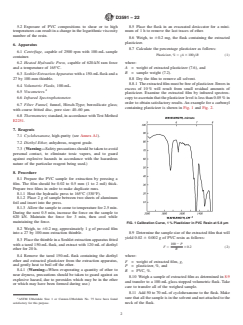
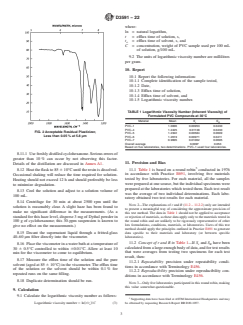
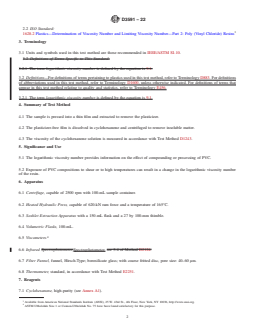
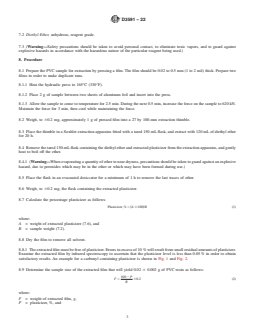
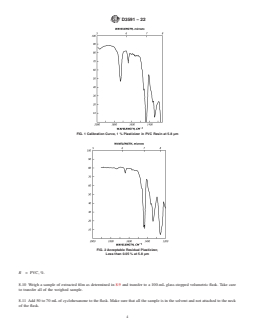
8.8.1 The extracted film must be free of plasticizer. Errors in excess of 10 % will result from small residual amounts of plasticizer.
Examine the extracted film by infrared spectroscopy to ascertain that the plasticizer level is less than 0.05 % in order to obtain
satisfactory results. An example for a carbonyl containing plasticizer is shown in Fig. 1 and Fig. 2.
8.9 Determine the sample size of the extracted film that will yield 0.02 6 0.002 g of PVC resin as follows:
100 2 P
F 5 30.2 (2)
R
where:
F = weight of extracted film, g,
P = plasticizer, %, and
...
Questions, Comments and Discussion
Ask us and Technical Secretary will try to provide an answer. You can facilitate discussion about the standard in here.
Loading comments...