

ASTM F2980-13(2017)
(Test Method)Standard Test Method for Analysis of Heavy Metals in Glass by Field Portable X-Ray Fluorescence (XRF)
General Information
- Abstract
SIGNIFICANCE AND USE
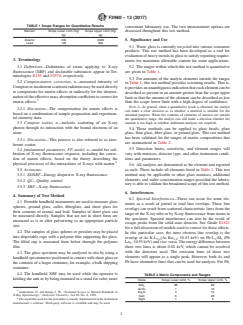
5.1 Waste glass is currently recycled into various consumer products. This test method has been developed as a tool for evaluation of heavy metals in glass to satisfy reporting requirements for maximum allowable content for some applications.
5.2 The ranges within which this test method is quantitative are given in Table 1.
5.3 For amounts of the analyte elements outside the ranges in Table 1, this test method provides screening results. That is, it provides an unambiguous indication that each element can be described as present in an amount greater than the scope upper limit or that the amount of the element can be described as less than the scope lower limit with a high degree of confidence.
Note 2: In general, when a quantitative result is obtained, the analyst can make a clear decision as to whether a material is suitable for the intended purpose. When the contents of elements of interest are outside the quantitative range, the analyst can still make a decision whether the amount is too high or whether additional analyses are required.
5.4 These methods can be applied to glass beads, plate glass, float glass, fiber glass, or ground glass. This test method has been validated for the ranges of matrix compositions that are summarized in Table 2.
5.5 Detection limits, sensitivity, and element ranges will vary with matrices, detector type, and other instrument conditions and parameters.
5.6 All analytes are determined as the element and reported as such. These include all elements listed in Table 1. This test method may be applicable to other glass matrices, additional elements, and wider concentration ranges provided the laboratory is able to validate the broadened scope of this test method.
SCOPE
1.1 This test method covers field portable X-ray fluorescence (XRF) spectrometric procedures for analyses of arsenic and lead in glass compositions using field portable energy dispersive XRF spectrometers.
1.2 The mass fraction range of arsenic within which this test method is quantitative is given in Table 1. Scope limits were determined from the interlaboratory study results using the approach given in Practice E1601.
1.3 The mass fraction range for which lead was tested is given in Table 1. However, lead results cannot be considered quantitative on the basis of single-sample results because the precision performance is not good enough to allow laboratories to compare results in a quantitative manner.
Note 1: The performance of this test method was evaluated using results based on single-sample determinations from specimens composed of glass beads. One laboratory has determined that performance can be significantly improved by basing reported results on the mean of determinations from multiple samples to overcome inherent heterogeneity of elements in glass beads, especially the element lead. Additional information is provided in Section 17 on Precision and Bias.
1.3.1 To obtain quantitative performance, lead results must consist of the average of four or more determinations.
1.4 The values stated in SI units are to be regarded as standard. No other units of measurement are included in this standard.
1.5 This standard does not purport to address all of the safety concerns, if any, associated with its use. It is the responsibility of the user of this standard to establish appropriate safety, health, and environmental practices and determine the applicability of regulatory limitations prior to use. Some specific hazards statements are given in Section 7 on Hazards.
1.6 This international standard was developed in accordance with internationally recognized principles on standardization established in the Decision on Principles for the Development of International Standards, Guides and Recommendations issued by the World Trade Organization Technical Barriers to Trade (TBT) Committee.
- Status
- Published
- Publication Date
- 31-Oct-2017
- Technical Committee
- F40 - Declarable Substances in Materials
- Drafting Committee
- F40.01 - Test Methods
Overview
ASTM F2980-13(2017) is the standard test method for analyzing heavy metals-specifically arsenic and lead-in glass using field portable X-ray fluorescence (XRF) spectrometers. Developed by ASTM International, this method addresses the need to assess the presence and concentration of heavy metals in glass products, particularly recycled glass used in consumer goods. With XRF, laboratories and field personnel can quickly determine if heavy metals meet regulatory limits for various applications, providing both quantitative results within validated ranges and reliable screening for content above or below those limits.
Key Topics
- Field Portable XRF Analysis: Utilizes handheld or portable XRF instruments for the rapid, on-site assessment of arsenic and lead in multiple forms of glass including beads, plate glass, float glass, fiber glass, and ground glass.
- Quantitative and Screening Ranges: The method provides quantitative data for arsenic (240-2000 mg/kg) and lead (120-500 mg/kg) when levels fall within validated ranges. For samples outside these ranges, the method offers clear screening results, indicating levels above or below the method’s scope.
- Sample Types and Preparation: Applicable to various glass types; minimal sample preparation is needed when samples and standards are similar in form and particle size.
- Instrument and Method Variability: Performance may vary depending on the matrix, detector type, instrument settings, and sample heterogeneity, particularly in lead determination.
- Reporting and Safety: Results are reported in SI units. The standard stresses the implementer’s responsibility for establishing safety, health, and environmental practices during XRF analysis.
Applications
- Glass Manufacturing and Recycling: Ensures that recycled glass used in consumer products such as glassware, tiles, and countertops complies with heavy metal content regulations.
- Product Compliance Testing: Assists manufacturers and regulatory agencies in verifying that glass materials meet maximum allowable concentrations of arsenic and lead for safety and regulatory conformity.
- Screening in Field and Laboratory: Offers reliable, rapid screening capabilities for quality control in both laboratory and field environments, making it ideal for continuous or batch sampling.
- Environmental and Waste Management: Supports environmental assessments and management of glass waste streams by detecting and monitoring potential heavy metal contamination.
- Supply Chain Management: Useful for stakeholders in the glass supply chain to ensure their materials are free from hazardous levels of heavy metals, thus aiding in risk mitigation and compliance reporting.
Related Standards
- ASTM E135 / F2576: Terminology standards related to analytical chemistry and declarable substances in materials.
- ASTM E1601: Practice for interlaboratory studies, underpinning method validation and precision.
- ASTM D75/D75M: Sampling aggregates, relevant when collecting glass samples from larger lots.
- ANSI N43.2: Pertains to radiation safety for X-ray analysis equipment, relevant for safe operation.
- AASHTO TP-97-11: Method for testing glass beads used in pavement markings, shares relevance for sample preparation and handling.
Practical Value
By employing the ASTM F2980-13(2017) standard, organizations gain a fast, non-destructive analytical approach for heavy metal analysis in glass. This supports regulatory compliance, product safety, and environmental stewardship, while allowing for flexible deployment in both laboratory and field settings. The method also helps companies efficiently manage risks associated with hazardous substances in recycled and manufactured glass products.
Keywords: XRF, heavy metals in glass, arsenic, lead, field portable XRF, ASTM F2980, glass recycling, compliance testing, environmental safety, consumer products, quantitative analysis, screening method.
Relations
- Effective Date
- 01-Nov-2017
- Effective Date
- 01-Dec-2023
- Effective Date
- 01-Jan-2020
- Effective Date
- 01-Nov-2019
- Effective Date
- 01-Nov-2019
- Effective Date
- 15-May-2019
- Effective Date
- 15-Dec-2017
- Effective Date
- 15-Nov-2017
- Effective Date
- 01-Jan-2017
- Effective Date
- 15-May-2016
- Effective Date
- 01-Aug-2015
- Effective Date
- 01-Jul-2015
- Effective Date
- 15-May-2015
- Effective Date
- 15-May-2015
- Effective Date
- 15-Aug-2014
Frequently Asked Questions
ASTM F2980-13(2017) is a standard published by ASTM International. Its full title is "Standard Test Method for Analysis of Heavy Metals in Glass by Field Portable X-Ray Fluorescence (XRF)". This standard covers: SIGNIFICANCE AND USE 5.1 Waste glass is currently recycled into various consumer products. This test method has been developed as a tool for evaluation of heavy metals in glass to satisfy reporting requirements for maximum allowable content for some applications. 5.2 The ranges within which this test method is quantitative are given in Table 1. 5.3 For amounts of the analyte elements outside the ranges in Table 1, this test method provides screening results. That is, it provides an unambiguous indication that each element can be described as present in an amount greater than the scope upper limit or that the amount of the element can be described as less than the scope lower limit with a high degree of confidence. Note 2: In general, when a quantitative result is obtained, the analyst can make a clear decision as to whether a material is suitable for the intended purpose. When the contents of elements of interest are outside the quantitative range, the analyst can still make a decision whether the amount is too high or whether additional analyses are required. 5.4 These methods can be applied to glass beads, plate glass, float glass, fiber glass, or ground glass. This test method has been validated for the ranges of matrix compositions that are summarized in Table 2. 5.5 Detection limits, sensitivity, and element ranges will vary with matrices, detector type, and other instrument conditions and parameters. 5.6 All analytes are determined as the element and reported as such. These include all elements listed in Table 1. This test method may be applicable to other glass matrices, additional elements, and wider concentration ranges provided the laboratory is able to validate the broadened scope of this test method. SCOPE 1.1 This test method covers field portable X-ray fluorescence (XRF) spectrometric procedures for analyses of arsenic and lead in glass compositions using field portable energy dispersive XRF spectrometers. 1.2 The mass fraction range of arsenic within which this test method is quantitative is given in Table 1. Scope limits were determined from the interlaboratory study results using the approach given in Practice E1601. 1.3 The mass fraction range for which lead was tested is given in Table 1. However, lead results cannot be considered quantitative on the basis of single-sample results because the precision performance is not good enough to allow laboratories to compare results in a quantitative manner. Note 1: The performance of this test method was evaluated using results based on single-sample determinations from specimens composed of glass beads. One laboratory has determined that performance can be significantly improved by basing reported results on the mean of determinations from multiple samples to overcome inherent heterogeneity of elements in glass beads, especially the element lead. Additional information is provided in Section 17 on Precision and Bias. 1.3.1 To obtain quantitative performance, lead results must consist of the average of four or more determinations. 1.4 The values stated in SI units are to be regarded as standard. No other units of measurement are included in this standard. 1.5 This standard does not purport to address all of the safety concerns, if any, associated with its use. It is the responsibility of the user of this standard to establish appropriate safety, health, and environmental practices and determine the applicability of regulatory limitations prior to use. Some specific hazards statements are given in Section 7 on Hazards. 1.6 This international standard was developed in accordance with internationally recognized principles on standardization established in the Decision on Principles for the Development of International Standards, Guides and Recommendations issued by the World Trade Organization Technical Barriers to Trade (TBT) Committee.
SIGNIFICANCE AND USE 5.1 Waste glass is currently recycled into various consumer products. This test method has been developed as a tool for evaluation of heavy metals in glass to satisfy reporting requirements for maximum allowable content for some applications. 5.2 The ranges within which this test method is quantitative are given in Table 1. 5.3 For amounts of the analyte elements outside the ranges in Table 1, this test method provides screening results. That is, it provides an unambiguous indication that each element can be described as present in an amount greater than the scope upper limit or that the amount of the element can be described as less than the scope lower limit with a high degree of confidence. Note 2: In general, when a quantitative result is obtained, the analyst can make a clear decision as to whether a material is suitable for the intended purpose. When the contents of elements of interest are outside the quantitative range, the analyst can still make a decision whether the amount is too high or whether additional analyses are required. 5.4 These methods can be applied to glass beads, plate glass, float glass, fiber glass, or ground glass. This test method has been validated for the ranges of matrix compositions that are summarized in Table 2. 5.5 Detection limits, sensitivity, and element ranges will vary with matrices, detector type, and other instrument conditions and parameters. 5.6 All analytes are determined as the element and reported as such. These include all elements listed in Table 1. This test method may be applicable to other glass matrices, additional elements, and wider concentration ranges provided the laboratory is able to validate the broadened scope of this test method. SCOPE 1.1 This test method covers field portable X-ray fluorescence (XRF) spectrometric procedures for analyses of arsenic and lead in glass compositions using field portable energy dispersive XRF spectrometers. 1.2 The mass fraction range of arsenic within which this test method is quantitative is given in Table 1. Scope limits were determined from the interlaboratory study results using the approach given in Practice E1601. 1.3 The mass fraction range for which lead was tested is given in Table 1. However, lead results cannot be considered quantitative on the basis of single-sample results because the precision performance is not good enough to allow laboratories to compare results in a quantitative manner. Note 1: The performance of this test method was evaluated using results based on single-sample determinations from specimens composed of glass beads. One laboratory has determined that performance can be significantly improved by basing reported results on the mean of determinations from multiple samples to overcome inherent heterogeneity of elements in glass beads, especially the element lead. Additional information is provided in Section 17 on Precision and Bias. 1.3.1 To obtain quantitative performance, lead results must consist of the average of four or more determinations. 1.4 The values stated in SI units are to be regarded as standard. No other units of measurement are included in this standard. 1.5 This standard does not purport to address all of the safety concerns, if any, associated with its use. It is the responsibility of the user of this standard to establish appropriate safety, health, and environmental practices and determine the applicability of regulatory limitations prior to use. Some specific hazards statements are given in Section 7 on Hazards. 1.6 This international standard was developed in accordance with internationally recognized principles on standardization established in the Decision on Principles for the Development of International Standards, Guides and Recommendations issued by the World Trade Organization Technical Barriers to Trade (TBT) Committee.
ASTM F2980-13(2017) is classified under the following ICS (International Classification for Standards) categories: 81.040.10 - Raw materials and raw glass. The ICS classification helps identify the subject area and facilitates finding related standards.
ASTM F2980-13(2017) has the following relationships with other standards: It is inter standard links to ASTM F2980-13, ASTM D6299-23a, ASTM E135-20, ASTM E1601-19, ASTM D75/D75M-19, ASTM E135-19, ASTM D6299-17b, ASTM D6299-17a, ASTM D6299-17, ASTM E135-16, ASTM F2576-15a, ASTM E135-15a, ASTM F2576-15, ASTM E135-15, ASTM E135-14b. Understanding these relationships helps ensure you are using the most current and applicable version of the standard.
ASTM F2980-13(2017) is available in PDF format for immediate download after purchase. The document can be added to your cart and obtained through the secure checkout process. Digital delivery ensures instant access to the complete standard document.
Standards Content (Sample)
This international standard was developed in accordance with internationally recognized principles on standardization established in the Decision on Principles for the
Development of International Standards, Guides and Recommendations issued by the World Trade Organization Technical Barriers to Trade (TBT) Committee.
Designation: F2980 − 13 (Reapproved 2017)
Standard Test Method for
Analysis of Heavy Metals in Glass by Field Portable X-Ray
Fluorescence (XRF)
This standard is issued under the fixed designation F2980; the number immediately following the designation indicates the year of
original adoption or, in the case of revision, the year of last revision. A number in parentheses indicates the year of last reapproval. A
superscript epsilon (´) indicates an editorial change since the last revision or reapproval.
1. Scope ization established in the Decision on Principles for the
Development of International Standards, Guides and Recom-
1.1 This test method covers field portable X-ray fluores-
mendations issued by the World Trade Organization Technical
cence (XRF) spectrometric procedures for analyses of arsenic
Barriers to Trade (TBT) Committee.
and lead in glass compositions using field portable energy
dispersive XRF spectrometers.
2. Referenced Documents
1.2 Themassfractionrangeofarsenicwithinwhichthistest
2.1 ASTM Standards:
method is quantitative is given in Table 1. Scope limits were
D75/D75M Practice for Sampling Aggregates
determined from the interlaboratory study results using the
D6299 Practice for Applying Statistical Quality Assurance
approach given in Practice E1601.
and Control Charting Techniques to Evaluate Analytical
1.3 The mass fraction range for which lead was tested is
Measurement System Performance
given in Table 1. However, lead results cannot be considered
E29 Practice for Using Significant Digits in Test Data to
quantitative on the basis of single-sample results because the
Determine Conformance with Specifications
precisionperformanceisnotgoodenoughtoallowlaboratories
E135 Terminology Relating to Analytical Chemistry for
to compare results in a quantitative manner.
Metals, Ores, and Related Materials
E177 Practice for Use of the Terms Precision and Bias in
NOTE 1—The performance of this test method was evaluated using
ASTM Test Methods
results based on single-sample determinations from specimens composed
of glass beads. One laboratory has determined that performance can be
E691 Practice for Conducting an Interlaboratory Study to
significantly improved by basing reported results on the mean of deter-
Determine the Precision of a Test Method
minations from multiple samples to overcome inherent heterogeneity of
E1361 Guide for Correction of Interelement Effects in
elements in glass beads, especially the element lead. Additional informa-
X-Ray Spectrometric Analysis
tion is provided in Section 17 on Precision and Bias.
E1601 Practice for Conducting an Interlaboratory Study to
1.3.1 To obtain quantitative performance, lead results must
Evaluate the Performance of an Analytical Method
consist of the average of four or more determinations.
E1621 Guide for ElementalAnalysis by Wavelength Disper-
1.4 The values stated in SI units are to be regarded as
sive X-Ray Fluorescence Spectrometry
standard. No other units of measurement are included in this
F2576 Terminology Relating to Declarable Substances in
standard.
Materials
1.5 This standard does not purport to address all of the
2.2 ANSI Standard:
safety concerns, if any, associated with its use. It is the
N43.2 Radiation Safety for X-Ray Diffraction and Fluores-
responsibility of the user of this standard to establish appro-
cence Analysis Equipment
priate safety, health, and environmental practices and deter- 4
2.3 AASHTO Standard:
mine the applicability of regulatory limitations prior to use.
TP-97-11 Test Method for Glass Beads used in Pavement
Some specific hazards statements are given in Section 7 on
Markings
Hazards.
1.6 This international standard was developed in accor-
dance with internationally recognized principles on standard-
For referenced ASTM standards, visit the ASTM website, www.astm.org, or
contact ASTM Customer Service at service@astm.org. For Annual Book of ASTM
Standards volume information, refer to the standard’s Document Summary page on
This test method is under the jurisdiction of ASTM Committee F40 on the ASTM website.
Declarable Substances in Materials and is the direct responsibility of Subcommittee Available fromAmerican National Standards Institute (ANSI), 25 W. 43rd St.,
F40.01 on Test Methods. 4th Floor, New York, NY 10036, http://www.ansi.org.
Current edition approved Nov. 1, 2017. Published November 2017. Originally Available from American Association of State Highway and Transportation
approved in 2013. Last previous edition approved in 2013 as F29180-13. DOI: Officials (AASHTO), 444 N. Capitol St., NW, Suite 249, Washington, DC 20001,
10.1520/F2980-13R17. http://www.transportation.org.
Copyright © ASTM International, 100 Barr Harbor Drive, PO Box C700, West Conshohocken, PA 19428-2959. United States
F2980 − 13 (2017)
TABLE 1 Scope Ranges for Quantitative Results
convenient laboratory use. The two measurement options are
Element Scope Lower Limit (mg/ Scope Upper Limit (mg/ discussed throughout this test method.
kg) kg)
Arsenic 240 2000
5. Significance and Use
Lead 120 500
5.1 Waste glass is currently recycled into various consumer
products. This test method has been developed as a tool for
evaluation of heavy metals in glass to satisfy reporting require-
3. Terminology
ments for maximum allowable content for some applications.
3.1 Definitions—Definitions of terms applying to X-ray
5.2 The ranges within which this test method is quantitative
fluorescence (XRF) and declarable substances appear in Ter- are given in Table 1.
minologies E135 and F2576, respectively.
5.3 For amounts of the analyte elements outside the ranges
3.2 Compton-matrix correction, n—measured intensity of
in Table 1, this test method provides screening results. That is,
Comptonorincoherentscatteredradiationmaybeuseddirectly
itprovidesanunambiguousindicationthateachelementcanbe
to compensate for matrix effects or indirectly for the determi-
described as present in an amount greater than the scope upper
nationoftheeffectivemassabsorptioncoefficienttocorrectfor
limit or that the amount of the element can be described as less
matrix effects.
than the scope lower limit with a high degree of confidence.
NOTE 2—In general, when a quantitative result is obtained, the analyst
3.2.1 Discussion—The compensation for matrix effects is
can make a clear decision as to whether a material is suitable for the
based on a combination of sample preparation and experimen-
intended purpose. When the contents of elements of interest are outside
tal intensity data. the quantitative range, the analyst can still make a decision whether the
amount is too high or whether additional analyses are required.
3.3 Compton scatter, n—inelastic scattering of an X-ray
photon through its interaction with the bound electrons of an
5.4 These methods can be applied to glass beads, plate
atom.
glass, float glass, fiber glass, or ground glass. This test method
has been validated for the ranges of matrix compositions that
3.3.1 Discussion—This process is also referred to as inco-
are summarized in Table 2.
herent scatter.
5.5 Detection limits, sensitivity, and element ranges will
3.4 fundamental parameters, FP, model, n—model for cali-
bration of X-ray fluorescence response, including the correc- vary with matrices, detector type, and other instrument condi-
tions and parameters.
tion of matrix effects, based on the theory describing the
physical processes of the interactions of X-rays with matter.
5.6 All analytes are determined as the element and reported
3.5 Acronyms: as such. These include all elements listed in Table 1. This test
method may be applicable to other glass matrices, additional
3.5.1 EDXRF—Energy dispersive X-ray fluorescence
elements, and wider concentration ranges provided the labora-
3.5.2 QC—Quality control
tory is able to validate the broadened scope of this test method.
3.5.3 XRF—X-ray fluorescence
6. Interferences
4. Summary of Test Method
6.1 Spectral Interferences—These can occur for some ele-
4.1 Portablehandheldinstrumentsareusedtomeasureglass
ments as a result of partial or total line overlaps. These line
spheres, ground glass, cullet, fiberglass, and sheet glass for
overlaps can result from scattered characteristic lines from the
their contents of arsenic and lead. Samples of sheet glass can
targetoftheX-raytubeorbyX-rayfluorescencefromatomsin
be measured directly. Samples that are not in sheet form are
the specimen. Spectral interference can also be the result of
measured as is or after pulverizing to an appropriate particle
escape peaks from the solid-state detector. See Guide E1621
size.
for a full discussion of models used to correct for these effects.
4.2 The samples of glass spheres or powders may be placed
In this particular case, the most obvious line overlap is the
into disposable cups with a polymer film supporting the glass.
overlap of As K-L (As Kα ; 10.53 keV) on Pb L -M (Pb
2,3 1,2 3 5
The filled cup is measured from below through the polymer
Lα ;10.55keV)andviceversa.Theenergydifferencebetween
film.
these two lines is about 0.02 keV, which cannot be resolved
with the detectors used. The emission lines of these two
4.3 The glass specimen may be analyzed in situ by using a
elements will appear as a single peak. However, both As and
handheldspectrometerpositionedincontactwithsheetglassor
Pb have alternative lines that can be used for analysis. For Pb,
the contents of a larger container, for example, a bulk shipping
container.
4.4 The handheld XRF may be used while the operator is
TABLE 2 Matrix Components and Ranges
holding the unit or by being mounted in a stand for safer, more
Oxide Scope Lower Limit, % Scope Upper Limit, %
SiO 58 80
Al O 110
2 3
Andermann, G. and Kemp, J. W., “Scattered X-rays as Internal Standards in
NaO3 15
X-Ray Spectroscopy,” Analytical Chemistry, Vol 20, No. 8, 1958.
CaO 6 20
The algorithm used for the procedure is usually implemented in the instrument MgO 1 5
manufacturer’s software. Third-party software is available and may be used.
F2980 − 13 (2017)
the use of the doublet Pb L -M ,N (Pb Lβ ; 12.61 keV) is 7.1.3 Signal conditioning and data-handling electronics in-
2,3 4 5 1,2
highly recommended. This line has virtually the same sensi- clude the functions of X-ray counting and peak processing.
tivity as the Pb L -M line. For As, the As K-M (As Kβ ;
3 5 2,3 1,3
7.2 The following spectrometer features and accessories are
11.72 keV) can be used; its sensitivity is about 20 % of the
optional.
more intenseAs K-L line. It is possible to determine the net
2,3
7.2.1 Beam Filters—used to make the excitation more
intensity of Pb L -M based on the intensity of Pb L -M ,N
3 5 2,3 4 5
selective and reduce background count rates.
(this implies determining a proportionality factor between the
7.2.2 Drift Correction Monitor(s)—Because of instability of
two lines on specimens with no or varying amounts of As).
the measurement system, the sensitivity and background of the
This can then be used to calculate the intensity of As K-L .
2,3
spectrometer may drift with time. Drift correction monitors
6.2 In EDXRF, the possibility exists that two photons are may be used to correct for this drift. The optimum drift
seen and treated as a single one by the counting electronics. correction monitor specimens are permanent materials that are
When that happens, they appear as a single photon with an stable with time and repeated exposure to X-rays.
energy corresponding to the sum of the energies of the
7.3 Reference Materials:
individual photons. This phenomenon is called the sum-peak.
7.3.1 Purchased certified reference materials, and
For this effect to be significant, the total count rate must be
7.3.2 In-house reference materials that were analyzed by at
high; and (at least) one element must be present at a relatively
least two independent methods.
high level; and the element concerned must have a high yield.
7.4 Consumables:
In the current method, the presence of e.g. iron at high levels
7.4.1 Disposable latex or nitrile gloves,
could lead to a sum-peak of 2 Fe K-L3 (6.4 keV) photons, with
7.4.2 Methanol or isopropyl alcohol,
an energy of about 12.6- 12.8 keV - this corresponds to the
7.4.3 Deionized water,
energy of Pb L -M ,N . The software provided by the
2,3 4 5
7.4.4 XRF sample cups,
manufacturer must correct for this effect; otherwise the inten-
7.4.5 Lint-free wipes, and
sity (and thus the contents) of Pb L -M ,N is overestimated.
2,3 4 5
7.4.6 Polymer film, including, but not limited to polyimide,
6.3 Matrix Interferences—Some of the X-rays generated
polyester, and polypropylene.
within the sample will interact with atoms in the matrix. As a
result of such interactions, the emitted intensity of the analyte
8. Hazards
depends on the amount of the analyte in the sample and, to a
8.1 Safety practices shall conform to applicable local, state,
lesser, but measurable degree, on the amounts of other ele-
and national regulations. For example, personal monitoring
ments. The magnitude of such matrix interferences is most
devices and periodic radiation surveys may be required.
pronounced for elements that are present in high concentra-
8.2 Dust Mask—When this test method is performed on
tions. Several mathematical models, such as the fundamental
powder samples, it may be advisable to use a dust mask.
parameter model, exist for the correction of such effects; see
Guide E1361 for a full discussion. Typically, these matrix
8.3 Gloves—The use of powder-free polymer gloves is
correction models require that the net intensities are free from
recommended to prevent contamination of sample surfaces by
line overlap effects. In practice, the approach chosen depends
body oils and other substances.
upon the manufacturer.
9. Sampling
6.4 Float glass is heterogeneous because one side is coated
9.1 Usersshoulddevelopplanstodetermineifthemeasured
with tin. Differential absorption can bias the results.
specimens are representative of a larger quantity of material.
7. Apparatus
Refer to AASHTO TP-97-11 or Practice D75/D75M for
7.1 EDXRF Spectrometer—designed for X-ray fluorescence examples of sampling procedures for quantities greater than 45
kg.
analysis with energy dispersive selection of radiation. Any
EDXRF spectrometer can be used if its design incorporates the
9.2 For laboratories having small quantities of material,
following features.
three replicate measurements may be taken to obtain informa-
7.1.1 Source of X-Ray Excitation—capable of exciting the
tiononhomogeneity.Iftherangeofthreeresultsisgreaterthan
recommended lines, typically an X-ray tube. The recom-
the repeatability limit of this standard test method, there may
mended lines are shown in Table 3.
be evidence for statistically significant heterogeneity. The
7.1.2 X-Ray Detector—An energy resolution of better than
analyst may measure more samples and note standard devia-
250eVatMnK-L hasbeenfoundsuitableforuseinthistest
2,3
tion.
method.
10. Preparation of Test Specimens
TABLE 3 Analytical Lines for Analysis of Arsenic and Lead
10.1 Treat reference materials and test specimens for each
Analyte
method exactly the same way to ensure reproducible results.
Arsenic Lead
Samples may be analyzed with little sample preparation, if
Preferred Line As K-L Pb L –M,N
2,3 2,3 4 5
calibration standards and specimens are in the same form.
(As Kα ; at 10.53 keV) (Pb Lβ ; at 12.61 keV)
1,2 1,2
Second Choice Line As K-M
2,3
10.2 Loose Beads—For loose beads, simply place them in
(As Kβ ; at 11.72 keV)
1,3
sample cups with polymer film. Samples and standards should
F2980 − 13 (2017)
beofcomparableparticlesizeforpresentationtothespectrom- the specification or regulatory limit. This shall be performed
eter. The cup should be filled to a depth greater than 6 mm to for both arsenic and lead and for each anaticipated sample/
achieve infinite thickness for arsenic and lead. The sample cup matrix type.
is placed in the measurement position of the EDXRF instru- 11.3.1 The required measurement time for an individual
analyte (As or Pb) can be calculated by using Eq 1:
ment for measurement.
2 2
100 1 100 2·BGD
10.3 Plate or Float Glass—Plate or float glass may be
t$ · 1 · (1)
S D S D
CSE% R CSE% R
placed in the X-ray beam of the EDXRF for measurement. For
plateorfloatglass,ifthesheetisatleast6mmthickandcovers
where:
the entire beam aperture of the instrument, direct measure-
R = net count of Pb or As X-rays in counts per second
ments can be made by placing the EDXRF on the sample or
(cps) measured for time, t,
setting the sample to be in the instrument beam.
t = counting time in seconds, s,
10.3.1 Provided it is known that multiple pieces are of the BGD = count rate of background under the Pb orAs peak in
same composition, more than one piece of glass may be
cps, measured for time, t, and
stacked to obtain the minimum thickness. CSE = relative error of counting statistics, %
10.3.1.1 Although the results will be biased, the individual
11.3.2 When the background count rate, BGD, is much less
sheets can be measured to verify that they are the same
than the net count rate, R, the second term in Eq 1 may be
composition before they are stacked.
omitted and then the product of R and t equals the total number
10.3.2 For float glass, the air side is measured, as significant of net counts accumulated under the Pb peak in EDXRF
measurements. This time corresponds to a measuring time
and varying quantities of tin can be picked up from the tin bath
used in production. EDXRF may be used to determine which resulting in collection of >100 counts after accounting for
background.
side was exposed to the tin bath and then the analysis shall be
taken from the airside. Alternatively, the tin side can be 11.3.3 In cases of instruments precalibrated by the
determined by observing the fluorescent glow emitted from the manufacturer, measure specimens containing As and Pb at the
tin side when the glass is exposed to a black light. Float glass levels close to specification or regulatory limit for as long as it
can be ground to minimize interference. takes the measurement error reported by the instrument for
each analyte at one sigma level to be <10 % relative to the
10.4 Fiberglass—Fiberglass is chopped and then poured
value measured. the measurement time thus determined shall
into a disposable cup with polymer film to a depth greater than
be used for subsequent tests.
6 mm for analysis. Samples and standards should be in the
11.4 Verify the Limit of Detection—The limit of detection,
form of glass fibers of comparable length and diameter for
L ,shallbeestimatedforeachanalyte,AsandPb,andforeach
presentation to the spectrometer. The sample cup is placed in D
anticipatedsample/matrixtypeandmeasurementconditionsby
the measurement position of the EDXRF instrument for
the use of Eq 2:
analysis.
L 5 3· s (2)
D
10.5 Ground Glass—Crushed, ground, or powdered glass
samples may originate from beads, float, fiberglass or plate
where:
glass. Ground or powdered glass samples shall be prepared in
s = standard deviation of a series of at least seven measure-
the same manner as the glass beads to give maximum consis-
ments of an arsenic and lead-free sample.
tent particle size of 1680 micron (U.S. mesh sieve size 12) .
11.4.1 For optimum results, the L should be less than 30 %
D
The ground glass shall be poured into a sample cup with
of the specification or regulatory limit or of the laboratory’s
polymer film to a depth greater than 6 mm and then analyzed.
action limit, whichever is less.
Hence, if standards are in the form of ground glass, samples of
NOTE 3—Longer measurement time may be necessary for some
glass to be analyzed may be ground to match the form of the
instruments to achieve performance stipulated in 11.3 and 11.4. Relative
standards.
error of measurement in EDXRF decreases twofold for each
...