

ASTM E1425-14(2023)
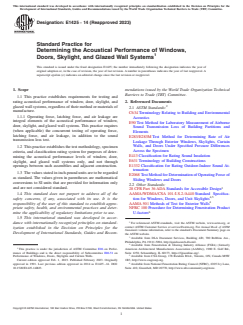
(Practice)Standard Practice for Determining the Acoustical Performance of Windows, Doors, Skylight, and Glazed Wall Systems
General Information
- Abstract
SIGNIFICANCE AND USE
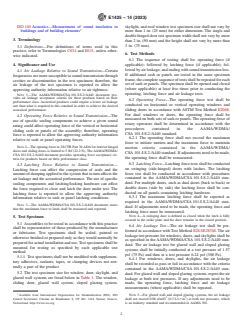
4.1 Air Leakage Relative to Sound Transmission—Certain frequencies are more susceptible to sound transmission through cavities or discontinuities in the test specimen; therefore, the air leakage of the test specimen is reported to allow the approving authority information relative to air tightness.
Note 1: The AAMA/WDMA/CSA 101/I.S.2/A440 document provides air leakage acceptance criteria for these products based on their performance class. Acoustical products could require a lower air leakage rate than what is required in this standard in order to achieve the desired acoustical performance.
4.2 Operating Force Relative to Sound Transmission—The use of specific sealing components to achieve a given sound rating could affect operating force of the vertical or horizontal sliding sash or panels of the assembly; therefore, operating force is reported to allow the approving authority information relative to sash or panel operating forces.
Note 2: The opening force in 28 CFR Part 36 ADA for interior hinged doors and sliding doors is limited to 5 lbf (22.2 N). The AAMA/WDMA/CSA 101/I.S.2/A440 document provides operating force acceptance criteria for products based on their performance class.
4.3 Latching Force Relative to Sound Transmission—Latching force can affect the compression of seals and the amount of damping applied to the system that in turn affects the air leakage and the acoustical performance. The use of specific sealing components and latching/locking hardware can affect the force required to close and latch the door under test. The latching force is reported to allow the approving authority information relative to sash or panel latching conditions.
Note 3: The AAMA/WDMA/CSA 101/I.S.2/A440 document states that the maximum force to latch shall be measured and reported.
SCOPE
1.1 This practice establishes requirements for testing and rating acoustical performance of window, door, skylight, and glazed wall systems, regardless of their method or materials of manufacture.
1.1.1 Operating force, latching force, and air leakage are integral elements of the acoustical performance of window, door, skylight, and glazed wall systems. This practice requires (when applicable) the concurrent testing of operating force, latching force, and air leakage, in addition to the sound transmission loss test.
1.2 This practice establishes the test methodology, specimen criteria, and classification rating system for purposes of determining the acoustical performance levels of window, door, skylight, and glazed wall systems only, and not through openings between such assemblies and adjacent construction.
1.3 The values stated in inch-pound units are to be regarded as standard. The values given in parentheses are mathematical conversions to SI units that are provided for information only and are not considered standard.
1.4 This standard does not purport to address all of the safety concerns, if any, associated with its use. It is the responsibility of the user of this standard to establish appropriate safety, health, and environmental practices and determine the applicability of regulatory limitations prior to use.
1.5 This international standard was developed in accordance with internationally recognized principles on standardization established in the Decision on Principles for the Development of International Standards, Guides and Recommendations issued by the World Trade Organization Technical Barriers to Trade (TBT) Committee.
- Status
- Published
- Publication Date
- 31-Jan-2023
- Technical Committee
- E06 - Performance of Buildings
- Drafting Committee
- E06.51 - Performance of Windows, Doors, Skylights and Curtain Walls

Overview
ASTM E1425-14(2023) is the internationally recognized standard practice for determining the acoustical performance of windows, doors, skylights, and glazed wall systems. Published by ASTM International, this standard outlines a comprehensive methodology for testing and rating the ability of fenestration products to reduce sound transmission. The practice covers key performance elements - air leakage, operating force, and latching force - that affect both sound insulation and product usability. By following the guidelines in ASTM E1425, architects, manufacturers, regulatory bodies, and building owners can objectively compare products and ensure compliance with sound attenuation requirements in commercial and residential buildings.
Key Topics
Acoustical Testing of Fenestration Products
- Establishes laboratory procedures to measure sound transmission loss in windows, doors, skylights, and glazed wall assemblies.
- Requires concurrent testing of air leakage, operating force, and latching force, which are integral to overall acoustical performance.
Air Leakage
- Evaluates airtightness of test specimens as air leakage pathways can compromise sound insulation, especially at specific frequencies.
- Reported results help authorities and specifiers assess product suitability for projects requiring enhanced acoustic control.
Operating Force
- Investigates the force needed to operate sliding sash or panels, ensuring soundproofing components do not hinder product usability or accessibility.
Latching Force
- Assesses the force required to close and latch systems completely, impacting seal compression and ultimately acoustic dampening.
Sound Transmission Loss and Ratings
- Specifies use of standardized methods to determine Outdoor-Indoor Transmission Class (OITC) and Sound Transmission Class (STC).
- Provides a classification system for easy comparison of product performance.
Applications
ASTM E1425 is widely applied in the building and construction industry to:
Architectural Design and Specification
- Supports the selection of windows, doors, skylights, and glazed wall systems with verified sound attenuation performance, crucial in schools, hospitals, mixed-use developments, hotels, and urban residential buildings.
Product Development and Quality Assurance
- Enables manufacturers to consistently verify and report the acoustical properties of their fenestration products, aligning with project requirements and regulatory limits.
Regulatory Compliance and Certification
- Facilitates compliance with national and international building codes and accessibility guidelines, including ADA standards and those issued by agencies such as AAMA/WDMA/CSA.
Project Approval and Tendering
- Assists approving authorities, consultants, and procurement professionals in evaluating product submittals for acoustical suitability.
Related Standards
To provide robust and reliable results, ASTM E1425 references and aligns with other key standards:
- ASTM E90: Laboratory Measurement of Airborne Sound Transmission Loss of Building Partitions and Elements
- ASTM E283/E283M: Determining Rate of Air Leakage Through Exterior Fenestration
- ASTM E2068: Determination of Operating Force of Sliding Windows and Doors
- ASTM E413: Classification for Rating Sound Insulation
- ASTM E1332: Rating Outdoor-Indoor Sound Attenuation
- AAMA/WDMA/CSA 101/I.S.2/A440: Specification for Windows, Doors, and Unit Skylights
- ISO 140: Measurement of Sound Insulation in Buildings
- 28 CFR Part 36 ADA: Accessibility Standards for Interior and Sliding Doors
By adhering to these standards, ASTM E1425 ensures credible and globally recognized evaluation of acoustical performance in the fenestration industry.
Keywords: acoustical performance, windows, doors, skylights, glazed wall systems, sound transmission loss, air leakage, operating force, latching force, STC, OITC, fenestration, ASTM E1425, building acoustics, sound insulation, testing standards
Relations
- Effective Date
- 01-Dec-2023
- Effective Date
- 01-Dec-2016
- Effective Date
- 01-Mar-2015
- Effective Date
- 01-Nov-2014
- Effective Date
- 01-Sep-2013
- Effective Date
- 01-Dec-2011
- Effective Date
- 01-Sep-2010
- Effective Date
- 01-Sep-2010
- Effective Date
- 01-Jun-2010
- Effective Date
- 01-May-2010
- Refers
ASTM E1332-10 - Standard Classification for Determination of Outdoor-Indoor Transmission Class - Effective Date
- 01-Apr-2010
- Effective Date
- 01-Jul-2009
- Effective Date
- 01-Apr-2009
- Effective Date
- 01-Sep-2008
- Effective Date
- 01-Sep-2008
Get Certified
Connect with accredited certification bodies for this standard

DIBt (Deutsches Institut für Bautechnik)
German Institute for Building Technology.
DIN CERTCO
DIN Group product certification.

Aboma Certification B.V.
Specialized in construction, metal, and transport sectors.
Sponsored listings
Frequently Asked Questions
ASTM E1425-14(2023) is a standard published by ASTM International. Its full title is "Standard Practice for Determining the Acoustical Performance of Windows, Doors, Skylight, and Glazed Wall Systems". This standard covers: SIGNIFICANCE AND USE 4.1 Air Leakage Relative to Sound Transmission—Certain frequencies are more susceptible to sound transmission through cavities or discontinuities in the test specimen; therefore, the air leakage of the test specimen is reported to allow the approving authority information relative to air tightness. Note 1: The AAMA/WDMA/CSA 101/I.S.2/A440 document provides air leakage acceptance criteria for these products based on their performance class. Acoustical products could require a lower air leakage rate than what is required in this standard in order to achieve the desired acoustical performance. 4.2 Operating Force Relative to Sound Transmission—The use of specific sealing components to achieve a given sound rating could affect operating force of the vertical or horizontal sliding sash or panels of the assembly; therefore, operating force is reported to allow the approving authority information relative to sash or panel operating forces. Note 2: The opening force in 28 CFR Part 36 ADA for interior hinged doors and sliding doors is limited to 5 lbf (22.2 N). The AAMA/WDMA/CSA 101/I.S.2/A440 document provides operating force acceptance criteria for products based on their performance class. 4.3 Latching Force Relative to Sound Transmission—Latching force can affect the compression of seals and the amount of damping applied to the system that in turn affects the air leakage and the acoustical performance. The use of specific sealing components and latching/locking hardware can affect the force required to close and latch the door under test. The latching force is reported to allow the approving authority information relative to sash or panel latching conditions. Note 3: The AAMA/WDMA/CSA 101/I.S.2/A440 document states that the maximum force to latch shall be measured and reported. SCOPE 1.1 This practice establishes requirements for testing and rating acoustical performance of window, door, skylight, and glazed wall systems, regardless of their method or materials of manufacture. 1.1.1 Operating force, latching force, and air leakage are integral elements of the acoustical performance of window, door, skylight, and glazed wall systems. This practice requires (when applicable) the concurrent testing of operating force, latching force, and air leakage, in addition to the sound transmission loss test. 1.2 This practice establishes the test methodology, specimen criteria, and classification rating system for purposes of determining the acoustical performance levels of window, door, skylight, and glazed wall systems only, and not through openings between such assemblies and adjacent construction. 1.3 The values stated in inch-pound units are to be regarded as standard. The values given in parentheses are mathematical conversions to SI units that are provided for information only and are not considered standard. 1.4 This standard does not purport to address all of the safety concerns, if any, associated with its use. It is the responsibility of the user of this standard to establish appropriate safety, health, and environmental practices and determine the applicability of regulatory limitations prior to use. 1.5 This international standard was developed in accordance with internationally recognized principles on standardization established in the Decision on Principles for the Development of International Standards, Guides and Recommendations issued by the World Trade Organization Technical Barriers to Trade (TBT) Committee.
SIGNIFICANCE AND USE 4.1 Air Leakage Relative to Sound Transmission—Certain frequencies are more susceptible to sound transmission through cavities or discontinuities in the test specimen; therefore, the air leakage of the test specimen is reported to allow the approving authority information relative to air tightness. Note 1: The AAMA/WDMA/CSA 101/I.S.2/A440 document provides air leakage acceptance criteria for these products based on their performance class. Acoustical products could require a lower air leakage rate than what is required in this standard in order to achieve the desired acoustical performance. 4.2 Operating Force Relative to Sound Transmission—The use of specific sealing components to achieve a given sound rating could affect operating force of the vertical or horizontal sliding sash or panels of the assembly; therefore, operating force is reported to allow the approving authority information relative to sash or panel operating forces. Note 2: The opening force in 28 CFR Part 36 ADA for interior hinged doors and sliding doors is limited to 5 lbf (22.2 N). The AAMA/WDMA/CSA 101/I.S.2/A440 document provides operating force acceptance criteria for products based on their performance class. 4.3 Latching Force Relative to Sound Transmission—Latching force can affect the compression of seals and the amount of damping applied to the system that in turn affects the air leakage and the acoustical performance. The use of specific sealing components and latching/locking hardware can affect the force required to close and latch the door under test. The latching force is reported to allow the approving authority information relative to sash or panel latching conditions. Note 3: The AAMA/WDMA/CSA 101/I.S.2/A440 document states that the maximum force to latch shall be measured and reported. SCOPE 1.1 This practice establishes requirements for testing and rating acoustical performance of window, door, skylight, and glazed wall systems, regardless of their method or materials of manufacture. 1.1.1 Operating force, latching force, and air leakage are integral elements of the acoustical performance of window, door, skylight, and glazed wall systems. This practice requires (when applicable) the concurrent testing of operating force, latching force, and air leakage, in addition to the sound transmission loss test. 1.2 This practice establishes the test methodology, specimen criteria, and classification rating system for purposes of determining the acoustical performance levels of window, door, skylight, and glazed wall systems only, and not through openings between such assemblies and adjacent construction. 1.3 The values stated in inch-pound units are to be regarded as standard. The values given in parentheses are mathematical conversions to SI units that are provided for information only and are not considered standard. 1.4 This standard does not purport to address all of the safety concerns, if any, associated with its use. It is the responsibility of the user of this standard to establish appropriate safety, health, and environmental practices and determine the applicability of regulatory limitations prior to use. 1.5 This international standard was developed in accordance with internationally recognized principles on standardization established in the Decision on Principles for the Development of International Standards, Guides and Recommendations issued by the World Trade Organization Technical Barriers to Trade (TBT) Committee.
ASTM E1425-14(2023) is classified under the following ICS (International Classification for Standards) categories: 91.060.50 - Doors and windows. The ICS classification helps identify the subject area and facilitates finding related standards.
ASTM E1425-14(2023) has the following relationships with other standards: It is inter standard links to ASTM E90-23, ASTM E90-09(2016), ASTM E631-15, ASTM E631-14, ASTM C634-13, ASTM C634-11, ASTM E413-10, ASTM C634-10a, ASTM C634-10, ASTM E1332-10a, ASTM E1332-10, ASTM E90-09, ASTM C634-09, ASTM C634-08a, ASTM E2068-00(2008). Understanding these relationships helps ensure you are using the most current and applicable version of the standard.
ASTM E1425-14(2023) is available in PDF format for immediate download after purchase. The document can be added to your cart and obtained through the secure checkout process. Digital delivery ensures instant access to the complete standard document.
Standards Content (Sample)
This international standard was developed in accordance with internationally recognized principles on standardization established in the Decision on Principles for the
Development of International Standards, Guides and Recommendations issued by the World Trade Organization Technical Barriers to Trade (TBT) Committee.
Designation: E1425 − 14 (Reapproved 2023)
Standard Practice for
Determining the Acoustical Performance of Windows,
Doors, Skylight, and Glazed Wall Systems
This standard is issued under the fixed designation E1425; the number immediately following the designation indicates the year of
original adoption or, in the case of revision, the year of last revision. A number in parentheses indicates the year of last reapproval. A
superscript epsilon (´) indicates an editorial change since the last revision or reapproval.
1. Scope mendations issued by the World Trade Organization Technical
Barriers to Trade (TBT) Committee.
1.1 This practice establishes requirements for testing and
rating acoustical performance of window, door, skylight, and
2. Referenced Documents
glazed wall systems, regardless of their method or materials of 2
2.1 ASTM Standards:
manufacture.
C634 Terminology Relating to Building and Environmental
1.1.1 Operating force, latching force, and air leakage are
Acoustics
integral elements of the acoustical performance of window,
E90 Test Method for Laboratory Measurement of Airborne
door, skylight, and glazed wall systems. This practice requires
Sound Transmission Loss of Building Partitions and
(when applicable) the concurrent testing of operating force,
Elements
latching force, and air leakage, in addition to the sound
E283/E283M Test Method for Determining Rate of Air
transmission loss test.
Leakage Through Exterior Windows, Skylights, Curtain
Walls, and Doors Under Specified Pressure Differences
1.2 This practice establishes the test methodology, specimen
Across the Specimen
criteria, and classification rating system for purposes of deter-
E413 Classification for Rating Sound Insulation
mining the acoustical performance levels of window, door,
E631 Terminology of Building Constructions
skylight, and glazed wall systems only, and not through
E1332 Classification for Rating Outdoor-Indoor Sound At-
openings between such assemblies and adjacent construction.
tenuation
1.3 The values stated in inch-pound units are to be regarded
E2068 Test Method for Determination of Operating Force of
as standard. The values given in parentheses are mathematical
Sliding Windows and Doors
conversions to SI units that are provided for information only
2.2 Other Standards:
and are not considered standard. 3
28 CFR Part 36 ADA Standards for Accessible Design
1.4 This standard does not purport to address all of the AAMA/WDMA/CSA 101 ⁄I.S.2 ⁄A440 Standard Specifica-
4,5
safety concerns, if any, associated with its use. It is the tion for Windows, Doors, and Unit Skylights
responsibility of the user of this standard to establish appro- AAMA 501 Methods of Test for Exterior Walls
priate safety, health, and environmental practices and deter- NFRC 100 Procedure for Determining Fenestration Product
mine the applicability of regulatory limitations prior to use. U-factors
1.5 This international standard was developed in accor-
For referenced ASTM standards, visit the ASTM website, www.astm.org, or
dance with internationally recognized principles on standard-
contact ASTM Customer Service at service@astm.org. For Annual Book of ASTM
ization established in the Decision on Principles for the
Standards volume information, refer to the standard’s Document Summary page on
Development of International Standards, Guides and Recom-
the ASTM website.
Available from DLA Document Services, Building 4/D, 700 Robbins Ave.,
Philadelphia, PA 19111-5094, http://quicksearch.dla.mil.
Available from Fenestration & Glazing Industry Alliance (FGIA) (formerly
This practice is under the jurisdiction of ASTM Committee E06 on Perfor- American Architectural Manufacturers Association (AAMA)), 1900 E. Golf Rd.,
mance of Buildings and is the direct responsibility of Subcommittee E06.51 on Suite 1250, Schaumburg, IL 60173, https://fgiaonline.org/.
Performance of Windows, Doors, Skylights and Curtain Walls. Available from CSA Group, 178 Rexdale Blvd., Toronto, ON, Canada M9W
Current edition approved Feb. 1, 2023. Published February 2023. Originally 1R3, http://www.csagroup.org.
approved in 1991. Last previous edition approved in 2014 as E1425 –14. DOI: Available from National Fenestration Rating Council (NFRC), 6305 Ivy Lane,
10.1520/E1425-14R23. Suite 410, Greenbelt, MD 20770, http://www.nfrccommunity.org/store.
Copyright © ASTM International, 100 Barr Harbor Drive, PO Box C700, West Conshohocken, PA 19428-2959. United States
E1425 − 14 (2023)
ISO 140 Acoustics—Measurement of sound insulation in skylight, and roof window test specimen size shall not vary by
buildings and of building elements more than 1 in. (25 mm) for either dimension. The single and
double hinged door test specimen width shall not vary by more
3. Terminology
than 2 in. (50 mm) and the height shall not vary by more than
3 in. (75 mm).
3.1 Definitions—For definitions of terms used in this
practice, refer to Terminologies C634 and E631, unless other-
6. Test Methods
wise indicated.
6.1 The sequence of testing shall be: operating force (if
4. Significance and Use
applicable); followed by latching force (if applicable); fol-
lowed by air leakage; and ending with sound transmission loss.
4.1 Air Leakage Relative to Sound Transmission—Certain
If additional sash or panels are tested in the same specimen
frequencies are more susceptible to sound transmission through
frame, the complete sequence of tests shall be repeated for each
cavities or discontinuities in the test specimen; therefore, the
set of sash or panels. The specimen shall be opened and closed
air leakage of the test specimen is reported to allow the
(where applicable) at least five times prior to conducting the
approving authority information relative to air tightness.
operating, latching force and air leakage tests.
NOTE 1—The AAMA/WDMA/CSA 101 ⁄I.S.2 ⁄A440 document pro-
vides air leakage acceptance criteria for these products based on their
6.2 Operating Force—The operating force test shall be
performance class. Acoustical products could require a lower air leakage
conducted on horizontal or vertical operating windows and
rate than what is required in this standard in order to achieve the desired
sliding doors in accordance with ASTM Test Method E2068.
acoustical performance.
For dual windows or doors, the operating force shall be
4.2 Operating Force Relative to Sound Transmission—The
measured on both sets of sash or panels. The operating force of
use of specific sealing components to achieve a given sound
rotary operators shall be determined in accordance with the
rating could affect operating force of the vertical or horizontal
procedures contained in the AAMA/WDMA/
sliding sash or panels of the assembly; therefore, operating
CSA 101 ⁄I.S.2 ⁄A440 standard.
force is reported to allow the approving authority information
6.2.1 The operating force shall not exceed the maximum
relative to sash or panel operating forces.
force to initiate motion and the maximum force to maintain
NOTE 2—The opening force in 28 CFR Part 36 ADA for interior hinged
motion criteria contained in the AAMA/WDMA/
doors and sliding doors is limited to 5 lbf (22.2 N). The AAMA/WDMA/
CSA 101 ⁄I.S.2 ⁄A440 standard. If adjustments need to be made,
CSA 101 ⁄I.S.2 ⁄A440 document provides operating force acceptance cri-
the operating force shall be remeasured.
teria for products based on their performance class.
6.3 Latching Force—Latching force tests shall be conducted
4.3 Latching Force Relative to Sound Transmission—
on swinging (side-hinged) doors with latches. The latching
Latching force can affect the compression of seals and the
force test shall be conducted in accordance with procedures
amount of damping applied to the system that in turn affects the
contained in the AAMA/WDMA/CSA 101 ⁄I.S.2 ⁄A440 stan-
air leakage and the acoustical performance. The use of specific
dard. For multiple doors, such as dual doors (back to back) or
sealing components and latching/locking hardware can affect
double doors (side by side) the latching force shall be con-
the force required to close and latch the door under test. The
ducted on all panels containing latching hardware.
latching force is reported to allow the approving authority
6.3.1 The maximum latching force shall be reported as
information relative to sash or panel latching conditions.
required in the AAMA/WDMA/CSA 101 ⁄I.S.2 ⁄A440 stan-
NOTE 3—The AAMA/WDMA/CSA 101 ⁄I.S.2 ⁄A440 document states
dard. If adjustments need to be made, the operating force and
that the maximum force to latch shall be measured and reported.
latching force must be remeasured.
NOTE 4—A swinging door is defined as closed when the
...