

ASTM D5969-21
(Test Method)Standard Test Method for Corrosion-Preventive Properties of Lubricating Greases in Presence of Dilute Synthetic Sea Water Environments
General Information
- Abstract
SIGNIFICANCE AND USE
5.1 This test method differentiates the relative corrosion-preventive capabilities of lubricating greases under the test conditions.
SCOPE
1.1 This test method covers the determination of the corrosion-preventive properties of greases using grease-lubricated tapered roller bearings exposed to various concentrations of dilute synthetic sea water stored under wet conditions. It is based on Test Method D1743, which is practiced using a similar procedure and distilled water. The reported result is a pass or fail rating as determined by at least two of three bearings.
1.2 Apparatus Dimensions—The values stated in inch-pound units are to be regarded as standard. The values given in parentheses are mathematical conversions to SI units that are provided for information only and are not considered standard.
1.3 All Other Values—The values stated in SI units are to be regarded as standard. No other units of measurement are included in this standard.
1.4 This standard does not purport to address all of the safety concerns, if any, associated with its use. It is the responsibility of the user of this standard to establish appropriate safety, health, and environmental practices and determine the applicability of regulatory limitations prior to use.
1.5 This international standard was developed in accordance with internationally recognized principles on standardization established in the Decision on Principles for the Development of International Standards, Guides and Recommendations issued by the World Trade Organization Technical Barriers to Trade (TBT) Committee.
- Status
- Published
- Publication Date
- 30-Nov-2021
- Technical Committee
- D02 - Petroleum Products, Liquid Fuels, and Lubricants
- Drafting Committee
- D02.G0.06 - Functional Tests - Contamination
Buy Documents
ASTM D5969-21 - Standard Test Method for Corrosion-Preventive Properties of Lubricating Greases in Presence of Dilute Synthetic Sea Water Environments
REDLINE ASTM D5969-21 - Standard Test Method for Corrosion-Preventive Properties of Lubricating Greases in Presence of Dilute Synthetic Sea Water Environments
Overview
ASTM D5969-21 is the Standard Test Method for Corrosion-Preventive Properties of Lubricating Greases in the Presence of Dilute Synthetic Sea Water Environments. Developed by ASTM International, this standard provides a recognized laboratory procedure to evaluate the corrosion-inhibiting capabilities of lubricating greases when exposed to synthetic sea water under controlled wet and humid conditions. This test is vital for industries where metal components lubricated with grease are vulnerable to corrosion in marine or high-humidity environments.
Key Topics
- Corrosion-Preventive Assessment: This method determines whether a lubricating grease can effectively protect metal bearings from corrosion when exposed to diluted synthetic sea water.
- Test Method Procedure: The test uses cleaned, lubricated tapered roller bearings subjected to a controlled environment of synthetic sea water, humidity, and temperature. The outcome is reported as a pass or fail, based on observations of corrosion on the bearings.
- Pass/Fail Criteria: Bearings are rated after exposure. The presence of corrosion spots 1.0 mm or larger qualifies as a failure. The grease passes if at least two out of three bearings in a set show no qualifying corrosion.
- Reproducibility and Reliability: The standard emphasizes interlaboratory agreement and consistent application of the test, which is essential for reliable comparisons across products and industries.
- Safety and Compliance: ASTM D5969-21 highlights the responsibilities of users to follow relevant safety, health, and environmental regulations during testing.
Applications
The ASTM D5969-21 test method is crucial for quality assurance and specification of lubricating greases in environments prone to corrosion. Key applications of this standard include:
- Marine Equipment: Used to qualify lubricating greases for shipboard machinery, offshore platforms, and port equipment that frequently encounters sea water.
- Automotive and Transportation: Ensures grease performance in coastal vehicles and components subject to road salt and high humidity.
- Industrial Bearings: Validates corrosion protection for process equipment, pumps, and rotating machinery operating in damp or saline conditions.
- Research and Development: Grease manufacturers and R&D laboratories use this method to develop and qualify new products or improve existing formulations for corrosion resistance.
- Comparative Product Evaluation: Enables direct, repeatable comparison of different lubricating greases’ corrosion-preventive properties under standardized conditions.
Related Standards
For comprehensive evaluation and compatibility within industry practices, ASTM D5969-21 should be considered alongside related standards:
- ASTM D1743: Standard Test Method for Determining Corrosion Preventive Properties of Lubricating Greases (using distilled water)
- ASTM D665: Test Method for Rust-Preventing Characteristics of Inhibited Mineral Oil in the Presence of Water
- ASTM D1193: Specification for Reagent Water
These referenced ASTM standards provide further guidance on testing procedures, water purity, and related rust-prevention practices.
By following ASTM D5969-21, manufacturers, quality control labs, and technical users can reliably assess the corrosion-preventive performance of lubricating greases in synthetic sea water environments, ensuring equipment reliability and long-term protection against corrosion in challenging applications.
Relations
- Effective Date
- 01-Dec-2023
- Effective Date
- 01-Dec-2019
- Effective Date
- 01-Oct-2014
- Effective Date
- 01-May-2013
- Effective Date
- 01-Nov-2012
- Effective Date
- 01-May-2010
- Effective Date
- 01-May-2006
- Effective Date
- 01-Mar-2006
- Effective Date
- 01-Jul-2005
- Effective Date
- 01-Jul-2005
- Effective Date
- 01-Jun-2005
- Effective Date
- 01-Nov-2003
- Effective Date
- 10-Nov-2002
- Effective Date
- 10-Jan-2001
- Effective Date
- 10-Jan-2001
Buy Documents
ASTM D5969-21 - Standard Test Method for Corrosion-Preventive Properties of Lubricating Greases in Presence of Dilute Synthetic Sea Water Environments
REDLINE ASTM D5969-21 - Standard Test Method for Corrosion-Preventive Properties of Lubricating Greases in Presence of Dilute Synthetic Sea Water Environments
Get Certified
Connect with accredited certification bodies for this standard

Element Materials Technology
Materials testing and product certification.

ABS Group Brazil
ABS Group certification services in Brazil.

ABS Quality Evaluations Inc.
American Bureau of Shipping quality certification.
Sponsored listings
Frequently Asked Questions
ASTM D5969-21 is a standard published by ASTM International. Its full title is "Standard Test Method for Corrosion-Preventive Properties of Lubricating Greases in Presence of Dilute Synthetic Sea Water Environments". This standard covers: SIGNIFICANCE AND USE 5.1 This test method differentiates the relative corrosion-preventive capabilities of lubricating greases under the test conditions. SCOPE 1.1 This test method covers the determination of the corrosion-preventive properties of greases using grease-lubricated tapered roller bearings exposed to various concentrations of dilute synthetic sea water stored under wet conditions. It is based on Test Method D1743, which is practiced using a similar procedure and distilled water. The reported result is a pass or fail rating as determined by at least two of three bearings. 1.2 Apparatus Dimensions—The values stated in inch-pound units are to be regarded as standard. The values given in parentheses are mathematical conversions to SI units that are provided for information only and are not considered standard. 1.3 All Other Values—The values stated in SI units are to be regarded as standard. No other units of measurement are included in this standard. 1.4 This standard does not purport to address all of the safety concerns, if any, associated with its use. It is the responsibility of the user of this standard to establish appropriate safety, health, and environmental practices and determine the applicability of regulatory limitations prior to use. 1.5 This international standard was developed in accordance with internationally recognized principles on standardization established in the Decision on Principles for the Development of International Standards, Guides and Recommendations issued by the World Trade Organization Technical Barriers to Trade (TBT) Committee.
SIGNIFICANCE AND USE 5.1 This test method differentiates the relative corrosion-preventive capabilities of lubricating greases under the test conditions. SCOPE 1.1 This test method covers the determination of the corrosion-preventive properties of greases using grease-lubricated tapered roller bearings exposed to various concentrations of dilute synthetic sea water stored under wet conditions. It is based on Test Method D1743, which is practiced using a similar procedure and distilled water. The reported result is a pass or fail rating as determined by at least two of three bearings. 1.2 Apparatus Dimensions—The values stated in inch-pound units are to be regarded as standard. The values given in parentheses are mathematical conversions to SI units that are provided for information only and are not considered standard. 1.3 All Other Values—The values stated in SI units are to be regarded as standard. No other units of measurement are included in this standard. 1.4 This standard does not purport to address all of the safety concerns, if any, associated with its use. It is the responsibility of the user of this standard to establish appropriate safety, health, and environmental practices and determine the applicability of regulatory limitations prior to use. 1.5 This international standard was developed in accordance with internationally recognized principles on standardization established in the Decision on Principles for the Development of International Standards, Guides and Recommendations issued by the World Trade Organization Technical Barriers to Trade (TBT) Committee.
ASTM D5969-21 is classified under the following ICS (International Classification for Standards) categories: 75.100 - Lubricants, industrial oils and related products. The ICS classification helps identify the subject area and facilitates finding related standards.
ASTM D5969-21 has the following relationships with other standards: It is inter standard links to ASTM D665-23, ASTM D665-19, ASTM D665-14, ASTM D1743-13, ASTM D665-12, ASTM D1743-10, ASTM D665-06, ASTM D1193-06, ASTM D1743-05ae1, ASTM D1743-05a, ASTM D1743-05, ASTM D665-03, ASTM D665-02, ASTM D1743-01, ASTM D1743-94e1. Understanding these relationships helps ensure you are using the most current and applicable version of the standard.
ASTM D5969-21 is available in PDF format for immediate download after purchase. The document can be added to your cart and obtained through the secure checkout process. Digital delivery ensures instant access to the complete standard document.
Standards Content (Sample)
This international standard was developed in accordance with internationally recognized principles on standardization established in the Decision on Principles for the
Development of International Standards, Guides and Recommendations issued by the World Trade Organization Technical Barriers to Trade (TBT) Committee.
Designation: D5969 − 21
Standard Test Method for
Corrosion-Preventive Properties of Lubricating Greases in
Presence of Dilute Synthetic Sea Water Environments
This standard is issued under the fixed designation D5969; the number immediately following the designation indicates the year of
original adoption or, in the case of revision, the year of last revision. A number in parentheses indicates the year of last reapproval. A
superscript epsilon (´) indicates an editorial change since the last revision or reapproval.
1. Scope* D1193 Specification for Reagent Water
D1743 Test Method for Determining Corrosion Preventive
1.1 This test method covers the determination of the
Properties of Lubricating Greases
corrosion-preventive properties of greases using grease-
lubricated tapered roller bearings exposed to various concen-
3. Terminology
trations of dilute synthetic sea water stored under wet condi-
3.1 Definitions of Terms Specific to This Standard:
tions. It is based on Test Method D1743, which is practiced
3.1.1 corrosion, n—the chemical or electrochemical reac-
using a similar procedure and distilled water. The reported
tion between a material, usually a metal, and its environment
result is a pass or fail rating as determined by at least two of
that produces a deterioration of the material and its properties.
three bearings.
3.1.1.1 Discussion—In this test method, corrosion is mani-
1.2 Apparatus Dimensions—The values stated in inch-
fested by red rust or black stains on the bearing race. Stains,
pound units are to be regarded as standard.The values given in
through which the underlying metal surface is still visible, are
parentheses are mathematical conversions to SI units that are
not considered corrosion in Test Method D5969 and shall be
provided for information only and are not considered standard.
ignored. D1743
1.3 All Other Values—The values stated in SI units are to be
regarded as standard. No other units of measurement are
4. Summary of Test Method
included in this standard.
4.1 New, cleaned, and lubricated bearings are run under a
1.4 This standard does not purport to address all of the
light thrust load for 60 s 6 3 s to distribute the lubricant in a
safety concerns, if any, associated with its use. It is the
pattern that might be found in service. The bearings are
responsibility of the user of this standard to establish appro-
exposedtoasolutionofsyntheticseawateratsomepercentage
priate safety, health, and environmental practices and deter-
in distilled water, then stored for 24 h 6 ⁄2hat52°C 61°C
mine the applicability of regulatory limitations prior to use.
and 100 % relative humidity. After cleaning, the bearing cups
1.5 This international standard was developed in accor-
are examined for evidence of corrosion.
dance with internationally recognized principles on standard-
ization established in the Decision on Principles for the 5. Significance and Use
Development of International Standards, Guides and Recom-
5.1 This test method differentiates the relative corrosion-
mendations issued by the World Trade Organization Technical
preventive capabilities of lubricating greases under the test
Barriers to Trade (TBT) Committee.
conditions.
2. Referenced Documents
6. Apparatus
2.1 ASTM Standards:
6.1 Bearings, Timken bearing cone and roller assembly
D665 Test Method for Rust-Preventing Characteristics of
LM11949 and cup LM11910.
Inhibited Mineral Oil in the Presence of Water
6.2 Motor, 1750 r⁄min (approximate) speed, ⁄15 hp (min).
6.3 Bearing Holder,(seeFig.1)consistsofa1 kg 60.01 kg
This test method is under the jurisdiction of ASTM Committee D02 on
Petroleum Products, Liquid Fuels, and Lubricants and is the direct responsibility of mass, upper and lower plastic collars for the bearing cone
Subcommittee D02.G0.06 on Functional Tests - Contamination.
(PartsAand B), a metal screw, and a plastic collar for the cup
Current edition approved Dec. 1, 2021. Published December 2021. Originally
(Part C).
approved in 1996. Last previous edition approved in 2016 as D5969 – 11 (2016).
DOI: 10.1520/D5969-21.
6.4 Plastic Test Jar, as shown in Fig. 2.
For referenced ASTM standards, visit the ASTM website, www.astm.org, or
contact ASTM Customer Service at service@astm.org. For Annual Book of ASTM
Standards volume information, refer to the standard’s Document Summary page on
the ASTM website. Manufactured by the Timken Co., Canton, OH 44706.
*A Summary of Changes section appears at the end of this standard
Copyright © ASTM International, 100 Barr Harbor Drive, PO Box C700, West Conshohocken, PA 19428-2959. United States
D5969 − 21
KEY DESCRIPTION QUANTITY
1 PISTON 1
2 O RING 1
3 WEIGHT 1
4 UPPER FLANGE 1
5 LOWER FLANGE 1
1 1
6 ⁄4−20×1- ⁄4 FILLISTER HD. MACH. SCREW S.S. 1
7 O RING 1
8 BEARING HOLDER 1
9 PLASTIC JAR 1
10 O RING 1
FIG. 1 Test Method D1743 Bearing Holder Assembly
D5969 − 21
sufficiently high purity to permit its use without lessening the
accuracy of the determination.
7.2 Purity of Water—Unless otherwise indicated, references
to water shall be understood to mean reagent water conforming
to Specification D1193, Type III.
7.3 Isopropyl Alcohol. (Warning—Flammable.)
7.4 Solvent Rinse Solution, of the following composition by
volume:
7.4.1 Isopropyl Alcohol, 90 %,
7.4.2 Distilled Water, 9 %, and
7.4.3 Ammonium Hydroxide, 1%. (Warning—Poison.
Causes burns. Vapor extremely irritating. May be fatal if
swallowed. Harmful if inhaled.)
7.5 Mineral Spirits, reagent grade, minimum purity.
(Warning—Combustible. Vapor harmful.)
7.6 Synthetic Sea Water, prepared as described in Test
Method D665.(Warning—Poison. May be fatal if swal-
lowed.)
8. Standardization of Thrust Loading Device
Test Jar Specifications
Inner Diameter Range: 3.11–3.31 in. (79–84 mm)
8.1 Pack a bearing, and install it into the holder. Place the
Inner Height Range: 3.5–4.0 in. (89–102 mm)
assemblyintoaplasticjarasdescribedin10.1–10.4.Placethe
FIG. 2 Plastic Test Jar
jar onto the base of the motor drive spindle and center it under
the indexing pin of the drive. Lower the drive until the O-ring
just contacts the 1 kg weight. Run the bottom nut of the depth
6.5 Run-in Stand, as shown in Fig. 3.
gauge(seeFig.3)downtothestop.Placea3 mmspacerontop
6.6 Spindle/Thrust Loading Device, as shown in Fig. 4. of this nut. Bring the top nut down to the spacer.While holding
the top nut in position, remove the spacer and run the bottom
6.7 Mechanical Grease Packer, as shown in Fig. 5.
nut up and tighten it against the top nut. When the O-ring is
6.8 Pliers, as shown in Fig. 6.
compressed against the 1 kg weight until the adjustment nut
6.9 Syringe, of at least 100 mL 6 5 mL volume and with a hits the stop, there will be a 29 N load added, giving a total
load of 39 N on the bearing. (The loads described are provided
needle of at least 16 gauge and a minimum length of 100 mm
(4 in.). by the forces of the spring in the thrust loading spindle and the
sum of the 1 kg weight and spring, respectively. These loads
6.10 Timer, capable of measuring a 60 s 6 3 s interval.
are approximate. The 1 kg weights should be within 0.010 kg
6.11 Oven, a laboratory oven, essentially free of vibration,
of their stated values. The thrust loading spindle should be
capable of maintaining 52 °C 6 1 °C.
calibrated by some suitable method when it is first put into
service, recalibrated periodically, and replaced if its spring
7. Reagents
does not provide sufficient force to spin the test bearings
7.1 Purity of Reagents—Reagent grade chemicals shall be
without slippage during the 60 s run to distribute the grease.)
used in all tests. Unless otherwise indicated, it is intended that
Examine the O-ring periodically, and replace it if it shows any
all reagents shall conform to the specifications of the Commit-
cracks or other signs of deterioration.
tee onAnalytical Reagents of theAmerican Chemical Society,
8.2 The thrust loading device should be standardized before
where such specifications are available. Other grades may be
use, once per day if used daily, and again if there is reason to
used, provided that it is first ascertained that the reagent is of
believe that the standardization has changed. The thrust load-
ing device may be standardized using one of the greases to be
4 tested.
The sole source of supply of the apparatus known to the committee at this time
is Falex Corp., 1020 Airpark Drive, Sugar Grove, IL, 60554. If you are aware of
alternative suppliers, please provide this information to ASTM International
9. Preparation of Bearings
Headquarters.Your comments will receive careful consideration at a meeting of the
9.1 Examine the test bearings carefully and select only
responsible technical committee, which you may attend.
AWaldes Truarc Plier No. 4, available from Truarc Co., or similar, modified as
bearingsthathaveouterraces(cups)androllersentirelyfreeof
in Fig. 6.
corrosion. During the bearing preparation, handle the bearings
ACS Reagent Chemicals, Specifications and Procedures for Reagents and
with tongs or rubber or plastic gloves. Do not touch bearings
Standard-Grade Reference Materials, American Chemical Society, Washington,
DC. For suggestions on the testing of reagents not listed by theAmerican Chemical with the fingers at any time.
Society, see Analar Standards for Laboratory Chemicals, BDH Ltd., Poole, Dorset,
9.2 Wash the selected bearings thoroughly in hot (52 °C to
U.K., and the United States Pharmacopeia and National Formulary, U.S. Pharma-
copeial Convention, Inc. (USPC), Rockville, MD. 66 °C) mineral spirits, reagent grade (Warning—see 7.5)to
D5969 − 21
FIG. 3 Run-in Stand Drawing
remove the rust preventive. To ensure complete removal of the
rust preventive, subject the bearings to a second wash in fresh
hot mineral spirits, re
...
This document is not an ASTM standard and is intended only to provide the user of an ASTM standard an indication of what changes have been made to the previous version. Because
it may not be technically possible to adequately depict all changes accurately, ASTM recommends that users consult prior editions as appropriate. In all cases only the current version
of the standard as published by ASTM is to be considered the official document.
Designation: D5969 − 11 (Reapproved 2016) D5969 − 21
Standard Test Method for
Corrosion-Preventive Properties of Lubricating Greases in
Presence of Dilute Synthetic Sea Water Environments
This standard is issued under the fixed designation D5969; the number immediately following the designation indicates the year of
original adoption or, in the case of revision, the year of last revision. A number in parentheses indicates the year of last reapproval. A
superscript epsilon (´) indicates an editorial change since the last revision or reapproval.
1. Scope Scope*
1.1 This test method covers the determination of the corrosion-preventive properties of greases using grease-lubricated tapered
roller bearings exposed to various concentrations of dilute synthetic sea water stored under wet conditions. It is based on Test
Method D1743, which is practiced using a similar procedure and distilled water. The reported result is a pass or fail rating as
determined by at least two of three bearings.
1.2 Apparatus Dimensions—The values stated in inch-pound units are to be regarded as standard. The values given in parentheses
are mathematical conversions to SI units that are provided for information only and are not considered standard.
1.3 All Other Values—The values stated in SI units are to be regarded as standard. No other units of measurement are included
in this standard.
1.4 This standard does not purport to address all of the safety concerns, if any, associated with its use. It is the responsibility
of the user of this standard to establish appropriate safety safety, health, and healthenvironmental practices and determine the
applicability of regulatory limitations prior to use.
1.5 This international standard was developed in accordance with internationally recognized principles on standardization
established in the Decision on Principles for the Development of International Standards, Guides and Recommendations issued
by the World Trade Organization Technical Barriers to Trade (TBT) Committee.
2. Referenced Documents
2.1 ASTM Standards:
D665 Test Method for Rust-Preventing Characteristics of Inhibited Mineral Oil in the Presence of Water
D1193 Specification for Reagent Water
D1743 Test Method for Determining Corrosion Preventive Properties of Lubricating Greases
3. Terminology
3.1 Definitions of Terms Specific to This Standard:
3.1.1 corrosion—corrosion, n—the chemical or electrochemical reaction between a material, usually a metal, and its environment
that produces a deterioration of the material and its properties.
This test method is under the jurisdiction of ASTM Committee D02 on Petroleum Products, Liquid Fuels, and Lubricants and is the direct responsibility of Subcommittee
D02.G0.06 on Functional Tests - Contamination.
Current edition approved Oct. 1, 2016Dec. 1, 2021. Published November 2016December 2021. Originally approved in 1996. Last previous edition approved in 20112016
ɛ1
as D5969 – 11 (2016). . DOI: 10.1520/D5969-11R16. 10.1520/D5969-21.
For referenced ASTM standards, visit the ASTM website, www.astm.org, or contact ASTM Customer Service at service@astm.org. For Annual Book of ASTM Standards
volume information, refer to the standard’s Document Summary page on the ASTM website.
*A Summary of Changes section appears at the end of this standard
Copyright © ASTM International, 100 Barr Harbor Drive, PO Box C700, West Conshohocken, PA 19428-2959. United States
D5969 − 21
3.1.1.1 Discussion—
In this test method, corrosion is manifested by red rust or black stains on the bearing race. Stains, through which the underlying
metal surface is still visible, are not considered corrosion in Test Method D5969 and shall be ignored. D1743
4. Summary of Test Method
4.1 New, cleaned, and lubricated bearings are run under a light thrust load for 60 s 6 3 s to distribute the lubricant in a pattern
that might be found in service. The bearings are exposed to a solution of synthetic sea water at some percentage in distilled water,
then stored for 24 h 6 ⁄2 h at 52 °C 6 1 °C and 100 % relative humidity. After cleaning, the bearing cups are examined for
evidence of corrosion.
5. Significance and Use
5.1 This test method differentiates the relative corrosion-preventive capabilities of lubricating greases under the test conditions.
6. Apparatus
6.1 Bearings, Timken bearing cone and roller assembly LM11949 and cup LM11910.
6.2 Motor, 1750 r ⁄min (approximate) speed, ⁄15 hp (min).
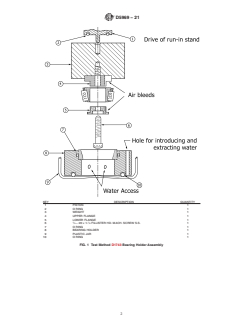
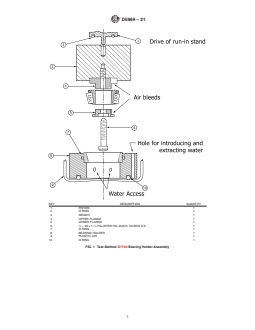
6.3 Bearing Holder, (see Fig. 1) consists of a 1 kg 6 0.01 kg mass, upper and lower plastic collars for the bearing cone (Parts A
and B), a metal screw, and a plastic collar for the cup (Part C).
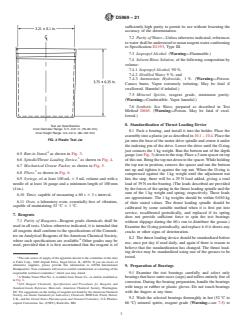
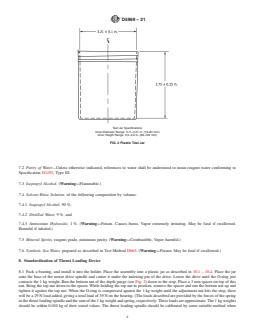
6.4 Plastic Test Jar, as shown in Fig. 2.
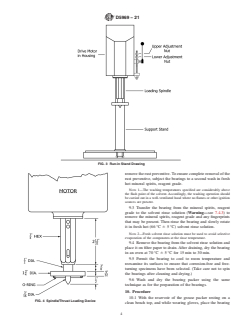
6.5 Run-in Stand, as as shown in Fig. 3.
6.6 Spindle/Thrust Loading Device, as as shown in Fig. 4.
6.7 Mechanical Grease Packer, as shown in Fig. 5.
6.8 Pliers, as as shown in Fig. 6.
6.9 Syringe, of at least 100 mL 6 5 mL volume and with a needle of at least 16 gauge and a minimum length of 100 mm (4 in.).
6.10 Timer, capable of measuring a 60 s 6 3 s interval.
6.11 Oven, a laboratory oven, essentially free of vibration, capable of maintaining 52 °C 6 1 °C.
7. Reagents
7.1 Purity of Reagents—Reagent grade chemicals shall be used in all tests. Unless otherwise indicated, it is intended that all
reagents shall conform to the specifications of the Committee on Analytical Reagents of the American Chemical Society, where
such specifications are available. Other grades may be used, provided that it is first ascertained that the reagent is of sufficiently
high purity to permit its use without lessening the accuracy of the determination.
Manufactured by the Timken Co., Canton, OH 44706.
The sole source of supply of the apparatus known to the committee at this time is Falex Corp., 1020 Airpark Drive, Sugar Grove, IL, 60554. If you are aware of alternative
suppliers, please provide this information to ASTM International Headquarters. Your comments will receive careful consideration at a meeting of the responsible technical
committee, which you may attend.
A Waldes Truarc Plier No. 4, available from Truarc Co., or similar, modified as in Fig. 6.
Reagent Chemicals, American Chemical Society Specifications,ACS Reagent Chemicals, Specifications and Procedures for Reagents and Standard-Grade Reference
Materials, American Chemical Society, Washington, DC. For Suggestionssuggestions on the testing of reagents not listed by the American Chemical Society, see
AnnualAnalar Standards for Laboratory Chemicals, BDH Ltd., Poole, Dorset, U.K., and the United States Pharmacopeia and National Formulary, U.S. Pharmacopeial
Convention, Inc. (USPC), Rockville, MD.
D5969 − 21
KEY DESCRIPTION QUANTITY
1 PISTON 1
2 O RING 1
3 WEIGHT 1
4 UPPER FLANGE 1
5 LOWER FLANGE 1
1 1
6 ⁄4 − 20 × 1- ⁄4 FILLISTER HD. MACH. SCREW S.S. 1
7 O RING 1
8 BEARING HOLDER 1
9 PLASTIC JAR 1
10 O RING 1
FIG. 1 Test Method D1743 Bearing Holder Assembly
D5969 − 21
Test Jar Specifications
Inner Diameter Range: 3.11–3.31 in. (79–84 mm)
Inner Height Range: 3.5–4.0 in. (89–102 mm)
FIG. 2 Plastic Test Jar
7.2 Purity of Water—Unless otherwise indicated, references to water shall be understood to mean reagent water conforming to
Specification D1193, Type III.
7.3 Isopropyl Alcohol. (Warning—Flammable.)
7.4 Solvent Rinse Solution, of the following composition by volume:
7.4.1 Isopropyl Alcohol, 90 %,
7.4.2 Distilled Water, 9 %, and
7.4.3 Ammonium Hydroxide, 1 %. (Warning—Poison. Causes burns. Vapor extremely irritating. May be fatal if swallowed.
Harmful if inhaled.)
7.5 Mineral Spirits, reagent grade, minimum purity. (Warning—Combustible. Vapor harmful.)
7.6 Synthetic Sea Water, prepared as described in Test Method D665. (Warning—Poison. May be fatal if swallowed.)
8. Standardization of Thrust Loading Device
8.1 Pack a bearing, and install it into the holder. Place the assembly into a plastic jar as described in 10.1 – 10.4. Place the jar
onto the base of the motor drive spindle and center it under the indexing pin of the drive. Lower the drive until the O-ring just
contacts the 1 kg weight. Run the bottom nut of the depth gauge (see Fig. 3) down to the stop. Place a 3 mm spacer on top of this
nut. Bring the top nut down to the spacer. While holding the top nut in position, remove the spacer and run the bottom nut up and
tighten it against the top nut. When the O-ring is compressed against the 1 kg weight until the adjustment nut hits the stop, there
will be a 29 N load added, giving a total load of 39 N on the bearing. (The loads described are provided by the forces of the spring
in the thrust loading spindle and the sum of the 1 kg weight and spring, respectively. These loads are approximate. The 1 kg weights
should be within 0.010 kg of their stated values. The thrust loading spindle should be calibrated by some suitable method when
D5969 − 21
FIG. 3 Run-in Stand Drawing
FIG. 4 Spindle/Thrust Loading Device
D5969 − 21
FIG. 5 Bearing Packer Brass
(Tolerances are 0.003 in. unless otherwise specified)
it is first put into service, recalibrated periodically, and replaced if its spring does not provide sufficient force to spin the test
bearings without slippage during the 60 s run to distribute the grease.) Examine the O-ring periodically, and replace it if it shows
any cracks or other signs of deterioration.
8.2 The thrust loading device should be standardized before use, once per day if used daily, and again if there is reason to believe
that the standardization has changed. The thrust loading device may be standardized using one of the greases to be tested.
9. Preparation of Bearings
9.1 Examine the test bearings carefully and select only bearings that have outer races (cups) and rollers entirely free of corrosion.
During the bearing preparation, handle the bearings with tongs or rubber or plastic gloves. Do not touch bearings with the fingers
at any time.
9.2 Wash the selected bearings tho
...