

ASTM E1680-16(2022)
(Test Method)Standard Test Method for Rate of Air Leakage through Exterior Metal Roof Panel Systems
General Information
- Abstract
SIGNIFICANCE AND USE
5.1 This test method is a standard procedure for determining air leakage characteristics under specified air pressure differences.
Note 1: The air pressure differences acting across a building envelope vary greatly. The slope of the roof and other factors affecting air pressure differences and the implications of the resulting air leakage relative to the environment within buildings are discussed in the literature.4,5,6 These factors shall be considered fully when specifying the test pressure difference to be used.
Note 2: When applying the results of tests by this test method, note that the performance of a roof or its components, or both, may be a function of proper installation and adjustment. The performance in service will also depend on the rigidity of supporting construction, the presence of interior treatments, the roof slope, and the resistance of components to deterioration by various causes: corrosive atmospheres, aging, ice, vibration, thermal expansion, and contraction, etc. It is difficult to simulate the identical complex environmental conditions that can be encountered in service, including rapidly changing pressures due to wind gusting. Some designs are more sensitive than others to these environmental conditions.
5.2 Rates of air leakage are sometimes used for comparison purposes. The comparisons are not always valid unless the components being tested and compared are of essentially the same size, configuration, and design.
Note 3: The specimen construction discussed in 1.2 and required in 8.1 isolates a source of leakage. The rate of air leakage measured during the test method has units of cubic feet per minute per square foot (litres per second per square metre). Openings and details such as end laps or roof curbs are excluded since leakage is measured more appropriately in cubic feet per minute per foot (litres per second per metre) at these conditions. The test specimen area is relatively small; the inclusion of details will give unrea...
SCOPE
1.1 This test method covers the determination of the resistance of exterior metal roof panel systems to air infiltration resulting from either positive or negative air pressure differences. The test method described is for tests with constant temperature and humidity across the specimen. This test method is a specialized adaption of Test Method E283.
1.2 This test method is applicable to any roof area. This test method is intended to measure only the air leakage associated with the field of the roof, including the panel side laps and structural connections; it does not include leakage at the openings or perimeter or any other details.
1.3 The proper use of this test method requires knowledge of the principles of air flow and pressure measurements.
1.4 The text of this test method references notes and footnotes excluding tables and figures, which provide explanatory material. These notes and footnotes shall not be considered to be requirements of the test method.
1.5 The values stated in inch-pound units are to be regarded as standard. The values given in parentheses are mathematical conversions to SI units that are provided for information only and are not considered standard.
1.6 This standard does not purport to address all of the safety concerns, if any, associated with its use. It is the responsibility of the user of this standard to establish appropriate safety, health, and environmental practices and determine the applicability of regulatory limitations prior to use. For specific precautionary statements, see Section 7.
1.7 This international standard was developed in accordance with internationally recognized principles on standardization established in the Decision on Principles for the Development of International Standards, Guides and Recommendations issued by the World Trade Organization Technical Barriers to Trade (TBT) Committee.
- Status
- Published
- Publication Date
- 30-Apr-2022
- Technical Committee
- E06 - Performance of Buildings
- Drafting Committee
- E06.57 - Performance of Metal Roof Systems
Overview
ASTM E1680-16(2022): Standard Test Method for Rate of Air Leakage through Exterior Metal Roof Panel Systems provides industry-recognized procedures for determining the rate at which air infiltrates through the field of exterior metal roof panel systems when subjected to specified positive or negative air pressure differences. Developed and maintained by ASTM International, this standard supports the evaluation of building envelope performance, focusing on the airtightness of roof panel systems under controlled laboratory conditions.
The test method is applicable to any roof area and is intended to help manufacturers, architects, consultants, contractors, and building owners assess the air leakage characteristics that can impact building energy efficiency, occupant comfort, and moisture migration.
Key Topics
- Air Leakage Measurement: The standard outlines procedures for quantifying air leakage in metal roof panel assemblies, including panel side laps and structural connections, under constant temperature and humidity.
- Pressure Differentials: Tests are performed to simulate typical building pressures, both positive (inward) and negative (outward), that occur due to wind and other forces on building envelopes.
- Specimen Preparation: Only the ‘field’ of the roof-excluding details such as openings, penetrations, curbs, or perimeters-is tested to isolate leakage specific to the roof panel system.
- Instrumentation Requirements: Proper air flow meters, pressure measuring devices, and sealed test chambers are required to ensure accurate results.
- Repeatability and Reproducibility: The standard addresses test precision through statistical data, supporting reliable comparison between products or systems.
- Installation and Environmental Variables: The standard highlights the importance of proper installation, construction rigidity, roof slope, and resistance to environmental degradation when interpreting test results.
Applications
Adherence to ASTM E1680-16(2022) serves a wide range of practical applications in commercial, industrial, and institutional construction:
- Product Evaluation and Certification: Manufacturers use this standard to verify air infiltration performance of new or existing metal roof panel systems, aiding in product development and market certification.
- Building Envelope Commissioning: Specifiers and consultants rely on the test method to assess compliance with energy codes, sustainability standards, and performance-based contracts.
- Comparison of Roofing Systems: Designers and facility managers can use measured air leakage rates to compare different roof panel products, provided systems are of comparable size and configuration.
- Quality Assurance and Field Performance: Although the standard is a laboratory method, its controlled approach helps ensure that installed systems meet expected performance under service conditions.
- Regulatory and Warranty Documentation: Results from this method can support documentation required by building codes, insurance policies, or warranty claims regarding the airtightness of the roofing system.
Related Standards
Several key standards are referenced alongside ASTM E1680-16(2022) to support comprehensive building envelope performance testing:
- ASTM E283: Test Method for Determining Rate of Air Leakage Through Exterior Windows, Skylights, Curtain Walls, and Doors Under Specified Pressure Differences
- ASTM E1592: Test Method for Structural Performance of Sheet Metal Roof and Siding Systems by Uniform Static Air Pressure Difference
- ASTM E1646: Test Method for Water Penetration of Exterior Metal Roof Panel Systems by Uniform Static Air Pressure Difference
- ASTM E631: Terminology of Building Constructions
- AAMA 501: Methods of Test for Metal Curtain Walls
By following ASTM E1680-16(2022) and referenced standards, stakeholders ensure that exterior metal roof panel systems are tested, specified, and installed to minimize air leakage, improving energy efficiency and building durability.
Keywords: ASTM E1680, air leakage, metal roof panels, building envelope, pressure testing, roof airtightness, energy efficiency, building standards, laboratory test methods, roof system performance.
Relations
- Effective Date
- 01-Nov-2018
- Effective Date
- 01-Oct-2017
- Effective Date
- 01-Mar-2015
- Effective Date
- 01-Nov-2014
- Effective Date
- 01-May-2014
- Effective Date
- 01-May-2013
- Effective Date
- 01-May-2013
- Effective Date
- 01-Apr-2012
- Effective Date
- 01-Apr-2012
- Effective Date
- 01-Nov-2011
- Effective Date
- 01-Mar-2011
- Effective Date
- 01-Oct-2010
- Effective Date
- 01-Oct-2008
- Effective Date
- 01-Oct-2008
- Refers
ASTM E177-06b - Standard Practice for Use of the Terms Precision and Bias in ASTM Test Methods - Effective Date
- 15-Nov-2006
Get Certified
Connect with accredited certification bodies for this standard

DIBt (Deutsches Institut für Bautechnik)
German Institute for Building Technology.
DIN CERTCO
DIN Group product certification.

Aboma Certification B.V.
Specialized in construction, metal, and transport sectors.
Sponsored listings
Frequently Asked Questions
ASTM E1680-16(2022) is a standard published by ASTM International. Its full title is "Standard Test Method for Rate of Air Leakage through Exterior Metal Roof Panel Systems". This standard covers: SIGNIFICANCE AND USE 5.1 This test method is a standard procedure for determining air leakage characteristics under specified air pressure differences. Note 1: The air pressure differences acting across a building envelope vary greatly. The slope of the roof and other factors affecting air pressure differences and the implications of the resulting air leakage relative to the environment within buildings are discussed in the literature.4,5,6 These factors shall be considered fully when specifying the test pressure difference to be used. Note 2: When applying the results of tests by this test method, note that the performance of a roof or its components, or both, may be a function of proper installation and adjustment. The performance in service will also depend on the rigidity of supporting construction, the presence of interior treatments, the roof slope, and the resistance of components to deterioration by various causes: corrosive atmospheres, aging, ice, vibration, thermal expansion, and contraction, etc. It is difficult to simulate the identical complex environmental conditions that can be encountered in service, including rapidly changing pressures due to wind gusting. Some designs are more sensitive than others to these environmental conditions. 5.2 Rates of air leakage are sometimes used for comparison purposes. The comparisons are not always valid unless the components being tested and compared are of essentially the same size, configuration, and design. Note 3: The specimen construction discussed in 1.2 and required in 8.1 isolates a source of leakage. The rate of air leakage measured during the test method has units of cubic feet per minute per square foot (litres per second per square metre). Openings and details such as end laps or roof curbs are excluded since leakage is measured more appropriately in cubic feet per minute per foot (litres per second per metre) at these conditions. The test specimen area is relatively small; the inclusion of details will give unrea... SCOPE 1.1 This test method covers the determination of the resistance of exterior metal roof panel systems to air infiltration resulting from either positive or negative air pressure differences. The test method described is for tests with constant temperature and humidity across the specimen. This test method is a specialized adaption of Test Method E283. 1.2 This test method is applicable to any roof area. This test method is intended to measure only the air leakage associated with the field of the roof, including the panel side laps and structural connections; it does not include leakage at the openings or perimeter or any other details. 1.3 The proper use of this test method requires knowledge of the principles of air flow and pressure measurements. 1.4 The text of this test method references notes and footnotes excluding tables and figures, which provide explanatory material. These notes and footnotes shall not be considered to be requirements of the test method. 1.5 The values stated in inch-pound units are to be regarded as standard. The values given in parentheses are mathematical conversions to SI units that are provided for information only and are not considered standard. 1.6 This standard does not purport to address all of the safety concerns, if any, associated with its use. It is the responsibility of the user of this standard to establish appropriate safety, health, and environmental practices and determine the applicability of regulatory limitations prior to use. For specific precautionary statements, see Section 7. 1.7 This international standard was developed in accordance with internationally recognized principles on standardization established in the Decision on Principles for the Development of International Standards, Guides and Recommendations issued by the World Trade Organization Technical Barriers to Trade (TBT) Committee.
SIGNIFICANCE AND USE 5.1 This test method is a standard procedure for determining air leakage characteristics under specified air pressure differences. Note 1: The air pressure differences acting across a building envelope vary greatly. The slope of the roof and other factors affecting air pressure differences and the implications of the resulting air leakage relative to the environment within buildings are discussed in the literature.4,5,6 These factors shall be considered fully when specifying the test pressure difference to be used. Note 2: When applying the results of tests by this test method, note that the performance of a roof or its components, or both, may be a function of proper installation and adjustment. The performance in service will also depend on the rigidity of supporting construction, the presence of interior treatments, the roof slope, and the resistance of components to deterioration by various causes: corrosive atmospheres, aging, ice, vibration, thermal expansion, and contraction, etc. It is difficult to simulate the identical complex environmental conditions that can be encountered in service, including rapidly changing pressures due to wind gusting. Some designs are more sensitive than others to these environmental conditions. 5.2 Rates of air leakage are sometimes used for comparison purposes. The comparisons are not always valid unless the components being tested and compared are of essentially the same size, configuration, and design. Note 3: The specimen construction discussed in 1.2 and required in 8.1 isolates a source of leakage. The rate of air leakage measured during the test method has units of cubic feet per minute per square foot (litres per second per square metre). Openings and details such as end laps or roof curbs are excluded since leakage is measured more appropriately in cubic feet per minute per foot (litres per second per metre) at these conditions. The test specimen area is relatively small; the inclusion of details will give unrea... SCOPE 1.1 This test method covers the determination of the resistance of exterior metal roof panel systems to air infiltration resulting from either positive or negative air pressure differences. The test method described is for tests with constant temperature and humidity across the specimen. This test method is a specialized adaption of Test Method E283. 1.2 This test method is applicable to any roof area. This test method is intended to measure only the air leakage associated with the field of the roof, including the panel side laps and structural connections; it does not include leakage at the openings or perimeter or any other details. 1.3 The proper use of this test method requires knowledge of the principles of air flow and pressure measurements. 1.4 The text of this test method references notes and footnotes excluding tables and figures, which provide explanatory material. These notes and footnotes shall not be considered to be requirements of the test method. 1.5 The values stated in inch-pound units are to be regarded as standard. The values given in parentheses are mathematical conversions to SI units that are provided for information only and are not considered standard. 1.6 This standard does not purport to address all of the safety concerns, if any, associated with its use. It is the responsibility of the user of this standard to establish appropriate safety, health, and environmental practices and determine the applicability of regulatory limitations prior to use. For specific precautionary statements, see Section 7. 1.7 This international standard was developed in accordance with internationally recognized principles on standardization established in the Decision on Principles for the Development of International Standards, Guides and Recommendations issued by the World Trade Organization Technical Barriers to Trade (TBT) Committee.
ASTM E1680-16(2022) is classified under the following ICS (International Classification for Standards) categories: 91.060.20 - Roofs. The ICS classification helps identify the subject area and facilitates finding related standards.
ASTM E1680-16(2022) has the following relationships with other standards: It is inter standard links to ASTM E1646-95(2018), ASTM E1592-05(2017), ASTM E631-15, ASTM E631-14, ASTM E177-14, ASTM E691-13, ASTM E177-13, ASTM E1592-05(2012), ASTM E283-04(2012), ASTM E691-11, ASTM E1646-95(2011), ASTM E177-10, ASTM E177-08, ASTM E691-08, ASTM E177-06b. Understanding these relationships helps ensure you are using the most current and applicable version of the standard.
ASTM E1680-16(2022) is available in PDF format for immediate download after purchase. The document can be added to your cart and obtained through the secure checkout process. Digital delivery ensures instant access to the complete standard document.
Standards Content (Sample)
This international standard was developed in accordance with internationally recognized principles on standardization established in the Decision on Principles for the
Development of International Standards, Guides and Recommendations issued by the World Trade Organization Technical Barriers to Trade (TBT) Committee.
Designation: E1680 − 16 (Reapproved 2022)
Standard Test Method for
Rate of Air Leakage through Exterior Metal Roof Panel
Systems
This standard is issued under the fixed designation E1680; the number immediately following the designation indicates the year of
original adoption or, in the case of revision, the year of last revision.Anumber in parentheses indicates the year of last reapproval.A
superscript epsilon (´) indicates an editorial change since the last revision or reapproval.
1. Scope 2. Referenced Documents
1.1 This test method covers the determination of the resis- 2.1 ASTM Standards:
tance of exterior metal roof panel systems to air infiltration E177Practice for Use of the Terms Precision and Bias in
resulting from either positive or negative air pressure differ- ASTM Test Methods
ences. The test method described is for tests with constant E283Test Method for Determining Rate of Air Leakage
temperature and humidity across the specimen. This test Through ExteriorWindows, Skylights, CurtainWalls, and
method is a specialized adaption of Test Method E283. Doors Under Specified Pressure Differences Across the
Specimen
1.2 This test method is applicable to any roof area.This test
E631Terminology of Building Constructions
method is intended to measure only the air leakage associated
E691Practice for Conducting an Interlaboratory Study to
with the field of the roof, including the panel side laps and
Determine the Precision of a Test Method
structural connections; it does not include leakage at the
E1592Test Method for Structural Performance of Sheet
openings or perimeter or any other details.
Metal Roof and Siding Systems by Uniform Static Air
1.3 The proper use of this test method requires knowledge
Pressure Difference
of the principles of air flow and pressure measurements.
E1646Test Method for Water Penetration of Exterior Metal
Roof Panel Systems by Uniform Static Air Pressure
1.4 The text of this test method references notes and
footnotes excluding tables and figures, which provide explana- Difference
tory material. These notes and footnotes shall not be consid-
2.2 Other Standard:
ered to be requirements of the test method.
AAMA 501Methods of Test for Metal Curtain Walls
1.5 The values stated in inch-pound units are to be regarded
3. Terminology
as standard. The values given in parentheses are mathematical
conversions to SI units that are provided for information only 3.1 Definitions—For definitions of general terms relating to
buildingconstructionusedinthistestmethod,seeTerminology
and are not considered standard.
E631.
1.6 This standard does not purport to address all of the
3.2 Definitions of Terms Specific to This Standard:
safety concerns, if any, associated with its use. It is the
3.2.1 air leakage (Q)—the volume of air flowing per unit of
responsibility of the user of this standard to establish appro-
time through the assembled specimen under a test pressure
priate safety, health, and environmental practices and deter-
difference,expressedincubicfeetperminute(cubicmetresper
mine the applicability of regulatory limitations prior to use.
second).
For specific precautionary statements, see Section 7.
1.7 This international standard was developed in accor- 3.2.2 extraneous air leakage (Q )—the difference between
L
the metered air flow (Q ) and air leakage (Q); the leakage of
dance with internationally recognized principles on standard-
m
ization established in the Decision on Principles for the the remainder of the test chamber.
Development of International Standards, Guides and Recom-
3.2.3 metered air flow (Q )—the volume of air flowing per
m
mendations issued by the World Trade Organization Technical
unitoftimethroughtheairflowmeteringsystem,expressedin
Barriers to Trade (TBT) Committee.
cubic feet per minute (cubic metres per second).
1 2
This test method is under the jurisdiction of ASTM Committee E06 on For referenced ASTM standards, visit the ASTM website, www.astm.org, or
Performance of Buildings and is the direct responsibility of Subcommittee E06.57 contact ASTM Customer Service at service@astm.org. For Annual Book of ASTM
on Performance of Metal Roof Systems. Standards volume information, refer to the standard’s Document Summary page on
Current edition approved May 1, 2022. Published May 2022. Originally the ASTM website.
approved in 1995. Last previous edition approved in 2016 as E1680–16. DOI: Available from Fenestration & Glazing IndustryAlliance (FGIA), 1900 E Golf
10.1520/E1680-16R22. Rd, Suite 1250, Schaumburg, IL 60173, https://www.fgiaonline.org/.
Copyright © ASTM International, 100 Barr Harbor Drive, PO Box C700, West Conshohocken, PA 19428-2959. United States
E1680 − 16 (2022)
feet per minute per foot (litres per second per metre) at these conditions.
3.2.4 rate of air leakage—the air leakage per unit of
Thetestspecimenareaisrelativelysmall;theinclusionofdetailswillgive
specimen area (A), expressed in cubic feet per minute per
unrealistic import to the detail’s presence when compared to actual roof
square foot (cubic metres per second per square metre).
constructions. This test method shall not be relied on singularly to form
conclusionsaboutoverallairleakagethroughmetalroofs.Aroofcontains
3.2.5 reference standard conditions—dryairatapressureof
many details.Although prescribed modifications are outside the scope of
29.92in.Hg(101.3kPa),temperatureof69.4°F(20.8°C),and
3 3 this test method, an experienced testing engineer is able to use the
air density of 0.075 lb/ft (1.2 kg/m ).
principles presented in the test method and to generate significant data by
3.2.6 specimen—the entire assembled unit submitted for isolating specific details and measuring leakage.
Additional leakage sources are introduced if details are included. If
testing as described in Section 8.
total leakage is then measured, the results will generally be conservative
3.2.7 specimen area (A)—theareadeterminedbytheoverall
relative to tests without details. To minimize the number of tests, the
dimensions of the test specimen expressed in square feet specifier may allow details such as end laps when qualitative or general
quantitative results are desired and the isolation of sources is not required
(square metres). The dimensions used to determine area shall
for performance. Only one panel end lap shall be allowed. The user shall
not include exterior framework.
be aware of the bias when comparing alternate systems if end laps are
3.2.8 test pressure difference—the specified difference in
included.
NOTE 4—This is a test procedure. It is the responsibility of the
static air pressure across the fixed specimen, expressed in
specifying agency to determine the specimen construction, size, and test
pounds-force per square foot (pascals).
pressures after considering the test methods’ guidelines. Practical consid-
erations suggest that every combination of panel thickness, span, and
4. Summary of Test Method
design load need not be tested in order to substantiate product perfor-
4.1 The test procedure consists of sealing and fixing a test mance.
specimen into or against one face of an air chamber, supplying
6. Apparatus
airtoorexhaustingairfromthechamberattheraterequiredto
6.1 This description of the apparatus is general in nature,
maintain the specified test pressure difference across the
and any arrangement of equipment capable of performing the
specimen, and measuring the resultant air flow through the
test procedure within the allowable tolerances is permitted.
specimen.
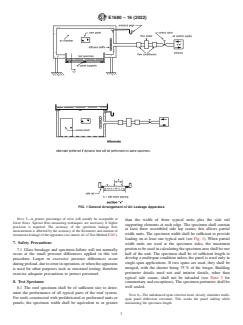
6.2 Major Components (see Fig. 1).
5. Significance and Use
6.2.1 Test Chamber—A well-sealed chamber or box with
5.1 Thistestmethodisastandardprocedurefordetermining either an opening, a removable mounting panel, or one open
air leakage characteristics under specified air pressure differ-
face in which or against which the specimen is installed and
ences. sealed. The specimen shall be installed horizontally. At least
one static pressure tap shall be provided to measure the
NOTE 1—The air pressure differences acting across a building envelope
chamber pressure.All pressure taps shall be located so that the
vary greatly. The slope of the roof and other factors affecting air pressure
differences and the implications of the resulting air leakage relative to the reading is unaffected by the air supply either to or from the
4,5,6
environment within buildings are discussed in the literature. These
chamber. The air supply opening into the chamber shall be
factors shall be considered fully when specifying the test pressure
arranged so that air does not impinge directly on the test
difference to be used.
specimen with any significant velocity. When required, a
NOTE 2—When applying the results of tests by this test method, note
meansofaccessshallbeprovidedintothechambertofacilitate
that the performance of a roof or its components, or both, may be a
functionofproperinstallationandadjustment.Theperformanceinservice adjustments and observations after the specimen has been
willalsodependontherigidityofsupportingconstruction,thepresenceof
installed.
interior treatments, the roof slope, and the resistance of components to
6.2.2 Air System—A controllable blower, compressed air
deterioration by various causes: corrosive atmospheres, aging, ice,
supply, exhaust system, or reversible blower designed to
vibration,thermalexpansion,andcontraction,etc.Itisdifficulttosimulate
provide the required air flow at the specified test pressure
theidenticalcomplexenvironmentalconditionsthatcanbeencounteredin
service, including rapidly changing pressures due to wind gusting. Some
difference. the system shall provide constant air flow at a fixed
designs are more sensitive than others to these environmental conditions.
pressure for the period required to obtain readings of air flow
5.2 Rates of air leakage are sometimes used for comparison and pressure difference, and it shall be capable of maintaining
purposes. The comparisons are not always valid unless the positive and negative pressures.
components being tested and compared are of essentially the 6.2.3 Pressure Measuring Apparatus—Adeviceformeasur-
same size, configuration, and design. ing the test pressure difference within a tolerance of 62%,or
60.01 in. (62.5Pa), of water column, whichever is greater.
NOTE 3—The specimen construction discussed in 1.2 and required in
The device must measure positive and negative pressures.
8.1 isolates a source of leakage. The rate of air leakage measured during
6.2.4 Air-Flow Metering System—A device to measure the
thetestmethodhasunitsofcubicfeetperminutepersquarefoot(litresper
second per square metre). Openings and details such as end laps or roof
air flow within the limitations of error prescribed in 6.3. (The
5,6
curbs are excluded since leakage is measured more appropriately in cubic
publications listed in Footnotes 5 and 6 present background
information on fluid metering practices.)
ASHRAE Handbook of Fundamentals, American Society of Heating,
6.3 The air flow through the test specimen shall be deter-
Refrigeration, and Air-Conditioning Engineers, Inc., 1972, Chapter 25.
mined with an error not greater than 6 5% when this flow
Fluid Meters—Their Theory and Application, 5th edition, 1959.
6 equals or exceeds 2 ft /min (0.94 L/s) or 6 10% when the air
Chapter 4, “Flow Measurements,” ASME—Power Test Code, 2nd edition, Part
3 3
5, 1956. flow is below 2 ft /min but more than ⁄2 ft /min (0.24 L/s).
E1680 − 16 (2022)
FIG. 1 General Arrangement of Air Leakage Apparatus
NOTE 5—A greater percentage of error will usually be acceptable at
than the width of three typical units plus the side rail
lower flows. Special flow-measuring techniques are necessary if higher
supporting elements at each edge. The specimen shall contain
precision is required. The accuracy of the specimen leakage flow
at least three assembled side lap seams; this allows partial
measurement is affected by the accuracy of the flowmeter and amount of
width units. The specimen width shall be sufficient to provide
extraneousleakageoftheapparatus(seeAnnexA1ofTestMethodE283).
loading on at least one typical unit (see Fig. 1). When partial
7. Safety Precautions
width units are used at the specimen sides, the maximum
portiontobeusedincalculatingthespecimenareashallbeone
7.1 Glass breakage and specimen failure will not normally
half of the unit. The specimen shall be of sufficient length to
occur at the small pressure differences applied in this test
develop a multispan condition unless the panel is used only in
procedure. Larger or excessive pressure differences occur
single-span applications. If two spans are used, they shall be
duringpreload,duetoerrorinoperation,orwhentheapparatus
unequal, with the shorter being 75% of the longer. Building
is used for other purposes such as structural testing; therefore
perimeter details need not and interior details, other than
exercise adequate precautions to protect personnel.
typical side seams, shall not be inlcuded (see Note 3 for
8. Test Specimen
commentary and exceptions).The specimen perimeter shall be
well sealed.
8.1 The roof specimen shall be of sufficient size to deter-
mine the performance of all typical parts of the roof system.
NOTE 6—The unbalanced span criterion more closely simulates multi-
For roofs constructed with prefabricated or preformed units or
span panel deflection curvature. This works the panel sidelap while
panels, the specimen width shall be equivalent to or greater minimizing the specimen length.
E1680 − 16 (2022)
8.1.1 All parts of the roof test specimen shall be full size, 9.5 Performance of the flow measurements shall be made
using the same materials, details, and methods of construction under normal operation conditions for the laboratory being
and anchorage as those on actual buildings. calibrated. Provision must be made to account for extraneous
chamber leakage so as not to compromise the integrity of the
8.1.2 The condition of structural support shall be simulated
calibration procedure.
as accurately as possible. If the roof accommodates thermal
expansion parallel to the panel length, this detail must be
9.6 Flow readings shall be measured at each of the three
included in the test specimen, and the interior support must be
pressure differentials given in 9.2. Reverse the calibration
able to slide parallel to the panel or its attachment, or both.
orifice plate if required, reseal the plate, and measure the flow
readings at the negative value of each of the three pressure
8.2 If insulation is an optional component of the roof
differentials given in 9.2.
system, it shall not be included in the test specimen.
9.7 The measured flow at each listed pressure for each
8.3 If only one specimen is to be tested, the selection shall
orificeplatemustbeinaccordancewiththelimitsgivenin6.3.
be determined by the specifying authority.
9.8 Calibration shall be performed every six months at a
NOTE 7—Air leakage is likely to be a function of size, geometry, and
minimum.
stiffness. Therefore, select specimens covering the range of sizes to be
used in a building. In general, the largest size and least stiff of a particular
10. Information Required
design,type,construction,andconfigurationshallbetested(seeNote3for
related commentary).
10.1 Unless otherwise specified, the test-pressure difference
or differences at which air leakage is to be determined shall
9. Calibration
be−1.57 lbf/ft (−75 Pa). Unless otherwise specified, test-
9.1 Calibration shall be accomplished by mounting a ply-
pressure differences shall be both+and−1.57 lbf⁄ft for roof
woodorsimilarrigidblanktothetestchamberinplaceofatest applications steeper then 30° from horizontal.
specimen, using the same mounting procedures as those used
NOTE 10—This commentary is included to assist the specifier in the
7 1
for standard specimens. The blank shall be ⁄8in. 6 ⁄8 in.
selection of test pressures. This test method is consistent with the Test
(22mm 6 3mm) thick, with a 6in. (150mm) diameter hole
Method E283 default test pressure and the AAMA 501.
Shallow roofs rarely see large positive wind pressures unless the
over which calibrated orifice plates shall be mounted. The
resultant pressure is caused by building openings. The Test Method E283
blank is not prohibited from accommodating more than one
default magnitude has been adopted for low sloped roofs, but a negative
orifice plate.
pressure has been chosen. Positive pressures are more probable at steeper
slopes. Most model codes recognize this, and 30° from horizontal is
9.2 Each calibration orifice plate shall be constructed of
generally selected as the slope above which positive external wind
⁄8in.(3mm)thickstainlesssteelhavinganoutsidediameterof
pressures must be considered.This test method selects the 30° slope as its
8 in. (200 mm) and containing an interior diameter square-
break point. The test method adopts Test Method E283 test pressure
edged orifice, which has been calibrated traceable to the
recommendations over the steeper slope range but requires both positive
National Institute of Standards and Technology (NIST) at and negative pressure applications.
2 2 2
If a product will be used only on applications greater than 60° from
0.57lbf⁄ft ,1.57lbf⁄ft ,and6.24lbf/ft (27Pa,75Pa,and298
horizontal, consider testing in accordance with Test Method E283 while
Pa).
recognizing that steep roofs are subject
...