

ASTM F679-21
(Specification)Standard Specification for Poly(Vinyl Chloride) (PVC) Large-Diameter Plastic Gravity Sewer Pipe and Fittings
General Information
- Abstract
ABSTRACT
This specification covers requirements and test methods for poly(vinyl chloride) (PVC) large-diameter plastic gravity sewer pipe and fittings. Pipe requirements include workmanship, pipe dimensions, flattening resistance, impact resistance, pipe stiffness, gaskets requirements, joint tightness, extrusion quality, joining system, and markings. Test procedures shall include referee testing, quality control tests, test conditions, flattening tests, impact resistance, pipe stiffness, and acetone immersion test. Retest, rejection, inspection, certification, marking, delivery, and quality assurance shall conform to the requirements of this specification.
SCOPE
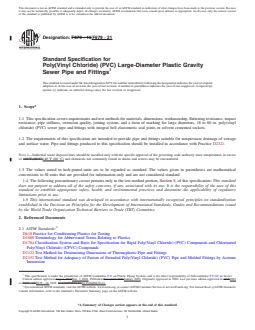
1.1 This specification covers requirements and test methods for materials, dimensions, workmanship, flattening resistance, impact resistance, pipe stiffness, extrusion quality, joining system, and a form of marking for large diameters, 18 to 60 in. poly(vinyl chloride) (PVC) sewer pipe and fittings with integral bell elastomeric seal joints or solvent cemented sockets.
1.2 The requirements of this specification are intended to provide pipe and fittings suitable for nonpressure drainage of sewage and surface water. Pipe and fittings produced to this specification should be installed in accordance with Practice D2321.
Note 1: Industrial waste disposal lines should be installed only with the specific approval of the governing code authority since temperatures in excess of 140 °F (60 °C) and chemicals not commonly found in drains and sewers may be encountered.
1.3 The values stated in inch-pound units are to be regarded as standard. The values given in parentheses are mathematical conversions to SI units that are provided for information only and are not considered standard.
1.4 The following precautionary caveat pertains only to the test method portion, Section 8, of this specification: This standard does not purport to address all of the safety concerns, if any, associated with its use. It is the responsibility of the user of this standard to establish appropriate safety, health, and environmental practices and determine the applicability of regulatory limitations prior to use.
1.5 This international standard was developed in accordance with internationally recognized principles on standardization established in the Decision on Principles for the Development of International Standards, Guides and Recommendations issued by the World Trade Organization Technical Barriers to Trade (TBT) Committee.
- Status
- Published
- Publication Date
- 31-Oct-2021
- Technical Committee
- F17 - Plastic Piping Systems
- Drafting Committee
- F17.62 - Sewer
Buy Documents
ASTM F679-21 - Standard Specification for Poly(Vinyl Chloride) (PVC) Large-Diameter Plastic Gravity Sewer Pipe and Fittings
REDLINE ASTM F679-21 - Standard Specification for Poly(Vinyl Chloride) (PVC) Large-Diameter Plastic Gravity Sewer Pipe and Fittings
Overview
ASTM F679-21 is the internationally recognized standard specification for large-diameter poly(vinyl chloride) (PVC) plastic gravity sewer pipe and fittings. Developed by ASTM International, this standard details the minimum requirements for materials, dimensions, physical performance, and quality for PVC pipes and fittings used in nonpressure drainage systems. The pipes covered range from 18 to 60 inches in nominal diameter and are intended primarily for sanitary sewage and surface water gravity drainage applications, featuring integral bell elastomeric seal joints or solvent-cemented sockets.
Adherence to ASTM F679-21 ensures reliable performance, consistent quality, and compliance for manufacturers, engineers, and contractors involved in gravity sewer infrastructure projects.
Key Topics
ASTM F679-21 addresses essential criteria for large-diameter PVC gravity sewer pipe and fittings, including:
- Material Requirements
- PVC compounds must meet specified minimum cell classifications, providing durability and chemical resistance.
- Clean rework material generated during manufacturing may be used if performance requirements are met.
- Physical and Mechanical Properties
- Pipes and fittings are evaluated for impact strength, pipe stiffness, flattening resistance, and extrusion quality.
- Dimensions and Tolerances
- Precise pipe dimensions, wall thickness, and tolerances for various nominal sizes support effective system design and installation.
- Joining Systems
- Options for joining include elastomeric-sealed integral bell joints and solvent-cemented sockets, both requiring water-tight, secure assembly.
- Testing Methods
- Prescribed test methods address flattening, impact resistance, pipe stiffness, acetone immersion (for fusion quality), and joint tightness.
- Marking and Certification
- Pipes and fittings require permanent markings for traceability, including manufacturer, nominal size, material classification, pipe stiffness designation, and standard reference.
Applications
ASTM F679-21 PVC gravity sewer pipe and fittings are widely specified for:
- Municipal Sanitary Sewer Systems
- Transporting wastewater via gravity flow in urban and suburban networks.
- Stormwater Drainage
- Managing surface water runoff from streets, parking areas, or commercial sites.
- Large-Scale Infrastructure Projects
- Suitable for public works and private developments requiring robust, corrosion-resistant piping solutions.
- Replacement and Rehab Projects
- Ideal for upgrading or relining aging sewer or drainage systems with durable, leak-resistant PVC solutions.
Installation: All products manufactured to this standard are intended to be installed in line with ASTM D2321 for underground thermoplastic pipe systems, ensuring longevity and performance.
Note: For industrial waste disposal, specific code authority approval is required due to potential exposure to high temperatures or aggressive chemicals.
Related Standards
Projects referencing ASTM F679-21 often involve or benefit from knowledge of related standards, including:
- ASTM D1784: Classification for Rigid PVC Compounds
- ASTM D2321: Practice for Underground Installation of Thermoplastic Pipe
- ASTM D2412: External Loading Characteristics of Plastic Pipe
- ASTM D2444: Impact Resistance of Thermoplastic Pipe
- ASTM D2855: Practice for Solvent Cemented Joints
- ASTM D3212: Joints for Drain and Sewer Pipes Using Flexible Elastomeric Seals
- ASTM F477: Specification for Elastomeric Seals (Gaskets) for Joining Plastic Pipe
- ASTM D618: Conditioning Plastics for Testing
ASTM F679-21 promotes best practices, quality control, and compatibility across gravity sewer system components, helping engineers, specifiers, and installation teams achieve modern infrastructure goals.
Relations
- Effective Date
- 01-Nov-2023
- Effective Date
- 01-Aug-2020
- Effective Date
- 01-Aug-2020
- Effective Date
- 01-Apr-2020
- Effective Date
- 15-Mar-2020
- Effective Date
- 15-Jan-2020
- Effective Date
- 01-Jan-2019
- Effective Date
- 01-Aug-2018
- Effective Date
- 01-Mar-2018
- Refers
ASTM D1600-18 - Standard Terminology for Abbreviated Terms Relating to Plastics (Withdrawn 2024) - Effective Date
- 01-Jan-2018
- Effective Date
- 15-Nov-2017
- Effective Date
- 01-Nov-2017
- Effective Date
- 01-Aug-2017
- Effective Date
- 01-Feb-2017
- Effective Date
- 15-Nov-2016
Buy Documents
ASTM F679-21 - Standard Specification for Poly(Vinyl Chloride) (PVC) Large-Diameter Plastic Gravity Sewer Pipe and Fittings
REDLINE ASTM F679-21 - Standard Specification for Poly(Vinyl Chloride) (PVC) Large-Diameter Plastic Gravity Sewer Pipe and Fittings
Get Certified
Connect with accredited certification bodies for this standard

Institut za varilstvo d.o.o. (Welding Institute)
Slovenia's leading welding institute since 1952. ISO 3834, EN 1090, pressure equipment certification, NDT personnel, welder qualification. Only IIW Au
Sponsored listings
Frequently Asked Questions
ASTM F679-21 is a technical specification published by ASTM International. Its full title is "Standard Specification for Poly(Vinyl Chloride) (PVC) Large-Diameter Plastic Gravity Sewer Pipe and Fittings". This standard covers: ABSTRACT This specification covers requirements and test methods for poly(vinyl chloride) (PVC) large-diameter plastic gravity sewer pipe and fittings. Pipe requirements include workmanship, pipe dimensions, flattening resistance, impact resistance, pipe stiffness, gaskets requirements, joint tightness, extrusion quality, joining system, and markings. Test procedures shall include referee testing, quality control tests, test conditions, flattening tests, impact resistance, pipe stiffness, and acetone immersion test. Retest, rejection, inspection, certification, marking, delivery, and quality assurance shall conform to the requirements of this specification. SCOPE 1.1 This specification covers requirements and test methods for materials, dimensions, workmanship, flattening resistance, impact resistance, pipe stiffness, extrusion quality, joining system, and a form of marking for large diameters, 18 to 60 in. poly(vinyl chloride) (PVC) sewer pipe and fittings with integral bell elastomeric seal joints or solvent cemented sockets. 1.2 The requirements of this specification are intended to provide pipe and fittings suitable for nonpressure drainage of sewage and surface water. Pipe and fittings produced to this specification should be installed in accordance with Practice D2321. Note 1: Industrial waste disposal lines should be installed only with the specific approval of the governing code authority since temperatures in excess of 140 °F (60 °C) and chemicals not commonly found in drains and sewers may be encountered. 1.3 The values stated in inch-pound units are to be regarded as standard. The values given in parentheses are mathematical conversions to SI units that are provided for information only and are not considered standard. 1.4 The following precautionary caveat pertains only to the test method portion, Section 8, of this specification: This standard does not purport to address all of the safety concerns, if any, associated with its use. It is the responsibility of the user of this standard to establish appropriate safety, health, and environmental practices and determine the applicability of regulatory limitations prior to use. 1.5 This international standard was developed in accordance with internationally recognized principles on standardization established in the Decision on Principles for the Development of International Standards, Guides and Recommendations issued by the World Trade Organization Technical Barriers to Trade (TBT) Committee.
ABSTRACT This specification covers requirements and test methods for poly(vinyl chloride) (PVC) large-diameter plastic gravity sewer pipe and fittings. Pipe requirements include workmanship, pipe dimensions, flattening resistance, impact resistance, pipe stiffness, gaskets requirements, joint tightness, extrusion quality, joining system, and markings. Test procedures shall include referee testing, quality control tests, test conditions, flattening tests, impact resistance, pipe stiffness, and acetone immersion test. Retest, rejection, inspection, certification, marking, delivery, and quality assurance shall conform to the requirements of this specification. SCOPE 1.1 This specification covers requirements and test methods for materials, dimensions, workmanship, flattening resistance, impact resistance, pipe stiffness, extrusion quality, joining system, and a form of marking for large diameters, 18 to 60 in. poly(vinyl chloride) (PVC) sewer pipe and fittings with integral bell elastomeric seal joints or solvent cemented sockets. 1.2 The requirements of this specification are intended to provide pipe and fittings suitable for nonpressure drainage of sewage and surface water. Pipe and fittings produced to this specification should be installed in accordance with Practice D2321. Note 1: Industrial waste disposal lines should be installed only with the specific approval of the governing code authority since temperatures in excess of 140 °F (60 °C) and chemicals not commonly found in drains and sewers may be encountered. 1.3 The values stated in inch-pound units are to be regarded as standard. The values given in parentheses are mathematical conversions to SI units that are provided for information only and are not considered standard. 1.4 The following precautionary caveat pertains only to the test method portion, Section 8, of this specification: This standard does not purport to address all of the safety concerns, if any, associated with its use. It is the responsibility of the user of this standard to establish appropriate safety, health, and environmental practices and determine the applicability of regulatory limitations prior to use. 1.5 This international standard was developed in accordance with internationally recognized principles on standardization established in the Decision on Principles for the Development of International Standards, Guides and Recommendations issued by the World Trade Organization Technical Barriers to Trade (TBT) Committee.
ASTM F679-21 is classified under the following ICS (International Classification for Standards) categories: 23.040.20 - Plastics pipes. The ICS classification helps identify the subject area and facilitates finding related standards.
ASTM F679-21 has the following relationships with other standards: It is inter standard links to ASTM D2152-23, ASTM D2855-20, ASTM D2564-20, ASTM F412-20, ASTM D2321-20, ASTM D1784-20, ASTM F412-19, ASTM D2564-12(2018), ASTM D2321-18, ASTM D1600-18, ASTM D2444-17, ASTM D2152-17, ASTM F412-17a, ASTM F412-17, ASTM F412-16a. Understanding these relationships helps ensure you are using the most current and applicable version of the standard.
ASTM F679-21 is available in PDF format for immediate download after purchase. The document can be added to your cart and obtained through the secure checkout process. Digital delivery ensures instant access to the complete standard document.
Standards Content (Sample)
This international standard was developed in accordance with internationally recognized principles on standardization established in the Decision on Principles for the
Development of International Standards, Guides and Recommendations issued by the World Trade Organization Technical Barriers to Trade (TBT) Committee.
Designation:F679 −21
Standard Specification for
Poly(Vinyl Chloride) (PVC) Large-Diameter Plastic Gravity
Sewer Pipe and Fittings
ThisstandardisissuedunderthefixeddesignationF679;thenumberimmediatelyfollowingthedesignationindicatestheyearoforiginal
adoptionor,inthecaseofrevision,theyearoflastrevision.Anumberinparenthesesindicatestheyearoflastreapproval.Asuperscript
epsilon (´) indicates an editorial change since the last revision or reapproval.
1. Scope* 2. Referenced Documents
2.1 ASTM Standards:
1.1 This specification covers requirements and test methods
D618Practice for Conditioning Plastics for Testing
for materials, dimensions, workmanship, flattening resistance,
D1600TerminologyforAbbreviatedTermsRelatingtoPlas-
impact resistance, pipe stiffness, extrusion quality, joining
tics
system, and a form of marking for large diameters, 18 to 60 in.
D1784Classification System and Basis for Specification for
poly(vinyl chloride) (PVC) sewer pipe and fittings with inte-
Rigid Poly(Vinyl Chloride) (PVC) Compounds and Chlo-
gral bell elastomeric seal joints or solvent cemented sockets.
rinated Poly(Vinyl Chloride) (CPVC) Compounds
1.2 The requirements of this specification are intended to D2122Test Method for Determining Dimensions of Ther-
moplastic Pipe and Fittings
provide pipe and fittings suitable for nonpressure drainage of
D2152Test Method for Adequacy of Fusion of Extruded
sewage and surface water. Pipe and fittings produced to this
Poly(Vinyl Chloride) (PVC) Pipe and Molded Fittings by
specification should be installed in accordance with Practice
Acetone Immersion
D2321.
D2321PracticeforUndergroundInstallationofThermoplas-
NOTE 1—Industrial waste disposal lines should be installed only with
tic Pipe for Sewers and Other Gravity-Flow Applications
thespecificapprovalofthegoverningcodeauthoritysincetemperaturesin
D2412Test Method for Determination of External Loading
excessof140°F(60°C)andchemicalsnotcommonlyfoundindrainsand
Characteristics of Plastic Pipe by Parallel-Plate Loading
sewers may be encountered.
D2444Practice for Determination of the Impact Resistance
1.3 The values stated in inch-pound units are to be regarded
of Thermoplastic Pipe and Fittings by Means of a Tup
as standard. The values given in parentheses are mathematical
(Falling Weight)
conversions to SI units that are provided for information only D2564Specification for Solvent Cements for Poly(Vinyl
and are not considered standard. Chloride) (PVC) Plastic Piping Systems
D2855Practice for the Two-Step (Primer and Solvent Ce-
1.4 The following precautionary caveat pertains only to the
ment) Method of Joining Poly (Vinyl Chloride) (PVC) or
test method portion, Section 8, of this specification: This
Chlorinated Poly (Vinyl Chloride) (CPVC) Pipe and
standard does not purport to address all of the safety concerns,
Piping Components with Tapered Sockets
if any, associated with its use. It is the responsibility of the user
D3212Specification for Joints for Drain and Sewer Plastic
of this standard to establish appropriate safety, health, and
Pipes Using Flexible Elastomeric Seals
environmental practices and determine the applicability of
F402 Practice for Safe Handling of Solvent Cements,
regulatory limitations prior to use.
Primers, and Cleaners Used for Joining Thermoplastic
1.5 This international standard was developed in accor-
Pipe and Fittings
dance with internationally recognized principles on standard-
F412Terminology Relating to Plastic Piping Systems
ization established in the Decision on Principles for the F477Specification for Elastomeric Seals (Gaskets) for Join-
Development of International Standards, Guides and Recom- ing Plastic Pipe
mendations issued by the World Trade Organization Technical
2.2 Federal Standard:
Barriers to Trade (TBT) Committee.
Fed. Std. No. 123Marking for Shipment (Civil Agencies)
For referenced ASTM standards, visit the ASTM website, www.astm.org, or
This specification is under the jurisdiction ofASTM Committee F17 on Plastic contact ASTM Customer Service at service@astm.org. For Annual Book of ASTM
Piping Systems and is the direct responsibility of Subcommittee F17.62 on Sewer. Standards volume information, refer to the standard’s Document Summary page on
Current edition approved Nov. 1, 2021. Published January 2022. Originally the ASTM website.
approved in 1980. Last previous edition approved in 2016 as F679–16. DOI: Available from DLA Document Services, Building 4/D, 700 Robbins Ave.,
10.1520/F0679-21. Philadelphia, PA 19111-5094, http://quicksearch.dla.mil.
*A Summary of Changes section appears at the end of this standard
Copyright © ASTM International, 100 Barr Harbor Drive, PO Box C700, West Conshohocken, PA 19428-2959. United States
F679−21
2.3 Military Standard: 6.2 Pipe Dimensions:
MIL-STD-129Marking for Shipment and Storage 6.2.1 Pipe Diameter—The average outside diameter of the
pipe shall meet the requirements given in Table 1, when
3. Terminology
measured in accordance with Test Method D2122.
6.2.2 Wall Thickness—Pipe wall thicknesses shall meet the
3.1 Definitions:
requirements of Table 1, when measured in accordance with
3.1.1 General—Definitions used in the specification are in
Test Method D2122. In the case of belled pipe and fittings
accordance with Terminology F412, unless otherwise indi-
fabricated from pipe sections, the thickness of the wall in the
cated.Theabbreviationforpoly(vinylchloride)pipeisPVC,in
bell shall be considered satisfactory if it was formed from pipe
accordance with Terminology D1600.
meeting the above requirements.
4. Materials
NOTE 2—The wall thickness variability in any cross section of the pipe
is normally 612% or less from minimum.
4.1 Basic Materials—ThepipeshallbemadeofPVCplastic
having a minimum cell classification of 12364 or 12454 as
6.3 Pipe Flattening—There shall be no evidence of
defined in Specification D1784. Homopolymer PVC com-
splitting, cracking, or breaking, when pipe is tested in accor-
pounds must equal or exceed the requirements of the above
dance with 8.4.
listed minimum cell classification number.
6.4 Wall Thickness of Fittings—The minimum wall thick-
4.2 Rework Material—Clean rework material generated
nesses of the fittings shall be the same as the minimum wall
from the manufacturer’s own pipe or fittings production may
thickness of the equivalent size of pipe as specified in Table 1.
be used by the same manufacturer provided that the rework
For reducing fittings or those with smaller inlets, the minimum
material meets the requirements of 4.1 and that the pipe or
wall thickness of each inlet shall be no less than the minimum
fittings produced meet all the requirements of this specifica-
wall thickness for that size pipe. The thickness shall be
tion.
determined in accordance with Test Method D2122.
4.3 Gaskets—Rubber gaskets shall be in compliance with
NOTE 3—Owing to the present state of technology in the industry, all
Specification F477. fittings are fabricated fittings. Fabricated fittings with solvent-cemented
components should be made in accordance with Practice D2855 and
4.4 Lubricant—The lubricant used for assembly shall have
taking cognizance of Practice F402.
no detrimental effect on the gasket or pipe.
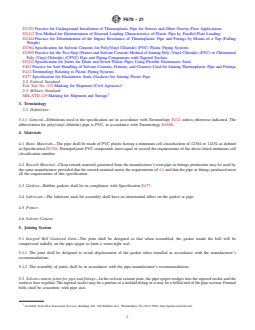
6.5 Pipe Impact Strength—The impact strength of the pipe
4.5 Primer.
shall be not less than 220 ft·lbf (298.3 J), when tested in
accordance with 8.5.
4.6 Solvent Cement.
NOTE 4—This requirement is intended only for use as a quality control
5. Joining System
test, not as a simulated service test.As aged impact data is developed, the
applicable aged impact values will be included to reflect long-term
5.1 Integral Bell Gasketed Joint—The joint shall be de-
performance needs.
signed so that when assembled, the gasket inside the bell will
6.6 Pipe Stiffness—Pipe stiffness values for the pipe shall
becompressedradiallyonthepipespigottoformawater-tight
comply with Table 1, when tested in accordance with 8.6.
seal.
6.6.1 The wall thickness must be increased to meet the pipe
5.1.1 The joint shall be designed to avoid displacement of
stiffness requirement PS46 or PS115 listed in Table 1 when
the gasket when installed in accordance with the manufactur-
material with modulus lower than 500,000 psi (3447 MPa) is
er’s recommendations.
used.
5.1.2 Theassemblyofjointsshallbeinaccordancewiththe
pipe manufacturer’s recommendations.
6.7 Gaskets:
6.7.1 All gaskets shall meet the requirements of Specifica-
5.2 Solvent cement joints for pipe and fittings—In the
tionF477andbemoldedintoacircularformorextrudedtothe
solvent cement joint, the pipe spigot wedges into the tapered
proper section and then spliced into circular form. Gaskets
socket and the surfaces fuse together. The tapered socket may
shall be made of a properly vulcanized high-grade elastomeric
beaportionofamoldedfittingoritmaybeabelledendofthe
compound.
pipe section. Formed bells shall be concentric with pipe axis.
6.7.2 The basic polymer shall be natural rubber, synthetic
5.2.1 The assembly of the joints shall be accordance with
elastomer, or a blend of both.
Practice D2855.
6.7.3 The gasket shall be designed with an adequate com-
5.2.2 Joint Tightness—Joints made with pipe and fittings or
pressive force so as to effect a positive seal under all combi-
with belled-end pipe shall show no signs of leakage when
nationsofjointtolerances.Thegasketshallbetheonlyelement
tested in accordance with 7.5.
depended upon to make the joint flexible and watertight.
6. Requirements
6.8 Joint Tightness—Jointsmadewithpipeandfittingsshall
6.1 Workmanship—The pipe and fittings shall be homoge- show no sign of leakage, when tested in accordance with
neous throughout and free from visible cracks, holes, foreign Specification D3212. All surfaces of the joint upon which the
inclusions, or other injurious defects. The pipe shall be as gasket may bear shall be smooth and free of imperfections,
uniform as commercially practical in color, opacity, density, ridges, fractures, or cracks that could adversely affect sealabil-
and other physical properties. ity.
F679−21
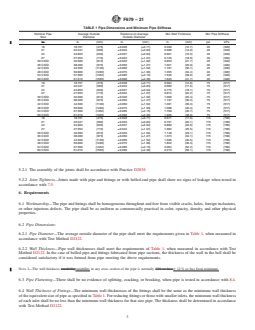
TABLE 1 Pipe Dimensions and Minimum Pipe Stiffness
Nominal Pipe Average Outside Tolerance on Average Min Wall Thickness Min Pipe Stiffness
Size Diameter Outside Diameter
in. (mm) in. (mm) in. (mm) psi kPa
18 18.701 (475) ±0.028 (±0.71) 0.499 (12.7) 46 (320)
21 22.047 (560) ±0.033 (±0.84) 0.588 (14.9) 46 (320)
24 24.803 (630) ±0.037 (±0.94) 0.661 (15.5) 46 (320)
27 27.953 (710) ±0.042 (±1.07) 0.745 (18.9) 46 (320)
30 CIOD 32.000 (813) ±0.040 (±1.02) 0.853 (21.7) 46 (320)
36 CIOD 38.300 (973) ±0.050 (±1.27) 1.021 (25.9) 46 (320)
42 CIOD 44.500 (1130) ±0.060 (±1.52) 1.187 (30.1) 46 (320)
48 CIOD 50.800 (1290) ±0.075 (±1.90) 1.355 (34.4) 46 (320)
54 CIOD 57.560 (1462) ±0.085 (±2.15) 1.535 (39.0) 46 (320)
60 CIOD 61.610 (1565) ±0.090 (±2.30) 1.643 (41.7) 46 (320)
18 18.701 (475) ±0.028 (±0.71) 0.584 (14.8) 75 (517)
21 22.047 (560) ±0.033 (±0.84) 0.689 (17.5) 75 (517)
24 24.803 (630) ±0.037 (±0.94) 0.775 (19.7) 75 (517)
27 27.953 (710) ±0.042 (±1.07) 0.874 (22.2) 75 (517)
30 CIOD 32.000 (813) ±0.040 (±1.02) 1.000 (25.4) 75 (517)
36 CIOD 38.300 (973) ±0.050 (±1.27) 1.197 (30.4) 75 (517)
42 CIOD 44.500 (1130) ±0.060 (±1.52) 1.391 (35.3) 75 (517)
48 CIOD 50.800 (1290) ±0.075 (±1.90) 1.588 (40.3) 75 (517)
54 CIOD 57.560 (1462) ±0.085 (±2.15) 1.799 (45.7) 75 (517)
60 CIOD 61.610 (1565) ±0.090 (±2.30) 1.926 (48.9) 75 (517)
18 18.701 (475) ±0.028 (±0.71) 0.671 (17.0) 115 (790)
21 22.047 (560) ±0.033 (±0.84) 0.791 (20.1) 115 (790)
24 24.803 (630) ±0.037 (±0.94) 0.889 (22.6) 115 (790)
27 27.953 (710) ±0.042 (±1.07) 1.002 (25.5) 115 (790)
30 CIOD 32.000 (813) ±0.040 (±1.02) 1.148 (29.1) 115 (790)
36 CIOD 38.300 (973) ±0.050 (±1.27) 1.373 (34.1) 115 (790)
42 CIOD 44.500 (1130) ±0.060 (±1.52) 1.596 (40.5) 115 (790)
48 CIOD 50.800 (1290) ±0.075 (±1.90) 1.822 (46.3) 115 (790)
54 CIOD 57.560 (1462) ±0.085 (±2.15) 2.064 (52.4) 115 (790)
60 CIOD 61.610 (1565) ±0.090 (±2.30) 2.210 (56.1) 115 (790)
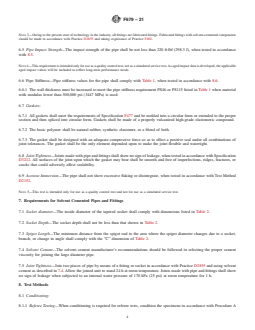
6.9 Acetone Immersion—The pipe shall not show excessive 8.1.1 Referee Testing—When conditioning is required for
flaking or disintegrate, when tested in accordance with Test referee tests, condition the specimens in accordance with
Method D2152. ProcedureAof Practice D618 at 73°F 6 4°F (23°C 6 2°C)
and50% 610%relativehumidityfornotlessthan40hprior
NOTE 5—This test is intended only for use as a quality control test and
totest.Conducttestsunderthesameconditionsoftemperature
not for use as a simulated service test.
and humidity, unless otherwise specified.
7. Requirements for Solvent Cemented Pipes and Fittings
8.1.2 Quality Control Tests—For quality control tests, con-
dition specimens for a minimum of4hinairor1hin water at
7.1 Socket diameter—The inside diameter of the tapered
73°F 6 4°F (23°C 6 2°C). Test the specimens at 23°C 6
socket shall comply with dimensions listed in Table 2.
2°C without regard to relative humidity.
7.2 Socket Depth—The socket depth shall not be less than
8.2 Test Conditions—Conduct tests in the Standard Labora-
that shown in Table 2.
toryAtmosphere of 73°F 6 4°F (23°C 6 2°C) and 50% 6
7.3 Spigot Length—The minimum distance from the spigot
10% relative humidity, unless otherwise specified in this
end to the area where the spigot diameter changes due to a
specification. In cases of disagreement, the tolerances shall be
socket, branch, or change in angle shall comply with the “C”
62°F(61°C) and 62% relative humidity.
dimension of Table 2.
8.3 Sampling—The selection of the sample or samp
...
This document is not an ASTM standard and is intended only to provide the user of an ASTM standard an indication of what changes have been made to the previous version. Because
it may not be technically possible to adequately depict all changes accurately, ASTM recommends that users consult prior editions as appropriate. In all cases only the current version
of the standard as published by ASTM is to be considered the official document.
Designation: F679 − 16 F679 − 21
Standard Specification for
Poly(Vinyl Chloride) (PVC) Large-Diameter Plastic Gravity
Sewer Pipe and Fittings
This standard is issued under the fixed designation F679; the number immediately following the designation indicates the year of original
adoption or, in the case of revision, the year of last revision. A number in parentheses indicates the year of last reapproval. A superscript
epsilon (´) indicates an editorial change since the last revision or reapproval.
1. Scope*
1.1 This specification covers requirements and test methods for materials, dimensions, workmanship, flattening resistance, impact
resistance, pipe stiffness, extrusion quality, joining system, and a form of marking for large diameters, 18 to 60 in. poly(vinyl
chloride) (PVC) sewer pipe and fittings with integral bell elastomeric seal joints or solvent cemented sockets.
1.2 The requirements of this specification are intended to provide pipe and fittings suitable for nonpressure drainage of sewage
and surface water. Pipe and fittings produced to this specification should be installed in accordance with Practice D2321.
NOTE 1—Industrial waste disposal lines should be installed only with the specific approval of the governing code authority since temperatures in excess
of 140°F (60°C)140 °F (60 °C) and chemicals not commonly found in drains and sewers may be encountered.
1.3 The values stated in inch-pound units are to be regarded as standard. The values given in parentheses are mathematical
conversions to SI units that are provided for information only and are not considered standard.
1.4 The following precautionary caveat pertains only to the test method portion, Section 8, of this specification: This standard
does not purport to address all of the safety concerns, if any, associated with its use. It is the responsibility of the user of this
standard to establish appropriate safety, health, and environmental practices and determine the applicability of regulatory
limitations prior to use.
1.5 This international standard was developed in accordance with internationally recognized principles on standardization
established in the Decision on Principles for the Development of International Standards, Guides and Recommendations issued
by the World Trade Organization Technical Barriers to Trade (TBT) Committee.
2. Referenced Documents
2.1 ASTM Standards:
D618 Practice for Conditioning Plastics for Testing
D1600 Terminology for Abbreviated Terms Relating to Plastics
D1784 Classification System and Basis for Specification for Rigid Poly(Vinyl Chloride) (PVC) Compounds and Chlorinated
Poly(Vinyl Chloride) (CPVC) Compounds
D2122 Test Method for Determining Dimensions of Thermoplastic Pipe and Fittings
D2152 Test Method for Adequacy of Fusion of Extruded Poly(Vinyl Chloride) (PVC) Pipe and Molded Fittings by Acetone
Immersion
This specification is under the jurisdiction of ASTM Committee F17 on Plastic Piping Systems and is the direct responsibility of Subcommittee F17.62 on Sewer.
Current edition approved Aug. 1, 2016Nov. 1, 2021. Published November 2016January 2022. Originally approved in 1980. Last previous edition approved in 20152016
as F679 – 15.F679 – 16. DOI: 10.1520/F0679-16.10.1520/F0679-21.
For referenced ASTM standards, visit the ASTM website, www.astm.org, or contact ASTM Customer Service at service@astm.org. For Annual Book of ASTM Standards
volume information, refer to the standard’s Document Summary page on the ASTM website.
*A Summary of Changes section appears at the end of this standard
Copyright © ASTM International, 100 Barr Harbor Drive, PO Box C700, West Conshohocken, PA 19428-2959. United States
F679 − 21
D2321 Practice for Underground Installation of Thermoplastic Pipe for Sewers and Other Gravity-Flow Applications
D2412 Test Method for Determination of External Loading Characteristics of Plastic Pipe by Parallel-Plate Loading
D2444 Practice for Determination of the Impact Resistance of Thermoplastic Pipe and Fittings by Means of a Tup (Falling
Weight)
D2564 Specification for Solvent Cements for Poly(Vinyl Chloride) (PVC) Plastic Piping Systems
D2855 Practice for the Two-Step (Primer and Solvent Cement) Method of Joining Poly (Vinyl Chloride) (PVC) or Chlorinated
Poly (Vinyl Chloride) (CPVC) Pipe and Piping Components with Tapered Sockets
D3212 Specification for Joints for Drain and Sewer Plastic Pipes Using Flexible Elastomeric Seals
F402 Practice for Safe Handling of Solvent Cements, Primers, and Cleaners Used for Joining Thermoplastic Pipe and Fittings
F412 Terminology Relating to Plastic Piping Systems
F477 Specification for Elastomeric Seals (Gaskets) for Joining Plastic Pipe
2.2 Federal Standard:
Fed. Std. No. 123 Marking for Shipment (Civil Agencies)
2.3 Military Standard:
MIL-STD-129 Marking for Shipment and Storage
3. Terminology
3.1 Definitions:
3.1.1 General—Definitions used in the specification are in accordance with Terminology F412, unless otherwise indicated. The
abbreviation for poly(vinyl chloride) pipe is PVC, in accordance with Terminology D1600.
4. Materials
4.1 Basic Materials—The pipe shall be made of PVC plastic having a minimum cell classification of 12364 or 12454 as defined
in Specification D1784. Homopolymer PVC compounds must equal or exceed the requirements of the above listed minimum cell
classification number.
4.2 Rework Material—Clean rework material generated from the manufacturer’s own pipe or fittings production may be used by
the same manufacturer provided that the rework material meets the requirements of 4.1 and that the pipe or fittings produced meet
all the requirements of this specification.
4.3 Gaskets—Rubber gaskets shall be in compliance with Specification F477.
4.4 Lubricant—The lubricant used for assembly shall have no detrimental effect on the gasket or pipe.
4.5 Primer.
4.6 Solvent Cement.
5. Joining System
5.1 Integral Bell Gasketed Joint—The joint shall be designed so that when assembled, the gasket inside the bell will be
compressed radially on the pipe spigot to form a water-tight seal.
5.1.1 The joint shall be designed to avoid displacement of the gasket when installed in accordance with the manufacturer’s
recommendations.
5.1.2 The assembly of joints shall be in accordance with the pipe manufacturer’s recommendations.
5.2 Solvent cement joints for pipe and fittings—In the solvent cement joint, the pipe spigot wedges into the tapered socket and the
surfaces fuse together. The tapered socket may be a portion of a molded fitting or it may be a belled end of the pipe section. Formed
bells shall be concentric with pipe axis.
Available from DLA Document Services, Building 4/D, 700 Robbins Ave., Philadelphia, PA 19111-5094, http://quicksearch.dla.mil.
F679 − 21
TABLE 1 Pipe Dimensions and Minimum Pipe Stiffness
Nominal Pipe Average Outside Tolerance on Average Min Wall Thickness Min Pipe Stiffness
Size Diameter Outside Diameter
in. in. (mm) in. (mm) in. (mm) psi kPa
18 18.701 (475) ±0.028 (±0.71) 0.499 (12.7) 46 (320)
21 22.047 (560) ±0.033 (±0.84) 0.588 (14.9) 46 (320)
24 24.803 (630) ±0.037 (±0.94) 0.661 (15.5) 46 (320)
27 27.953 (710) ±0.042 (±1.07) 0.745 (18.9) 46 (320)
30 CIOD 32.000 (813) ±0.040 (±1.02) 0.853 (21.7) 46 (320)
36 CIOD 38.300 (973) ±0.050 (±1.27) 1.021 (25.9) 46 (320)
42 CIOD 44.500 (1130) ±0.060 (±1.52) 1.187 (30.1) 46 (320)
48 CIOD 50.800 (1290) ±0.075 (±1.90) 1.355 (34.4) 46 (320)
54 CIOD 57.560 (1462) ±0.085 (±2.15) 1.535 (39.0) 46 (320)
60 CIOD 61.610 (1565) ±0.090 (±2.30) 1.643 (41.7) 46 (320)
18 18.701 (475) ±0.028 (±0.71) 0.584 (14.8) 75 (517)
21 22.047 (560) ±0.033 (±0.84) 0.689 (17.5) 75 (517)
24 24.803 (630) ±0.037 (±0.94) 0.775 (19.7) 75 (517)
27 27.953 (710) ±0.042 (±1.07) 0.874 (22.2) 75 (517)
30 CIOD 32.000 (813) ±0.040 (±1.02) 1.000 (25.4) 75 (517)
36 CIOD 38.300 (973) ±0.050 (±1.27) 1.197 (30.4) 75 (517)
42 CIOD 44.500 (1130) ±0.060 (±1.52) 1.391 (35.3) 75 (517)
48 CIOD 50.800 (1290) ±0.075 (±1.90) 1.588 (40.3) 75 (517)
54 CIOD 57.560 (1462) ±0.085 (±2.15) 1.799 (45.7) 75 (517)
60 CIOD 61.610 (1565) ±0.090 (±2.30) 1.926 (48.9) 75 (517)
18 18.701 (475) ±0.028 (±0.71) 0.671 (17.0) 115 (790)
21 22.047 (560) ±0.033 (±0.84) 0.791 (20.1) 115 (790)
24 24.803 (630) ±0.037 (±0.94) 0.889 (22.6) 115 (790)
27 27.953 (710) ±0.042 (±1.07) 1.002 (25.5) 115 (790)
30 CIOD 32.000 (813) ±0.040 (±1.02) 1.148 (29.1) 115 (790)
36 CIOD 38.300 (973) ±0.050 (±1.27) 1.373 (34.1) 115 (790)
42 CIOD 44.500 (1130) ±0.060 (±1.52) 1.596 (40.5) 115 (790)
48 CIOD 50.800 (1290) ±0.075 (±1.90) 1.822 (46.3) 115 (790)
54 CIOD 57.560 (1462) ±0.085 (±2.15) 2.064 (52.4) 115 (790)
60 CIOD 61.610 (1565) ±0.090 (±2.30) 2.210 (56.1) 115 (790)
5.2.1 The assembly of the joints shall be accordance with Practice D2855.
5.2.2 Joint Tightness—Joints made with pipe and fittings or with belled-end pipe shall show no signs of leakage when tested in
accordance with 7.5.
6. Requirements
6.1 Workmanship—The pipe and fittings shall be homogeneous throughout and free from visible cracks, holes, foreign inclusions,
or other injurious defects. The pipe shall be as uniform as commercially practical in color, opacity, density, and other physical
properties.
6.2 Pipe Dimensions:
6.2.1 Pipe Diameter—The average outside diameter of the pipe shall meet the requirements given in Table 1, when measured in
accordance with Test Method D2122.
6.2.2 Wall Thickness—Pipe wall thicknesses shall meet the requirements of Table 1, when measured in accordance with Test
Method D2122. In the case of belled pipe and fittings fabricated from pipe sections, the thickness of the wall in the bell shall be
considered satisfactory if it was formed from pipe meeting the above requirements.
NOTE 2—The wall thickness varaibilityvariability in any cross section of the pipe is normally 12% or less.6 12 % or less from minimum.
6.3 Pipe Flattening—There shall be no evidence of splitting, cracking, or breaking, when pipe is tested in accordance with 8.4.
6.4 Wall Thickness of Fittings—The minimum wall thicknesses of the fittings shall be the same as the minimum wall thickness
of the equivalent size of pipe as specified in Table 1. For reducing fittings or those with smaller inlets, the minimum wall thickness
of each inlet shall be no less than the minimum wall thickness for that size pipe. The thickness shall be determined in accordance
with Test Method D2122.
F679 − 21
NOTE 3—Owing to the present state of technology in the industry, all fittings are fabricated fittings. Fabricated fittings with solvent-cemented components
should be made in accordance with Practice D2855 and taking cognizance of Practice F402.
6.5 Pipe Impact Strength—The impact strength of the pipe shall be not less than 220 ft·lbf (298.3 J), when tested in accordance
with 8.5.
NOTE 4—This requirement is intended only for use as a quality control test, not as a simulated service test. As aged impact data is developed, the applicable
aged impact values will be included to reflect long-term performance needs.
6.6 Pipe Stiffness—Pipe stiffness values for the pipe shall comply with Table 1, when tested in accordance with 8.6.
6.6.1 The wall thickness must be increased to meet the pipe stiffness requirement PS46 or PS115 listed in Table 1 when material
with modulus lower than 500,000 psi (3447 MPa) is used.
6.7 Gaskets:
6.7.1 All gaskets shall meet the requirements of Specification F477 and be molded into a circular form or extruded to the proper
section and then spliced into circular form. Gaskets shall be made of a properly vulcanized high-grade elastomeric compound.
6.7.2 The basic polymer shall be natural rubber, synthetic elastomer, or a blend of both.
6.7.3 The gasket shall be designed with an adequate compressive force so as to effect a positive seal under all combinations of
joint tolerances. The gasket shall be the only element depended upon to make the joint flexible and watertight.
6.8 Joint Tightness—Joints made with pipe and fittings shall show no sign of leakage, when tested in accordance with Specification
D3212. All surfaces of the joint upon which the gasket may bear shall be smooth and free of imperfections, ridges, fractures, or
cracks that could adversely affect sealability.
6.9 Acetone Immersion—The pipe shall not show excessive flaking or disintegrate, when tested in accordance with Test Method
D2152.
NOTE 5—This test is intended only for use as a quality control test and not for use as a simulated service test.
7. Requirements for Solvent Cemented Pipes and Fittings
7.1 Socket diameter—The inside diameter of the tapered socket shall comply with dimensions listed in Table 2.
7.2 Socket Depth—The socket depth shall not be less than that shown in Table 2.
7.3 Spigot Length—The minimum distance from the spigot end to the area where the spigot diameter changes due to a socket,
branch, or change in angle shall comply with the “C” dimension of Table 2.
7.4 Solvent Cement—The solvent cement manufacturer’s recommendations should be followed in selecting the proper cement
viscosity for joining the large diameter pipe.
7.5 Joint Tightness—Join two pieces of pipe by means of a fitting or socket in accordance with Practice D2855 and using solvent
cement as described in 7.4. Allow the joined unit to stand 24 h at room temperature. Joints made with pipe and fittings shall show
no sign of leakage when subjected to an internal water pressure of 170 kPa (25 psi) at room temperature for 1 h.
8. Test Methods
8.1 Conditioning:
8.1.1 Referee Testing—When conditioning is required for referee tests, condition the specimens in accordance with Procedure A
F679 − 21
TABLE 2 Solvent Cement Socket Dimensions
Solvent Cement Socket Dimensions
Nominal Size, in. A B C
Nominal Size A B C
18 18.757 ± 0.028 18.673 ± 0.028 9.000
21 22.113 ± 0.033 22.014 ± 0.033 10.500
24 24.877 ± 0.037 24.766 ± 0.037 12.000
27 28.0
...