

ASTM B808-10(2020)
(Test Method)Standard Test Method for Monitoring of Atmospheric Corrosion Chambers by Quartz Crystal Microbalances
General Information
- Abstract
SIGNIFICANCE AND USE
4.1 Corrosion film growth with thicknesses varying from a monolayer of atoms up to 1 μm can readily be measured on a continuous, real-time, in-situ, basis with QCMs.
4.2 The test results obtained for this test method are influenced by various factors, including geometrical effects, temperature, humidity, film thickness, film materials, electrode conditions, gases in the corrosion chamber, atmospheric pressure, and so forth. Calibration of coated crystals and instrumentation and reproducible crystal operating conditions are necessary for consistent results.
SCOPE
1.1 This test method monitors the reactivity of a gaseous test environment in which metal surfaces (for example, electrical contacts, assembled printed wiring boards, and so forth) and other materials subject to pollutant gas attack undergo accelerated atmospheric corrosion testing. This test method is applicable to the growth of adherent corrosion films whose total corrosion film thickness ranges from a few atomic monolayers to approximately a micrometre.
1.2 The test method provides a dynamic, continuous, in-situ, procedure for monitoring the corrosion rate in corrosion chambers; the uniformity of corrosion chambers; and the corrosion rate on different surfaces. Response time in the order of seconds is possible.
1.3 With the proper samples, the quartz crystal microbalance (QCM) test method can also be used to monitor the weight loss from a surface as a result of the desorption of surface species (that is, reduction of an oxide in a reducing atmosphere). (Alternative names for QCM are quartz crystal oscillator, piezoelectric crystal oscillator, or thin-film evaporation monitor.)
1.4 This test method is not sufficient to specify the corrosion process that may be occurring in a chamber, since a variety of pollutant gases and environments may cause similar weight gains.
1.5 This test method is generally not applicable to test environments in which solid or liquid particles are deposited on the surface of the quartz crystal.
1.6 The values stated in SI units are to be regarded as standard. The values in parentheses are for information only.
1.7 This standard does not purport to address all of the safety concerns, if any, associated with its use. It is the responsibility of the user of this standard to become familiar with all hazards including those identified in the appropriate Safety Data Sheet (SDS) for this product/material as provided by the manufacturer, to establish appropriate safety, health, and environmental practices, and determine the applicability of regulatory limitations prior to use.
1.8 This international standard was developed in accordance with internationally recognized principles on standardization established in the Decision on Principles for the Development of International Standards, Guides and Recommendations issued by the World Trade Organization Technical Barriers to Trade (TBT) Committee.
- Status
- Published
- Publication Date
- 30-Sep-2020
- Technical Committee
- B02 - Nonferrous Metals and Alloys

Overview
ASTM B808-10(2020) - Standard Test Method for Monitoring of Atmospheric Corrosion Chambers by Quartz Crystal Microbalances (QCMs) provides a dynamic, continuous, in-situ test method for monitoring the corrosion rate and uniformity within atmospheric corrosion chambers. This standard is highly relevant for industries and research facilities that require accurate and real-time tracking of corrosion film growth on metal surfaces subjected to pollutant gases under controlled conditions.
Quartz crystal microbalances enable precise detection of corrosion film thicknesses, from a single atomic monolayer up to approximately 1 micrometre, making them invaluable for accelerated corrosion testing and reliability assessments of materials such as electrical contacts and printed wiring boards.
Key Topics
- Corrosion Film Growth Monitoring: QCMs measure real-time changes in mass and thickness of corrosion films deposited on their surfaces, providing sensitive detection down to nanogram-level changes.
- Test Chamber Reactivity: The method assesses the corrosiveness of gaseous environments and verifies chamber uniformity, ensuring the reliability of accelerated corrosion tests.
- Factors Influencing Results: Results are impacted by variables such as geometrical effects, temperature, humidity, film and electrode conditions, gas types, atmospheric pressure, and more. Proper calibration and reproducible conditions are essential for consistent data.
- Dynamic Measurement: With rapid response times-down to seconds-this method allows for immediate feedback on corrosion processes.
- Surface Desorption Monitoring: QCMs can also detect weight loss due to desorption, such as oxide reduction in a reducing environment.
- Test Limitations: The method is not designed to specify exact corrosion mechanisms or to be used where solid or liquid particle deposition occurs on crystals.
Applications
ASTM B808-10(2020) is applicable to:
- Accelerated Corrosion Testing: Evaluating the performance of materials and coatings, particularly metals used in electronics, automotive, and aerospace industries, under simulated atmospheric conditions.
- Environmental Reactivity Studies: Monitoring the effects of pollutant gases on sensitive surfaces, contributing to reliability engineering and lifespan estimations for critical components.
- Uniformity Assessments: Mapping corrosion rates across chamber locations to verify test setup quality and consistency of conditions.
- Dynamic Process Monitoring: Supporting real-time quality control and failure analysis by tracking corrosion and desorption events as they happen.
- Research and Development: Facilitating the development and optimization of new corrosion-resistant materials and coatings.
Related Standards
- ASTM B810: Test Method for Calibration of Atmospheric Corrosion Test Chambers by Change in Mass of Copper Coupons. Often referenced for calibration procedures and best practices in chamber uniformity evaluations.
- ISO and IEC Standards: Numerous international standards exist for environmental simulation, material testing, and corrosion analysis, which can be used in conjunction with this ASTM method.
- Guides and Recommendations by the World Trade Organization (WTO) TBT Committee: The standard follows internationally recognized principles for standardization as set forth by the WTO TBT Committee.
Applying ASTM B808-10(2020) ensures high-precision atmospheric corrosion monitoring, supporting industry best practices for material evaluation and compliance with international testing protocols. This standard enhances the reliability and comparability of corrosion data critical for product development, certification, and quality assurance in harsh or polluted environments.
Relations
- Effective Date
- 01-Oct-2011
- Effective Date
- 01-Dec-2006
- Effective Date
- 10-Nov-2001
- Effective Date
- 10-Nov-2001
- Effective Date
- 10-Nov-2001
Get Certified
Connect with accredited certification bodies for this standard

Element Materials Technology
Materials testing and product certification.

Inštitut za kovinske materiale in tehnologije
Institute of Metals and Technology. Materials testing, metallurgical analysis, NDT.
Sponsored listings
Frequently Asked Questions
ASTM B808-10(2020) is a standard published by ASTM International. Its full title is "Standard Test Method for Monitoring of Atmospheric Corrosion Chambers by Quartz Crystal Microbalances". This standard covers: SIGNIFICANCE AND USE 4.1 Corrosion film growth with thicknesses varying from a monolayer of atoms up to 1 μm can readily be measured on a continuous, real-time, in-situ, basis with QCMs. 4.2 The test results obtained for this test method are influenced by various factors, including geometrical effects, temperature, humidity, film thickness, film materials, electrode conditions, gases in the corrosion chamber, atmospheric pressure, and so forth. Calibration of coated crystals and instrumentation and reproducible crystal operating conditions are necessary for consistent results. SCOPE 1.1 This test method monitors the reactivity of a gaseous test environment in which metal surfaces (for example, electrical contacts, assembled printed wiring boards, and so forth) and other materials subject to pollutant gas attack undergo accelerated atmospheric corrosion testing. This test method is applicable to the growth of adherent corrosion films whose total corrosion film thickness ranges from a few atomic monolayers to approximately a micrometre. 1.2 The test method provides a dynamic, continuous, in-situ, procedure for monitoring the corrosion rate in corrosion chambers; the uniformity of corrosion chambers; and the corrosion rate on different surfaces. Response time in the order of seconds is possible. 1.3 With the proper samples, the quartz crystal microbalance (QCM) test method can also be used to monitor the weight loss from a surface as a result of the desorption of surface species (that is, reduction of an oxide in a reducing atmosphere). (Alternative names for QCM are quartz crystal oscillator, piezoelectric crystal oscillator, or thin-film evaporation monitor.) 1.4 This test method is not sufficient to specify the corrosion process that may be occurring in a chamber, since a variety of pollutant gases and environments may cause similar weight gains. 1.5 This test method is generally not applicable to test environments in which solid or liquid particles are deposited on the surface of the quartz crystal. 1.6 The values stated in SI units are to be regarded as standard. The values in parentheses are for information only. 1.7 This standard does not purport to address all of the safety concerns, if any, associated with its use. It is the responsibility of the user of this standard to become familiar with all hazards including those identified in the appropriate Safety Data Sheet (SDS) for this product/material as provided by the manufacturer, to establish appropriate safety, health, and environmental practices, and determine the applicability of regulatory limitations prior to use. 1.8 This international standard was developed in accordance with internationally recognized principles on standardization established in the Decision on Principles for the Development of International Standards, Guides and Recommendations issued by the World Trade Organization Technical Barriers to Trade (TBT) Committee.
SIGNIFICANCE AND USE 4.1 Corrosion film growth with thicknesses varying from a monolayer of atoms up to 1 μm can readily be measured on a continuous, real-time, in-situ, basis with QCMs. 4.2 The test results obtained for this test method are influenced by various factors, including geometrical effects, temperature, humidity, film thickness, film materials, electrode conditions, gases in the corrosion chamber, atmospheric pressure, and so forth. Calibration of coated crystals and instrumentation and reproducible crystal operating conditions are necessary for consistent results. SCOPE 1.1 This test method monitors the reactivity of a gaseous test environment in which metal surfaces (for example, electrical contacts, assembled printed wiring boards, and so forth) and other materials subject to pollutant gas attack undergo accelerated atmospheric corrosion testing. This test method is applicable to the growth of adherent corrosion films whose total corrosion film thickness ranges from a few atomic monolayers to approximately a micrometre. 1.2 The test method provides a dynamic, continuous, in-situ, procedure for monitoring the corrosion rate in corrosion chambers; the uniformity of corrosion chambers; and the corrosion rate on different surfaces. Response time in the order of seconds is possible. 1.3 With the proper samples, the quartz crystal microbalance (QCM) test method can also be used to monitor the weight loss from a surface as a result of the desorption of surface species (that is, reduction of an oxide in a reducing atmosphere). (Alternative names for QCM are quartz crystal oscillator, piezoelectric crystal oscillator, or thin-film evaporation monitor.) 1.4 This test method is not sufficient to specify the corrosion process that may be occurring in a chamber, since a variety of pollutant gases and environments may cause similar weight gains. 1.5 This test method is generally not applicable to test environments in which solid or liquid particles are deposited on the surface of the quartz crystal. 1.6 The values stated in SI units are to be regarded as standard. The values in parentheses are for information only. 1.7 This standard does not purport to address all of the safety concerns, if any, associated with its use. It is the responsibility of the user of this standard to become familiar with all hazards including those identified in the appropriate Safety Data Sheet (SDS) for this product/material as provided by the manufacturer, to establish appropriate safety, health, and environmental practices, and determine the applicability of regulatory limitations prior to use. 1.8 This international standard was developed in accordance with internationally recognized principles on standardization established in the Decision on Principles for the Development of International Standards, Guides and Recommendations issued by the World Trade Organization Technical Barriers to Trade (TBT) Committee.
ASTM B808-10(2020) is classified under the following ICS (International Classification for Standards) categories: 77.060 - Corrosion of metals. The ICS classification helps identify the subject area and facilitates finding related standards.
ASTM B808-10(2020) has the following relationships with other standards: It is inter standard links to ASTM B810-01a(2011), ASTM B810-01a(2006), ASTM B810-01, ASTM B810-00, ASTM B810-01a. Understanding these relationships helps ensure you are using the most current and applicable version of the standard.
ASTM B808-10(2020) is available in PDF format for immediate download after purchase. The document can be added to your cart and obtained through the secure checkout process. Digital delivery ensures instant access to the complete standard document.
Standards Content (Sample)
This international standard was developed in accordance with internationally recognized principles on standardization established in the Decision on Principles for the
Development of International Standards, Guides and Recommendations issued by the World Trade Organization Technical Barriers to Trade (TBT) Committee.
Designation: B808 − 10 (Reapproved 2020)
Standard Test Method for
Monitoring of Atmospheric Corrosion Chambers by Quartz
Crystal Microbalances
This standard is issued under the fixed designation B808; the number immediately following the designation indicates the year of
original adoption or, in the case of revision, the year of last revision. A number in parentheses indicates the year of last reapproval. A
superscript epsilon (´) indicates an editorial change since the last revision or reapproval.
1. Scope Safety Data Sheet (SDS) for this product/material as provided
by the manufacturer, to establish appropriate safety, health,
1.1 This test method monitors the reactivity of a gaseous
and environmental practices, and determine the applicability
test environment in which metal surfaces (for example, elec-
of regulatory limitations prior to use.
trical contacts, assembled printed wiring boards, and so forth)
1.8 This international standard was developed in accor-
and other materials subject to pollutant gas attack undergo
dance with internationally recognized principles on standard-
accelerated atmospheric corrosion testing. This test method is
ization established in the Decision on Principles for the
applicable to the growth of adherent corrosion films whose
Development of International Standards, Guides and Recom-
total corrosion film thickness ranges from a few atomic
mendations issued by the World Trade Organization Technical
monolayers to approximately a micrometre.
Barriers to Trade (TBT) Committee.
1.2 The test method provides a dynamic, continuous, in-
situ, procedure for monitoring the corrosion rate in corrosion
2. Referenced Documents
chambers; the uniformity of corrosion chambers; and the
2.1 ASTM Standards:
corrosion rate on different surfaces. Response time in the order
B810 Test Method for Calibration of Atmospheric Corrosion
of seconds is possible.
Test Chambers by Change in Mass of Copper Coupons
1.3 With the proper samples, the quartz crystal microbal-
ance (QCM) test method can also be used to monitor the
3. Summary of Test Method
weight loss from a surface as a result of the desorption of
3.1 A single crystal of quartz has various natural resonant
surface species (that is, reduction of an oxide in a reducing
frequencies depending on the crystal’s size and shape. The
atmosphere). (Alternative names for QCM are quartz crystal
decrease in natural frequency is linearly proportional to the
oscillator, piezoelectric crystal oscillator, or thin-film evapora-
crystal mass and the mass of well-bonded surface films. For
tion monitor.)
crystals with reactive metal films on the surface (usually
1.4 This test method is not sufficient to specify the corrosion driving electrodes), the mass of the crystal/metal film increases
process that may be occurring in a chamber, since a variety of
as the metal oxidizes or forms other compounds with gases
3,4
pollutant gases and environments may cause similar weight adsorbed from the atmosphere. Thus, by measuring the rate
gains.
of resonant frequency change, a rate of corrosion is measured.
Non-adherent corrosion films, particles, and droplets yield
1.5 This test method is generally not applicable to test
ambiguous results. A review of theory and applications is given
environments in which solid or liquid particles are deposited on
in Lu and Czanderna. See Appendix X1 for discussion of the
the surface of the quartz crystal.
quantitative relationship between frequency change and mass
1.6 The values stated in SI units are to be regarded as
change.
standard. The values in parentheses are for information only.
3.2 The chamber environmental uniformity and corrosion
1.7 This standard does not purport to address all of the
rate can be measured by placing matching quartz crystals with
safety concerns, if any, associated with its use. It is the
responsibility of the user of this standard to become familiar
with all hazards including those identified in the appropriate
For referenced ASTM standards, visit the ASTM website, www.astm.org, or
contact ASTM Customer Service at service@astm.org. For Annual Book of ASTM
Standards volume information, refer to the standard’s Document Summary page on
This test method is under the jurisdiction of ASTM Committee B02 on the ASTM website.
Nonferrous Metals and Alloys and is the direct responsibility of Subcommittee King, W. H. Jr., Analytical Chemistry, Vol 36, 1964, p. 173.
B02.05 on Precious Metals and Electrical Contact Materials and Test Methods. Karmarkar, K. H. and Guilbaut, G. G., Analytical Chemistry Acta, Vol 75, 1975,
Current edition approved Oct. 1, 2020. Published October 2020. Originally p. 111.
approved in 1997. Last previous edition approved in 2015 as B808 – 10 (2015). Lu, C. and Czanderna, A. W. Eds., Applications of Piezoelectric Quartz Crystal
DOI: 10.1520/B0808-10R20. Microbalances, Elsevier, c1984.
Copyright © ASTM International, 100 Barr Harbor Drive, PO Box C700, West Conshohocken, PA 19428-2959. United States
B808 − 10 (2020)
matching reactive metal films at various locations in the crystal surface. The material under study or being used to
chamber. If the chamber and corrosion rate have been calibrate the system may be the same as or different than the
standardized, the corrosion rate on various surface materials electrode material. If the two materials are different, the
that have been deposited on the quartz crystal can be deter- potential corrosion of the electrodes shall be accounted for
mined. during the design and subsequent experiments. Depending on
the materials under test, the QCMs can have copper, silver,
4. Significance and Use
nickel, zinc, gold, etc. electrodes. The preferred method of
4.1 Corrosion film growth with thicknesses varying from a deposition is by evaporation for a high purity, smooth surface.
If sublayers are used to enhance the adhesion of the final
monolayer of atoms up to 1 μm can readily be measured on a
continuous, real-time, in-situ, basis with QCMs. electrode, they should be covered by the final electrode
material so that less than 1 % of the metallic area is of exposed
4.2 The test results obtained for this test method are
sublayer material. Because of the fragility of the metal elec-
influenced by various factors, including geometrical effects,
trode there should be multiple (three or more), spring-loaded
temperature, humidity, film thickness, film materials, electrode
contacts between the crystal and electronics.
conditions, gases in the corrosion chamber, atmospheric
6.3 After metallization of the crystals, they should be stored
pressure, and so forth. Calibration of coated crystals and
in desiccators. After two years storage or if the metallization
instrumentation and reproducible crystal operating conditions
shows discoloration or staining, the crystals shall be discarded.
are necessary for consistent results.
Crystal surfaces should not be chemically or mechanically
5. Apparatus
cleaned before use in the corrosion chamber. They should be
blown clean with inert compressed gas. Chilling and conden-
5.1 Apparatus can be a simple series circuit of crystal (with
sation on the surface, as can occur with the use of pressurized
electrodes and sensing film), oscillator (typically 6 MHz) and
fluorocarbons, shall be avoided. Care shall be exercised so that
frequency counter (610-Hz accuracy and stability), as sche-
the crystals are only handled by clean tweezers or tongs and
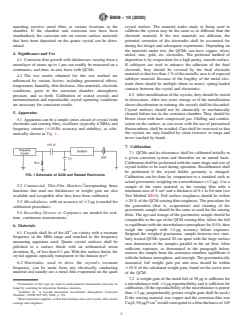
matically shown in Fig. 1.
never touched by hands.
7. Calibration
7.1 QCMs and its electronics shall be calibrated initially in
a given corrosion system and thereafter on an annual basis.
Calibration shall be performed with the same shape and size of
crystal holder to be used during operation. Recalibration shall
be performed if the crystal holder geometry is changed.
FIG. 1 Schematic of QCM and Related Electronics
Calibration can be done by comparison to a standard such as
actual gravimetric weighing on a microbalance (62 μg). Use a
5.2 Commercial, Thin-Film Monitors, incorporating those
sample of the same material as the sensing film with a
functions that read out thicknesses or weight gain are also
minimum area of 5 cm and a thickness of 0.1 to 0.6 mm (see
available and acceptable after they have been calibrated.
Test Method B810). Foil surface roughness should be within
620 % of the QCM sensing film roughness. The procedure for
5.3 Microbalance, with an accuracy of 62 μg is needed for
the generation (that is, evaporation) and cleaning of the
calibration procedures.
gravimetric sample should be the same as used for the sensing
5.4 Recording Devices or Computers are needed for real-
films. The age and storage of the gravimetric sample should be
time, continuous measurements.
comparable to the age of the QCM sensing film. Allow the foil
to e
...