

ASTM G13/G13M-21
(Test Method)Standard Test Method for Impact Resistance of Pipeline Coatings(Limestone Drop Test)
General Information
- Abstract
SIGNIFICANCE AND USE
4.1 This test method is intended to simulate the effects of backfilling after pipe has been placed in the trench. The backfill is often rocky soil and, if it is unscreened and the coated pipe is unshielded by sand or other protective padding, the falling rocks may seriously damage the coating.
SCOPE
1.1 This test method covers the determination of the relative resistance of pipeline coatings to impact by observing the effects of falling stones on coated pipe specimens.
1.2 The values stated in either SI units or inch-pound units are to be regarded separately as standard. The values stated in each system are not necessarily exact equivalents; therefore, to ensure conformance with the standard, each system shall be used independently of the other, and values from the two systems shall not be combined.
1.3 This standard does not purport to address all of the safety concerns, if any, associated with its use. It is the responsibility of the user of this standard to establish appropriate safety, health, and environmental practices and determine the applicability of regulatory limitations prior to use.
1.4 This international standard was developed in accordance with internationally recognized principles on standardization established in the Decision on Principles for the Development of International Standards, Guides and Recommendations issued by the World Trade Organization Technical Barriers to Trade (TBT) Committee.
- Status
- Published
- Publication Date
- 31-May-2021
- Technical Committee
- D01 - Paint and Related Coatings, Materials, and Applications
- Drafting Committee
- D01.48 - Durability of Pipeline Coating and Linings
Buy Documents


ASTM G13/G13M-21 - Standard Test Method for Impact Resistance of Pipeline Coatings<brk/>(Limestone Drop Test)
REDLINE ASTM G13/G13M-21 - Standard Test Method for Impact Resistance of Pipeline Coatings<brk/>(Limestone Drop Test)
Overview
ASTM G13/G13M-21: Standard Test Method for Impact Resistance of Pipeline Coatings (Limestone Drop Test) provides a systematic approach for evaluating the impact resistance of pipeline coatings. Developed by ASTM International, this standard simulates the effects of backfilling pipelines with rocky, unscreened soil-a common real-world scenario-by dropping a weighed amount of limestone onto coated pipe specimens. This method is vital for pipeline construction and maintenance, helping ensure that coatings can withstand physical damage and continue to protect the integrity of pipelines in service.
Key Topics
- Purpose: The test method is designed to measure how well pipeline coatings resist impact from falling stones, mimicking the stress encountered during pipeline installation and backfilling.
- Test Procedure: Weighed limestone, conforming to AASHTO M80–51 specifications, is dropped from a set height onto the coated test specimen. The number of drops required to breach the coating (to expose bare metal) is recorded.
- Evaluation Methods:
- Visual examination for visible coating damage
- Electrical detection (holiday testing) for small faults or pinholes in the coating
- Reporting: The results include a detailed identification of each specimen, the temperature at testing, and the number of drops to the first observed coating breach.
- Dual Unit Standardization: Both SI and inch-pound units are supported; results in each system are not interchangeable and should be kept separate.
Applications
ASTM G13/G13M-21 is essential for manufacturers, inspection agencies, and pipeline operators concerned with coating durability and asset protection in the oil, gas, and water sectors. Key applications include:
- Pipeline Coating Evaluation: Helps select and validate protective coatings capable of withstanding mechanical damage during installation and trench backfilling.
- Quality Control: Provides a repeatable, objective method for verifying coating performance in factory or field settings.
- Failure Analysis: Assists in identifying coating vulnerabilities that could lead to corrosion and costly pipeline failures.
- Specification Compliance: Ensures compliance with project and regulatory standards governing pipeline integrity and environmental protection.
Related Standards
When conducting impact resistance testing according to ASTM G13/G13M-21, users may also reference the following standards:
- ASTM G62: Test Methods for Holiday Detection in Pipeline Coatings – Used to detect flaws or pinholes in protective coatings.
- AASHTO M80–51: Specification for coarse aggregate used in the test procedure.
- ASTM D7091: Practice for Nondestructive Measurement of Dry Film Thickness of Pipeline Coatings – Ensures accurate assessment of coating thickness prior to impact testing.
Practical Value
By using ASTM G13/G13M-21, companies reinforce their commitment to pipeline safety, minimize the risk of coating failures, and enhance asset longevity. The Limestone Drop Test is recognized internationally and aligns with the World Trade Organization (WTO) principles for standardization, facilitating global trade and regulatory acceptance.
Keywords: ASTM G13/G13M-21, impact resistance, pipeline coatings, limestone drop test, backfill simulation, coating durability, holiday detection, pipeline construction standards, coating evaluation.
Relations
- Refers
ASTM G62-23 - Standard Test Methods for Holiday Detection of Coatings used to Protect Pipelines - Effective Date
- 01-Oct-2023
- Effective Date
- 01-Jun-2013
- Effective Date
- 01-Apr-2012
- Effective Date
- 01-Jul-2007
- Effective Date
- 01-Aug-2005
- Effective Date
- 25-Sep-1987
Buy Documents
ASTM G13/G13M-21 - Standard Test Method for Impact Resistance of Pipeline Coatings<brk/>(Limestone Drop Test)
REDLINE ASTM G13/G13M-21 - Standard Test Method for Impact Resistance of Pipeline Coatings<brk/>(Limestone Drop Test)
Frequently Asked Questions
ASTM G13/G13M-21 is a standard published by ASTM International. Its full title is "Standard Test Method for Impact Resistance of Pipeline Coatings<brk/>(Limestone Drop Test)". This standard covers: SIGNIFICANCE AND USE 4.1 This test method is intended to simulate the effects of backfilling after pipe has been placed in the trench. The backfill is often rocky soil and, if it is unscreened and the coated pipe is unshielded by sand or other protective padding, the falling rocks may seriously damage the coating. SCOPE 1.1 This test method covers the determination of the relative resistance of pipeline coatings to impact by observing the effects of falling stones on coated pipe specimens. 1.2 The values stated in either SI units or inch-pound units are to be regarded separately as standard. The values stated in each system are not necessarily exact equivalents; therefore, to ensure conformance with the standard, each system shall be used independently of the other, and values from the two systems shall not be combined. 1.3 This standard does not purport to address all of the safety concerns, if any, associated with its use. It is the responsibility of the user of this standard to establish appropriate safety, health, and environmental practices and determine the applicability of regulatory limitations prior to use. 1.4 This international standard was developed in accordance with internationally recognized principles on standardization established in the Decision on Principles for the Development of International Standards, Guides and Recommendations issued by the World Trade Organization Technical Barriers to Trade (TBT) Committee.
SIGNIFICANCE AND USE 4.1 This test method is intended to simulate the effects of backfilling after pipe has been placed in the trench. The backfill is often rocky soil and, if it is unscreened and the coated pipe is unshielded by sand or other protective padding, the falling rocks may seriously damage the coating. SCOPE 1.1 This test method covers the determination of the relative resistance of pipeline coatings to impact by observing the effects of falling stones on coated pipe specimens. 1.2 The values stated in either SI units or inch-pound units are to be regarded separately as standard. The values stated in each system are not necessarily exact equivalents; therefore, to ensure conformance with the standard, each system shall be used independently of the other, and values from the two systems shall not be combined. 1.3 This standard does not purport to address all of the safety concerns, if any, associated with its use. It is the responsibility of the user of this standard to establish appropriate safety, health, and environmental practices and determine the applicability of regulatory limitations prior to use. 1.4 This international standard was developed in accordance with internationally recognized principles on standardization established in the Decision on Principles for the Development of International Standards, Guides and Recommendations issued by the World Trade Organization Technical Barriers to Trade (TBT) Committee.
ASTM G13/G13M-21 is classified under the following ICS (International Classification for Standards) categories: 87.040 - Paints and varnishes. The ICS classification helps identify the subject area and facilitates finding related standards.
ASTM G13/G13M-21 has the following relationships with other standards: It is inter standard links to ASTM G62-23, ASTM G62-07(2013), ASTM D7091-12, ASTM G62-07, ASTM D7091-05, ASTM G62-87(1998)e1. Understanding these relationships helps ensure you are using the most current and applicable version of the standard.
ASTM G13/G13M-21 is available in PDF format for immediate download after purchase. The document can be added to your cart and obtained through the secure checkout process. Digital delivery ensures instant access to the complete standard document.
Standards Content (Sample)
This international standard was developed in accordance with internationally recognized principles on standardization established in the Decision on Principles for the
Development of International Standards, Guides and Recommendations issued by the World Trade Organization Technical Barriers to Trade (TBT) Committee.
Designation: G13/G13M − 21
Standard Test Method for
Impact Resistance of Pipeline Coatings
(Limestone Drop Test)
This standard is issued under the fixed designation G13/G13M; the number immediately following the designation indicates the year
of original adoption or, in the case of revision, the year of last revision. A number in parentheses indicates the year of last reapproval.
A superscript epsilon (´) indicates an editorial change since the last revision or reapproval.
1. Scope 2.2 AASHTO Standard:
M80–51 (No. 67) Specification for Coarse Aggregate for
1.1 This test method covers the determination of the relative
Portland Cement Concrete
resistance of pipeline coatings to impact by observing the
effects of falling stones on coated pipe specimens.
3. Summary of Test Method
1.2 The values stated in either SI units or inch-pound units
3.1 The impact resistance of pipeline coatings is determined
are to be regarded separately as standard. The values stated in
by dropping weighed amounts of a specified type of limestone
each system are not necessarily exact equivalents; therefore, to
through a chute onto a coated pipe specimen. Results are
ensure conformance with the standard, each system shall be
reported as the number of drops required to pierce through the
used independently of the other, and values from the two
coating to bare metal, as determined visually and electrically.
systems shall not be combined.
4. Significance and Use
1.3 This standard does not purport to address all of the
safety concerns, if any, associated with its use. It is the 4.1 This test method is intended to simulate the effects of
responsibility of the user of this standard to establish appro- backfillingafterpipehasbeenplacedinthetrench.Thebackfill
priate safety, health, and environmental practices and deter- is often rocky soil and, if it is unscreened and the coated pipe
is unshielded by sand or other protective padding, the falling
mine the applicability of regulatory limitations prior to use.
rocks may seriously damage the coating.
1.4 This international standard was developed in accor-
dance with internationally recognized principles on standard-
5. Apparatus
ization established in the Decision on Principles for the
Development of International Standards, Guides and Recom-
5.1 The impact apparatus shall be essentially as shown in
mendations issued by the World Trade Organization Technical
Fig. 1 and shall include the following:
Barriers to Trade (TBT) Committee.
5.1.1 BoxwithChute, providing a means of dropping stones
from a height of 1830 mm [6.0 ft] measured to the top of a
2. Referenced Documents piece of coated pipe under test. Construction details are shown
in Fig. 2.
2.1 ASTM Standards:
NOTE 1—The box and chute described in Fig. 2 are designed for testing
D7091 Practice for Nondestructive Measurement of Dry
coatings on 100-mm [4-in.] and 150-mm [6-in.] pipe specimens. Smaller
Film Thickness of Nonmagnetic Coatings Applied to
diameter pipe may be used by inserting woodV-blocks in the trough in the
Ferrous Metals and Nonmagnetic, Nonconductive Coat-
box below the chute.
ings Applied to Non-Ferrous Metals
5.1.2 Stones, hard, coarse, limestone aggregate, conforming
G62 Test Methods for Holiday Detection in Pipeline Coat-
to AASHTO Designation: M80-51 (No. 67) which is taken
ings
from America Association of State Highway and Transporta-
tion Officials “Standard Specifications for Coarse Aggregate
for Portland Cement Concrete.”
This test method is under the jurisdiction of ASTM Committee D01 on Paint
NOTE 2—These specifications cover the quality and size of coarse
and Related Coatings, Materials, andApplications and is the direct responsibility of
aggregate. No. 67 designates a 19-mm [ ⁄4-in.] to No. 4 size stone with the
Subcommittee D01.48 on Durability of Pipeline Coating and Linings.
CurrenteditionapprovedJune1,2021.PublishedJuly2021.Originallyapproved following sieve analysis:
in 1989. Last previous edition approved in 2013 as G13/G13M – 13. DOI:
10.1520/G0013_G0013M-21.
For referenced ASTM standards, visit the ASTM website, www.astm.org, or
contact ASTM Customer Service at service@astm.org. For Annual Book of ASTM Available from American Association of State Highway and Transportation
Standards volume information, refer to the standard’s Document Summary page on Officials (AASHTO), 444 N. Capitol St., NW, Suite 249, Washington, DC 20001,
the ASTM website. http://www.transportation.org.
Copyright © ASTM International, 100 Barr Harbor Drive, PO Box C700, West Conshohocken, PA 19428-2959. United States
G13/G13M − 21
NOTE 1—Framing lumber 40 by 90 mm [2 by 4 in.]; all other material
20 mm [ ⁄4 in.].
FIG. 2 Construction Details of Box and Chute
FIG. 1 Box, Chute, and Bucket
Square Opening, mm [in.] Weight % Passing
25 [1] 100
7. Procedure
19 [ ⁄4] 95to100
10 [ ⁄8] 20to55 7.1 Condition the sampl
...
This document is not an ASTM standard and is intended only to provide the user of an ASTM standard an indication of what changes have been made to the previous version. Because
it may not be technically possible to adequately depict all changes accurately, ASTM recommends that users consult prior editions as appropriate. In all cases only the current version
of the standard as published by ASTM is to be considered the official document.
Designation: G13/G13M − 13 G13/G13M − 21
Standard Test Method for
Impact Resistance of Pipeline Coatings
(Limestone Drop Test)
This standard is issued under the fixed designation G13/G13M; the number immediately following the designation indicates the year
of original adoption or, in the case of revision, the year of last revision. A number in parentheses indicates the year of last reapproval.
A superscript epsilon (´) indicates an editorial change since the last revision or reapproval.
1. Scope
1.1 This test method covers the determination of the relative resistance of pipeline coatings to impact by observing the effects of
falling stones on coated pipe specimens.
1.2 The values stated in either SI units or inch-pound units are to be regarded separately as standard. The values stated in each
system are not necessarily exact equivalents; therefore, to ensure conformance with the standard, each system shall be used
independently of the other, and values from the two systems shall not be combined.
1.3 This standard does not purport to address all of the safety concerns, if any, associated with its use. It is the responsibility
of the user of this standard to establish appropriate safety safety, health, and healthenvironmental practices and determine the
applicability of regulatory limitations prior to use.
1.4 This international standard was developed in accordance with internationally recognized principles on standardization
established in the Decision on Principles for the Development of International Standards, Guides and Recommendations issued
by the World Trade Organization Technical Barriers to Trade (TBT) Committee.
2. Referenced Documents
2.1 ASTM Standards:
G12D7091 Test Method Practice for Nondestructive Measurement of Dry Film Thickness of Pipeline Coatings on SteelNon-
magnetic Coatings Applied to Ferrous Metals and Nonmagnetic, Nonconductive Coatings Applied to Non-Ferrous Metals
(Withdrawn 2013)
G62 Test Methods for Holiday Detection in Pipeline Coatings
2.2 AASHTO Standard:
M80–51 (No. 67) Specification for Coarse Aggregate for Portland Cement Concrete
3. Summary of Test Method
3.1 The impact resistance of pipeline coatings is determined by dropping weighed amounts of a specified type of limestone
This test method is under the jurisdiction of ASTM Committee D01 on Paint and Related Coatings, Materials, and Applications and is the direct responsibility of
Subcommittee D01.48 on Durability of Pipeline Coating and Linings.
Current edition approved Nov. 1, 2013June 1, 2021. Published November 2013July 2021. Originally approved in 1989. Last previous edition approved in 19962013 as
ε1
G13G13/G13M – 13. – 89 (1996) which was withdrawn December 2003 and reinstated in November 2013. DOI: 10.1520G0013_G0013M-13.DOI: 10.1520/G0013_
G0013M-21.
For referenced ASTM standards, visit the ASTM website, www.astm.org, or contact ASTM Customer Service at service@astm.org. For Annual Book of ASTM Standards
volume information, refer to the standard’s Document Summary page on the ASTM website.
Available from American Association of State Highway and Transportation Officials (AASHTO), 444 N. Capitol St., NW, Suite 249, Washington, DC 20001,
http://www.transportation.org.
Copyright © ASTM International, 100 Barr Harbor Drive, PO Box C700, West Conshohocken, PA 19428-2959. United States
G13/G13M − 21
through a chute onto a coated pipe specimen. Results are reported as the number of drops required to pierce through the coating
to bare metal, as determined visually orand electrically.
4. Significance and Use
4.1 This test method is intended to simulate the effects of backfilling after pipe has been placed in the trench. The backfill is often
rocky soil and, if it is unscreened and the coated pipe is unshielded by sand or other protective padding, the falling rocks may
seriously damage the coating.
5. Apparatus
5.1 The impact apparatus shall be essentially as shown in Fig. 1 and shall include the following:
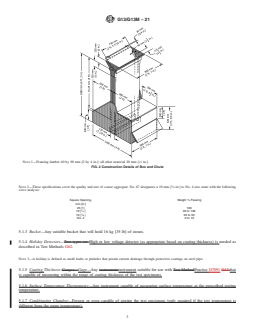
5.1.1 Box with Chute, providing a means of dropping stones from a height of 1830 mm [6.0 ft] measured to the top of a piece
of coated pipe under test. Construction details are shown in Fig. 2.
NOTE 1—The box and chute described in Fig. 2 are designed for testing coatings on 100-mm [4-in.] and 150-mm [6-in.] pipe specimens. Smaller diameter
pipe may be used by inserting wood V-blocks in the trough in the box below the chute.
NOTE 1—The box and chute described in Fig. 2 are designed for testing coatings on 100-mm [4-in.] and 150-mm [6-in.] pipe specimens. Smaller diameter
pipe may be used by inserting wood V-blocks in the trough in the box below the chute.>>
5.1.2 Stones, hard, coarse, limestone aggregate, conforming to AASHTO Designation: M80-51 (No. 67) which is taken from
America Association of State Highway and Transportation Officials “Standard Specifications for Coarse Aggregate for Portland
Cement Concrete.”
FIG. 1 Box, Chute, and Bucket
G13/G13M − 21
NOTE 1—Framing lumber 40 by 90 mm [2 by 4 in.]; all other material 20 mm [ ⁄4 in.].
FIG. 2 Construction Details of Box and Chute
NOTE 2—These specifications cover the quality and size of coarse aggregate. No. 67 designates a 19-mm [ ⁄4-in.] to No. 4 size stone with the following
sieve analysis:
Square Opening, Weight % Passing
mm [in.]
25 [1] 100
19 [ ⁄4 ] 95 to 100
10 [ ⁄8 ] 20 to 55
No. 4 0 to 10
5.1.3 Bucket—Any suitable bucket that will hold 16 kg [35 lb] of stones.
5.1.4 Holiday Detecto
...