

ASTM D3014-19a
(Test Method)Standard Test Method for Flame Height, Time of Burning, and Loss of Mass of Rigid Thermoset Cellular Plastics in a Vertical Position
General Information
- Abstract
SIGNIFICANCE AND USE
5.1 Tests made on rigid cellular materials in accordance with the conditions described by this test method can be of considerable value in comparing their burning characteristics.
5.2 This test method has been applied to flexible cellular materials and other plastics, but no detailed studies have been conducted to determine its general applicability to these materials.
5.3 In this procedure, the specimens are subjected to one or more specific sets of laboratory test conditions. If different test conditions are substituted or the end-use conditions are changed, it is not always possible by or from this test to predict changes in the fire-test-response characteristics measured. The results are therefore valid only for the fire-test-exposure conditions described in this procedure.
SCOPE
1.1 This is a fire-test-response standard. This test method covers a small-scale laboratory screening procedure for comparing relative extent and time of burning and loss of mass of rigid thermoset cellular plastics. This test method is to be used solely to establish relative burning characteristics.
1.1.1 This test method shall not be used for materials that drip or melt under the test conditions.
1.2 During the course of combustion, gases or vapors, or both, are evolved which are potentially hazardous to personnel. Adequate precautions shall be taken to protect the operator.
1.3 This standard does not purport to address all of the safety concerns, if any, associated with its use. It is the responsibility of the user of this standard to establish appropriate safety, health, and environmental practices and determine the applicability of regulatory limitations prior to use. A specific precautionary statement is given in 1.2.
1.4 This standard is used to measure and describe the response of materials, products, or assemblies to heat and flame under controlled conditions, but does not by itself incorporate all factors required for fire hazard or fire risk assessment of materials, products, or assemblies under actual fire conditions.
1.5 Fire testing is inherently hazardous. Adequate safeguards for personnel and property shall be employed in conducting these tests.
Note 1: There is no known ISO equivalent to this standard.
1.6 This international standard was developed in accordance with internationally recognized principles on standardization established in the Decision on Principles for the Development of International Standards, Guides and Recommendations issued by the World Trade Organization Technical Barriers to Trade (TBT) Committee.
- Status
- Published
- Publication Date
- 30-Nov-2019
- Technical Committee
- D20 - Plastics
- Drafting Committee
- D20.30 - Thermal Properties
Buy Documents
ASTM D3014-19a - Standard Test Method for Flame Height, Time of Burning, and Loss of Mass of Rigid Thermoset Cellular Plastics in a Vertical Position
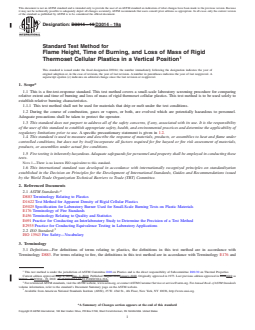
REDLINE ASTM D3014-19a - Standard Test Method for Flame Height, Time of Burning, and Loss of Mass of Rigid Thermoset Cellular Plastics in a Vertical Position
Overview
ASTM D3014-19a is the Standard Test Method for Flame Height, Time of Burning, and Loss of Mass of Rigid Thermoset Cellular Plastics in a Vertical Position. Developed by ASTM International, this fire-test-response standard provides a small-scale laboratory screening procedure to compare the relative burning characteristics of rigid thermoset cellular plastics. Specifically, it quantifies three main fire behavior metrics: flame height, time of burning, and mass loss when the plastic specimens are exposed to a direct flame in a vertical orientation.
This test is essential for manufacturers, quality control laboratories, and material specifiers seeking consistent methodologies to assess the flammability of rigid thermoset cellular plastic materials under controlled laboratory conditions. While primarily designed for rigid materials, note that this method should not be used for materials that drip or melt during testing.
Key Topics
- Burning Characteristics: The method provides comparative data on the extent and time of burning, as well as the percentage of mass retained after the fire exposure.
- Test Procedure: Specimens are ignited in a vertical orientation using a standard laboratory burner. Measurements include:
- Maximum flame height
- Total time burning until extinction
- Mass of specimen before and after testing
- Applicability: The results are specific to the described laboratory exposure conditions and may not directly predict fire behavior in end-use situations or under other fire scenarios.
- Safety Precautions: Combustion of plastics releases potentially hazardous gases and vapors. Proper safety, health, and environmental practices are critical. The user is responsible for determining regulatory applicability and ensuring the safety of personnel and facilities.
- Limitation: This standard should not be applied to materials that drip or exhibit significant melting during burning.
Applications
ASTM D3014-19a is widely used for quality assurance, research, and product development involving rigid thermoset cellular plastics. Common practical applications include:
- Material Comparison: Enables consistent and repeatable comparison of flammability performance among different plastic formulations or batches.
- Product Development: Supports material selection for applications where flame resistance, minimized burning duration, and reduced mass loss are critical performance indicators.
- Regulatory Documentation: Used to provide objective fire reaction data for regulatory compliance or product safety documentation.
- Quality Assurance: Helps manufacturers and laboratories assess batch consistency and ensure products meet specified fire performance criteria.
Industries benefiting from this standard include construction, automotive, electronics, appliance manufacturing, and any sector where fire behavior of rigid foam plastics is a concern.
Related Standards
For comprehensive evaluation and background terminology, users of ASTM D3014-19a may also consider several associated standards:
- ASTM D883 - Terminology Relating to Plastics
- ASTM D1622 - Test Method for Apparent Density of Rigid Cellular Plastics
- ASTM D5025 - Specification for Laboratory Burner Used for Small-Scale Burning Tests on Plastic Materials
- ASTM E176 - Terminology of Fire Standards
- ASTM E456 - Terminology Relating to Quality and Statistics
- ASTM E691 - Practice for Conducting an Interlaboratory Study to Determine the Precision of a Test Method
- ASTM E2935 - Practice for Conducting Equivalence Testing in Laboratory Applications
- ISO 13943 - Fire Safety-Vocabulary
Note: There is currently no known ISO equivalent to ASTM D3014-19a.
By following ASTM D3014-19a, organizations achieve greater reliability and comparability in evaluating the flame propagation and mass retention characteristics of rigid thermoset cellular plastics, enhancing fire safety and supporting regulatory compliance in diverse industrial applications.
Relations
- Effective Date
- 01-Dec-2019
- Effective Date
- 01-Feb-2024
- Effective Date
- 01-Jan-2024
- Effective Date
- 01-Nov-2023
- Effective Date
- 01-Apr-2022
- Effective Date
- 15-Jul-2020
- Effective Date
- 01-Feb-2020
- Effective Date
- 01-Jan-2020
- Effective Date
- 01-Aug-2019
- Effective Date
- 15-Apr-2019
- Effective Date
- 01-Feb-2019
- Effective Date
- 15-Dec-2018
- Effective Date
- 01-Dec-2018
- Effective Date
- 01-Nov-2018
- Effective Date
- 01-Mar-2018
Buy Documents
ASTM D3014-19a - Standard Test Method for Flame Height, Time of Burning, and Loss of Mass of Rigid Thermoset Cellular Plastics in a Vertical Position
REDLINE ASTM D3014-19a - Standard Test Method for Flame Height, Time of Burning, and Loss of Mass of Rigid Thermoset Cellular Plastics in a Vertical Position
Get Certified
Connect with accredited certification bodies for this standard

DIN CERTCO
DIN Group product certification.

Smithers Quality Assessments
US management systems and product certification.
Sponsored listings
Frequently Asked Questions
ASTM D3014-19a is a standard published by ASTM International. Its full title is "Standard Test Method for Flame Height, Time of Burning, and Loss of Mass of Rigid Thermoset Cellular Plastics in a Vertical Position". This standard covers: SIGNIFICANCE AND USE 5.1 Tests made on rigid cellular materials in accordance with the conditions described by this test method can be of considerable value in comparing their burning characteristics. 5.2 This test method has been applied to flexible cellular materials and other plastics, but no detailed studies have been conducted to determine its general applicability to these materials. 5.3 In this procedure, the specimens are subjected to one or more specific sets of laboratory test conditions. If different test conditions are substituted or the end-use conditions are changed, it is not always possible by or from this test to predict changes in the fire-test-response characteristics measured. The results are therefore valid only for the fire-test-exposure conditions described in this procedure. SCOPE 1.1 This is a fire-test-response standard. This test method covers a small-scale laboratory screening procedure for comparing relative extent and time of burning and loss of mass of rigid thermoset cellular plastics. This test method is to be used solely to establish relative burning characteristics. 1.1.1 This test method shall not be used for materials that drip or melt under the test conditions. 1.2 During the course of combustion, gases or vapors, or both, are evolved which are potentially hazardous to personnel. Adequate precautions shall be taken to protect the operator. 1.3 This standard does not purport to address all of the safety concerns, if any, associated with its use. It is the responsibility of the user of this standard to establish appropriate safety, health, and environmental practices and determine the applicability of regulatory limitations prior to use. A specific precautionary statement is given in 1.2. 1.4 This standard is used to measure and describe the response of materials, products, or assemblies to heat and flame under controlled conditions, but does not by itself incorporate all factors required for fire hazard or fire risk assessment of materials, products, or assemblies under actual fire conditions. 1.5 Fire testing is inherently hazardous. Adequate safeguards for personnel and property shall be employed in conducting these tests. Note 1: There is no known ISO equivalent to this standard. 1.6 This international standard was developed in accordance with internationally recognized principles on standardization established in the Decision on Principles for the Development of International Standards, Guides and Recommendations issued by the World Trade Organization Technical Barriers to Trade (TBT) Committee.
SIGNIFICANCE AND USE 5.1 Tests made on rigid cellular materials in accordance with the conditions described by this test method can be of considerable value in comparing their burning characteristics. 5.2 This test method has been applied to flexible cellular materials and other plastics, but no detailed studies have been conducted to determine its general applicability to these materials. 5.3 In this procedure, the specimens are subjected to one or more specific sets of laboratory test conditions. If different test conditions are substituted or the end-use conditions are changed, it is not always possible by or from this test to predict changes in the fire-test-response characteristics measured. The results are therefore valid only for the fire-test-exposure conditions described in this procedure. SCOPE 1.1 This is a fire-test-response standard. This test method covers a small-scale laboratory screening procedure for comparing relative extent and time of burning and loss of mass of rigid thermoset cellular plastics. This test method is to be used solely to establish relative burning characteristics. 1.1.1 This test method shall not be used for materials that drip or melt under the test conditions. 1.2 During the course of combustion, gases or vapors, or both, are evolved which are potentially hazardous to personnel. Adequate precautions shall be taken to protect the operator. 1.3 This standard does not purport to address all of the safety concerns, if any, associated with its use. It is the responsibility of the user of this standard to establish appropriate safety, health, and environmental practices and determine the applicability of regulatory limitations prior to use. A specific precautionary statement is given in 1.2. 1.4 This standard is used to measure and describe the response of materials, products, or assemblies to heat and flame under controlled conditions, but does not by itself incorporate all factors required for fire hazard or fire risk assessment of materials, products, or assemblies under actual fire conditions. 1.5 Fire testing is inherently hazardous. Adequate safeguards for personnel and property shall be employed in conducting these tests. Note 1: There is no known ISO equivalent to this standard. 1.6 This international standard was developed in accordance with internationally recognized principles on standardization established in the Decision on Principles for the Development of International Standards, Guides and Recommendations issued by the World Trade Organization Technical Barriers to Trade (TBT) Committee.
ASTM D3014-19a is classified under the following ICS (International Classification for Standards) categories: 83.080.01 - Plastics in general. The ICS classification helps identify the subject area and facilitates finding related standards.
ASTM D3014-19a has the following relationships with other standards: It is inter standard links to ASTM D3014-19, ASTM D883-24, ASTM E176-24, ASTM D883-23, ASTM E456-13a(2022)e1, ASTM D1622-20, ASTM D5025-20, ASTM D883-20, ASTM D883-19c, ASTM D883-19a, ASTM D883-19, ASTM E176-18a, ASTM D883-18a, ASTM D883-18, ASTM E176-18. Understanding these relationships helps ensure you are using the most current and applicable version of the standard.
ASTM D3014-19a is available in PDF format for immediate download after purchase. The document can be added to your cart and obtained through the secure checkout process. Digital delivery ensures instant access to the complete standard document.
Standards Content (Sample)
This international standard was developed in accordance with internationally recognized principles on standardization established in the Decision on Principles for the
Development of International Standards, Guides and Recommendations issued by the World Trade Organization Technical Barriers to Trade (TBT) Committee.
Designation: D3014 − 19a
Standard Test Method for
Flame Height, Time of Burning, and Loss of Mass of Rigid
Thermoset Cellular Plastics in a Vertical Position
This standard is issued under the fixed designation D3014; the number immediately following the designation indicates the year of
original adoption or, in the case of revision, the year of last revision. A number in parentheses indicates the year of last reapproval. A
superscript epsilon (´) indicates an editorial change since the last revision or reapproval.
1. Scope* 2. Referenced Documents
2.1 ASTM Standards:
1.1 This is a fire-test-response standard. This test method
D883 Terminology Relating to Plastics
covers a small-scale laboratory screening procedure for com-
D1622 Test Method for Apparent Density of Rigid Cellular
paring relative extent and time of burning and loss of mass of
Plastics
rigid thermoset cellular plastics. This test method is to be used
D5025 Specification for Laboratory Burner Used for Small-
solely to establish relative burning characteristics.
Scale Burning Tests on Plastic Materials
1.1.1 This test method shall not be used for materials that
E176 Terminology of Fire Standards
drip or melt under the test conditions.
E456 Terminology Relating to Quality and Statistics
E691 Practice for Conducting an Interlaboratory Study to
1.2 During the course of combustion, gases or vapors, or
Determine the Precision of a Test Method
both,areevolvedwhicharepotentiallyhazardoustopersonnel.
E2935 Practice for Conducting Equivalence Testing in
Adequate precautions shall be taken to protect the operator.
Laboratory Applications
1.3 This standard does not purport to address all of the
2.2 ISO Standard:
safety concerns, if any, associated with its use. It is the
ISO 13943 Fire Safety—Vocabulary
responsibility of the user of this standard to establish appro-
priate safety, health, and environmental practices and deter-
3. Terminology
mine the applicability of regulatory limitations prior to use. A
3.1 Definitions—For definitions of terms relating to plastics,
specific precautionary statement is given in 1.2.
the definitions in this test method are in accordance with
1.4 This standard is used to measure and describe the
Terminology D883. For terms relating to fire, the definitions in
response of materials, products, or assemblies to heat and
this test method are in accordance with Terminology E176 and
flame under controlled conditions, but does not by itself
ISO 13943. In case of conflict, the definitions given in Termi-
incorporate all factors required for fire hazard or fire risk
nology E176 shall prevail. For terms relating to precision and
assessment of materials, products, or assemblies under actual
bias and associated issues, the terms used in this test method
fire conditions.
are in accordance with the definitions in Terminology E456.
1.5 Fire testing is inherently hazardous. Adequate safe-
4. Summary of Test Method
guards for personnel and property shall be employed in
4.1 The specimen is mounted by positioning the specimen
conducting these tests.
in a vertical chimney with a glass front and ignited with a
NOTE 1—There is no known ISO equivalent to this standard.
bunsen burner for 10 s. The height and duration of flame and
1.6 This international standard was developed in accor-
the mass percent retained by the specimen are recorded.
dance with internationally recognized principles on standard-
5. Significance and Use
ization established in the Decision on Principles for the
Development of International Standards, Guides and Recom-
5.1 Tests made on rigid cellular materials in accordance
mendations issued by the World Trade Organization Technical
with the conditions described by this test method can be of
Barriers to Trade (TBT) Committee.
considerable value in comparing their burning characteristics.
For referenced ASTM standards, visit the ASTM website, www.astm.org, or
This test method is under the jurisdiction ofASTM Committee D20 on Plastics contact ASTM Customer Service at service@astm.org. For Annual Book of ASTM
and is the direct responsibility of Subcommittee D20.30 on Thermal Properties Standards volume information, refer to the standard’s Document Summary page on
Current edition approved Dec. 1, 2019. Published January 2020. Originally the ASTM website.
approved in 1973. Last previous edition approved in 2019 as D3014 - 19. DOI: Available fromAmerican National Standards Institute (ANSI), 25 W. 43rd St.,
10.1520/D3014-19A. 4th Floor, New York, NY 10036, http://www.ansi.org.
*A Summary of Changes section appears at the end of this standard
Copyright ©ASTM International, 100 Barr Harbor Drive, PO Box C700, West Conshohocken, PA19428-2959. United States
D3014 − 19a
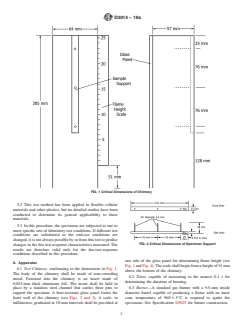
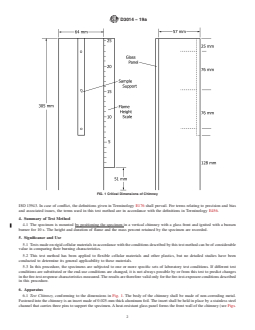
FIG. 1 Critical Dimensions of Chimney
5.2 This test method has been applied to flexible cellular
materials and other plastics, but no detailed studies have been
conducted to determine its general applicability to these
materials.
5.3 In this procedure, the specimens are subjected to one or
more specific sets of laboratory test conditions. If different test
conditions are substituted or the end-use conditions are
changed, it is not always possible by or from this test to predict
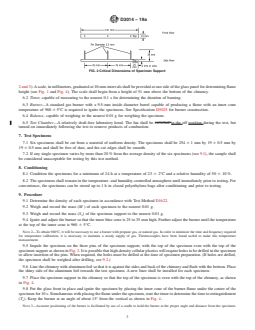
FIG. 2 Critical Dimensions of Specimen Support
changes in the fire-test-response characteristics measured. The
results are therefore valid only for the fire-test-exposure
conditions described in this procedure.
one side of the glass panel for determining flame height (see
6. Apparatus
Fig.1andFig.4).Thescaleshallbeginfromaheightof51mm
6.1 Test Chimney, conforming to the dimensions in Fig. 1.
above the bottom of the chimney.
The body of the chimney shall be made of non-corroding
6.2 Timer, capable of measuring to the nearest 0.1 s for
metal. Fastened into the chimney is an insert made of
determining the duration of burning.
0.025-mm thick aluminum foil. The insert shall be held in
place by a stainless steel channel that carries three pins to 6.3 Burner—A standard gas burner with a 9.5-mm inside
support the specimen. A heat-resistant glass panel forms the diameter barrel capable of producing a flame with an inner
front wall of the chimney (see Figs. 2 and 3). A scale, in cone temperature of 960 6 5°C is required to ignite the
millimeters, graduated at 10-mm intervals shall be provided at specimens. See Specification D5025 for burner construction.
D3014 − 19a
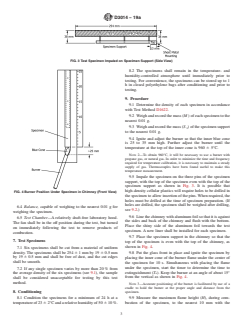
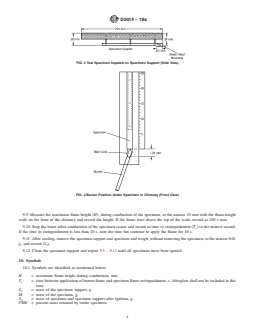
FIG. 3 Test Specimen Impaled on Specimen Support (Side View)
8.2 The specimens shall remain in the temperature- and
humidity-controlled atmosphere until immediately prior to
testing. For convenience, the specimens can be stored up to 1
h in closed polyethylene bags after conditioning and prior to
testing.
9. Procedure
9.1 Determine the density of each specimen in accordance
with Test Method D1622.
9.2 Weigh and record the mass (M ) of each specimen to the
nearest 0.01 g.
9.3 Weighandrecordthemass(S )ofthespecimensupport
to the nearest 0.01 g.
9.4 Ignite and adjust the burner so that the inner blue cone
is 25 to 35 mm high. Further adjust the burner until the
temperature at the top of the inner cone is 960 6 5°C.
NOTE 2—To obtain 960°C, it will be necessary to use a burner with
propane gas, or natural gas. In order to minimize the time and frequency
required for temperature calibration, it is necessary to maintain a steady
supply of gas. Thermocouples have been found useful to make this
temperature measurement.
9.5 Impale the specimen on the three pins of the specimen
support, with the top of the specimen even with the top of the
specimen support as shown in Fig. 3. It is possible that
high-density cellular plastics will require holes to be drilled in
FIG. 4 Burner Position Under Specimen in Chimney (Front View)
the specimen to allow insertion of the pins.When required, the
holes must be drilled at the time of specimen preparation. (If
holes are drilled, the specimen shall be weighed after drilling,
6.4 Balance, capable of weighing to the nearest 0.01 g for
see 9.2.)
weighing the specimen.
9.
...
This document is not an ASTM standard and is intended only to provide the user of an ASTM standard an indication of what changes have been made to the previous version. Because
it may not be technically possible to adequately depict all changes accurately, ASTM recommends that users consult prior editions as appropriate. In all cases only the current version
of the standard as published by ASTM is to be considered the official document.
Designation: D3014 − 19 D3014 − 19a
Standard Test Method for
Flame Height, Time of Burning, and Loss of Mass of Rigid
Thermoset Cellular Plastics in a Vertical Position
This standard is issued under the fixed designation D3014; the number immediately following the designation indicates the year of
original adoption or, in the case of revision, the year of last revision. A number in parentheses indicates the year of last reapproval. A
superscript epsilon (´) indicates an editorial change since the last revision or reapproval.
1. Scope*
1.1 This is a fire-test-response standard. This test method covers a small-scale laboratory screening procedure for comparing
relative extent and time of burning and loss of mass of rigid thermoset cellular plastics. This test method is to be used solely to
establish relative burning characteristics.
1.1.1 This test method shall not be used for materials that drip or melt under the test conditions.
1.2 During the course of combustion, gases or vapors, or both, are evolved which are potentially hazardous to personnel.
Adequate precautions shall be taken to protect the operator.
1.3 This standard does not purport to address all of the safety concerns, if any, associated with its use. It is the responsibility
of the user of this standard to establish appropriate safety, health, and environmental practices and determine the applicability of
regulatory limitations prior to use. A specific precautionary statement is given in 1.2.
1.4 This standard is used to measure and describe the response of materials, products, or assemblies to heat and flame under
controlled conditions, but does not by itself incorporate all factors required for fire hazard or fire risk assessment of materials,
products, or assemblies under actual fire conditions.
1.5 Fire testing is inherently hazardous. Adequate safeguards for personnel and property shall be employed in conducting these
tests.
NOTE 1—There is no known ISO equivalent to this standard.
1.6 This international standard was developed in accordance with internationally recognized principles on standardization
established in the Decision on Principles for the Development of International Standards, Guides and Recommendations issued
by the World Trade Organization Technical Barriers to Trade (TBT) Committee.
2. Referenced Documents
2.1 ASTM Standards:
D883 Terminology Relating to Plastics
D1622 Test Method for Apparent Density of Rigid Cellular Plastics
D5025 Specification for Laboratory Burner Used for Small-Scale Burning Tests on Plastic Materials
E176 Terminology of Fire Standards
E456 Terminology Relating to Quality and Statistics
E691 Practice for Conducting an Interlaboratory Study to Determine the Precision of a Test Method
E2935 Practice for Conducting Equivalence Testing in Laboratory Applications
2.2 ISO Standard:
ISO 13943 Fire Safety—Vocabulary
3. Terminology
3.1 Definitions—For definitions of terms relating to plastics, the definitions in this test method are in accordance with
Terminology D883. For terms relating to fire, the definitions in this test method are in accordance with Terminology E176 and
This test method is under the jurisdiction of ASTM Committee D20 on Plastics and is the direct responsibility of Subcommittee D20.30 on Thermal Properties
Current edition approved Aug. 1, 2019Dec. 1, 2019. Published August 2019January 2020. Originally approved in 1973. Last previous edition approved in 20182019 as
D3014 - 18.D3014 - 19. DOI: 10.1520/D3014-19.10.1520/D3014-19A.
For referenced ASTM standards, visit the ASTM website, www.astm.org, or contact ASTM Customer Service at service@astm.org. For Annual Book of ASTM Standards
volume information, refer to the standard’s Document Summary page on the ASTM website.
Available from American National Standards Institute (ANSI), 25 W. 43rd St., 4th Floor, New York, NY 10036, http://www.ansi.org.
*A Summary of Changes section appears at the end of this standard
Copyright © ASTM International, 100 Barr Harbor Drive, PO Box C700, West Conshohocken, PA 19428-2959. United States
D3014 − 19a
FIG. 1 Critical Dimensions of Chimney
ISO 13943. In case of conflict, the definitions given in Terminology E176 shall prevail. For terms relating to precision and bias
and associated issues, the terms used in this test method are in accordance with the definitions in Terminology E456.
4. Summary of Test Method
4.1 The specimen is mounted by positioning the specimen in a vertical chimney with a glass front and ignited with a bunsen
burner for 10 s. The height and duration of flame and the mass percent retained by the specimen are recorded.
5. Significance and Use
5.1 Tests made on rigid cellular materials in accordance with the conditions described by this test method can be of considerable
value in comparing their burning characteristics.
5.2 This test method has been applied to flexible cellular materials and other plastics, but no detailed studies have been
conducted to determine its general applicability to these materials.
5.3 In this procedure, the specimens are subjected to one or more specific sets of laboratory test conditions. If different test
conditions are substituted or the end-use conditions are changed, it is not always possible by or from this test to predict changes
in the fire-test-response characteristics measured. The results are therefore valid only for the fire-test-exposure conditions described
in this procedure.
6. Apparatus
6.1 Test Chimney, conforming to the dimensions in Fig. 1. The body of the chimney shall be made of non-corroding metal.
Fastened into the chimney is an insert made of 0.025-mm thick aluminum foil. The insert shall be held in place by a stainless steel
channel that carries three pins to support the specimen. A heat-resistant glass panel forms the front wall of the chimney (see Figs.
D3014 − 19a
FIG. 2 Critical Dimensions of Specimen Support
2 and 3). A scale, in millimeters, graduated at 10-mm intervals shall be provided at one side of the glass panel for determining flame
height (see Fig. 1 and Fig. 4). The scale shall begin from a height of 51 mm above the bottom of the chimney.
6.2 Timer, capable of measuring to the nearest 0.1 s for determining the duration of burning.
6.3 Burner—A standard gas burner with a 9.5-mm inside diameter barrel capable of producing a flame with an inner cone
temperature of 960 6 5°C is required to ignite the specimens. See Specification D5025 for burner construction.
6.4 Balance, capable of weighing to the nearest 0.01 g for weighing the specimen.
6.5 Test Chamber—A relatively draft-free laboratory hood. The fan shall be switched in the off position during the test, but
turned on immediately following the test to remove products of combustion.
7. Test Specimens
7.1 Six specimens shall be cut from a material of uniform density. The specimens shall be 254 6 1 mm by 19 6 0.5 mm by
19 6 0.5 mm and shall be free of dust, and the cut edges shall be smooth.
7.2 If any single specimen varies by more than 20 % from the average density of the six specimens (see 9.1), the sample shall
be considered unacceptable for testing by this test method.
8. Conditioning
8.1 Condition the specimens for a minimum of 24 h at a temperature of 23 6 2°C and a relative humidity of 50 6 10 %.
8.2 The specimens shall remain in the temperature- and humidity-controlled atmosphere until immediately prior to testing. For
convenience, the specimens can be stored up to 1 h in closed polyethylene bags after conditioning and prior to testing.
9. Procedure
9.1 Determine the density of each specimen in accordance with Test Method D1622.
9.2 Weigh and record the mass (M ) of each specimen to the nearest 0.01 g.
9.3 Weigh and record the mass (S ) of the specimen support to the nearest 0.01 g.
9.4 Ignite and adjust the burner so that the inner blue cone is 25 to 35 mm high. Further adjust the burner until the temperature
at the top of the inner cone is 960 6 5°C.
NOTE 2—To obtain 960°C, it will be necessary to use a burner with propane gas, or natural gas. In order to minimize the time and frequency required
for t
...