

ASTM D8000-15(2020)
(Practice)Standard Practice for Flow Conditioning of Natural Gas and Liquids
General Information
- Abstract
SIGNIFICANCE AND USE
4.1 Flow conditioners are used for the conditioning of the turbulent flow profile of gases or liquids to reduce the ADD (velocity profile distortion) DEL (turbulence), swirl, or irregularities caused by the installation effects of piping elbows, length of pipe, valves, tees, and other such equipment or piping configurations that will affect the reading of flow measurement meters thus inducing measurement errors as a result of the flow profile of the gas or liquid not having a fully developed flow profile at the measurement point.4
SCOPE
1.1 This practice covers flow conditioners that produce a fully developed flow profile for liquid and gas phase fluid flow for circular duct sizes 1- to 60-in. (25.4- to 1525-mm) diameter and Reynolds Number (Re) ranges from transition (100) to 100 000 000. These flow conditioners can be used for any type of flow meter or development of a fully developed flow profile for other uses.
1.2 The central single-hole configuration that is derived using fundamental screen theory is referenced as the flow conditioner described herein.
1.3 Piping lengths upstream and downstream of a flow conditioner are considered a critical component of a flow conditioner and constitute the complete flow conditioner system.
1.4 The values stated in inch-pound units are to be regarded as standard. The values given in parentheses are mathematical conversions to SI units that are provided for information only and are not considered standard.
1.5 This standard does not purport to address all of the safety concerns, if any, associated with its use. It is the responsibility of the user of this standard to establish appropriate safety, health, and environmental practices and determine the applicability of regulatory limitations prior to use.
1.6 This international standard was developed in accordance with internationally recognized principles on standardization established in the Decision on Principles for the Development of International Standards, Guides and Recommendations issued by the World Trade Organization Technical Barriers to Trade (TBT) Committee.
- Status
- Published
- Publication Date
- 31-Oct-2020
- Technical Committee
- D03 - Gaseous Fuels
- Drafting Committee
- D03.12 - On-Line/At-Line Analysis of Gaseous Fuels
Overview
ASTM D8000-15(2020), titled Standard Practice for Flow Conditioning of Natural Gas and Liquids, provides guidelines for the use of flow conditioners to ensure accurate measurement of natural gas and liquid flow in pipelines. Developed by ASTM International, this standard focuses on producing a fully developed flow profile for gases and liquids in circular ducts, covering pipe sizes from 1 to 60 inches (25.4 to 1525 mm) and Reynolds Numbers from transitional flow (100) up to 100,000,000.
Flow conditioners are essential in mitigating velocity profile distortion, turbulence, swirl, and other irregularities commonly introduced by piping components like elbows, tees, valves, and short runs of pipe. By reducing these disturbances, flow conditioners help achieve reliable and repeatable flow measurements, as they allow flow meters to operate in conditions that closely replicate long, straight pipe runs.
Key Topics
Purpose of Flow Conditioners: Flow conditioners are used to create a fully developed, axially-symmetric velocity profile upstream of flow meters, which reduces measurement uncertainty caused by disturbed flow.
Types and Configurations:
- Central single-hole configurations, developed from fundamental screen theory, are specifically referenced.
- Flow conditioners are tailored for varying pipe diameters, wall thicknesses, and pressure classes, with details provided for proper identification and specification.
Critical Installation Factors:
- The length of pipe upstream and downstream from the flow conditioner is a critical part of the conditioning system.
- Proper marking, including manufacturer details and material type, must be included on all devices.
Pressure Drop Considerations:
- The standard references methods for calculating the pressure loss across a flow conditioner and highlights the importance of balancing effectiveness with acceptable pressure loss.
Material Requirements:
- Flow conditioners can be manufactured from various materials, with stainless steel grades commonly used.
Organization and Safety:
- The standard aligns with internationally recognized guidelines established by the World Trade Organization Technical Barriers to Trade (TBT) Committee.
- Users are responsible for ensuring compliance with applicable safety, health, and environmental regulations.
Applications
ASTM D8000-15(2020) has significant practical value in industries where accurate flow measurement is critical:
- Natural Gas Transmission and Distribution: Ensures gas flow meters operate with minimal error, providing accurate billing and custody transfer.
- Oil & Gas Processing Plants: Used where liquids and gases must be correctly metered for operational efficiency and safety compliance.
- Chemical and Petrochemical Industries: Vital for process control and instrumentation accuracy where pipeline layout may cause flow disturbances.
- Power Generation: Essential wherever steam, water, or gas lines require precise flow measurement.
By delivering consistent and predictable flow profiles, proper flow conditioning per ASTM D8000 improves the reliability of ultrasonic, orifice plate, turbine, and other flow measurement technologies. The guidelines for marking, ordering, and installing flow conditioners help procurement and maintenance teams select the right device for their application, minimizing setup errors and maximizing measurement accuracy.
Related Standards
- ASTM D4150 - Terminology Relating to Gaseous Fuels: Provides definitions pertinent to flow measurement and conditioning.
- AGA Report No. 8 - Compressibility Factor of Natural Gas and Related Hydrocarbon Gases: Essential for calculating gas density and flow under operating conditions.
- ISO 5167 - Measurement of Fluid Flow by Means of Pressure Differential Devices: Often referenced in conjunction with flow profiling requirements.
- ASME MFC Series - Covers general practices for flow measurement in closed conduits, relevant to flow meter installation and operation.
Keywords: flow conditioners, turbulent flow profile, velocity profile distortion, natural gas measurement, liquid flow metering, pipeline installation effects, ASTM D8000-15, flow conditioning, gas and liquid flow standards, accurate flow measurement.
By following ASTM D8000-15(2020), industries can ensure optimal flow metering conditions, reduce measurement error, and comply with international best practices for natural gas and liquid flow conditioning.
Relations
- Effective Date
- 15-Dec-2019
- Effective Date
- 01-Jul-2016
- Effective Date
- 01-Dec-2008
- Effective Date
- 10-Aug-2003
- Effective Date
- 10-Jun-2000
Get Certified
Connect with accredited certification bodies for this standard

BSMI (Bureau of Standards, Metrology and Inspection)
Taiwan's standards and inspection authority.
Sponsored listings
Frequently Asked Questions
ASTM D8000-15(2020) is a standard published by ASTM International. Its full title is "Standard Practice for Flow Conditioning of Natural Gas and Liquids". This standard covers: SIGNIFICANCE AND USE 4.1 Flow conditioners are used for the conditioning of the turbulent flow profile of gases or liquids to reduce the ADD (velocity profile distortion) DEL (turbulence), swirl, or irregularities caused by the installation effects of piping elbows, length of pipe, valves, tees, and other such equipment or piping configurations that will affect the reading of flow measurement meters thus inducing measurement errors as a result of the flow profile of the gas or liquid not having a fully developed flow profile at the measurement point.4 SCOPE 1.1 This practice covers flow conditioners that produce a fully developed flow profile for liquid and gas phase fluid flow for circular duct sizes 1- to 60-in. (25.4- to 1525-mm) diameter and Reynolds Number (Re) ranges from transition (100) to 100 000 000. These flow conditioners can be used for any type of flow meter or development of a fully developed flow profile for other uses. 1.2 The central single-hole configuration that is derived using fundamental screen theory is referenced as the flow conditioner described herein. 1.3 Piping lengths upstream and downstream of a flow conditioner are considered a critical component of a flow conditioner and constitute the complete flow conditioner system. 1.4 The values stated in inch-pound units are to be regarded as standard. The values given in parentheses are mathematical conversions to SI units that are provided for information only and are not considered standard. 1.5 This standard does not purport to address all of the safety concerns, if any, associated with its use. It is the responsibility of the user of this standard to establish appropriate safety, health, and environmental practices and determine the applicability of regulatory limitations prior to use. 1.6 This international standard was developed in accordance with internationally recognized principles on standardization established in the Decision on Principles for the Development of International Standards, Guides and Recommendations issued by the World Trade Organization Technical Barriers to Trade (TBT) Committee.
SIGNIFICANCE AND USE 4.1 Flow conditioners are used for the conditioning of the turbulent flow profile of gases or liquids to reduce the ADD (velocity profile distortion) DEL (turbulence), swirl, or irregularities caused by the installation effects of piping elbows, length of pipe, valves, tees, and other such equipment or piping configurations that will affect the reading of flow measurement meters thus inducing measurement errors as a result of the flow profile of the gas or liquid not having a fully developed flow profile at the measurement point.4 SCOPE 1.1 This practice covers flow conditioners that produce a fully developed flow profile for liquid and gas phase fluid flow for circular duct sizes 1- to 60-in. (25.4- to 1525-mm) diameter and Reynolds Number (Re) ranges from transition (100) to 100 000 000. These flow conditioners can be used for any type of flow meter or development of a fully developed flow profile for other uses. 1.2 The central single-hole configuration that is derived using fundamental screen theory is referenced as the flow conditioner described herein. 1.3 Piping lengths upstream and downstream of a flow conditioner are considered a critical component of a flow conditioner and constitute the complete flow conditioner system. 1.4 The values stated in inch-pound units are to be regarded as standard. The values given in parentheses are mathematical conversions to SI units that are provided for information only and are not considered standard. 1.5 This standard does not purport to address all of the safety concerns, if any, associated with its use. It is the responsibility of the user of this standard to establish appropriate safety, health, and environmental practices and determine the applicability of regulatory limitations prior to use. 1.6 This international standard was developed in accordance with internationally recognized principles on standardization established in the Decision on Principles for the Development of International Standards, Guides and Recommendations issued by the World Trade Organization Technical Barriers to Trade (TBT) Committee.
ASTM D8000-15(2020) is classified under the following ICS (International Classification for Standards) categories: 17.120.10 - Flow in closed conduits. The ICS classification helps identify the subject area and facilitates finding related standards.
ASTM D8000-15(2020) has the following relationships with other standards: It is inter standard links to ASTM D4150-19, ASTM D4150-08(2016), ASTM D4150-08, ASTM D4150-03, ASTM D4150-00. Understanding these relationships helps ensure you are using the most current and applicable version of the standard.
ASTM D8000-15(2020) is available in PDF format for immediate download after purchase. The document can be added to your cart and obtained through the secure checkout process. Digital delivery ensures instant access to the complete standard document.
Standards Content (Sample)
This international standard was developed in accordance with internationally recognized principles on standardization established in the Decision on Principles for the
Development of International Standards, Guides and Recommendations issued by the World Trade Organization Technical Barriers to Trade (TBT) Committee.
Designation:D8000 −15 (Reapproved 2020)
Standard Practice for
Flow Conditioning of Natural Gas and Liquids
This standard is issued under the fixed designation D8000; the number immediately following the designation indicates the year of
original adoption or, in the case of revision, the year of last revision. A number in parentheses indicates the year of last reapproval. A
superscript epsilon (´) indicates an editorial change since the last revision or reapproval.
1. Scope 2.2 AGA Standard:
AGA Report No. 8 Compressibility Factor of Natural Gas
1.1 This practice covers flow conditioners that produce a
and Related Hydrocarbon Gases
fully developed flow profile for liquid and gas phase fluid flow
for circular duct sizes 1- to 60-in. (25.4- to 1525-mm) diameter
3. Terminology
and Reynolds Number (Re) ranges from transition (100) to
100 000 000. These flow conditioners can be used for any type 3.1 Refer to Terminology D4150 for general definitions
of flow meter or development of a fully developed flow profile related to gaseous fuels. Definitions specific to this standard
for other uses. follow.
1.2 The central single-hole configuration that is derived 3.2 Definitions of Terms Specific to This Standard:
using fundamental screen theory is referenced as the flow
3.2.1 annuli, n—ring-shaped object, structure, or region.
conditioner described herein.
3.2.2 axial symmetry, n—symmetry around an axis; an
1.3 Piping lengths upstream and downstream of a flow object is axially symmetric if its appearance is unchanged if
conditioner are considered a critical component of a flow rotated around an axis.
conditioner and constitute the complete flow conditioner sys-
3.2.3 Reynolds number, n—dimensionless number used in
tem.
fluid mechanics to indicate whether fluid flow past a body or in
1.4 The values stated in inch-pound units are to be regarded a duct is steady or turbulent.
as standard. The values given in parentheses are mathematical
3.2.4 velocity profile, n—variation in velocity along a line at
conversions to SI units that are provided for information only
right angles to the general direction of flow.
and are not considered standard.
4. Significance and Use
1.5 This standard does not purport to address all of the
safety concerns, if any, associated with its use. It is the
4.1 Flow conditioners are used for the conditioning of the
responsibility of the user of this standard to establish appro-
turbulent flow profile of gases or liquids to reduce the ADD
priate safety, health, and environmental practices and deter-
(velocity profile distortion) DEL (turbulence), swirl, or irregu-
mine the applicability of regulatory limitations prior to use.
larities caused by the installation effects of piping elbows,
1.6 This international standard was developed in accor-
lengthofpipe,valves,tees,andothersuchequipmentorpiping
dance with internationally recognized principles on standard-
configurations that will affect the reading of flow measurement
ization established in the Decision on Principles for the
meters thus inducing measurement errors as a result of the flow
Development of International Standards, Guides and Recom-
profile of the gas or liquid not having a fully developed flow
mendations issued by the World Trade Organization Technical
profile at the measurement point.
Barriers to Trade (TBT) Committee.
5. Flow Conditioner Design Methodology
2. Referenced Documents
5.1 Pipe Flow Profiles—Almost any description can be
2.1 ASTM Standards:
prescribed by using the perforated plate utilizing screen theory.
D4150 Terminology Relating to Gaseous Fuels
That is, any upstream velocity profile, U , can be changed to a
1 downstream velocity profile, U , with the use of a screen
This practice is under the jurisdiction of ASTM Committee D03 on Gaseous 2
Fuels and is the direct responsibility of Subcommittee D03.12 on On-Line/At-Line (herein referred to as a flow conditioner) (see Fig. 1).
Analysis of Gaseous Fuels.
Current edition approved Nov. 1, 2020. Published December 2020. Originally
approved in 1986. Last previous edition approved in 2015 as D8000 – 15. DOI:
10.1520/D8000-15R20. Available from the American Gas Association, 400 N. Capital St., NW,
For referenced ASTM standards, visit the ASTM website, www.astm.org, or Washington, DC 20001, www.techstreet.com/aga.
contact ASTM Customer Service at service@astm.org. For Annual Book of ASTM Per various Coriolis Flow Meter manufacturer statements: A Coriolis Flow
Standards volume information, refer to the standard’s Document Summary page on Meter reportedly does not require flow conditioning, therefore this ASTM standard
the ASTM website. does not apply.
Copyright © ASTM International, 100 Barr Harbor Drive, PO Box C700, West Conshohocken, PA 19428-2959. United States
D8000−15 (2020)
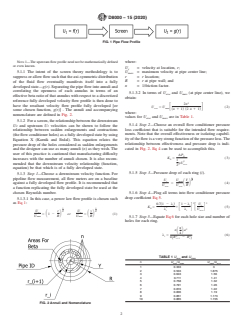
FIG. 1Pipe Flow Profile
NOTE 1—The upstream flow profile need not be mathematically defined
where:
or even known.
U = velocity at location, r;
r
5.1.1 The intent of the screen theory methodology is to U = maximum velocity at pipe center line;
max
r = r location;
suppress or allow flow such that the axi-symmetric distribution
R = r at pipe wall; and
of the fluid flow eventually manifests itself into a fully
n = 1/friction factor.
developed state—g(r). Separating the pipe flow into annuli and
correlating the openness of each annulus in terms of an
5.1.3.2 In terms of U and U (at pipe center line), we
ave max
effective beta ratio of that annulus with respect to a discretized
obtain:
reference fully developed velocity flow profile is then done to
2n
have the resultant velocity flow profile fully developed [or
U 5 U (2)
F G
ave max
~n 1 1!~2 n 1 1!
some chosen function, g(r)] . The annuli and accompanying
where:
nomenclature are defined in Fig. 2.
values for U and U are in Table 1.
ave max
5.1.2 For a screen, the relationship between the downstream
5.1.4 Step 2—Choose an overall flow conditioner pressure
U and upstream U velocities can be shown to follow the
2 1
loss coefficient that is suitable for the intended flow require-
relationship between sudden enlargements and contractions
ments. Note that the overall effectiveness or isolating capabil-
(the flow conditioner holes) as a fully developed state by using
ityoftheflowisaverystrongfunctionofthepressureloss.The
Equation X (Karnik and Erdal). This equation relates the
relationship between effectiveness and pressure drop is indi-
pressure drop of the holes considered as sudden enlargements
cated in Fig. 2. Eq 4 can be used to accomplish this.
and the designer can use as many annuli (n) as they wish. The
user of this practice is cautioned that manufacturing difficulty
∆P
K 5 (3)
increases with the number of annuli chosen. It is also recom- 0
ρU
ave
mended that the downstream velocity relationship (function,
equation) be that which is of a fully developed state.
5.1.5 Step 3—Pressure drop of each ring (i).
5.1.3 Step 1—Choose a downstream velocity function. For
pipeline flow measurement, all flow meters are on a baseline
U U Y n
i max i
5 (4)
against a fully developed flow profile. It is recommended that S D
U U R
ave ave
a function replicating the fully developed state be used at the
chosen Reynolds number. 5.1.6 Step 4—Plug all terms into flow conditioner pressure
drop coefficient Eq 5.
5.1.3.1 In this case, a power law flow profile is chosen such
2 2
as Eq 1:
0.7 1 2 λ 1 2λ U
~ !
i i i
K 5 1 (5)
F G F G
0 2
1 1
λ λ U
i i ave
U r n U y n
r y
5 1 2 or 5 (1)
S D S D
U R U R
max max 5.1.7 Step 5—Equate Eq 6 for each hole size and number of
holes for each ring.
π
n a
S D
λ 5 (6)
i 2 2
π~R 2 R !
i11 i
TABLE 1 U and U
ave max
n U /U U /U
ave max max ave
1 0.333 3
2 0.533 1.875
3 0.643 1.56
4 0.711 1.41
5 0.758 1.32
6 0.791 1.26
7 0.816 1.22
8 0.836 1.19
9 0.851 1.173
10 0.865 1.155
FIG. 2Annuli and Nomenclature
D8000−15 (2020)
where: 5.3.1 The nomenclature used to specify a flow-conditioning
device is the following (9 in. (23 cm) not included in the
λ = porosity of ring, i;
i
description):
n = number of holes in ring, i;
a = area of each hole; and [NPS] [AA] [BB] [CC ANSI Rating] [Material Type]
R = r at x.
5.3.2 The terms for a complete description are:
x
5.3.2.1 AA = Nominal Pipe Size (NPS)
5.2 Flow Conditioner Qualification Pipe Flow Profiles—To
(1) NPS does not refer to the pipe outside diameter up to
comply with the requirements of this practice, the flow
NPS 12-in. (30.5-cm) pipe. For NPS 14-in. (35.5-cm) and
conditioner shall be shown to provide a state of flow within the
larger pipe sizes, NPS corresponds to pipe outside diameter.
pipe that resembles the fluid flow characteristics of a straight
(2) In 90 % of applications, NPS will correspond with a
piece of pipe not shorter than 200 inside pipe diameters. This
publishedpipeschedule.InapplicationsthatexceedNPS30in.
shall be shown when installed downstream of any piping
(76 cm), actual pipe inside diameters are used more than
installation effect in any pipe length chosen.
schedules. This may be due to difficulty meeting pressure
5.2.1 This requirement ensures that specific flow meter type
containment requirements with published pipe schedules in
and flow conditioner peculiarities are avoided.
larger pipe sizes. In some instances [even if smaller pipe sizes;
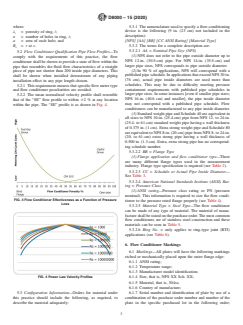
5.2.2 The mean normalized velocity profile shall resemble
NPS 16-in. (40.6 cm) and smaller], the pipe inside diameter
that of the “SE” flow profile to within 62 % at any location
may not correspond with a published pipe schedule. Flow
within the pipe. The “SE” profile is as shown in Fig. 4.
conditioners can be manufactured to any pipe inside diameter.
(3) Standard weight pipe and Schedule 40 are equivalent in
all sizes to NPS 10-in. (25.4-cm) pipe from NPS 12- to 24-in.
(25.4- to 61-cm) standard weight pipe having a wall thickness
of 0.375 in. (1 cm). Extra strong weight pipe and Schedule 80
are equivalent to NPS 8-in. (20-cm) pipe from NPS 8- to 24-in.
(20- to 61-cm) extra strong pipe having a wall thickness of
0.500 in. (1.3 cm). Extra, extra strong pipe has no correspond-
ing schedule number.
5.3.2.2 BB = Flange Type
(1) Flange application and flow conditioner type—There
are many different flange types used in the measurement
industry. Flange type specification is required (see Table 2).
5.3.2.3 CC = Schedule or Actual Pipe Inside Diameter—
See Table 3.
5.3.2.4 American National Standards Institute (ANSI) Rat-
ing = Pressure Class
(1) ANSI rating—Pressure class rating or PN (pressure
nominal). This information is required to size the flow condi-
FIG. 3Flow Conditioner Effectiveness as a Function of Pressure
tioner to the pressure rated flange properly (see Table 4).
Loss
5.3.2.5 Material Type = Steel Type—The flow conditioner
can be made of any type of material. The material of manu-
factureshallbestatedonthepurchaseorder.Themostcommon
flow conditioners are of stainless steel construction and these
materials can be seen in Table 5.
5.3.2.6 Ring No. = only applies to ring-type joint (RTJ)
applications (see Table 6).
6. Flow Conditioner Markings
6.1 Markings—All plates will have the following markings
etched or mechanically placed upon the outer flange edge:
6.1.1 ANSI rating;
6.1.2 Temperature range;
6.1.3 Manufacturer model identification;
FIG. 4Power Law Velocity Profiles 6.1.4 Size, that is, NPS XX Sch. XX;
6.1.5 Material, that is, 304ss;
6.1.6 Country of manufacture;
5.3 Configuration Information—Orders for material under 6.1.7 Serial number and identification of plate by use of a
this practice should include the following, as required, to combination of the purchase order number and number of the
describe the material adequately: plate in the specific purchased lot in the following order;
D8000−15 (2020)
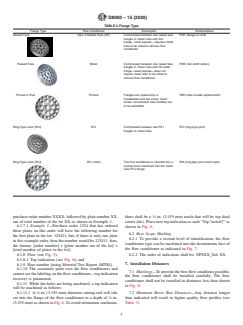
TABLE 2 Flange Type
Flange Type Flow Conditioner Description Nomenclature
Raised Face Type A Raised Face (RF) Compressed between two raised face FOE (flange on end)
flanges in meter tube with thin
flange—most popular—requires meter
tube to be rolled to remove flow
conditioner.
Raised Face Wafer Compressed between two raised face FWO (full width option)
flanges in meter tube with full width
flange—least popular—does not
require meter tube to be rolled to
remove flow conditioner.
Pinned in Pipe Pinned Flanges are replaced by a TBR (tube bundle replacement)
threadolette and set screw. Used
where conventional tube bundles are
to be retrofitted.
Ring-Type Joint (RTJ) RTJ Compressed between two RTJ RTJ (ring-type joint)
flanges in meter tube.
Ring-Type Joint (RTJ) RTJ Insert The flow conditioner is inserted into a RIS (ring-type joint insert style)
counter bore machined into the meter
tube RTJ flange.
purchase order number XXXX, followed by plate number XX, there shall be a ⁄8-in. (3.155-mm) notch that will be top dead
out of total number of the lot XX as shown in Example 1. center (tdc). Place new top indication as such “Top↑notch↑”as
6.1.7.1 Example 1—Purchase order 1234 that has ordered
shown in Fig. 6.
three plates on this order will have the following number for
6.2 Bore Scope Marking
the first plate in the lot: 123431; but, if there is only one plate
6.2.1 To provide a second level of identification, the flow
in this example order, then the number would be 123411, thus,
conditioner type can be machined into the downstream face of
the format: [order number] + [plate number out of the lot] +
the flow conditioner as indicated in Fig. 7.
[total number of plates in the lot];
6.2.2 The order of indication shall be: NPSXX_Sch XX.
6.1.8 Flow (see Fig. 5);
6.1.8.1 Top indication (see Fig. 6); and
6.1.9 Heat number [using Material Test Report (MTR)]. 7. Installation Distances
6.1.10 The customers paint over the flow conditioners and
7.1 Markings—Toprovidethebestflowconditionspossible,
cannot see the labeling on the flow conditioner—top indication
the flow conditioner shall be installed carefully. The flow
recovery is paramount.
conditioner shall not be installed in distances less than shown
6.1.11 While the holes are being machined, a top indication
in Fig. 8.
will be machined as follows:
6.1.11.1 A ⁄8-in. (3.155-mm) diameter cutting tool will side 7.2 Minimum Meter Run Distances—Any distance longer
cut into the flange of the flow conditioner to a depth of ⁄8-in. than indicated will result in higher quality flow profiles (see
(3.155-mm)asshowninFig.6.Toavoidorientationconfusion, Table 7).
D8000−15 (2020)
TABLE3 Continued
TABLE 3 Schedule or Actual Pipe Inside Diameter
Nominal Pipe Size Schedule Inside Flange
Nominal Pipe Size Schedule Inside Flange
Diameter Thickness
Diameter Thickness
Outside Number Wall Thickness Designation
Outside Number Wall Thickness Designation
Diameter (in.)
Diameter (in.)
60 7.813 0.250
1 1.185 0.125
80 XS 7.625 0.250
1.315 1.097 0.125
100 7.439 0.250
40 Std 1.049 0.125
120 7.189 0.250
80 XS 0.957 0.125
140 7.001 0.250
160 0.815 0.125
160 6.813 0.250
XXS 0.599 0.125
6.625 0.250
1 1/4 1.530 0.125
6.375 0.250
1.660 1.442 0.125
10 10.482 0.250
40 Std 1.380 0.125
10.750 10.420 0.250
80 XS 1.278 0.125
10.312 0.250
160 1.160 0.125
20 10.250 0.250
XXS 0.896 0.125
30 10.136 0.250
1 1/2 1.770 0.125
40 Std 10.020 0.250
1.900 1.682 0.125
60 9.750 0.250
40 Std 1.610 0.125
80 XS 9.564 0.250
80 XS 1.500 0.125
100 9.314 0.250
160 1.338 0.125
120 9.064 0.250
XXS 1.100 0.125
9.000 0.250
0.850 0.125
140 8.750 0.250
0.600 0.125
160 8.500 0.250
2 2.245 0.125
8.250 0.250
2.375 2.157 0.125
7.750 0.250
40 Std 2.067 0.125
12 12.438 0.250
80 XS 1.939 0.125
12.750 12.390 0.250
160 1.689 0.125
20 12.250 0.250
XXS 1.503 0.125
30 12.090 0.250
1.251 0.125
Std 12.000 0.250
1.001 0.125
40 11.938 0.250
2 1/2 2.709 0.125
XS 11.750 0.250
2.875 2.635 0.125
60 11.626 0.250
40 Std 2.469 0.125
80 11.376 0.250
80 XS 2.323 0.125
11.250 0.250
160 2.125 0.125
100 11.064 0.250
XXS 1.771 0.125
11.000 0.250
1.525 0.125
120 10.750 0.250
1.275 0.125
140 10.500 0.250
3 3.334 0.250
10.250 0.250
3.500 3.260 0.250
160 10.126 0.250
40 Std 3.068 0.250
14 13.688 0.250
80 XS 2.900 0.250
14.000 13.624 0.250
160 2.626 0.250
13.580 0.250
XXS 2.300 0.250
13.562 0.250
2.050 0.250
10 13.500 0.250
1.800 0.250
13.438 0.250
4 4.334 0.250
20 13.376 0.250
4.500 4.260 0.250
13.312 0.250
4.124 0.250
30 Std 13.250 0.250
40 Std 4.026 0.250
40 13.126 0.250
80 XS 3.826 0.250
13.062 0.250
120 3.626 0.250
XS 13.000 0.250
3.500 0.250
60 12.814 0.250
160 3.438 0.250
12.750 0.250
XXS 3.152 0.250
80 12.500 0.250
2.900 0.250
100 12.126 0.250
2.650 0.250
120 11.814 0.250
6 6.407 0.250
140 11.500 0.250
6.625 6.357 0.250
160 11.188 0.250
6.187 0.250
16 15.670 0.250
40 Std 6.065 0.250
16.000 15.624 0.250
80 XS 5.761 0.250
10 15.500 0.250
120 5.501 0.250
20 15.376 0.250
160 5.189 0.250
30 Std 15.250 0.250
XXS 4.897 0.250
40 XS 15.000 0.250
4.625 0.250
60 14.688 0.250
4.375 0.250
80 14.314 0.250
8 8.407 0.250
100 13.938 0.250
8.625 8.329 0.250
120 13.564 0.250
8.187 0.250
140 13.126 0.250
20 8.125 0.250
160 12.814 0.250
30 8.071 0.250
18 17.670 0.250
40 Std 7.981 0.250
D8000−15 (2020)
TABLE3 Continued
TABLE 4 ANSI Rating
Nominal Pipe Size Schedule Inside Flange ANSI Class Designation Nominal Pressure Class Approximate Cold
Working Pressure
Diameter Thickness
A
Rating
Outside Number Wall Thickness Designation
150 PN 20 290 psi (2000 kPa)
Diameter (in.)
300 PN 50 725 psi (5000 kPa)
18.000 17.624 0.250
400 PN 68 986 psi (6800 kPa)
10 17.500 0.250
600 PN 100 1450 psi (10 000 kPa)
20 17.376 0.250
900 PN 150 2175 psi (15 000 kPa)
Std 17.250 0.250
1500 PN 250 3625 psi (25 000 kPa)
30 17.126 0.250
2500 PN 420 6091 psi (42 000 kPa)
XS 17.000 0.250
A
Not to be used in lieu of standards compliant pressure calculations for wall
40 16.876 0.250
thicknessesandstrengthrequirements.Fortemperaturerangesfrom-20to100 °F
60 16.500 0.250
(-28.8 to 37.7 °C).
80 16.126 0.250
100 15.688 0.250
120 15.250 0.250
140 14.876 0.250
160 14.438 0.250
20 19.634 0.375
20.000 19.564 0.375
7.3 In bi-directional metering applications, identical meter
10 19.500 0.375
run distances will increase the chance of pulsation-induced
20 Std 19.250 0.375
30 XS 19.000 0.375 meter run harmonics that can be detrimental to proper meter
40 18.814 0.375
operation.
60 18.376 0.375
18.250 0.375
7.4 Pressure Drop Determination
80 17.938 0.375
7.4.1 Let:
100 17.438 0.375
120 17.000 0.375 2
1 2 β
~ !
140 16.500 0.375
k 5 0.52 (7)
β
160 16.064 0.375
24 10 23.500 0.500
kρU
24.00 20 Std 23.250 0.500
∆p 5 (8)
XS 23.000 0.500
30 22.876 0.500
where:
22.750 0.500
40 22.626 0.500
∆p = recovered pressure loss across the flow conditioner
22.500 0.500
[lb/in. (Pa)];
23.564 0.500
k = pressure loss coefficient (experimentally determined);
22.250 0.500
60 22.064 0.500
ρ = fluid density, kg/m ;
80 21.564 0.500
U = fluid velocity, m/s; and
100 20.938 0.500
K = dimensionless pressure drop coefficient.
120 20.376 0.500
140 19.876 0.500
7.5 k Values
160 19.314 0.500
30 29.500 0.750 7.5.1 Low Reynolds Number Turbulent Pipe Flow (Inertial
30.00 10 29.376 0.750
Flow)—See Fig. 9.
Std 29.250 0.750
7.5.2 High Reynolds Number Turbulent Pipe Flow (Inertial
20 XS 29.000 0.750
Flow)—See Fig. 10.
30 28.750 0.750
40 28.500 0.750
7.5.3 High Viscosity Fluids Laminar Low Reynolds Number
28.250 0.750
Flow (Frictional Flow):
28.000 0.750
27.750 0.750 7.5.3.1 For high viscosity fluids, an additional viscosity
32 31.500 0.750
adjustment factor is installed into the pressure-drop equation.
32.000 10 31.376 0.750
These values shall be experimentally determined. L. P. Marti-
Std 31.250 0.750
20 XS 31.000 0.750 nez provides a very useful overview of low Reynolds number
30 30.750 0.750
k factor determination with comparisons between previous
40 30.624 0.750
estimations.
30.500 0.750
30.250 0.750
7.5.3.2 In the absence of test results availability, we propose
30.000 0.750
the following estimation for lack of a better method presently
29.750 0.750
available.
36 35.500 1.000
36.000 10 35.376 1.000
(1) The pressure-drop k factor results are extrapolated to
Std 35.250 1.000
extend to very low Re and to obtain the results in Table 8.
20 XS 35.000 1.000
30 24.750 1.000
7.6 Pressure-Loss Examples
40 34.500 1.000
7.6.1 Methodology—The methodology used to determine
34.250 1.000
34.000 1.000 the pressure losses as a result of fluid movement past the flow
33.750 1.000
conditioner is the following typical pressure-loss approach:
∆P 5 k ρv (9)
D8000−15 (2020)
TABLE 5 Chemical Requirements for Austenitic Stainless Steel Flow Conditioners
Grade Composition %
CMn P S Si Ni Cr Mb Ti se
MT 302 0.08 to 0.20 2.0 0.04 0.03 1.0 8.0–10.0 17.0–19.0
MT 303 0.15 max. 2.0 0.04 0.04 1.0 8.0–11.0 17.0–19.0 0.12–0.20
MT 304 0.08 max. 2.0 0.04 0.03 1.0 8.0–13.0 18.0–20.0
MT 304L 0.035 max. 2.0 0.04 0.03 1.0 8.0–11.0 18.0–20.0
MT 305 0.12 2.0 0.04 0.
...