

ASTM D8446-22
(Test Method)Standard Test Method for Water Vapor Content in Compressed Air Using Electronic Moisture Analyzers
General Information
- Abstract
SIGNIFICANCE AND USE
5.1 Water vapor is ubiquitous and a basic contaminant in compressed air. It cannot be eliminated but shall be controlled. Knowledge of the vapor content of compressed air is important for industrial processes to ensure that compressors that generate compressed air are functioning properly and equipment and systems that use the compressed air will function properly and maintain high reliability. This test method describes the measurement of water vapor using direct readout electronic instrumentation. Measurements are provided as dew point/frost point and calculations of related unitless quantities (ppm) are provided. Sampling techniques and warnings are provided to reduce false readings caused by contamination from the sampling method. Dry compressed air typically has a frost point between –80 °C and –40 °C (0.5 PPMV to 127 PPMV) at atmospheric pressure.
5.2 Measurement of moisture in compressed air can be done after regulating the pressure down to ATM or measured at elevated pressure up to the full system pressure. When measurements are made of the actual dew point (for example, condensation) or the related property of vapor pressure, the value of the dew point (and vapor pressure) is directly affected by the sample pressure since the vapor pressure is a component of the total pressure. The relationship between vapor pressure and moisture content (and dew point) is well defined below 5 MPa, but at greater pressures, additional study needs to be done to define this relationship.
5.3 Electronic moisture analyzers are also used for measuring moisture levels in other gases, including gaseous fuels. See Test Method D5454. In addition, tunable diode laser spectroscopy (TDLAS) is another technology that may be applicable to detecting moisture in compressed air. This technology is already being used in gases. See Test Method D7904.
SCOPE
1.1 This test method covers the determination of the water vapor content in compressed air using portable or in-situ electronic moisture analyzers. Such analyzers commonly use sensing cells based on phosphorus pentoxide, P2O5, aluminum oxide, Al2O3, or silicon piezoelectric-type cells or laser-based technologies.
1.2 This test method is applicable for the range of condensation temperatures from –80 °C to 60 °C.
1.3 Testing is often performed at reduced pressure from the full pressure of the system or source of compressed air depending on the capability of the specific analyzer. Testing above 2000 kPa may introduce additional uncertainty because of changes in the relationship between water vapor pressure and actual moisture content at elevated pressures.
1.4 Units—The values stated in SI units are to be regarded as the standard. No other units of measurement are included in this standard.
1.5 This standard does not purport to address all of the safety concerns, if any, associated with its use. It is the responsibility of the user of this standard to establish appropriate safety, health, and environmental practices and determine the applicability of regulatory limitations prior to use.
1.6 This international standard was developed in accordance with internationally recognized principles on standardization established in the Decision on Principles for the Development of International Standards, Guides and Recommendations issued by the World Trade Organization Technical Barriers to Trade (TBT) Committee.
- Status
- Published
- Publication Date
- 31-May-2022
- Technical Committee
- D22 - Air Quality
- Drafting Committee
- D22.13 - Compressed Air Quality
Overview
ASTM D8446-22, "Standard Test Method for Water Vapor Content in Compressed Air Using Electronic Moisture Analyzers," provides a rigorous method to determine water vapor content in compressed air systems. Published by ASTM International, this standard focuses on using both portable and in-situ electronic moisture analyzers, ensuring reliable and accurate moisture measurements vital for industrial and commercial compressed air applications. The method is applicable to a wide range of condensation temperatures, from –80 °C to 60 °C, and is designed for sample pressures up to 2000 kPa, beyond which additional precautions and uncertainties may arise.
Water vapor is a ubiquitous contaminant in compressed air, impacting the operation, longevity, and reliability of compressors and downstream equipment. By identifying and controlling water vapor levels using this standard, facilities can help ensure optimal equipment function, minimize downtime due to moisture-related issues, and maintain high product and process quality.
Key Topics
- Types of Electronic Moisture Analyzer Technologies: Includes phosphorus pentoxide, aluminum oxide, silicon piezoelectric, and tunable diode laser (TDLAS) cells.
- Measurement Ranges and Units: Moisture quantified in dew point/frost point (°C) as well as in parts per million by volume (PPMV) and weight (PPMW).
- Sampling Techniques: Emphasizes the importance of correct sampling procedures and equipment material selection to minimize false readings due to contamination or moisture retention.
- Pressure Considerations: Outlines the effect of sample pressure on moisture readings and highlights uncertainties above 2000 kPa (20 bara).
- Calibration and Validation: Stresses regular calibration and periodic validation of analyzers to ensure data integrity.
- Safety and Environmental Precautions: Addresses handling compressed air safely and mitigating hazards during sampling and testing.
Applications
- Compressed Air Quality Monitoring: Ensures that air supplied to industrial processes meets required dryness criteria, preventing equipment corrosion, malfunctions, or product contamination.
- System Performance Verification: Confirms the efficiency and health of compressors and air dryers.
- Preventive Maintenance: Early detection of rising moisture levels allows for proactive maintenance, reducing downtime and repair costs.
- Broad Gas Analysis Use: Electronic moisture analyzers described in ASTM D8446-22 can also be adapted for moisture measurement in other gases, including gaseous fuels, by referencing related ASTM methods.
Testing is carried out using commercial or portable hygrometers and sample test rigs that are constructed from materials with low moisture absorption properties, such as 300-series stainless steel or PTFE-coated hoses. The methodology includes detailed sampling, measurement, calibration, and reporting procedures suitable for both direct line and portable test scenarios.
Related Standards
Understanding ASTM D8446-22’s context is enhanced by familiarity with related ASTM standards, which address complementary aspects of moisture measurement:
- ASTM D1356 – Terminology Relating to Sampling and Analysis of Atmospheres
- ASTM D4178 – Practice for Calibrating Moisture Analyzers
- ASTM D4230 – Test Method for Measuring Humidity with Cooled-Surface (Dew-Point) Hygrometer
- ASTM D5454 – Test Method for Water Vapor Content of Gaseous Fuels Using Electronic Moisture Analyzers
- ASTM D7904 – Test Method for Determination of Water Vapor (Moisture Concentration) in Natural Gas by Tunable Diode Laser Spectroscopy (TDLAS)
These standards collectively support best practices for quantifying and controlling water vapor in various gaseous environments, enhancing reliability and compliance across industries.
Keywords: ASTM D8446-22, water vapor, compressed air, electronic moisture analyzers, dew point, frost point, moisture content, calibration, compressed air quality, industrial air systems, TDLAS, air sampling method, ppmv, moisture measurement.
Relations
- Effective Date
- 01-Oct-2023
- Effective Date
- 01-Sep-2020
- Effective Date
- 15-Mar-2020
- Effective Date
- 01-Mar-2020
- Effective Date
- 01-Oct-2017
- Effective Date
- 15-Oct-2015
- Effective Date
- 01-Jul-2015
- Effective Date
- 01-Dec-2014
- Effective Date
- 01-May-2014
- Effective Date
- 15-Jan-2014
- Effective Date
- 01-Apr-2012
- Effective Date
- 01-Jun-2011
- Effective Date
- 01-Jun-2011
- Effective Date
- 01-Apr-2010
- Effective Date
- 01-Oct-2007
Get Certified
Connect with accredited certification bodies for this standard

ECOCERT
Organic and sustainability certification.

Eurofins Food Testing Global
Global leader in food, environment, and pharmaceutical product testing.

Intertek Bangladesh
Intertek certification and testing services in Bangladesh.
Sponsored listings
Frequently Asked Questions
ASTM D8446-22 is a standard published by ASTM International. Its full title is "Standard Test Method for Water Vapor Content in Compressed Air Using Electronic Moisture Analyzers". This standard covers: SIGNIFICANCE AND USE 5.1 Water vapor is ubiquitous and a basic contaminant in compressed air. It cannot be eliminated but shall be controlled. Knowledge of the vapor content of compressed air is important for industrial processes to ensure that compressors that generate compressed air are functioning properly and equipment and systems that use the compressed air will function properly and maintain high reliability. This test method describes the measurement of water vapor using direct readout electronic instrumentation. Measurements are provided as dew point/frost point and calculations of related unitless quantities (ppm) are provided. Sampling techniques and warnings are provided to reduce false readings caused by contamination from the sampling method. Dry compressed air typically has a frost point between –80 °C and –40 °C (0.5 PPMV to 127 PPMV) at atmospheric pressure. 5.2 Measurement of moisture in compressed air can be done after regulating the pressure down to ATM or measured at elevated pressure up to the full system pressure. When measurements are made of the actual dew point (for example, condensation) or the related property of vapor pressure, the value of the dew point (and vapor pressure) is directly affected by the sample pressure since the vapor pressure is a component of the total pressure. The relationship between vapor pressure and moisture content (and dew point) is well defined below 5 MPa, but at greater pressures, additional study needs to be done to define this relationship. 5.3 Electronic moisture analyzers are also used for measuring moisture levels in other gases, including gaseous fuels. See Test Method D5454. In addition, tunable diode laser spectroscopy (TDLAS) is another technology that may be applicable to detecting moisture in compressed air. This technology is already being used in gases. See Test Method D7904. SCOPE 1.1 This test method covers the determination of the water vapor content in compressed air using portable or in-situ electronic moisture analyzers. Such analyzers commonly use sensing cells based on phosphorus pentoxide, P2O5, aluminum oxide, Al2O3, or silicon piezoelectric-type cells or laser-based technologies. 1.2 This test method is applicable for the range of condensation temperatures from –80 °C to 60 °C. 1.3 Testing is often performed at reduced pressure from the full pressure of the system or source of compressed air depending on the capability of the specific analyzer. Testing above 2000 kPa may introduce additional uncertainty because of changes in the relationship between water vapor pressure and actual moisture content at elevated pressures. 1.4 Units—The values stated in SI units are to be regarded as the standard. No other units of measurement are included in this standard. 1.5 This standard does not purport to address all of the safety concerns, if any, associated with its use. It is the responsibility of the user of this standard to establish appropriate safety, health, and environmental practices and determine the applicability of regulatory limitations prior to use. 1.6 This international standard was developed in accordance with internationally recognized principles on standardization established in the Decision on Principles for the Development of International Standards, Guides and Recommendations issued by the World Trade Organization Technical Barriers to Trade (TBT) Committee.
SIGNIFICANCE AND USE 5.1 Water vapor is ubiquitous and a basic contaminant in compressed air. It cannot be eliminated but shall be controlled. Knowledge of the vapor content of compressed air is important for industrial processes to ensure that compressors that generate compressed air are functioning properly and equipment and systems that use the compressed air will function properly and maintain high reliability. This test method describes the measurement of water vapor using direct readout electronic instrumentation. Measurements are provided as dew point/frost point and calculations of related unitless quantities (ppm) are provided. Sampling techniques and warnings are provided to reduce false readings caused by contamination from the sampling method. Dry compressed air typically has a frost point between –80 °C and –40 °C (0.5 PPMV to 127 PPMV) at atmospheric pressure. 5.2 Measurement of moisture in compressed air can be done after regulating the pressure down to ATM or measured at elevated pressure up to the full system pressure. When measurements are made of the actual dew point (for example, condensation) or the related property of vapor pressure, the value of the dew point (and vapor pressure) is directly affected by the sample pressure since the vapor pressure is a component of the total pressure. The relationship between vapor pressure and moisture content (and dew point) is well defined below 5 MPa, but at greater pressures, additional study needs to be done to define this relationship. 5.3 Electronic moisture analyzers are also used for measuring moisture levels in other gases, including gaseous fuels. See Test Method D5454. In addition, tunable diode laser spectroscopy (TDLAS) is another technology that may be applicable to detecting moisture in compressed air. This technology is already being used in gases. See Test Method D7904. SCOPE 1.1 This test method covers the determination of the water vapor content in compressed air using portable or in-situ electronic moisture analyzers. Such analyzers commonly use sensing cells based on phosphorus pentoxide, P2O5, aluminum oxide, Al2O3, or silicon piezoelectric-type cells or laser-based technologies. 1.2 This test method is applicable for the range of condensation temperatures from –80 °C to 60 °C. 1.3 Testing is often performed at reduced pressure from the full pressure of the system or source of compressed air depending on the capability of the specific analyzer. Testing above 2000 kPa may introduce additional uncertainty because of changes in the relationship between water vapor pressure and actual moisture content at elevated pressures. 1.4 Units—The values stated in SI units are to be regarded as the standard. No other units of measurement are included in this standard. 1.5 This standard does not purport to address all of the safety concerns, if any, associated with its use. It is the responsibility of the user of this standard to establish appropriate safety, health, and environmental practices and determine the applicability of regulatory limitations prior to use. 1.6 This international standard was developed in accordance with internationally recognized principles on standardization established in the Decision on Principles for the Development of International Standards, Guides and Recommendations issued by the World Trade Organization Technical Barriers to Trade (TBT) Committee.
ASTM D8446-22 is classified under the following ICS (International Classification for Standards) categories: 71.100.20 - Gases for industrial application. The ICS classification helps identify the subject area and facilitates finding related standards.
ASTM D8446-22 has the following relationships with other standards: It is inter standard links to ASTM D4178-23, ASTM D1356-20a, ASTM D1356-20, ASTM D4230-20, ASTM D4178-82(2017), ASTM D1356-15a, ASTM D1356-15, ASTM D1356-14b, ASTM D1356-14a, ASTM D1356-14, ASTM D4230-02(2012), ASTM D5454-11, ASTM D5454-11e1, ASTM D1356-05(2010), ASTM D4230-02(2007). Understanding these relationships helps ensure you are using the most current and applicable version of the standard.
ASTM D8446-22 is available in PDF format for immediate download after purchase. The document can be added to your cart and obtained through the secure checkout process. Digital delivery ensures instant access to the complete standard document.
Standards Content (Sample)
This international standard was developed in accordance with internationally recognized principles on standardization established in the Decision on Principles for the
Development of International Standards, Guides and Recommendations issued by the World Trade Organization Technical Barriers to Trade (TBT) Committee.
Designation: D8446 − 22
Standard Test Method for
Water Vapor Content in Compressed Air Using Electronic
Moisture Analyzers
This standard is issued under the fixed designation D8446; the number immediately following the designation indicates the year of
original adoption or, in the case of revision, the year of last revision. A number in parentheses indicates the year of last reapproval. A
superscript epsilon (´) indicates an editorial change since the last revision or reapproval.
1. Scope D1356 Terminology Relating to Sampling and Analysis of
Atmospheres
1.1 This test method covers the determination of the water
D4178 Practice for Calibrating Moisture Analyzers
vapor content in compressed air using portable or in-situ
D4230 Test Method for Measuring Humidity with Cooled-
electronic moisture analyzers. Such analyzers commonly use
Surface Condensation (Dew-Point) Hygrometer
sensing cells based on phosphorus pentoxide, P O , aluminum
2 5
D5454 Test Method for Water Vapor Content of Gaseous
oxide, Al O , or silicon piezoelectric-type cells or laser-based
2 3
Fuels Using Electronic Moisture Analyzers
technologies.
D7904 Test Method for Determination of Water Vapor
1.2 This test method is applicable for the range of conden-
(Moisture Concentration) in Natural Gas by Tunable
sation temperatures from –80 °C to 60 °C.
Diode Laser Spectroscopy (TDLAS)
1.3 Testing is often performed at reduced pressure from the
full pressure of the system or source of compressed air 3. Terminology
depending on the capability of the specific analyzer. Testing
3.1 Definitions—For definitions of other terms used in this
above 2000 kPa may introduce additional uncertainty because
test method, refer to Terminology D1356.
of changes in the relationship between water vapor pressure
3.2 Definitions of Terms Specific to This Standard:
and actual moisture content at elevated pressures.
3.2.1 capacitance-type cell, n—this cell typically uses alu-
1.4 Units—The values stated in SI units are to be regarded
minum coated with aluminum oxide, Al O , as part of a
2 3
as the standard. No other units of measurement are included in
capacitor.
this standard.
3.2.1.1 Discussion—The dielectric Al O film changes the
2 3
1.5 This standard does not purport to address all of the
capacity of the capacitor in relation to the water vapor present.
safety concerns, if any, associated with its use. It is the
Silicone cells also operate on this principal by reporting a
responsibility of the user of this standard to establish appro-
capacitance change when adsorbing or desorbing water vapor.
priate safety, health, and environmental practices and deter-
3.2.2 dew point, n—temperature (at a specified pressure) at
mine the applicability of regulatory limitations prior to use.
which liquid water will start to condense from the water vapor
1.6 This international standard was developed in accor-
present as measured over water.
dance with internationally recognized principles on standard-
3.2.2.1 Discussion—The term “dew point” is often used to
ization established in the Decision on Principles for the
include “frost point” (see 3.2.4) when generally referring to the
Development of International Standards, Guides and Recom-
water content based upon this principle, but there are unique
mendations issued by the World Trade Organization Technical
values for each for temperatures below 0 °C.
Barriers to Trade (TBT) Committee.
3.2.3 electrolytic-type cell, n—this cell is composed of two
noble metal electrode wires coated with phosphorus pentoxide,
2. Referenced Documents
P O .
2 5
2.1 ASTM Standards:
3.2.3.1 Discussion—A bias voltage is applied to the elec-
trodes and water vapor chemically reacts generating a current
between the electrodes proportional to the reaction with the
This test method is under the jurisdiction of ASTM Committee D22 on Air
water vapor present.
Quality and is the direct responsibility of Subcommittee D22.13 on CompressedAir
Quality.
3.2.4 frost point, n—temperature (at a specified pressure) at
Current edition approved June 1, 2022. Published August 2022. DOI: 10.1520/
which liquid water will start to condense from the water vapor
D8446-22.
For referenced ASTM standards, visit the ASTM website, www.astm.org, or
present as measured over ice.
contact ASTM Customer Service at service@astm.org. For Annual Book of ASTM
3.2.5 laser-type cell, n—consists of a sample cell with an
Standards volume information, refer to the standard’s Document Summary page on
the ASTM website. optical head mounted on one end and a mirror mounted on the
Copyright © ASTM International, 100 Barr Harbor Drive, PO Box C700, West Conshohocken, PA 19428-2959. United States
D8446 − 22
other; however, some models will not need a mirror to reflect 5. Significance and Use
the light wavelength emitted from the laser.
5.1 Water vapor is ubiquitous and a basic contaminant in
3.2.5.1 Discussion—The optical head contains a near infra-
compressed air. It cannot be eliminated but shall be controlled.
red (NIR) laser that emits light at a wavelength known to be
Knowledge of the vapor content of compressed air is important
absorbed by the water molecule. Mounted with the laser is a
for industrial processes to ensure that compressors that gener-
detectorsensitivetoNIRwavelengthlight.Lightfromthelaser
ate compressed air are functioning properly and equipment and
passes through the far end and returns to the detector in the
systems that use the compressed air will function properly and
optical head.Aportion of the emitted light, proportional to the
maintain high reliability. This test method describes the mea-
concentration of the water molecules present, is absorbed as
surement of water vapor using direct readout electronic instru-
the light transits the sample cell and returns to the detector.
mentation.Measurementsareprovidedasdewpoint/frostpoint
3.2.6 resistance-type cell, n—similar to capacitance-type
and calculations of related unitless quantities (ppm) are pro-
cells, some manufacturers make a resistance-based cell, based
vided. Sampling techniques and warnings are provided to
on a lithium chloride and the carbon resistance film layer.
reduce false readings caused by contamination from the
3.2.6.1 Discussion—The conducting film of the resistive sampling method. Dry compressed air typically has a frost
hygrometer is sandwiched between metal electrodes. The
point between –80 °C and –40 °C (0.5 PPM to 127 PPM )at
V V
resistance of the conducting film varies with the change in the
atmospheric pressure.
value of humidity present in the surrounding air.The change in
5.2 Measurementofmoistureincompressedaircanbedone
the value of resistance is measured by applying the alternating
after regulating the pressure down to ATM or measured at
current to the bridge.
elevated pressure up to the full system pressure. When mea-
3.2.7 water content, n—water content is customarily ex-
surements are made of the actual dew point (for example,
pressed in terms of dew point or frost point, °C, at a specific
condensation) or the related property of vapor pressure, the
pressure, or the nonmetric term of parts per million (PPM).
value of the dew point (and vapor pressure) is directly affected
3.2.7.1 Discussion—For moisture in air, parts per million
by the sample pressure since the vapor pressure is a component
can be stated in terms of volume (PPM ) or molecular weight
V of the total pressure. The relationship between vapor pressure
(PPM ).
W and moisture content (and dew point) is well defined below
5 MPa, but at greater pressures, additional study needs to be
3.3 Symbols:
done to define this relationship.
ATM—atmospheric pressure at sea level equivalent to
1013.25 mbar or 101.325 kPa
5.3 Electronic moisture analyzers are also used for measur-
e—vapor pressure of water vapor in moist air
ing moisture levels in other gases, including gaseous fuels. See
e —saturation pressure of water vapor in equilibrium with
i Test Method D5454. In addition, tunable diode laser spectros-
the plane surface of ice
copy (TDLAS) is another technology that may be applicable to
e —saturation pressure of water vapor in equilibrium with
w detecting moisture in compressed air. This technology is
the plane surface of water
already being used in gases. See Test Method D7904.
M —molecular weight of total (for subject gas mixture)
T
M —molecular weight of water vapor
6. Interferences
W
P—sample pressure, kPa or Pa
6.1 Other contaminants in air such as particles (dust/dirt) or
T—air temperature, °C
volatilegasesmaycontaminateelectronicanalyzersandleadto
T —thermodynamic dew point temperature
d
inaccurate readings. These types of interferences may increase
T —thermodynamic frost point temperature
i
over time with usage of the analyzer. If these conditions exist,
decrease time between calibrations or verification of instru-
4. Summary of Test Method
ment or both.
4.1 A sample of compressed air is connected to a hygrom-
6.2 Since water vapor is ubiquitous, connection of sample
eter with an electronic cell that measures moisture content of
lines, connection points between the air to be tested, and the
the air as it passes through the cell. The principle of the
instrument analyzer shall be cleared of water vapor before
measurement is based on the type of cell that is used. The
taking test readings. The material of the connection line may
compressedairisregulateddowntoanacceptablepressureand
retain moisture and slowly release water vapor into the test
flow rate based on the manufacturer’s rating of the hygrometer,
connections leading to false readings, so the type of materials
as necessary.
used and the size and condition of the internal surface areas
4.2 For comparison purposes, moisture content measured as
need to be considered before testing.
dew point/frost point at pressures up to 2000 kPa (20 bara) can
be calculated for the equivalent moisture content at atmo- 7. Apparatus
spheric pressure, 100 kPa (1 bara). Details are provided in
7.1 Dew-point hygrometers, specifically designed for indus-
Section 13.
trial applications are available commercially. These instru-
4.3 Appendix X1 provides some guidance for selecting a ments vary in design and analysis principles but typically have
hygrometer technology for specific ranges of expected dew several common features. Instruments may have internal flow,
point, level of uncertainty, and other application-specific needs filteringorpressureregulation,orsamplepipingconnectionsto
covered in this test method. provide control and protection from the high pressures and
D8446 − 22
TABLE 1 Recommended Test Rig Materials
pressure fluctuations from the compressed air source. Follow
the manufacturer’s instructions for pressure and flowrate limi- Recommended Not Recommended
tations and filtering so as not to damage the test instrument and Stainless steel (300 series) Stainless steel (400 series)
Polytetrafluoroethylene (PTFE)- Rubber hose or thin walled
obtain inaccurate readings.
coated flexible hose plastic flexible tubing
Copper, brass tubing
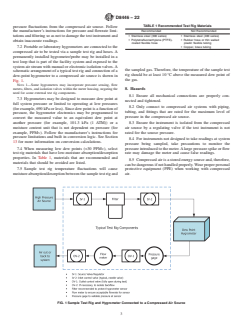
7.2 Portable or laboratory hygrometers are connected to the
compressed air to be tested via a sample test rig and hoses. A
permanently installed hygrometer/probe may be installed in a
test loop that is part of the facility system and exposed to the
system air stream with manual or electronic isolation valves.A
the sampled gas. Therefore, the temperature of the sample test
schematic arrangement of a typical test rig and connection of a
rig should be at least 10 °C above the measured dew point of
dew-point hygrometer to a compressed air source is shown in
the gas.
Fig. 1.
NOTE 1—Some hygrometers may incorporate pressure sensing, flow
meters, filters, and isolation valves within the meter housing, negating the 8. Hazards
need for some external test rig components.
8.1 Ensure all mechanical connections are properly con-
7.3 Hygrometers may be designed to measure dew point at
nected and tightened.
full system pressure or limited to operating at low pressures
8.2 Only connect to compressed air systems with piping,
(for example, 690 kPa or less). Since dew point is a function of
tubing, and fittings that are rated for the maximum level of
pressure, the hygrometer electronics may be programmed to
pressure in the compressed air source.
convert the measured value to an equivalent dew point at
another pressure (for example, 101.3 kPa (1 ATM)) or a 8.3 Ensure the instrument is isolated from the compressed
moisture content unit that is not dependent on pressure (for air source by a regulating valve if the test instrument is not
example, PPM ). Follow the manufacturer’s instructions for rated for the source pressure.
V
pressure limitations and built in conversion logic. See Section
8.4 For instruments not designed to take readings at system
13 for more information on conversion calculations.
pressure being sampled, take precautions to monitor the
7.4 When measuring low dew points (<30 PPM ), select pressure introduced to the meter.Alarge pressure spike or flow
V
test rig materials that have low-moisture absorption/desorption rate may damage the meter and cause false readings.
properties. In Table 1, materials that are recommended and
8.5 Compressed air is a stored energy source and, therefore,
materials that should be avoided are listed.
canbedangerousifnothandledproperly.Wearproperpersonal
7.5 Sample test rig temperature fluctuations will cause protective equipment (PPE) when working with compressed
moistureabsorption/desorptionbetweenthesampletestrigand air.
FIG. 1 Sample Test Rig and Hygrometer Connected to a Compressed Air Source
D8446 − 22
8.6 Release of compressed air can cause high noise levels icityofoneyearisrecommended.Acalibrationcertificateshall
and hearing damage. be provided by the calibration laboratory with data that support
calibration traceability. Practice D4178 provides guidance on a
8.7 Never release compressed air into or onto the human
calibration technique and preparation of standards of known
body.
water content.
9. Sampling, Test Specimens, and Test Units
11.2 Validation of the hygrometer before use is recom-
mended to ensure proper operation in between calibrations.
9.1 Moisture testing may be done with hygrometers that are
Validation does not replace calibration and is not intended to
permanently installed in an air system or portable hygrometers
validate the accuracy of the hygrometer over the operating
that are connected to a portable or fixed system or located in a
range; rather, it is a means to identify an instrument that has
testfacilitywherethegasisconnectedtoafixedinstrumentvia
been damaged or lost sensitivity since the previous calibration.
a test board. In each case, connecting lines shall be thoroughly
There are multiple methods to validate the operation or
flushed with the gas to be tested to ensure residual moisture is
accuracy of a test instrument and each activity should decide
removed from the test connections. In each case, control the
on a method that is appropriate based on a risk assessment of
pressure and flow rate to the levels acceptable for the instru-
their specific needs. Example methods of validation are:
ment in use. In some cases, it may be necessary to take a dew
11.2.1 Method 1—Instruments may be validated by com-
point at a defined
...