

ASTM C1536-19
(Test Method)Standard Test Method for Measuring the Yield for Aerosol Foam Sealants
General Information
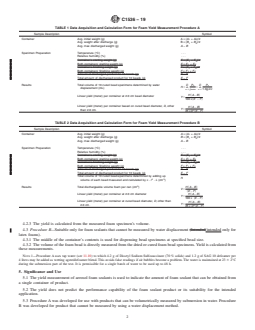
- Abstract
SIGNIFICANCE AND USE
5.1 The yield measurement of aerosol foam sealants is used to indicate the amount of foam sealant that can be obtained from a single container of product.
5.2 The yield does not predict the performance capability of the foam sealant product or its suitability for the intended application.
5.3 Procedure A was developed for use with products that can be volumetrically measured by submersion in water. Procedure B was developed for product that cannot be measured by using a water displacement method.
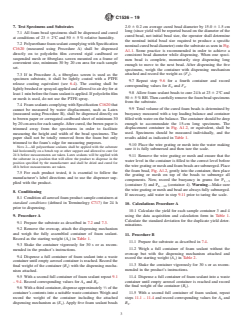
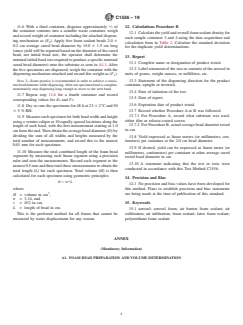
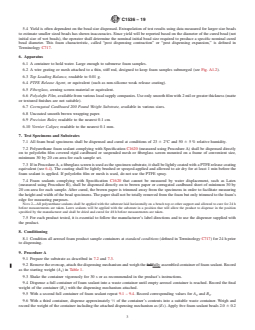
5.4 Yield is often dependent on the bead size dispensed. Extrapolation of test results using data measured for larger size beads to estimate smaller sized beads has shown inaccuracies. Since yield will be reported based on the diameter of the cured bead (not initial size of wet beads), the operator shall determine the nominal initial bead size required to produce a specific nominal cured bead diameter. This foam characteristic, called “post dispensing contraction” or “post dispensing expansion,” is defined in Terminology C717.
SCOPE
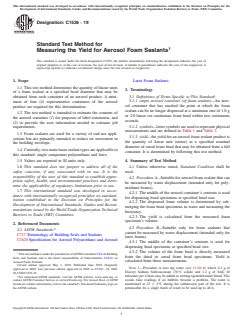
1.1 This test method determines the quantity of linear units of a foam sealant at a specified bead diameter that may be obtained from each container of an aerosol product. A minimum of four (4) representative containers of the aerosol product are required for this determination.
1.2 The test method is intended to estimate the contents of the aerosol container (1) for purposes of label statements, and (2) to provide the user information needed to estimate job requirements.
1.3 Foam sealants are used for a variety of end-use applications but are primarily intended to reduce air movement in the building envelope.
1.4 Currently, two main foam sealant types are applicable to this standard: single component polyurethane and latex.
1.5 Values are reported in SI units only.
1.6 This standard does not purport to address all of the safety concerns, if any, associated with its use. It is the responsibility of the user of this standard to establish appropriate safety, health, and environmental practices and determine the applicability of regulatory limitations prior to use.
1.7 This international standard was developed in accordance with internationally recognized principles on standardization established in the Decision on Principles for the Development of International Standards, Guides and Recommendations issued by the World Trade Organization Technical Barriers to Trade (TBT) Committee.
- Status
- Published
- Publication Date
- 30-Apr-2019
- Technical Committee
- C24 - Building Seals and Sealants
- Drafting Committee
- C24.61 - Aerosol Foam Sealants
Overview
ASTM C1536-19: Standard Test Method for Measuring the Yield for Aerosol Foam Sealants specifies a reliable procedure to determine the yield of aerosol foam sealant products. Yield measurement provides essential data about the amount of usable foam a consumer can expect to obtain from a single container, expressed as the number of linear units at a specified cured bead diameter. The standard is widely referenced within the building materials, construction, and sealant manufacturing industries to support accurate label statements, estimate job requirements, and ensure consistent product information for polyurethane and latex-based aerosol foam sealants.
Key Topics
- Yield Measurement: The core purpose of ASTM C1536-19 is to quantify the actual linear meters of foam dispensed at a particular cured bead diameter from a given container, supporting both transparency and planning in product usage.
- Test Procedures: The standard outlines two methods:
- Procedure A: Suited for aerosol foam sealants measurable by water displacement, typically polyurethane foams. The cured foam's volume is determined via submersion and buoyancy.
- Procedure B: Designed for foam sealants that cannot be assessed by water displacement, such as latex foams. The cured bead’s volume is calculated based on geometric measurements.
- Environmental Conditioning: Samples must be conditioned to controlled temperature and humidity to ensure test consistency.
- Reporting: Detailed instructions specify reporting yield per container at the tested bead diameter, along with all relevant test conditions, so results are predictable and reproducible.
- Significance: While yield reflects the total amount of sealant available, it does not predict the in-service performance or suitability for specific applications.
- Bead Size Considerations: Yield results are reported based on the cured bead diameter, acknowledging foam expansion or contraction after dispensing.
Applications
- Product Labeling: Manufacturers utilize this test method for accurate label statements regarding content yield, helping consumers make informed purchasing decisions.
- Project Estimation: Builders, installers, and contractors use yield measurements to estimate the number of aerosol foam sealant containers required for air sealing and insulation tasks, minimizing material waste and ensuring project efficiency.
- Quality Control: Consistent measurement methods help maintain batch-to-batch uniformity and underpin standards compliance in manufacturing plants.
- Regulatory Compliance: The method supports compliance with both national and international building codes and guidelines concerning building envelope air sealing.
- End-Use Flexibility: While yield does not directly indicate foam sealant performance, the data is crucial for diverse applications, especially where reducing air infiltration and exfiltration is required.
Related Standards
- ASTM C717: Terminology of Building Seals and Sealants – provides key definitions used within ASTM C1536-19, including terms like "post dispensing contraction" and "post dispensing expansion."
- ASTM C1620: Specification for Aerosol Polyurethane and Aerosol Latex Foam Sealants – details product requirements pertinent to the two main sealant types referenced in this standard.
- Industry Practices: ASTM C1536-19 aligns with international standards development principles (such as the WTO’s Technical Barriers to Trade Committee guidance), supporting global acceptance and harmonization.
Keywords: ASTM C1536-19, aerosol foam sealant, foam sealant yield, polyurethane foam, latex foam, air barrier, building envelope, air sealing, air infiltration, air exfiltration, construction standards, product labeling.
Relations
- Effective Date
- 01-May-2019
- Effective Date
- 01-Mar-2019
- Effective Date
- 01-Mar-2018
- Effective Date
- 01-Nov-2017
- Effective Date
- 01-Jan-2017
- Effective Date
- 15-Nov-2016
- Effective Date
- 01-Sep-2016
- Refers
ASTM C1620-16 - Standard Specification for Aerosol Polyurethane and Aerosol Latex Foam Sealants - Effective Date
- 01-Jan-2016
- Effective Date
- 01-May-2014
- Effective Date
- 01-Feb-2014
- Effective Date
- 01-Nov-2013
- Effective Date
- 01-Dec-2012
- Refers
ASTM C1620-12 - Standard Specification for Aerosol Polyurethane and Aerosol Latex Foam Sealants - Effective Date
- 01-Jun-2012
- Effective Date
- 01-May-2012
- Effective Date
- 15-Jan-2012
Get Certified
Connect with accredited certification bodies for this standard

DIBt (Deutsches Institut für Bautechnik)
German Institute for Building Technology.
DIN CERTCO
DIN Group product certification.

Aboma Certification B.V.
Specialized in construction, metal, and transport sectors.
Sponsored listings
Frequently Asked Questions
ASTM C1536-19 is a standard published by ASTM International. Its full title is "Standard Test Method for Measuring the Yield for Aerosol Foam Sealants". This standard covers: SIGNIFICANCE AND USE 5.1 The yield measurement of aerosol foam sealants is used to indicate the amount of foam sealant that can be obtained from a single container of product. 5.2 The yield does not predict the performance capability of the foam sealant product or its suitability for the intended application. 5.3 Procedure A was developed for use with products that can be volumetrically measured by submersion in water. Procedure B was developed for product that cannot be measured by using a water displacement method. 5.4 Yield is often dependent on the bead size dispensed. Extrapolation of test results using data measured for larger size beads to estimate smaller sized beads has shown inaccuracies. Since yield will be reported based on the diameter of the cured bead (not initial size of wet beads), the operator shall determine the nominal initial bead size required to produce a specific nominal cured bead diameter. This foam characteristic, called “post dispensing contraction” or “post dispensing expansion,” is defined in Terminology C717. SCOPE 1.1 This test method determines the quantity of linear units of a foam sealant at a specified bead diameter that may be obtained from each container of an aerosol product. A minimum of four (4) representative containers of the aerosol product are required for this determination. 1.2 The test method is intended to estimate the contents of the aerosol container (1) for purposes of label statements, and (2) to provide the user information needed to estimate job requirements. 1.3 Foam sealants are used for a variety of end-use applications but are primarily intended to reduce air movement in the building envelope. 1.4 Currently, two main foam sealant types are applicable to this standard: single component polyurethane and latex. 1.5 Values are reported in SI units only. 1.6 This standard does not purport to address all of the safety concerns, if any, associated with its use. It is the responsibility of the user of this standard to establish appropriate safety, health, and environmental practices and determine the applicability of regulatory limitations prior to use. 1.7 This international standard was developed in accordance with internationally recognized principles on standardization established in the Decision on Principles for the Development of International Standards, Guides and Recommendations issued by the World Trade Organization Technical Barriers to Trade (TBT) Committee.
SIGNIFICANCE AND USE 5.1 The yield measurement of aerosol foam sealants is used to indicate the amount of foam sealant that can be obtained from a single container of product. 5.2 The yield does not predict the performance capability of the foam sealant product or its suitability for the intended application. 5.3 Procedure A was developed for use with products that can be volumetrically measured by submersion in water. Procedure B was developed for product that cannot be measured by using a water displacement method. 5.4 Yield is often dependent on the bead size dispensed. Extrapolation of test results using data measured for larger size beads to estimate smaller sized beads has shown inaccuracies. Since yield will be reported based on the diameter of the cured bead (not initial size of wet beads), the operator shall determine the nominal initial bead size required to produce a specific nominal cured bead diameter. This foam characteristic, called “post dispensing contraction” or “post dispensing expansion,” is defined in Terminology C717. SCOPE 1.1 This test method determines the quantity of linear units of a foam sealant at a specified bead diameter that may be obtained from each container of an aerosol product. A minimum of four (4) representative containers of the aerosol product are required for this determination. 1.2 The test method is intended to estimate the contents of the aerosol container (1) for purposes of label statements, and (2) to provide the user information needed to estimate job requirements. 1.3 Foam sealants are used for a variety of end-use applications but are primarily intended to reduce air movement in the building envelope. 1.4 Currently, two main foam sealant types are applicable to this standard: single component polyurethane and latex. 1.5 Values are reported in SI units only. 1.6 This standard does not purport to address all of the safety concerns, if any, associated with its use. It is the responsibility of the user of this standard to establish appropriate safety, health, and environmental practices and determine the applicability of regulatory limitations prior to use. 1.7 This international standard was developed in accordance with internationally recognized principles on standardization established in the Decision on Principles for the Development of International Standards, Guides and Recommendations issued by the World Trade Organization Technical Barriers to Trade (TBT) Committee.
ASTM C1536-19 is classified under the following ICS (International Classification for Standards) categories: 91.100.50 - Binders. Sealing materials. The ICS classification helps identify the subject area and facilitates finding related standards.
ASTM C1536-19 has the following relationships with other standards: It is inter standard links to ASTM C1536-18, ASTM C717-19, ASTM C717-18, ASTM C717-17a, ASTM C717-17, ASTM C717-16a, ASTM C717-16, ASTM C1620-16, ASTM C717-14a, ASTM C717-14, ASTM C717-13, ASTM C717-12b, ASTM C1620-12, ASTM C717-12a, ASTM C717-12. Understanding these relationships helps ensure you are using the most current and applicable version of the standard.
ASTM C1536-19 is available in PDF format for immediate download after purchase. The document can be added to your cart and obtained through the secure checkout process. Digital delivery ensures instant access to the complete standard document.
Standards Content (Sample)
This international standard was developed in accordance with internationally recognized principles on standardization established in the Decision on Principles for the
Development of International Standards, Guides and Recommendations issued by the World Trade Organization Technical Barriers to Trade (TBT) Committee.
Designation: C1536 − 19
Standard Test Method for
Measuring the Yield for Aerosol Foam Sealants
This standard is issued under the fixed designation C1536; the number immediately following the designation indicates the year of
original adoption or, in the case of revision, the year of last revision. A number in parentheses indicates the year of last reapproval. A
superscript epsilon (´) indicates an editorial change since the last revision or reapproval.
1. Scope Latex Foam Sealants
1.1 This test method determines the quantity of linear units
3. Terminology
of a foam sealant at a specified bead diameter that may be
obtained from each container of an aerosol product. A mini- 3.1 Definitions of Terms Specific to This Standard:
3.1.1 empty aerosol container (of foam sealant)—An aero-
mum of four (4) representative containers of the aerosol
product are required for this determination. sol container that has reached the point at which the foam
sealant can be no longer dispensed at a minimum rate of 1.0 g
1.2 The test method is intended to estimate the contents of
or 2.0 linear cm continuous foam bead within two continuous
the aerosol container (1) for purposes of label statements, and
seconds.
(2) to provide the user information needed to estimate job
3.1.2 symbols—letter symbols are used to represent physical
requirements.
measurements and are defined in Table 1 and Table 2.
1.3 Foam sealants are used for a variety of end-use appli-
3.1.3 yield—the yield for an aerosol foam sealant product is
cations but are primarily intended to reduce air movement in
the quantity of linear unit (meter) at a specified nominal
the building envelope.
diameter of cured foam bead that may be obtained from a full
1.4 Currently, two main foam sealant types are applicable to
container. It is determined by following this test method.
this standard: single component polyurethane and latex.
1.5 Values are reported in SI units only. 4. Summary of Test Method
1.6 This standard does not purport to address all of the 4.1 Unless otherwise stated, Standard Condition shall be
safety concerns, if any, associated with its use. It is the
used.
responsibility of the user of this standard to establish appro-
4.2 Procedure A—Suitable for aerosol foam sealant that can
priate safety, health, and environmental practices and deter-
be measured by water displacement (intended only for poly-
mine the applicability of regulatory limitations prior to use.
urethane foams).
1.7 This international standard was developed in accor-
4.2.1 The middle of the aerosol container’s contents is used
dance with internationally recognized principles on standard-
for dispensing bead specimens at specified bead size.
ization established in the Decision on Principles for the
4.2.2 The dispensed foam volume is determined by sub-
Development of International Standards, Guides and Recom-
merging the foam bead specimens in water and measuring the
mendations issued by the World Trade Organization Technical
buoyancy.
Barriers to Trade (TBT) Committee.
4.2.3 The yield is calculated from the measured foam
specimen’s volume.
2. Referenced Documents
4.3 Procedure B—Suitable only for foam sealants that
2.1 ASTM Standards:
cannot be measured by water displacement (intended only for
C717 Terminology of Building Seals and Sealants
latex foams).
C1620 Specification for Aerosol Polyurethane and Aerosol
4.3.1 The middle of the container’s contents is used for
dispensing bead specimens at specified bead size.
4.3.2 The volume of the foam bead is directly measured
ThistestmethodisunderthejurisdictionofASTMCommitteeC24onBuilding
from the dried or cured foam bead specimens. Yield is
Seals and Sealants and is the direct responsibility of Subcommittee C24.61 on
calculated from these measurements.
Aerosol Foam Sealants.
Current edition approved May 1, 2019. Published June 2019. Originally
NOTE 1—Procedure A uses tap water (see 11.10) to which 4.2 g of
approved in 2002. Last previous edition approved in 2018 as C1536 – 18. DOI:
Dioctyl Sodium Sulfosuccinate (70 % solids) and 1.2 g of SAG 10
10.1520/C1536-19.
defoamer per 4 liters may be added as wetting agent/defoamer blend.This
For referenced ASTM standards, visit the ASTM website, www.astm.org, or
avoids false readings if air bubbles become a problem. The water is
contact ASTM Customer Service at service@astm.org. For Annual Book of ASTM
Standards volume information, refer to the standard’s Document Summary page on maintained at 23 6 2°C during the submersion part of the test. It is
theASTM website. permissible for a single batch of water to be used up to 48 h.
Copyright © ASTM International, 100 Barr Harbor Drive, PO Box C700, West Conshohocken, PA 19428-2959. United States
C1536 − 19
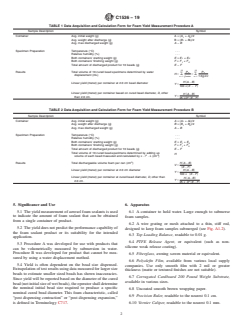
TABLE 1 Data Acquisition and Calculation Form for Foam Yield Measurement Procedure A
Sample Description Symbol
Container Avg. initial weight (g) A = (A + A )/2
1 2
Avg. weight after discharge (g) B = (B + B )/2
1 2
Avg. max discharged weight (g) A − B
Specimen Preparation Temperature (°C) . . .
Relative humidity (%) . . .
Both containers’ starting weight (g) E = E +E
1 2
Both containers’ finishing weight (g) F = F +F
1 2
Total amount of discharged product for 10 beads (g) E − F
10 10
P P
Results Total volume of 10 cured bead specimens determined by water
n n
H5 5
o o
displacement (mL)
n51 ρ n51 1.0g/cc
water
Linear yield (meter) per container at 2.0 cm bead diameter H sA2Bd
Y5
100 π E 2 F
s d
Linear yield (meter) per container based on cured bead diameter, D, other
H A2B
s d
Y5
than 2.0 cm.
25 πD sE2Fd
TABLE 2 Data Acquisition and Calculation Form for Foam Yield Measurement Procedure B
Sample Description Symbol
Container Avg. initial weight (g) A =(A + A )/2
1 2
Avg. weight after discharge (g) B =(B + B )/2
1 2
Avg. max discharged weight (g) A − B
Specimen Preparation Temperature (°C) . . .
Relative humidity (%) . . .
Both containers’ starting weight (g) E = E + E
1 2
Both containers’ finishing weight (g) F = F + F
1 2
Total amount of discharged product for 10 beads (g) E − F
Total volume of 10 cured bead-specimens determined by adding up
H
2 3
volume of each bead measured and calculated by π · r · L (cm )
H sA2Bd
Results Total dischargeable volume foam per can (cm )
V5
E2F
s d
H sA2Bd
Linear yield (meter) per container at 2.0 cm diameter
Y5
100 π E2F
s d
Linear yield (meter) per container at cured bead diameter, D, other than
H sA2Bd
Y5
2.0 cm. 2
25 π D E2F
s d
6. Apparatus
5. Significance and Use
5.1 The yield measurement of aerosol foam sealants is used
6.1 A container to hold water. Large enough to submerse
to indicate the amount of foam sealant that can be obtained
foam samples.
from a single container of product.
6.2 A wire grating or mesh attached to a thin, stiff rod,
5.2 The yield does not predict the performance capability of
designed to keep foam samples submerged (see Fig. A1.2).
the foam sealant product or its suitability for the intended
6.3 Top Loading Balance, readable to 0.01 g.
application.
6.4 PTFE Release Agent, or equivalent (such as non-
5.3 Procedure A was developed for use with products that
silicone weak release coating).
can be volumetrically measured by submersion in water.
Procedure B was developed for product that cannot be mea-
6.5 Fiberglass, awning screen material or equivalent.
sured by using a water displacement method.
6.6 Polyolefin Film, available from various local supply
5.4 Yield is often dependent on the bead size dispensed.
companies. Use only smooth film with 2 mil or greater
Extrapolation of test results using data measured for larger size
thickness (matte or textured finishes are not suitable).
beads to estimate smaller sized beads has shown inaccuracies.
6.7 Corrugated Cardboard 200 Pound Weight Substrate,
Since yield will be reported based on the diameter of the cured
available in various sizes.
bead(notinitialsizeofwetbeads),theoperatorshalldetermine
the nominal initial bead size required to produce a specific
6.8 Uncoated smooth brown wrapping paper.
nominal cured bead diameter. This foam characteristic, called
6.9 Precision Ruler, readable to the nearest 0.1 cm.
“post dispensing contraction” or “post dispensing expansion,”
is defined in Terminology C717. 6.10 Vernier Caliper, readable to the nearest 0.1 mm.
C1536 − 19
7. Test Specimens and Substrates 2.0 6 0.2 cm average cured bead diameter by 15.0 6 1.5 cm
long (since yield will be reported based on the diameter of the
7.1 All foam bead specimens shall be dispensed and cured
cured bead, not initial bead size, the operator shall determine
at conditions of 23 6 2°C and 50 6 5 % relative humidity.
the nominal initial bead size required to produce a specific
7.2 PolyurethanefoamsealantcomplyingwithSpecification
nominal cured bead diameter) onto the substrate as seen in Fig.
C1620 (measured using Procedure A) shall be dispensed
A1.1. Some practice is recommended in order to achieve a
directly on to polyolefin film covered rigid cardboard or
consistent bead diameter while dispensing. When one speci-
suspended mesh or fiberglass screen mounted on a frame of
men bead is complete, momentarily stop dispensing long
convenient size, minimum 30 by 20 cm area for each sample
enough to move to the next bead. After dispensing the five
set.
specimens, weigh the container with dispensing mechanism
attached and record the weight as (F ).
7.3 If in Procedure A, a fiberglass screen is used as the
specimen substrate, it shall be lightl
...
This document is not an ASTM standard and is intended only to provide the user of an ASTM standard an indication of what changes have been made to the previous version. Because
it may not be technically possible to adequately depict all changes accurately, ASTM recommends that users consult prior editions as appropriate. In all cases only the current version
of the standard as published by ASTM is to be considered the official document.
Designation: C1536 − 18 C1536 − 19
Standard Test Method for
Measuring the Yield for Aerosol Foam Sealants
This standard is issued under the fixed designation C1536; the number immediately following the designation indicates the year of
original adoption or, in the case of revision, the year of last revision. A number in parentheses indicates the year of last reapproval. A
superscript epsilon (´) indicates an editorial change since the last revision or reapproval.
1. Scope
1.1 This test method determines the quantity of linear units of a foam sealant at a specified bead diameter that may be obtained
from each container of an aerosol product. A minimum of four (4) representative containers of the aerosol product are required
for this determination.
1.2 The test method is intended to estimate the contents of the aerosol container (1) for purposes of label statements, and (2)
to provide the user information needed to estimate job requirements.
1.3 Foam sealants are used for a variety of end-use applications but are primarily intended to reduce air movement in the
building envelope.
1.4 Currently, two main foam sealant types are applicable to this standard: single component polyurethane and latex.
1.5 Values are reported in SI units only.
1.6 This standard does not purport to address all of the safety concerns, if any, associated with its use. It is the responsibility
of the user of this standard to establish appropriate safety, health, and environmental practices and determine the applicability of
regulatory limitations prior to use.
1.7 This international standard was developed in accordance with internationally recognized principles on standardization
established in the Decision on Principles for the Development of International Standards, Guides and Recommendations issued
by the World Trade Organization Technical Barriers to Trade (TBT) Committee.
2. Referenced Documents
2.1 ASTM Standards:
C717 Terminology of Building Seals and Sealants
C1620 Specification for Aerosol Polyurethane and Aerosol Latex Foam Sealants
3. Terminology
3.1 Definitions of Terms Specific to This Standard:
3.1.1 empty aerosol container (of foam sealant)—An aerosol container that has reached the point at which the foam sealant can
be no longer dispensed at a minimum rate of 1.0 g or 2.0 linear cm continuous foam bead within two continuous seconds.
3.1.2 symbols—letter symbols are used to represent physical measurements and are defined in Table 1 and Table 2.
3.1.3 yield—the yield for an aerosol foam sealant product is the quantity of linear unit (meter) at a specified nominal diameter
of cured foam bead that may be obtained from a full container. It is determined by following this test method.
4. Summary of Test Method
4.1 Unless otherwise stated, Standard Condition shall be used.
4.2 Procedure A—Suitable for aerosol foam sealant that can be measured by water displacement (intended only for polyurethane
foams).
4.2.1 The middle of the aerosol container’s contents is used for dispensing bead specimens at specified bead size.
4.2.2 The dispensed foam volume is determined by submerging the foam bead specimens in water and measuring the buoyancy.
This test method is under the jurisdiction of ASTM Committee C24 on Building Seals and Sealants and is the direct responsibility of Subcommittee C24.61 on Aerosol
Foam Sealants.
Current edition approved Sept. 15, 2018May 1, 2019. Published November 2018June 2019. Originally approved in 2002. Last previous edition approved in 20102018 as
C1536C1536 – 18.–10. DOI: 10.1520/C1536-18.10.1520/C1536-19.
For referenced ASTM standards, visit the ASTM website, www.astm.org, or contact ASTM Customer Service at service@astm.org. For Annual Book of ASTM Standards
volume information, refer to the standard’s Document Summary page on the ASTM website.
Copyright © ASTM International, 100 Barr Harbor Drive, PO Box C700, West Conshohocken, PA 19428-2959. United States
C1536 − 19
TABLE 1 Data Acquisition and Calculation Form for Foam Yield Measurement Procedure A
Sample Description Symbol
Container Avg. initial weight (g) A = (A + A )/2
1 2
Avg. weight after discharge (g) B = (B + B )/2
1 2
Avg. max discharged weight (g) A − B
Specimen Preparation Temperature (°C) . . .
Relative humidity (%) . . .
Container’s starting weight (g) E = (E + E )/2
1 2
Both containers’ starting weight (g) E = E + E
1 2
Container’s finishing weight (g) F = (F + F )/2
1 2
Both containers’ finishing weight (g) F = F + F
1 2
Amount of discharged product for 10 beads (g) E − F
Total amount of discharged product for 10 beads (g) E − F
10 10
P P
Results Total volume of 10 cured bead specimens determined by water
n n
H5 5
o o
displacement (mL) ρ 1.0g/cc
n51 n51
water
H A2B
Linear yield (meter) per container at 2.0 cm bead diameter s d
Y5
100 πsE 2 Fd
Linear yield (meter) per container based on cured bead diameter, D, other
H sA2Bd
Y5
than 2.0 cm. 2
25 πD E2F
s d
TABLE 2 Data Acquisition and Calculation Form for Foam Yield Measurement Procedure B
Sample Description Symbol
Container Avg. initial weight (g) A = (A + A )/2
1 2
Avg. weight after discharge (g) B = (B + B )/2
1 2
Avg. max discharged weight (g) A − B
Specimen Preparation Temperature (°C) . . .
Relative humidity (%) . . .
Container’s starting weight (g) E = (E + E )/2
1 2
Both containers’ starting weight (g) E = E + E
1 2
Container’s finishing weight (g) F = (F + F )/2
1 2
Both containers’ finishing weight (g) F = F + F
1 2
Amount of discharged product for 10 beads (g) E − F
Total amount of discharged product for 10 beads (g) E − F
Total volume of 10 cured bead-specimens determined by adding up
H
2 3
volume of each bead measured and calculated by π · r · L (cm )
H A2B
Results Total dischargeable volume foam per can (cm ) s d
V5
sE2Fd
H A2B
Linear yield (meter) per container at 2.0 cm diameter s d
Y5
100 π sE2Fd
Linear yield (meter) per container at cured bead diameter, D, other than
H A2B
s d
Y5
2.0 cm.
25 π D sE2Fd
4.2.3 The yield is calculated from the measured foam specimen’s volume.
4.3 Procedure B—Suitable only for foam sealants that cannot be measured by water displacement (Intended(intended only for
latex foams).
4.3.1 The middle of the container’s contents is used for dispensing bead specimens at specified bead size.
4.3.2 The volume of the foam bead is directly measured from the dried or cured foam bead specimens. Yield is calculated from
these measurements.
NOTE 1—Procedure A uses tap water (see 11.10) to which 4.2 g of Dioctyl Sodium Sulfosuccinate (70 % solids) and 1.2 g of SAG 10 defoamer per
4 liters may be added as wetting agent/defoamer blend. This avoids false readings if air bubbles become a problem. The water is maintained at 23 6 2°C
during the submersion part of the test. It is permissible for a single batch of water to be used up to 48 h.
5. Significance and Use
5.1 The yield measurement of aerosol foam sealants is used to indicate the amount of foam sealant that can be obtained from
a single container of product.
5.2 The yield does not predict the performance capability of the foam sealant product or its suitability for the intended
application.
5.3 Procedure A was developed for use with products that can be volumetrically measured by submersion in water. Procedure
B was developed for product that cannot be measured by using a water displacement method.
C1536 − 19
5.4 Yield is often dependent on the bead size dispensed. Extrapolation of test results using data measured for larger size beads
to estimate smaller sized beads has shown inaccuracies. Since yield will be reported based on the diameter of the cured bead (not
initial size of wet beads), the operator shall determine the nominal initial bead size required to produce a specific nominal cured
bead diameter. This foam characteristic, called “post dispensing contraction” or “post dispensing expansion,” is defined in
Terminology C717.
6. Apparatus
6.1 A container to hold water. Large enough to submerse foam samples.
6.2 A wire grating or mesh attached to a thin, stiff rod, designed to keep foam samples submerged (see Fig. A1.2).
6.3 Top Loading Balance, readable to 0.01 g.
6.4 PTFE Release Agent, or equivalent (such as non-silicone weak release coating).
6.5 Fiberglass, awning screen material or equivalent.
6.6 Polyolefin Film, available from various local supply companies. Use only smooth film with 2 mil or greater thickness (matte
or textured finishes are not suitable).
6.7 Corrugated Cardboard 200 Pound Weight Substrate, available in various sizes.
6.8 Uncoated smooth brown wrapping paper.
6.9 Precision Ruler, readable to the nearest 0.1 cm.
6.10 Vernier Caliper, readable to the nearest 0.1 mm.
7. Test Specimens and Substrates
7.1 All foam bead specimens shall be dispensed and cured at conditions of 23 6 2°C and 50 6 5 % relative humidity.
7.2 Polyurethane foam sealant complying with Specification C1620 (measured using Procedure A) shall be dispensed directly
on to polyolefin film covered rigid cardboard or suspended mesh or fiberglass screen mounted on a frame of convenient size,
minimum 30 by 20 cm area for each sample set.
7.3 If in Procedure A, a fiberglass screen is used as the specimen substrate, it shall be lightly coated with a PTFE release coating
equivalent (see 6.4). The coating shall be lightly brushed or sprayed-applied and allowed to air dry for at least 1 min before the
foam sealant is applied. If polyolefin film or mesh is used, do not use the PTFE spray.
7.4 Foam sealants complying with Specification C1620 that cannot be measured by water displacement, such as Latex
(measured using Procedure B), shall be dispensed directly on to brown paper or corrugated
...