

ASTM D2452-15(2019)
(Test Method)Standard Test Method for Extrudability of Oil- and Resin-Base Caulking Compounds
General Information
- Abstract
SIGNIFICANCE AND USE
4.1 The rate of extrusion determined by this test may be correlated with the rate of gunning of the compound.
SCOPE
1.1 This test method describes the laboratory procedure for determining the rate of extrusion of oil- and resin-base caulking compounds.
1.2 The values stated in metric (SI) units are to be regarded as the standard. The values given in parentheses are provided for information only.
1.3 The subcommittee with jurisdiction is not aware of any similar ISO standard.
1.4 This standard does not purport to address all of the safety concerns, if any, associated with its use. It is the responsibility of the user of this standard to establish appropriate safety, health, and environmental practices and determine the applicability of regulatory limitations prior to use.
1.5 This international standard was developed in accordance with internationally recognized principles on standardization established in the Decision on Principles for the Development of International Standards, Guides and Recommendations issued by the World Trade Organization Technical Barriers to Trade (TBT) Committee.
- Status
- Published
- Publication Date
- 30-Sep-2019
- Technical Committee
- C24 - Building Seals and Sealants
- Drafting Committee
- C24.20 - General Test Methods


Overview
ASTM D2452-15(2019): Standard Test Method for Extrudability of Oil- and Resin-Base Caulking Compounds defines a precise laboratory procedure to measure the rate of extrusion for oil- and resin-based caulking compounds. This standard provides an essential tool for evaluating how efficiently caulking compounds can be dispensed, which is highly relevant for manufacturers, quality control laboratories, and professionals working with building seals and sealants.
By quantifying extrudability, this ASTM standard allows comparison between products and aids in aligning material properties with application requirements. The extrudability rate is determined in metric (SI) units, and results can be directly related to practical usage conditions, such as the rate of "gunning" or dispensing by applicators.
Key Topics
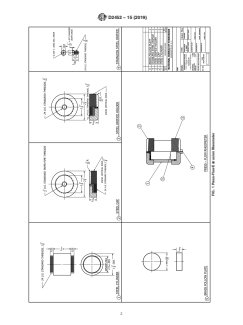
- Extrudability Testing: The method describes how to use a press-flow extrusion rheometer to measure the time needed to extrude a fixed mass or volume of caulking compound under controlled air pressure.
- Preparation and Conditioning: Specifies protocols for sampling (from unopened containers, thorough mixing), equipment conditioning, and measurement under standard laboratory conditions.
- Calculation: Extrudability is calculated as seconds per millilitre, taking into account the specific gravity (weight per gallon) of the compound.
- Repeatability and Reproducibility: Provides guidelines for evaluating the consistency of results between laboratories and highlights criteria for judging results’ acceptability at the 95% confidence level.
- Safety Considerations: Users are responsible for ensuring safe laboratory practices, environmental compliance, and adherence to regulations.
Applications
The most practical value of ASTM D2452-15(2019) lies in its widespread use throughout the construction and building materials industries, including:
- Product Quality Control: Manufacturers use this standard to verify that oil- and resin-base caulking compounds meet required performance criteria for ease of application and workability.
- Product Development: Formulators rely on extrudability data to optimize the composition of caulking products, ensuring desirable flow characteristics for various application methods.
- Job Site Selection: Contractors and applicators benefit from knowing the extrudability rates of various compounds to match the product with project needs, minimizing waste and improving results.
- Comparative Benchmarking: Laboratories and quality managers utilize this test method to compare different brands or batches, ensuring consistency and reliability.
- Regulatory and Specification Compliance: Provides a reproducible reference for meeting customer or regulatory specifications where the application and performance of caulking compounds are critical.
Related Standards
Several other ASTM standards complement and reference ASTM D2452-15(2019):
- ASTM C717 - Terminology of Building Seals and Sealants: Defines essential terms related to caulking compounds and sealants.
- ASTM D1475 - Test Method for Density of Liquid Coatings, Inks, and Related Products: Used for determining specific gravity required for extrudability calculations.
It is important to note that, as of publication, there is no directly comparable ISO standard for the extrudability of oil- and resin-base caulking compounds.
Keywords: ASTM D2452, extrudability, caulking compounds, oil-based caulking, resin-based caulking, gunnability, building sealants, extrusion test, laboratory test methods, standardization, construction materials testing, quality control.
Relations
- Replaces
ASTM D2452-15 - Standard Test Method for Extrudability of Oil- and Resin-Base Caulking Compounds - Effective Date
- 01-Oct-2019
- Effective Date
- 01-Mar-2019
- Effective Date
- 01-Mar-2018
- Effective Date
- 01-Nov-2017
- Effective Date
- 01-Jan-2017
- Effective Date
- 15-Nov-2016
- Effective Date
- 01-Sep-2016
- Effective Date
- 01-May-2014
- Effective Date
- 01-Feb-2014
- Effective Date
- 01-Nov-2013
- Effective Date
- 01-Dec-2012
- Effective Date
- 01-Nov-2012
- Effective Date
- 01-May-2012
- Effective Date
- 15-Jan-2012
- Effective Date
- 01-Mar-2011
Get Certified
Connect with accredited certification bodies for this standard

DIBt (Deutsches Institut für Bautechnik)
German Institute for Building Technology.
DIN CERTCO
DIN Group product certification.

Aboma Certification B.V.
Specialized in construction, metal, and transport sectors.
Sponsored listings
Frequently Asked Questions
ASTM D2452-15(2019) is a standard published by ASTM International. Its full title is "Standard Test Method for Extrudability of Oil- and Resin-Base Caulking Compounds". This standard covers: SIGNIFICANCE AND USE 4.1 The rate of extrusion determined by this test may be correlated with the rate of gunning of the compound. SCOPE 1.1 This test method describes the laboratory procedure for determining the rate of extrusion of oil- and resin-base caulking compounds. 1.2 The values stated in metric (SI) units are to be regarded as the standard. The values given in parentheses are provided for information only. 1.3 The subcommittee with jurisdiction is not aware of any similar ISO standard. 1.4 This standard does not purport to address all of the safety concerns, if any, associated with its use. It is the responsibility of the user of this standard to establish appropriate safety, health, and environmental practices and determine the applicability of regulatory limitations prior to use. 1.5 This international standard was developed in accordance with internationally recognized principles on standardization established in the Decision on Principles for the Development of International Standards, Guides and Recommendations issued by the World Trade Organization Technical Barriers to Trade (TBT) Committee.
SIGNIFICANCE AND USE 4.1 The rate of extrusion determined by this test may be correlated with the rate of gunning of the compound. SCOPE 1.1 This test method describes the laboratory procedure for determining the rate of extrusion of oil- and resin-base caulking compounds. 1.2 The values stated in metric (SI) units are to be regarded as the standard. The values given in parentheses are provided for information only. 1.3 The subcommittee with jurisdiction is not aware of any similar ISO standard. 1.4 This standard does not purport to address all of the safety concerns, if any, associated with its use. It is the responsibility of the user of this standard to establish appropriate safety, health, and environmental practices and determine the applicability of regulatory limitations prior to use. 1.5 This international standard was developed in accordance with internationally recognized principles on standardization established in the Decision on Principles for the Development of International Standards, Guides and Recommendations issued by the World Trade Organization Technical Barriers to Trade (TBT) Committee.
ASTM D2452-15(2019) is classified under the following ICS (International Classification for Standards) categories: 91.100.50 - Binders. Sealing materials. The ICS classification helps identify the subject area and facilitates finding related standards.
ASTM D2452-15(2019) has the following relationships with other standards: It is inter standard links to ASTM D2452-15, ASTM C717-19, ASTM C717-18, ASTM C717-17a, ASTM C717-17, ASTM C717-16a, ASTM C717-16, ASTM C717-14a, ASTM C717-14, ASTM C717-13, ASTM C717-12b, ASTM D1475-98(2012), ASTM C717-12a, ASTM C717-12, ASTM C717-11a. Understanding these relationships helps ensure you are using the most current and applicable version of the standard.
ASTM D2452-15(2019) is available in PDF format for immediate download after purchase. The document can be added to your cart and obtained through the secure checkout process. Digital delivery ensures instant access to the complete standard document.
Standards Content (Sample)
This international standard was developed in accordance with internationally recognized principles on standardization established in the Decision on Principles for the
Development of International Standards, Guides and Recommendations issued by the World Trade Organization Technical Barriers to Trade (TBT) Committee.
Designation: D2452 − 15 (Reapproved 2019)
Standard Test Method for
Extrudability of Oil- and Resin-Base Caulking Compounds
This standard is issued under the fixed designation D2452; the number immediately following the designation indicates the year of
original adoption or, in the case of revision, the year of last revision.Anumber in parentheses indicates the year of last reapproval.A
superscript epsilon (´) indicates an editorial change since the last revision or reapproval.
1. Scope 4. Significance and Use
4.1 The rate of extrusion determined by this test may be
1.1 This test method describes the laboratory procedure for
correlated with the rate of gunning of the compound.
determining the rate of extrusion of oil- and resin-base caulk-
ing compounds.
5. Apparatus
1.2 The values stated in metric (SI) units are to be regarded
5.1 Press-Flow Extrusion Rheometer constructed in accor-
as the standard. The values given in parentheses are provided
dance with Fig. 1.
for information only.
5.2 Air Supply and Pressure Gage, accurate to 6.9 kPa (1
1.3 The subcommittee with jurisdiction is not aware of any
psi).
similar ISO standard.
5.3 Clamps and Stand to hold rheometer.
1.4 This standard does not purport to address all of the
5.4 Balance, accurate to 0.01 g.
safety concerns, if any, associated with its use. It is the
responsibility of the user of this standard to establish appro-
5.5 Stopwatch.
priate safety, health, and environmental practices and deter-
5.6 Spatula (Steel).
mine the applicability of regulatory limitations prior to use.
5.7 Weight-per-gallon Cup, capacity 83.2 cm .
1.5 This international standard was developed in accor-
dance with internationally recognized principles on standard-
6. Reagent
ization established in the Decision on Principles for the
6.1 Solvent, such as methyl ethyl ketone.
Development of International Standards, Guides and Recom-
mendations issued by the World Trade Organization Technical
7. Sampling
Barriers to Trade (TBT) Committee.
7.1 The compound to be tested shall be taken from a
2. Referenced Documents
previously unopened container and thoroughly mixed before
2 using.
2.1 ASTM Standards:
C717Terminology of Building Seals and Sealants
8. Conditioning
D1475Test Method for Density of Liquid Coatings, Inks,
8.1 Afterthoroughlycleaningthepress-flowrheometerwith
and Related Products
solvent, condition the compound and the rheometer in the
laboratory for at least5hat standard conditions.
3. Terminology
3.1 Definitions—Definitions of the following terms are
9. Procedure
found in Terminology C717: caulking compound, compound,
9.1 Remove the orifice holder from the rheometer cylinder
sealant, standard conditions.
and hold the open end up, making sure that the follower plate
remains inside.
9.2 Fill the cylinder with compound, avoiding air pockets.
ThistestmethodisunderthejurisdictionofASTMCommitteeC24onBuilding
Strike off the filled cylinder with a spatula and replace the
Seals and Sealants and is the direct responsibility of Subcommittee C24.20 on
General Test Methods.
bottom orifice cap. Connect the tube to an air supply and fix it
Current edition approved Oct. 1, 2019. Published October 2019. Originally
to a support stand above the balance.
approved in 1966. Last previous edition approved in 2015 as D2452–15. DOI:
10.1520/D2452-15R19.
9.3 Adjust the air pressure to 207 kPa (30 psi) and open the
For referenced ASTM standards, visit the ASTM website, www.astm.org, or
air valve. If the pressure drops, readjust to 207 kPa while
contact ASTM Customer Service at service@astm.org. For Annual Book of ASTM
extrusion is in progress. Close the air valve and discard this
Standards volume information, refer to the standard’s Document Summary page on
the AST
...