

ASTM D6687-07(2020)
(Guide)Standard Guide for Testing Printing Ink Vehicles and Components Thereof
General Information
- Abstract
ABSTRACT
This guide covers a list of test methods, practices, guides, and specifications that can be used for the testing and evaluation of printing ink vehicles and their components thereof. Included here are methods that were developed to test impact and non-impact inks and vehicles associated with letterpress, lithography, flexography and gravure. Tests on raw materials and analytical tests in general have been included as well.
SCOPE
1.1 This guide covers a list of test methods, practices, guides, and specifications that can be used for the testing and evaluation of printing ink vehicles and components thereof (see Table 1).2
1.2 This guide includes methods that were developed to test impact and non-impact inks and vehicles associated with letterpress, lithography, flexography and gravure. Tests on raw materials and analytical tests in general have been included.
1.3 Other ASTM standards not specified here may also be applicable.
1.4 This standard does not purport to address all of the safety concerns, if any, associated with its use. It is the responsibility of the user of this standard to establish appropriate safety, health, and environmental practices and determine the applicability of regulatory limitations prior to use.
1.5 This international standard was developed in accordance with internationally recognized principles on standardization established in the Decision on Principles for the Development of International Standards, Guides and Recommendations issued by the World Trade Organization Technical Barriers to Trade (TBT) Committee.
- Status
- Published
- Publication Date
- 31-Aug-2020
- Technical Committee
- D01 - Paint and Related Coatings, Materials, and Applications
- Drafting Committee
- D01.37 - Ink Vehicles

Overview
ASTM D6687-07(2020): Standard Guide for Testing Printing Ink Vehicles and Components Thereof is an essential international guide developed by ASTM International. This standard provides a comprehensive overview of the test methods, practices, guides, and specifications used for the testing and evaluation of printing ink vehicles, their raw materials, and related components. The guide covers ink vehicles for a variety of printing processes, including letterpress, lithography, flexography, and gravure, and addresses both impact and non-impact inks. By compiling relevant test standards, ASTM D6687-07(2020) supports consistency and quality control in ink vehicle production and analysis across the printing industry.
Key Topics
- Comprehensive Test Method Listing: The standard offers a curated list of ASTM test methods, guides, and specifications applicable to printing ink vehicles and their raw materials.
- Applicability to Printing Methods: Covers ink vehicles for major printing technologies - letterpress, lithography, flexography, and gravure.
- Analytical Testing: Includes tests for raw materials, vehicle components, and additives to ensure the desired performance characteristics of the final ink product.
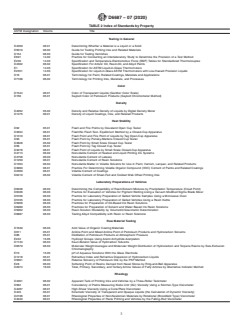
- Test Categories: Organized by property such as color, density, heat stability, viscosity, rheological properties, surface tension, volatile content, and water content.
- Safety and Regulatory Considerations: Reminds users to implement appropriate safety, health, and environmental practices, and be aware of regulatory requirements.
- Standardization Principles: Developed in accordance with World Trade Organization (WTO) principles for harmonized international standardization.
Applications
ASTM D6687-07(2020) is invaluable for the following practical applications in the printing and coatings industry:
- Quality Control in Manufacturing: Ink manufacturers and suppliers can use this standard to guide consistent testing of vehicle properties, helping ensure inks perform reliably under various printing conditions.
- Research and Development: Laboratories engaged in ink formulation can reference listed methods to evaluate raw material compatibility, identify optimal vehicle formulations, and troubleshoot performance issues.
- Process Standardization: Printing companies benefit from standardized vehicle testing, supporting color consistency, print durability, and efficiency across print runs.
- Compliance and Verification: Regulatory and third-party testing organizations can reference the guide to ensure inks and vehicles meet industry requirements and customer specifications.
- Supplier Evaluation: Purchasing departments can use the standard to confirm that supplied vehicles or additives are tested using recognized ASTM procedures, supporting supply chain transparency and reliability.
Related Standards
ASTM D6687-07(2020) references an extensive range of related ASTM standards that are fundamental for the testing and evaluation of printing ink vehicles and components:
- ASTM D16: Terminology for Paint, Related Coatings, Materials and Applications
- ASTM D445, D562, D1200, D2196, D4287, D4212: Various viscosity and rheology test methods
- ASTM D154, D5010: Guides for testing varnishes and printing inks
- ASTM D1475, D4052: Methods for determining the density of liquids and coatings
- ASTM D1544, D156: Color measurement standards
- ASTM D92, D56, D93, D1310, D3934: Flash and fire point testing for heat stability
- ASTM D2369, D6419, D4713, D4758: Nonvolatile and volatile content testing
- ASTM D3792, D4017, D4942: Water content and water pickup measurement
- ASTM D6038, D6989, D5958: Laboratory methods for preparation and compatibility testing of ink vehicles
For a full list of referenced standards and guidance on their applications, consult the appendices and tables included in ASTM D6687-07(2020).
Keywords: ASTM D6687, printing ink vehicles, ink vehicle testing, ASTM ink standards, printing ink evaluation, quality control, analytical testing, flexography, lithography, gravure, letterpress, rheological properties, volatile content, water content, ink manufacturing, standardized methods
Relations
- Replaces
ASTM D6687-07(2013) - Standard Guide for Testing Printing Ink Vehicles and Components Thereof - Effective Date
- 01-Sep-2020
- Effective Date
- 01-Sep-2020
Frequently Asked Questions
ASTM D6687-07(2020) is a guide published by ASTM International. Its full title is "Standard Guide for Testing Printing Ink Vehicles and Components Thereof". This standard covers: ABSTRACT This guide covers a list of test methods, practices, guides, and specifications that can be used for the testing and evaluation of printing ink vehicles and their components thereof. Included here are methods that were developed to test impact and non-impact inks and vehicles associated with letterpress, lithography, flexography and gravure. Tests on raw materials and analytical tests in general have been included as well. SCOPE 1.1 This guide covers a list of test methods, practices, guides, and specifications that can be used for the testing and evaluation of printing ink vehicles and components thereof (see Table 1).2 1.2 This guide includes methods that were developed to test impact and non-impact inks and vehicles associated with letterpress, lithography, flexography and gravure. Tests on raw materials and analytical tests in general have been included. 1.3 Other ASTM standards not specified here may also be applicable. 1.4 This standard does not purport to address all of the safety concerns, if any, associated with its use. It is the responsibility of the user of this standard to establish appropriate safety, health, and environmental practices and determine the applicability of regulatory limitations prior to use. 1.5 This international standard was developed in accordance with internationally recognized principles on standardization established in the Decision on Principles for the Development of International Standards, Guides and Recommendations issued by the World Trade Organization Technical Barriers to Trade (TBT) Committee.
ABSTRACT This guide covers a list of test methods, practices, guides, and specifications that can be used for the testing and evaluation of printing ink vehicles and their components thereof. Included here are methods that were developed to test impact and non-impact inks and vehicles associated with letterpress, lithography, flexography and gravure. Tests on raw materials and analytical tests in general have been included as well. SCOPE 1.1 This guide covers a list of test methods, practices, guides, and specifications that can be used for the testing and evaluation of printing ink vehicles and components thereof (see Table 1).2 1.2 This guide includes methods that were developed to test impact and non-impact inks and vehicles associated with letterpress, lithography, flexography and gravure. Tests on raw materials and analytical tests in general have been included. 1.3 Other ASTM standards not specified here may also be applicable. 1.4 This standard does not purport to address all of the safety concerns, if any, associated with its use. It is the responsibility of the user of this standard to establish appropriate safety, health, and environmental practices and determine the applicability of regulatory limitations prior to use. 1.5 This international standard was developed in accordance with internationally recognized principles on standardization established in the Decision on Principles for the Development of International Standards, Guides and Recommendations issued by the World Trade Organization Technical Barriers to Trade (TBT) Committee.
ASTM D6687-07(2020) is classified under the following ICS (International Classification for Standards) categories: 37.100.10 - Reproduction equipment. The ICS classification helps identify the subject area and facilitates finding related standards.
ASTM D6687-07(2020) has the following relationships with other standards: It is inter standard links to ASTM D6687-07(2013), ASTM D7188-05(2019). Understanding these relationships helps ensure you are using the most current and applicable version of the standard.
ASTM D6687-07(2020) is available in PDF format for immediate download after purchase. The document can be added to your cart and obtained through the secure checkout process. Digital delivery ensures instant access to the complete standard document.
Standards Content (Sample)
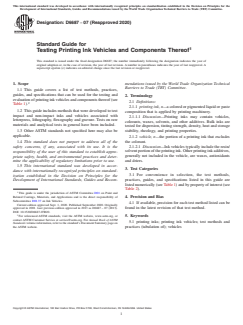
This international standard was developed in accordance with internationally recognized principles on standardization established in the Decision on Principles for the
Development of International Standards, Guides and Recommendations issued by the World Trade Organization Technical Barriers to Trade (TBT) Committee.
Designation: D6687 − 07 (Reapproved 2020)
Standard Guide for
Testing Printing Ink Vehicles and Components Thereof
This standard is issued under the fixed designation D6687; the number immediately following the designation indicates the year of
original adoption or, in the case of revision, the year of last revision. A number in parentheses indicates the year of last reapproval. A
superscript epsilon (´) indicates an editorial change since the last revision or reapproval.
1. Scope mendations issued by the World Trade Organization Technical
Barriers to Trade (TBT) Committee.
1.1 This guide covers a list of test methods, practices,
guides, and specifications that can be used for the testing and
2. Terminology
evaluationofprintinginkvehiclesandcomponentsthereof(see
2.1 Definitions:
Table 1).
2.1.1 printing ink, n—a colored or pigmented liquid or paste
1.2 This guide includes methods that were developed to test
composition that is applied by printing machinery.
impact and non-impact inks and vehicles associated with
2.1.1.1 Discussion—Printing inks may contain vehicles,
letterpress, lithography, flexography and gravure. Tests on raw
colorants, waxes, solvents, and other additives. Bulk inks are
materials and analytical tests in general have been included.
tested for dispersion, tinting strength, density, heat and storage
stability, rheology, and printing properties.
1.3 Other ASTM standards not specified here may also be
applicable.
2.1.2 vehicle, n—the portion of a printing ink that excludes
the colorant.
1.4 This standard does not purport to address all of the
2.1.2.1 Discussion—Ink vehicles typically include the resin/
safety concerns, if any, associated with its use. It is the
solvent portion of the printing ink. Other printing ink additives,
responsibility of the user of this standard to establish appro-
generally not included in the vehicle, are waxes, antioxidants
priate safety, health, and environmental practices and deter-
and driers.
mine the applicability of regulatory limitations prior to use.
1.5 This international standard was developed in accor-
3. Test Categories
dance with internationally recognized principles on standard-
3.1 For convenience in selection, the test methods,
ization established in the Decision on Principles for the
practices, guides, and specifications listed in this guide are
Development of International Standards, Guides and Recom-
listed numerically (see Table 1) and by property of interest (see
Table 2).
This guide is under the jurisdiction of ASTM Committee D01 on Paint and
Related Coatings, Materials, and Applications and is the direct responsibility of 4. Precision and Bias
Subcommittee D01.37 on Ink Vehicles.
4.1 If available, precision for each test method listed can be
Current edition approved Sept. 1, 2020. Published September 2020. Originally
approved in 2001. Last previous edition approved in 2013 as D6687 – 07 (2013). found in the latest revision of that test method.
DOI: 10.1520/D6687-07R20.
For referenced ASTM standards, visit the ASTM website, www.astm.org, or 5. Keywords
contact ASTM Customer Service at service@astm.org. For Annual Book of ASTM
5.1 printing inks; printing ink vehicles; test methods and
Standards volume information, refer to the standard’s Document Summary page on
the ASTM website. practices (tabulation of); vehicles
Copyright © ASTM International, 100 Barr Harbor Drive, PO Box C700, West Conshohocken, PA 19428-2959. United States
D6687 − 07 (2020)
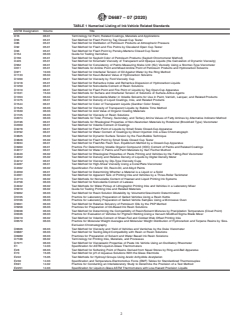
TABLE 1 Numerical Listing of Ink Vehicle Related Standards
ASTM Designation Volume Title
D16 06.01 Terminology for Paint, Related Coatings, Materials and Applications
D56 05.01 Test Method for Flash Point by Tag Closed Cup Tester
D86 05.01 Test Method for Distillation of Petroleum Products at Atmospheric Pressure
D92 05.01 Test Method for Flash and Fire Points by Cleveland Open Cup Tester
D93 05.01 Test Method for Flash Point by Pensky-Martens Closed Cup Tester
D154 06.03 Guide for Testing Varnishes
D156 05.01 Test Method for Saybolt Color of Petroleum Products (Saybolt Chromometer Method)
D445 05.01 Test Method for Kinematic Viscosity of Transparent and Opaque Liquids (the Calculation of Dynamic Viscosity)
D562 06.01 Test Method for Consistency of Paints Measuring Krebs Unit (KU) Viscosity Using a Stormer-Type Viscometer
D611 05.01 Test Methods for Aniline Point and Mixed Aniline Point of Petroleum Products and Hydrocarbon Solvents
D971 10.03 Test Method for Interfacial Tension of Oil Against Water by the Ring Method
D1133 06.04 Test Method for Kauri-Butanol Value of Hydrocarbon Solvents
D1200 06.01 Test Method for Viscosity by Ford Viscosity Cup
D1218 05.01 Test Method for Refractive Index and Refractive Dispersion of Hydrocarbon Liquids
D1259 06.01 Test Method for Nonvolatile Content of Resin Solutions
D1310 06.01 Test Method for Flash Point and Fire Point of Liquids by Tag Open-Cup Apparatus
D1331 15.04 Test Methods for Surface and Interfacial Tension of Solutions of Surface-Active Agents
D1353 06.04 Test Method for Nonvolatile Matter in Volatile Solvents for Use in Paint, Varnish, Lacquer, and Related Products
D1475 06.01 Test Method for Density of Liquid Coatings, Inks, and Related Products
D1544 06.01 Test Method for Color of Transparent Liquids (Gardner Color Scale)
D1545 06.03 Test Method for Viscosity of Transparent Liquids by Bubble Time Method
D1639 06.03 Test Method for Acid Value of Organic Coating Materials
D1725 06.03 Test Method for Viscosity of Resin Solutions
D2074 06.03 Test Methods for Total, Primary, Secondary, and Tertiary Amine Values of Fatty Amines by Alternative Indicator Method
D2196 06.01 Test Methods for Rheological Properties of Non-Newtonian Materials by Rotational (Brookfield Type) Viscometer
D2369 06.01 Test Method for Volatile Content of Coatings
D3278 06.01 Test Method for Flash Point of Liquids by Small Scale Closed-Cup Apparatus
D3792 06.01 Test Method for Water Content of Coatings by Direct Injection Into a Gas Chromatograph
D3825 05.02 Test Method for Dynamic Surface Tension by the Fast-Bubble Technique
D3828 05.02 Test Method for Flash Point by Small Scale Closed Cup Tester
D3934 06.01 Test Method for Flash/No Flash Test- Equilibrium Method by a Closed-Cup Apparatus
D3960 06.01 Practice For Determining Volatile Organic Compound (VOC) Content of Paints and Related Coatings
D4017 06.01 Test Method for Water in Paints and Paint Materials by Karl Fischer Method
D4040 06.02 Test Method for Rheological Properties of Paste Printing and Vehicles by the Falling-Rod Viscometer
D4052 05.02 Test Method for Density and Relative Density of Liquids by Digital Density Meter
D4212 06.01 Test Method for Viscosity by Dip-Type Viscosity Cups
D4287 06.01 Test Method for High-Shear Viscosity Using a Cone/Plate Viscometer
D4302 06.02 Specification For Artists’ Oil, Resin-Oil, and Alkyd Paints
D4359 06.01 Test Method for Determining Whether a Material is a Liquid or a Solid
D4361 06.02 Test Method for Apparent Tack of Printing Inks and Vehicles by a Three-Roller Tackmeter
D4713 06.02 Test Methods for Nonvolatile Content of Heatset and Liquid Printing Ink Systems
D4758 06.03 Test Method for Nonvolatile Content of Latexes
D4942 06.02 Test Methods for Water Pickup of Lithographic Printing Inks and Vehicles in a Laboratory Mixer
D5010 06.02 Guide for Testing Printing Inks and Related Materials
D5062 06.03 Test Method for Resin Solution Dilutability by Volumetric/Gravimetric Determination
D5165 06.03 Practice for Laboratory Preparation of Gelled Vehicles Using a Resin Kettle
D5166 06.03 Practice for Laboratory Preparation of Gelled Vehicle Samples Using a Microwave Oven
D5661 06.03 Test Method for Relative Solvency of Petroleum Oils by the PKP Method
D5958 06.03 Practices for Preparation of Oil-Based Ink Resin Solutions
D6038 06.03 Test Method for Determining the Compatibility of Resin/Solvent Mixtures by Precipitation Temperature (Cloud Point)
D6336 06.03 Practice for Evaluation of
...