

ASTM E3021/E3021M-15(2019)
(Guide)Standard Guide for Evaluating the Relative Effectiveness of Building Systems to Resist the Passage of Products of Combustion Based on the Aggregation of Leakage Rates
General Information
- Abstract
SIGNIFICANCE AND USE
5.1 Use of this guide can be beneficial in determining the relative effectiveness of building systems as it relates to potential protection from passage of products of combustion between building spaces under both ambient and elevated temperatures.
5.2 Determining the relative effectiveness of a building system to limit the total air leakage between building spaces is important in the evaluation and selection of potential construction components to meet desired performance requirements for a building.
5.3 To properly assess the relative effectiveness of a building system’s total air leakage rate, a guide as to how to aggregate the individual component air leakage rates into a total air leakage rate for the building system is needed.
5.4 It is the intent of this guide to provide a methodology for the conversion of individual component air leakage rates into common values that can be aggregated into a total air leakage rate for a building system, thus providing a means for establishing the relative effectiveness of various building systems to resist the passage of products of combustion.
SCOPE
1.1 This guide provides a method of evaluating the relative effectiveness of building systems to resist the passage of smoke.
1.2 The method of evaluating the relative effectiveness of a building system is based on the aggregation of leakage rates of openings, penetrations, joints, and interfaces of the construction elements forming the building system.
1.3 Units—The values stated in either SI units or inch-pound units are to be regarded separately as standard. The values stated in each system may not be exact equivalents; therefore, each system shall be used independently of the other. Combining values from the two systems may result in non-conformance with the standard.
1.4 This standard does not purport to address all of the safety concerns, if any, associated with its use. It is the responsibility of the user of this standard to establish appropriate safety, health, and environmental practices and determine the applicability of regulatory limitations prior to use.
1.5 This international standard was developed in accordance with internationally recognized principles on standardization established in the Decision on Principles for the Development of International Standards, Guides and Recommendations issued by the World Trade Organization Technical Barriers to Trade (TBT) Committee.
- Status
- Published
- Publication Date
- 28-Feb-2019
- Technical Committee
- E05 - Fire Standards
- Drafting Committee
- E05.11 - Fire Resistance
Overview
ASTM E3021/E3021M-15(2019), developed by ASTM International, provides a standardized guide for evaluating the relative effectiveness of building systems in resisting the passage of products of combustion (smoke). The standard focuses on aggregating air leakage rates of various construction components - such as walls, floors, ceilings, penetrations, joints, and interfaces - to produce an overall assessment of a building system’s ability to control smoke movement under both ambient and elevated temperatures. This method supports safer building design by facilitating informed decisions when selecting construction materials and methods to limit smoke migration during fire scenarios.
Key Topics
- Air Leakage Rate Aggregation: The guide details methodologies for aggregating the air leakage rates from individual components (e.g., doors, windows, joints, penetrations) into a total value representing the system’s overall performance.
- Evaluation Under Various Conditions: Emphasizes the importance of assessing leakage under both ambient (normal) and elevated (fire) temperature scenarios to ensure comprehensive analysis.
- Measurement Units: Permits evaluation using either SI or inch-pound units, but requires consistency - mixing units is not allowed to ensure conformance with the standard.
- Component Consideration: Takes into account every element that may constitute a path for air or smoke leakage, including walls, floors, ceilings, and penetrations for pipes, ducts, cables, as well as the interface joints between building system components.
- Use of Existing Test Data: Utilizes test results from established air leakage standards (e.g., ASTM E283, ASTM E1424, UL 555S, UL 1479, UL 1784, and UL 2079) for individual component performance, providing methods to aggregate and compare these to determine total system leakage.
Applications
- Building Design and Construction: Architects and engineers apply this guide to compare, evaluate, and select building systems and components that effectively minimize the migration of products of combustion, supporting life safety and property protection.
- Code Compliance and Life Safety: By providing a systematic method for evaluating air leakage, ASTM E3021/E3021M assists stakeholders in demonstrating compliance with code requirements for smoke barriers, smoke partitions, and compartmentation.
- Retrofitting and Renovation: This guide enables building owners and facility managers to assess the performance of existing structures, identify areas for improvement, and prioritize upgrades to enhance smoke control during fire events.
- Product Specification: Manufacturers can reference this standard when designing or certifying products that are intended to form part of smoke-resistant barriers in buildings.
Related Standards
- ASTM E176 - Terminology of Fire Standards: Defines key terms used in fire safety and testing.
- ASTM E283 - Air Leakage Through Exterior Windows, Curtain Walls, and Doors: Establishes test methods for determining air leakage metrics.
- ASTM E1424 - Rate of Air Leakage Through Exterior Windows, Curtain Walls, and Doors: Further methodology for measuring component air leakage.
- UL 555S - Smoke Dampers: Pertains to testing smoke dampers for air leakage resistance.
- UL 1479 - Fire Tests of Through-Penetration Firestops: Focuses on evaluating the performance of firestop systems, including air leakage aspects.
- UL 1784 - Air Leakage Tests of Door Assemblies: Provides a process for assessing the air leakage of door assemblies.
- UL 2079 - Fire Resistance of Building Joint Systems: Covers the evaluation of fire resistance and leakage in building joint systems.
Keywords: air leakage, smoke control, building system effectiveness, combustion products, smoke barrier, smoke partition, ASTM E3021, fire safety standards, leakage rate aggregation, life safety, code compliance, building enclosure performance.
By enabling a direct and standardized comparison of building system performance regarding the passage of smoke, ASTM E3021/E3021M supports safer buildings and more reliable life safety strategies in the built environment.
Relations
- Effective Date
- 01-Mar-2019
- Effective Date
- 01-Jan-2024
- Effective Date
- 15-Dec-2018
- Effective Date
- 01-Mar-2018
- Effective Date
- 01-Aug-2015
- Effective Date
- 01-Aug-2015
- Effective Date
- 01-Feb-2015
- Effective Date
- 01-Oct-2014
- Effective Date
- 15-Aug-2014
- Effective Date
- 01-Aug-2014
- Effective Date
- 01-Jul-2014
- Effective Date
- 01-Apr-2013
- Effective Date
- 15-Dec-2012
- Effective Date
- 01-Nov-2012
- Effective Date
- 01-Oct-2012
Get Certified
Connect with accredited certification bodies for this standard

DIBt (Deutsches Institut für Bautechnik)
German Institute for Building Technology.
DIN CERTCO
DIN Group product certification.

Kiwa BDA Testing
Building and construction product certification.
Sponsored listings
Frequently Asked Questions
ASTM E3021/E3021M-15(2019) is a guide published by ASTM International. Its full title is "Standard Guide for Evaluating the Relative Effectiveness of Building Systems to Resist the Passage of Products of Combustion Based on the Aggregation of Leakage Rates". This standard covers: SIGNIFICANCE AND USE 5.1 Use of this guide can be beneficial in determining the relative effectiveness of building systems as it relates to potential protection from passage of products of combustion between building spaces under both ambient and elevated temperatures. 5.2 Determining the relative effectiveness of a building system to limit the total air leakage between building spaces is important in the evaluation and selection of potential construction components to meet desired performance requirements for a building. 5.3 To properly assess the relative effectiveness of a building system’s total air leakage rate, a guide as to how to aggregate the individual component air leakage rates into a total air leakage rate for the building system is needed. 5.4 It is the intent of this guide to provide a methodology for the conversion of individual component air leakage rates into common values that can be aggregated into a total air leakage rate for a building system, thus providing a means for establishing the relative effectiveness of various building systems to resist the passage of products of combustion. SCOPE 1.1 This guide provides a method of evaluating the relative effectiveness of building systems to resist the passage of smoke. 1.2 The method of evaluating the relative effectiveness of a building system is based on the aggregation of leakage rates of openings, penetrations, joints, and interfaces of the construction elements forming the building system. 1.3 Units—The values stated in either SI units or inch-pound units are to be regarded separately as standard. The values stated in each system may not be exact equivalents; therefore, each system shall be used independently of the other. Combining values from the two systems may result in non-conformance with the standard. 1.4 This standard does not purport to address all of the safety concerns, if any, associated with its use. It is the responsibility of the user of this standard to establish appropriate safety, health, and environmental practices and determine the applicability of regulatory limitations prior to use. 1.5 This international standard was developed in accordance with internationally recognized principles on standardization established in the Decision on Principles for the Development of International Standards, Guides and Recommendations issued by the World Trade Organization Technical Barriers to Trade (TBT) Committee.
SIGNIFICANCE AND USE 5.1 Use of this guide can be beneficial in determining the relative effectiveness of building systems as it relates to potential protection from passage of products of combustion between building spaces under both ambient and elevated temperatures. 5.2 Determining the relative effectiveness of a building system to limit the total air leakage between building spaces is important in the evaluation and selection of potential construction components to meet desired performance requirements for a building. 5.3 To properly assess the relative effectiveness of a building system’s total air leakage rate, a guide as to how to aggregate the individual component air leakage rates into a total air leakage rate for the building system is needed. 5.4 It is the intent of this guide to provide a methodology for the conversion of individual component air leakage rates into common values that can be aggregated into a total air leakage rate for a building system, thus providing a means for establishing the relative effectiveness of various building systems to resist the passage of products of combustion. SCOPE 1.1 This guide provides a method of evaluating the relative effectiveness of building systems to resist the passage of smoke. 1.2 The method of evaluating the relative effectiveness of a building system is based on the aggregation of leakage rates of openings, penetrations, joints, and interfaces of the construction elements forming the building system. 1.3 Units—The values stated in either SI units or inch-pound units are to be regarded separately as standard. The values stated in each system may not be exact equivalents; therefore, each system shall be used independently of the other. Combining values from the two systems may result in non-conformance with the standard. 1.4 This standard does not purport to address all of the safety concerns, if any, associated with its use. It is the responsibility of the user of this standard to establish appropriate safety, health, and environmental practices and determine the applicability of regulatory limitations prior to use. 1.5 This international standard was developed in accordance with internationally recognized principles on standardization established in the Decision on Principles for the Development of International Standards, Guides and Recommendations issued by the World Trade Organization Technical Barriers to Trade (TBT) Committee.
ASTM E3021/E3021M-15(2019) is classified under the following ICS (International Classification for Standards) categories: 13.220.50 - Fire-resistance of building materials and elements; 91.040.01 - Buildings in general. The ICS classification helps identify the subject area and facilitates finding related standards.
ASTM E3021/E3021M-15(2019) has the following relationships with other standards: It is inter standard links to ASTM E3021/E3021M-15, ASTM E176-24, ASTM E176-18a, ASTM E176-18, ASTM E176-15a, ASTM E176-15ae1, ASTM E176-15, ASTM E176-14c, ASTM E176-14b, ASTM E176-14a, ASTM E176-14, ASTM E176-13, ASTM E176-12b, ASTM E176-12a, ASTM E176-12. Understanding these relationships helps ensure you are using the most current and applicable version of the standard.
ASTM E3021/E3021M-15(2019) is available in PDF format for immediate download after purchase. The document can be added to your cart and obtained through the secure checkout process. Digital delivery ensures instant access to the complete standard document.
Standards Content (Sample)
This international standard was developed in accordance with internationally recognized principles on standardization established in the Decision on Principles for the
Development of International Standards, Guides and Recommendations issued by the World Trade Organization Technical Barriers to Trade (TBT) Committee.
Designation: E3021/E3021M − 15 (Reapproved 2019) An American National Standard
Standard Guide for
Evaluating the Relative Effectiveness of Building Systems to
Resist the Passage of Products of Combustion Based on
the Aggregation of Leakage Rates
ThisstandardisissuedunderthefixeddesignationE3021/E3021M;thenumberimmediatelyfollowingthedesignationindicatestheyear
of original adoption or, in the case of revision, the year of last revision. A number in parentheses indicates the year of last reapproval.
A superscript epsilon (´) indicates an editorial change since the last revision or reapproval.
1. Scope Under Specified Pressure Differences Across the Speci-
men
1.1 This guide provides a method of evaluating the relative
E1424 Test Method for Determining the Rate ofAir Leakage
effectiveness of building systems to resist the passage of
Through Exterior Windows, Curtain Walls, and Doors
smoke.
Under Specified Pressure and Temperature Differences
1.2 The method of evaluating the relative effectiveness of a
Across the Specimen
building system is based on the aggregation of leakage rates of
2.2 Underwriters Laboratories Standards:
openings, penetrations, joints, and interfaces of the construc-
UL 555S Standard for Smoke Dampers
tion elements forming the building system.
UL 1479 Fire Tests of Through-Penetration Firestops
1.3 Units—The values stated in either SI units or inch-
UL1784 Standard forAir LeakageTests of DoorAssemblies
pound units are to be regarded separately as standard. The
UL2079 Tests for Fire Resistance of Building Joint Systems
values stated in each system may not be exact equivalents;
therefore, each system shall be used independently of the other. 3. Terminology
Combining values from the two systems may result in non-
3.1 For definitions of terms other than those contained in
conformance with the standard.
this guide, refer to Terminology E176.
1.4 This standard does not purport to address all of the
3.2 Definitions:
safety concerns, if any, associated with its use. It is the
3.2.1 building system, n—for the purpose of this guide,a
responsibility of the user of this standard to establish appro-
building system is defined as any assembly of wall, floor, or
priate safety, health, and environmental practices and deter-
combination floor and ceiling elements, as applicable, includ-
mine the applicability of regulatory limitations prior to use.
ing any penetrating items, intended to function as a barrier to
1.5 This international standard was developed in accor-
resist the passage of products of combustion through the
dance with internationally recognized principles on standard-
barrier.
ization established in the Decision on Principles for the
NOTE 1—See commentary for examples of building systems.
Development of International Standards, Guides and Recom-
mendations issued by the World Trade Organization Technical
4. Summary of Guide
Barriers to Trade (TBT) Committee.
4.1 Using current air leakage rate tests and test results, this
2. Referenced Documents
guide provides a method of aggregating the air leakage rates
for the various components, interfaces, and penetrations in a
2.1 ASTM Standards:
building system.
E176 Terminology of Fire Standards
E283 Test Method for Determining Rate of Air Leakage
4.2 The determination of the total air leakage rates of
Through Exterior Windows, Curtain Walls, and Doors
building systems provides a direct comparative tool for the
relative ranking of such building systems.
This guide is under the jurisdiction ofASTM Committee E05 on Fire Standards
5. Significance and Use
and is the direct responsibility of Subcommittee E05.11 on Fire Resistance.
Current edition approved March 1, 2019. Published March 2019. Originally 5.1 Use of this guide can be beneficial in determining the
approved in 2015. Last previous edition approved in 2015 as E3021/E3021M – 15.
relative effectiveness of building systems as it relates to
DOI: 10.1520/E3021_E3021M – 15R19
For referenced ASTM standards, visit the ASTM website, www.astm.org, or
contact ASTM Customer Service at service@astm.org. For Annual Book of ASTM
Standards volume information, refer to the standard’s Document Summary page on Available from Underwriters Laboratories (UL), 2600 N.W. Lake Rd., Camas,
the ASTM website. WA 98607-8542, http://www.ul.com.
Copyright © ASTM International, 100 Barr Harbor Drive, PO Box C700, West Conshohocken, PA 19428-2959. United States
E3021/E3021M − 15 (2019)
potential protection from passage of products of combustion 6. Procedure
between building spaces under both ambient and elevated
6.1 The effectiveness of building systems to resist the
temperatures.
passage of products of combustion is dependent upon the
ability of such building systems to limit the total amount of air
5.2 Determining the relative effectiveness of a building
leakage.
system to limit the total air leakage between building spaces is
6.2 Buildingsystemsmayconsistofawidevarietyofoneor
important in the evaluation and selection of potential construc-
more components including but not limited to walls, floors and
tion components to meet desired performance requirements for
ceilings. In some cases, such as but not limited to, pipes,
a building.
wiring, doors, windows, and ducts, the penetration of compo-
5.3 To properly assess the relative effectiveness of a build-
nents may provide a path for air leakage.
ing system’s total air leakage rate, a guide as to how to
6.3 In order to calculate the total amount of air leakage
aggregate the individual component air leakage rates into a
through a building system, the air leakage for all the individual
total air leakage rate for the building system is needed.
components must be known, including all penetration and
component interfaces.
5.4 Itistheintentofthisguidetoprovideamethodologyfor
the conversion of individual component air leakage rates into
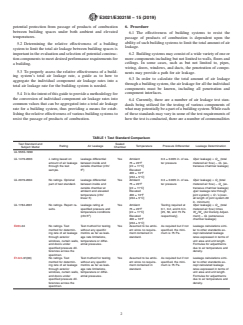
6.4 Currently, there are a number of air leakage test stan-
common values that can be aggregated into a total air leakage
dards being utilized for the testing of various components of
rate for a building system, thus providing a means for estab-
whatmaypotentiallybeapartofabuildingsystem.Whileeach
lishing the relative effectiveness of various building systems to of these standards may vary in some of the test requirements of
resist the passage of products of combustion. how the test is conducted, there are a number of commonalities
TABLE 1 Test Standard Comparison
Test Standard and Sealed
Rating Air Leakage Temperature Pressure Differential Leakage Determination
Subject Matter Chamber
UL 555S-1999
UL 1479-2003 L rating based on Leakage differential Yes Ambient 0.3 ± 0.005 in. of wa- Q(air leakage) = Q (total
m
amount of air leakage between inside and 75 ± 20°F ter pressure metered air flow) – Q (ex-
L
through the test outside chamber (cfm/ [24 ± 11°C] traneous chamber leakage)
sample. ft ) Elevated
400 ± 10°F
[204 ± 5°C]
UL 2079-2004 No ratings. Optional Leakage differential Yes Ambient 0.3 ± 0.005 in. of wa- Q(air leakage) = Q (total
t
part of test standard. between inside and 75 ± 20°F ter pressure metered air flow) – Q (ex-
e
outside chamber at [24 ± 11°C] traneous chamber leakage)
ambient and elevated Elevated q(air leakage rate through
temperature (cfm/ 400 ± 10°F joint system) =Q/L(over-
linear ft) [204 ± 5°C] all length of joint system-39
in. minimum)
UL 1784-2001 No ratings. Report re- Leakage rating at Yes Ambient Testing required at Q(air leakage) = Q (total
m
sults. specified pressure and 75 ± 20°F 0.1, 0.2, and 0.3 in. metered air flow) times
temperature conditions [24 ± 11°C] [25, 50, and 75 Pa W /W (Air Density Adjust-
m w
(cfm/ft ) Elevated respectively]. ment) – Q (extraneous
L
400 ± 10°F chamber leakage)
[204 ± 5°C]
E283-04 No ratings. Test Test method for testing Yes Assumed to be ambi- As required but if not Leakage calculations simi-
method for determin- without any specific ent since no require- specified, the mini- lar to other standards ex-
ing rate of air leakage metrics as far as leak- ment contained in mum is 75 Pa. cept calculated leakage
through exterior age rate limitations, standard. rates expressed in terms of
windows, curtain walls, temperature or differ- unit area and unit length.
and doors under ential pressures. Formulas for adjustments
specified pressure dif- due to air temperature and
ferences across the density.
specimen.
E1424-91(00) No ratings. Test Test method for testing Yes Assumed to be ambi- As required but if not Leakage calculations simi-
method for determin- without any specific ent since no require- specified, the mini- lar to other standards ex-
ing rate of air leakage metrics as far as leak- ment contained in mum is 75 Pa. cept calculated leakage
through exterior age rate limitations, standard. rates expressed in terms of
windows, curtain walls, temperature or differ- unit area and unit length.
and doors under ential pressures. Formulas for adjustments
specified pressure dif- due to air temperature and
ferences across the density.
specimen.
E3021/E3021M − 15 (2019)
that should be noted when attempting to aggregate the amount well as any penetrations of the wall, floor, and ceiling compo-
of total air leakage through a building system. Table 1 provides nents. To facilitate the aggregation of results, the leakage rate
a listing of important test requirements and conditions for each of the individual components and penetrating elements shall
of the currently used test standards. when necessary be converted to leakage rates with common
units of measure. In addition, whenever possible, leakage rates
6.5 Each of the current test standards uses a somewhat
shall be aggregated for both the ambient and elevated tempera-
different nomenclature for the computation of the component
ture test conditions. In some cases, test methods such as Test
leakage rate. In order to establish a common nomenclature for
Methods E283 and E1424 do not provide test results for
this guide, the component leakage rate is computed based on
elevated temperature test conditions and therefore, aggregation
the total metered air flow out of the chamber minus the
of leakage values is only possible for ambient temperature test
extraneous chamber leakage loss in accordance with the
conditions. Table 1 provides a comparison of the various
following:
leakage rate test methods and the manner in which the results
Q 5 Q 2 Q (1)
C T L
are reported.
where:
7.2 The total aggregation of leakage rates for a building
3 2 3 2
Q = component leakage rate (ft /min-ft)[m /s-m ], system can be determined through a process of summing the
C
3 2
Q = total meter air flow out of the chamber (ft /min-ft )
individual leakage rates of all components of the building
T
3 2
[m /s-m ], and
system including their associated penetrations and interfaces.
3 2
Q = extraneous chamber leakage loss (ft /min-ft )
L
7.3 The calculating of the total aggregation of leakage rates
3 2
[m /s-m ].
can be accomplished using the following general aggregation
6.6 In order to aggregate the total air leakage rates of all
formula:
components in a building system, some of the test conditions
Total Leakage Rate 5 $Σ ~R !1Σ~R !1Σ~R !
door damper penetration
used in the currently available test standards must be converted
1Σ~R !% (3)
joint
to a common set of test conditions, that is, sealed chamber,
temperature, pressure differential.
where:
6.7 The air leakage for individual components should be R = the leakage rate of the item, with units as specified in
determined based on testing using a sealed chamber apparatus. 7.4, and
Σ = the summation of the leakage contributed by each
6.8 While the influence of
...