

ASTM D5141-23
(Test Method)Standard Test Method for Determining Filtering Efficiency and Flow Rate of the Filtration Component of a Sediment Retention Device
General Information
- Abstract
SIGNIFICANCE AND USE
5.1 This test method is used to determine the filtering efficiency and flow rate of the filtration component of a sediment retention device, such as a silt fence, a silt barrier, or a silt curtain, for specific soil tested.
5.2 This test method may be used for the design of the filtration component of a sediment retention device to meet requirements of regulatory agencies in filtering efficiency or flow rate for the specific soil tested.
5.2.1 The designer can use this test method to determine the spacing between sediment retention devices.
5.3 This test method is intended for performance evaluation, as the results will depend on the specific soil evaluated. Unless testing with the default soil is desired, it is recommended that the user or representative perform the test to pre-approve products, as sediment retention device manufacturers are not typically equipped to handle or test soil requirements.
5.4 This test method provides a means of evaluating the filtration component of sediment retention devices with different soils under various conditions that simulate the conditions that exist in a sediment retention device installation. This test method may be used to simulate several storm events on the same sediment retention device specimen. Therefore, the number of times this test is repeated per specimen is dependent upon the user and the site conditions.
SCOPE
1.1 This test method is used to determine the filtering efficiency and the flow rate of the filtration component of a sediment retention device, such as a silt fence, silt barrier, or inlet protector.
1.1.1 The results are shown as a percentage for filtering efficiency and cubic metres per square metre per minute (m3/m2/min) or gallons per square foot per minute (gal/ft2/min) for flow rate.
1.1.2 The filtering efficiency indicates the percent of sediment removed from sediment-laden water.
1.1.3 The flow rate is the average rate of passage of the sediment-laden water through the filtration component of a sediment retention device.
1.2 This test method requires several specialized pieces of equipment, such as an integrated water sampler and an analytical balance, or a vacuum filtration system. At the client’s discretion, the test soil is either a site-specific soil or a soil that is representative of a target default gradation.
1.3 The values stated in SI units are the standard, while the inch-pound units are provided for information. The values expressed in each system may not be exact equivalents; therefore, each system must be used independently of the other, without combining values in any way.
1.4 This standard does not purport to address all of the safety concerns, if any, associated with its use. It is the responsibility of the user of this standard to establish appropriate safety, health, and environmental practices and determine the applicability of regulatory limitations prior to use.
1.5 This international standard was developed in accordance with internationally recognized principles on standardization established in the Decision on Principles for the Development of International Standards, Guides and Recommendations issued by the World Trade Organization Technical Barriers to Trade (TBT) Committee.
- Status
- Published
- Publication Date
- 31-Aug-2023
- Technical Committee
- D35 - Geosynthetics
- Drafting Committee
- D35.03 - Permeability and Filtration
Buy Documents
ASTM D5141-23 - Standard Test Method for Determining Filtering Efficiency and Flow Rate of the Filtration Component of a Sediment Retention Device
REDLINE ASTM D5141-23 - Standard Test Method for Determining Filtering Efficiency and Flow Rate of the Filtration Component of a Sediment Retention Device
Overview
ASTM D5141-23 is the recognized standard test method developed by ASTM International for determining the filtering efficiency and flow rate of the filtration component of sediment retention devices. Examples of such devices include silt fences, silt barriers, silt curtains, and inlet protectors, which are widely used in construction and environmental management to control sediment runoff.
This standard provides a rigorous laboratory-based methodology to evaluate how well geosynthetic filters or similar materials remove sediment from water and how much flow these filters can handle. Test results are crucial for designers, engineers, and regulators who ensure erosion and sediment control measures meet project and statutory requirements.
Key Topics
Filtering Efficiency
Measures the percentage of sediment removed from sediment-laden water by the filtration component. Expressed as a percentage, this result indicates the effectiveness of a sediment retention device in trapping suspended solids.Flow Rate
Assesses the volume of water passing through the filter per unit area and time. Results are given in cubic metres per square metre per minute (m³/m²/min) or gallons per square foot per minute (gal/ft²/min). This value is essential for determining whether a device can accommodate expected water flow during storm events.Test Soils
Tests can be performed using either site-specific soils or soils of a specified standard gradation, allowing relevance to local conditions or regulatory default requirements.Performance Evaluation
The test simulates field conditions including multiple storm events, enabling performance evaluation under realistic scenarios.Technical Equipment and Reporting
The procedure requires specialized apparatus such as flumes, water samplers, analytical balances, and supporting equipment. Reports must detail sample characteristics, testing conditions, and all observed results.
Applications
The ASTM D5141-23 standard is vital for a range of professionals and applications:
Product Pre-Approval and Quality Assurance
Manufacturers and project managers use this test to pre-approve and evaluate geosynthetic products for sediment control, ensuring compliance with local, state, and federal regulations.Design of Sediment Retention Systems
Engineers utilize filtering efficiency and flow rate results to select materials and configure silt fences, barriers, and curtains for optimal placement and spacing on construction or remediation sites.Regulatory Compliance
Environmental regulators and agencies rely on standardized test data to verify that sediment retention devices meet performance benchmarks for water quality protection.Simulating Field Conditions
The method supports simulation of various storm events and diverse soil conditions, enhancing the reliability of geosynthetic device selection and deployment.Construction and Environmental Management
Helps reduce sediment runoff into waterways, protecting aquatic ecosystems and ensuring successful site stabilization.
Related Standards
Understanding the broader context of sediment retention device testing involves reference to several related ASTM standards:
- ASTM D123: Terminology Relating to Textiles
- ASTM D653: Terminology Relating to Soil, Rock, and Contained Fluids
- ASTM D4354: Practice for Sampling of Geosynthetics and Rolled Erosion Control Products (RECPs) for Testing
- ASTM D4439: Terminology for Geosynthetics
- ASTM D4759: Practice for Determining Specification Conformance of Geosynthetics
These standards provide complementary terminology, sampling, and conformance practices integral to applying ASTM D5141-23. By referencing and applying ASTM D5141-23, professionals ensure consistent sediment control system evaluation and contribute to safer and more sustainable site management practices.
Relations
- Effective Date
- 01-Feb-2024
- Effective Date
- 01-May-2020
- Effective Date
- 15-Apr-2018
- Effective Date
- 01-Aug-2017
- Effective Date
- 01-Mar-2017
- Effective Date
- 15-Sep-2015
- Effective Date
- 01-Sep-2015
- Effective Date
- 01-Sep-2015
- Effective Date
- 01-Jul-2015
- Effective Date
- 01-Apr-2015
- Effective Date
- 01-Aug-2014
- Effective Date
- 01-Mar-2014
- Effective Date
- 15-Jun-2013
- Effective Date
- 15-Jun-2013
- Effective Date
- 15-May-2013
Buy Documents
ASTM D5141-23 - Standard Test Method for Determining Filtering Efficiency and Flow Rate of the Filtration Component of a Sediment Retention Device
REDLINE ASTM D5141-23 - Standard Test Method for Determining Filtering Efficiency and Flow Rate of the Filtration Component of a Sediment Retention Device
Get Certified
Connect with accredited certification bodies for this standard

Control Union Certifications
Global certification for agriculture and sustainability.

Hohenstein Institut
Textile testing and certification.

Bureau Veritas Bangladesh
Bureau Veritas certification services in Bangladesh.
Sponsored listings
Frequently Asked Questions
ASTM D5141-23 is a standard published by ASTM International. Its full title is "Standard Test Method for Determining Filtering Efficiency and Flow Rate of the Filtration Component of a Sediment Retention Device". This standard covers: SIGNIFICANCE AND USE 5.1 This test method is used to determine the filtering efficiency and flow rate of the filtration component of a sediment retention device, such as a silt fence, a silt barrier, or a silt curtain, for specific soil tested. 5.2 This test method may be used for the design of the filtration component of a sediment retention device to meet requirements of regulatory agencies in filtering efficiency or flow rate for the specific soil tested. 5.2.1 The designer can use this test method to determine the spacing between sediment retention devices. 5.3 This test method is intended for performance evaluation, as the results will depend on the specific soil evaluated. Unless testing with the default soil is desired, it is recommended that the user or representative perform the test to pre-approve products, as sediment retention device manufacturers are not typically equipped to handle or test soil requirements. 5.4 This test method provides a means of evaluating the filtration component of sediment retention devices with different soils under various conditions that simulate the conditions that exist in a sediment retention device installation. This test method may be used to simulate several storm events on the same sediment retention device specimen. Therefore, the number of times this test is repeated per specimen is dependent upon the user and the site conditions. SCOPE 1.1 This test method is used to determine the filtering efficiency and the flow rate of the filtration component of a sediment retention device, such as a silt fence, silt barrier, or inlet protector. 1.1.1 The results are shown as a percentage for filtering efficiency and cubic metres per square metre per minute (m3/m2/min) or gallons per square foot per minute (gal/ft2/min) for flow rate. 1.1.2 The filtering efficiency indicates the percent of sediment removed from sediment-laden water. 1.1.3 The flow rate is the average rate of passage of the sediment-laden water through the filtration component of a sediment retention device. 1.2 This test method requires several specialized pieces of equipment, such as an integrated water sampler and an analytical balance, or a vacuum filtration system. At the client’s discretion, the test soil is either a site-specific soil or a soil that is representative of a target default gradation. 1.3 The values stated in SI units are the standard, while the inch-pound units are provided for information. The values expressed in each system may not be exact equivalents; therefore, each system must be used independently of the other, without combining values in any way. 1.4 This standard does not purport to address all of the safety concerns, if any, associated with its use. It is the responsibility of the user of this standard to establish appropriate safety, health, and environmental practices and determine the applicability of regulatory limitations prior to use. 1.5 This international standard was developed in accordance with internationally recognized principles on standardization established in the Decision on Principles for the Development of International Standards, Guides and Recommendations issued by the World Trade Organization Technical Barriers to Trade (TBT) Committee.
SIGNIFICANCE AND USE 5.1 This test method is used to determine the filtering efficiency and flow rate of the filtration component of a sediment retention device, such as a silt fence, a silt barrier, or a silt curtain, for specific soil tested. 5.2 This test method may be used for the design of the filtration component of a sediment retention device to meet requirements of regulatory agencies in filtering efficiency or flow rate for the specific soil tested. 5.2.1 The designer can use this test method to determine the spacing between sediment retention devices. 5.3 This test method is intended for performance evaluation, as the results will depend on the specific soil evaluated. Unless testing with the default soil is desired, it is recommended that the user or representative perform the test to pre-approve products, as sediment retention device manufacturers are not typically equipped to handle or test soil requirements. 5.4 This test method provides a means of evaluating the filtration component of sediment retention devices with different soils under various conditions that simulate the conditions that exist in a sediment retention device installation. This test method may be used to simulate several storm events on the same sediment retention device specimen. Therefore, the number of times this test is repeated per specimen is dependent upon the user and the site conditions. SCOPE 1.1 This test method is used to determine the filtering efficiency and the flow rate of the filtration component of a sediment retention device, such as a silt fence, silt barrier, or inlet protector. 1.1.1 The results are shown as a percentage for filtering efficiency and cubic metres per square metre per minute (m3/m2/min) or gallons per square foot per minute (gal/ft2/min) for flow rate. 1.1.2 The filtering efficiency indicates the percent of sediment removed from sediment-laden water. 1.1.3 The flow rate is the average rate of passage of the sediment-laden water through the filtration component of a sediment retention device. 1.2 This test method requires several specialized pieces of equipment, such as an integrated water sampler and an analytical balance, or a vacuum filtration system. At the client’s discretion, the test soil is either a site-specific soil or a soil that is representative of a target default gradation. 1.3 The values stated in SI units are the standard, while the inch-pound units are provided for information. The values expressed in each system may not be exact equivalents; therefore, each system must be used independently of the other, without combining values in any way. 1.4 This standard does not purport to address all of the safety concerns, if any, associated with its use. It is the responsibility of the user of this standard to establish appropriate safety, health, and environmental practices and determine the applicability of regulatory limitations prior to use. 1.5 This international standard was developed in accordance with internationally recognized principles on standardization established in the Decision on Principles for the Development of International Standards, Guides and Recommendations issued by the World Trade Organization Technical Barriers to Trade (TBT) Committee.
ASTM D5141-23 is classified under the following ICS (International Classification for Standards) categories: 59.080.70 - Geotextiles. The ICS classification helps identify the subject area and facilitates finding related standards.
ASTM D5141-23 has the following relationships with other standards: It is inter standard links to ASTM D4439-24, ASTM D4354-12(2020), ASTM D4439-18, ASTM D4439-17, ASTM D123-17, ASTM D123-15b, ASTM D123-15a, ASTM D4439-15a, ASTM D4439-15, ASTM D123-15, ASTM D653-14, ASTM D4439-14, ASTM D123-13a, ASTM D123-13ae1, ASTM D123-13. Understanding these relationships helps ensure you are using the most current and applicable version of the standard.
ASTM D5141-23 is available in PDF format for immediate download after purchase. The document can be added to your cart and obtained through the secure checkout process. Digital delivery ensures instant access to the complete standard document.
Standards Content (Sample)
This international standard was developed in accordance with internationally recognized principles on standardization established in the Decision on Principles for the
Development of International Standards, Guides and Recommendations issued by the World Trade Organization Technical Barriers to Trade (TBT) Committee.
Designation: D5141 − 23
Standard Test Method for
Determining Filtering Efficiency and Flow Rate of the
Filtration Component of a Sediment Retention Device
This standard is issued under the fixed designation D5141; the number immediately following the designation indicates the year of
original adoption or, in the case of revision, the year of last revision. A number in parentheses indicates the year of last reapproval. A
superscript epsilon (´) indicates an editorial change since the last revision or reapproval.
1. Scope 2. Referenced Documents
1.1 This test method is used to determine the filtering 2.1 ASTM Standards:
efficiency and the flow rate of the filtration component of a D123 Terminology Relating to Textiles
sediment retention device, such as a silt fence, silt barrier, or D653 Terminology Relating to Soil, Rock, and Contained
inlet protector. Fluids
1.1.1 The results are shown as a percentage for filtering D4354 Practice for Sampling of Geosynthetics and Rolled
efficiency and cubic metres per square metre per minute Erosion Control Products (RECPs) for Testing
3 2 2
(m /m /min) or gallons per square foot per minute (gal/ft /min) D4439 Terminology for Geosynthetics
for flow rate. D4759 Practice for Determining the Specification Confor-
1.1.2 The filtering efficiency indicates the percent of sedi- mance of Geosynthetics
ment removed from sediment-laden water.
2.2 American Public Health Association (APHA) Stan-
1.1.3 The flow rate is the average rate of passage of the
dard:
sediment-laden water through the filtration component of a
208D Total Nonfiltrable Residue Dried at 103–105°C (Total
sediment retention device.
Suspended Matter)
1.2 This test method requires several specialized pieces of
3. Terminology
equipment, such as an integrated water sampler and an ana-
lytical balance, or a vacuum filtration system. At the client’s 3.1 Definitions:
discretion, the test soil is either a site-specific soil or a soil that
3.1.1 filter—See Terminology D653.
is representative of a target default gradation.
3.1.2 filtration component—a geotextile or other material
designed to act as a filter.
1.3 The values stated in SI units are the standard, while the
inch-pound units are provided for information. The values
3.1.3 geosynthetic, n—a planar product manufactured from
expressed in each system may not be exact equivalents;
polymeric material used with foundation soil, rock, earth, or
therefore, each system must be used independently of the other,
any other geotechnical engineering related material as an
without combining values in any way.
integral part of a man-made project, structure, or system. (See
1.4 This standard does not purport to address all of the Practice D4759.)
safety concerns, if any, associated with its use. It is the
3.1.4 performance property, n—a result obtained by con-
responsibility of the user of this standard to establish appro-
ducting a performance test.
priate safety, health, and environmental practices and deter-
3.1.5 performance test, n—in geosynthetics, a laboratory
mine the applicability of regulatory limitations prior to use.
procedure that simulates selected field conditions which can be
1.5 This international standard was developed in accor-
used in design.
dance with internationally recognized principles on standard-
3.1.6 For definitions of other terms relating to
ization established in the Decision on Principles for the
geosynthetics, refer to Terminology D4439. For definitions of
Development of International Standards, Guides and Recom-
textile terms, refer to Terminology D123. For definitions of soil
mendations issued by the World Trade Organization Technical
terms, refer to Terminology D653.
Barriers to Trade (TBT) Committee.
1 2
This test method is under the jurisdiction of ASTM Committee D35 on For referenced ASTM standards, visit the ASTM website, www.astm.org, or
Geosynthetics and is the direct responsibility of Subcommittee D35.03 on Perme- contact ASTM Customer Service at service@astm.org. For Annual Book of ASTM
ability and Filtration. Standards volume information, refer to the standard’s Document Summary page on
Current edition approved Sept. 1, 2023. Published September 2023. Originally the ASTM website.
approved in 1991. Last previous edition approved in 2018 as D5141 – 11 (2018). Available from American Public Health Association (APHA), 1015 Eighteenth
DOI: 10.1520/D5141-23. St. NW, Washington, DC 20036.
Copyright © ASTM International, 100 Barr Harbor Drive, PO Box C700, West Conshohocken, PA 19428-2959. United States
D5141 − 23
3.2 Definitions of Terms Specific to This Standard: 6. Apparatus
3.2.1 filtering effıciency, FE, n—in geosynthetics, the per-
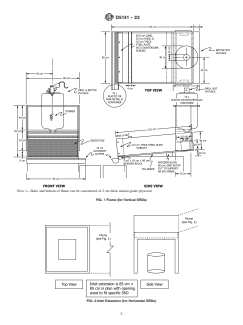
6.1 Flume, constructed from marine-grade plywood,
cent of sediment removed from sediment-laden water by the
plexiglas, aluminum, or other material. The flume shall be
filtration component of a sediment retention device over a
watertight and constructed as shown in Fig. 1.
specified period of time.
3 −2 −1
NOTE 1—Metal flumes shall be mounted on a wood frame. The flume
3.2.2 flow rate, FR [L L T ], n—in geosynthetics, the
opening is the standard length of a straw bale. With a standard length
volume of fluid per unit time, expressed as an average, which
flume of 122 cm (48 in.), the height of the back of the flume would be
passes through a cross-sectional plane perpendicular to the
elevated 10 cm (3 ⁄8 in.).
fluid flow.
6.2 Inlet Extension, constructed from marine-grade
3.2.3 flume, n—an apparatus that carries a liquid to an outlet.
plywood, plexiglass, aluminum, or other material. The inlet
3.2.4 sediment retention device (SRD), n—in geosynthetics, extension shall be watertight and constructed as shown in Fig.
2.
a temporary composite structure used to induce the removal of
suspended sediments from sediment-laden flowing water.
NOTE 2—Metal inlet extensions shall be mounted on a wood frame. The
3.2.5 silt fence, n—in geosynthetics, a type of sediment
inlet extension opening shall be appropriate for the type of SRD being
tested.
retention device.
6.3 Sample Cutter, appropriate to prepare test specimens.
4. Summary of Test Method
6.4 Two Containers, 75 L (20 gal), plastic or nonmetallic.
4.1 A filtration component of a sediment retention device
6.5 Stopwatch.
specimen is placed vertically across a flume or over a horizon-
tal opening at the end of a flume while sediment-laden water is
6.6 Stirrer, such as a stirring rod on a portable electric drill.
passed through the specimen.
6.7 Sediment-Free Water, containing no flocculent agents.
4.1.1 The time that water flows through the filtration com-
ponent of a sediment retention device and the amount of soil
NOTE 3—Flocculent agents used in water treatment may cause errone-
passed by the filtration component of a sediment retention ous results by affecting the settling rate of soil particles in the water.
device are measured. The amount of soil retained, filtering
6.8 Soil, either site-specific or representative of a target
efficiency, and flow rate are calculated from these measured
default gradation.
values.
6.9 Gooch Crucible.
4.2 Either a site-specific soil or a soil representative of a
6.10 Membrane Filter Apparatus.
target default gradation, at the client’s discretion, shall be used
in this test method.
6.11 Vacuum Pump.
6.12 Planchet, aluminum or stainless steel.
5. Significance and Use
5.1 This test method is used to determine the filtering 6.13 Desiccator.
efficiency and flow rate of the filtration component of a
6.14 Analytical Balance, sensitivity of 0.01 g.
sediment retention device, such as a silt fence, a silt barrier, or
a silt curtain, for specific soil tested.
7. Sampling
5.2 This test method may be used for the design of the
7.1 SRD Filtration Component:
filtration component of a sediment retention device to meet
7.1.1 Lot Sample—Divide the product into lots and take the
requirements of regulatory agencies in filtering efficiency or
lot sample as directed in Practice D4354.
flow rate for the specific soil tested.
7.1.2 Laboratory Sample—Cut off sufficient length of the
5.2.1 The designer can use this test method to determine the
filtration component of the sediment retention device to get the
spacing between sediment retention devices.
appropriate number of test specimens. If holes or damaged
5.3 This test method is intended for performance evaluation,
areas are evident, then damaged material shall be discarded and
as the results will depend on the specific soil evaluated. Unless
additional material sampled.
testing with the default soil is desired, it is recommended that
7.1.3 Test Specimens—Cut the appropriate number of speci-
the user or representative perform the test to pre-approve
mens to be tested from the machine direction of the laboratory
products, as sediment retention device manufacturers are not
sample by a random method. Each test specimen shall be cut
typically equipped to handle or test soil requirements.
(1 m long
...
This document is not an ASTM standard and is intended only to provide the user of an ASTM standard an indication of what changes have been made to the previous version. Because
it may not be technically possible to adequately depict all changes accurately, ASTM recommends that users consult prior editions as appropriate. In all cases only the current version
of the standard as published by ASTM is to be considered the official document.
Designation: D5141 − 11 (Reapproved 2018) D5141 − 23
Standard Test Method for
Determining Filtering Efficiency and Flow Rate of the
Filtration Component of a Sediment Retention Device
This standard is issued under the fixed designation D5141; the number immediately following the designation indicates the year of
original adoption or, in the case of revision, the year of last revision. A number in parentheses indicates the year of last reapproval. A
superscript epsilon (´) indicates an editorial change since the last revision or reapproval.
1. Scope
1.1 This test method is used to determine the filtering efficiency and the flow rate of the filtration component of a sediment
retention device, such as a silt fence, silt barrier, or inlet protector.
3 2
1.1.1 The results are shown as a percentage for filtering efficiency and cubic metres per square metre per minute (m /m /min) or
gallons per square foot per minute (gal/ft /min) for flow rate.
1.1.2 The filtering efficiency indicates the percent of sediment removed from sediment-laden water.
1.1.3 The flow rate is the average rate of passage of the sediment-laden water through the filtration component of a sediment
retention device.
1.2 This test method requires several specialized pieces of equipment, such as an integrated water sampler and an analytical
balance, or a vacuum filtration system. At the client’s discretion, the test soil is either a site-specific soil or a soil that is
representative of a target default gradation.
1.3 The values stated in SI units are the standard, while the inch-pound units are provided for information. The values expressed
in each system may not be exact equivalents; therefore, each system must be used independently of the other, without combining
values in any way.
1.4 This standard does not purport to address all of the safety concerns, if any, associated with its use. It is the responsibility
of the user of this standard to establish appropriate safety, health, and environmental practices and determine the applicability of
regulatory limitations prior to use.
1.5 This international standard was developed in accordance with internationally recognized principles on standardization
established in the Decision on Principles for the Development of International Standards, Guides and Recommendations issued
by the World Trade Organization Technical Barriers to Trade (TBT) Committee.
2. Referenced Documents
2.1 ASTM Standards:
D123 Terminology Relating to Textiles
This test method is under the jurisdiction of ASTM Committee D35 on Geosynthetics and is the direct responsibility of Subcommittee D35.03 on Permeability and
Filtration.
Current edition approved Feb. 1, 2018Sept. 1, 2023. Published February 2018September 2023. Originally approved in 1991. Last previous edition approved in 20112018
as D5141 – 11.D5141 – 11 (2018). DOI: 10.1520/D5141-11R18.10.1520/D5141-23.
For referenced ASTM standards, visit the ASTM website, www.astm.org, or contact ASTM Customer Service at service@astm.org. For Annual Book of ASTM Standards
volume information, refer to the standard’s Document Summary page on the ASTM website.
Copyright © ASTM International, 100 Barr Harbor Drive, PO Box C700, West Conshohocken, PA 19428-2959. United States
D5141 − 23
D653 Terminology Relating to Soil, Rock, and Contained Fluids
D4354 Practice for Sampling of Geosynthetics and Rolled Erosion Control Products (RECPs) for Testing
D4439 Terminology for Geosynthetics
D4759 Practice for Determining the Specification Conformance of Geosynthetics
2.2 American Public Health Association (APHA) Standard:
208D Total Nonfiltrable Residue Dried at 103–105°C (Total Suspended Matter)
3. Terminology
3.1 Definitions:
3.1.1 filter—See Terminology D653.
3.1.2 filtration component—a geotextile or other material designed to act as a filter.
3.1.3 geosynthetic, n—a planar product manufactured from polymeric material used with foundation soil, rock, earth, or any other
geotechnical engineering related material as an integral part of a man-made project, structure, or system. (See Practice D4759.)
3.1.4 performance property, n—a result obtained by conducting a performance test.
3.1.5 performance test, n—in geosynthetics, a laboratory procedure that simulates selected field conditions which can be used in
design.
3.1.6 For definitions of other terms relating to geosynthetics, refer to Terminology D4439. For definitions of textile terms, refer
to Terminology D123. For definitions of soil terms, refer to Terminology D653.
3.2 Definitions of Terms Specific to This Standard:
3.2.1 filtering effıciency, FE, n—in geosynthetics, the percent of sediment removed from sediment-laden water by the filtration
component of a sediment retention device over a specified period of time.
3 −2 −1
3.2.2 flow rate, FR [L L T ], n—in geosynthetics, the volume of fluid per unit time, expressed as an average, which passes
through a cross-sectional plane perpendicular to the fluid flow.
3.2.3 flume, n—an apparatus that carries a liquid to an outlet.
3.2.4 sediment retention device (SRD), n—in geosynthetics, a temporary composite structure used to induce the removal of
suspended sediments from sediment-laden flowing water.
3.2.5 silt fence, n—in geosynthetics, a type of sediment retention device.
4. Summary of Test Method
4.1 A filtration component of a sediment retention device specimen is placed vertically across a flume or over a horizontal opening
at the end of a flume while sediment-laden water is passed through the specimen.
4.1.1 The time that water flows through the filtration component of a sediment retention device and the amount of soil passed by
the filtration component of a sediment retention device are measured. The amount of soil retained, filtering efficiency, and flow rate
are calculated from these measured values.
4.2 Either a site-specific soil or a soil representative of a target default gradation, at the client’s discretion, shouldshall be used
in this test method.
Available from American Public Health Association (APHA), 1015 Eighteenth St. NW, Washington, DC 20036.
D5141 − 23
5. Significance and Use
5.1 This test method is used to determine the filtering efficiency and flow rate of the filtration component of a sediment retention
device, such as a silt fence, a silt barrier, or a silt curtain, for specific soil tested.
5.2 This test method may be used for the design of the filtration component of a sediment retention device to meet requirements
of regulatory agencies in filtering efficiency or flow rate for the specific soil tested.
5.2.1 The designer can use this test method to determine the spacing between sediment retention devices.
5.3 This test method is intended for performance evaluation, as the results will depend on the specific soil evaluated. Unless testing
with the default soil is desired, it is recommended that the user or representative perform the test to pre-approve products, as
sediment retention device manufacturers are not typically equipped to handle or test soil requirements.
5.4 This test method provides a means of evaluating the filtration component of sediment retention devices with different soils
under various conditions that simulate the conditions that exist in a sediment retention device installation. This test method may
be used to simulate several storm events on the same sediment retention device specimen. Therefore, the number of times this test
is repeated per specimen is dependent upon the user and the site conditions.
6. Apparatus
6.1 Flume, constructed from marine-grade plywood, plexiglas, aluminum, or other material. The flume shouldshall be watertight
and constructed as shown in Fig. 1.
NOTE 1—Metal flumes shouldshall be mounted on a wood frame. The flume opening is the standard length of a straw bale. With a standard length flume
of 122 cm (48 in.), the height of the back of the flume would be elevated 10 cm (3 ⁄8 in.).
6.2 Inlet Extension, constructed from marine-grade plywood, plexiglass, aluminum, or other material. The inlet extension
shouldshall be watertight and constructed as shown in Fig. 2.
NOTE 2—Metal inlet extensions shouldshall be mounted on a wood frame. The inlet extension opening shouldshall be appropriate for the type of SRD
being tested.
6.3 Sample Cutter, appropriate to prepare test specimens.
6.4 Integrated Water Sampler, a 500-mL (0.13-gal) device used to collect integrated samples of water.
6.4 Two Containers, 75-L (20-gal),75 L (20 gal), plastic or nonmetallic.
6.5 Stopwatch.
6.6 Stirrer, such as a stirring rod on a portable electric drill.
6.7 Sediment-Free Water, containing no flocculent agents.
NOTE 3—Flocculent agents used in water treatment may cause erroneous results by affecting the settling rate of soil particles in the water.
6.8 Soil, either site-specific or representative of a target default gradation.
6.9 Gooch Crucible.
6.10 Membrane Filter Apparatus.
D5141 − 23
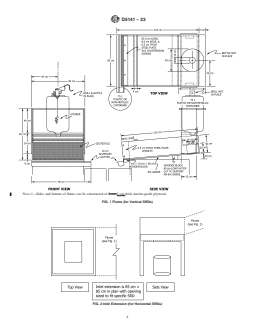
NOTE 1—Sides and bottom of flume can be constructed of 2-cm 2 cm thick marine-grade plywood.
FIG. 1 Flume (for Vertical SRDs)
FIG. 2 Inlet Extension (for Horizontal SRDs)
D5141 − 23
6.11 Vacuum Pump.
6.12 Planchet, aluminum or stainless steel.
6.13 Desiccator.
6.14 Analytical Balance, sensitivity of 0.01 g.
7. Sampling
7.1 SRD Filtration Component:
7.1.1 Lot Sample—Divide the product into lots and take the lot sample as directed in Practice D4354.
7.1.2 Laboratory Sample—Cut off sufficient length of the filtration component of the sediment retention device to get the
appropriate number of test specimens. If holes or damaged areas are evident, then damaged material shouldshall be discarded and
additional material sampled.
7.1.3 Test Specimens—Cut the appropriate number of specimens to be tested from the machine direction of the laboratory sample
by a random method. Each test specimen shouldshall be cut (1 m (1 m long by 0.3 m wide (3.3 ft long by 12 in. wide)) to fit the
flume or as necessary to fit the inlet opening.
NOTE 4—No speci
...