

ASTM B751-21
(Specification)Standard Specification for General Requirements for Nickel and Nickel Alloy Welded Tube
General Information
- Abstract
ABSTRACT
This general specification contains the mandatory requirements to the ASTM standards listed herein for longitudinally welded tubular products made from nickel and nickel alloys. In case of conflict, the requirements listed in the particular product specification takes precedence over those listed here.
SCOPE
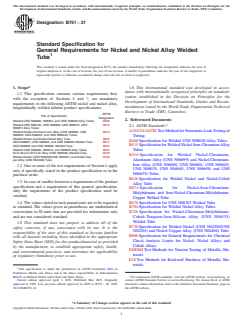
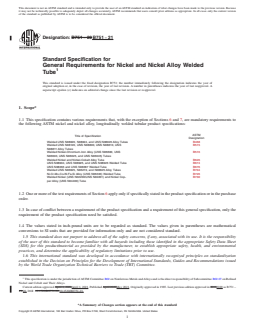
1.1 This specification contains various requirements that, with the exception of Sections 6 and 7, are mandatory requirements to the following ASTM nickel and nickel alloy, longitudinally welded tubular product specifications:
Title of Specification
ASTM
Designation
Welded UNS N08020, N08024, and UNS N08026 Alloy Tubes
B468
Welded UNS N08120, UNS N08800, UNS N08810, UNS N08811 Alloy Tubes
B515
Welded Nickel-Chromium-Iron Alloy (UNS N06600, UNS N06603, UNS N06025, and UNS N06045) Tubes
B516
Welded Nickel and Nickel-Cobalt Alloy Tube
B626
UNS N08904, UNS N08925, and UNS N08926 Welded Tube
B674
UNS N08366 and UNS N08367 Welded Tube
B676
Welded UNS N06625, N06219, and N08825 Alloy Tubes
B704
Ni-Cr-Mo-Co-W-Fe-Si Alloy (UNS N06333) Welded Tube
B726
Welded Nickel (UNS N02200/UNS N02201) and Nickel Copper Alloy (UNS N04400) Tube
B730
1.2 One or more of the test requirements of Section 6 apply only if specifically stated in the product specification or in the purchase order.
1.3 In case of conflict between a requirement of the product specification and a requirement of this general specification, only the requirement of the product specification need be satisfied.
1.4 The values stated in inch-pound units are to be regarded as standard. The values given in parentheses are mathematical conversions to SI units that are provided for information only and are not considered standard.
1.5 This standard does not purport to address all of the safety concerns, if any, associated with its use. It is the responsibility of the user of this standard to become familiar with all hazards including those identified in the appropriate Safety Data Sheet (SDS) for this product/material as provided by the manufacturer, to establish appropriate safety, health, and environmental practices, and determine the applicability of regulatory limitations prior to use.
1.6 This international standard was developed in accordance with internationally recognized principles on standardization established in the Decision on Principles for the Development of International Standards, Guides and Recommendations issued by the World Trade Organization Technical Barriers to Trade (TBT) Committee.
- Status
- Published
- Publication Date
- 31-Mar-2021
- Technical Committee
- B02 - Nonferrous Metals and Alloys
- Drafting Committee
- B02.07 - Refined Nickel and Cobalt and Their Alloys
Buy Documents
ASTM B751-21 - Standard Specification for General Requirements for Nickel and Nickel Alloy Welded Tube
REDLINE ASTM B751-21 - Standard Specification for General Requirements for Nickel and Nickel Alloy Welded Tube
Overview
ASTM B751-21 is the standard specification developed by ASTM International that outlines general requirements for welded tubes made of nickel and nickel alloys. This specification serves as a unified reference for the manufacture, testing, inspection, and certification of longitudinally welded nickel and nickel alloy tubular products across multiple product-specific ASTM standards. ASTM B751-21 provides essential criteria related to dimensions, mechanical properties, testing methods, and marking guidelines, promoting consistency and reliability in industrial applications where nickel alloy tubes are used.
Key Topics
- Scope and Applicability: The specification applies to welded tubular products manufactured from a variety of nickel and nickel alloys, covering UNS N08020, N08024, N08026, N08120, N08800, N08810, N08811, and more.
- Mandatory Requirements: With the exception of Sections 6 and 7, most requirements in B751-21 are mandatory when referenced by the applicable product standards.
- Dimensions and Tolerances: Specifies permissible variations in outside diameter, wall thickness, length, and straightness to ensure precise tolerances for all product sizes.
- Testing Protocols: Outlines necessary mechanical tests and nondestructive examinations, including:
- Flange, flattening, and flare tests
- Hydrostatic and pneumatic (air underwater) pressure tests
- Eddy current and ultrasonic nondestructive examinations
- Material Quality: Establishes criteria for material uniformity, absence of defects, chemical composition verification, and grain size requirements.
- Certification and Marking: Specifies how products should be marked and documentation provided for traceability and end-user assurance.
- Safety and Compliance: Advises adherence to safety, health, and environmental practices, ensuring proper hazard awareness and regulatory compliance.
Applications
ASTM B751-21 is critical within industries utilizing nickel and nickel alloy welded tubes in demanding environments. Typical applications include:
- Chemical Processing: Piping and heat exchangers require corrosion-resistant tubes that meet strict mechanical and chemical standards.
- Oil & Gas: Used in offshore and onshore equipment due to the need for resistance to harsh and corrosive environments.
- Power Generation: Boiler and condenser tubes where high temperature and corrosion resistance are necessary.
- Aerospace and Defense: Components with stringent quality and reliability requirements.
- Pharmaceutical and Food Processing: Environments with rigorous demands for cleanliness and corrosion resistance.
Manufacturers and purchasers refer to ASTM B751-21 to ensure welded tubes meet quality and performance expectations for critical operations.
Related Standards
ASTM B751-21 is a general requirement standard and must be used alongside relevant product-specific ASTM specifications. Common referenced standards include:
- ASTM B468: Welded UNS N08020, N08024, N08026 Alloy Tubes
- ASTM B515: Welded Nickel-Iron-Chromium Alloy Tubes
- ASTM B516: Welded Nickel-Chromium-Iron Alloy Tubes
- ASTM B626: Welded Nickel and Nickel-Cobalt Alloy Tubes
- ASTM B674, B676, B704, B726, B730: Other specific alloy welded tubes
- ASTM B880: Requirements for chemical check analysis limits for nickel, nickel alloys, and cobalt alloys
- ASTM E8/E8M, E18, E112, E213, E426, E571: Testing and analysis methodology
- ASTM A1047/A1047M: Pneumatic leak testing of tubing
The ongoing relevance and accuracy of ASTM B751-21 are maintained through regular committee review and updates, ensuring alignment with international best practices and evolving industry needs.
SEO Keywords: ASTM B751-21, nickel alloy welded tube, ASTM nickel tube standard, welded nickel tube, quality requirements, nondestructive examination, pressure testing, chemical analysis, tube marking, industrial applications.
Relations
- Effective Date
- 01-Apr-2024
- Effective Date
- 01-Jan-2024
- Effective Date
- 01-Nov-2023
- Effective Date
- 01-Nov-2019
- Effective Date
- 01-Nov-2019
- Effective Date
- 01-Jul-2019
- Effective Date
- 01-Nov-2018
- Effective Date
- 01-Nov-2018
- Effective Date
- 01-Jul-2018
- Effective Date
- 01-Jul-2017
- Effective Date
- 01-Jul-2017
- Effective Date
- 01-Jun-2017
- Effective Date
- 15-Jul-2016
- Effective Date
- 01-Oct-2015
- Effective Date
- 01-May-2015
Buy Documents
ASTM B751-21 - Standard Specification for General Requirements for Nickel and Nickel Alloy Welded Tube
REDLINE ASTM B751-21 - Standard Specification for General Requirements for Nickel and Nickel Alloy Welded Tube
Get Certified
Connect with accredited certification bodies for this standard

Element Materials Technology
Materials testing and product certification.

Inštitut za kovinske materiale in tehnologije
Institute of Metals and Technology. Materials testing, metallurgical analysis, NDT.
Sponsored listings
Frequently Asked Questions
ASTM B751-21 is a technical specification published by ASTM International. Its full title is "Standard Specification for General Requirements for Nickel and Nickel Alloy Welded Tube". This standard covers: ABSTRACT This general specification contains the mandatory requirements to the ASTM standards listed herein for longitudinally welded tubular products made from nickel and nickel alloys. In case of conflict, the requirements listed in the particular product specification takes precedence over those listed here. SCOPE 1.1 This specification contains various requirements that, with the exception of Sections 6 and 7, are mandatory requirements to the following ASTM nickel and nickel alloy, longitudinally welded tubular product specifications: Title of Specification ASTM Designation Welded UNS N08020, N08024, and UNS N08026 Alloy Tubes B468 Welded UNS N08120, UNS N08800, UNS N08810, UNS N08811 Alloy Tubes B515 Welded Nickel-Chromium-Iron Alloy (UNS N06600, UNS N06603, UNS N06025, and UNS N06045) Tubes B516 Welded Nickel and Nickel-Cobalt Alloy Tube B626 UNS N08904, UNS N08925, and UNS N08926 Welded Tube B674 UNS N08366 and UNS N08367 Welded Tube B676 Welded UNS N06625, N06219, and N08825 Alloy Tubes B704 Ni-Cr-Mo-Co-W-Fe-Si Alloy (UNS N06333) Welded Tube B726 Welded Nickel (UNS N02200/UNS N02201) and Nickel Copper Alloy (UNS N04400) Tube B730 1.2 One or more of the test requirements of Section 6 apply only if specifically stated in the product specification or in the purchase order. 1.3 In case of conflict between a requirement of the product specification and a requirement of this general specification, only the requirement of the product specification need be satisfied. 1.4 The values stated in inch-pound units are to be regarded as standard. The values given in parentheses are mathematical conversions to SI units that are provided for information only and are not considered standard. 1.5 This standard does not purport to address all of the safety concerns, if any, associated with its use. It is the responsibility of the user of this standard to become familiar with all hazards including those identified in the appropriate Safety Data Sheet (SDS) for this product/material as provided by the manufacturer, to establish appropriate safety, health, and environmental practices, and determine the applicability of regulatory limitations prior to use. 1.6 This international standard was developed in accordance with internationally recognized principles on standardization established in the Decision on Principles for the Development of International Standards, Guides and Recommendations issued by the World Trade Organization Technical Barriers to Trade (TBT) Committee.
ABSTRACT This general specification contains the mandatory requirements to the ASTM standards listed herein for longitudinally welded tubular products made from nickel and nickel alloys. In case of conflict, the requirements listed in the particular product specification takes precedence over those listed here. SCOPE 1.1 This specification contains various requirements that, with the exception of Sections 6 and 7, are mandatory requirements to the following ASTM nickel and nickel alloy, longitudinally welded tubular product specifications: Title of Specification ASTM Designation Welded UNS N08020, N08024, and UNS N08026 Alloy Tubes B468 Welded UNS N08120, UNS N08800, UNS N08810, UNS N08811 Alloy Tubes B515 Welded Nickel-Chromium-Iron Alloy (UNS N06600, UNS N06603, UNS N06025, and UNS N06045) Tubes B516 Welded Nickel and Nickel-Cobalt Alloy Tube B626 UNS N08904, UNS N08925, and UNS N08926 Welded Tube B674 UNS N08366 and UNS N08367 Welded Tube B676 Welded UNS N06625, N06219, and N08825 Alloy Tubes B704 Ni-Cr-Mo-Co-W-Fe-Si Alloy (UNS N06333) Welded Tube B726 Welded Nickel (UNS N02200/UNS N02201) and Nickel Copper Alloy (UNS N04400) Tube B730 1.2 One or more of the test requirements of Section 6 apply only if specifically stated in the product specification or in the purchase order. 1.3 In case of conflict between a requirement of the product specification and a requirement of this general specification, only the requirement of the product specification need be satisfied. 1.4 The values stated in inch-pound units are to be regarded as standard. The values given in parentheses are mathematical conversions to SI units that are provided for information only and are not considered standard. 1.5 This standard does not purport to address all of the safety concerns, if any, associated with its use. It is the responsibility of the user of this standard to become familiar with all hazards including those identified in the appropriate Safety Data Sheet (SDS) for this product/material as provided by the manufacturer, to establish appropriate safety, health, and environmental practices, and determine the applicability of regulatory limitations prior to use. 1.6 This international standard was developed in accordance with internationally recognized principles on standardization established in the Decision on Principles for the Development of International Standards, Guides and Recommendations issued by the World Trade Organization Technical Barriers to Trade (TBT) Committee.
ASTM B751-21 is classified under the following ICS (International Classification for Standards) categories: 77.150.40 - Nickel and chromium products. The ICS classification helps identify the subject area and facilitates finding related standards.
ASTM B751-21 has the following relationships with other standards: It is inter standard links to ASTM B516-24, ASTM E8/E8M-24, ASTM B704-23, ASTM B626-19, ASTM B676-19, ASTM E571-19, ASTM B730-08(2018), ASTM B516-18, ASTM E18-18, ASTM B626-17a, ASTM E18-17, ASTM B626-17, ASTM E8/E8M-16, ASTM B626-15, ASTM B516-15. Understanding these relationships helps ensure you are using the most current and applicable version of the standard.
ASTM B751-21 is available in PDF format for immediate download after purchase. The document can be added to your cart and obtained through the secure checkout process. Digital delivery ensures instant access to the complete standard document.
Standards Content (Sample)
This international standard was developed in accordance with internationally recognized principles on standardization established in the Decision on Principles for the
Development of International Standards, Guides and Recommendations issued by the World Trade Organization Technical Barriers to Trade (TBT) Committee.
Designation:B751 −21
Standard Specification for
General Requirements for Nickel and Nickel Alloy Welded
Tube
This standard is issued under the fixed designation B751; the number immediately following the designation indicates the year of
original adoption or, in the case of revision, the year of last revision. A number in parentheses indicates the year of last reapproval. A
superscript epsilon (´) indicates an editorial change since the last revision or reapproval.
1. Scope* 1.6 This international standard was developed in accor-
dance with internationally recognized principles on standard-
1.1 This specification contains various requirements that,
ization established in the Decision on Principles for the
with the exception of Sections 6 and 7, are mandatory
Development of International Standards, Guides and Recom-
requirements to the following ASTM nickel and nickel alloy,
mendations issued by the World Trade Organization Technical
longitudinally welded tubular product specifications:
Barriers to Trade (TBT) Committee.
ASTM
Title of Specification
Designation
2. Referenced Documents
Welded UNS N08020, N08024, and UNS N08026 Alloy Tubes B468
Welded UNS N08120, UNS N08800, UNS N08810, UNS B515 2
2.1 ASTM Standards:
N08811 Alloy Tubes
A1047/A1047M Test Method for Pneumatic LeakTesting of
Welded Nickel-Chromium-Iron Alloy (UNS N06600, UNS B516
N06603, UNS N06025, and UNS N06045) Tubes
Tubing
Welded Nickel and Nickel-Cobalt Alloy Tube B626
B468 Specification for Welded UNS N08020 Alloy Tubes
UNS N08904, UNS N08925, and UNS N08926 Welded Tube B674
B515 SpecificationforWeldedNickel-Iron-ChromiumAlloy
UNS N08366 and UNS N08367 Welded Tube B676
Welded UNS N06625, N06219, and N08825 Alloy Tubes B704
Tubes
Ni-Cr-Mo-Co-W-Fe-Si Alloy (UNS N06333) Welded Tube B726
B516 Specification for Welded Nickel-Chromium-
Welded Nickel (UNS N02200/UNS N02201) and Nickel Cop- B730
Aluminum Alloy (UNS N06699) and Nickel-Chromium-
per Alloy (UNS N04400) Tube
Iron Alloy (UNS N06600, UNS N06601, UNS N06603,
1.2 One or more of the test requirements of Section 6 apply
UNS N06025, UNS N06045, UNS N06690, and UNS
only if specifically stated in the product specification or in the
N06693) Tubes
purchase order.
B626 Specification for Welded Nickel and Nickel-Cobalt
1.3 In case of conflict between a requirement of the product
Alloy Tube
specification and a requirement of this general specification,
B674 Specification for Nickel-Iron-Chromium-
only the requirement of the product specification need be
Molybdenum and Iron-Nickel-Chromium-Molybdenum-
satisfied.
Copper Welded Tube
1.4 The values stated in inch-pound units are to be regarded B676 Specification for UNS N08367 Welded Tube
as standard. The values given in parentheses are mathematical B704 Specification for Welded Nickel Alloy Tubes
conversions to SI units that are provided for information only B726 Specification for Nickel-Chromium-Molybdenum-
and are not considered standard. Cobalt-Tungsten-Iron-Silicon Alloy (UNS N06333)
Welded Tube
1.5 This standard does not purport to address all of the
B730 Specification for Welded Nickel (UNS N02200/UNS
safety concerns, if any, associated with its use. It is the
N02201) and Nickel Copper Alloy (UNS N04400) Tube
responsibility of the user of this standard to become familiar
B880 Specification for General Requirements for Chemical
with all hazards including those identified in the appropriate
Check Analysis Limits for Nickel, Nickel Alloys and
Safety Data Sheet (SDS) for this product/material as provided
Cobalt Alloys
by the manufacturer, to establish appropriate safety, health,
E8/E8M Test Methods for Tension Testing of Metallic Ma-
and environmental practices, and determine the applicability
terials
of regulatory limitations prior to use.
E18 Test Methods for Rockwell Hardness of Metallic Ma-
terials
This specification is under the jurisdiction of ASTM Committee B02 on
Nonferrous Metals and Alloys and is the direct responsibility of Subcommittee
B02.07 on Refined Nickel and Cobalt and Their Alloys. For referenced ASTM standards, visit the ASTM website, www.astm.org, or
Current edition approved April 1, 2021. Published May 2021. Originally contact ASTM Customer Service at service@astm.org. For Annual Book of ASTM
approved in 1985. Last previous edition approved in 2020 as B751 – 20. DOI: Standards volume information, refer to the standard’s Document Summary page on
10.1520/B0751-21. the ASTM website.
*A Summary of Changes section appears at the end of this standard
Copyright © ASTM International, 100 Barr Harbor Drive, PO Box C700, West Conshohocken, PA 19428-2959. United States
B751−21
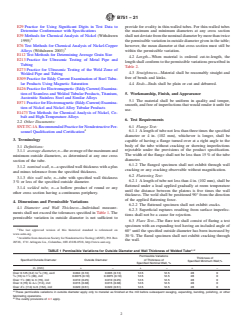
E29 Practice for Using Significant Digits in Test Data to provide for ovality in thin-walled tubes. For thin-walled tubes
Determine Conformance with Specifications the maximum and minimum diameters at any cross section
E39 Methods for Chemical Analysis of Nickel (Withdrawn shallnotdeviatefromthenominaldiameterbymorethantwice
1995) the permissible variation in outside diameter given in the table;
E76 Test Methods for Chemical Analysis of Nickel-Copper however, the mean diameter at that cross section must still be
Alloys (Withdrawn 2003) within the permissible variation.
E112 Test Methods for Determining Average Grain Size
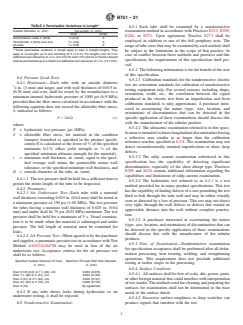
4.2 Length—When material is ordered cut-to-length, the
E213 Practice for Ultrasonic Testing of Metal Pipe and
length shall conform to the permissible variations prescribed in
Tubing
Table 2.
E273 Practice for Ultrasonic Testing of the Weld Zone of
4.3 Straightness—Material shall be reasonably straight and
Welded Pipe and Tubing
free of bends and kinks.
E309 Practice for Eddy Current Examination of Steel Tubu-
lar Products Using Magnetic Saturation
4.4 Ends—Ends shall be plain or cut and deburred.
E426 Practice for Electromagnetic (Eddy Current) Examina-
tion of Seamless and Welded Tubular Products, Titanium,
5. Workmanship, Finish, and Appearance
Austenitic Stainless Steel and Similar Alloys
5.1 The material shall be uniform in quality and temper,
E571 PracticeforElectromagnetic(Eddy-Current)Examina-
smooth, and free of imperfections that would render it unfit for
tion of Nickel and Nickel Alloy Tubular Products
use.
E1473 Test Methods for Chemical Analysis of Nickel, Co-
balt and High-Temperature Alloys
6. Test Requirements
2.2 Other Documents:
6.1 Flange Test:
SNT-TC-1A RecommendedPracticeforNondestructivePer-
6.1.1 Alength of tube not less than three times the specified
sonnel Qualification and Certification
diameter or 4 in. (102 mm), whichever is longer, shall be
3. Terminology
capable of having a flange turned over at a right angle to the
body of the tube without cracking or showing imperfections
3.1 Definitions:
rejectable under the provisions of the product specification.
3.1.1 averagediameter,n—theaverageofthemaximumand
The width of the flange shall not be less than 15 % of the tube
minimum outside diameters, as determined at any one cross
diameter.
section of the tube.
6.1.2 The flanged specimen shall not exhibit through wall
3.1.2 nominalwall,n—aspecifiedwallthicknesswithaplus
cracking or any cracking observable without magnification.
and minus tolerance from the specified thickness.
6.2 Flattening Test:
3.1.3 thin wall tube, n—tube with specified wall thickness
6.2.1 Alength of tube not less than 4 in. (102 mm), shall be
3 % or less of the specified outside diameter.
flattened under a load applied gradually at room temperature
3.1.4 welded tube, n—a hollow product of round or any
until the distance between the platens is five times the wall
other cross section having a continuous periphery.
thickness. The weld shall be positioned 90° from the direction
of the applied flattening force.
4. Dimensions and Permissible Variations
6.2.2 The flattened specimen shall not exhibit cracks.
4.1 Diameter and Wall Thickness—Individual measure-
6.2.3 Superficial ruptures resulting from surface imperfec-
ments shall not exceed the tolerances specified in Table 1. The
tions shall not be a cause for rejection.
permissible variation in outside diameter is not sufficient to
6.3 Flare Test—The flare test shall consist of flaring a test
specimen with an expanding tool having an included angle of
The last approved version of this historical standard is referenced on
60° until the specified outside diameter has been increased by
www.astm.org.
30 %. The flared specimen shall not exhibit cracking through
AvailablefromAmericanSocietyforNondestructiveTesting(ASNT),P.O.Box
the wall.
28518, 1711 Arlingate Ln., Columbus, OH 43228-0518, http://www.asnt.org.
A,B
TABLE 1 Permissible Variations for Outside Diameter and Wall Thickness of Welded Tube
Permissible Variations
Thickness of
Specified Outside Diameter Outside Diameter of Thickness of
Specified Minimum Wall,%
Specified Nominal Wall, %
in. (mm) + − + − + −
Over 0.125 (3.2) to ⁄8 (16), excl 0.004 (0.10) 0.005 (0.13) 12.5 12.5 28 0
5 1
⁄8 (16) to 1 ⁄2 (38), incl 0.0075 (0.19) 0.0075 (0.19) 12.5 12.5 28 0
Over 1 ⁄2 (38) to 3 (76), incl 0.010 (0.25) 0.010 (0.25) 12.5 12.5 28 0
Over 3 (76) to 4 ⁄2 (114), incl 0.015 (0.38) 0.015 (0.38) 12.5 12.5 28 0
Over 4 ⁄2 (114) to 6 (152), incl 0.020 (0.51) 0.020 (0.51) 12.5 12.5 28 0
A
These permissible variations in outside diameter apply only to material as finished at the mill before subsequent swaging, expanding, bending, polishing, or other
fabricating operations.
B
The ovality provisions of 4.1 apply.
B751−21
A
TABLE 2 Permissible Variations in Length
6.5.1 Each tube shall be examined by a nondestructive
Outside Diameter, in. (mm) Cut Length, in. (mm)
examination method in accordance with Practices E213, E309,
Over Under
E426,or E571. Upon agreement, Practice E273 shall be
Cold-finished: under 2 (50.8) ⁄8 (3.2) 0
employed in addition to one of the full periphery tests. The
Hot-finished: 2 (50.8) and over ⁄16 (4.8) 0
all sizes ⁄16 (4.8) 0
range of tube sizes that may be examined by each method shall
A
These permissible variations in length apply to tube in straight lengths. They
be subject to the limitations in the scope of that practice. In
apply to cut lengths up to and including 24 ft (7.3 m). For lengths over 24 ft an
case of conflict between these methods and practices and this
additionalover-toleranceof ⁄8in.(3.2mm)foreach10ft(3.0m)orfractionthereof
1 specification, the requirements of this specification shall pre-
shallbepermissibleuptoamaximumadditionalover-toleranceof ⁄2in.(12.7mm).
vail.
6.5.2 Thefollowinginformationisforthebenefitoftheuser
of this specification.
6.4 Pressure (Leak Test):
6.5.2.1 Calibration standards for the nondestructive electric
6.4.1 Hydrostatic—Each tube with an outside diameter
test are convenient standards for calibration of nondestructive
⁄8 in. (3 mm) and larger, and with wall thickness of 0.015 in.
testing equipment only. For several reasons, including shape,
(0.38 mm) and over, shall be tested by the manufacturer to a
orientation, width, etc., the correlation between the signal
minimum internal hydrostatic pressure of 1000 psi (6.9 MPa)
produced in the electric test from an imperfection and from
provided that the fiber stress calculated in accordance with the
calibration standards is only approximate. A purchaser inter-
following equation does not exceed the allowable fiber stress,
ested in ascertaining the nature (type, size, location, and
S, indicated as follows:
orientation) of discontinuities that can be detected in the
P 5 2St/D (1)
specific application of these examinations should discuss this
with the manufacturer of the tubular product.
where:
6.5.2.2 The ultrasonic examination referred to in this speci-
P = hydrostatic test pressure, psi (MPa),
ficationisintendedtodetectlongitudinaldiscontinuitieshaving
S = allowable fiber stress, for material in the condition
a reflective area similar to or larger than the calibration
(temper) furnished as specified in the product specifi-
reference notches specified in 6.5.8. The examination may not
cation (S is calculated as the lower of ⁄3 of the specified
detect circumferentially oriented imperfections or short, deep
minimum 0.2 % offset yield strength or ⁄4 of the
defects.
specified minimum ultimate strength for the material),
6.5.2.3 The eddy current examination referenced in this
t = minimum wall thickness, in. (mm), equal to the speci-
specification has the capability of detecting significant
fied average wall minus the permissible minus wall
discontinuities, especially of the short abrupt type. Practices
tolerance, or the specified minimum wall thickness, and
E309 and E426 contain additional information regarding the
D = outside diameter of the tube, in. (mm).
capabilities and limitations of eddy-current examination.
6.4.1.1 Thetestpressureshallbeheldforasufficienttimeto
6.5.2.4 The hydrostatic test referred to in 6.4.1 is a test
permit the entire length of the tube to be inspected.
method provided for in many product specifications. This test
6.4.2 Pneumatic:
hasthecapabilityoffindingdefectsofasizepermittingthetest
6.4.2.1 Air Underwater Test—Each tube with a nominal
fluid to leak through the tube wall and may be either visually
wall thickness exceeding 0.025 in. (0.64 mm) shall be tested at
seen or detected by a loss of pressure. This test may not detect
a minimum pressure of 150 psi (1.05 MPa). The test pressure
very tight, through-the-wall defects or defects that extend an
for tubes having a nominal wall thickness of 0.025 in. (0.64
appreciable distance into the wall without complete penetra-
mm) and under shall be 75 psi (0.52 MPa) minimum. The test
tion.
pressure shall be held for a minimum of 5 s. Visual examina-
6.5.2.5 A purchaser interested in ascertaining the nature
tion is to be made when the material is submerged and under
(type, size, location, and orientation) of discontinuities that can
pressure. The full length of material must be examined for
be detected in the specific application of these examinations
leaks.
should discuss this with the manufacturer of the tubular
6.4.2.2 Air Pressure Test—When agreed to by the purchaser
products.
and supplier, a pneumatic pressure test in accordance with Test
6.5.3 Time of Examination—Nondestructive examination
Method A1047/A1047M may be used in lieu of the air
for specification acceptance shall be performed after all defor-
underwater test. Acceptance criteria for the air pressure test
mation processing, heat treating, welding, and straightening
shall be as follows:
operations. This requirement does not preclude additional
Specified Outside Diameter of Tube, Maximum Through Wall Hole Diameter,
testing at earlier stages in the processing.
in. (mm) in. (mm)
6.5.4 Surface Condition:
Over 0.125 (3.2) to 1 ⁄2 (38), incl 0.003 (0.076)
6.5.4.1 All surfaces shall be free of scale, dirt, grease, paint,
Over 1 ⁄2 (38) to 2 (51), incl 0.004 (0.102)
Over 2 (51) to 2 ⁄2 (64), incl 0.005 (0.127) orotherforeignmaterialthatcouldinterferewithinterpretation
Over 2 ⁄2 (64) to 3 (76), incl 0.006 (0.152)
oftestresults.Themethodsusedforcleaningandpreparingthe
Over 3 (76) By agreement
surfaces for examination shall not be detrimental to the base
6.4.3 If any tube shows leaks during hydrostatic or air
metal or the surface finish.
underwater testing, it shall be rejected.
6.5.4.2 Excessive surface roughness or deep scratches can
6.5 Nondestructive Examination: produce signals that interfere with the test.
B751−21
6.5.5 Extent of Examination: 0.004 in. (0.1 mm), whichever is greater. The length of the
6.5.5.1 The relative motion of the tube and the notch shall be compatible with the testing method.
transducer(s), coil(s), or sensor(s) shall be such that the entire
6.5.8.3 For ultrasonic testing, the reference ID and OD
tube surface is scanned, except for end effects as noted in
notches shall be any one of the three common notch shapes
6.5.5.2.
shown in Practice E213, at the option of the manufacturer. The
6.5.5.2 The existence of end effects is recognized, and the
depth of the notches shall not exceed 12 ⁄2 % of the specified
extent of such effects shall be determined by the manufacturer,
wall thickness of the tube or 0.004 in. (0.1 mm), whichever is
and, if requested, shall be reported to the purchaser. Other
greater. The width of the notch shall not exceed two times the
nondestructive tests may be applied to the end areas, subject to
depth. For welded tubing, the notches shall be placed in the
agreement between the purchaser and the manufacturer. weld, if the weld is visible.
6.5.6 Operator Qualifications:
6.5.8.4 More or smaller reference discontinuities, or both,
6.5.6.1 Thetestunitoperatorshallbecertifiedinaccordance
may be used by agreement between the pur
...
This document is not an ASTM standard and is intended only to provide the user of an ASTM standard an indication of what changes have been made to the previous version. Because
it may not be technically possible to adequately depict all changes accurately, ASTM recommends that users consult prior editions as appropriate. In all cases only the current version
of the standard as published by ASTM is to be considered the official document.
Designation: B751 − 20 B751 − 21
Standard Specification for
General Requirements for Nickel and Nickel Alloy Welded
Tube
This standard is issued under the fixed designation B751; the number immediately following the designation indicates the year of
original adoption or, in the case of revision, the year of last revision. A number in parentheses indicates the year of last reapproval. A
superscript epsilon (´) indicates an editorial change since the last revision or reapproval.
1. Scope*
1.1 This specification contains various requirements that, with the exception of Sections 6 and 7, are mandatory requirements to
the following ASTM nickel and nickel alloy, longitudinally welded tubular product specifications:
ASTM
Title of Specification
Designation
Welded UNS N08020, N08024, and UNS N08026 Alloy Tubes B468
Welded UNS N08120, UNS N08800, UNS N08810, UNS B515
N08811 Alloy Tubes
Welded Nickel-Chromium-Iron Alloy (UNS N06600, UNS B516
N06603, UNS N06025, and UNS N06045) Tubes
Welded Nickel and Nickel-Cobalt Alloy Tube B626
UNS N08904, UNS N08925, and UNS N08926 Welded Tube B674
UNS N08366 and UNS N08367 Welded Tube B676
Welded UNS N06625, N06219, and N08825 Alloy Tubes B704
Ni-Cr-Mo-Co-W-Fe-Si Alloy (UNS N06333) Welded Tube B726
Welded Nickel (UNS N02200/UNS N02201) and Nickel Cop- B730
per Alloy (UNS N04400) Tube
1.2 One or more of the test requirements of Section 6 apply only if specifically stated in the product specification or in the purchase
order.
1.3 In case of conflict between a requirement of the product specification and a requirement of this general specification, only the
requirement of the product specification need be satisfied.
1.4 The values stated in inch-pound units are to be regarded as standard. The values given in parentheses are mathematical
conversions to SI units that are provided for information only and are not considered standard.
1.5 This standard does not purport to address all of the safety concerns, if any, associated with its use. It is the responsibility
of the user of this standard to become familiar with all hazards including those identified in the appropriate Safety Data Sheet
(SDS) for this product/material as provided by the manufacturer, to establish appropriate safety, health, and environmental
practices, and determine the applicability of regulatory limitations prior to use.
1.6 This international standard was developed in accordance with internationally recognized principles on standardization
established in the Decision on Principles for the Development of International Standards, Guides and Recommendations issued
by the World Trade Organization Technical Barriers to Trade (TBT) Committee.
This specification is under the jurisdiction of ASTM Committee B02 on Nonferrous Metals and Alloys and is the direct responsibility of Subcommittee B02.07 on Refined
Nickel and Cobalt and Their Alloys.
Current edition approved April 1, 2020April 1, 2021. Published April 2020May 2021. Originally approved in 1985. Last previous edition approved in 20192020 as B751 –
19.20. DOI: 10.1520/B0751-20.10.1520/B0751-21.
*A Summary of Changes section appears at the end of this standard
Copyright © ASTM International, 100 Barr Harbor Drive, PO Box C700, West Conshohocken, PA 19428-2959. United States
B751 − 21
2. Referenced Documents
2.1 ASTM Standards:
A1047/A1047M Test Method for Pneumatic Leak Testing of Tubing
B468 Specification for Welded UNS N08020 Alloy Tubes
B515 Specification for Welded Nickel-Iron-Chromium Alloy Tubes
B516 Specification for Welded Nickel-Chromium-Aluminum Alloy (UNS N06699) and Nickel-Chromium-Iron Alloy (UNS
N06600, UNS N06601, UNS N06603, UNS N06025, UNS N06045, UNS N06690, and UNS N06693) Tubes
B626 Specification for Welded Nickel and Nickel-Cobalt Alloy Tube
B674 Specification for Nickel-Iron-Chromium-Molybdenum and Iron-Nickel-Chromium-Molybdenum-Copper Welded Tube
B676 Specification for UNS N08367 Welded Tube
B704 Specification for Welded Nickel Alloy Tubes
B726 Specification for Nickel-Chromium-Molybdenum-Cobalt-Tungsten-Iron-Silicon Alloy (UNS N06333) Welded Tube
B730 Specification for Welded Nickel (UNS N02200/UNS N02201) and Nickel Copper Alloy (UNS N04400) Tube
B880 Specification for General Requirements for Chemical Check Analysis Limits for Nickel, Nickel Alloys and Cobalt Alloys
E8/E8M Test Methods for Tension Testing of Metallic Materials
E18 Test Methods for Rockwell Hardness of Metallic Materials
E29 Practice for Using Significant Digits in Test Data to Determine Conformance with Specifications
E39 Methods for Chemical Analysis of Nickel (Withdrawn 1995)
E76 Test Methods for Chemical Analysis of Nickel-Copper Alloys (Withdrawn 2003)
E112 Test Methods for Determining Average Grain Size
E213 Practice for Ultrasonic Testing of Metal Pipe and Tubing
E273 Practice for Ultrasonic Testing of the Weld Zone of Welded Pipe and Tubing
E309 Practice for Eddy Current Examination of Steel Tubular Products Using Magnetic Saturation
E426 Practice for Electromagnetic (Eddy Current) Examination of Seamless and Welded Tubular Products, Titanium, Austenitic
Stainless Steel and Similar Alloys
E571 Practice for Electromagnetic (Eddy-Current) Examination of Nickel and Nickel Alloy Tubular Products
E1473 Test Methods for Chemical Analysis of Nickel, Cobalt and High-Temperature Alloys
2.2 Other Documents:
SNT-TC-1A Recommended Practice for Nondestructive Personnel Qualification and Certification
3. Terminology
3.1 Definitions:
3.1.1 average diameter, n—the average of the maximum and minimum outside diameters, as determined at any one cross section
of the tube.
3.1.2 nominal wall, n—a specified wall thickness with a plus and minus tolerance from the specified thickness.
3.1.3 thin wall tube, n—tube with specified wall thickness 3 % or less of the specified outside diameter.
3.1.4 welded tube, n—a hollow product of round or any other cross section having a continuous periphery.
4. Dimensions and Permissible Variations
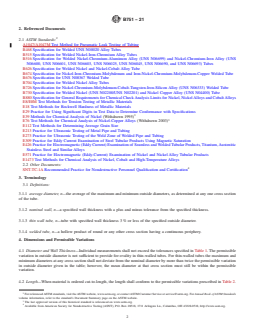
4.1 Diameter and Wall Thickness—Individual measurements shall not exceed the tolerances specified in Table 1. The permissible
variation in outside diameter is not sufficient to provide for ovality in thin-walled tubes. For thin-walled tubes the maximum and
minimum diameters at any cross section shall not deviate from the nominal diameter by more than twice the permissible variation
in outside diameter given in the table; however, the mean diameter at that cross section must still be within the permissible
variation.
4.2 Length—When material is ordered cut-to-length, the length shall conform to the permissible variations prescribed in Table 2.
For referenced ASTM standards, visit the ASTM website, www.astm.org, or contact ASTM Customer Service at service@astm.org. For Annual Book of ASTM Standards
volume information, refer to the standard’s Document Summary page on the ASTM website.
The last approved version of this historical standard is referenced on www.astm.org.
Available from American Society for Nondestructive Testing (ASNT), P.O. Box 28518, 1711 Arlingate Ln., Columbus, OH 43228-0518, http://www.asnt.org.
B751 − 21
A,B
TABLE 1 Permissible Variations for Outside Diameter and Wall Thickness of Welded Tube
Permissible Variations
Thickness of
Specified Outside Diameter Outside Diameter of Thickness of
Specified Minimum Wall,%
Specified Nominal Wall, %
in. (mm) + − + − + −
Over 0.125 (3.2) to ⁄8 (16), excl 0.004 (0.10) 0.005 (0.13) 12.5 12.5 28 0
5 1
⁄8 (16) to 1 ⁄2 (38), incl 0.0075 (0.19) 0.0075 (0.19) 12.5 12.5 28 0
Over 1 ⁄2 (38) to 3 (76), incl 0.010 (0.25) 0.010 (0.25) 12.5 12.5 28 0
Over 3 (76) to 4 ⁄2 (114), incl 0.015 (0.38) 0.015 (0.38) 12.5 12.5 28 0
Over 4 ⁄2 (114) to 6 (152), incl 0.020 (0.51) 0.020 (0.51) 12.5 12.5 28 0
A
These permissible variations in outside diameter apply only to material as finished at the mill before subsequent swaging, expanding, bending, polishing, or other
fabricating operations.
B
The ovality provisions of 4.1 apply.
A
TABLE 2 Permissible Variations in Length
Outside Diameter, in. (mm) Cut Length, in. (mm)
Over Under
Cold-finished: under 2 (50.8) ⁄8 (3.2) 0
Hot-finished: 2 (50.8) and over ⁄16 (4.8) 0
all sizes ⁄16 (4.8) 0
A
These permissible variations in length apply to tube in straight lengths. They
apply to cut lengths up to and including 24 ft (7.3 m). For lengths over 24 ft an
additional over-tolerance of ⁄8 in. (3.2 mm) for each 10 ft (3.0 m) or fraction thereof
shall be permissible up to a maximum additional over-tolerance of ⁄2 in. (12.7 mm).
4.3 Straightness—Material shall be reasonably straight and free of bends and kinks.
4.4 Ends—Ends shall be plain or cut and deburred.
5. Workmanship, Finish, and Appearance
5.1 The material shall be uniform in quality and temper, smooth, and free of imperfections that would render it unfit for use.
6. Test Requirements
6.1 Flange Test:
6.1.1 A length of tube not less than three times the specified diameter or 4 in. (102 mm), whichever is longer, shall be capable
of having a flange turned over at a right angle to the body of the tube without cracking or showing imperfections rejectable under
the provisions of the product specification. The width of the flange shall not be less than 15 % of the tube diameter.
6.1.2 The flanged specimen shall not exhibit through wall cracking or any cracking observable without magnification.
6.2 Flattening Test:
6.2.1 A length of tube not less than 4 in. (102 mm), shall be flattened under a load applied gradually at room temperature until
the distance between the platens is five times the wall thickness. The weld shall be positioned 90° from the direction of the applied
flattening force.
6.2.2 The flattened specimen shall not exhibit cracks.
6.2.3 Superficial ruptures resulting from surface imperfections shall not be a cause for rejection.
6.3 Flare Test—The flare test shall consist of flaring a test specimen with an expanding tool having an included angle of 60° until
the specified outside diameter has been increased by 30 %. The flared specimen shall not exhibit cracking through the wall.
6.4 Pressure (Leak Test):
B751 − 21
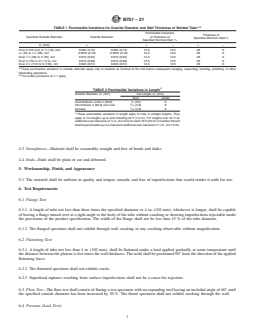
6.4.1 Hydrostatic—Each tube with an outside diameter ⁄8 in. in. (3 mm) and larger, and with wall thickness of 0.015 in. (0.38
mm) and over, shall be tested by the manufacturer to a minimum internal hydrostatic pressure of 1000 psi (6.9 MPa) provided that
the fiber stress calculated in accordance with the following equation does not exceed the allowable fiber stress, S, indicated as
follows:
P 5 2St/D (1)
where:
P = hydrostatic test pressure, psi (MPa),
S = allowable fiber stress, for material in the condition (temper) furnished as specified in the product specification (S is
2 1
calculated as the lower of ⁄3 of the specified minimum 0.2 % offset yield strength or ⁄4 of the specified minimum ultimate
strength for the material),
t = minimum wall thickness, in. (mm), equal to the specified average wall minus the permissible minus wall tolerance, or the
specified minimum wall thickness, and
D = outside diameter of the tube, in. (mm).
6.4.1.1 The test pressure shall be held for a sufficient time to permit the entire length of the tube to be inspected.
6.4.2 Pneumatic (Air Underwater) Test—Pneumatic: Each tube with a nominal wall thickness exceeding 0.025 in. (0.64 mm) shall
be tested at a minimum pressure of 150 psi (1.05 MPa). The test pressure for tubes having a nominal wall thickness of 0.025 in.
(0.64 mm) and under shall be 75 psi (0.52 MPa) minimum. The test pressure shall be held for a minimum of 5 s. Visual examination
is to be made when the material is submerged and under pressure. The full length of material must be examined for leaks.
6.4.2.1 Air Underwater Test—Each tube with a nominal wall thickness exceeding 0.025 in. (0.64 mm) shall be tested at a minimum
pressure of 150 psi (1.05 MPa). The test pressure for tubes having a nominal wall thickness of 0.025 in. (0.64 mm) and under shall
be 75 psi (0.52 MPa) minimum. The test pressure shall be held for a minimum of 5 s. Visual examination is to be made when the
material is submerged and under pressure. The full length of material must be examined for leaks.
6.4.2.2 Air Pressure Test—When agreed to by the purchaser and supplier, a pneumatic pressure test in accordance with Test
Method A1047/A1047M may be used in lieu of the air underwater test. Acceptance criteria for the air pressure test shall be as
follows:
Specified Outside Diameter of Tube, Maximum Through Wall Hole Diameter,
in. (mm) in. (mm)
Over 0.125 (3.2) to 1 ⁄2 (38), incl 0.003 (0.076)
Over 1 ⁄2 (38) to 2 (51), incl 0.004 (0.102)
Over 2 (51) to 2 ⁄2 (64), incl 0.005 (0.127)
Over 2 ⁄2 (64) to 3 (76), incl 0.006 (0.152)
Over 3 (76) By agreement
6.4.3 If any tube shows leaks during hydrostatic or pneumatic air underwater testing, it shall be rejected.
6.5 Nondestructive Examination:
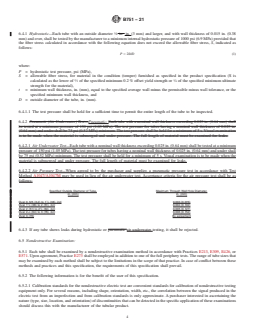
6.5.1 Each tube shall be examined by a nondestructive examination method in accordance with Practices E213, E309, E426, or
E571. Upon agreement, Practice E273 shall be employed in addition to one of the full periphery tests. The range of tube sizes that
may be examined by each method shall be subject to the limitations in the scope of that practice. In case of conflict between these
methods and practices and this specification, the requirements of this specification shall prevail.
6.5.2 The following information is for the benefit of the user of this specification.
6.5.2.1 Calibration standards for the nondestructive electric test are convenient standards for calibration of nondestructive testing
equipment only. For several reasons, including shape, orientation, width, etc., the correlation between the signal produced in the
electric test from an imperfection and from calibration standards is only approximate. A purchaser interested in ascertaining the
nature (type, size, location, and orientation) of discontinuities that can be detected in the specific application of these examinations
should discuss this with the manufacturer of the tubular product.
B751 − 21
6.5.2.2 The ultrasonic examination referred to in this specification is intended to detect longitudinal discontinuities having a
reflective area similar to or larger than the calibration reference notches specified in 6.5.8. The examination may not detect
circumferentially oriented imperfections or short, deep defects.
6.5.2.3 The eddy current examination referenced in this specification has the capability of detecting significant discontinuities,
especially of the short abrupt type. Practices E309 and E426 contain additional information regarding the capabilities and
limitations of eddy-current examination.
6.5.2.4 The hydrostatic test referred to in 6.4.1 is a test method provided for in many product specifications. This test has the
capability of finding defects of a size permitting the test fluid to leak through the tube wall and may be either visually seen or
detected by a loss of pressure. This test may not detect very tight, through-the-wall defects or defects that extend an appreciable
distance into the wall without complete penetration.
6.5.2.5 A purchaser interested in ascertaining the nature (type, size, location, and orientation) of discontinuities that can be
detected in the specific application of these examinations should discuss this with the manufacturer of the tubular products.
6.5.3 Time of Examination: Examination—Nondestructive examination for specification acceptance shall be performed after all
deformation processing, heat treating, welding, and straightening operations. This requirement does not preclude additional testing
at earlier stages in the processing.
6.5.4 Surface Condition:
6.5.4.1 All surfaces shall be free of scale, dirt, grease, paint, or other foreign material that could interfere with interpretation of
test results. The methods used for cleaning and preparing the surfaces for examination shall not be detrimental to the base metal
or the surface finish.
6.5.4.2 Excessive surface roughness or deep scratches can produce signals that interfere with the test.
6.5.5 Extent of Examination:
6.5.5.1 The relative motion of the tube and the transducer(s), coil(s), or sensor(s) shall be such that the entire tube surface is
scanned, except for end effects as noted in 6.5.5.2.
6.5.5.2 The existence of end effects is recognized, and the extent of such effects shall be determined by the manufacturer, and, if
requested, shall be reported to the purchaser. Other nondestructive tests may be applied to the end areas, subject to agreement
between the purchaser and the manufacturer.
6.5.6 Operator Qualifications:
6.5.6.1 The test unit operator shall be certified in accordance with SNT-TC-1A, or an equivalent documented standard agreeable
to both purchaser and manufacturer.
6.5.7 Test Conditions:
6.5.7.1 For examination by the ultrasonic method, the minimum nominal transducer frequency shall be 2.0 MHz, and the
maximum transducer size shall be 1.5 in. (38 mm).
6.5.7.2 For eddy current testing, the excitation coil frequency shall be chosen to ensure adequate penetration, yet provide good
signal-to-noise ratio. The maximum coil frequency shall be:
Specified Wall Thickness, in. (mm) Maximum Frequency, kHz
<0.050 in. (1.25 mm) 100
0.050 to 0.150
...