

ASTM A618/A618M-21
(Specification)Standard Specification for Hot-Formed Welded and Seamless High-Strength Low-Alloy Structural Tubing
General Information
- Abstract
ABSTRACT
This specification covers grades of hot-formed welded and seamless high-strength low-alloy square, rectangular, round, or special shape structural tubing for welded, riveted, or bolted construction of bridges and buildings and for general structural purposes. These grades are: Grade Ia and Ib; Grade II; and Grade III. When the steel is used in welded construction, the welding procedure shall be suitable for the steel and the intended service. The tubing shall be made by the seamless, furnace-buttwelded (continuous-welded), or hot-stretch-reduced electric-resistance-welded process. Tensile test and bend test shall be performed for the material to conform to the requirements specified. If the results of the mechanical tests representing any heat do not conform to a requirement, retests shall be made.
SCOPE
1.1 This specification covers grades of hot-formed welded and seamless high-strength low-alloy square, rectangular, round, or special shape structural tubing for welded, riveted, or bolted construction of bridges and buildings and for general structural purposes. When the steel is used in welded construction, the welding procedure shall be suitable for the steel and the intended service.
1.2 Square and rectangular tubing is produced with flats of 1 in. to 16 in. [25 mm to 405 mm] and a specified wall thickness of 0.095 in. to 1.0 in. [2.5 mm to 25 mm]. Round tubing is produced with diameters of 1 in. to 48 in. [25 mm to 1220 mm] and a specified wall thickness of 0.095 in. to 2.50 in. [2.5 mm to 65 mm].
1.3 This specification covers the following grades: Ia, Ib, II, III, IV, V, VI and VII.
1.4 The text of this specification contains notes and footnotes that provide explanatory material. Such notes and footnotes, excluding those in tables and figures, do not contain any mandatory requirements.
1.5 This specification is expressed in both inch-pound units and in SI units; however, unless the purchase order specifies the applicable M specification designation (SI units), the inch-pound units shall apply. The values stated in either SI units or inch-pound units are to be regarded separately as standard. Within the text, the SI units are shown in brackets. The values stated in each system may not be exact equivalents; therefore, each system shall be used independently of the other. Combining values from the two systems may result in nonconformance with the standard.
1.6 This international standard was developed in accordance with internationally recognized principles on standardization established in the Decision on Principles for the Development of International Standards, Guides and Recommendations issued by the World Trade Organization Technical Barriers to Trade (TBT) Committee.
- Status
- Published
- Publication Date
- 31-Jul-2021
- Technical Committee
- A01 - Steel, Stainless Steel and Related Alloys
- Drafting Committee
- A01.09 - Carbon Steel Tubular Products
Buy Documents
ASTM A618/A618M-21 - Standard Specification for Hot-Formed Welded and Seamless High-Strength Low-Alloy Structural Tubing
REDLINE ASTM A618/A618M-21 - Standard Specification for Hot-Formed Welded and Seamless High-Strength Low-Alloy Structural Tubing
Overview
ASTM A618/A618M-21 is the standard specification for hot-formed welded and seamless high-strength low-alloy (HSLA) structural tubing. Developed by ASTM International, this standard governs the manufacture, mechanical properties, and tolerances of square, rectangular, round, and special shape steel structural tubes. These products are primarily used in welded, riveted, or bolted construction for bridges, buildings, and general structural applications where high strength and durability are critical.
Hot-formed HSLA tubing specified under ASTM A618/A618M-21 offers improved strength, toughness, and atmospheric corrosion resistance, making it a preferred choice in demanding structural environments. The standard covers multiple steel grades (Ia, Ib, II, III, IV, V, VI, VII) to meet a range of design requirements and environmental exposures.
Key Topics
Product Scope and Grades
- Covers hot-formed welded and seamless structural tubing in various shapes: square, rectangular, round, and custom.
- Includes tubing with outside dimensions and wall thicknesses suited to broad construction needs.
- Addresses several grades, each providing different balance of mechanical and corrosion-resistant properties.
Manufacturing and Tolerances
- Allows production by seamless, furnace-butt welded, or electric-resistance-welded processes.
- Specifies permissible variations in outside dimensions, wall thickness, straightness, squareness, twist, and corner radii.
- Sets requirements for weight tolerances and surface quality.
Mechanical Properties and Testing
- Mandates minimum levels of tensile strength, yield strength, and elongation based on grade and wall thickness.
- Requires impact testing (Charpy V-notch) for certain grades and applications.
- Sets procedures for sample selection, mechanical test methods, and retesting protocols.
Corrosion Resistance
- Grades Ia and Ib offer superior atmospheric corrosion resistance, suitable for bare, uncoated applications.
- Grade III and others may be specified when enhanced corrosion resistance (such as higher copper content) is desired.
Certification and Marking
- Stipulates manufacturer certification, including compliance with chemical and mechanical properties.
- Details product marking for traceability, including bar coding options.
- Covers packaging and shipping requirements following ASTM and government standards.
Applications
ASTM A618/A618M-21 structural tubing is widely used in applications where high strength-to-weight ratio and corrosion resistance are essential, including:
- Bridge Construction: Utilized for structural members subjected to high stress and exposure to the elements.
- Building Structures: Favored in frameworks for commercial, industrial, and residential buildings due to its robust structural performance.
- General Structural Uses: Employed in cranes, towers, sign supports, and other infrastructure demanding reliability and durability.
- Architectural Features: Chosen for exposed structures and architectural elements where surface finish and weathering are considerations.
Use of this standard ensures structural integrity, regulatory compliance, and optimal performance in both new construction and retrofitting projects.
Related Standards
For comprehensive design and integration, users of ASTM A618/A618M-21 should consider the following related standards:
- ASTM A500: Specification for cold-formed welded and seamless carbon steel structural tubing.
- ASTM A370: Test Methods and Definitions for Mechanical Testing of Steel Products.
- ASTM A700: Guide for Packaging, Marking, and Loading Methods for Steel Products.
- ASTM A751: Test Methods and Practices for Chemical Analysis of Steel Products.
- ASTM G101: Guide for Estimating the Atmospheric Corrosion Resistance of Low-Alloy Steels.
- ASTM A941: Terminology Relating to Steel, Stainless Steel, Related Alloys, and Ferroalloys.
By adhering to ASTM A618/A618M-21 and its companion standards, engineers, fabricators, and specifiers can ensure quality, safety, and longevity in their structural steel projects.
Keywords: hot-formed structural tubing, high-strength low-alloy steel, welded tubing, seamless tubing, ASTM A618, bridge construction, building frameworks, corrosion-resistant steel tube, structural steel standards.
Relations
- Effective Date
- 01-Mar-2024
- Effective Date
- 01-Mar-2024
- Effective Date
- 01-Nov-2019
- Effective Date
- 01-Jul-2019
- Refers
ASTM A370-17a - Standard Test Methods and Definitions for Mechanical Testing of Steel Products - Effective Date
- 15-Nov-2017
- Effective Date
- 01-Sep-2017
- Effective Date
- 01-Jan-2017
- Effective Date
- 01-Nov-2015
- Effective Date
- 01-Nov-2015
- Effective Date
- 01-Nov-2014
- Effective Date
- 15-May-2014
- Effective Date
- 01-Mar-2014
- Effective Date
- 15-Nov-2013
- Effective Date
- 01-Jun-2013
- Effective Date
- 01-May-2013
Buy Documents
ASTM A618/A618M-21 - Standard Specification for Hot-Formed Welded and Seamless High-Strength Low-Alloy Structural Tubing
REDLINE ASTM A618/A618M-21 - Standard Specification for Hot-Formed Welded and Seamless High-Strength Low-Alloy Structural Tubing
Get Certified
Connect with accredited certification bodies for this standard

Institut za varilstvo d.o.o. (Welding Institute)
Slovenia's leading welding institute since 1952. ISO 3834, EN 1090, pressure equipment certification, NDT personnel, welder qualification. Only IIW Au
Sponsored listings
Frequently Asked Questions
ASTM A618/A618M-21 is a technical specification published by ASTM International. Its full title is "Standard Specification for Hot-Formed Welded and Seamless High-Strength Low-Alloy Structural Tubing". This standard covers: ABSTRACT This specification covers grades of hot-formed welded and seamless high-strength low-alloy square, rectangular, round, or special shape structural tubing for welded, riveted, or bolted construction of bridges and buildings and for general structural purposes. These grades are: Grade Ia and Ib; Grade II; and Grade III. When the steel is used in welded construction, the welding procedure shall be suitable for the steel and the intended service. The tubing shall be made by the seamless, furnace-buttwelded (continuous-welded), or hot-stretch-reduced electric-resistance-welded process. Tensile test and bend test shall be performed for the material to conform to the requirements specified. If the results of the mechanical tests representing any heat do not conform to a requirement, retests shall be made. SCOPE 1.1 This specification covers grades of hot-formed welded and seamless high-strength low-alloy square, rectangular, round, or special shape structural tubing for welded, riveted, or bolted construction of bridges and buildings and for general structural purposes. When the steel is used in welded construction, the welding procedure shall be suitable for the steel and the intended service. 1.2 Square and rectangular tubing is produced with flats of 1 in. to 16 in. [25 mm to 405 mm] and a specified wall thickness of 0.095 in. to 1.0 in. [2.5 mm to 25 mm]. Round tubing is produced with diameters of 1 in. to 48 in. [25 mm to 1220 mm] and a specified wall thickness of 0.095 in. to 2.50 in. [2.5 mm to 65 mm]. 1.3 This specification covers the following grades: Ia, Ib, II, III, IV, V, VI and VII. 1.4 The text of this specification contains notes and footnotes that provide explanatory material. Such notes and footnotes, excluding those in tables and figures, do not contain any mandatory requirements. 1.5 This specification is expressed in both inch-pound units and in SI units; however, unless the purchase order specifies the applicable M specification designation (SI units), the inch-pound units shall apply. The values stated in either SI units or inch-pound units are to be regarded separately as standard. Within the text, the SI units are shown in brackets. The values stated in each system may not be exact equivalents; therefore, each system shall be used independently of the other. Combining values from the two systems may result in nonconformance with the standard. 1.6 This international standard was developed in accordance with internationally recognized principles on standardization established in the Decision on Principles for the Development of International Standards, Guides and Recommendations issued by the World Trade Organization Technical Barriers to Trade (TBT) Committee.
ABSTRACT This specification covers grades of hot-formed welded and seamless high-strength low-alloy square, rectangular, round, or special shape structural tubing for welded, riveted, or bolted construction of bridges and buildings and for general structural purposes. These grades are: Grade Ia and Ib; Grade II; and Grade III. When the steel is used in welded construction, the welding procedure shall be suitable for the steel and the intended service. The tubing shall be made by the seamless, furnace-buttwelded (continuous-welded), or hot-stretch-reduced electric-resistance-welded process. Tensile test and bend test shall be performed for the material to conform to the requirements specified. If the results of the mechanical tests representing any heat do not conform to a requirement, retests shall be made. SCOPE 1.1 This specification covers grades of hot-formed welded and seamless high-strength low-alloy square, rectangular, round, or special shape structural tubing for welded, riveted, or bolted construction of bridges and buildings and for general structural purposes. When the steel is used in welded construction, the welding procedure shall be suitable for the steel and the intended service. 1.2 Square and rectangular tubing is produced with flats of 1 in. to 16 in. [25 mm to 405 mm] and a specified wall thickness of 0.095 in. to 1.0 in. [2.5 mm to 25 mm]. Round tubing is produced with diameters of 1 in. to 48 in. [25 mm to 1220 mm] and a specified wall thickness of 0.095 in. to 2.50 in. [2.5 mm to 65 mm]. 1.3 This specification covers the following grades: Ia, Ib, II, III, IV, V, VI and VII. 1.4 The text of this specification contains notes and footnotes that provide explanatory material. Such notes and footnotes, excluding those in tables and figures, do not contain any mandatory requirements. 1.5 This specification is expressed in both inch-pound units and in SI units; however, unless the purchase order specifies the applicable M specification designation (SI units), the inch-pound units shall apply. The values stated in either SI units or inch-pound units are to be regarded separately as standard. Within the text, the SI units are shown in brackets. The values stated in each system may not be exact equivalents; therefore, each system shall be used independently of the other. Combining values from the two systems may result in nonconformance with the standard. 1.6 This international standard was developed in accordance with internationally recognized principles on standardization established in the Decision on Principles for the Development of International Standards, Guides and Recommendations issued by the World Trade Organization Technical Barriers to Trade (TBT) Committee.
ASTM A618/A618M-21 is classified under the following ICS (International Classification for Standards) categories: 23.040.10 - Iron and steel pipes; 23.040.40 - Metal fittings. The ICS classification helps identify the subject area and facilitates finding related standards.
ASTM A618/A618M-21 has the following relationships with other standards: It is inter standard links to ASTM A370-24, ASTM A941-24, ASTM A700-14(2019), ASTM A370-19, ASTM A370-17a, ASTM A941-17, ASTM A370-17, ASTM A370-15, ASTM A941-15, ASTM A700-14, ASTM A370-14, ASTM A751-14, ASTM A370-13, ASTM A941-13b, ASTM A941-13a. Understanding these relationships helps ensure you are using the most current and applicable version of the standard.
ASTM A618/A618M-21 is available in PDF format for immediate download after purchase. The document can be added to your cart and obtained through the secure checkout process. Digital delivery ensures instant access to the complete standard document.
Standards Content (Sample)
This international standard was developed in accordance with internationally recognized principles on standardization established in the Decision on Principles for the
Development of International Standards, Guides and Recommendations issued by the World Trade Organization Technical Barriers to Trade (TBT) Committee.
Designation:A618/A618M −21
Standard Specification for
Hot-Formed Welded and Seamless High-Strength Low-Alloy
Structural Tubing
This standard is issued under the fixed designationA618/A618M; the number immediately following the designation indicates the year
of original adoption or, in the case of revision, the year of last revision. A number in parentheses indicates the year of last reapproval.
A superscript epsilon (´) indicates an editorial change since the last revision or reapproval.
This standard has been approved for use by agencies of the U.S. Department of Defense.
1. Scope* Development of International Standards, Guides and Recom-
mendations issued by the World Trade Organization Technical
1.1 This specification covers grades of hot-formed welded
Barriers to Trade (TBT) Committee.
and seamless high-strength low-alloy square, rectangular,
round, or special shape structural tubing for welded, riveted, or
2. Referenced Documents
bolted construction of bridges and buildings and for general
2.1 ASTM Standards:
structural purposes. When the steel is used in welded
A370 Test Methods and Definitions for Mechanical Testing
construction, the welding procedure shall be suitable for the
of Steel Products
steel and the intended service.
A700 Guide for Packaging, Marking, and Loading Methods
1.2 Square and rectangular tubing is produced with flats of
for Steel Products for Shipment
1 in. to 16 in. [25 mm to 405 mm] and a specified wall
A751 Test Methods and Practices for Chemical Analysis of
thickness of 0.095 in. to 1.0 in. [2.5 mm to 25 mm]. Round
Steel Products
tubing is produced with diameters of 1 in. to 48 in. [25 mm to
A941 TerminologyRelatingtoSteel,StainlessSteel,Related
1220mm]andaspecifiedwallthicknessof0.095in.to2.50in.
Alloys, and Ferroalloys
[2.5 mm to 65 mm].
G101 Guide for Estimating the Atmospheric Corrosion Re-
1.3 This specification covers the following grades: Ia, Ib, II, sistance of Low-Alloy Steels
III, IV, V, VI and VII.
2.2 Federal Standard:
Fed. Std. No. 123 Marking for Shipments (Civil Agencies)
1.4 The text of this specification contains notes and foot-
2.3 Military Standard:
notes that provide explanatory material. Such notes and
MIL-STD-129 Marking for Shipment and Storage
footnotes, excluding those in tables and figures, do not contain
any mandatory requirements.
3. Terminology
1.5 This specification is expressed in both inch-pound units
3.1 Definitions—For definitions of terms used in this
and in SI units; however, unless the purchase order specifies
specification, refer to Terminology A941.
the applicable M specification designation (SI units), the
inch-pound units shall apply. The values stated in either SI
4. Ordering Information
units or inch-pound units are to be regarded separately as
4.1 Orders for material under this specification should
standard. Within the text, the SI units are shown in brackets.
include the following as required to describe the material
The values stated in each system may not be exact equivalents;
adequately:
therefore,eachsystemshallbeusedindependentlyoftheother.
4.1.1 Quantity (weight in metric tons, feet [meters], or
Combining values from the two systems may result in noncon-
number of lengths),
formance with the standard.
4.1.2 Name of the material (hot-formed tubing),
1.6 This international standard was developed in accor-
4.1.3 Method of manufacture (seamless or welded),
dance with internationally recognized principles on standard-
4.1.4 Grade (Ia, Ib, II, III, IV, V, VI or VII),
ization established in the Decision on Principles for the
For referenced ASTM standards, visit the ASTM website, www.astm.org, or
This specification is under the jurisdiction of ASTM Committee A01 on Steel, contact ASTM Customer Service at service@astm.org. For Annual Book of ASTM
Stainless Steel and Related Alloys and is the direct responsibility of Subcommittee Standards volume information, refer to the standard’s Document Summary page on
A01.09 on Carbon Steel Tubular Products. the ASTM website.
Current edition approved Aug. 1, 2021. Published September 2021. Originally Available from U.S. Government Printing Office, Superintendent of
approved in 1968. Last previous edition approved in 2015 as A618/A618M – 04 Documents, 732 N. Capitol St., NW, Washington, DC 20401-0001, http://
(2015). DOI: 10.1520/A0618_A0618M-21. www.access.gpo.gov.
*A Summary of Changes section appears at the end of this standard
Copyright © ASTM International, 100 Barr Harbor Drive, PO Box C700, West Conshohocken, PA 19428-2959. United States
A618/A618M−21
4.1.5 Size (outside diameter and nominal wall thickness for 6.3 The weld shall not be located within the radius of the
round tubing and the outside dimensions and nominal wall corners of any tube having one or more flat sides.
thickness for square and rectangular tubing),
6.4 It shall be permissible for tubing with a wall thickness
4.1.6 Length (random, multiple, or specific; see 12.4),
greater than ⁄2 in. [13 mm] to add a normalizing heat
4.1.7 End condition (see 16.5),
treatment.
4.1.8 Burr removal (see 16.5),
4.1.9 Certification (see Section 18),
6.5 A quenching and tempering process shall be used for
4.1.10 Packaging, package marking, and loading for ship-
Grade V, Grade VI and Grade VII and may be used for Grade
ment (see Section 20),
IV.
4.1.11 Product analysis (see Supplementary Requirements
S1),
7. Heat Analysis
4.1.12 Specification designation (A618 or A618M, includ-
ing year date), 7.1 When subjected to heat analysis the steel shall conform
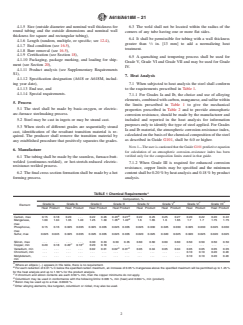
4.1.13 End use, and to the requirements prescribed in Table 1.
4.1.14 Special requirements.
7.1.1 For Grades Ia and Ib, the choice and use of alloying
elements, combined with carbon, manganese, and sulfur within
5. Process
the limits prescribed in Table 1 to give the mechanical
5.1 The steel shall be made by basic-oxygen, or electric-
properties prescribed in Table 2 and to provide atmospheric
arc-furnace steelmaking process.
corrosion resistance, should be made by the manufacturer and
included and reported in the heat analysis for information
5.2 Steel may be cast in ingots or may be strand cast.
purposes only to identify the type of steel applied. For Grades
5.3 When steels of different grades are sequentially strand
Ia and Ib material, the atmospheric corrosion-resistance index,
cast, identification of the resultant transition material is re-
calculated on the basis of the chemical composition of the steel
quired. The producer shall remove the transition material by
as described in Guide G101, shall be 6.0 or higher.
any established procedure that positively separates the grades.
NOTE 1—The user is cautioned that the Guide G101 predictive equation
6. Manufacture
for calculation of an atmospheric corrosion–resistance index has been
verified only for the composition limits stated in that guide.
6.1 The tubing shall be made by the seamless, furnace-butt-
welded (continuous-welded), or hot-stretch-reduced electric-
7.1.2 When Grade III is required for enhanced corrosion
resistance-welded process.
resistance, copper limits may be specified and the minimum
6.2 The final cross section formation shall be made by a hot content shall be 0.20 % by heat analysis and 0.18 % by product
forming process. analysis.
A
TABLE 1 Chemical Requirements
Composition, %
E F F
Grade Ia Grade Ib Grade II Grade III Grade IV Grade V Grade VI Grade VII
Element
Heat Product Heat Product Heat Product Heat Product Heat Product Heat Product Heat Product Heat Product
B B
Carbon, max 0.15 0.18 0.20 . . . 0.22 0.26 0.23 0.27 0.22 0.25 0.25 0.27 0.20 0.22 0.20 0.22
B B
Manganese, 1.00 1.04 1.35 1.40 1.25 1.30 1.35 1.40 1.6 1.65 1.6 1.65 1.7 1.7 1.75 1.75
max
Phosphorus, 0.15 0.16 0.025 0.035 0.025 0.035 0.025 0.035 0.025 0.030 0.025 0.030 0.025 0.030 0.025 0.030
max
Sulfur, max 0.025 0.045 0.025 0.035 0.025 0.035 0.025 0.035 0.020 0.025 0.020 0.025 0.020 0.025 0.020 0.025
Silicon, max . . . . . . . . . . . . 0.30 0.33 0.30 0.35 0.60 0.60 0.60 0.60 0.50 0.50 0.50 0.50
C C
Copper, min 0.20 0.18 0.20 0.18 0.20 0.18 . . . . . . . . . .
D D
Vanadium, min . . . . . . . . . . . . 0.02 0.01 0.02 0.01 0.05 0.04 0.05 0.04 0.05 0.05 0.05 0.05
Chromium,min . . . . . . . . . . . . 0.10 0.10 0.20 0.20
Molybdenum, . . . . . . . . . . . . 0.10 0.10 0.20 0.20
min
A
Where an ellipsis (.) appears in this table, there is no requirement.
B
For each reduction of 0.01 % C below the specified carbon maximum, an increase of 0.05 % manganese above the specified maximum will be permitted up to 1.45 %
for the heat analysis and up to 1.50 % for the product analysis.
C
If chromium and silicon contents are each 0.50 % min, then the copper minimums do not apply.
D
Columbium may be used in conformance with the following limits: 0.005 %, min (heat) and 0.004 %, min (product).
E
Boron may be used up to a max. 0.0040 %.
F
Other alloying elements, like tungsten, columbium or nickel, may also be used.
A618/A618M−21
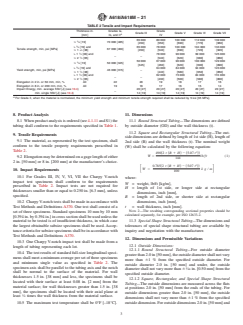
TABLE 2 Tensile and Impact Requirements
Thickness in. Grades Ia, Grade
Grade III Grade V Grade VI Grade VII
A
[mm] Ib, and II IV
65 000 80 000 100 000 112 000 139 000
# ⁄4 [19] 70 000 [485]
[450] [550] [690] [770] [960]
> ⁄4 [19] and 65 000 78 000 100 000 104 000 133 000
Tensile strength, min, psi [MPa] 67 000 [460]
# 1 ⁄2 [38] [450] [540] [690] [720] [920]
>1 ⁄2 [38] and 78 000 90 000 99 000 125 000
––
# 2 ⁄2 [65] [540] [620] [680] [860]
50 000 67 000 90 000 100 000 129 000
# ⁄4 [19] 50 000 [345]
[345] [460] [620] [690] [890]
> ⁄4 [19] and 64 000 84 000 94 000 123 000
Yield strength, min, psi [MPa] 46 000 [315] –
# 1 ⁄2 [38] [440] [580] [650] [850]
>1 ⁄2 [38] and 62 000 73 000 84 000 116 000
––
# 2 ⁄2 [65] [430] [500] [580] [800]
Elongation in 2 in. or 50 mm, min, % All 22 20 19 18 17 16
Elongation in 8 in. or 200 mm, min, % All 19 18 17 16 15 14
Impact Energy, min. average ft/lbf [J] (see 10.4) 20 [27] 20 [27] 20 [27] 20 [27] 20 [27]
–
min. single ft/lbf [J] (see 10.4) 14 [19] 14 [19] 14 [19] 14 [19] 14 [19]
A
For Grade II, when the material is normalized, the minimum yield strength and minimum tensile strength required shall be reduced by 5 ksi [35 MPa].
8. Product Analysis 11. Dimensions
8.1 Whenproductanalysisisordered(see4.1.11andS1)the 11.1 Round Structural Tubing—The dimensions are defined
tubing shall conform to the requirements specified in Table 1. by outside diameter (OD) and the wall thickness (t).
11.2 Square and Rectangular Structural Tubing—The out-
9. Tensile Requirements
side dimensions are defined by length of 1st side (H), length of
9.1 The material, as represented by the test specimen, shall
2nd side (B) and the wall thickness (t). The nominal weight
conform to the tensile property requirements prescribed in
(W) shall be calculated by the following equation:
Table 2.
490 2 t B 1 H 2 5.07 t
~ ~ ! ~ !!
W 5 lb⁄ft (1)
9.2 Elongationmaybedeterminedonagagelengthofeither
2 in. [50 mm] or 8 in. [200 mm] at the manufacturer’s choice.
0.785~2 t ~B 1 H! 2 ~5.07 t !!
W 5 kg ⁄ m
F G
10. Impact Requirements
10.1 For Grades III, IV, V, VI, VII the Charpy V-notch
where:
impact test specimens shall conform to the requirements
W = weight, lb/ft [kg/m],
prescribed in Table 2. Impact tests are not required for
H = length of 1st side, or longer side at rectangular
thicknesses smaller than or equal to 0.250 in. [6.3 mm], unless
dimensions, inch [mm],
specified.
B = length of 2nd side, or shorter side at rectangular
dimensions, inch [mm],
10.2 Charpy V-notch tests shall be made in accordance with
t = wall thickness, inch [mm].
Test Methods and Definitions A370. One test shall consist of a
NOTE 2—The resulting corresponding sectional properties should be
set of three specimens. Standard specimens 10 mm by 10 mm
calculated separately, for example, per ISO 12633-2.
[0.394 in. by 0.394 in.] in cross section shall be used unless the
material to be tested is of insufficient thickness, in which case 11.3 Special Shape Structural Tubing—The dimensions and
tolerances of special shape structural tubing are available by
the largest obtainable subsize specimens shall be used.Accep-
tancecriteriaforsubsizespecimensshallbeinaccordancewith inquiry and negotiation with the manufacturer.
Test Methods and Definitions A370.
12. Dimensions and Permissible Variations
10.3 One Charpy V-notch impact test shall be made from a
12.1 Outside Dimensions:
length of tubing representing each lot.
12.1.1 Round Structural Tubing—For outside diameter
10.4 The test results of standard full-size longitudinal speci-
greater than 2.0 in [50 mm], the outside diameter shall not vary
mens shall meet a minimum average per set of three specimens
more than 61 % from the specified outside diameter. For
and minimum single value as specified in Table 2. The
outside diameter 2.0 in. [50 mm] and under, the outside
specimen axis shall be parallel to the tubing axis and the notch
diameter shall not vary more than 6 ⁄48 in. [0.50 mm] from the
shall be normal to the surface of the material. For wall
specified outside diameter.
thicknesses 1.5 in. [38 mm] and less, the specimens shall be
12.1.2 Square, Rectangular, and Special Shape Structural
located with their surface at least 0.08 in. [2 mm] from the
Tubing—The outside dimensions are measured across the flats
material surface; for wall thicknesses greater than 1.5 in. [38
at positions 2.0 in. [50 mm] from
...
This document is not an ASTM standard and is intended only to provide the user of an ASTM standard an indication of what changes have been made to the previous version. Because
it may not be technically possible to adequately depict all changes accurately, ASTM recommends that users consult prior editions as appropriate. In all cases only the current version
of the standard as published by ASTM is to be considered the official document.
Designation: A618/A618M − 04 (Reapproved 2015) A618/A618M − 21
Standard Specification for
Hot-Formed Welded and Seamless High-Strength Low-Alloy
Structural Tubing
This standard is issued under the fixed designation A618/A618M; the number immediately following the designation indicates the year
of original adoption or, in the case of revision, the year of last revision. A number in parentheses indicates the year of last reapproval.
A superscript epsilon (´) indicates an editorial change since the last revision or reapproval.
This standard has been approved for use by agencies of the U.S. Department of Defense.
1. Scope Scope*
1.1 This specification covers grades of hot-formed welded and seamless high-strength low-alloy square, rectangular, round, or
special shape structural tubing for welded, riveted, or bolted construction of bridges and buildings and for general structural
purposes. When the steel is used in welded construction, the welding procedure shall be suitable for the steel and the intended
service.
1.2 Grade II has atmospheric corrosion resistance equivalent to that of carbon steel with copper (0.20 minimum Cu) Grades Ia and
Ib have atmospheric corrosion resistance substantially better than that of Grade II (Square and rectangular tubing is produced with
flats of 1 in. Note 1). When properly exposed to the atmosphere, Grades Ia and Ib can be used bare (unpainted) for many
applications. When enhanced corrosion resistance is desired, Grade III, copper limits may be specified.to 16 in. [25 mm to 405
mm] and a specified wall thickness of 0.095 in. to 1.0 in. [2.5 mm to 25 mm]. Round tubing is produced with diameters of 1 in.
to 48
NOTE 1—For methods of estimating the atmospheric corrosion resistance of low alloy steels see Guide G101 or actual data.in. [25 mm to 1220 mm]
and a specified wall thickness of 0.095 in. to 2.50 in. [2.5 mm to 65 mm].
1.3 This specification covers the following grades: Ia, Ib, II, III, IV, V, VI and VII.
1.4 The text of this specification contains notes and footnotes that provide explanatory material. Such notes and footnotes,
excluding those in tables and figures, do not contain any mandatory requirements.
1.5 This specification is expressed in both inch-pound units and in SI units; however, unless the purchase order specifies the
applicable M specification designation (SI units), the inch-pound units shall apply. The values stated in either SI units or
inch-pound units are to be regarded separately as standard. Within the text, the SI units are shown in brackets. The values stated
in each system may not be exact equivalents; therefore, each system shall be used independently of the other. Combining values
from the two systems may result in non-conformancenonconformance with the standard.
1.6 This international standard was developed in accordance with internationally recognized principles on standardization
established in the Decision on Principles for the Development of International Standards, Guides and Recommendations issued
by the World Trade Organization Technical Barriers to Trade (TBT) Committee.
This specification is under the jurisdiction of ASTM Committee A01 on Steel, Stainless Steel and Related Alloys and is the direct responsibility of Subcommittee A01.09
on Carbon Steel Tubular Products.
Current edition approved Sept. 1, 2015Aug. 1, 2021. Published September 2015September 2021. Originally approved in 1968. Last previous edition approved in 20102015
as A618/A618MA618/A618M – 04 (2015).–04 (2010). DOI: 10.1520/A0618_A0618M-04R15.10.1520/A0618_A0618M-21.
*A Summary of Changes section appears at the end of this standard
Copyright © ASTM International, 100 Barr Harbor Drive, PO Box C700, West Conshohocken, PA 19428-2959. United States
A618/A618M − 21
2. Referenced Documents
2.1 ASTM Standards:
A370 Test Methods and Definitions for Mechanical Testing of Steel Products
A700 Guide for Packaging, Marking, and Loading Methods for Steel Products for Shipment
A751 Test Methods and Practices for Chemical Analysis of Steel Products
A941 Terminology Relating to Steel, Stainless Steel, Related Alloys, and Ferroalloys
G101 Guide for Estimating the Atmospheric Corrosion Resistance of Low-Alloy Steels
2.2 Federal Standard:
Fed. Std. No. 123 Marking for Shipments (Civil Agencies)
2.3 Military Standard:
MIL-STD-129 Marking for Shipment and Storage
3. Terminology
3.1 Definitions—For definitions of terms used in this specification, refer to Terminology A941.
4. Ordering Information
4.1 Orders for material under this specification should include the following as required to describe the material adequately:
TABLE 1 Chemical Requirements
Composition, %
Grade Ia Grade Ib Grade II Grade III
Element
Heat Product Heat Product Heat Product Heat Product
A A
Carbon, max 0.15 0.18 0.20 . . . 0.22 0.26 0.23 0.27
A
Manganese 1.00 max 1.04 1.35 max 1.40 0.85–1.25 1.30 1.35 max 1.40
A
max max max max
Phosphorus, 0.15 0.16 0.025 0.035 0.025 0.035 0.025 0.035
max
Sulfur, max 0.025 0.045 0.025 0.035 0.025 0.035 0.025 0.035
Silicon, max . . . . . . . . . . . . 0.30 0.33 0.30 0.35
B B
Copper, min 0.20 0.18 0.20 0.18 0.20 0.18 . . . . . .
C
Vanadium, min . . . . . . . . . . . . 0.02 0.01 0.02 0.01
A
TABLE 1 Chemical Requirements
Composition, %
E F F
Grade Ia Grade Ib Grade II Grade III Grade IV Grade V Grade VI Grade VII
Element
Heat Product Heat Product Heat Product Heat Product Heat Product Heat Product Heat Product Heat Product
B B
Carbon, max 0.15 0.18 0.20 . . . 0.22 0.26 0.23 0.27 0.22 0.25 0.25 0.27 0.20 0.22 0.20 0.22
B B
Manganese, 1.00 1.04 1.35 1.40 1.25 1.30 1.35 1.40 1.6 1.65 1.6 1.65 1.7 1.7 1.75 1.75
max
Phosphorus, 0.15 0.16 0.025 0.035 0.025 0.035 0.025 0.035 0.025 0.030 0.025 0.030 0.025 0.030 0.025 0.030
max
Sulfur, max 0.025 0.045 0.025 0.035 0.025 0.035 0.025 0.035 0.020 0.025 0.020 0.025 0.020 0.025 0.020 0.025
Silicon, max . . . . . . . . . . . . 0.30 0.33 0.30 0.35 0.60 0.60 0.60 0.60 0.50 0.50 0.50 0.50
C C
Copper, min 0.20 0.18 0.20 0.18 0.20 0.18 . . . . . . . . . . . . . . . . . . . . . . . . . . . . . .
D D
Vanadium, min . . . . . . . . . . . . 0.02 0.01 0.02 0.01 0.05 0.04 0.05 0.04 0.05 0.05 0.05 0.05
Chromium, min . . . . . . . . . . . . . . . . . . . . . . . . . . . . . . . . . . . . 0.10 0.10 0.20 0.20
Molybdenum, . . . . . . . . . . . . . . . . . . . . . . . . . . . . . . . . . . . . 0.10 0.10 0.20 0.20
min
A
Where an ellipsis (.) appears in this table, there is no requirement.
B
For each reduction of 0.01 % C below the specified carbon maximum, an increase of 0.05 % manganese above the specified maximum will be permitted up to 1.45 %
for the heat analysis and up to 1.50 % for the product analysis.
C
If chromium and silicon contents are each 0.50 % min, then the copper minimums do not apply.
D
For Grade III, columbium Columbium may be used in conformance with the following limits: 0.005 %, min (heat) and 0.004 %, min (product).
E
Boron may be used up to a max. 0.0040 %.
F
Other alloying elements, like tungsten, columbium or nickel, may also be used.
For referenced ASTM standards, visit the ASTM website, www.astm.org, or contact ASTM Customer Service at service@astm.org. For Annual Book of ASTM Standards
volume information, refer to the standard’s Document Summary page on the ASTM website.
Available from U.S. Government Printing Office, Superintendent of Documents, 732 N. Capitol St., NW, Washington, DC 20401-0001, http://www.access.gpo.gov.
A618/A618M − 21
4.1.1 Quantity (feet, metres, (weight in metric tons, feet [meters], or number of lengths),
3.1.2 Grade (Table 1 and Table 2),
4.1.2 Material (round, square, or rectangularName of the material (hot-formed tubing),
4.1.3 Method of manufacture (seamless, buttwelded, or hot-stretch-reduced electric-resistance (seamless or welded),
4.1.4 Grade (Ia, Ib, II, III, IV, V, VI or VII),
4.1.5 Size (outside diameter and nominal wall thickness for round tubing and the outside dimensions and calculated nominal wall
thickness for square and rectangular tubing),
4.1.6 Length (specific (random, multiple, or random,specific; see 8.212.4),
4.1.7 End condition (see 9.216.5),
4.1.8 Burr removal (see 9.216.5),
TABLE 2 Tensile Requirements
Grades la,
Grade lll
lb, and ll
Walls ⁄4 in. [19.0 Walls
mm] over
and Under ⁄4 to
1 ⁄2 in.
[19.0
to
38.0
mm],
incl
70 [485] 67 [460] 65 [450]
50 [345] 46 [315] 50 [345]
Elongation
in 2
in. or
A
Tensile strength, min, ksi [MPa]
Yield strength, 22 20
mm,
A
min, ksi [MPa]
min,
%
Elongation in 8 in. or 200 mm, min, % 19
18 18
TABLE 2 Tensile and Impact Requirements
Thickness in. Grades Ia, Grade
Grade III Grade V Grade VI Grade VII
A
[mm] Ib, and II IV
65 000 80 000 100 000 112 000 139 000
# ⁄4 [19] 70 000 [485]
[450] [550] [690] [770] [960]
> ⁄4 [19] and 65 000 78 000 100 000 104 000 133 000
Tensile strength, min, psi [MPa] 67 000 [460]
# 1 ⁄2 [38] [450] [540] [690] [720] [920]
> 1 ⁄2 [38] and 78 000 90 000 99 000 125 000
– –
# 2 ⁄2 [65] [540] [620] [680] [860]
50 000 67 000 90 000 100 000 129 000
# ⁄4 [19] 50 000 [345]
[345] [460] [620] [690] [890]
> ⁄4 [19] and 64 000 84 000 94 000 123 000
Yield strength, min, psi [MPa] 46 000 [315] –
# 1 ⁄2 [38] [440] [580] [650] [850]
> 1 ⁄2 [38] and 62 000 73 000 84 000 116 000
– –
# 2 ⁄2 [65] [430] [500] [580] [800]
Elongation in 2 in. or 50 mm, min, % All 22 20 19 18 17 16
Elongation in 8 in. or 200 mm, min, % All 19 18 17 16 15 14
Impact Energy, min. average ft/lbf [J] (see 10.4) 20 [27] 20 [27] 20 [27] 20 [27] 20 [27]
–
min. single ft/lbf [J] (see 10.4) 14 [19] 14 [19] 14 [19] 14 [19] 14 [19]
A
For Grade II, when the material is normalized, the minimum yield strength and minimum tensile strength required shall be reduced by 5 ksi [35 MPa].
A618/A618M − 21
4.1.9 Certification (see Section 12.118),
4.1.10 Packaging, package marking, and loading for shipment (see Section 20),
4.1.11 Product analysis (see Supplementary Requirements S1),
4.1.12 Specification designation (A618 or A618M, including yeardate), year date),
4.1.13 End use, and
4.1.14 Special requirements.
5. Process
5.1 The steel shall be made by one or more of the following processes: open-hearth, basic-oxygen, or electric-furnace.
basic-oxygen, or electric-arc-furnace steelmaking process.
5.2 Steel may be cast in ingots or may be strand cast.
5.3 Steel may be cast in ingots or may be strand cast. When steels of different grades are sequentially strand cast, identification
of the resultant transition material is required. The producer shall remove the transition material by any established procedure that
positively separates the grades.
6. Manufacture
6.1 The tubing shall be made by the seamless, furnace-buttweldedfurnace-butt-welded (continuous-welded), or hot-stretch-
reduced electric-resistance-welded process.
6.2 The final cross section formation shall be made by a hot forming process.
6.3 The weld shall not be located within the radius of the corners of any tube having one or more flat sides.
6.4 It shall be permissible for tubing with a wall thickness greater than ⁄2 in. [13 mm] to add a normalizing heat treatment.
6.5 A quenching and tempering process shall be used for Grade V, Grade VI and Grade VII and may be used for Grade IV.
6. Chemical Composition
6.1 When subjected to the heat and product analysis, respectively, the steel shall conform to the requirements prescribed in Table
1.
6.1.1 For Grades Ia and Ib, the choice and use of alloying elements, combined with carbon, manganese, and sulfur within the limits
prescribed in Table 1 to give the mechanical properties prescribed in Table 2 and to provide the atmospheric corrosion resistance
of 1.2, should be made by the manufacturer and included and reported in the heat analysis for information purposes only to identify
the type of steel applied. For Grades Ia and Ib material, the atmospheric corrosion-resistance index, calculated on the basis of the
chemical composition of the steel as described in Guide G101, shall be 6.0 or higher.
NOTE 2—The user is cautioned that the Guide G101 predictive equation for calculation of an atmospheric corrosion–resistance index has been verified
only for the composition limits stated in that guide.
6.1.2 When Grade III is required for enhanced corrosion resistance, copper limits may be specified and the minimum content shall
be 0.20 % by heat analysis and 0.18 % by product analysis.
6.2 Heat Analysis—An analysis of each heat of open-hearth, basic-oxygen, or electric-furnace steel shall be made by the
A618/A618M − 21
manufacturer. This analysis shall be made from a test ingot taken during the pouring of the heat. The chemical composition thus
determined shall conform to the requirements specified in Table 1 for heat analysis.
6.3 Product Analysis:
6.3.1 An analysis may be made by the purchaser from finished tubing manufactured in accordance with this specification, or an
analysis may be made from flat-rolled stock from which the welded tubing is manufactured. When product analyses are made, two
sample lengths from a lot of each 500 lengths, or fraction thereof, shall be selected. The specimens for chemical analysis shall be
taken from the sample lengths in accordance with the applicable procedures of Test Methods, Practices, and Terminology A751.
The chemical composition thus determined shall conform to the requirements specified in Table 1 for product analysis.
6.3.2 In the event the chemical composition of one of the sample lengths does not conform to the requirements shown in Table
1 for product analysis, an analysis of two additional lengths selected from the same lot shall be made, each of which shall conform
to the requirements shown in Table 1 for product analysis, or the lot is subject to rejection.
7. Heat Analysis
7.1 When subjected to heat analysis the steel shall conform to the requirements prescribed in Table 1.
7.1.1 For Grades Ia and Ib, the choice and use of alloying elements, combined with carbon, manganese, and sulfur within the limits
prescribed in Table 1 to give the mechanical properties prescribed in Table 2 and to provide atmospheric corrosion resistance,
should be made by the manufacturer and included and reported in the heat analysis for information purposes only to identify the
type of steel applied. For Grades Ia and Ib material, the atmospheric corrosion-resistance index, calculated on the basis of the
chemical composition of the steel as described in Guide G101, shall be 6.0 or higher.
NOTE 1—The user is cautioned that the Guide G101 predictive equation for calculation of an atmospheric corrosion–resistance index has been verified
only for the composition limits stated in that guide.
7.1.2 When Grade III is required for enhanced corrosion resistance, copper limits may be specified and the minimum content shall
be 0.20 % by heat analysis and 0.18 % by product analysis.
8. Product Analysis
8.1 When product analysis is ordered (see 4.1.11 and S1) the tubing shall conform to the requirements specified in Table 1.
9. Tensile Requirements
9.1 The material, as represented by the test specimen, shall conform to the tensile property requirements prescribed in Table 2.
9.2 Elongation may be determined on a gage length of either 2 in. [50 mm] or 8 in. [200 mm] at the manufacturer’s choice.
10. MechanicalImpact Requirements
10.1 Tensile Properties: For Grades III, IV, V, VI, VII the Charpy V-notch impact test specimens shall conform to the requirements
prescribed in Table 2. Impact tests are not required for thicknesses smaller than or equal to 0.250 in. [6.3 mm], unless specified.
7.1.1 The material, as represented by the test specimen, shall conform to the requirements prescribed in Table 2.
7.1.2 Elongation may be determined on a gage length of either 2 in. [50 mm] or 8 in. [200 mm] at the manufacturer’s option.
7.1.3 For material under ⁄16 in. [8.0 mm] in thickness, a deduction from the percentage elongation of 1.25 percentage points in
1 5
8 in. [200 mm] specified in Table 2 shall be made for each decrease of ⁄32 in. [0.8 mm] of the specified thickness under ⁄16 in.
[8.0 mm].
7.2 Bend Test—The bend test specimen shall stand being bent cold through 180° without cracking on the outside of the bent
portion, to an inside diameter which shall have a relation to the thickness of the specimen as prescribed in Table 3.
A618/A618M − 21
7.3 Number of Tests—Two tension and two bend tests, as specified in 7.4.2, and 7.4.3, shall be made from tubing representing each
heat. However, if tubing from one heat differs in the ordered nominal wall thickness, one tension test and one bend test shall be
made from both the heaviest and lightest wall thicknesses processed.
10.2 Test Specimens: Charpy V-notch tests shall be made in accordance with Test Methods and Definitions A370. One test shall
consist of a set of three specimens. Standard specimens 10 mm by 10 mm [0.394 in. by 0.394 in.] in cross section shall be used
unless the material to be tested is of insufficient thickness, in which case the largest obtainable subsize specimens shall be used.
Acceptance criteria for subsize specimens shall be in accordance with Test Methods and Definitions A370.
7.4.1 The test specimens required by this specification shall conform to those described in the latest issue of Test Methods and
Definitions A370.
7.4.2 The tension test specimen shall be taken longitudinally from a section of the finished tubing, at a location at least 90° from
the weld in the case of welded tubing, and shall not be flattened between gage marks. If desired, the tension test may be made on
the full section of the tubing; otherwise, a longitudinal strip test specimen shall be used as prescribed in Test Methods and
Definitions A370, Annex A2. The specimens shall have all burrs removed and shall not contain surface imperfections that would
interfere with the proper determination of the tensile properties of the metal.
7.4.3 The bend test specimen shall be taken longitudinally from the tubing, and shall represent the full wall thickness of material.
The sides of the bend test specimen may have the corners rounded to a maximum radius of ⁄16 in. [1.6 mm].
10.3 Test Methods: One Charpy V-notch impact test shall be made from a length of tubing representing each lot.
7.5.1 The yield strength shall be determined in accordance with one of the alternatives described in Test Methods and Definitions
A370.
7.5.2 The bend test shall be made on square or rectangular tubing manufactured in accordance with this specification.
10.4 TheRetests: test results of standard full-size longitudinal specimens shall meet a minimum average per set of three specimens
and minimum single value as specified in Table 2. The specimen axis shall be parallel to the tubing axis and the notch shall be
normal to the surface of the material. For wall thicknesses 1.5 in. [38 mm] and less, the specimens shall be located with their
surface at least 0.08 in. [2 mm] from the material surface; for wall thicknesses greater than 1.5 in. [38 mm], the specimens shall
be located with their axial plane at least ⁄4 times the wall thickness from the material surface.
7.6.1 If the results of the mechanical tests representing any heat do not conform to a requirement, as specified in 7.1 and 7.2, retests
may be made on additional tubing of double the original number from the same heat, each of which shall conform to the
requirement specified, or the tubing represented by the test is subject to rejection.
7.6.2 In case of failure on retest to meet the requirements of 7.1 and 7.2, the manufacturer may elect to retreat, rework, or
otherwise eliminate the condition responsible for failure to meet the specified requirements. Thereafter, the material remaining
from the respective heat originally represented may be tested, and shall comply with all requirements of this specification.
10.5 The maximum test temperature shall be 0°F [–18°C].
11. Dimensions
11.1 Round Structural Tubing—The dimensions are defined by outside diameter (OD) and the wall thickness (t).
11.2 Square and Rectangular Structural Tubing—The outside dimensions are defined by length of 1st side (H), length of 2nd side
(B) and the wall thickness (t). The nominal weight (W) shall be calculated by the following equation:
490 2 t B 1 H 2 5.07 t
~ ~ ! ~ !!
W 5 lb⁄ft (1)
0.785~2 t ~B 1 H! 2~5.07 t !!
W 5 k g ⁄ m
F G
A618/A618M − 21
where:
W = weight, lb/ft [kg/m],
H = length of 1st side, or longer side at rectangular dimensions, inch [mm],
B = length of 2nd side, or shorter side at rectangular dimensions, inch [mm]
...