

ASTM A511/A511M-21a
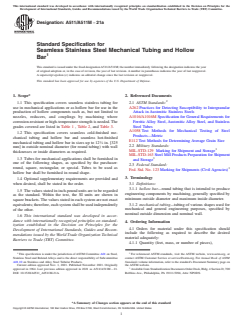
(Specification)Standard Specification for Seamless Stainless Steel Mechanical Tubing and Hollow Bar
General Information
- Abstract
ABSTRACT
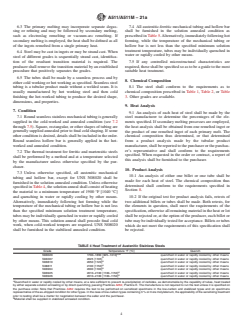
This specification covers seamless stainless tubing for use in mechanical applications where corrosion-resistant or high-temperature strength is needed. The steel may be cast in ingots or may be strand cast. When steel of different grades is sequentially strand cast, identification of the resultant transition material is required. The tubes shall be made by a seamless process and by either cold working or hot working as specified. Seamless steel tubing is a tubular product made without a welded seam. It is usually manufactured by hot working steel and then cold finishing the hot-worked tubing to produce the desired shape, dimensions and properties All austenitic tubes shall be furnished in the annealed condition. An analysis of each heat of steel shall be made to determine the percentages of the elements specified. If secondary melting processes are employed, the heat analysis shall be obtained from one remelted ingot or the product of one remelted ingot of each primary melt.
SCOPE
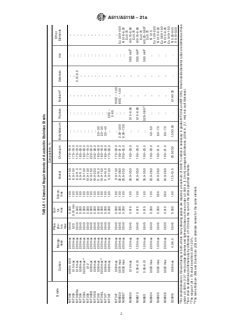
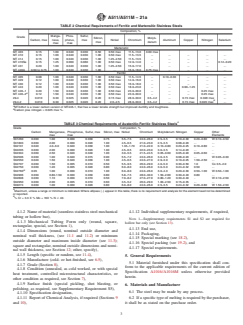
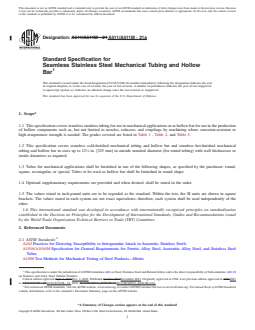
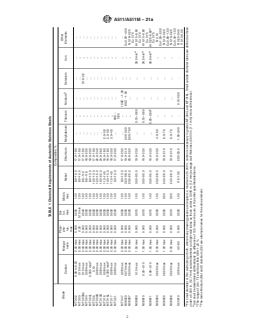
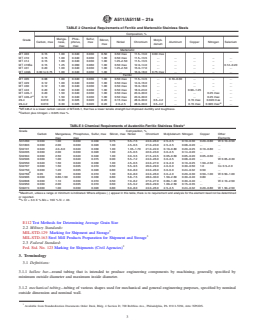
1.1 This specification covers seamless stainless tubing for use in mechanical applications or as hollow bar for use in the production of hollow components such as, but not limited to nozzles, reducers, and couplings by machining where corrosion-resistant or high-temperature strength is needed. The grades covered are listed in Table 1 , Table 2, and Table 3.
1.2 This specification covers seamless cold-finished mechanical tubing and hollow bar and seamless hot-finished mechanical tubing and hollow bar in sizes up to 123/4 in. [325 mm] in outside nominal diameter (for round tubing) with wall thicknesses or inside diameters as required.
1.3 Tubes for mechanical applications shall be furnished in one of the following shapes, as specified by the purchaser: round, square, rectangular, or special. Tubes to be used as hollow bar shall be furnished in round shape.
1.4 Optional supplementary requirements are provided and when desired, shall be stated in the order.
1.5 The values stated in inch-pound units are to be regarded as the standard. Within the text, the SI units are shown in square brackets. The values stated in each system are not exact equivalents; therefore, each system shall be used independently of the other.
1.6 This international standard was developed in accordance with internationally recognized principles on standardization established in the Decision on Principles for the Development of International Standards, Guides and Recommendations issued by the World Trade Organization Technical Barriers to Trade (TBT) Committee.
- Status
- Published
- Publication Date
- 31-Oct-2021
- Technical Committee
- A01 - Steel, Stainless Steel and Related Alloys
- Drafting Committee
- A01.10 - Stainless and Alloy Steel Tubular Products
Buy Documents
ASTM A511/A511M-21a - Standard Specification for Seamless Stainless Steel Mechanical Tubing and Hollow Bar
REDLINE ASTM A511/A511M-21a - Standard Specification for Seamless Stainless Steel Mechanical Tubing and Hollow Bar
Overview
ASTM A511/A511M-21a is the internationally recognized standard specification published by ASTM that defines requirements for seamless stainless steel mechanical tubing and hollow bar. These tubular products are primarily used in mechanical applications and for producing hollow components through machining, where superior corrosion resistance and high-temperature strength are critical. Available in a wide range of grades and sizes, this standard provides comprehensive guidance on manufacturing, heat treatment, chemical composition, dimensions, mechanical properties, and quality assurance for seamless stainless steel tubing and hollow bar.
Key Topics
- Material Types: Covers austenitic, ferritic, martensitic, and duplex stainless steel grades suitable for various mechanical and engineering needs.
- Manufacturing Methods: Specifies seamless production processes, which include hot working followed by cold finishing or hot finishing, depending on product requirements.
- Product Forms: Tubing is available in round, square, rectangular, and special shapes, while hollow bar is supplied in round form for further machining.
- Dimensional Tolerances: Details permissible variations for diameter, wall thickness, length, straightness, and squareness to ensure consistency and fit in downstream applications.
- Heat Treatment: All austenitic tubes and most duplex types are delivered in the solution annealed condition to optimize corrosion resistance and mechanical properties.
- Chemical and Mechanical Requirements: Outlines precise chemical composition requirements for each grade and establishes associated hardness and tensile properties.
- Supplementary Requirements: Offers optional tests and requirements such as hardness and tensile testing, tailored by purchaser specification.
- Quality and Workmanship: Emphasizes surface quality, burr-free ends, and freedom from injurious defects, with provisions for machining allowances on hollow bar.
Applications
ASTM A511/A511M-21a seamless stainless steel tubing and hollow bar are widely used for:
- Precision mechanical components: Including shafts, spindles, and hydraulic cylinders demanding high strength, ductility, and machinability.
- Manufacturing of hollow parts: Such as nozzles, reducers, and couplings that require corrosion resistance and superior mechanical performance.
- Machining applications: Hollow bar is intended to provide an efficient starting form for components produced by machining, minimizing waste.
- Chemical, petrochemical, food, and pharmaceutical industries: Where resistance to corrosion and ease of sterilization are key.
- Aerospace and automotive: Utilized in critical assemblies where product integrity, tight tolerances, and surface finish are essential.
Related Standards
For a comprehensive approach to specification and quality assurance in stainless steel tubing production and application, the following related ASTM standards may be referenced:
- ASTM A262 - Practices for Detecting Susceptibility to Intergranular Attack in Austenitic Stainless Steels
- ASTM A1016/A1016M - General Requirements for Ferritic Alloy Steel, Austenitic Alloy Steel, and Stainless Steel Tubes
- ASTM A1058 - Test Methods for Mechanical Testing of Steel Products
- E112 - Test Methods for Determining Average Grain Size
Other relevant standards may cover marking, shipment, and storage requirements, especially in government or defense sectors.
By adhering to ASTM A511/A511M-21a, manufacturers, engineers, and end-users ensure the consistent production and application of seamless stainless steel mechanical tubing and hollow bar. This standard supports the fabrication of dimensionally precise, reliable, and high-quality components, meeting the rigorous demands of modern engineering and industrial environments.
Relations
- Effective Date
- 01-Nov-2023
- Effective Date
- 01-Sep-2018
- Effective Date
- 01-Mar-2018
- Effective Date
- 01-Sep-2017
- Effective Date
- 15-Mar-2017
- Effective Date
- 01-Mar-2014
- Effective Date
- 01-Mar-2014
- Effective Date
- 01-May-2013
- Effective Date
- 01-Apr-2013
- Effective Date
- 15-Nov-2012
- Effective Date
- 01-Nov-2012
- Effective Date
- 01-Oct-2012
- Effective Date
- 15-Mar-2012
- Effective Date
- 15-May-2011
- Effective Date
- 01-Apr-2011
Buy Documents
ASTM A511/A511M-21a - Standard Specification for Seamless Stainless Steel Mechanical Tubing and Hollow Bar
REDLINE ASTM A511/A511M-21a - Standard Specification for Seamless Stainless Steel Mechanical Tubing and Hollow Bar
Get Certified
Connect with accredited certification bodies for this standard

Institut za varilstvo d.o.o. (Welding Institute)
Slovenia's leading welding institute since 1952. ISO 3834, EN 1090, pressure equipment certification, NDT personnel, welder qualification. Only IIW Au
Sponsored listings
Frequently Asked Questions
ASTM A511/A511M-21a is a technical specification published by ASTM International. Its full title is "Standard Specification for Seamless Stainless Steel Mechanical Tubing and Hollow Bar". This standard covers: ABSTRACT This specification covers seamless stainless tubing for use in mechanical applications where corrosion-resistant or high-temperature strength is needed. The steel may be cast in ingots or may be strand cast. When steel of different grades is sequentially strand cast, identification of the resultant transition material is required. The tubes shall be made by a seamless process and by either cold working or hot working as specified. Seamless steel tubing is a tubular product made without a welded seam. It is usually manufactured by hot working steel and then cold finishing the hot-worked tubing to produce the desired shape, dimensions and properties All austenitic tubes shall be furnished in the annealed condition. An analysis of each heat of steel shall be made to determine the percentages of the elements specified. If secondary melting processes are employed, the heat analysis shall be obtained from one remelted ingot or the product of one remelted ingot of each primary melt. SCOPE 1.1 This specification covers seamless stainless tubing for use in mechanical applications or as hollow bar for use in the production of hollow components such as, but not limited to nozzles, reducers, and couplings by machining where corrosion-resistant or high-temperature strength is needed. The grades covered are listed in Table 1 , Table 2, and Table 3. 1.2 This specification covers seamless cold-finished mechanical tubing and hollow bar and seamless hot-finished mechanical tubing and hollow bar in sizes up to 123/4 in. [325 mm] in outside nominal diameter (for round tubing) with wall thicknesses or inside diameters as required. 1.3 Tubes for mechanical applications shall be furnished in one of the following shapes, as specified by the purchaser: round, square, rectangular, or special. Tubes to be used as hollow bar shall be furnished in round shape. 1.4 Optional supplementary requirements are provided and when desired, shall be stated in the order. 1.5 The values stated in inch-pound units are to be regarded as the standard. Within the text, the SI units are shown in square brackets. The values stated in each system are not exact equivalents; therefore, each system shall be used independently of the other. 1.6 This international standard was developed in accordance with internationally recognized principles on standardization established in the Decision on Principles for the Development of International Standards, Guides and Recommendations issued by the World Trade Organization Technical Barriers to Trade (TBT) Committee.
ABSTRACT This specification covers seamless stainless tubing for use in mechanical applications where corrosion-resistant or high-temperature strength is needed. The steel may be cast in ingots or may be strand cast. When steel of different grades is sequentially strand cast, identification of the resultant transition material is required. The tubes shall be made by a seamless process and by either cold working or hot working as specified. Seamless steel tubing is a tubular product made without a welded seam. It is usually manufactured by hot working steel and then cold finishing the hot-worked tubing to produce the desired shape, dimensions and properties All austenitic tubes shall be furnished in the annealed condition. An analysis of each heat of steel shall be made to determine the percentages of the elements specified. If secondary melting processes are employed, the heat analysis shall be obtained from one remelted ingot or the product of one remelted ingot of each primary melt. SCOPE 1.1 This specification covers seamless stainless tubing for use in mechanical applications or as hollow bar for use in the production of hollow components such as, but not limited to nozzles, reducers, and couplings by machining where corrosion-resistant or high-temperature strength is needed. The grades covered are listed in Table 1 , Table 2, and Table 3. 1.2 This specification covers seamless cold-finished mechanical tubing and hollow bar and seamless hot-finished mechanical tubing and hollow bar in sizes up to 123/4 in. [325 mm] in outside nominal diameter (for round tubing) with wall thicknesses or inside diameters as required. 1.3 Tubes for mechanical applications shall be furnished in one of the following shapes, as specified by the purchaser: round, square, rectangular, or special. Tubes to be used as hollow bar shall be furnished in round shape. 1.4 Optional supplementary requirements are provided and when desired, shall be stated in the order. 1.5 The values stated in inch-pound units are to be regarded as the standard. Within the text, the SI units are shown in square brackets. The values stated in each system are not exact equivalents; therefore, each system shall be used independently of the other. 1.6 This international standard was developed in accordance with internationally recognized principles on standardization established in the Decision on Principles for the Development of International Standards, Guides and Recommendations issued by the World Trade Organization Technical Barriers to Trade (TBT) Committee.
ASTM A511/A511M-21a is classified under the following ICS (International Classification for Standards) categories: 23.040.10 - Iron and steel pipes; 23.040.40 - Metal fittings. The ICS classification helps identify the subject area and facilitates finding related standards.
ASTM A511/A511M-21a has the following relationships with other standards: It is inter standard links to ASTM A1016/A1016M-23, ASTM A1016/A1016M-18a, ASTM A1016/A1016M-18, ASTM A1016/A1016M-17a, ASTM A1016/A1016M-17, ASTM A1016/A1016M-14e1, ASTM A1016/A1016M-14, ASTM A262-13, ASTM A1016/A1016M-13, ASTM E112-12, ASTM A1058-12b, ASTM A1058-12a, ASTM A1058-12, ASTM A1016/A1016M-11a, ASTM A1016/A1016M-11. Understanding these relationships helps ensure you are using the most current and applicable version of the standard.
ASTM A511/A511M-21a is available in PDF format for immediate download after purchase. The document can be added to your cart and obtained through the secure checkout process. Digital delivery ensures instant access to the complete standard document.
Standards Content (Sample)
This international standard was developed in accordance with internationally recognized principles on standardization established in the Decision on Principles for the
Development of International Standards, Guides and Recommendations issued by the World Trade Organization Technical Barriers to Trade (TBT) Committee.
Designation:A511/A511M −21a
Standard Specification for
Seamless Stainless Steel Mechanical Tubing and Hollow
Bar
This standard is issued under the fixed designationA511/A511M; the number immediately following the designation indicates the year
of original adoption or, in the case of revision, the year of last revision.Anumber in parentheses indicates the year of last reapproval.
A superscript epsilon (´) indicates an editorial change since the last revision or reapproval.
This standard has been approved for use by agencies of the U.S. Department of Defense.
1. Scope* 2. Referenced Documents
1.1 This specification covers seamless stainless tubing for 2.1 ASTM Standards:
use in mechanical applications or as hollow bar for use in the A262Practices for Detecting Susceptibility to Intergranular
production of hollow components such as, but not limited to Attack in Austenitic Stainless Steels
nozzles, reducers, and couplings by machining where A1016/A1016MSpecification for General Requirements for
corrosion-resistantorhigh-temperaturestrengthisneeded.The Ferritic Alloy Steel, Austenitic Alloy Steel, and Stainless
grades covered are listed in Table 1 , Table 2, and Table 3. Steel Tubes
A1058 Test Methods for Mechanical Testing of Steel
1.2 This specification covers seamless cold-finished me-
Products—Metric
chanical tubing and hollow bar and seamless hot-finished
E112Test Methods for Determining Average Grain Size
mechanical tubing and hollow bar in sizes up to 12 ⁄4 in. [325
2.2 Military Standards:
mm] in outside nominal diameter (for round tubing) with wall
MIL-STD-129 Marking for Shipment and Storage
thicknesses or inside diameters as required.
MIL-STD-163SteelMillProductsPreparationfor Shipment
1.3 Tubes for mechanical applications shall be furnished in
and Storage
one of the following shapes, as specified by the purchaser:
2.3 Federal Standard:
round, square, rectangular, or special. Tubes to be used as
Fed. Std. No. 123Marking for Shipments (CivilAgencies)
hollow bar shall be furnished in round shape.
3. Terminology
1.4 Optional supplementary requirements are provided and
when desired, shall be stated in the order. 3.1 Definitions:
3.1.1 hollow bar—round tubing that is intended to produce
1.5 The values stated in inch-pound units are to be regarded
engineering components by machining, generally specified by
as the standard. Within the text, the SI units are shown in
minimum outside diameter and maximum inside diameter.
square brackets.The values stated in each system are not exact
3.1.2 mechanical tubing—tubing of various shapes used for
equivalents;therefore,eachsystemshallbeusedindependently
mechanical and general engineering purposes, specified by
of the other.
nominal outside dimension and nominal wall.
1.6 This international standard was developed in accor-
dance with internationally recognized principles on standard-
4. Ordering Information
ization established in the Decision on Principles for the
4.1 Orders for material under this specification should
Development of International Standards, Guides and Recom-
include the following as required to describe the desired
mendations issued by the World Trade Organization Technical
material adequately:
Barriers to Trade (TBT) Committee.
4.1.1 Quantity (feet, mass, or number of pieces),
1 2
This specification is under the jurisdiction ofASTM Committee A01 on Steel, For referenced ASTM standards, visit the ASTM website, www.astm.org, or
Stainless Steel and RelatedAlloys and is the direct responsibility of Subcommittee contact ASTM Customer Service at service@astm.org. For Annual Book of ASTM
A01.10 on Stainless and Alloy Steel Tubular Products. Standards volume information, refer to the standard’s Document Summary page on
Current edition approved Nov. 1, 2021. Published November 2021. Originally the ASTM website.
approved in 1964. Last previous edition approved in 2021 as A511/A511M–21. AvailablefromStandardizationDocumentsOrderDesk,Bldg.4SectionD,700
DOI: 10.1520/A0511_A0511M-21A. Robbins Ave., Philadelphia, PA 19111-5094, Attn: NPODS.
*A Summary of Changes section appears at the end of this standard
Copyright © ASTM International, 100 Barr Harbor Drive, PO Box C700, West Conshohocken, PA 19428-2959. United States
A511/A511M−21a
TABLE 1 Chemical Requirements of Austenitic Stainless Steels
Composition, %
Phos- Sul-
Other
Grade
Manga- pho- fur, Silicon,
D
Carbon Nickel Chromium Molybdenum Titanium Niobium Selenium Iron Elements
nese rus, max max
max
MT 302 0.08 to 0.20 2.00 max 0.040 0.030 1.00 8.0–10.0 17.0–19.0 . . . . . .
MT 303 0.15 max 2.00 max 0.20 0.15 min 1.00 8.0–10.0 17.0–19.0 . . . . . .
MT 303Se 0.15 max 2.00 max 0.040 0.040 1.00 8.0–11.0 17.0–19.0 . . . 0.12–0.2 . .
MT 304 0.08 max 2.00 max 0.040 0.030 1.00 8.0–11.0 18.0–20.0 . . . . . .
A
MT 304L 0.035 max 2.00 max 0.040 0.030 1.00 8.0–13.0 18.0–20.0 . . . . . .
MT 305 0.12 2.00 max 0.040 0.030 1.00 10.0–13.0 17.0–19.0 . . . . . .
MT 309S 0.08 max 2.00 max 0.040 0.030 1.00 12.0–15.0 22.0–24.0 . . . . . .
MT 310S 0.08 max 2.00 max 0.040 0.030 1.00 19.0–22.0 24.0–26.0 . . . . . .
MT 316 0.08 max 2.00 max 0.040 0.030 1.00 11.0–14.0 16.0–18.0 2.0–3.0 . . . . .
A
MT 316L 0.035 max 2.00 max 0.040 0.030 1.00 10.0–15.0 16.0–18.0 2.0–3.0 . . . . .
MT 317 0.08 max 2.00 max 0.040 0.030 1.00 11.0–14.0 18.0–20.0 3.0–4.0 . . . . .
MT 321 0.08 max 2.00 max 0.040 0.030 1.00 9.0–13.0 17.0–20.0 . 5XC – . . . .
0.60
MT 347 0.08 max 2.00 max 0.040 0.030 1.00 9.0–13.0 17.0–20.0 . . 10XC – 1.00 . . .
N08020 0.070 max 2.00 max 0.045 0.035 1.00 32.0–38.0 19.0–21.0 2.00–3.00 . 8XC – 1.00 . . Cu 3.00–4.00
N08367 0.030 max 2.00 max 0.040 0.030 1.00 23.5–25.5 20.0–22.0 6.00–7.00 . . . . N 0.18–0.25
Cu 0.75
B
N08800 0.10 max 1.50 max 0.045 0.015 1.00 30.0–35.0 19.0–23.0 . 0.15–0.60 . . 39.5 min Al 0.15–0.60
Cu 0.75
B
N08810 0.05–0.10 1.50 max 0.045 0.015 1.00 30.0–35.0 19.0–23.0 . 0.15–0.60 . . 39.5 min Al 0.15–0.60
Cu 0.75
C B C
N08811 0.06–0.10 1.50 max 0.045 0.015 1.00 30.0–35.0 19.0–23.0 . 0.25–0.60 . . 39.5 min Al 0.25–0.60
Cu 0.75
N08904 0.020 max 2.00 max 0.040 0.030 1.00 23.0–28.0 19.0–23.0 4.0–5.0 . . . . N 0.10
Cu 1.00–2.00
N08925 0.020 max 1.00 max 0.045 0.030 0.50 24.0–26.0 19.0–21.0 6.0–7.0 . . . . N 0.10–0.20
Cu 0.80–1.50
N08926 0.020 max 2.00 max 0.030 0.010 0.50 24.0–26.0 19.0–21.0 6.0–7.0 . . . . N 0.15–0.25
Cu 0.40–1.50
S20910 0.06 max 4.0-6.0 0.045 0.030 1.00 11.5-13.5 20.5-23.5 1.50-3.00 { 0.10-0.30 {{ N 0.20-0.40
V 0.10-0.30
A
For small diameter or thin wall tubing or both, where many drawing passes are required, a maximum of 0.040 % carbon is necessary in grades MT-304L and MT-316L. Small outside diameter tubes are defined as those
under a 0.500 in. [12.7 mm] outside diameter and light-wall tubes as those under a 0.049 in. [1.2 mm] average wall thickness (0.044 in. [1.1 mm] min wall thickness).
B
Iron shall be determined arithmetically by difference of 100 minus the sum of the other specified elements.
C
The range of (Al + Ti) shall be within 0.85–1.20 %.
D
The terms Niobium (Nb) and Columbium (Cb) are alternate names for the same element.
A511/A511M−21a
TABLE 2 Chemical Requirements of Ferritic and Martensitic Stainless Steels
Composition, %
Manga- Phos- Sulfur,
Grade
Silicon, Molyb-
Carbon, max nese, phorus, max Nickel Chromium Aluminum Copper Nitrogen Selenium
max denum
max max
Martensitic
MT 403 0.15 1.00 0.040 0.030 0.50 0.50 max 11.5–13.0 0.60 max
MT 410 0.15 1.00 0.040 0.030 1.00 0.50 max 11.5–13.5 . . . . .
MT 414 0.15 1.00 0.040 0.030 1.00 1.25–2.50 11.5–13.5 . . . . .
MT 416Se 0.15 1.25 0.060 0.060 1.00 0.50 max 12.0–14.0 . . . . 0.12–0.20
MT 431 0.20 1.00 0.040 0.030 1.00 1.25–2.50 15.0–17.0 . . . . .
MT 440A 0.60 to 0.75 1.00 0.040 0.030 1.00 . 16.0–18.0 0.75 max . . . .
Ferritic
MT 405 0.08 1.00 0.040 0.030 1.00 0.50 max 11.5–14.5 . 0.10–0.30 . . .
MT 429 0.12 1.00 0.040 0.030 1.00 0.50 max 14.0–16.0 . . . . .
MT 430 0.12 1.00 0.040 0.030 1.00 0.50 max 16.0–18.0 . . . . .
MT 443 0.20 1.00 0.040 0.030 1.00 0.50 max 18.0–23.0 . . 0.90–1.25 . .
MT 446–1 0.20 1.50 0.040 0.030 1.00 0.50 max 23.0–30.0 . . . 0.25 max .
A
MT 446–2 0.12 1.50 0.040 0.030 1.00 0.50 max 23.0–30.0 . . . 0.25 max .
29-4 0.010 0.30 0.025 0.020 0.20 0.15 max 28.0–30.0 3.5–4.2 . 0.15 max 0.020 max .
B
29-4-2 0.010 0.30 0.025 0.020 0.20 2.0–2.5 28.0–30.0 3.5–4.2 . 0.15 max 0.020 max .
A
MT446-2 is a lower carbon version of MT446-1, that has a lower tensile strength but improved ductility and toughness.
B
Carbon plus nitrogen = 0.025 max %.
A
TABLE 3 Chemical Requirements of Austenitic-Ferritic Stainless Steels
Grade Composition, %
Carbon Manganese, Phosphorus, Sulfur, max Silicon, max Nickel Chromium Molybdenum Nitrogen Copper Other
max max Elements
S31260 0.030 1.00 0.030 0.030 0.75 5.5–7.5 24.0–26.0 2.5–3.5 0.10–0.30 0.20–0.80 W 0.10–0.50
S31803 0.030 2.00 0.030 0.020 1.00 4.5–6.5 21.0–23.0 2.5–3.5 0.08–0.20 . .
S32101 0.040 4.0–6.0 0.040 0.030 1.00 1.35–1.70 21.0–22.0 0.10–0.80 0.20–0.25 0.10–0.80 .
S32205 0.030 2.00 0.030 0.020 1.00 4.5–6.5 22.0–23.0 3.0–3.5 0.14–0.20 . {
S32304 0.030 2.50 0.040 0.040 1.00 3.0–5.5 21.5–24.5 0.05–0.60 0.05–0.20 0.05–0.60 .
S32506 0.030 1.00 0.040 0.015 0.90 5.5–7.2 24.0–26.0 3.0–3.5 0.08–0.20 . W 0.05–0.30
S32550 0.040 1.50 0.040 0.030 1.00 4.5–6.5 24.0–27.0 2.9–3.9 0.10–0.25 1.50–2.50 .
S32707 0.030 1.50 0.035 0.010 0.50 5.5–9.5 26.0–29.0 4.0–5.0 0.30–0.50 1.0 Co 0.5–2.0
S32750 0.030 1.20 0.035 0.020 0.80 6.0–8.0 24.0–26.0 3.0–5.0 0.24–0.32 0.50 .
B
S32760 0.05 1.00 0.030 0.010 1.00 6.0–8.0 24.0–26.0 3.0–4.0 0.20–0.30 0.50–1.00 W 0.50–1.00
S32906 0.030 0.80-1.50 0.030 0.030 0.80 5.8–7.5 28.0–30.0 1.50–2.60 0.30–0.40 0.80 .
S32808 0.030 1.10 0.030 0.010 0.50 7.0–8.2 27.0–27.9 0.80–1.20 0.30–0.40 { W 2.10–2.50
S32950 0.030 2.00 0.035 0.010 0.60 3.5–5.2 26.0–29.0 1.00–2.50 0.15–0.35 . .
S39274 0.030 1.00 0.030 0.020 0.80 6.0–8.0 24.0–26.0 2.5–3.5 0.24–0.32 0.20–0.80 W 1.50–2.50
A
Maximum, unless a range or minimum is indicated. Where ellipses ({) appear in this table, there is no requirement and analysis for the element need not be determined
or reported.
B
%Cr+3.3X%Mo+16X%N$ 40.
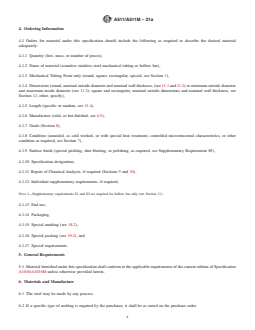
4.1.2 Name of material (seamless stainless steel mechanical 4.1.12 Individual supplementary requirements, if required,
tubing or hollow bar),
NOTE 1—Supplementary requirements S1 and S2 are required for
4.1.3 Mechanical Tubing Form only (round, square,
hollow bar only (see Section 13).
rectangular, special, see Section 1),
4.1.13 End use,
4.1.4 Dimensions (round, nominal outside diameter and
4.1.14 Packaging,
nominal wall thickness, (see 11.1 and 11.2) or minimum
4.1.15 Special marking (see 18.2),
outside diameter and maximum inside diameter (see 11.3);
4.1.16 Special packing (see 19.2), and
square and rectangular, nominal outside dimensions and nomi-
4.1.17 Special requirements.
nal wall thickness, see Section 12; other, specify),
4.1.5 Length (specific or random, see 11.4),
5. General Requirements
4.1.6 Manufacture (cold- or hot-finished, see 6.5),
5.1 Material furnished under this specification shall con-
4.1.7 Grade (Section 8),
form to the applicable requirements of the current edition of
4.1.8 Condition (annealed, as cold worked, or with special
Specification A1016/A1016M unless otherwise provided
heat treatment, controlled microstructural characteristics, or
herein.
other condition as required, see Section 7),
4.1.9 Surface finish (special pickling, shot blasting, or
6. Materials and Manufacture
polishing, as required, see Supplementary Requirement S5),
6.1 The steel may be made by any process.
4.1.10 Specification designation,
4.1.11 Report of ChemicalAnalysis, if required (Sections 9 6.2 Ifaspecifictypeofmeltingisrequiredbythepurchaser,
and 10), it shall be as stated on the purchase order.
A511/A511M−21a
6.3 The primary melting may incorporate separate degas- 7.4 All austenitic-ferritic mechanical tubing and hollow bar
sing or refining and may be followed by secondary melting, shall be furnished in the solution annealed condition as
such as electroslag remelting or vacuum-arc remelting. If prescribedinTable5.Alternatively,immediatelyfollowinghot
secondary melting is employed, the heat shall be defined as all forming, while the temperature of the mechanical tubing or
of the ingots remelted from a single primary heat. hollow bar is not less than the specified minimum solution
treatment temperature, tubes may be individually quenched in
6.4 Steel may be cast in ingots or may be strand cast.When
water or rapidly cooled by other means.
steel of different grades is sequentially strand cast, identifica-
tion of the resultant transition material is required. The 7.5 If any controlled microstructural characteristics are
producer shall remove the transition material by an established required,theseshallbespecifiedsoastobeaguidetothemost
procedure that positively separates the grades. suitable heat treatment.
6.5 The tubes shall be made by a seamless process and by
8. Chemical Composition
eithercoldworkingorhotworkingasspecified.Seamlesssteel
tubing is a tubular product made without a welded seam. It is 8.1 The steel shall conform to the requirements as to
usually manufactured by hot working steel and then cold chemical composition prescribed in Table 1, Table 2,or Table
finishing the hot-worked tubing to produce the desired shape, 3. Other grades are available.
dimensions, and properties.
9. Heat Analysis
7. Condition
9.1 An analysis of each heat of steel shall be made by the
7.1 Roundseamlessstainlessmechanicaltubingisgenerally steel manufacturer to determine the percentages of the ele-
supplied in the cold-worked and annealed condition (see 7.2
ments specified. If secondary melting processes are employed,
through 7.5). Square, rectangular, or other shapes of tubing are the heat analysis shall be obtained from one remelted ingot or
generallysuppliedannealedpriortofinalcoldshaping.Ifsome
the product of one remelted ingot of each primary melt. The
otherconditionisdesired,detailsshallbeincludedintheorder. chemical composition thus determined, or that determined
Round seamless hollow bar is generally applied in the hot- from a product analysis made by the tubular product
worked and annealed condition. manufacturer,shallbereportedtothepurchaserorthepurchas-
er’s representative and shall conform to the requirements
7.2 The thermal treatment for ferritic and martensitic steels
specified. When requested in the order or contract, a report of
shall be performed by a method and at a temperature selected
this analysis shall be furnished to the purchaser.
by the manufacturer unless otherwise specified by the pur-
chaser.
10. Product Analysis
7.3 Unless otherwise specified, all austenitic mechanical
10.1 An analysis of either one billet or one tube shall be
tubing and hollow bar, except for UNS N08020 shall be
made for each heat of steel. The chemical composition thus
furnished in the solution annealed condition. Unless otherwise
determined shall conform to the requirements specified in
specifiedinTable4,thesolutionannealshallconsistofheating
Section 8.
the material to a minimum temperature of 1900 °F [1040 °C]
and quenching in water or rapidly cooling by other means. 10.2 If the original test for product analysis fails, retests of
Alternatively, immediately following hot forming while the two additional billets or tubes shall be made. Both retests, for
temperature of the mechanical tubing or hollow bar is not less the elements in question, shall meet the requirements of the
than the specified minimum solution treatment temperature, specification,otherwiseallremainingmaterialintheheatorlot
tubes may be individually quenched in water or rapidly cooled shall be rejected or, at the option of the producer, each billet or
by other means. This solution anneal shall precede final cold tubemaybeindividuallytestedforacceptance.Billetsortubes
work, when cold-worked tempers are required. UNS N08020 which do not meet the requirements of this specification shall
shall be furnished in the stabilized annealed condition. be rejected.
TABLE 4 Heat Treatment of Austenitic Stainless Steels
Grade Temperature °F [°C] Quench
A,B
N08020 1700–1850 [925–1010] quenched in water or rapidly cooled by other means
A
N08367 2025 [1105] quenched in water or rapidly cooled by other means
A
N08810 2050 [1120] quenched in water or rapidly cooled by other means
A
N08811 2100 [1150] quenched in water or rapidly cooled by other means
A
N08904 2000 [1100] quenched in water or rapidly cooled by other means
A
N08925 2010–2100 [1100–1150] quenched in water or rapidly cooled by other means
A
N08926 2010–2100 [1100–1150] quenched in water or rapidly cooled by other means
A
Quenched in water or rapidly cooled by other means, at a rate sufficient to prevent re-precipitation of carbides, as demonstrable by the capability of tubes, heat treated
by either separate solution annealing or by direct quenching, passing Practices A262, Practice E. The manufacture is not required to run the test unless it is specified on
the purchase order. Note that Practices A262 requires the test to be performed on sensitized specimens in the low-carbon and stabilized types and on specimens
representative of the as-shipped condition for other types. In the case of low-carbon types containing 3 % or more molybdenum, the applicability of the sensitizing treatment
prior to testing shall be a matter for negotiation between the seller and the purchaser.
B
Material shall be supplied in stabilized annealed condition.
A511/A511M−21a
TABLE 5 Heat Treatment of Austenitic-Ferritic Stainless Steels
Grade Temperature °F [°C] Quench
S31260 1870-2010 [1020-1100] rapid cooling in air or water
S31803 1870-2010 [1020-1100] rapid cooling in air or water
S32101 1870 [1020] min quenched in water or rapidly cooled by other means
S32205 1870-2010 [1020-1100] rapid cooling in air or water
S32304 1700-1920 [925-1050] rapid cooling in air or water
S32506 1870-2050 [1020-1120] rapid cooling in air or water
S32550 1900 [1040] min rapid cooling in air or water
S32707 1975-2050 [1080-1120] rapid cooling in air or water
S32750 1880-2060 [1025-1125] rapid cooling in air or water
S32760 1960-2085 [1070-1140] rapid cooling in air or water
S32808 1920-2100 [1050-1150] rapid cooling in air or water
S32906 1870-2100 [1020-1150] rapid cooling in air or water
S32950 1820-1880 [990-1025] air cool
S39274 1880-2060 [1025-1125] rapid cooling in air or water
11. Permissible Variations in Dimensions of Round hollow bar length (L) shall not exceed 0.0015 L, and not
Mechanical Tubing and Hollow Bar exceeding 0.072 in. per 3 ft [2 mm per 1 m] when measured
with a 3-ft [1-m] straight edge and feeler gage. If determined
11.1 Nominal Outside Diameter and Nominal Wall Thick-
by the dial indicator method, the values obtained will be
ness (Cold Finished Mechanical Tubing and Hollow Bar)—
approximately twice those determined by the straight edge –
Variations in outside diameter and wall thickness shall not
feeler gage method.
exceed the amounts prescribed in Table 6.
11.2 Nominal Diameter and Nominal Wall Thickness (Hot
12. Permissible Variations in Dimensions of Square and
Finished Mechanical Tubing and Hollow Bar)—
Rectangular Mechanical Tubing
Variations in outside diameter and wall thickness shall not
12.1 Square and rectangular seamless stainless mechanical
exceed the amounts prescribed in Table 7.
tubing is supplied as cold worked unless otherwise specified.
11.3 Minimum Outside Diameter and Maximum Inside Di-
For this tubing, variations in dimensions from those specified
ameter (Cold-Finished and Hot-Finished Hollow Bar)—
shall not exceed the amounts prescribed in Table 10, Table 11,
Variations in outside diameter and wall thickness shall not
Table 12, and Table 13.
exceed the amounts prescribed in Table 8.
12.2 The squareness of sides is commonly determined by
11.4 Lengths (Cold Finished or Hot Finished)—Mechanical
one of the following methods.
tubing and hollow bar are commonly furnished in mill lengths
12.2.1 Asquare, with two adjustable contact points on each
5 ft [1.5 m] and over. When random lengths are ordered,
arm, is placed on two sides. A fixed feeler gauge is then used
mechanical tubing and hollow bar lengths may vary by an
to measure the maximum distance between the free contact
amount up to 7 ft [2.1 m]. Definite cut lengths are furnished,
point and the surface of the tubing.
when specified, to the length tolerances shown in Table 6 or
12.2.2 Asquare,equippedwithadirectreadingvernier,may
Table 7. For mechanical tubing and hollow bar ordered in
be used to determine the angular deviation which, in turn, may
multiple lengths, it is common practice to allow a definite
be related to distance in inches.
amount over for each multiple for the purchaser’s cutting
12.3 The squareness of sides varies in accordance with the
operations. This amount depends on the type of purchaser’s
following equation:
cutting and varies with differing wall thickness. The cutting
6 b = c × 0.006
allowance should be specified on the purchase order. When it
is not specified, mechanical tubing and hollow bar are custom-
where:
arily supplied with the following allowance for each multiple:
b = tolerance for out-of-square, and
Excess Length
c = length of longest side.
Wall Thickness, per Multiple,
in. [mm] in. [mm] Example:Rectangulartubes2by1mayhavesidesfailtobe
1 1
Up to ⁄8 [3.2] ⁄8 [3]
90° to each other by 60.012 in. [0.3 mm].
1 1 3
Over ⁄8 to ⁄2 [3.2 to 12.7] ⁄16 [5]
1 1
Over ⁄2 [12.7] ⁄4 [6]
12.4 The twist in square and rectangular tubing may be
11.5 Straightness Tolerances (Cold Finished or Hot Fin- measured by holding one end of the tubing on a surface plate
andnotingtheheightabovethesurfaceplateofeithercornerof
ished Mechanical Tubing)—The deviation from straightness
shallnotexceedtheamountsshowninTable9whenmeasured the opposite end of the same side.Twist may also be measured
by the use of a beveled protractor, equipped with a level, and
with a 3-ft [1-m] straightedge and feeler gauge. If determined
by the dial indicator method, the values obtained will be noting the angular deviation on opposite ends, or at any point
throughout the length.
approximately twice those determined by the straightedge
feeler gauge method.
13. Mechanical Properties – Hollow Bar
11.6 Straightness Tolerances (Cold Finished or Hot Fin-
ished Hollow Bar—The deviation from straightness of any 13.1 Tensile Requirements:
A511/A511M−21a
TABLE 6 Permissible Variations in Outside Diameter, Ovality, Wall Thickness, and Cut-Length Variations
A
(Cold-Finished Round Mechanical Tubing and Hollow Bar)
B
Prevailing Outside Ovality, Double Permissible
Outside
Range of Diameter, Variations
B Diameter
Commercially Tolerance, Wall Thickness in Cut
Outside
Tolerance
C,D E
in. [mm] Over
Available in % Length, in. [mm]
Nominal
when
and Under
Metric Sizes,
Diameter, wall is:
mm
in. [mm]
Over Under Over Under
1 1
Under ⁄2 [13] Under 12.7 0.005 [0.1] less than 0.015 in. 15 15 ⁄8 [3] 0
[0.4 mm]
1 1 1
⁄2 [13] to 1 ⁄2 12.7 to 38.1, excl 0.005 [0.1] less than 0.065 in. 10 10 ⁄8 [3] 0
[38], excl [1.6 mm]
1 1 3
1 ⁄2 [38] to 3 ⁄2 38.1 to 88.9 excl 0.010 [0.3] less than 0.095 in. 10 10 ⁄16 [5] 0
[90], excl [2.4 mm]
1 1 3
3 ⁄2 [90] to 5 ⁄2 88.9 to 139.7, excl 0.015 [0.4] less than 0.150 in. 10 10 ⁄16 [5] 0
[140], excl [3.8 mm]
1 3
5 ⁄2 [140] to 8 139.7 to 203.2, excl 0.030 [0.8] less than 0.240 in. 10 10 ⁄16 [5] 0
[200], excl [6.1 mm]
5 3
8 [200] to 8 ⁄8 203.2 to 219.1, excl 0.045 [1.1] less than 0.300 in. 10 10 ⁄16 [5] 0
[220], excl [7.6 mm]
5 3
8 ⁄8 [220] to 219.1 to 323.9, incl 0.062 [1.6] less than 0.350 in. 10 10 ⁄16 [5] 0
12 ⁄4 [325], incl [8.9 mm]
A
1 5
Tolerances of tubes produced by the rod or bar mandrel process and which have an inside diameter under ⁄2 in. [12.7 mm] (or an inside diameter under ⁄8 in. [15.8 mm] when the wall thickness is more than 20 % of
the outside diameter) are as shown in this table, except that wall thickness tolerances are 10 % over and under the specified wall thickness.
B
For ovality values, the tolerance for average outside diameter at any one cross section does not exceed the outside diameter tolerance value for the applicable outside diameter.
C
Many tubes with wall thicknesses more than 25 % of outside diameter or with wall thicknesses over 1 ⁄4 in., [31.7 mm] or weighing more than 90 lb/ft [60.5 kg/m], are difficult to draw over a mandrel. Therefore, the wall
thickness can vary 12 ⁄2 % over and under that specified. Also see Footnote (B).
D
1 5
For those tubes with inside diameter under ⁄2 in. [12.7 mm] (or under ⁄8 in. [15.8 mm] when the wall thickness is more than 20 % of the outside diameter) which are not commonly drawn over a mandrel, Footnote (A)
is not applicable. Therefore, the wall thickness can vary 15 % over and under that specified, and the inside diameter is governed by both the outside diameter and wall thickness tolerances.
E
These tolerances apply to cut lengths up to and including 24 ft. [7.3 m]. For lengths over 24 ft [7.3 m], an additional over tolerance of ⁄8 in. [3 mm] for each 10 ft [3 m] or fraction thereof shall be permissible, up to a
maximum tolerance of ⁄2 in. [13 mm].
A511/A511M−21a
TABLE 7 Permissible Variations in Outside Diameter, Wall Thickness, and Cut-Length Variations
(Hot-Finished Round Mechanical Tubing and Hollow Bar)
Outside Diameter and Wall Thickness Tolerances Permissible Variations
Prevailing
A
Specified Range in Cut Length, in. [mm]
Ratio of Wall
Nominal Inch of
Wall Thickness, %
Thickness to
S
...
This document is not an ASTM standard and is intended only to provide the user of an ASTM standard an indication of what changes have been made to the previous version. Because
it may not be technically possible to adequately depict all changes accurately, ASTM recommends that users consult prior editions as appropriate. In all cases only the current version
of the standard as published by ASTM is to be considered the official document.
Designation: A511/A511M − 21 A511/A511M − 21a
Standard Specification for
Seamless Stainless Steel Mechanical Tubing and Hollow
Bar
This standard is issued under the fixed designation A511/A511M; the number immediately following the designation indicates the year
of original adoption or, in the case of revision, the year of last revision. A number in parentheses indicates the year of last reapproval.
A superscript epsilon (´) indicates an editorial change since the last revision or reapproval.
This standard has been approved for use by agencies of the U.S. Department of Defense.
1. Scope*
1.1 This specification covers seamless stainless tubing for use in mechanical applications or as hollow bar for use in the production
of hollow components such as, but not limited to nozzles, reducers, and couplings by machining where corrosion-resistant or
high-temperature strength is needed. The grades covered are listed in Table 1 , Table 2, and Table 3.
1.2 This specification covers seamless cold-finished mechanical tubing and hollow bar and seamless hot-finished mechanical
tubing and hollow bar in sizes up to 12 ⁄4 in. [325 mm] in outside nominal diameter (for round tubing) with wall thicknesses or
inside diameters as required.
1.3 Tubes for mechanical applications shall be furnished in one of the following shapes, as specified by the purchaser: round,
square, rectangular, or special. Tubes to be used as hollow bar shall be furnished in round shape.
1.4 Optional supplementary requirements are provided and when desired, shall be stated in the order.
1.5 The values stated in inch-pound units are to be regarded as the standard. Within the text, the SI units are shown in square
brackets. The values stated in each system are not exact equivalents; therefore, each system shall be used independently of the
other.
1.6 This international standard was developed in accordance with internationally recognized principles on standardization
established in the Decision on Principles for the Development of International Standards, Guides and Recommendations issued
by the World Trade Organization Technical Barriers to Trade (TBT) Committee.
2. Referenced Documents
2.1 ASTM Standards:
A262 Practices for Detecting Susceptibility to Intergranular Attack in Austenitic Stainless Steels
A1016/A1016M Specification for General Requirements for Ferritic Alloy Steel, Austenitic Alloy Steel, and Stainless Steel
Tubes
A1058 Test Methods for Mechanical Testing of Steel Products—Metric
This specification is under the jurisdiction of ASTM Committee A01 on Steel, Stainless Steel and Related Alloys and is the direct responsibility of Subcommittee A01.10
on Stainless and Alloy Steel Tubular Products.
Current edition approved Sept. 1, 2021Nov. 1, 2021. Published October 2021November 2021. Originally approved in 1964. Last previous edition approved in 20202021
as A511/A511M – 20.A511/A511M – 21. DOI: 10.1520/A0511_A0511M-21.10.1520/A0511_A0511M-21A.
For referenced ASTM standards, visit the ASTM website, www.astm.org, or contact ASTM Customer Service at service@astm.org. For Annual Book of ASTM Standards
volume information, refer to the standard’s Document Summary page on the ASTM website.
*A Summary of Changes section appears at the end of this standard
Copyright © ASTM International, 100 Barr Harbor Drive, PO Box C700, West Conshohocken, PA 19428-2959. United States
A511/A511M − 21a
TABLE 1 Chemical Requirements of Austenitic Stainless Steels
Composition, %
Phos- Sul-
Other
Grade
Manga- pho- fur, Silicon,
D
Carbon Nickel Chromium Molybdenum Titanium Niobium Selenium Iron Elements
nese rus, max max
max
MT 302 0.08 to 0.20 2.00 max 0.040 0.030 1.00 8.0–10.0 17.0–19.0 . . . . . .
MT 303 0.15 max 2.00 max 0.20 0.15 min 1.00 8.0–10.0 17.0–19.0 . . . . . .
MT 303Se 0.15 max 2.00 max 0.040 0.040 1.00 8.0–11.0 17.0–19.0 . . . 0.12–0.2 . .
MT 304 0.08 max 2.00 max 0.040 0.030 1.00 8.0–11.0 18.0–20.0 . . . . . .
A
MT 304L 0.035 max 2.00 max 0.040 0.030 1.00 8.0–13.0 18.0–20.0 . . . . . .
MT 305 0.12 2.00 max 0.040 0.030 1.00 10.0–13.0 17.0–19.0 . . . . . .
MT 309S 0.08 max 2.00 max 0.040 0.030 1.00 12.0–15.0 22.0–24.0 . . . . . .
MT 310S 0.08 max 2.00 max 0.040 0.030 1.00 19.0–22.0 24.0–26.0 . . . . . .
MT 316 0.08 max 2.00 max 0.040 0.030 1.00 11.0–14.0 16.0–18.0 2.0–3.0 . . . . .
A
MT 316L 0.035 max 2.00 max 0.040 0.030 1.00 10.0–15.0 16.0–18.0 2.0–3.0 . . . . .
MT 317 0.08 max 2.00 max 0.040 0.030 1.00 11.0–14.0 18.0–20.0 3.0–4.0 . . . . .
MT 321 0.08 max 2.00 max 0.040 0.030 1.00 9.0–13.0 17.0–20.0 . 5XC – . . . .
0.60
MT 347 0.08 max 2.00 max 0.040 0.030 1.00 9.0–13.0 17.0–20.0 . . 10XC – 1.00 . . .
N08020 0.070 max 2.00 max 0.045 0.035 1.00 32.0–38.0 19.0–21.0 2.00–3.00 . 8XC – 1.00 . . Cu 3.00–4.00
N08367 0.030 max 2.00 max 0.040 0.030 1.00 23.5–25.5 20.0–22.0 6.00–7.00 . . . . N 0.18–0.25
Cu 0.75
B
N08800 0.10 max 1.50 max 0.045 0.015 1.00 30.0–35.0 19.0–23.0 . 0.15–0.60 . . 39.5 min Al 0.15–0.60
Cu 0.75
B
N08810 0.05–0.10 1.50 max 0.045 0.015 1.00 30.0–35.0 19.0–23.0 . 0.15–0.60 . . 39.5 min Al 0.15–0.60
Cu 0.75
C B C
N08811 0.06–0.10 1.50 max 0.045 0.015 1.00 30.0–35.0 19.0–23.0 . 0.25–0.60 . . 39.5 min Al 0.25–0.60
Cu 0.75
N08904 0.020 max 2.00 max 0.040 0.030 1.00 23.0–28.0 19.0–23.0 4.0–5.0 . . . . N 0.10
Cu 1.00–2.00
N08925 0.020 max 1.00 max 0.045 0.030 0.50 24.0–26.0 19.0–21.0 6.0–7.0 . . . . N 0.10–0.20
Cu 0.80–1.50
N08926 0.020 max 2.00 max 0.030 0.010 0.50 24.0–26.0 19.0–21.0 6.0–7.0 . . . . N 0.15–0.25
Cu 0.40–1.50
S20910 0.06 max 4.0-6.0 0.045 0.030 1.00 11.5-13.5 20.5-23.5 1.50-3.00 { 0.10-0.30 { { N 0.20-0.40
V 0.10-0.30
A
For small diameter or thin wall tubing or both, where many drawing passes are required, a maximum of 0.040 % carbon is necessary in grades MT-304L and MT-316L. Small outside diameter tubes are defined as those
under a 0.500 in. [12.7 mm] outside diameter and light-wall tubes as those under a 0.049 in. [1.2 mm] average wall thickness (0.044 in. [1.1 mm] min wall thickness).
B
Iron shall be determined arithmetically by difference of 100 minus the sum of the other specified elements.
C
The range of (Al + Ti) shall be within 0.85–1.20 %.
D
The terms Niobium (Nb) and Columbium (Cb) are alternate names for the same element.
A511/A511M − 21a
TABLE 2 Chemical Requirements of Ferritic and Martensitic Stainless Steels
Composition, %
Manga- Phos- Sulfur,
Grade
Silicon, Molyb-
Carbon, max nese, phorus, max Nickel Chromium Aluminum Copper Nitrogen Selenium
max denum
max max
Martensitic
MT 403 0.15 1.00 0.040 0.030 0.50 0.50 max 11.5–13.0 0.60 max
MT 410 0.15 1.00 0.040 0.030 1.00 0.50 max 11.5–13.5 . . . . .
MT 414 0.15 1.00 0.040 0.030 1.00 1.25–2.50 11.5–13.5 . . . . .
MT 416Se 0.15 1.25 0.060 0.060 1.00 0.50 max 12.0–14.0 . . . . 0.12–0.20
MT 431 0.20 1.00 0.040 0.030 1.00 1.25–2.50 15.0–17.0 . . . . .
MT 440A 0.60 to 0.75 1.00 0.040 0.030 1.00 . 16.0–18.0 0.75 max . . . .
Ferritic
MT 405 0.08 1.00 0.040 0.030 1.00 0.50 max 11.5–14.5 . 0.10–0.30 . . .
MT 429 0.12 1.00 0.040 0.030 1.00 0.50 max 14.0–16.0 . . . . .
MT 430 0.12 1.00 0.040 0.030 1.00 0.50 max 16.0–18.0 . . . . .
MT 443 0.20 1.00 0.040 0.030 1.00 0.50 max 18.0–23.0 . . 0.90–1.25 . .
MT 446–1 0.20 1.50 0.040 0.030 1.00 0.50 max 23.0–30.0 . . . 0.25 max .
A
MT 446–2 0.12 1.50 0.040 0.030 1.00 0.50 max 23.0–30.0 . . . 0.25 max .
29-4 0.010 0.30 0.025 0.020 0.20 0.15 max 28.0–30.0 3.5–4.2 . 0.15 max 0.020 max .
B
29-4-2 0.010 0.30 0.025 0.020 0.20 2.0–2.5 28.0–30.0 3.5–4.2 . 0.15 max 0.020 max .
A
MT446-2 is a lower carbon version of MT446-1, that has a lower tensile strength but improved ductility and toughness.
B
Carbon plus nitrogen = 0.025 max %.
A
TABLE 3 Chemical Requirements of Austenitic-Ferritic Stainless Steels
Grade Composition, %
Carbon Manganese, Phosphorus, Sulfur, max Silicon, max Nickel Chromium Molybdenum Nitrogen Copper Other
max max Elements
S31260 0.030 1.00 0.030 0.030 0.75 5.5–7.5 24.0–26.0 2.5–3.5 0.10–0.30 0.20–0.80 W 0.10–0.50
S31803 0.030 2.00 0.030 0.020 1.00 4.5–6.5 21.0–23.0 2.5–3.5 0.08–0.20 . .
S32101 0.040 4.0–6.0 0.040 0.030 1.00 1.35–1.70 21.0–22.0 0.10–0.80 0.20–0.25 0.10–0.80 .
S32205 0.030 2.00 0.030 0.020 1.00 4.5–6.5 22.0–23.0 3.0–3.5 0.14–0.20 . {
S32304 0.030 2.50 0.040 0.040 1.00 3.0–5.5 21.5–24.5 0.05–0.60 0.05–0.20 0.05–0.60 .
S32506 0.030 1.00 0.040 0.015 0.90 5.5–7.2 24.0–26.0 3.0–3.5 0.08–0.20 . W 0.05–0.30
S32550 0.040 1.50 0.040 0.030 1.00 4.5–6.5 24.0–27.0 2.9–3.9 0.10–0.25 1.50–2.50 .
S32707 0.030 1.50 0.035 0.010 0.50 5.5–9.5 26.0–29.0 4.0–5.0 0.30–0.50 1.0 Co 0.5–2.0
S32750 0.030 1.20 0.035 0.020 0.80 6.0–8.0 24.0–26.0 3.0–5.0 0.24–0.32 0.50 .
B
S32760 0.05 1.00 0.030 0.010 1.00 6.0–8.0 24.0–26.0 3.0–4.0 0.20–0.30 0.50–1.00 W 0.50–1.00
S32906 0.030 0.80-1.50 0.030 0.030 0.80 5.8–7.5 28.0–30.0 1.50–2.60 0.30–0.40 0.80 .
S32808 0.030 1.10 0.030 0.010 0.50 7.0–8.2 27.0–27.9 0.80–1.20 0.30–0.40 { W 2.10–2.50
S32950 0.030 2.00 0.035 0.010 0.60 3.5–5.2 26.0–29.0 1.00–2.50 0.15–0.35 . .
S39274 0.030 1.00 0.030 0.020 0.80 6.0–8.0 24.0–26.0 2.5–3.5 0.24–0.32 0.20–0.80 W 1.50–2.50
A
Maximum, unless a range or minimum is indicated. Where ellipses ({) appear in this table, there is no requirement and analysis for the element need not be determined
or reported.
B
% Cr + 3.3 X % Mo + 16X % N $ 40.
E112 Test Methods for Determining Average Grain Size
2.2 Military Standards:
MIL-STD-129 Marking for Shipment and Storage
MIL-STD-163 Steel Mill Products Preparation for Shipment and Storage
2.3 Federal Standard:
Fed. Std. No. 123 Marking for Shipments (Civil Agencies)
3. Terminology
3.1 Definitions:
3.1.1 hollow bar—round tubing that is intended to produce engineering components by machining, generally specified by
minimum outside diameter and maximum inside diameter.
3.1.2 mechanical tubing—tubing of various shapes used for mechanical and general engineering purposes, specified by nominal
outside dimension and nominal wall.
Available from Standardization Documents Order Desk, Bldg. 4 Section D, 700 Robbins Ave., Philadelphia, PA 19111-5094, Attn: NPODS.
A511/A511M − 21a
4. Ordering Information
4.1 Orders for material under this specification should include the following as required to describe the desired material
adequately:
4.1.1 Quantity (feet, mass, or number of pieces),
4.1.2 Name of material (seamless stainless steel mechanical tubing or hollow bar),
4.1.3 Mechanical Tubing Form only (round, square, rectangular, special, see Section 1),
4.1.4 Dimensions (round, nominal outside diameter and nominal wall thickness, (see 11.1 and 11.2) or minimum outside diameter
and maximum inside diameter (see 11.3); square and rectangular, nominal outside dimensions and nominal wall thickness, see
Section 12; other, specify),
4.1.5 Length (specific or random, see 11.4),
4.1.6 Manufacture (cold- or hot-finished, see 6.5),
4.1.7 Grade (Section 8),
4.1.8 Condition (annealed, as cold worked, or with special heat treatment, controlled microstructural characteristics, or other
condition as required, see Section 7),
4.1.9 Surface finish (special pickling, shot blasting, or polishing, as required, see Supplementary Requirement S5),
4.1.10 Specification designation,
4.1.11 Report of Chemical Analysis, if required (Sections 9 and 10),
4.1.12 Individual supplementary requirements, if required,
NOTE 1—Supplementary requirements S1 and S2 are required for hollow bar only (see Section 13).
4.1.13 End use,
4.1.14 Packaging,
4.1.15 Special marking (see 18.2),
4.1.16 Special packing (see 19.2), and
4.1.17 Special requirements.
5. General Requirements
5.1 Material furnished under this specification shall conform to the applicable requirements of the current edition of Specification
A1016/A1016M unless otherwise provided herein.
6. Materials and Manufacture
6.1 The steel may be made by any process.
6.2 If a specific type of melting is required by the purchaser, it shall be as stated on the purchase order.
A511/A511M − 21a
6.3 The primary melting may incorporate separate degassing or refining and may be followed by secondary melting, such as
electroslag remelting or vacuum-arc remelting. If secondary melting is employed, the heat shall be defined as all of the ingots
remelted from a single primary heat.
6.4 Steel may be cast in ingots or may be strand cast. When steel of different grades is sequentially strand cast, identification of
the resultant transition material is required. The producer shall remove the transition material by an established procedure that
positively separates the grades.
6.5 The tubes shall be made by a seamless process and by either cold working or hot working as specified. Seamless steel tubing
is a tubular product made without a welded seam. It is usually manufactured by hot working steel and then cold finishing the
hot-worked tubing to produce the desired shape, dimensions, and properties.
7. Condition
7.1 Round seamless stainless mechanical tubing is generally supplied in the cold-worked and annealed condition (see 7.2 through
7.5). Square, rectangular, or other shapes of tubing are generally supplied annealed prior to final cold shaping. If some other
condition is desired, details shall be included in the order. Round seamless hollow bar is generally applied in the hot-worked and
annealed condition.
7.2 The thermal treatment for ferritic and martensitic steels shall be performed by a method and at a temperature selected by the
manufacturer unless otherwise specified by the purchaser.
7.3 Unless otherwise specified, all austenitic mechanical tubing and hollow bar, except for UNS N08020 shall be furnished in the
solution annealed condition. Unless otherwise specified in Table 4, the solution anneal shall consist of heating the material to a
minimum temperature of 1900 °F [1040 °C] and quenching in water or rapidly cooling by other means. Alternatively, immediately
following hot forming while the temperature of the mechanical tubing or hollow bar is not less than the specified minimum solution
treatment temperature, tubes may be individually quenched in water or rapidly cooled by other means. This solution anneal shall
precede final cold work, when cold-worked tempers are required. UNS N08020 shall be furnished in the stabilized annealed
condition.
7.4 All austenitic-ferritic mechanical tubing and hollow bar shall be furnished in the solution annealed condition as prescribed in
Table 5. Alternatively, immediately following hot forming, while the temperature of the mechanical tubing or hollow bar is not
less than the specified minimum solution treatment temperature, tubes may be individually quenched in water or rapidly cooled
by other means.
7.5 If any controlled microstructural characteristics are required, these shall be specified so as to be a guide to the most suitable
heat treatment.
8. Chemical Composition
8.1 The steel shall conform to the requirements as to chemical composition prescribed in Table 1, Table 2, or Table 3. Other grades
are available.
TABLE 4 Heat Treatment of Austenitic Stainless Steels
Grade Temperature °F [°C] Quench
A,B
N08020 1700–1850 [925–1010] quenched in water or rapidly cooled by other means
A
N08367 2025 [1105] quenched in water or rapidly cooled by other means
A
N08810 2050 [1120] quenched in water or rapidly cooled by other means
A
N08811 2100 [1150] quenched in water or rapidly cooled by other means
A
N08904 2000 [1100] quenched in water or rapidly cooled by other means
A
N08925 2010–2100 [1100–1150] quenched in water or rapidly cooled by other means
A
N08926 2010–2100 [1100–1150] quenched in water or rapidly cooled by other means
A
Quenched in water or rapidly cooled by other means, at a rate sufficient to prevent re-precipitation of carbides, as demonstrable by the capability of tubes, heat treated
by either separate solution annealing or by direct quenching, passing Practices A262, Practice E. The manufacture is not required to run the test unless it is specified on
the purchase order. Note that Practices A262 requires the test to be performed on sensitized specimens in the low-carbon and stabilized types and on specimens
representative of the as-shipped condition for other types. In the case of low-carbon types containing 3 % or more molybdenum, the applicability of the sensitizing treatment
prior to testing shall be a matter for negotiation between the seller and the purchaser.
B
Material shall be supplied in stabilized annealed condition.
A511/A511M − 21a
TABLE 5 Heat Treatment of Austenitic-Ferritic Stainless Steels
Grade Temperature °F [°C] Quench
S31260 1870-2010 [1020-1100] rapid cooling in air or water
S31803 1870-2010 [1020-1100] rapid cooling in air or water
S32101 1870 [1020] min quenched in water or rapidly cooled by other means
S32205 1870-2010 [1020-1100] rapid cooling in air or water
S32304 1700-1920 [925-1050] rapid cooling in air or water
S32506 1870-2050 [1020-1120] rapid cooling in air or water
S32550 1900 [1040] min rapid cooling in air or water
S32707 1975-2050 [1080-1120] rapid cooling in air or water
S32750 1880-2060 [1025-1125] rapid cooling in air or water
S32760 1960-2085 [1070-1140] rapid cooling in air or water
S32808 1920-2100 [1050-1150] rapid cooling in air or water
S32906 1870-2100 [1020-1150] rapid cooling in air or water
S32950 1820-1880 [990-1025] air cool
S39274 1880-2060 [1025-1125] rapid cooling in air or water
9. Heat Analysis
9.1 An analysis of each heat of steel shall be made by the steel manufacturer to determine the percentages of the elements
specified. If secondary melting processes are employed, the heat analysis shall be obtained from one remelted ingot or the product
of one remelted ingot of each primary melt. The chemical composition thus determined, or that determined from a product analysis
made by the tubular product manufacturer, shall be reported to the purchaser or the purchaser’s representative and shall conform
to the requirements specified. When requested in the order or contract, a report of this analysis shall be furnished to the purchaser.
10. Product Analysis
10.1 An analysis of either one billet or one tube shall be made for each heat of steel. The chemical composition thus determined
shall conform to the requirements specified in Section 8.
10.2 If the original test for product analysis fails, retests of two additional billets or tubes shall be made. Both retests, for the
elements in question, shall meet the requirements of the specification, otherwise all remaining material in the heat or lot shall be
rejected or, at the option of the producer, each billet or tube may be individually tested for acceptance. Billets or tubes which do
not meet the requirements of this specification shall be rejected.
11. Permissible Variations in Dimensions of Round Mechanical Tubing and Hollow Bar
11.1 Nominal Outside Diameter and Nominal Wall Thickness (Cold Finished Mechanical Tubing and Hollow Bar)—
Variations in outside diameter and wall thickness shall not exceed the amounts prescribed in Table 6.
11.2 Nominal Diameter and Nominal Wall Thickness (Hot Finished Mechanical Tubing and Hollow Bar)—
Variations in outside diameter and wall thickness shall not exceed the amounts prescribed in Table 7.
11.3 Minimum Outside Diameter and Maximum Inside Diameter (Cold-Finished and Hot-Finished Hollow Bar)—Variations in
outside diameter and wall thickness shall not exceed the amounts prescribed in Table 8.
11.4 Lengths (Cold Finished or Hot Finished)—Mechanical tubing and hollow bar are commonly furnished in mill lengths 5 ft
[1.5 m] and over. When random lengths are ordered, mechanical tubing and hollow bar lengths may vary by an amount up to 7
ft [2.1 m]. Definite cut lengths are furnished, when specified, to the length tolerances shown in Table 6 or Table 7. For mechanical
tubing and hollow bar ordered in multiple lengths, it is common practice to allow a definite amount over for each multiple for the
purchaser’s cutting operations. This amount depends on the type of purchaser’s cutting and varies with differing wall thickness.
The cutting allowance should be specified on the purchase order. When it is not specified, mechanical tubing and hollow bar are
customarily supplied with the following allowance for each multiple:
Excess Length
Wall Thickness, per Multiple,
in. [mm] in. [mm]
1 1
Up to ⁄8 [3.2] ⁄8 [3]
1 1 3
Over ⁄8 to ⁄2 [3.2 to 12.7] ⁄16 [5]
1 1
Over ⁄2 [12.7] ⁄4 [6]
A511/A511M − 21a
TABLE 6 Permissible Variations in Outside Diameter, Ovality, Wall Thickness, and Cut-Length Variations
A
(Cold-Finished Round Mechanical Tubing and Hollow Bar)
B
Prevailing Outside Ovality, Double Permissible
Outside
Range of Diameter, Variations
Diameter
B
Commercially Tolerance, Wall Thickness in Cut
Outside
Tolerance
C,D E
in. [mm] Over
Available in % Length, in. [mm]
Nominal
when
and Under
Metric Sizes,
wall is:
Diameter,
mm
in. [mm]
Over Under Over Under
1 1
Under ⁄2 [13] Under 12.7 0.005 [0.1] less than 0.015 in. 15 15 ⁄8 [3] 0
[0.4 mm]
1 1 1
⁄2 [13] to 1 ⁄2 12.7 to 38.1, excl 0.005 [0.1] less than 0.065 in. 10 10 ⁄8 [3] 0
[38], excl [1.6 mm]
1 1 3
1 ⁄2 [38] to 3 ⁄2 38.1 to 88.9 excl 0.010 [0.3] less than 0.095 in. 10 10 ⁄16 [5] 0
[90], excl [2.4 mm]
1 1 3
3 ⁄2 [90] to 5 ⁄2 88.9 to 139.7, excl 0.015 [0.4] less than 0.150 in. 10 10 ⁄16 [5] 0
[140], excl [3.8 mm]
1 3
5 ⁄2 [140] to 8 139.7 to 203.2, excl 0.030 [0.8] less than 0.240 in. 10 10 ⁄16 [5] 0
[200], excl [6.1 mm]
5 3
8 [200] to 8 ⁄8 203.2 to 219.1, excl 0.045 [1.1] less than 0.300 in. 10 10 ⁄16 [5] 0
[220], excl [7.6 mm]
5 3
8 ⁄8 [220] to 219.1 to 323.9, incl 0.062 [1.6] less than 0.350 in. 10 10 ⁄16 [5] 0
12 ⁄4 [325], incl [8.9 mm]
A
1 5
Tolerances of tubes produced by the rod or bar mandrel process and which have an inside diameter under ⁄2 in. [12.7 mm] (or an inside diameter under ⁄8 in. [15.8 mm] when the wall thickness is more than 20 % of
the outside diameter) are as shown in this table, except that wall thickness tolerances are 10 % over and under the specified wall thickness.
B
For ovality values, the tolerance for average outside diameter at any one cross section does not exceed the outside diameter tolerance value for the applicable outside diameter.
C
Many tubes with wall thicknesses more than 25 % of outside diameter or with wall thicknesses over 1 ⁄4 in., [31.7 mm] or weighing more than 90 lb/ft [60.5 kg/m], are difficult to draw over a mandrel. Therefore, the wall
thickness can vary 12 ⁄2 % over and under that specified. Also see Footnote (B).
D
1 5
For those tubes with inside diameter under ⁄2 in. [12.7 mm] (or under ⁄8 in. [15.8 mm] when the wall thickness is more than 20 % of the outside diameter) which are not commonly drawn over a mandrel, Footnote (A)
is not applicable. Therefore, the wall thickness can vary 15 % over and under that specified, and the inside diameter is governed by both the outside diameter and wall thickness tolerances.
E
These tolerances apply to cut lengths up to and including 24 ft. [7.3 m]. For lengths over 24 ft [7.3 m], an additional over tolerance of ⁄8 in. [3 mm] for each 10 ft [3 m] or fraction thereof shall be permissible, up to a
maximum tolerance of ⁄2 in. [13 mm].
A511/A511M − 21a
TABLE 7 Permissible Variations in Outside Diameter, Wall Thickness, and Cut-Length Variations
(Hot-Finished Round Mechanical Tubing and Hollow Bar)
Prevailing Outside Diameter and Wall Thickness Tolerances Permissible Variations
A
in Cut Length, in. [mm]
Specified Range
Ratio of Wall
Nominal Inch of
Wall Thickness, %
Thickness to
Size, Outside Commercially Outside
Outside
0.109 in. [2.77 mm] 0.109 [2.77] to Over 0.172 [4.37] to
Diameter, in. Available Diameter, in. [mm]
Over 0.203 in. [5.16 mm]
Diameter
and under 0.172 in. [4.37 mm], incl 0.203 in. [5.16 mm], incl
[mm] Metric
Sizes, mm Over Under Over Under Over Under Over Under Over Under
Under 3 [75] Under 76.1 all wall 0.023 [0.6] 0.023 [0.6] 16.5 16.5 15 15 14 14 12.5 12.5 ⁄16 [4.8] 0
thicknesses
1 3
3 [75] to 5 ⁄2 76.1 to all wall 0.031 [0.8] 0.031 [0.8] 16.5 16.5 15 15 14 14 12.5 12.5 ⁄16 [4.8] 0
[140], excl 139.7, excl thicknesses
1 3
5 ⁄2 [140] to 8 139.7 to all wall 0.047 [1.2] 0.047 [1.2] . . . . 14 14 12.5 12.5 ⁄16 [4.8] 0
[200], excl 203.2, excl thicknesses
8 [200] to 203.2 to 5 % and 0.047 [1.2] 0.047 [1.2] . . . . . . 12.5 12.5 ⁄16 [4.8] 0
10 ⁄4 [275], 273.1, excl over
excl
3 3
10 ⁄4 [275] to 273.1 to under 5 % 0.063 [1.6] 0.063 [1.6] . . . . . . 12.5 12.5 ⁄16 [4.8] 0
12 ⁄4 [325], 323.9, incl
incl
A
These tolerances apply to cut lengths up to and including 24 ft [7.3 m]. For lengths over 24 ft [7.3 m], an additional over tolerance of ⁄8 in. [3 mm] for each 10 ft [3 m] or faction thereof shall be permissible, up to a maximum
tolerance of ⁄2 in. [13 mm].
A511/A511M − 21a
TABLE 8 Permissible Variations in Minimum Outside Diameter and Maximum Inside Diameter (Cold-Finished and Hot-Finished Round
Hollow Bar)
Minimum Outside Tolerance on Outside Diameter in. [mm] Maximum Inside Tolerance on Inside Diameter in. [mm]
Diameter (D) in. [mm] Diameter (d) in. [mm]
Over Under Over Under
D < 2 [50] 0.04 [1] 0.00 [0] d < 2 [50] 0.00 [0] 0.04 [1]
A
D $ 2 [50] 0.02 D 0.00 [0] d < 2 [50] 0.00 [0] 0.04 [1]
A B
D $ 2 [50] 0.02 D 0.00 [0] d $ 2 [50] 0.00 [0] 0.02 d
A
Calculate value: 2 % × Specified Minimum Outside Diameter.
B
Calculate value: 2 % × Specified Maximum Inside Diameter.
11.5 Straightness Tolerances (Cold Finished or Hot Finished Mechanical Tubing)—The deviation from straightness shall not
exceed the amounts shown in Table 9 when measured with a 3-ft [1-m] straightedge and feeler gauge. If determined by the dial
indicator method, the values obtained will be approximately twice those determined by the straightedge feeler gauge method.
11.6 Straightness Tolerances (Cold Finished or Hot Finished Hollow Bar—The dev
...