

ASTM A632-19
(Specification)Standard Specification for Seamless and Welded Austenitic Stainless Steel Tubing (Small-Diameter) for General Service
General Information
- Abstract
ABSTRACT
The specification covers grades of stainless steel tubing for general corrosion-resisting and low or high-temperature service. The tubes shall be cold finished and shall be made by the seamless or welded process. All material shall be furnished in the heat-treated condition. The heat-treatment procedure shall consist of heating the material and quenching in water or rapidly cooling by other means. Tension tests, flaring tests, hydrostatic tests, air underwater pressure tests, and nondestructive electric tests shall be performed in accordance to the specified requirements.
SCOPE
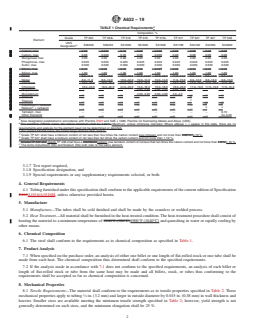
1.1 This specification covers grades of stainless steel tubing in sizes under 1/2 down to 0.050 in. (12.7 to 1.27 mm) in outside diameter and wall thicknesses less than 0.065 in. down to 0.005 in. (1.65 to 0.13 mm) for general corrosion-resisting and low- or high-temperature service, as designated in Table 1.
Note 1: The grades of austenitic stainless steel tubing furnished in accordance with this specification have been found suitable for low-temperature service down to −325°F (−200°C) in which Charpy notched-bar impact values of 15 ft·lbf (20 J), minimum, are required and these grades need not be impact tested.
1.2 Optional supplementary requirements are provided and, when desired, shall be so stated in the order.
1.3 The values stated in inch-pound units are to be regarded as standard. The values given in parentheses are mathematical conversions to SI units that are provided for information only and are not considered standard.
1.4 This international standard was developed in accordance with internationally recognized principles on standardization established in the Decision on Principles for the Development of International Standards, Guides and Recommendations issued by the World Trade Organization Technical Barriers to Trade (TBT) Committee.
- Status
- Published
- Publication Date
- 31-Aug-2019
- Technical Committee
- A01 - Steel, Stainless Steel and Related Alloys
- Drafting Committee
- A01.10 - Stainless and Alloy Steel Tubular Products
Buy Documents

ASTM A632-19 - Standard Specification for Seamless and Welded Austenitic Stainless Steel Tubing (Small-Diameter) for General Service
REDLINE ASTM A632-19 - Standard Specification for Seamless and Welded Austenitic Stainless Steel Tubing (Small-Diameter) for General Service
Overview
ASTM A632-19: Standard Specification for Seamless and Welded Austenitic Stainless Steel Tubing (Small-Diameter) for General Service is a widely recognized international standard developed by ASTM International. This specification covers small-diameter austenitic stainless steel tubing designed for general corrosion-resisting applications and scenarios requiring either low- or high-temperature service. The standard emphasizes cold-finished tubes produced through either seamless or welded methods, all delivered in a heat-treated condition to ensure optimal durability and performance. The covered tube sizes range from under 1/2 inch down to 0.050 inch in outside diameter and with wall thicknesses less than 0.065 inch down to 0.005 inch.
Key Topics
- Materials Covered: Grades of seamless and welded austenitic stainless steel, including common UNS designations such as S30400 (304), S31600 (316), and S32100 (321), among others.
- Manufacturing Requirements:
- Tubes must be cold finished.
- Heat treatment requirements specify heating to at least 1900°F (1040°C) and rapid cooling or water quenching.
- Mechanical Properties: Tubes must meet specified minimum requirements for tensile strength, yield strength, and elongation, ensuring reliable performance in critical applications.
- Testing Procedures:
- Tubes are subject to mechanical tests such as tension and flaring.
- Each tube undergoes hydrostatic, air underwater pressure, or nondestructive electric testing to verify integrity.
- Dimensional Tolerances: Strict permissible variations for outside diameter and wall thickness are defined.
- Surface Condition: Tubes must be pickled free of scale or bright annealed, maintaining high levels of cleanliness and corrosion resistance.
- Supplementary Requirements: Optional tests, such as dye penetrant inspection and intergranular corrosion testing, can be specified by the purchaser for additional assurance.
Applications
ASTM A632-19 stainless steel tubing is designed for a broad range of industries and services, including:
- Chemical and Petrochemical Processing: The tubing's corrosion resistance and mechanical performance make it ideal for transporting aggressive chemicals and pressurized fluids.
- Pharmaceutical and Food Processing: The standard’s requirements ensure a high level of purity and cleanliness, suitable for critical hygienic applications.
- Instrumentation and Control: Small-diameter stainless steel tubing is used extensively in systems that require precise measurement and control under demanding environments.
- Cryogenic Applications: The tubing grades covered by the standard are suitable for service at temperatures as low as -325°F (-200°C), making them appropriate for low-temperature engineering.
- General Industrial Applications: Utilized wherever robust resistance to corrosion and mechanical reliability in small-diameter tubing is needed.
Related Standards
For users and specifiers of stainless steel tubing, the following related standards may also be relevant:
- ASTM A262: Practices for Detecting Susceptibility to Intergranular Attack in Austenitic Stainless Steels.
- ASTM A380/A380M: Practice for Cleaning, Descaling, and Passivation of Stainless Steel Parts, Equipment, and Systems.
- ASTM A1016/A1016M: Specification for General Requirements for Ferritic Alloy Steel, Austenitic Alloy Steel, and Stainless Steel Tubes.
- ASTM E165/E165M: Practice for Liquid Penetrant Testing for General Industry.
- ASTM E527: Practice for Numbering Metals and Alloys in the Unified Numbering System (UNS).
- SAE J1086: Practice for Numbering Metals and Alloys.
By referring to ASTM A632-19, manufacturers, suppliers, and end-users can ensure that the small-diameter stainless steel tubing they specify or procure meets rigorous requirements for quality, safety, and performance in a variety of demanding service environments.
Relations
- Effective Date
- 01-Sep-2019
- Effective Date
- 01-Nov-2023
- Effective Date
- 01-Sep-2018
- Effective Date
- 01-Mar-2018
- Effective Date
- 01-Sep-2017
- Effective Date
- 15-Mar-2017
- Effective Date
- 01-Mar-2014
- Effective Date
- 01-Mar-2014
- Effective Date
- 01-May-2013
- Effective Date
- 01-Apr-2013
- Effective Date
- 15-Feb-2013
- Effective Date
- 15-May-2011
- Effective Date
- 01-Apr-2011
- Effective Date
- 01-Oct-2010
- Effective Date
- 01-Apr-2010
Buy Documents
ASTM A632-19 - Standard Specification for Seamless and Welded Austenitic Stainless Steel Tubing (Small-Diameter) for General Service
REDLINE ASTM A632-19 - Standard Specification for Seamless and Welded Austenitic Stainless Steel Tubing (Small-Diameter) for General Service
Get Certified
Connect with accredited certification bodies for this standard

Institut za varilstvo d.o.o. (Welding Institute)
Slovenia's leading welding institute since 1952. ISO 3834, EN 1090, pressure equipment certification, NDT personnel, welder qualification. Only IIW Au
Sponsored listings
Frequently Asked Questions
ASTM A632-19 is a technical specification published by ASTM International. Its full title is "Standard Specification for Seamless and Welded Austenitic Stainless Steel Tubing (Small-Diameter) for General Service". This standard covers: ABSTRACT The specification covers grades of stainless steel tubing for general corrosion-resisting and low or high-temperature service. The tubes shall be cold finished and shall be made by the seamless or welded process. All material shall be furnished in the heat-treated condition. The heat-treatment procedure shall consist of heating the material and quenching in water or rapidly cooling by other means. Tension tests, flaring tests, hydrostatic tests, air underwater pressure tests, and nondestructive electric tests shall be performed in accordance to the specified requirements. SCOPE 1.1 This specification covers grades of stainless steel tubing in sizes under 1/2 down to 0.050 in. (12.7 to 1.27 mm) in outside diameter and wall thicknesses less than 0.065 in. down to 0.005 in. (1.65 to 0.13 mm) for general corrosion-resisting and low- or high-temperature service, as designated in Table 1. Note 1: The grades of austenitic stainless steel tubing furnished in accordance with this specification have been found suitable for low-temperature service down to −325°F (−200°C) in which Charpy notched-bar impact values of 15 ft·lbf (20 J), minimum, are required and these grades need not be impact tested. 1.2 Optional supplementary requirements are provided and, when desired, shall be so stated in the order. 1.3 The values stated in inch-pound units are to be regarded as standard. The values given in parentheses are mathematical conversions to SI units that are provided for information only and are not considered standard. 1.4 This international standard was developed in accordance with internationally recognized principles on standardization established in the Decision on Principles for the Development of International Standards, Guides and Recommendations issued by the World Trade Organization Technical Barriers to Trade (TBT) Committee.
ABSTRACT The specification covers grades of stainless steel tubing for general corrosion-resisting and low or high-temperature service. The tubes shall be cold finished and shall be made by the seamless or welded process. All material shall be furnished in the heat-treated condition. The heat-treatment procedure shall consist of heating the material and quenching in water or rapidly cooling by other means. Tension tests, flaring tests, hydrostatic tests, air underwater pressure tests, and nondestructive electric tests shall be performed in accordance to the specified requirements. SCOPE 1.1 This specification covers grades of stainless steel tubing in sizes under 1/2 down to 0.050 in. (12.7 to 1.27 mm) in outside diameter and wall thicknesses less than 0.065 in. down to 0.005 in. (1.65 to 0.13 mm) for general corrosion-resisting and low- or high-temperature service, as designated in Table 1. Note 1: The grades of austenitic stainless steel tubing furnished in accordance with this specification have been found suitable for low-temperature service down to −325°F (−200°C) in which Charpy notched-bar impact values of 15 ft·lbf (20 J), minimum, are required and these grades need not be impact tested. 1.2 Optional supplementary requirements are provided and, when desired, shall be so stated in the order. 1.3 The values stated in inch-pound units are to be regarded as standard. The values given in parentheses are mathematical conversions to SI units that are provided for information only and are not considered standard. 1.4 This international standard was developed in accordance with internationally recognized principles on standardization established in the Decision on Principles for the Development of International Standards, Guides and Recommendations issued by the World Trade Organization Technical Barriers to Trade (TBT) Committee.
ASTM A632-19 is classified under the following ICS (International Classification for Standards) categories: 23.040.10 - Iron and steel pipes; 23.040.40 - Metal fittings. The ICS classification helps identify the subject area and facilitates finding related standards.
ASTM A632-19 has the following relationships with other standards: It is inter standard links to ASTM A632-04(2014), ASTM A1016/A1016M-23, ASTM A1016/A1016M-18a, ASTM A1016/A1016M-18, ASTM A1016/A1016M-17a, ASTM A1016/A1016M-17, ASTM A1016/A1016M-14e1, ASTM A1016/A1016M-14, ASTM A262-13, ASTM A1016/A1016M-13, ASTM A380/A380M-13, ASTM A1016/A1016M-11a, ASTM A1016/A1016M-11, ASTM A1016/A1016M-10, ASTM A262-10. Understanding these relationships helps ensure you are using the most current and applicable version of the standard.
ASTM A632-19 is available in PDF format for immediate download after purchase. The document can be added to your cart and obtained through the secure checkout process. Digital delivery ensures instant access to the complete standard document.
Standards Content (Sample)
This international standard was developed in accordance with internationally recognized principles on standardization established in the Decision on Principles for the
Development of International Standards, Guides and Recommendations issued by the World Trade Organization Technical Barriers to Trade (TBT) Committee.
Designation:A632 −19
Standard Specification for
Seamless and Welded Austenitic Stainless Steel Tubing
(Small-Diameter) for General Service
This standard is issued under the fixed designation A632; the number immediately following the designation indicates the year of
original adoption or, in the case of revision, the year of last revision.Anumber in parentheses indicates the year of last reapproval.A
superscript epsilon (´) indicates an editorial change since the last revision or reapproval.
1. Scope* E165/E165MPractice for Liquid Penetrant Testing for Gen-
eral Industry
1.1 This specification covers grades of stainless steel tubing
E527Practice for Numbering Metals and Alloys in the
insizesunder ⁄2downto0.050in.(12.7to1.27mm)inoutside
Unified Numbering System (UNS)
diameterandwallthicknesseslessthan0.065in.downto0.005
2.2 SAE Standard:
in. (1.65 to 0.13 mm) for general corrosion-resisting and low-
SAE J1086Practice for Numbering Metals and Alloys
or high-temperature service, as designated in Table 1.
(UNS)
NOTE 1—The grades of austenitic stainless steel tubing furnished in
accordance with this specification have been found suitable for low-
3. Ordering Information
temperature service down to −325°F (−200°C) in which Charpy notched-
3.1 Orders for product under this specification should in-
bar impact values of 15 ft·lbf (20 J), minimum, are required and these
grades need not be impact tested. clude the following, as required, to describe the desired
material adequately:
1.2 Optional supplementary requirements are provided and,
3.1.1 Quantity (feet or number of lengths),
when desired, shall be so stated in the order.
3.1.2 Name of product (seamless or welded tubes),
1.3 The values stated in inch-pound units are to be regarded
3.1.3 Grade (see Table 1),
as standard. The values given in parentheses are mathematical
3.1.4 Size (only two of the following: outside diameter,
conversions to SI units that are provided for information only
inside diameter, and average wall),
and are not considered standard.
3.1.5 Length (specific or random),
1.4 This international standard was developed in accor-
3.1.6 Optional requirements (check analysis, see Section 7;
dance with internationally recognized principles on standard-
hydrostatic, air underwater pressure test, or nondestructive
ization established in the Decision on Principles for the
electric test, see Section 13),
Development of International Standards, Guides and Recom-
3.1.7 Test report required,
mendations issued by the World Trade Organization Technical
3.1.8 Specification designation, and
Barriers to Trade (TBT) Committee.
3.1.9 Special requirements or any supplementary require-
ments selected, or both.
2. Referenced Documents
2.1 ASTM Standards: 4. General Requirements
A262Practices for Detecting Susceptibility to Intergranular
4.1 Tubing furnished under this specification shall conform
Attack in Austenitic Stainless Steels
to the applicable requirements of the current edition of Speci-
A380/A380MPractice for Cleaning, Descaling, and Passi-
fication A1016/A1016M, unless otherwise provided herein.
vation of Stainless Steel Parts, Equipment, and Systems
A1016/A1016MSpecification for General Requirements for
5. Manufacture
Ferritic Alloy Steel, Austenitic Alloy Steel, and Stainless
5.1 Manufacture—Thetubesshallbecoldfinishedandshall
Steel Tubes
be made by the seamless or welded process.
1 5.2 Heat Treatment—All material shall be furnished in the
This specification is under the jurisdiction ofASTM Committee A01 on Steel,
Stainless Steel and RelatedAlloys and is the direct responsibility of Subcommittee heat-treated condition. The heat-treatment procedure shall
A01.10 on Stainless and Alloy Steel Tubular Products.
consist of heating the material to a minimum temperature of
Current edition approved Sept. 1, 2019. Published September 2019. Originally
1900°F(1040°C)andquenchinginwaterorrapidlycoolingby
approved in 1969. Last previous edition approved in 2014 as A632–04 (2014).
other means.
DOI: 10.1520/A0632-19.
For referenced ASTM standards, visit the ASTM website, www.astm.org, or
contact ASTM Customer Service at service@astm.org. For Annual Book of ASTM
Standards volume information, refer to the standard’s Document Summary page on AvailablefromSAEInternational(SAE),400CommonwealthDr.,Warrendale,
the ASTM website. PA 15096-0001, http://www.sae.org.
*A Summary of Changes section appears at the end of this standard
Copyright © ASTM International, 100 Barr Harbor Drive, PO Box C700, West Conshohocken, PA 19428-2959. United States
A632−19
B
TABLE 1 Chemical Requirements
Composition, %
Grade TP 304 TP 304L TP 310 TP 316 TP 316L TP 317 TP 321 TP 347 TP 348
Element
UNS
S30400 S30403 S31000 S31600 S31603 S31700 S32100 S34700 S34800
A
Designation
Carbon, max 0.08 0.030 0.25 0.08 0.030 0.08 0.08 0.08 0.08
Manganese max 2.00 2.00 2.00 2.00 2.00 2.00 2.00 2.00 2.00
Phosphorus, max 0.045 0.045 0.045 0.045 0.045 0.045 0.045 0.045 0.045
Sulfur, max 0.030 0.030 0.030 0.030 0.030 0.030 0.030 0.030 0.030
Silicon, max 1.00 1.00 1.50 1.00 1.00 1.00 1.00 1.00 1.00
Nickel 8.0–11.0 8.0–12.0 19.0–22.0 10.0–14.0 10.0–14.0 11.0–15.0 9.0–12.0 9.0–13.0 9.0–13.0
Chromium 18.0–20.0 18.0–20.0 24.0–26.0 16.0–18.0 16.0–18.0 18.0–20.0 17.0–19.0 17.0–19.0 17.0–19.0
Molybdenum . . . 2.00–3.00 2.00–3.00 3.0–4.0 . . .
C
Titanium . . . . . . . .
F DE
Niobium + tantalum . . . . . . .
Tantalum, max . . . . . . . . 0.10
Other Elements . . . . . . . . Co 0.20
A
New designation established in accordance with Practice E527 and SAE J 1086, Practice for Numbering Metals and Alloys (UNS).
B
Maximum, unless otherwise indicated. Where ellipses (.) appear in this table, there are no requirements and analysis for the element need not be determined or
reported.
C
Grade TP 321 shall have a titanium content of not less than five times the carbon content plus nitrogen and not more than 0.70 %.
D
Grade TP 347 shall have a niobium content of not less than ten times the carbon content and not more than 1.10 %.
E
Grade TP 348 shall have a niobium plus tantalum content of not less than ten times the carbon content and not more than 1.10 %.
F
The terms Columbium (Cb) and Niobium (Nb) both refer to the same element.
6. Chemical Composition 9. Permissible Variations in Dimensions
6.1 The steel shall conform to the requirements as to 9.1 Variations in diameter and wall thickness from those
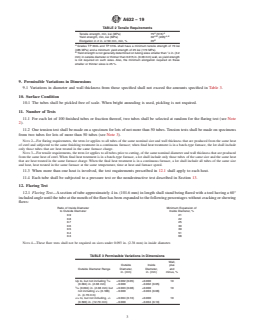
chemical composition as specified in Table 1. specified shall not exceed the amounts specified in Table 3.
10. Surface Condition
7. Product Analysis
7.1 When specified on the purchase order, an analysis of 10.1 The tubes shall be pickled free of scale. When bright
annealing is used, pickling is not required.
either one billet or one length of flat-rolled stock or one tube
shall be made from each heat. The chemical composition thus
11. Number of Tests
determined shall conform to the specified requirements.
11.1 For each lot of 100 finished tubes or fraction thereof,
7.2 If the analysis made in accordance with 7.1 does not
two tubes shall be selected at random for the flaring test (see
conform to the specified requirements, an analysis of each
Note 2).
billet or length of flat-rolled stock or tube from the same heat
maybemadeandallbillets,stock,ortubesthusconformingto
11.2 One tension test shall be made on a specimen for lots
the requirements shall be accepted so far as chemical compo-
of not more than 50 tubes. Tension tests shall be made on
sition is concerned. specimens from two tubes for lots of more than 50 tubes (see
Note 3).
8. Mechanical Properties
NOTE2—Forflaringrequirements,thetermlotappliestoalltubesofthe
8.1 Tensile Requirements—The material shall conform to
same nominal size and wall thickness that are produced from the same
the requirements as to tensile properties specified in Table 2. heat of steel and subjected to the same finishing treatment in a continuous
furnace; when final heat treatment is in a batch-type furnace, the lot shall
These mechanical properties apply to tubing ⁄8 in. (3.2 mm)
include only those tubes that are heat treated in the same furnace charge.
and larger in outside diameter by 0.015 in. (0.38 mm) in wall
NOTE3—Fortensilerequirements,thetermlotappliestoalltubesprior
thickness and heavier. Smaller sizes are ava
...
This document is not an ASTM standard and is intended only to provide the user of an ASTM standard an indication of what changes have been made to the previous version. Because
it may not be technically possible to adequately depict all changes accurately, ASTM recommends that users consult prior editions as appropriate. In all cases only the current version
of the standard as published by ASTM is to be considered the official document.
Designation: A632 − 04 (Reapproved 2014) A632 − 19
Standard Specification for
Seamless and Welded Austenitic Stainless Steel Tubing
(Small-Diameter) for General Service
This standard is issued under the fixed designation A632; the number immediately following the designation indicates the year of
original adoption or, in the case of revision, the year of last revision. A number in parentheses indicates the year of last reapproval. A
superscript epsilon (´) indicates an editorial change since the last revision or reapproval.
1. Scope Scope*
1.1 This specification covers grades of stainless steel tubing in sizes under ⁄2 down to 0.050 in. (12.7 to 1.27 mm) in outside
diameter and wall thicknesses less than 0.065 in. down to 0.005 in. (1.65 to 0.13 mm) for general corrosion-resisting and low- or
high-temperature service, as designated in Table 1.
NOTE 1—The grades of austenitic stainless steel tubing furnished in accordance with this specification have been found suitable for low-temperature
service down to −325°F (−200°C) in which Charpy notched-bar impact values of 15 ft·lbf (20 J), minimum, are required and these grades need not be
impact tested.
1.2 Optional supplementary requirements are provided and, when desired, shall be so stated in the order.
1.3 The values stated in inch-pound units are to be regarded as standard. The values given in parentheses are mathematical
conversions to SI units that are provided for information only and are not considered standard.
1.4 This international standard was developed in accordance with internationally recognized principles on standardization
established in the Decision on Principles for the Development of International Standards, Guides and Recommendations issued
by the World Trade Organization Technical Barriers to Trade (TBT) Committee.
2. Referenced Documents
2.1 ASTM Standards:
A262 Practices for Detecting Susceptibility to Intergranular Attack in Austenitic Stainless Steels
A380A380/A380M Practice for Cleaning, Descaling, and Passivation of Stainless Steel Parts, Equipment, and Systems
A1016/A1016M Specification for General Requirements for Ferritic Alloy Steel, Austenitic Alloy Steel, and Stainless Steel
Tubes
E165E165/E165M Practice for Liquid Penetrant Testing for General Industry
E527 Practice for Numbering Metals and Alloys in the Unified Numbering System (UNS)
2.2 SAE Standard:
SAE J 1086 Practice for Numbering Metals and Alloys (UNS)
3. Ordering Information
3.1 Orders for product under this specification should include the following, as required, to describe the desired material
adequately:
3.1.1 Quantity (feet or number of lengths),
3.1.2 Name of product (seamless or welded tubes),
3.1.3 Grade (see Table 1),
3.1.4 Size (only two of the following: outside diameter, inside diameter, and average wall),
3.1.5 Length (specific or random),
3.1.6 Optional requirements (check analysis, see Section 7; hydrostatic, air underwater pressure test, or nondestructive electric
test, see Section 13),
This specification is under the jurisdiction of ASTM Committee A01 on Steel, Stainless Steel and Related Alloys and is the direct responsibility of Subcommittee A01.10
on Stainless and Alloy Steel Tubular Products.
Current edition approved Oct. 1, 2014Sept. 1, 2019. Published October 2014September 2019. Originally approved in 1969. Last previous edition approved in 20092014
as A632A632 – 04 (2014). – 04 (2009). DOI: 10.1520/A0632-04R14.DOI: 10.1520/A0632-19.
For referenced ASTM standards, visit the ASTM website, www.astm.org, or contact ASTM Customer Service at service@astm.org. For Annual Book of ASTM Standards
volume information, refer to the standard’s Document Summary page on the ASTM website.
Available from SAE International (SAE), 400 Commonwealth Dr., Warrendale, PA 15096-0001, http://www.sae.org.
*A Summary of Changes section appears at the end of this standard
Copyright © ASTM International, 100 Barr Harbor Drive, PO Box C700, West Conshohocken, PA 19428-2959. United States
A632 − 19
B
TABLE 1 Chemical Requirements
Composition, %
Grade TP 304 TP 304L TP 310 TP 316 TP 316L TP 317 TP 321 TP 347 TP 348
Element
UNS
S30400 S30403 S31000 S31600 S31603 S31700 S32100 S34700 S34800
A
Designation
Carbon, max 0.08 0.030 0.15 0.08 0.030 0.08 0.08 0.08 0.08
Carbon, max 0.08 0.030 0.25 0.08 0.030 0.08 0.08 0.08 0.08
Manganese max 2.00 2.00 2.00 2.00 2.00 2.00 2.00 2.00 2.00
Phosphorus, max 0.045 0.045 0.045 0.045 0.045 0.045 0.045 0.045 0.045
Sulfur, max 0.030 0.030 0.030 0.030 0.030 0.030 0.030 0.030 0.030
B
Silicon, max 0.75 0.75 0.75 0.75 0.75 0.75 0.75 0.75 0.75
Silicon, max 1.00 1.00 1.50 1.00 1.00 1.00 1.00 1.00 1.00
C
Nickel 8.0–11.0 8.0–13.0 19.0–22.0 11.0–14.0 10.0–15.0 11.0–14.0 9.0–13.0 9.0–13.0 9.0–13.0
Nickel 8.0–11.0 8.0–12.0 19.0–22.0 10.0–14.0 10.0–14.0 11.0–15.0 9.0–12.0 9.0–13.0 9.0–13.0
Chromium 18.0–20.0 18.0–20.0 24.0–26.0 16.0–18.0 16.0–18.0 18.0–20.0 17.0–20.0 17.0–20.0 17.0–20.0
Chromium 18.0–20.0 18.0–20.0 24.0–26.0 16.0–18.0 16.0–18.0 18.0–20.0 17.0–19.0 17.0–19.0 17.0–19.0
Molybdenum . . . 2.00–3.00 2.00–3.00 3.00–4.00 . . .
Molybdenum . . . 2.00–3.00 2.00–3.00 3.0–4.0 . . .
D
Titanium . . . . . . . .
C
Titanium . . . . . . . .
E E
Columbium + tantalum . . . . . . .
F D E
Niobium + tantalum . . . . . . .
Tantalum, max . . . . . . . . 0.10
Other Elements . . . . . . . . Co 0.20
A
New designation established in accordance with Practice E527 and SAE J 1086, Practice for Numbering Metals and Alloys (UNS).
B
For seamless TP316L tubes, the silicon maximum shall be 1.00 %. Maximum, unless otherwise indicated. Where ellipses (.) appear in this table, there are no
requirements and analysis for the element need not be determined or reported.
C
For welded TP 316 tubes, the nickel range shall be 10.0–14.0 %.
C
Grade TP 321 shall have a titanium content of not less than five times the carbon content plus nitrogen and not more than 0.60 %. 0.70 %.
D
Grade TP 347 shall have a niobium content of not less than ten times the carbon content and not more than 1.10 %.
E
Grades TP 347 and Grade TP 348 shall have a columbiumniobium plus tantalum content of not less than ten times the carbon content and not more than 1.0 %.1.10 %.
F
The terms Columbium (Cb) and Niobium (Nb) both refer to the same element.
3.1.7 Test report required,
3.1.8 Specification designation, and
3.1.9 Special requirements or any supplementary requirements selected, or both.
4. General Requirements
4.1 Tubing furnished under this specification shall conform to the applicable requirements of the current edition of Specification
E165A1016/A1016M, unless otherwise provided herein.
5. Manufacture
5.1 Manufacture—The tubes shall be cold finished and shall be made by the seamless or welded process.
5.2 Heat Treatment—All material shall be furnished in the heat-treated condition. The heat-treatment procedure shall consist of
heating the material to a minimum temperature of 1800°F (980°C)1900°F (1040°C) and quenching in water or rapidly cooling by
other means.
6. Chemical Composition
6.1 The steel shall conform to the requirements as to chemical composition as specified in Table 1.
7. Product Analysis
7.1 When specified on the purchase order, an analysis of either one billet or one length of flat-rolled stock or one tube shall be
made from each heat. The chemical composition thus determined shall conform to the specified requirements.
7.2 If the analysis made in accordance with 7.1 does not conform to the specified requirements, an analysis of each billet or
length of flat-rolled stock or tube from the same heat may be made and all billets, stock, or tubes thus conforming to the
requirements shall be accepted so far as chemical composition is concerned.
8. Mechanical Properties
8.1 Tensile Requirements—The material shall conform to the requirements as to tensile properties specified in Table 2. These
mechanical properties apply to tubing ⁄8 in. (3.2 mm) and larger in outside diameter by 0.015 in. (0.38 mm) in wall thickness and
heavier. Smaller sizes are available meeting the minimum tensile strength specified in Table 2; however, yield strength is not
generally determined on such sizes, and the minimum elongation shall be 25 %.
A632 − 19
TABLE 2 Tensile Requirements
A A
Tensile strength, min, ksi (MPa) 75 (515)
A,B A,B
Yield strength, min, ksi (MPa) 30 (205)
B
Elongation in 2 in. or 50 mm, min, % 35
A
Grades TP 304L and TP 316L shall have a minimum tensile strength of 70 ksi
(485 MPa) and a minimum yield strength of 25 ksi (170 MPa).
B
Yield strength is not generally determined on tubing sizes smaller than ⁄8 in. (3.2
mm) in outside diameter or thinner than 0.015 in. (0.38 mm) wall, so yield strength
is not required on such sizes.
...