

ASTM D8010-18
(Test Method)Standard Test Method for Determination of Water Soluble Alkali Content in Coal
General Information
- Abstract
SIGNIFICANCE AND USE
5.1 Results obtained from the test method are used to serve a number of interests, including the indication of possible boiler tube fouling and possible furnace corrosion problems.
SCOPE
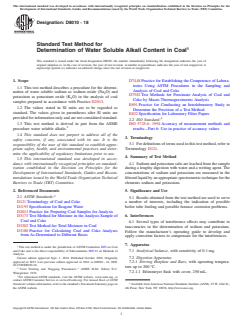
1.1 This test method describes a procedure for the determination of water soluble sodium as sodium oxide (Na2O) and potassium as potassium oxide (K2O) in the analysis of coal samples prepared in accordance with Practice D2013.
1.2 The values stated in SI units are to be regarded as standard. The values given in parentheses after SI units are provided for information only and are not considered standard.
1.3 This test method is derived in part from the ASME procedure water soluble alkalis.2
1.4 This standard does not purport to address all of the safety concerns, if any, associated with its use. It is the responsibility of the user of this standard to establish appropriate safety, health, and environmental practices and determine the applicability of regulatory limitations prior to use.
1.5 This international standard was developed in accordance with internationally recognized principles on standardization established in the Decision on Principles for the Development of International Standards, Guides and Recommendations issued by the World Trade Organization Technical Barriers to Trade (TBT) Committee.
- Status
- Published
- Publication Date
- 31-Aug-2018
- Technical Committee
- D05 - Coal and Coke
- Drafting Committee
- D05.21 - Methods of Analysis
Buy Documents
ASTM D8010-18 - Standard Test Method for Determination of Water Soluble Alkali Content in Coal
REDLINE ASTM D8010-18 - Standard Test Method for Determination of Water Soluble Alkali Content in Coal
Overview
ASTM D8010-18: Standard Test Method for Determination of Water Soluble Alkali Content in Coal specifies procedures to determine the water soluble alkali content, specifically sodium as sodium oxide (Na2O) and potassium as potassium oxide (K2O), in coal samples. Accurate determination of these alkalis is critical for understanding the potential of coal to cause boiler tube fouling and furnace corrosion in industrial combustion systems. This standard was developed to address both practical and safety considerations in laboratory analysis, and forms part of internationally recognized best practices for coal quality assessment.
Key Topics
Scope of the Method:
- Determines water soluble sodium (Na2O) and potassium (K2O) in coal, following sample preparation in compliance with ASTM D2013.
- Values are reported in standard SI units.
- Applicable to a variety of coal types, supporting global consistency in testing.
Significance and Use:
- Results highlight risk factors for boiler tube fouling and furnace corrosion due to alkali metals, aiding in predictive maintenance and material selection.
- Provides reliable data for coal quality control and coal processing optimization.
Procedure Highlights:
- Involves leaching coal sample with water and a wetting agent using either a hot plate or hot block digestion method.
- Subsequent filtering and analysis of the leached solution by spectrometric techniques to quantify sodium and potassium levels.
- Mandates careful calibration and verification of instrument performance to ensure accuracy.
Quality and Calibration:
- Requires the use of reagent grade chemicals and Type II reagent water.
- Frequent use of calibration standards and blanks to establish and verify analytical baselines.
- Focuses on minimizing measurement interference and maintaining high-quality laboratory practices.
Applications
Industrial and Commercial Uses:
- Power Generation: Essential for coal-fired plant operators to minimize operational risks by monitoring and managing alkali-induced fouling and corrosion.
- Coal Preparation Plants: Guides the selection and blending of coal to ensure compliance with user specifications regarding alkali content.
- Research and Development: Supports the evaluation and development of new coal utilization technologies and materials resistant to alkali attack.
Laboratory Testing:
- Establishes standardized procedures for analytical laboratories performing coal analysis, ensuring reproducibility and interlaboratory consistency.
- Facilitates compliance with international trade and quality frameworks, lowering the risk of disputes and delays in coal commerce.
Environmental and Safety Assessments:
- Indirectly assists in understanding environmental impacts of coal combustion by helping predict changes in emissions and residue formation associated with alkali content.
Related Standards
Several standards are referenced within ASTM D8010-18 to ensure all aspects of the methodology are comprehensive and harmonized:
- ASTM D2013 – Practice for Preparing Coal Samples for Analysis
- ASTM D1193 – Specification for Reagent Water
- ASTM D3173, D3302, D7582 – Methods for determination of moisture in coal and coke
- ASTM D121 – Terminology of Coal and Coke
- ASTM D3180 – Practice for Calculating Coal and Coke Analyses
- ASTM D7448 – Laboratory competence procedures for coal analysis
- ASTM E832 – Laboratory Filter Papers Specification
- ISO 5725-6 – Accuracy of measurement methods and results
Using ASTM D8010-18 in combination with these referenced standards ensures rigorous, repeatable results for the determination of water soluble alkali content in coal, supporting robust performance monitoring and operational efficiency across the coal supply chain.
Keywords: ASTM D8010-18, water soluble alkali, sodium oxide, potassium oxide, coal analysis, boiler tube fouling, furnace corrosion, coal quality, laboratory testing, standard test method, spectrometric technique, coal-fired power plant.
Relations
- Effective Date
- 01-Apr-2024
- Effective Date
- 01-Mar-2024
- Effective Date
- 01-Dec-2023
- Effective Date
- 01-Dec-2023
- Effective Date
- 01-Jul-2019
- Effective Date
- 01-Mar-2016
- Effective Date
- 01-Sep-2015
- Effective Date
- 01-Jan-2015
- Effective Date
- 01-May-2013
- Effective Date
- 01-Apr-2012
- Effective Date
- 01-Nov-2011
- Effective Date
- 01-Apr-2011
- Effective Date
- 01-Jun-2010
- Effective Date
- 01-Jun-2010
- Effective Date
- 01-Nov-2009
Buy Documents
ASTM D8010-18 - Standard Test Method for Determination of Water Soluble Alkali Content in Coal
REDLINE ASTM D8010-18 - Standard Test Method for Determination of Water Soluble Alkali Content in Coal
Get Certified
Connect with accredited certification bodies for this standard

Bureau Veritas Chile
Bureau Veritas certification services in Chile.
Bureau Veritas Peru
Bureau Veritas certification services in Peru.
BVQI Peru
Bureau Veritas certification in Peru.
Sponsored listings
Frequently Asked Questions
ASTM D8010-18 is a standard published by ASTM International. Its full title is "Standard Test Method for Determination of Water Soluble Alkali Content in Coal". This standard covers: SIGNIFICANCE AND USE 5.1 Results obtained from the test method are used to serve a number of interests, including the indication of possible boiler tube fouling and possible furnace corrosion problems. SCOPE 1.1 This test method describes a procedure for the determination of water soluble sodium as sodium oxide (Na2O) and potassium as potassium oxide (K2O) in the analysis of coal samples prepared in accordance with Practice D2013. 1.2 The values stated in SI units are to be regarded as standard. The values given in parentheses after SI units are provided for information only and are not considered standard. 1.3 This test method is derived in part from the ASME procedure water soluble alkalis.2 1.4 This standard does not purport to address all of the safety concerns, if any, associated with its use. It is the responsibility of the user of this standard to establish appropriate safety, health, and environmental practices and determine the applicability of regulatory limitations prior to use. 1.5 This international standard was developed in accordance with internationally recognized principles on standardization established in the Decision on Principles for the Development of International Standards, Guides and Recommendations issued by the World Trade Organization Technical Barriers to Trade (TBT) Committee.
SIGNIFICANCE AND USE 5.1 Results obtained from the test method are used to serve a number of interests, including the indication of possible boiler tube fouling and possible furnace corrosion problems. SCOPE 1.1 This test method describes a procedure for the determination of water soluble sodium as sodium oxide (Na2O) and potassium as potassium oxide (K2O) in the analysis of coal samples prepared in accordance with Practice D2013. 1.2 The values stated in SI units are to be regarded as standard. The values given in parentheses after SI units are provided for information only and are not considered standard. 1.3 This test method is derived in part from the ASME procedure water soluble alkalis.2 1.4 This standard does not purport to address all of the safety concerns, if any, associated with its use. It is the responsibility of the user of this standard to establish appropriate safety, health, and environmental practices and determine the applicability of regulatory limitations prior to use. 1.5 This international standard was developed in accordance with internationally recognized principles on standardization established in the Decision on Principles for the Development of International Standards, Guides and Recommendations issued by the World Trade Organization Technical Barriers to Trade (TBT) Committee.
ASTM D8010-18 is classified under the following ICS (International Classification for Standards) categories: 73.040 - Coals. The ICS classification helps identify the subject area and facilitates finding related standards.
ASTM D8010-18 has the following relationships with other standards: It is inter standard links to ASTM D7582-24, ASTM D121-15(2024), ASTM D3180-15(2023), ASTM D7582-15(2023), ASTM E832-81(2019), ASTM D7448-16, ASTM D121-15, ASTM D3180-15, ASTM E691-13, ASTM D3180-12, ASTM E691-11, ASTM D3173-11, ASTM D7582-10, ASTM D7582-10e1, ASTM D7582-09. Understanding these relationships helps ensure you are using the most current and applicable version of the standard.
ASTM D8010-18 is available in PDF format for immediate download after purchase. The document can be added to your cart and obtained through the secure checkout process. Digital delivery ensures instant access to the complete standard document.
Standards Content (Sample)
This international standard was developed in accordance with internationally recognized principles on standardization established in the Decision on Principles for the
Development of International Standards, Guides and Recommendations issued by the World Trade Organization Technical Barriers to Trade (TBT) Committee.
Designation: D8010 − 18
Standard Test Method for
Determination of Water Soluble Alkali Content in Coal
This standard is issued under the fixed designation D8010; the number immediately following the designation indicates the year of
original adoption or, in the case of revision, the year of last revision.Anumber in parentheses indicates the year of last reapproval.A
superscript epsilon (´) indicates an editorial change since the last revision or reapproval.
1. Scope D7448Practice for Establishing the Competence of Labora-
tories Using ASTM Procedures in the Sampling and
1.1 This test method describes a procedure for the determi-
Analysis of Coal and Coke
nation of water soluble sodium as sodium oxide (Na O) and
D7582Test Methods for Proximate Analysis of Coal and
potassium as potassium oxide (K O) in the analysis of coal
Coke by Macro Thermogravimetric Analysis
samples prepared in accordance with Practice D2013.
E691Practice for Conducting an Interlaboratory Study to
1.2 The values stated in SI units are to be regarded as
Determine the Precision of a Test Method
standard. The values given in parentheses after SI units are
E832Specification for Laboratory Filter Papers
providedforinformationonlyandarenotconsideredstandard. 4
2.2 ISO Standard:
1.3 This test method is derived in part from the ASME ISO 5725-6: 1994Accuracy of measurement methods and
procedure water soluble alkalis.
results—Part 6: Use in practice of accuracy values
1.4 This standard does not purport to address all of the
3. Terminology
safety concerns, if any, associated with its use. It is the
3.1 Fordefinitionsoftermsusedinthistestmethod,referto
responsibility of the user of this standard to establish appro-
Terminology D121.
priate safety, health, and environmental practices and deter-
mine the applicability of regulatory limitations prior to use.
4. Summary of Test Method
1.5 This international standard was developed in accor-
4.1 Sodiumandpotassiumsaltsareleachedfromthesample
dance with internationally recognized principles on standard-
ization established in the Decision on Principles for the during a lengthy digestion with water and a wetting agent.The
concentrations of sodium and potassium are measured in the
Development of International Standards, Guides and Recom-
mendations issued by the World Trade Organization Technical filteredliquidbyanappropriatespectrometrictechniqueforthe
elements sodium and potassium.
Barriers to Trade (TBT) Committee.
2. Referenced Documents
5. Significance and Use
2.1 ASTM Standards:
5.1 Results obtained from the test method are used to serve
D121Terminology of Coal and Coke
a number of interests, including the indication of possible
D1193Specification for Reagent Water
boiler tube fouling and possible furnace corrosion problems.
D2013Practice for Preparing Coal Samples for Analysis
6. Interferences
D3173Test Method for Moisture in theAnalysis Sample of
Coal and Coke
6.1 Several types of interference effects may contribute to
D3302Test Method for Total Moisture in Coal
inaccuracies in the determination of sodium and potassium.
D3180Practice for Calculating Coal and Coke Analyses
Follow the manufacturer’s operating guide to develop and
from As-Determined to Different Bases
apply correction factors to compensate for the interferences.
7. Apparatus
This test method is under the jurisdiction of ASTM Committee D05 on Coal
and Coke and is the direct responsibility of Subcommittee D05.21 on Methods of
7.1 Analytical balance, with sensitivity of 0.1mg.
Analysis.
7.2 Digestion Apparatus:
Current edition approved Sept. 1, 2018. Published October 2018. Originally
approved in 2015. Last previous edition approved in 2016 as D8010–16. DOI:
7.2.1 Stirring Hotplate and Bars, with operating tempera-
10.1520/D8010-18.
ture up to 200°C.
“Coal Fouling and Slagging Parameters.” ASME H-86. Editor E.C.
7.2.1.1 Erlenmeyer flask with cover, 250mL.
Winegartner, 1974.
For referenced ASTM standards, visit the ASTM website, www.astm.org, or
contact ASTM Customer Service at service@astm.org. For Annual Book of ASTM
Standards volume information, refer to the standard’s Document Summary page on Available fromAmerican National Standards Institute (ANSI), 25 W. 43rd St.,
the ASTM website. 4th Floor, New York, NY 10036, http://www.ansi.org.
Copyright © ASTM International, 100 Barr Harbor Drive, PO Box C700, West Conshohocken, PA 19428-2959. United States
D8010 − 18
7.2.1.2 Refluxing column (optional). 8.5 Blank Solutions—Two types of blank solutions are
7.2.2 Hot Block Digestion: required: a calibration blank of water that is used to establish
the analytical calibration curve and a method blank which is
7.2.2.1 Polycarbonate Bottles, 250mL capacity with an
used to evaluate possible contamination and assess spectral
O-ring seal and screw cap, capable of withstanding tempera-
background. The calibration blank is also used initially and
tures up to 130°C, the pressure that is developed during the
periodically to verify the baseline of the calibration has not
digestion, and resistant to oxidation. Other types of bottles or
changed significantly.
vials may be used provided they are capable of withstanding
thetemperaturesandpressuresdevelopedduringthedigestion.
8.5.1 Calibration Blank—Water.
8.5.2 Method Blank—Process the method blank through the
7.3 Filtering Apparatus:
same digestion procedure as the samples, using the same
7.3.1 Filter Paper or 0.45µm filter. The paper used must be
volumes of water and wetting agent as used in preparing the
ash-free, quantitative Type II filter paper, as described in
samples.
Specification E832.
7.3.2 Filter (gravity or vacuum).
9. Analysis Sample
7.3.3 Volumetric flask, 250mL.
9.1 Prepare the analysis sample in accordance with Practice
7.4 Spectrometer—Because of the differences between vari-
ous makes and models of satisfactory instruments, no detailed D2013 for coal by pulverizing the material to pass a 250µm
(No. 60) U.S.A. standard sieve. Determine moisture in accor-
operating instructions can be provided. Instead, follow the
instructions provided by the manufacturer of the particular dance with Test Method D3173, D3302,or D7582 to permit
calculations to other than as-determined bases.
instrument. Sensitivity, instrumental detection limit, precision,
linear dynamic range, and interference effects must be inves-
tigated and established for each individual analyte line on that 10. Procedure
particular instrument. All measurements must be within the
10.1 The solutions and proportions described below are the
instrument’s linear range in which correction factors are valid.
typical samples as represented by American coals. Therefore,
It is the responsibility of the analyst to verify that the
stronger or weaker dilutions may be required to establish
instrument configuration and operating conditions used satisfy
suitable concentrations for those elements of varying percents
the analytical requirements of this method and to maintain
outside the range of the typical sample. Analysts must deter-
quality control data confirming instrument performance and
minethesensitivityandlinearrangeofcalibrationoftheirown
analytical results.
equipment and choose concentration ranges for standards
compatible with the samples and instrument specific to their
8. Reagents and Materials
own work.
8.1 Purity of Reagents—Use reagent grade chemicals in all
10.2 Sample Digestion:
tests that conform to the specifications of the Committee on
10.2.1 Method A, Hot Plate—Accurately weigh 5g of
AnalyticalReagentsoftheAmericanChemicalSociety, where
sample to the nearest 0.1mg into a 250mL Erlenmeyer flask.
such specifications are available.
Thesamplemaybewettedwith1mLto5mLofwettingagent.
8.2 Purity of Water—Unless otherwise indicated, references
Add 100mL of water to the flask. Place the flask with sample
to water are understood to mean Type II reagent water as
onto the hot plate and cover.Allow to digest just under boiling
defined in Specification D1193.
for at least 16h. Do not allow the sample to go to dryness (a
8.3 Wetting Agent—Approximately 1mLto 5mLof isopro- refluxingcolumnmaybeusedtopreventthis).Allowtocoolto
pyl alcohol, methanol or ethanol may be added to the sample. room temperature. Filter by either gravity filtration or vacuum
filtration into a 250mL volumetric flask. Once filtration is
8.4 Calibration Standards—Standard stock solutions of
complete,dilutethefiltratetovolume(250mL)withwaterand
1000mg⁄L for each element are needed for preparation of
mix by inversion.
dilute calibration standards in the nominal range from
10.2.2 Method B, Hot Block—Accurately weigh 1g of
<0.1mg⁄Lto100mg⁄L.Preparecalibrationstandardsolutions
sample to the nearest 0.1mg into a weighing dish and
from99.99%(mass/mass)puritymetalsorsalts.Alternatively,
quantitatively transfer to a polycarbonate bottle. The sample
use commercially available standard stock solutions specifi-
maybewettedwith1mLto5mLofwettingagent.Add25mL
cally prepared for the correct spectroscopy method. Dilute
of water to the tube. Place the sample on the hot block and
calibration standard solutions are als
...
This document is not an ASTM standard and is intended only to provide the user of an ASTM standard an indication of what changes have been made to the previous version. Because
it may not be technically possible to adequately depict all changes accurately, ASTM recommends that users consult prior editions as appropriate. In all cases only the current version
of the standard as published by ASTM is to be considered the official document.
Designation: D8010 − 16 D8010 − 18
Standard Practice Test Method for
Determination of Water Soluble Alkali Content in Coal
This standard is issued under the fixed designation D8010; the number immediately following the designation indicates the year of
original adoption or, in the case of revision, the year of last revision. A number in parentheses indicates the year of last reapproval. A
superscript epsilon (´) indicates an editorial change since the last revision or reapproval.
1. Scope
1.1 This practice describes a procedure for the determination of water soluble sodium as sodium oxide (Na O) and potassium
as potassium oxide (K O) in the analysis of coal samples prepared in accordance with Practice D2013.
1.2 The values stated in SI units are to be regarded as standard. No other units of measurement are included in this standard.
1.3 This practice is derived in part from the ASME procedure water soluble alkalis.
1.4 This standard does not purport to address all of the safety concerns, if any, associated with its use. It is the responsibility
of the user of this standard to establish appropriate safety and health practices and determine the applicability of regulatory
limitations prior to use.
2. Referenced Documents
2.1 ASTM Standards:
D121 Terminology of Coal and Coke
D1193 Specification for Reagent Water
D2013 Practice for Preparing Coal Samples for Analysis
D3173 Test Method for Moisture in the Analysis Sample of Coal and Coke
D3302 Test Method for Total Moisture in Coal
D3180 Practice for Calculating Coal and Coke Analyses from As-Determined to Different Bases
D7448 Practice for Establishing the Competence of Laboratories Using ASTM Procedures in the Sampling and Analysis of Coal
and Coke
D7582 Test Methods for Proximate Analysis of Coal and Coke by Macro Thermogravimetric Analysis
E832 Specification for Laboratory Filter Papers
3. Terminology
3.1 For definitions of terms used in this practice, refer to Terminology D121.
4. Summary of Practice
4.1 Sodium and potassium salts are leached from the sample during a lengthy digestion with water and a wetting agent. The
concentrations of sodium and potassium are measured in the filtered liquid by an appropriate spectrometric technique for the
elements sodium and potassium.
5. Significance and Use
5.1 Results obtained from the practice are used to serve a number of interests, including the indication of possible boiler tube
fouling and possible furnace corrosion problems.
6. Interferences
6.1 Several types of interference effects may contribute to inaccuracies in the determination of sodium and potassium. Follow
the manufacturer’s operating guide to develop and apply correction factors to compensate for the interferences.
This test method is under the jurisdiction of ASTM Committee D05 on Coal and Coke and is the direct responsibility of Subcommittee D05.21 on Methods of Analysis.
Current edition approved Sept. 1, 2016Sept. 1, 2018. Published September 2016October 2018. Originally approved in 2015. Last previous edition approved in 20152016
as D8010D8010 – 16.–15. DOI: 10.1520/D8010-16.10.1520/D8010-18.
“Coal Fouling and Slagging Parameters.” ASME H-86. Editor E.C. Winegartner, 1974.
For referenced ASTM standards, visit the ASTM website, www.astm.org, or contact ASTM Customer Service at service@astm.org. For Annual Book of ASTM Standards
volume information, refer to the standard’s Document Summary page on the ASTM website.
Copyright © ASTM International, 100 Barr Harbor Drive, PO Box C700, West Conshohocken, PA 19428-2959. United States
D8010 − 18
7. Apparatus
7.1 Analytical balance, with sensitivity of 0.1 mg.
7.2 Digestion Apparatus
7.2.1 Stirring Hotplate and Bars, with operating temperature up to 200 °C.
7.2.1.1 Erlenmeyer flask with cover, 250 mL.
7.2.1.2 Refluxing column (optional).
7.2.2 Hot Block Digestion
7.2.2.1 Polycarbonate Bottles, 250 mL capacity with an O-ring seal and screw cap, capable of withstanding temperatures up to
130 °C, the pressure that is developed during the digestion, and resistant to oxidation. Other types of bottles or vials may be used
provided they are capable of withstanding the temperatures and pressures developed during the digestion.
7.3 Filtering Apparatus
7.3.1 Filter Paper or 0.45 micron filter. The paper used must be ash-free, quantitative Type II filter paper, as described in
Specification E832.
7.3.2 Filter (gravity or vacuum).
7.3.3 Volumetric flask, 250 mL.
7.4 Spectrometer—Because of the differences between various makes and models of satisfactory instruments, no detailed
operating instructions can be provided. Instead, follow the instructions provided by the manufacturer of the particular instrument.
Sensitivity, instrumental detection limit, precision, linear dynamic range, and interference effects must be investigated and
established for each individual analyte line on that particular instrument. All measurements must be within the instrument’s linear
range in which correction factors are valid. It is the responsibility of the analyst to verify that the instrument configuration and
operating conditions used satisfy the analytical requirements of this method and to maintain quality control data confirming
instrument performance and analytical results.
8. Reagents and Materials
8.1 Purity of Reagents—Use reagent grade chemicals in all tests that conform to the specifications of the Committee on
Analytical Reagents of the American Chemical Society, where such specifications are available.
8.2 Purity of Water—Unless otherwise indicated, references to water are understood to mean Type II reagent water as defined
in Specification D1193.
8.3 Wetting Agent—Approximately 1 to 5 mL of isopropyl alcohol, methanol or ethanol may be added to the sample.
8.4 Calibration Standards—Standard stock solutions of 1000 mg ⁄L for each element are needed for preparation of dilute
calibration standards in the nominal range from <0.1 to 100 mg/L. Prepare calibration standard solutions from 99.99 %
(mass/mass) purity metals or salts. Alternatively, use commercially available standard stock solutions specifically prepared for the
correct spectroscopy method. Dilute calibration standard solutions are also used initially and periodically to verify the baseline of
the calibration has not changed significantly.
8.5 Blank Solutions—Two types of blank solutions are required: a calibration blank of water that is used to establish the
analytical calibration curve and a method blank which is used to evaluate possible contamination and assess spectral background.
The calibration blank is also used initially and periodically to verify the baseline of the calibration has not changed significantly.
8.5.1 Calibration Blank—water.
8.5.2 Method Blank—Process the method blank through the same digestion procedure as the samples, using the same volumes
of water and wetting agent as used in preparing the samples.
9. Analysis Sample
9.1 Prepare the analysis sample in accordance with Practice D2013 for coal by pulverizing the material to pass a 250 μm (No.
60) U.S.A. standard sieve. Determine moisture in accordance with Test Method D3173, D3302, or D7582 to permit calculations
to other than as-determined bases.
10. Procedure
10.1 The solutions and proportions described below are the typical samples as represented by American coals. Therefore,
stronger or weaker dilutions may be required to establish suitable concentrations for those elements of varying percents outside
the range of the typical sample. Analysts must determine the sensitivity and linear range of calibration of their own equipment and
choose concentration ranges for standards compatible with the samples and instrument specific to their own work.
Reagent Chemicals, American Chemical Society Specifications, American Chemical Society, Washington, DC. For suggestions on the testing of reagents not listed by
the American Chemical Society, see Analar Standards for Laboratory Chemicals, BDH Ltd., Poole, Dorset, U.K., and the United States Pharmacopeia and National
Formulary, U.S. Pharmacopeial Convention, Inc. (USPC), Rockville, MD.
D8010 − 18
10.2 Sample Digestion
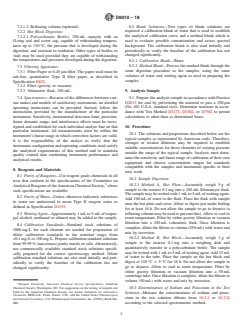
10.2.1 Method A, Hot Plate—Accurately weigh 5 g of sample to the nearest 0.1 mg into a 250 mL Erlenmeyer flask. The sample
may be wetted with 1 to 5 mL of wetting agent. Add 100 mL of water to the flask. Place the flask with sample onto the hot plate
and cover. Allow to digest just under boiling for at least 16 h. Do not allow the sample to go to dryness (a refluxing column may
be used to prevent this). Allow to cool to room temperature. Filter by either gravity filtration or vacuum filtration into a 250 mL
volumetric flask. Once filtration is complete, dilute the filtrate to volume (250 mL) with water and mix by inversion.
10.2.2 Method B, Hot Block—Accurately weigh 1 g of sample to the nearest 0.1 mg into a weighing dish and quantitatively
transfer to a polycarbonate bottle. The sample may be wetted with 1 to 5 mL of wetting agent. Add 25 mL of water to the tube.
Place the sample on the hot block and digest at 120 6 5 °C for 16 h. Do not allow the sample to go to dryness. Allow to cool
to room temperature. Filter by either gravity filtration or vacuum filtration into a 50 mL centrifuge tube. Once filtration is complete,
dilute the filtrate to volume (50 mL) with water and mix by inversion.
10.3 Determination of Sodium and Potassium in the Test Solution—Measure the concentrations of sodium and potassium in the
test solution (filtrate from 10.2.1 or 10.2.2) according to the selected spectrometric method.
11. Instrument Operation
11.1 Consult the manufacturer’s instructions for the chosen spectrometer. The present method assumes that good operating
procedures are followed. Design differences among instruments and different selected analytical wavelengths for individual
spectrometers make it impractical to list detailed conditions.
11.2 Calibration Procedure—Calibrate the instrument according to the procedure recommended by the manufacturer using a
calibration blank and calibration standards.
11.3 Initial Calibration Verification—Before analyzing test samples, analyze the method blank and verify the proper calibration
of the instrument by analyzing a reference material. Results for the reference material must be within the stated uncertainty limits
or the calibration procedure must be repeated.
11.4 Periodic Calibration Verification and Recalibration—In accordance with Guide D7448, analyze a control sample on a
periodic basis. Results obtained for the control sample must be within 10 % of the stated value or all results obtained since the
last successful control check for that element must be rejected and the calibration procedure repeated.
12. Report
12.1 For reporting analyses to other than as-determined basis, refer to Practice D3180.
12.2 For instruments that do not have calculation functions provided by the manufacturer for converting the concentration
amount of the analyte as analyzed to the appropriate oxide, the following calculations can be used:
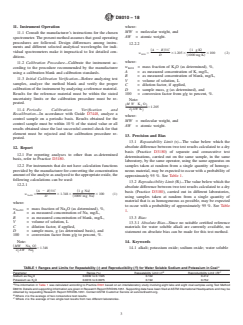
12.2.1
A 2 B VC 1 g N a
~ ! ~ !
%Na O as Det = 31.348 3 3100 % (1)
~ !
D ~1000 mg Na!
where:
A = as measured concentration of Na, mg/L,
B = as measured concentration of blank, mg/L,
V = volume of solution, L
C = dilution factor, if applied, and
D = sample mass, g (as determined basis).
Note:
~MW Na O!
51.348
2 AW Na
~ !
where:
MW = molecular weight, and
AW = atomic weight.
D8010 − 18
12.2.2
~A 2 B!VC ~1 g K!
%K O as Det 5 31.205 3 3100 % (2)
~ !
D 1000 mg K
~ !
where:
A = as measured concentration of K, mg/L,
B = as measured concentration of blank, mg/L,
V = volume of solution, L
C = dilution factor, if applied, and
D = sample mass, g (as determined).
Note:
M W K O
~ !
51.205
2~A W K!
where:
MW = molecular weight, and
AW = atomic weight.
13. Keywords
13.1 alkali; potassium oxide; sodium oxide; water soluble
ASTM International takes no position respecting the validity of any patent rights asserted in connection with any item mentioned
in this standard. Users of this standard are expressly advised that determination of the validity of any such patent rights, and the risk
of infringement of such rights, are entirely their own responsibility.
This standard is subject to revision at any time by the responsible technical committee and must be reviewed every five years and
if not revised, either reapproved or withdrawn. Your comments are invited either for revision of this standard or for additional standards
and should be addressed to ASTM International Headquarters. Your comments will receive careful consideration at a meeting of the
responsible technical committee, which you may attend. If you feel that your comments have not received a fair hearing you should
make your views known to the ASTM Committee on Standards, at the address shown below.
This standard is copyrighted by ASTM International, 100 Barr Harbor Drive, PO Box C700, West Conshohocken, PA 19428-2959,
United States. Individual reprints (single or multiple copies) of this standard may be obtained by contacting ASTM at the above
address or at 610-832-9585 (phone), 610-832-9555 (fax), or service@astm.org (e-mail); or through the ASTM website
(www.astm.org). Permission rights to photocopy the standard may also be secured from the Copyright Clearance Center, 222
Rosewood Drive, Danvers, MA 01923, Tel: (978) 646-2600; http://www.copyright.com/
1. Scope
1.1 This test method describes a procedure for the determination of water soluble sodium as sodium oxide (Na O) and
potassium as potassium oxide (K O) in the analysis of coal samples prepared in accordance with Practice D2013.
1.2 The values stated in SI units are to be regarded as standard. The values given in parentheses after SI units are provided for
information only and are not considered standard.
1.3 This test method is derived in part from the ASME procedure water soluble alkalis.
1.4 This standard does not purport to address all of the safety concerns, if any, associated with its use. It is the responsibility
of the user of this standard to establish appropriate safety, health, and environmental practices and determine the applicability of
regulatory limitations prior to use.
1.5 This international standard was developed in accordance with internationally recognized principles on standardization
established in the Decision on Principles for the Development of International Standards, Guides and Recommendations issued
by the World Trade Organization Technical Barriers to Trade (TBT) Committee.
2. Referenced Documents
2.1 ASTM Standards:
D121 Terminology of Coal and Coke
D1193 Specification for Reagent Water
D2013 Practice for Preparing Coal Samples for Analysis
D3173 Test Method for Moisture in the Analysis Sample of Coal and Coke
D3302 Test Method for Total Moisture in Coal
D3180 Practice for Calculating Coal and Coke Analyses from As-Determined to Different Bases
D7448 Practice for Establishing the Competence of Laboratories Using ASTM Pro
...