

ASTM D6305-21
(Practice)Standard Practice for Calculating Bending Strength Design Adjustment Factors for Fire-Retardant-Treated Plywood Roof Sheathing
General Information
- Abstract
SIGNIFICANCE AND USE
5.1 This practice establishes the procedure to determine adjustment factors that account for the isolated effects of fire-retardant treatment on plywood roof sheathing. These effects are established relative to performance of untreated plywood. This practice uses data from reference thermal-load cycles designed to simulate temperatures in sloped roofs of common design to evaluate products for 50 iterations.
5.2 This practice applies to material installed using construction practices recommended by the fire retardant chemical manufacturers that include avoiding exposure to precipitation, direct wetting, or regular condensation. This practice is not meant to apply to buildings with significantly different designs than those described in 1.3.
5.3 Test Method D5516 caused thermally induced strength losses in laboratory simulations within a reasonably short period. The environmental conditions used in the laboratory-activated chemical reactions that are considered to be similar to those occurring in the field. This assumption is the fundamental basis of this practice.
SCOPE
1.1 This practice covers procedures for calculating adjustment factors that account for the effects of fire-retardant treatment on bending strength of plywood roof sheathing. The adjustment factors calculated in accordance with this practice are to be applied to design values for untreated plywood in order to determine design values for fire-retardant-treated plywood used as sheathing in roof systems. The methods establish the effect of treatment based upon matched bending strength testing of materials with and without treatment after exposure at elevated temperatures.
Note 1: This analysis focuses on the relative performance of treated and untreated materials tested after equilibrating to ambient conditions following a controlled exposure to specified conditions of high temperature and humidity. Elevated temperature, moisture, load duration, and other factors typically accounted for in the design of untreated plywood must also be considered in the design of fire-retardant-treated plywood roof sheathing, but are outside the scope of the treatment adjustments developed under this practice.
1.2 It is assumed that the procedures will be used for fire-retardant-treated plywood installed using appropriate construction practices recommended by the fire retardant chemical manufacturers, which include avoiding exposure to precipitation, direct wetting, or regular condensation.
1.3 This practice uses thermal load profiles reflective of exposures encountered in normal service conditions in a wide variety of continental United States climates. The heat gains, solar loads, roof slopes, ventilation rates, and other parameters used in this practice were chosen to reflect common sloped roof designs. This practice is applicable to roofs of 3 in 12 or steeper slopes, to roofs designed with vent areas and vent locations conforming to national standards of practice, and to designs in which the bottom side of the sheathing is exposed to ventilation air. These conditions may not apply to significantly different designs and therefore this practice may not apply to such designs.
1.4 Information and a brief discussion supporting the provisions of this practice are in the Commentary in the appendix. A large, more detailed, separate Commentary is also available from ASTM.2
1.5 The methodology in this practice is not meant to account for all reported instances of fire-retardant plywood undergoing premature heat degradation.
1.6 The values stated in inch-pound units are to be regarded as standard. The values given in parentheses are mathematical conversions to SI units that are provided for information only and are not considered standard.
1.7 This standard does not purport to address all of the safety concerns, if any, associated with its use. It is the responsibility of the user of this standard to establish appropriate safety...
- Status
- Published
- Publication Date
- 31-May-2021
- Technical Committee
- D07 - Wood
- Drafting Committee
- D07.07 - Fire Performance of Wood
Buy Documents
ASTM D6305-21 - Standard Practice for Calculating Bending Strength Design Adjustment Factors for Fire-Retardant-Treated Plywood Roof Sheathing
REDLINE ASTM D6305-21 - Standard Practice for Calculating Bending Strength Design Adjustment Factors for Fire-Retardant-Treated Plywood Roof Sheathing
Overview
ASTM D6305-21: Standard Practice for Calculating Bending Strength Design Adjustment Factors for Fire-Retardant-Treated Plywood Roof Sheathing is a critical standard developed by ASTM International. It provides procedures for determining adjustment factors that account for the isolated effects of fire-retardant treatment on the bending strength of plywood roof sheathing. These adjustment factors are essential for accurately calculating design values specific to fire-retardant-treated plywood, ensuring safe and reliable structural performance when used as roof sheathing in compliance with current building codes and practices.
This standard applies to plywood roof sheathing installed using construction practices recommended by fire-retardant chemical manufacturers, especially avoiding exposure to precipitation, direct wetting, or regular condensation. The procedures simulate real-world climatic conditions using thermal-load cycles reflective of sloped roof environments encountered throughout the continental United States.
Key Topics
- Fire-Retardant Treatment Effects: Establishes methods to calculate the reduction in plywood bending strength resulting solely from fire-retardant treatment, as compared to untreated plywood.
- Adjustment Factor Calculation: Details a stepwise approach for computing adjustment factors based on matched bending strength tests of treated and untreated materials after controlled exposures to high temperature and humidity.
- Reference Thermal-Load Cycles: Utilizes data derived from reference thermal-load cycles to simulate rooftop temperatures and evaluate products across 50 iterations, approximating long-term service conditions.
- Installation Practices: Restricts practice to plywood installed in compliance with recommended construction procedures, particularly those avoiding moisture intrusion.
- Design Consistency: Specifies that adjustment factors derived are applicable to common sloped roof systems (minimum 3 in 12 slope) with standard ventilation and not to atypically designed roofs.
Applications
The practical value of ASTM D6305-21 lies in providing manufacturers, engineers, architects, and code officials a method to ensure that fire-retardant-treated plywood roof sheathing meets strength requirements for roofing applications:
- Safe Roof Design: By adjusting published bending strength values of untreated plywood, users can determine appropriate design values for fire-retardant-treated products, supporting structurally sound roof designs in residential and commercial buildings.
- Building Code Compliance: Offers an accepted method for substantiating the use of fire-retardant-treated plywood in roofing, as increasingly specified in building codes requiring improved fire performance for structural wood products.
- Quality Assurance: Supports testing and quality control protocols for fire-retardant-treated plywood manufacturers, ensuring product consistency across various climatic regions.
- Risk Reduction: Addresses potential long-term strength losses due to treatment and thermal exposure, helping builders mitigate the risks associated with structural degradation.
Related Standards
Professionals working with ASTM D6305-21 often reference related ASTM standards to ensure comprehensive understanding and compliance:
- ASTM D5516 - Test Method for Evaluating the Flexural Properties of Fire-Retardant Treated Softwood Plywood Exposed to Elevated Temperatures.
- ASTM D9 - Terminology Relating to Wood and Wood-Based Products.
- Building Codes: National and regional standards that specify fire-retardant-treated wood requirements for roof assemblies.
- Roofing and Ventilation Standards: Guidelines prescribing acceptable design for ventilation and protection from water exposure in sloped roof applications.
ASTM D6305-21 serves as a cornerstone in the evaluation and design of fire-retardant-treated plywood roof sheathing, ensuring both structural integrity and fire safety in modern construction. Its methodology empowers industry professionals to specify, use, and inspect plywood products with confidence in their performance under realistic building conditions.
Relations
- Effective Date
- 01-Jun-2018
- Effective Date
- 15-Apr-2017
- Effective Date
- 15-Oct-2012
- Effective Date
- 15-Nov-2009
- Effective Date
- 15-Nov-2009
- Effective Date
- 15-May-2009
- Effective Date
- 01-May-2009
- Effective Date
- 01-Dec-2005
- Effective Date
- 10-Apr-2003
- Effective Date
- 10-Nov-2002
- Effective Date
- 10-Sep-2001
- Effective Date
- 10-Sep-2001
- Effective Date
- 10-Sep-2001
- Effective Date
- 10-Apr-1999
- Effective Date
- 10-Apr-1999
Buy Documents
ASTM D6305-21 - Standard Practice for Calculating Bending Strength Design Adjustment Factors for Fire-Retardant-Treated Plywood Roof Sheathing
REDLINE ASTM D6305-21 - Standard Practice for Calculating Bending Strength Design Adjustment Factors for Fire-Retardant-Treated Plywood Roof Sheathing
Get Certified
Connect with accredited certification bodies for this standard

DIBt (Deutsches Institut für Bautechnik)
German Institute for Building Technology.
DIN CERTCO
DIN Group product certification.

Aboma Certification B.V.
Specialized in construction, metal, and transport sectors.
Sponsored listings
Frequently Asked Questions
ASTM D6305-21 is a standard published by ASTM International. Its full title is "Standard Practice for Calculating Bending Strength Design Adjustment Factors for Fire-Retardant-Treated Plywood Roof Sheathing". This standard covers: SIGNIFICANCE AND USE 5.1 This practice establishes the procedure to determine adjustment factors that account for the isolated effects of fire-retardant treatment on plywood roof sheathing. These effects are established relative to performance of untreated plywood. This practice uses data from reference thermal-load cycles designed to simulate temperatures in sloped roofs of common design to evaluate products for 50 iterations. 5.2 This practice applies to material installed using construction practices recommended by the fire retardant chemical manufacturers that include avoiding exposure to precipitation, direct wetting, or regular condensation. This practice is not meant to apply to buildings with significantly different designs than those described in 1.3. 5.3 Test Method D5516 caused thermally induced strength losses in laboratory simulations within a reasonably short period. The environmental conditions used in the laboratory-activated chemical reactions that are considered to be similar to those occurring in the field. This assumption is the fundamental basis of this practice. SCOPE 1.1 This practice covers procedures for calculating adjustment factors that account for the effects of fire-retardant treatment on bending strength of plywood roof sheathing. The adjustment factors calculated in accordance with this practice are to be applied to design values for untreated plywood in order to determine design values for fire-retardant-treated plywood used as sheathing in roof systems. The methods establish the effect of treatment based upon matched bending strength testing of materials with and without treatment after exposure at elevated temperatures. Note 1: This analysis focuses on the relative performance of treated and untreated materials tested after equilibrating to ambient conditions following a controlled exposure to specified conditions of high temperature and humidity. Elevated temperature, moisture, load duration, and other factors typically accounted for in the design of untreated plywood must also be considered in the design of fire-retardant-treated plywood roof sheathing, but are outside the scope of the treatment adjustments developed under this practice. 1.2 It is assumed that the procedures will be used for fire-retardant-treated plywood installed using appropriate construction practices recommended by the fire retardant chemical manufacturers, which include avoiding exposure to precipitation, direct wetting, or regular condensation. 1.3 This practice uses thermal load profiles reflective of exposures encountered in normal service conditions in a wide variety of continental United States climates. The heat gains, solar loads, roof slopes, ventilation rates, and other parameters used in this practice were chosen to reflect common sloped roof designs. This practice is applicable to roofs of 3 in 12 or steeper slopes, to roofs designed with vent areas and vent locations conforming to national standards of practice, and to designs in which the bottom side of the sheathing is exposed to ventilation air. These conditions may not apply to significantly different designs and therefore this practice may not apply to such designs. 1.4 Information and a brief discussion supporting the provisions of this practice are in the Commentary in the appendix. A large, more detailed, separate Commentary is also available from ASTM.2 1.5 The methodology in this practice is not meant to account for all reported instances of fire-retardant plywood undergoing premature heat degradation. 1.6 The values stated in inch-pound units are to be regarded as standard. The values given in parentheses are mathematical conversions to SI units that are provided for information only and are not considered standard. 1.7 This standard does not purport to address all of the safety concerns, if any, associated with its use. It is the responsibility of the user of this standard to establish appropriate safety...
SIGNIFICANCE AND USE 5.1 This practice establishes the procedure to determine adjustment factors that account for the isolated effects of fire-retardant treatment on plywood roof sheathing. These effects are established relative to performance of untreated plywood. This practice uses data from reference thermal-load cycles designed to simulate temperatures in sloped roofs of common design to evaluate products for 50 iterations. 5.2 This practice applies to material installed using construction practices recommended by the fire retardant chemical manufacturers that include avoiding exposure to precipitation, direct wetting, or regular condensation. This practice is not meant to apply to buildings with significantly different designs than those described in 1.3. 5.3 Test Method D5516 caused thermally induced strength losses in laboratory simulations within a reasonably short period. The environmental conditions used in the laboratory-activated chemical reactions that are considered to be similar to those occurring in the field. This assumption is the fundamental basis of this practice. SCOPE 1.1 This practice covers procedures for calculating adjustment factors that account for the effects of fire-retardant treatment on bending strength of plywood roof sheathing. The adjustment factors calculated in accordance with this practice are to be applied to design values for untreated plywood in order to determine design values for fire-retardant-treated plywood used as sheathing in roof systems. The methods establish the effect of treatment based upon matched bending strength testing of materials with and without treatment after exposure at elevated temperatures. Note 1: This analysis focuses on the relative performance of treated and untreated materials tested after equilibrating to ambient conditions following a controlled exposure to specified conditions of high temperature and humidity. Elevated temperature, moisture, load duration, and other factors typically accounted for in the design of untreated plywood must also be considered in the design of fire-retardant-treated plywood roof sheathing, but are outside the scope of the treatment adjustments developed under this practice. 1.2 It is assumed that the procedures will be used for fire-retardant-treated plywood installed using appropriate construction practices recommended by the fire retardant chemical manufacturers, which include avoiding exposure to precipitation, direct wetting, or regular condensation. 1.3 This practice uses thermal load profiles reflective of exposures encountered in normal service conditions in a wide variety of continental United States climates. The heat gains, solar loads, roof slopes, ventilation rates, and other parameters used in this practice were chosen to reflect common sloped roof designs. This practice is applicable to roofs of 3 in 12 or steeper slopes, to roofs designed with vent areas and vent locations conforming to national standards of practice, and to designs in which the bottom side of the sheathing is exposed to ventilation air. These conditions may not apply to significantly different designs and therefore this practice may not apply to such designs. 1.4 Information and a brief discussion supporting the provisions of this practice are in the Commentary in the appendix. A large, more detailed, separate Commentary is also available from ASTM.2 1.5 The methodology in this practice is not meant to account for all reported instances of fire-retardant plywood undergoing premature heat degradation. 1.6 The values stated in inch-pound units are to be regarded as standard. The values given in parentheses are mathematical conversions to SI units that are provided for information only and are not considered standard. 1.7 This standard does not purport to address all of the safety concerns, if any, associated with its use. It is the responsibility of the user of this standard to establish appropriate safety...
ASTM D6305-21 is classified under the following ICS (International Classification for Standards) categories: 91.060.20 - Roofs. The ICS classification helps identify the subject area and facilitates finding related standards.
ASTM D6305-21 has the following relationships with other standards: It is inter standard links to ASTM D5516-18, ASTM D5516-17, ASTM D9-12, ASTM D9-09ae1, ASTM D9-09a, ASTM D5516-09, ASTM D9-09, ASTM D9-05, ASTM D5516-03, ASTM D5516-02, ASTM D5516-01, ASTM D5516-01a, ASTM D5516-00, ASTM D9-87(1999)e1, ASTM D9-87(1999). Understanding these relationships helps ensure you are using the most current and applicable version of the standard.
ASTM D6305-21 is available in PDF format for immediate download after purchase. The document can be added to your cart and obtained through the secure checkout process. Digital delivery ensures instant access to the complete standard document.
Standards Content (Sample)
This international standard was developed in accordance with internationally recognized principles on standardization established in the Decision on Principles for the
Development of International Standards, Guides and Recommendations issued by the World Trade Organization Technical Barriers to Trade (TBT) Committee.
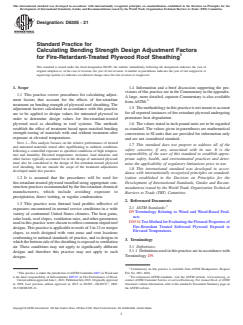
Designation: D6305 − 21
Standard Practice for
Calculating Bending Strength Design Adjustment Factors
for Fire-Retardant-Treated Plywood Roof Sheathing
This standard is issued under the fixed designation D6305; the number immediately following the designation indicates the year of
original adoption or, in the case of revision, the year of last revision.Anumber in parentheses indicates the year of last reapproval.A
superscript epsilon (´) indicates an editorial change since the last revision or reapproval.
1. Scope 1.4 Information and a brief discussion supporting the pro-
visionsofthispracticeareintheCommentaryintheappendix.
1.1 This practice covers procedures for calculating adjust-
Alarge, more detailed, separate Commentary is also available
ment factors that account for the effects of fire-retardant
from ASTM.
treatment on bending strength of plywood roof sheathing. The
1.5 Themethodologyinthispracticeisnotmeanttoaccount
adjustment factors calculated in accordance with this practice
for all reported instances of fire-retardant plywood undergoing
are to be applied to design values for untreated plywood in
premature heat degradation.
order to determine design values for fire-retardant-treated
plywood used as sheathing in roof systems. The methods
1.6 Thevaluesstatedininch-poundunitsaretoberegarded
establish the effect of treatment based upon matched bending
as standard. The values given in parentheses are mathematical
strength testing of materials with and without treatment after
conversions to SI units that are provided for information only
exposure at elevated temperatures.
and are not considered standard.
NOTE 1—This analysis focuses on the relative performance of treated
1.7 This standard does not purport to address all of the
and untreated materials tested after equilibrating to ambient conditions
safety concerns, if any, associated with its use. It is the
following a controlled exposure to specified conditions of high tempera-
responsibility of the user of this standard to establish appro-
ture and humidity. Elevated temperature, moisture, load duration, and
other factors typically accounted for in the design of untreated plywood priate safety, health, and environmental practices and deter-
must also be considered in the design of fire-retardant-treated plywood
mine the applicability of regulatory limitations prior to use.
roof sheathing, but are outside the scope of the treatment adjustments
1.8 This international standard was developed in accor-
developed under this practice.
dance with internationally recognized principles on standard-
1.2 It is assumed that the procedures will be used for
ization established in the Decision on Principles for the
fire-retardant-treated plywood installed using appropriate con-
Development of International Standards, Guides and Recom-
structionpracticesrecommendedbythefireretardantchemical mendations issued by the World Trade Organization Technical
manufacturers, which include avoiding exposure to
Barriers to Trade (TBT) Committee.
precipitation, direct wetting, or regular condensation.
2. Referenced Documents
1.3 This practice uses thermal load profiles reflective of
2.1 ASTM Standards:
exposures encountered in normal service conditions in a wide
D9Terminology Relating to Wood and Wood-Based Prod-
variety of continental United States climates. The heat gains,
ucts
solar loads, roof slopes, ventilation rates, and other parameters
D5516TestMethodforEvaluatingtheFlexuralPropertiesof
usedinthispracticewerechosentoreflectcommonslopedroof
Fire-Retardant Treated Softwood Plywood Exposed to
designs.Thispracticeisapplicabletoroofsof3in12orsteeper
Elevated Temperatures
slopes, to roofs designed with vent areas and vent locations
conforming to national standards of practice, and to designs in
3. Terminology
whichthebottomsideofthesheathingisexposedtoventilation
3.1 Definitions:
air. These conditions may not apply to significantly different
3.1.1 Definitionsusedinthispracticeareinaccordancewith
designs and therefore this practice may not apply to such
Terminology D9.
designs.
Commentary on this practice is available from ASTM Headquarters. Request
This practice is under the jurisdiction ofASTM Committee D07 on Wood and File No. D07–1004.
is the direct responsibility of Subcommittee D07.07 on Fire Performance of Wood. For referenced ASTM standards, visit the ASTM website, www.astm.org, or
CurrenteditionapprovedJune1,2021.PublishedJuly2021.Originallyapproved contact ASTM Customer Service at service@astm.org. For Annual Book of ASTM
ɛ1
in 1998. Last previous edition approved in 2015 as D6305–08(2015) . DOI: Standards volume information, refer to the standard’s Document Summary page on
10.1520/D6305-21. the ASTM website.
Copyright © ASTM International, 100 Barr Harbor Drive, PO Box C700, West Conshohocken, PA 19428-2959. United States
D6305 − 21
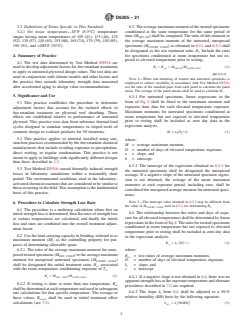
3.2 Definitions of Terms Specific to This Standard: 6.3 Theaveragemaximummomentofthetreatedspecimens
conditioned at the same temperature for the same period of
3.2.1 bin mean temperature—10°F (5.5°C) temperature
time(M )shallbecomputed.Theratioofthismomentto
ranges having mean temperatures of 105 (41), 115 (46), 125
TRT, EX
the average maximum moment of the untreated, unexposed
(52),135(57),145(63),155(68),165(74),175(79),185(85),
195 (91), and >200°F (93°C). specimens (M ) as obtained in 6.3.1 and 6.3.2 shall
UNTRT, UNEX
be designated as the test treatment ratio, R. Include the ratio
t
for specimens conditioned at room temperature but not ex-
4. Summary of Practice
posed to elevated temperature prior to testing.
4.1 The test data determined by Test Method D5516 are
R 5 R 5 M /M (2)
usedtodevelopadjustmentfactorsforfire-retardanttreatments
t test TRT,EX UNTRT,UNEX
to apply to untreated-plywood design values. The test data are
(per 6.3.2)
used in conjunction with climate models and other factors and
NOTE 2—When end matching of treated and untreated specimens is
the practice thus extends laboratory strength data measured
employed to reduce variability in accordance with Test Method D5516,
after accelerated aging to design value recommendations.
use the ratio of the matched pairs from each panel to calculate the panel
mean. The average of the panel means shall be used to calculate R.
t
5. Significance and Use
6.3.1 For untreated specimens, linear regressions in the
form of Eq 3 shall be fitted to the maximum moment and
5.1 This practice establishes the procedure to determine
exposure time data for each elevated temperature exposure.
adjustment factors that account for the isolated effects of
Maximum moments for untreated specimens conditioned at
fire-retardant treatment on plywood roof sheathing. These
room temperature but not exposed to elevated temperature
effects are established relative to performance of untreated
prior to testing shall be included as zero day data in the
plywood. This practice uses data from reference thermal-load
regression analysis.
cycles designed to simulate temperatures in sloped roofs of
common design to evaluate products for 50 iterations.
M 5 a~D!1b (3)
5.2 This practice applies to material installed using con-
where:
structionpracticesrecommendedbythefireretardantchemical
M = average maximum moment,
manufacturers that include avoiding exposure to precipitation,
D = number of days of elevated temperature exposure,
direct wetting, or regular condensation. This practice is not
a = slope, and
meant to apply to buildings with significantly different designs
b = intercept.
than those described in 1.3.
6.3.2 The intercept of the regression obtained in 6.3.1 for
5.3 Test Method D5516 caused thermally induced strength
the untreated specimens shall be designated the unexposed
losses in laboratory simulations within a reasonably short
average. If a negative slope of the untreated specimen regres-
period. The environmental conditions used in the laboratory-
sion is not obtained, the average of the mean maximum
activatedchemicalreactionsthatareconsideredtobesimilarto
moments at each exposure period, including zero, shall be
thoseoccurringinthefield.Thisassumptionisthefundamental
consideredtheunexposedaveragemomentforuntreatedspeci-
basis of this practice.
mens.
NOTE 3—The intercept value obtained in 6.3.2 may be different from
6. Procedure to Calculate Strength Loss Rate
the value of M used in 6.2.1 for determining R .
UNTRT, UNEX o
6.1 The procedure is a multistep calculation where first an
6.4 The relationship between the ratios and days of expo-
initialstrengthlossisdetermined,thentheratesofstrengthloss
sureforallelevatedtemperaturesshallbedeterminedbylinear
at various temperatures are calculated, and finally the initial
regressionsintheformofEq4.Theratiofortreatedspecimens
loss and rates are combined into the overall treatment adjust-
conditioned at room temperature but not exposed to elevated
ment factor.
temperature prior to testing shall be included as zero-day data
6.2 Usetheload-carryingcapacityinbending,referredtoas
in the regression analysis.
maximum moment (M), as the controlling property for pur-
R 5 k ~D!1c (4)
t,i t
poses of determining allowable spans.
6.2.1 The ratio of the average maximum moment for unex- where:
posedtreatedspecimens(M )totheaveragemaximum
R = test ratios of average maximum moments,
TRT, UNEX
t,i
moment for unexposed untreated specimens (M )
D = number of days of elevated temperature exposure,
UNTRT, UNEX
shall be designated the initial treatment ratio, R , associated
k = slope, and
o t
c = intercept.
with the room temperature conditioning exposure of T .
o
R 5 M /M (1)
o TRT, UNEX UNTRT,UNEX 6.4.1 If a negative slope is not obtained in 6.4, there was no
apparentstrengthlossattheexposuretemperatureandalternate
6.2.2 If testing is done at more than one temperature, R
oi
procedures described in 7.2 are required.
shallbedeterminedateachtemperatureandusedinsubsequent
6.4.2 The slope k from 6.4 shall be adjusted to a 50%
t
rate calculations for that specific temperature. The average of
relative humidity (RH) basis by the following equation:
these values, R shall be used in initial treatment effect
o,avg
calculations (see 7.1). k 5 k 50/RH (5)
~ !
50,i t i
D6305 − 21
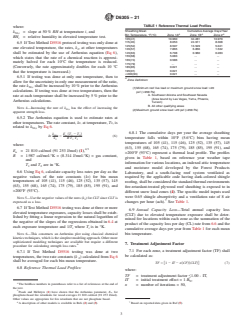
TABLE 1 Reference Thermal Load Profiles
where:
Sheathing Mean Cumulative Average Days/Year
k = slope at 50% RH at temperature i, and
50,i
A A A
Bin Temperature, °F(°C) Zone 1A Zone 1B Zone 2
RH = relative humidity in elevated temperature test.
i
105(41) 10.960 34.281 10.970
115(46) 8.053 24.911 8.308
6.5 IfTest Method D5516 protocol testing was only done at
125(52) 8.597 13.529 5.041
one elevated temperature, the rates, k , at other temperatures
135(57) 7.865 6.856 1.532
shall be estimated by the use of Arrhenius equation (Eq 6), 145(63) 6.798 0.960 0.283
155(68) 5.083 . .
which states that the rate of a chemical reaction is approxi-
165(74) 0.586 . .
mately halved for each 10°C the temperature is reduced.
175(79) . . .
185(85) 0.021 . .
(Conversely, the rate approximately doubles for each 10 °C
195(91) 0.021 . .
that the temperature is increased.)
$200(93) 0.021 . .
6.5.1 If testing was done at only one temperature, then to
A
Zone Definition:
allowfortheuncertaintyinonlyonemeasurementoftheratio,
the rate k shall be increased by 10% prior to theArrhenius
50,i
(1) Minimum roof live load or maximum ground snow load#20
calculations. If testing was done at two temperatures, then the
psf (#958 Pa)
A. Southwest Arizona and Southeast Nevada
rate at each temperature shall be increased by 5% prior to the
(Area bound by Las Vegas, Yuma, Phoenix,
Arrhenius calculations.
Tucson)
B. All other qualifying areas
NOTE 4—Increasing the rate of k has the effect of increasing the
50,i
(2) Maximum ground snow load >20 psf (>958 Pa)
apparent strength loss.
6.5.2 The Arrhenius equation is used to estimate rates at
other temperatures.The rate constant, k at temperature, T,is
2, 2
related to k by Eq 6.
50,i
6.8.1 The cumulative days per year the average sheathing
k E T 2 T
~ !
50,i a 1 2
In 5 (6)
temperature falls within 10°F (5.6°C) bins having mean
k RT T
2 1 2
temperatures of 105 (41), 115 (46), 125 (52), 135 (57), 145
where:
(63), 155 (68), 165 (74), 175 (79), 185 (85), 195 (91), and
4,5
E = 21 810 cal/mol (91 253 J/mol) (1),
a
>200°F (93°C) represent a thermal load profile. The profiles
R = 1.987 cal/mol-°K = (8.314 J/mol-°K) = gas constant,
given in Table 1, based on reference year weather tape
and
information for various locations, an indexed attic temperature
T and T are in °K.
1 2
and moisture model developed by the Forest Products
6.6 Using Eq 6, calculate capacity loss rates per day as the
Laboratory, and a south-facing roof system ventilated as
negative values of the rate constants (k ) for bin mean
2 required by the applicable code having dark-colored shingle
temperatures of 105 (41), 115 (46), 125 (52), 135 (57), 145
roofing,shallbeconsideredthestandardthermalenvironments
(63), 155 (68), 165 (74), 175 (79), 185 (85), 195 (91), and
fire-retardant-treated plywood roof sheathing is exposed to in
>200°F (93°C).
different snow load zones (4). The specific model inputs used
were 0.65 shingle absorptivity and a ventilation rate of 8 air
NOTE 5—Use the negative values of the rates (k ) for CLT since CLT is
expressed as a loss.
changes per hour (ach). See Table 1.
6.7 IfTestMethodD5516testingwasdoneatthreeormore
6.9 Annual Capacity Loss—Total annual capacity loss
elevated temperature exposures, capacity losses shall be estab-
(CLT) due to elevated temperature exposure shall be deter-
lished by fitting a linear regression to the natural logarithm of
mined for locations within each zone as the summation of the
the negative of the slopes of the regressions obtained in 6.4 at
product of the capacity loss per day (CL) rate from 6.6 and the
each exposure temperature and 1/T where T is in °K.
i i
cumulative average days per year from Table 1 for each mean
NOTE 6—This constructs an Arrhenius plot using classical chemical
bin temperature.
kineticstechniques,whichisthesimplestmodelingapproach.Othe
...
This document is not an ASTM standard and is intended only to provide the user of an ASTM standard an indication of what changes have been made to the previous version. Because
it may not be technically possible to adequately depict all changes accurately, ASTM recommends that users consult prior editions as appropriate. In all cases only the current version
of the standard as published by ASTM is to be considered the official document.
´1
Designation: D6305 − 08 (Reapproved 2015) D6305 − 21
Standard Practice for
Calculating Bending Strength Design Adjustment Factors
for Fire-Retardant-Treated Plywood Roof Sheathing
This standard is issued under the fixed designation D6305; the number immediately following the designation indicates the year of
original adoption or, in the case of revision, the year of last revision. A number in parentheses indicates the year of last reapproval. A
superscript epsilon (´) indicates an editorial change since the last revision or reapproval.
ε NOTE—Editorial corrections were made to Appendix X1 in October 2015.
1. Scope
1.1 This practice covers procedures for calculating bending strength design adjustment factors for fire-retardant-treated that
account for the effects of fire-retardant treatment on bending strength of plywood roof sheathing. The methods utilize the results
of strength testing after exposure at elevated temperatures and computer-generated thermal load profiles reflective of exposures
encountered in normal service conditions in a wide variety of continental United States climates.adjustment factors calculated in
accordance with this practice are to be applied to design values for untreated plywood in order to determine design values for
fire-retardant-treated plywood used as sheathing in roof systems. The methods establish the effect of treatment based upon matched
bending strength testing of materials with and without treatment after exposure at elevated temperatures.
NOTE 1—This analysis focuses on the relative performance of treated and untreated materials tested after equilibrating to ambient conditions following
a controlled exposure to specified conditions of high temperature and humidity. Elevated temperature, moisture, load duration, and other factors typically
accounted for in the design of untreated plywood must also be considered in the design of fire-retardant-treated plywood roof sheathing, but are outside
the scope of the treatment adjustments developed under this practice.
1.2 Necessarily, common laboratory practices were used to develop the methods herein. It is assumed that the procedures will be
used for fire-retardant-treated plywood installed using appropriate construction practices recommended by the fire retardant
chemical manufacturers, which include avoiding exposure to precipitation, direct wetting, or regular condensation.
1.3 This practice uses thermal load profiles reflective of exposures encountered in normal service conditions in a wide variety of
continental United States climates. The heat gains, solar loads, roof slopes, ventilation rates, and other parameters used in this
practice were chosen to reflect common sloped roof designs. This practice is applicable to roofs of 3 in 12 or steeper slopes, to
roofs designed with vent areas and vent locations conforming to national standards of practice, and to designs in which the bottom
side of the sheathing is exposed to ventilation air. These conditions may not apply to significantly different designs and therefore
this practice may not apply to such designs.
1.4 Information and a brief discussion supporting the provisions of this practice are in the Commentary in the appendix. A large,
more detailed, separate Commentary is also available from ASTM.
1.5 The methodology in this practice is not meant to account for all reported instances of fire-retardant plywood undergoing
premature heat degradation.
This practice is under the jurisdiction of ASTM Committee D07 on Wood and is the direct responsibility of Subcommittee D07.07 on Fire Performance of Wood.
Current edition approved Sept. 1, 2015June 1, 2021. Published October 2015July 2021. Originally approved in 1998. Last previous edition approved in 20082015 as
ɛ1
D6305 – 08.D6305 – 08(2015) . DOI: 10.1520/D6305-08R15E01.10.1520/D6305-21.
Commentary on this practice is available from ASTM Headquarters. Request File No. D07–1004.
Copyright © ASTM International, 100 Barr Harbor Drive, PO Box C700, West Conshohocken, PA 19428-2959. United States
D6305 − 21
1.6 The values stated in inch-pound units are to be regarded as standard. The values given in parentheses are mathematical
conversions to SI units that are provided for information only and are not considered standard.
1.7 This standard does not purport to address all of the safety concerns, if any, associated with its use. It is the responsibility
of the user of this standard to establish appropriate safety safety, health, and healthenvironmental practices and determine the
applicability of regulatory limitations prior to use.
1.8 This international standard was developed in accordance with internationally recognized principles on standardization
established in the Decision on Principles for the Development of International Standards, Guides and Recommendations issued
by the World Trade Organization Technical Barriers to Trade (TBT) Committee.
2. Referenced Documents
2.1 ASTM Standards:
D9 Terminology Relating to Wood and Wood-Based Products
D5516 Test Method for Evaluating the Flexural Properties of Fire-Retardant Treated Softwood Plywood Exposed to Elevated
Temperatures
3. Terminology
3.1 Definitions:
3.1.1 Definitions used in this practice are in accordance with Terminology D9.
3.2 Definitions of Terms Specific to This Standard:
3.2.1 bin mean temperature—10°F (5.5°C) temperature ranges having mean temperatures of 105 (41), 115 (46), 125 (52), 135
(57), 145 (63), 155 (68), 165 (74), 175 (79), 185 (85), 195 (91), and >200°F (93°C).
4. Summary of Practice
4.1 The test data determined by Test Method D5516 are used to develop adjustment factors for fire-retardant treatments to apply
to untreated-plywood design values. The test data are used in conjunction with climate models and other factors and the practice
thus extends laboratory strength data measured after accelerated aging to design value recommendations.
5. Significance and Use
5.1 This practice develops treatment factors that shall be used by fire retardant chemical manufacturers to adjust bending strength
design values for untreated plywood to account for the fire-retardant treatment effects. establishes the procedure to determine
adjustment factors that account for the isolated effects of fire-retardant treatment on plywood roof sheathing. These effects are
established relative to performance of untreated plywood. This practice uses data from reference thermal-load cycles designed to
simulate temperatures in sloped roofs of common design to evaluate products for 50 iterations.
5.2 This practice applies to material installed using construction practices recommended by the fire retardant chemical
manufacturers that include avoiding exposure to precipitation, direct wetting, or regular condensation. This practice is not meant
to apply to buildings with significantly different designs than those described in 1.3.
5.3 Test Method D5516 caused thermally induced strength losses in laboratory simulations within a reasonably short period. The
environmental conditions used in the laboratory-activated chemical reactions that are considered to be similar to those occurring
in the field. This assumption is the fundamental basis of this practice.
6. Procedure to Calculate Strength Loss Rate
6.1 The procedure is a multistep calculation where first an initial strength loss is determined, then the rates of strength loss at
various temperatures are calculated, and finally the initial loss and rates are combined into the overall treatment adjustment factor.
For referenced ASTM standards, visit the ASTM website, www.astm.org, or contact ASTM Customer Service at service@astm.org. For Annual Book of ASTM Standards
volume information, refer to the standard’s Document Summary page on the ASTM website.
D6305 − 21
6.2 Use the load-carrying capacity in bending, referred to as maximum moment (M), as the controlling property for purposes of
determining allowable spans.
6.2.1 The ratio of the average maximum moment for unexposed treated specimens (M ) for unexposed treated specimens
TRT, UNEX
to the average maximum moment for unexposed untreated specimens (M ) shall be designated the Initialinitial treatment
UNTRT, UNEX
effect,ratio, R , associated with the room temperature conditioning exposure of T .
o o
R 5 M /M (1)
o TRT, UNEX UNTRT,UNEX
6.2.2 If testing is done at more than one temperature, R shall be determined at each temperature and used in subsequent rate
oi
calculations for that specific temperature. The average of these values, R shall be used in initial treatment effect calculations
o,avg
(see 7.1).
6.3 The average maximum moment ( M) of the treated specimens conditioned at the same temperature for the same period of time
(M ) shall be computed. The ratio of these momentsthis moment to the average maximum moment of the untreated,
TRT, EX
unexposed specimens (M ) as obtained in 6.3.1 and 6.3.2 shall be designated as the test treatment ratio, R . Include the
UNTRT, UNEX t
ratio for specimens conditioned at room temperature but not exposed to elevated temperature prior to testing.
R 5 R 5 M /M (2)
t test TRT, UNEX, EX UNTRT,UNEX
~ !
R 5 R 5 M /M (2)
t test TRT,EX UNTRT,UNEX
(per 6.3.2)
NOTE 2—When end matching of treated and untreated specimens is employed to reduce variability in accordance with Test Method D5516, use the ratio
of the matched pairs from each panel to calculate the panel mean. The average of the panel means shall be used to calculate R .
t
6.3.1 For untreated specimens, linear regressions of the form:
M 5 a~D!1b (3)
where:
M = average maximum moment,
D = number of days of elevated temperature exposure,
a = constant, and
b = intercept.
For untreated specimens, linear regressions in the form of Eq 3 shall be fitted to the maximum moment and exposure time data
for each elevated temperature exposure. AverageMaximum moments for untreated specimens conditioned at room temperature but
not exposed to elevated temperature prior to testing shall be included as zero day data in the regression analysis.
M 5 a~D!1b (3)
where:
M = average maximum moment,
D = number of days of elevated temperature exposure,
a = slope, and
b = intercept.
6.3.2 The intercept of the regression obtained in 6.3.1 for the untreated specimens shall be designated the unexposed average. If
a negative slope of the untreated specimen regression is not obtained, the average of the mean maximum moments at each exposure
period, including zero, shall be considered the unexposed average moment for untreated specimens.
NOTE 3—The intercept value obtained in 6.3.2 may be different from the unexposed, untreatedvalue of valueM used in 6.2.1 for determining
UNTRT, UNEX
R .
o
6.4 The slope and intercept of the linear relationship between the ratios and days of exposure for all elevated temperatures shall
be determined by linear regressions in the form of Eq 4the form:. The ratio for treated specimens conditioned at room temperature
but not exposed to elevated temperature prior to testing shall be included as zero-day data in the regression analysis.
D6305 − 21
R 5 k D 1c (4)
~ !
t,i t
where:
R = test ratios of average maximum moments,
t,i
D = number of days of elevated temperature exposure,
k = slope, and
t
c = intercept.
Include the ratio for treated specimens conditioned at room temperature but not exposed to elevated temperature prior to testing
as zero day data in the regression analysis.
6.4.1 If a negative slope is not obtained in 6.4, there was no apparent strength loss at the exposure temperature and alternate
procedures described in 7.2 are required.
6.4.2 The slope k from 6.4 shall be adjusted to a 50 % relative humidity (RH) basis by the following equation:
t
k 5 k 50/RH (5)
~ !
50,i t i
where:
k = slope at 50 % RH at temperature i, and
50,i
RH = elevated temperature test RH.
i
RH = relative humidity in elevated temperature test.
i
6.5 If Test Method D5516 protocol testing was only done at one elevated temperature, rates the rates, k , at other temperatures
shall be estimated by the use of Arrhenius equation, equation (Eq 6), which states that the rate of a chemical reaction is
approximately halved for each 10°C the temperature is reduced. (Conversely, the rate approximately doubles for each 10°C 10 °C
that the temperature is increased.)
6.5.1 If testing was done at only one temperature, then to allow for the uncertainty in only one measurement of the ratio, the rate
k shall be increased by 10 % prior to the Arrhenius calculations. If testing was done at two temperatures, then the rate at each
50,i
temperature shall be increased by 5 % prior to the Arrhenius calculations.
NOTE 4—Increasing the rate of k has the effect of increasing the apparent strength loss.
50,i
6.5.2 The Arrhenius equation is used to estimate rates at other temperatures. The rate constant, k at temperature, T , is related
2, 2
to k by Eq 6.
50,i
k Ea T 2 T
~ !
50,i 1 2
In 5 (6)
k R T T
2 1 2
k E T 2 T
~ !
50,i a 1 2
In 5 (6)
k R T T
2 1 2
where:
4,5
Ea = 21 810 cal/mol (91 253 J/mol) (1),
4,5
E = 21 810 cal/mol (91 253 J/mol) (1),
a
R = 1.987 cal/mol-°K = (8.314 J/mol-°K) = gas constant, and
T and T are in °K.
1 2
6.6 ComputeUsing Eq 6, calculate capacity loss rates per day as the negative valuevalues of the rates rate constants (k ) for bin
mean temperatures of 105 (41), 115 (46), 125 (52), 135 (57), 145 (63), 155 (68), 165 (74), 175 (79), 185 (85), 195 (91), and >200°F
(93°C).
NOTE 5—Use the negative values of the rates (k ) for CLT since CLT is expressed as a loss.
The boldface numbers in parentheses refer to a list of references at the end of the text.
Pasek and McIntyre (1) have shown that the Arrhenius parameter, E , for phosphate-based fire retardants for wood averages 21 810 cal/mol (91 253 J/mol). Other values
a
are appropriate for fire retardants that are not phosphate based.
D6305 − 21
TABLE 1 Reference Thermal Load Profiles
Sheathing Mean Cumulative Average Days/Year
A A A
Bin Temperature, °F(°C) Zone 1A Zone 1B Zone 2
105(41) 10.960 34.281 10.970
115(46) 8.053 24.911 8.308
125(52) 8.597 13.529 5.041
135(57) 7.865 6.856 1.532
145(63) 6.798 0.960 0.283
155(68) 5.083 . .
165(74) 0.586 . .
175(79) . . .
185(85) 0.021 . .
195(91) 0.021 . .
$200(93) 0.021 . .
A
Zone Definition:
(1) Minimum roof live load or maximum ground snow load #20
psf (#958 Pa)
A. Southwest Arizona and Southeast Nevada
(Area bound by Las Vegas, Yuma, Phoenix,
Tucson)
B. All other qualifying areas
(2) Maximum ground snow load >20 psf (>958 Pa)
6.7 If Test Method D5516 testing was done at three or more elevated temperature exposures, capacity losses shall be established
by fitting a linear regression to the natural logarithm of the negative of the slopes of the regressions obtained in 6.4 at each exposure
temperature and 1/T where T is in °K.
i i
NOTE 6—This constructs an Arrhenius plot using classical chemical kinetics techniques, which is the simplest modeling approach. Other more
sophisticated modeling techniques are available but require a different procedure for calculating strength loss rates.
6.7.1 If Test Method D5516 testing was done at two temperatures, the two rate constants (k ) calculated from Eq 6 shall be
averaged for each bin mean temperature.
6.8 Reference Thermal Load Profiles:
6.8.1 The cumulative days per year the average sheathing temperature falls within 10°F (5.6°C) bins having mean temperatures
of 105 (41), 115 (46), 125 (52), 135 (57), 145 (63), 155 (68), 165 (74), 175 (79), 185 (85), 195 (91), and >200°F (93°C) represent
a thermal load profile. The profiles tabulated below,given in Table 1, based on reference year weather tape information for various
locations, an indexed attic temperature and moisture model developed by the Forest Products Laboratory, and a south-facing roof
system ventilated as required by the applicable code having dark-colored shingle roofing, shall be considered the standard thermal
environments fire-retardant-treated plywood roof sheathing is exposed t
...