


ASTM D6230-21e1
(Practice)Standard Practices for Monitoring Earth or Structural Movement Using Inclinometers
Standard Practices for Monitoring Earth or Structural Movement Using Inclinometers
SIGNIFICANCE AND USE
4.1 An inclinometer is a deformation monitoring system, which uses a grooved pipe or casing with internal longitudinal grooves aligned with the anticipated direction of movement, installed in either a soil/rock mass or a geotechnical structural element. The inclinometer casing can be surveyed with a single traversing probe or with an array of in-place inclinometer (IPI) gauges connected to a data logger. The measurement and calculation of deformation normal to the axis of the inclinometer casing is done by passing a probe along the length of this pipe or placement of a sensor array, guided by the internal grooves. The probe or sensor array measures the inclination of the pipe, usually in two orthogonal directions 90° apart (X- and Y-direction) with respect to the axis of the casing (Z-direction, usually the line of gravity). Measurements are converted to distances using trigonometric functions. Successive surveys compared with an initial survey give differences in position and indicate deformation normal to the axis of the inclinometer casing. In most cases the inclinometer casing is installed in a near-vertical hole, and the measurements indicate subsurface horizontal deformation. In some cases, the inclinometer casing is installed horizontally, and the measurements indicate vertical deformation.
4.2 Inclinometers are also called slope inclinometers or slope indicators. Typical applications include measuring the rate and direction of landslide movement and locating the zone of shearing, monitoring the magnitude and rate of horizontal movements for embankments and excavations, monitoring the settlement and lateral spread beneath tanks and embankments, and monitoring the deflection of bulkheads, piles or structural walls.
Note 1: The precision of this standard is dependent on the competence of the personnel performing it and the suitability of the equipment and facilities used. Agencies that meet the criteria of Practice D3740 are generally considered capable of...
SCOPE
1.1 This standard covers the use of inclinometers to monitor the internal movement of ground, or lateral movement of subsurface structures. The standard covers types of instruments, installation procedures, operating procedures, and maintenance requirements. The standard also provides formulae for data reduction.
1.2 All observed and calculated values shall conform to the guidelines for significant digits and rounding established in Practice D6026 unless superseded by this standard.
1.2.1 The procedures used to specify how data are collected, recorded or calculated in this standard are regarded as the industry standard. In addition, they are representative of the significant digits that generally should be retained. The procedures used do not consider material variation, purpose for obtaining the data, special purpose studies, or any considerations for the user’s objectives; it is common practice to increase or reduce significant digits of reported data to be commensurate with these considerations. It is beyond the scope of this standard to consider significant digits used in analytical methods for engineering design.
1.3 Units—The values stated in SI units are to be regarded as the standard. The inch-pound units given in parentheses are for information only. Reporting of test results in units other than SI shall not be regarded as nonconformance with this standard.
1.4 This standard offers an organized collection of information or a series of options and does not recommend a specific course of action. This document cannot replace education or experience and should be used in conjunction with professional judgment. Not all aspects of this standard may be applicable in all circumstances. This ASTM standard is not intended to represent or replace the standard of care by which the adequacy of a given professional service must be judged, nor should this document be applied without consideration of a project’s man...
General Information
- Status
- Published
- Publication Date
- 31-May-2021
- Technical Committee
- D18 - Soil and Rock
- Drafting Committee
- D18.23 - Field Instrumentation
Relations
- Effective Date
- 01-Nov-2023
- Effective Date
- 01-Oct-2019
- Effective Date
- 01-Aug-2014
- Effective Date
- 01-May-2012
- Effective Date
- 01-Mar-2012
- Effective Date
- 01-Sep-2011
- Effective Date
- 01-Sep-2011
- Effective Date
- 01-Mar-2010
- Effective Date
- 01-Jan-2009
- Effective Date
- 01-Dec-2008
- Effective Date
- 01-Nov-2008
- Effective Date
- 01-Mar-2008
- Effective Date
- 15-Dec-2007
- Effective Date
- 01-Nov-2007
- Effective Date
- 01-Aug-2007
Overview
ASTM D6230-21e1: Standard Practices for Monitoring Earth or Structural Movement Using Inclinometers is an internationally recognized ASTM standard developed to guide geotechnical, civil, and structural engineers in measuring internal ground or subsurface structural movements. This standard outlines equipment types, installation, operation, and maintenance steps for inclinometer systems, which are deformation monitoring devices. It covers both probe-based and fixed-array inclinometer methods, ensuring accurate monitoring of ground or structural movement for applications such as landslide assessment, embankment stability, and monitoring of retaining walls or deep foundations. This standard is aligned with global best practices, providing consistency and reliability in earth movement monitoring.
Key Topics
- Inclinometer Systems: Details the use of inclinometers, which consist of grooved casing and sensitive probes or fixed sensor arrays, to monitor deformation normal to the casing axis in soil, rock masses, or structural elements.
- Measurement Directions: Measurements are typically taken in two orthogonal directions (X-Y), allowing detection of movement in both horizontal and vertical alignments depending on casing installation.
- Installation Procedures: Specifies procedures for casing installation in both vertical and horizontal orientations, including borehole preparation, casing alignment, and appropriate selection of casing and backfill materials.
- Data Collection and Calculation: Offers industry-standard guidelines for measuring, calculating, and reporting deformation using inclinometer readings, including guidance on significant digits and data accuracy.
- System Verification and Maintenance: Stresses the importance of equipment calibration, system checks, and regular maintenance for reliable long-term data collection.
- Reporting Requirements: Requires proper documentation, including displacement versus depth tables and plots, and provides recommendations for diagnostic visualizations to ensure data quality.
- Safety and Units: Emphasizes adherence to appropriate safety, health, and environmental practices. SI units are the reference standard, with inch-pound units provided for reference.
Applications
ASTM D6230-21e1 is essential in a wide range of geotechnical and structural monitoring applications, including:
- Landslide Monitoring: Tracks movement rates and detects zones of shear for landslide-prone areas.
- Embankment and Excavation Monitoring: Measures lateral deformations to verify the stability of soil or rock masses during construction or over time.
- Settlement Analysis: Monitors settlement and lateral spreading beneath tanks, embankments, or other heavy structures.
- Structural Wall Deflection: Assesses movement and potential failure in bulkheads, piles, diaphragm walls, and other support systems.
- Engineering Design Validation: Provides critical data to inform, validate, and adjust engineering designs and construction methodologies.
- Infrastructure Safety: Enables long-term monitoring for continued safety and performance assurance of civil infrastructure.
Related Standards
- ASTM D653 – Terminology Relating to Soil, Rock, and Contained Fluids
- ASTM D3740 – Practice for Minimum Requirements for Agencies Engaged in Testing and/or Inspection of Soil and Rock as Used in Engineering Design and Construction
- ASTM D3966/D3966M – Test Methods for Deep Foundations Under Lateral Load
- ASTM D6026 – Practice for Using Significant Digits and Data Records in Geotechnical Data
- ASTM D7299 – Practice for Verifying Performance of a Vertical Inclinometer Probe
These related standards collectively support the accurate and standardized use of inclinometers in geotechnical and structural applications, ensuring reliable monitoring and risk mitigation in projects involving earth movement or structural deformation.
Keywords: ASTM D6230-21e1, inclinometer, deformation monitoring, earth movement, structural monitoring, geotechnical instrumentation, landslide monitoring, embankment stability, horizontal displacement, vertical deformation, subsurface movement, infrastructure safety.
Get Certified
Connect with accredited certification bodies for this standard

NSF International
Global independent organization facilitating standards development and certification.

CIS Institut d.o.o.
Personal Protective Equipment (PPE) certification body. Notified Body NB-2890 for EU Regulation 2016/425 PPE.

Kiwa BDA Testing
Building and construction product certification.
Sponsored listings
Frequently Asked Questions
ASTM D6230-21e1 is a standard published by ASTM International. Its full title is "Standard Practices for Monitoring Earth or Structural Movement Using Inclinometers". This standard covers: SIGNIFICANCE AND USE 4.1 An inclinometer is a deformation monitoring system, which uses a grooved pipe or casing with internal longitudinal grooves aligned with the anticipated direction of movement, installed in either a soil/rock mass or a geotechnical structural element. The inclinometer casing can be surveyed with a single traversing probe or with an array of in-place inclinometer (IPI) gauges connected to a data logger. The measurement and calculation of deformation normal to the axis of the inclinometer casing is done by passing a probe along the length of this pipe or placement of a sensor array, guided by the internal grooves. The probe or sensor array measures the inclination of the pipe, usually in two orthogonal directions 90° apart (X- and Y-direction) with respect to the axis of the casing (Z-direction, usually the line of gravity). Measurements are converted to distances using trigonometric functions. Successive surveys compared with an initial survey give differences in position and indicate deformation normal to the axis of the inclinometer casing. In most cases the inclinometer casing is installed in a near-vertical hole, and the measurements indicate subsurface horizontal deformation. In some cases, the inclinometer casing is installed horizontally, and the measurements indicate vertical deformation. 4.2 Inclinometers are also called slope inclinometers or slope indicators. Typical applications include measuring the rate and direction of landslide movement and locating the zone of shearing, monitoring the magnitude and rate of horizontal movements for embankments and excavations, monitoring the settlement and lateral spread beneath tanks and embankments, and monitoring the deflection of bulkheads, piles or structural walls. Note 1: The precision of this standard is dependent on the competence of the personnel performing it and the suitability of the equipment and facilities used. Agencies that meet the criteria of Practice D3740 are generally considered capable of... SCOPE 1.1 This standard covers the use of inclinometers to monitor the internal movement of ground, or lateral movement of subsurface structures. The standard covers types of instruments, installation procedures, operating procedures, and maintenance requirements. The standard also provides formulae for data reduction. 1.2 All observed and calculated values shall conform to the guidelines for significant digits and rounding established in Practice D6026 unless superseded by this standard. 1.2.1 The procedures used to specify how data are collected, recorded or calculated in this standard are regarded as the industry standard. In addition, they are representative of the significant digits that generally should be retained. The procedures used do not consider material variation, purpose for obtaining the data, special purpose studies, or any considerations for the user’s objectives; it is common practice to increase or reduce significant digits of reported data to be commensurate with these considerations. It is beyond the scope of this standard to consider significant digits used in analytical methods for engineering design. 1.3 Units—The values stated in SI units are to be regarded as the standard. The inch-pound units given in parentheses are for information only. Reporting of test results in units other than SI shall not be regarded as nonconformance with this standard. 1.4 This standard offers an organized collection of information or a series of options and does not recommend a specific course of action. This document cannot replace education or experience and should be used in conjunction with professional judgment. Not all aspects of this standard may be applicable in all circumstances. This ASTM standard is not intended to represent or replace the standard of care by which the adequacy of a given professional service must be judged, nor should this document be applied without consideration of a project’s man...
SIGNIFICANCE AND USE 4.1 An inclinometer is a deformation monitoring system, which uses a grooved pipe or casing with internal longitudinal grooves aligned with the anticipated direction of movement, installed in either a soil/rock mass or a geotechnical structural element. The inclinometer casing can be surveyed with a single traversing probe or with an array of in-place inclinometer (IPI) gauges connected to a data logger. The measurement and calculation of deformation normal to the axis of the inclinometer casing is done by passing a probe along the length of this pipe or placement of a sensor array, guided by the internal grooves. The probe or sensor array measures the inclination of the pipe, usually in two orthogonal directions 90° apart (X- and Y-direction) with respect to the axis of the casing (Z-direction, usually the line of gravity). Measurements are converted to distances using trigonometric functions. Successive surveys compared with an initial survey give differences in position and indicate deformation normal to the axis of the inclinometer casing. In most cases the inclinometer casing is installed in a near-vertical hole, and the measurements indicate subsurface horizontal deformation. In some cases, the inclinometer casing is installed horizontally, and the measurements indicate vertical deformation. 4.2 Inclinometers are also called slope inclinometers or slope indicators. Typical applications include measuring the rate and direction of landslide movement and locating the zone of shearing, monitoring the magnitude and rate of horizontal movements for embankments and excavations, monitoring the settlement and lateral spread beneath tanks and embankments, and monitoring the deflection of bulkheads, piles or structural walls. Note 1: The precision of this standard is dependent on the competence of the personnel performing it and the suitability of the equipment and facilities used. Agencies that meet the criteria of Practice D3740 are generally considered capable of... SCOPE 1.1 This standard covers the use of inclinometers to monitor the internal movement of ground, or lateral movement of subsurface structures. The standard covers types of instruments, installation procedures, operating procedures, and maintenance requirements. The standard also provides formulae for data reduction. 1.2 All observed and calculated values shall conform to the guidelines for significant digits and rounding established in Practice D6026 unless superseded by this standard. 1.2.1 The procedures used to specify how data are collected, recorded or calculated in this standard are regarded as the industry standard. In addition, they are representative of the significant digits that generally should be retained. The procedures used do not consider material variation, purpose for obtaining the data, special purpose studies, or any considerations for the user’s objectives; it is common practice to increase or reduce significant digits of reported data to be commensurate with these considerations. It is beyond the scope of this standard to consider significant digits used in analytical methods for engineering design. 1.3 Units—The values stated in SI units are to be regarded as the standard. The inch-pound units given in parentheses are for information only. Reporting of test results in units other than SI shall not be regarded as nonconformance with this standard. 1.4 This standard offers an organized collection of information or a series of options and does not recommend a specific course of action. This document cannot replace education or experience and should be used in conjunction with professional judgment. Not all aspects of this standard may be applicable in all circumstances. This ASTM standard is not intended to represent or replace the standard of care by which the adequacy of a given professional service must be judged, nor should this document be applied without consideration of a project’s man...
ASTM D6230-21e1 is classified under the following ICS (International Classification for Standards) categories: 13.080.99 - Other standards related to soil quality. The ICS classification helps identify the subject area and facilitates finding related standards.
ASTM D6230-21e1 has the following relationships with other standards: It is inter standard links to ASTM D3740-23, ASTM D3740-19, ASTM D653-14, ASTM D3740-12a, ASTM D3740-12, ASTM D653-11, ASTM D3740-11, ASTM D3740-10, ASTM D653-09, ASTM D653-08a, ASTM D653-08, ASTM D3740-08, ASTM D653-07f, ASTM D653-07e, ASTM D653-07d. Understanding these relationships helps ensure you are using the most current and applicable version of the standard.
ASTM D6230-21e1 is available in PDF format for immediate download after purchase. The document can be added to your cart and obtained through the secure checkout process. Digital delivery ensures instant access to the complete standard document.
Standards Content (Sample)
This international standard was developed in accordance with internationally recognized principles on standardization established in the Decision on Principles for the
Development of International Standards, Guides and Recommendations issued by the World Trade Organization Technical Barriers to Trade (TBT) Committee.
´1
Designation: D6230 − 21
Standard Practices for
Monitoring Earth or Structural Movement Using
Inclinometers
This standard is issued under the fixed designation D6230; the number immediately following the designation indicates the year of
original adoption or, in the case of revision, the year of last revision. A number in parentheses indicates the year of last reapproval. A
superscript epsilon (´) indicates an editorial change since the last revision or reapproval.
ε NOTE—Minor corrections were editorially made throughout in July 2021.
1. Scope* of a given professional service must be judged, nor should this
document be applied without consideration of a project’s many
1.1 This standard covers the use of inclinometers to monitor
unique aspects. The word “Standard” in the title of this
the internal movement of ground, or lateral movement of
document means only that the document has been approved
subsurface structures. The standard covers types of
through the ASTM consensus process.
instruments, installation procedures, operating procedures, and
1.5 This standard does not purport to address all of the
maintenance requirements. The standard also provides formu-
safety concerns, if any, associated with its use. It is the
lae for data reduction.
responsibility of the user of this standard to establish appro-
1.2 All observed and calculated values shall conform to the
priate safety, health, and environmental practices and deter-
guidelines for significant digits and rounding established in
mine the applicability of regulatory limitations prior to use.
Practice D6026 unless superseded by this standard.
1.6 This international standard was developed in accor-
1.2.1 Theproceduresusedtospecifyhowdataarecollected,
dance with internationally recognized principles on standard-
recorded or calculated in this standard are regarded as the
ization established in the Decision on Principles for the
industry standard. In addition, they are representative of the
Development of International Standards, Guides and Recom-
significant digits that generally should be retained. The proce-
mendations issued by the World Trade Organization Technical
dures used do not consider material variation, purpose for
Barriers to Trade (TBT) Committee.
obtaining the data, special purpose studies, or any consider-
ations for the user’s objectives; it is common practice to
2. Referenced Documents
increase or reduce significant digits of reported data to be
2.1 ASTM Standards:
commensuratewiththeseconsiderations.Itisbeyondthescope
D653 Terminology Relating to Soil, Rock, and Contained
of this standard to consider significant digits used in analytical
Fluids
methods for engineering design.
D3740 Practice for Minimum Requirements for Agencies
1.3 Units—The values stated in SI units are to be regarded
Engaged in Testing and/or Inspection of Soil and Rock as
as the standard. The inch-pound units given in parentheses are
Used in Engineering Design and Construction
for information only. Reporting of test results in units other
D3966/D3966M Test Methods for Deep Foundations Under
than SI shall not be regarded as nonconformance with this
Lateral Load
standard.
D6026 Practice for Using Significant Digits and Data Re-
cords in Geotechnical Data
1.4 This standard offers an organized collection of informa-
D7299 Practice for Verifying Performance of a Vertical
tion or a series of options and does not recommend a specific
Inclinometer Probe
course of action. This document cannot replace education or
experienceandshouldbeusedinconjunctionwithprofessional
3. Terminology
judgment. Not all aspects of this standard may be applicable in
3.1 For definitions of common technical terms used in this
all circumstances. This ASTM standard is not intended to
representorreplacethestandardofcarebywhichtheadequacy standard, refer to Terminology D653.
This practice is under the jurisdiction of ASTM Committee D18 on Soil and
Rock and is the direct responsibility of Subcommittee D18.23 on Field Instrumen-
tation. For referenced ASTM standards, visit the ASTM website, www.astm.org, or
Current edition approved June 1, 2021. Published June 2021. Originally contact ASTM Customer Service at service@astm.org. For Annual Book of ASTM
approved in 1998. Last previous edition approved in 2013 as D6230 – 13. DOI: Standards volume information, refer to the standard’s Document Summary page on
10.1520/D6230-21E01. the ASTM website.
*A Summary of Changes section appears at the end of this standard
Copyright © ASTM International, 100 Barr Harbor Drive, PO Box C700, West Conshohocken, PA 19428-2959. United States
´1
D6230 − 21
in itself ensure reliable results. Reliable testing depends on many factors;
3.2 Definitions of Terms Specific to This Standard:
Practice D3740 provides a means of evaluating some of those factors.
3.2.1 inclinometer casing, n—a (typically segmented) pipe
or casing with grooves specific for the type of inclinometer
5. Apparatus
being used.
3.2.1.1 Discussion—Casing is typically made of plastic,
5.1 Method A—The traveling-probe-type inclinometer sys-
aluminum alloy, or fiberglass. tem consists of an inclinometer probe, typically utilizing
microelectromechanical systems (MEMS) technology sensors,
3.2.2 inclinometer probe, n—an instrument comprised of a
whichgivetheinclinationoftheprobedigitally.Biaxialprobes
downhole probe which uses internal sensors to detect its own
contain two sensors oriented 90° apart to permit readings in
orientation relative to the force of gravity, with a wheel
orthogonal directions at the same time. Other sensor types,
assembly for lowering into the inclinometer casing along the
such as ones based on force balance accelerometers, which
alignment grooves, connected by a cable to a readout or
give a voltage output that is proportional to inclination of the
datalogger at the surface.
probe, may also be used. The probe(s) can have an analog or
3.2.3 in-place inclinometer gauge (IPI gauge), n—an incli-
digital output. Use of a single uniaxial or biaxial probe pulled
nometerprobewhichisdesignedtobeinstalledatafixeddepth
through the casing while being sampled is designated as
inaninclinometercasing,typicallyinanarrayofmultipleunits
Method “A.” A portable readout unit, connected via cable or
with known spacing and kept in place for the duration of the
wirelessly, is used to display probe inclination and record the
monitoring period.
inclination data.
3.2.4 spiral probe, n—awheeledprobethattracksalignment
5.1.1 An electrical cable with distance markings connects
differences between its top and bottom wheels. whose readings
the probe and power supply (which may also include the
measure the spiraling twist of an inclinometer casing installa-
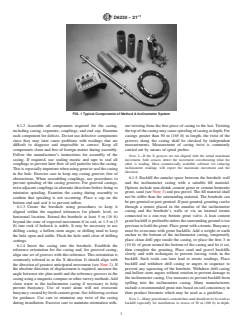
readout). Fig. 1 illustrates a typical set of components. The
tion.
cable should include a clamp to prevent the probe from falling
down the borehole. For deep holes a hoist or winch may be
4. Significance and Use
required.
4.1 An inclinometer is a deformation monitoring system,
5.2 Method B—The in-place inclinometer (IPI) array is a set
which uses a grooved pipe or casing with internal longitudinal
of gauges which are installed in the casing at fixed distances
grooves aligned with the anticipated direction of movement,
apart, using spacer rods or pipes. These gauges may be
installed in either a soil/rock mass or a geotechnical structural
individualunitswithconnectingandspacingelementsbetween
element.Theinclinometercasingcanbesurveyedwithasingle
them, or may consist of a continuous assembly. Some models
traversing probe or with an array of in-place inclinometer (IPI)
of in-place inclinometers may be held in plane using guide
gauges connected to a data logger. The measurement and
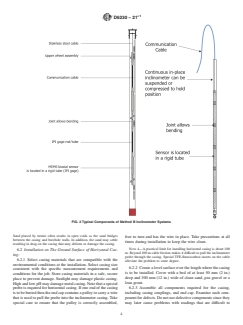
wheels in grooved casings. Fig. 2 illustrates two types of
calculation of deformation normal to the axis of the inclinom-
common in-place inclinometer assemblies. The left schematic
eter casing is done by passing a probe along the length of this
in Fig. 2 is an example of multiple probes assembled together
pipe or placement of a sensor array, guided by the internal
to form a single in-place inclinometer installation, with wheels
grooves. The probe or sensor array measures the inclination of
to align in a grooved casing. Gauge length for this assembly is
thepipe,usuallyintwoorthogonaldirections90°apart(X-and
measured wheel to wheel. The right schematic in Fig. 2 is an
Y-direction) with respect to the axis of the casing (Z-direction,
example of a continuous in-place inclinometer with no wheels.
usually the line of gravity). Measurements are converted to
Gauge length in this case is measured joint center to joint
distances using trigonometric functions. Successive surveys
center. Use of an in-place inclinometer array which is sampled
comparedwithaninitialsurveygivedifferencesinpositionand
while stationary in the casing is designated as Method “B.”
indicate deformation normal to the axis of the inclinometer
Other sensor types, including ones mentioned in Method “A”
casing. In most cases the inclinometer casing is installed in a
above and also ones based on vibrating wire technology, may
near-vertical hole, and the measurements indicate subsurface
be used. The use of an array may be more applicable in a
horizontal deformation. In some cases, the inclinometer casing
scenariowhereobservationsneedtobetakenrelativelyrapidly,
isinstalledhorizontally,andthemeasurementsindicatevertical
such as during a lateral pile load test (see Standard D3966/
deformation.
D3966M), or where observations need to be taken continually
4.2 Inclinometers are also called slope inclinometers or
over long periods of time, such as monitoring shoring for
slope indicators. Typical applications include measuring the
excess deformation during excavation. Individual instruments
rate and direction of landslide movement and locating the zone
in the array may be uniaxial or biaxial.
of shearing, monitoring the magnitude and rate of horizontal
movements for embankments and excavations, monitoring the
6. Procedure
settlement and lateral spread beneath tanks and embankments,
6.1 Installation of Casing in a Borehole:
and monitoring the deflection of bulkheads, piles or structural
6.1.1 Select casing materials that are compatible with the
walls.
environmental conditions at the installation. Select casing size
NOTE1—Theprecisionofthisstandardisdependentonthecompetence
consistent with the specific measurement requirements and
of the personnel performing it and the suitability of the equipment and
conditions for the job. Store casing materials in a safe, secure
facilities used. Agencies that meet the criteria of Practice D3740 are
place to prevent damage. Sunlight may damage plastic casing.
generally considered capable of competent and objective testing. Users of
this standard are cautioned that compliance with Practice D3740 does not High and low pH may damage metal casing.
´1
D6230 − 21
FIG. 1 Typical Components of Method A Inclinometer System
6.1.2 Assemble all components required for the casing, out twisting from the first piece of casing to the last. Twisting
including casing, segments, couplings, and end cap. Examine thetopofthecasingmaycausespiralingofcasingatdepth.For
each component for defects. Do not use defective components casings greater than 50 m (165 ft) in length, the twist of the
since they may later cause problems with readings that are grooves along the casing shall be checked by independent
difficult to diagnose and impossible to correct. Keep all measurements. Measurement of casing twist is commonly
components clean and free of foreign matter during assembly. carried out by means of spiral probes.
Follow the manufacturer’s instructions for assembly of the
NOTE 2—If the X grooves are not aligned with the actual maximum
casing. If required, use sealing mastic and tape to seal all
movement, both sensors detect the movement corroborating what the
couplings to prevent later flow of soil particles into the casing. other is reading. Most commercially available software for reducing
inclinometer readings will report the maximum movement and the
Thisisespeciallyimportantwhenusinggrouttosealthecasing
direction.
in the hole. Exercise care to keep any casing grooves free of
6.1.5 Backfill the annular space between the borehole wall
obstructions. When assembling couplings, use procedures to
and the inclinometer casing with a suitable fill material.
prevent spiraling of the casing grooves. For grooved casings,
Options include non-shrink cement grout or cement-bentonite
twist adjacent couplings in alternate directions before fixing to
grout, sand (see Note 3) and pea gravel. The fill material shall
minimize spiraling. Examine the casing during assembly to
not be stiffer than the surrounding material. The borehole can
confirm that spiraling is not occurring. Place a cap on the
bepre-groutedorpost-grouted.Ifpost-grouted,groutingcanbe
bottom end and seal it to prevent inflow.
through a tremie placed in the annulus of the inclinometer
6.1.3 Create the borehole using procedures to keep it
casing and the borehole’s walls or via an internal tremie
aligned within the required tolerances for plumb, level, or
connected to a one-way bottom grout valve. A lean cement
horizontal location. Extend the borehole at least 5 m (16 ft)
groutbackfillispreferableunlessthesurroundinggroundistoo
beyond the zone of expected movement if in soil, or 1.5 m (5
pervioustoholdthegrout.Placegroutwithatremie.Buoyancy
ft) into rock if bedrock is stable. It may be necessary to use
must be overcome with grout backfills. Add a weight or earth
drilling casing, a hollow-stem auger, or drilling mud to keep
anchor to the bottom of the inclinometer casing, temporarily
the hole open and stable. Flush the hole until clear of drilling
place clean drill pipe inside the casing, or place the first 3 m
cuttings.
(10 ft) of grout around the bottom of the casing and let it set,
6.1.4 Insert the casing into the borehole. Establish the
then complete the grouting. Place sand and gravel backfills
reference orientation for the casing and, for grooved casing,
slowly and with techniques to prevent leaving voids in the
align one set of grooves with this reference. This orientation is
backfill. Such voids can later lead to erratic readings. Place
commonly referred to as the X direction. It should align with
backfill and withdraw drill casing or augers in sequence to
the direction of greatest anticipated movement (see Note 2). If
prevent any squeezing of the borehole. Withdraw drill casing
the absolute direction of displacement is required, measure the
and hollow-stem augers without rotation to prevent damage to
angle between site plan north and the reference grooves in the
the inclinometer casing. Use measures to prevent backfill from
casingusingamagneticcompassorothersurveymethods.Add
spilling into the inclinometer casing. Many manufacturers
clean water to the inclinometer casing if necessary to help
include a recommended grout mix based on soil consistency in
prevent buoyancy. Use of water alone will not overcome
their product literature which may be used as a guideline.
buoyancy created by fresh cement grout. See following section
for guidance. Use care to minimize any twist of the casing
NOTE 3—Many practitioners contend that sand should never be used as
during installation. Exercise care to maintain orientation with- backfill especially for installations in excess of 30 m (100 ft) in depth.
´1
D6230 − 21
FIG. 2 Typical Components of Method B Inclinometer Systems
Sand placed by tremie often results in open voids as the sand bridges
free to turn and has the wire in place. Take precautions at all
between the casing and borehole walls. In addition, the sand may settle
times during installation to keep the wire clean.
resulting in drag on the casing that may deform or damage the casing.
NOTE 4—A practical limit for installing horizontal casing is about 100
6.2 Installation on The Ground Surface of Horizontal Cas-
m. Beyond 100 m cable friction makes it difficult to pull the inclinometer
ing:
probe through the casing. Special TFE-fluorocarbon inserts on the cable
6.2.1 Select casing materials that are compatible with the
alleviate the problem to some degree.
environmental conditions at the installation. Select casing size
6.2.2 Create a level surface over the length where the casing
consistent with the specific measurement requirements and
is to be installed. Cover with a bed of at least 50 mm (2 in.)
conditions for the job. Store casing materials in a safe, secure
deep and 300 mm (12 in.) wide of clean sand, pea gravel or a
place to prevent damage. Sunlight may damage plastic casing.
lean grout.
HighandlowpHmaydamagemetalcasing.Notethataspecial
6.2.3 Assemble all components required for the casing,
probe is required for horizontal casing. If one end of the casing
istobeburiedthentheendcapcontainsapulleytocarryawire including casing couplings, and end cap. Examine each com-
that is used to pull the probe into the inclinometer casing. Take ponentfordefects.Donotusedefectivecomponentssincethey
special care to ensure that the pulley is correctly assembled, may later cause problems with readings that are difficult to
´1
D6230 − 21
diagnose and impossible to correct. Keep all components clean 6.4.1 Insert the probe into the casing oriented in the refer-
and free of foreign matter during assembly. Follow the manu- ence direction (that is, the ‘X’ direction) to the bottom of a
facturer’s instructions for assembly of the casing. If required vertical or inclined casing or to the far end of a horizontal
usesealingmasticandtapetosealallcouplingstopreventlater casing. Allow probe to equilibrate to ambient temperature in
flow of soil particles into the casing. This is especially the casing for at least 10 minutes. Complete a measurement
important when using grout to seal the casing in the bed. traverse by holding the probe stationary at each depth interval
Exercise care to keep the casing grooves free of obstructions. and recording depth and reading. Recommended practice is to
When assembling couplings, use procedures to prevent spiral- use a reading interval equal to the wheel spacing on the probe.
ing of the casing grooves.Twist adjacent couplings in alternate After each reading, raise the probe by the reading interval and
directions before fixing to minimize spiraling. Examine the take the next set of r
...
Questions, Comments and Discussion
Ask us and Technical Secretary will try to provide an answer. You can facilitate discussion about the standard in here.
Loading comments...