

ASTM D6891-23
(Test Method)Standard Test Method for Evaluation of Automotive Engine Oils in the Sequence IVA Spark-Ignition Engine
General Information
- Abstract
SIGNIFICANCE AND USE
5.1 This test method was developed to evaluate automotive lubricant’s effect on controlling cam lobe wear for overhead valve-train equipped engines with sliding cam followers.
Note 1: This test method may be used for engine oil specifications, such as Specification D4485, API 1509, SAE J183, and ILSC GF 3.
SCOPE
1.1 This test method measures the ability of crankcase oil to control camshaft lobe wear for spark-ignition engines equipped with an overhead valve-train and sliding cam followers. This test method is designed to simulate extended engine idling vehicle operation. The Sequence IVA Test Method uses a Nissan KA24E engine. The primary result is camshaft lobe wear (measured at seven locations around each of the twelve lobes). Secondary results include cam lobe nose wear and measurement of iron wear metal concentration in the used engine oil. Other determinations such as fuel dilution of crankcase oil, non-ferrous wear metal concentrations, and total oil consumption, can be useful in the assessment of the validity of the test results.2
1.2 The values stated in SI units are to be regarded as standard. No other units of measurement are included in this standard.
1.2.1 Exceptions—Where there is no direct SI equivalent such as pipe fittings, tubing, NPT screw threads/diameters, or single source equipment specified.
1.3 This standard does not purport to address all of the safety concerns, if any, associated with its use. It is the responsibility of the user of this standard to establish appropriate safety, health, and environmental practices and determine the applicability of regulatory limitations prior to use. See Annex A8 for specific safety precautions.
1.4 This international standard was developed in accordance with internationally recognized principles on standardization established in the Decision on Principles for the Development of International Standards, Guides and Recommendations issued by the World Trade Organization Technical Barriers to Trade (TBT) Committee.
- Status
- Published
- Publication Date
- 30-Jun-2023
- Technical Committee
- D02 - Petroleum Products, Liquid Fuels, and Lubricants
- Drafting Committee
- D02.B0 - Automotive Lubricants
Buy Documents
ASTM D6891-23 - Standard Test Method for Evaluation of Automotive Engine Oils in the Sequence IVA Spark-Ignition Engine
REDLINE ASTM D6891-23 - Standard Test Method for Evaluation of Automotive Engine Oils in the Sequence IVA Spark-Ignition Engine
Overview
ASTM D6891-23 is the internationally recognized standard test method for evaluating automotive engine oils in the Sequence IVA spark-ignition engine. Issued by ASTM International, this standard focuses on assessing the effectiveness of crankcase oils in controlling camshaft lobe wear in gasoline engines equipped with overhead valve-trains and sliding cam followers. The method is designed to simulate the conditions of extended engine idling and measures cam lobe wear using a Nissan KA24E engine as the test platform.
This standard is essential for engine oil manufacturers, testing laboratories, and regulatory organizations aiming to qualify engine lubricants against industry specifications. It provides a reliable procedure to generate reproducible and comparable data on lubricant performance, supporting quality assurance and product development processes within the automotive industry.
Key Topics
- Purpose and Scope
- Measures the ability of engine oils to minimize camshaft lobe wear in overhead valve-train engines with sliding cam followers.
- Simulates extended idling conditions typical in real-world vehicle operation.
- Test Procedure
- Uses a Nissan KA24E spark-ignition engine as the standardized test platform.
- Monitors camshaft lobe wear at multiple locations on each cam lobe.
- Secondary measurements include cam lobe nose wear and iron wear metal content in used oil.
- Data Collection
- Computes average wear for comprehensive evaluation.
- Analyzes fuel dilution, oil consumption, and non-ferrous metal concentration for additional insight.
- Calibration and Quality Control
- Laboratories may utilize ASTM Test Monitoring Center (TMC) services for reference oils, statistical guidance, and calibration.
- Results from calibrated labs offer higher confidence and industry comparability.
- Measurement Units
- Standardizes use of SI units except for specific applications without direct SI equivalents.
Applications
ASTM D6891-23 is widely applicable in the following areas:
- Engine Oil Development
Enables lubricant formulators and manufacturers to assess and optimize products for camshaft wear protection, ensuring compliance with global performance specifications. - Product Certification and Quality Assurance
Used by regulatory and certification bodies such as API (American Petroleum Institute) and original equipment manufacturers (OEMs) to certify engine oils for marketplace approval. - Comparative Performance Testing
Laboratories and research organizations utilize this standardized method to benchmark new oil formulations against established reference standards, aiding in R&D. - Industry Specification Compliance
Supports compliance with major oil specification documents, such as API 1509, ASTM D4485, SAE J183, and ILSAC GF-3, ensuring broad acceptance and market access. - Technical Due Diligence
Provides robust and reproducible test data for oil purchasers, fleet operators, and maintenance providers when evaluating lubricant suppliers and products.
Related Standards
To ensure comprehensive testing and compliance, ASTM D6891-23 references and complements several other key standards:
- ASTM D4485 - Specification for Performance of Active API Service Category Engine Oils
- API 1509 - Engine Oil Licensing and Certification System
- SAE J183 - Engine Oil Performance and Engine Service Classification
- JASO M 328-95 - Valve-train Wear Test Procedure for Evaluating Automobile Gasoline Engine Oils
- CEC-L-38-A-94 - Peugeot TU-3M/KDX Valve-train Scuffing Wear Test
- ASTM D5185 - Multielement Determination of Used and Unused Lubricating Oils by ICP-AES
These related standards help provide a holistic view of engine oil performance, particularly for wear, oxidation stability, and other critical attributes.
Relevant keywords: ASTM D6891-23, engine oil wear test, camshaft lobe wear, Sequence IVA, spark-ignition engine, lubricant evaluation, API 1509, engine oil standard, automotive lubricants testing, overhead valve-train, sliding cam followers, oil specification compliance.
Relations
- Effective Date
- 01-Apr-2024
- Effective Date
- 01-Nov-2023
- Refers
ASTM D4485-18 - Standard Specification for Performance of Active API Service Category Engine Oils - Effective Date
- 01-Jul-2018
- Effective Date
- 01-Apr-2018
- Effective Date
- 15-Dec-2016
- Refers
ASTM D4485-16 - Standard Specification for Performance of Active API Service Category Engine Oils - Effective Date
- 15-Dec-2016
- Effective Date
- 01-Apr-2016
- Refers
ASTM D4485-15a - Standard Specification for Performance of Active API Service Category Engine Oils - Effective Date
- 15-Apr-2015
- Effective Date
- 01-Apr-2015
- Refers
ASTM D4485-15 - Standard Specification for Performance of Active API Service Category Engine Oils - Effective Date
- 01-Apr-2015
- Refers
ASTM D4485-14 - Standard Specification for Performance of Active API Service Category Engine Oils - Effective Date
- 01-Dec-2014
- Effective Date
- 01-Jul-2014
- Effective Date
- 01-Jul-2014
- Effective Date
- 15-May-2012
- Refers
ASTM D525-12 - Standard Test Method for Oxidation Stability of Gasoline (Induction Period Method) - Effective Date
- 15-Apr-2012
Buy Documents
ASTM D6891-23 - Standard Test Method for Evaluation of Automotive Engine Oils in the Sequence IVA Spark-Ignition Engine
REDLINE ASTM D6891-23 - Standard Test Method for Evaluation of Automotive Engine Oils in the Sequence IVA Spark-Ignition Engine
Get Certified
Connect with accredited certification bodies for this standard

Element Materials Technology
Materials testing and product certification.

ABS Group Brazil
ABS Group certification services in Brazil.

ABS Quality Evaluations Inc.
American Bureau of Shipping quality certification.
Sponsored listings
Frequently Asked Questions
ASTM D6891-23 is a standard published by ASTM International. Its full title is "Standard Test Method for Evaluation of Automotive Engine Oils in the Sequence IVA Spark-Ignition Engine". This standard covers: SIGNIFICANCE AND USE 5.1 This test method was developed to evaluate automotive lubricant’s effect on controlling cam lobe wear for overhead valve-train equipped engines with sliding cam followers. Note 1: This test method may be used for engine oil specifications, such as Specification D4485, API 1509, SAE J183, and ILSC GF 3. SCOPE 1.1 This test method measures the ability of crankcase oil to control camshaft lobe wear for spark-ignition engines equipped with an overhead valve-train and sliding cam followers. This test method is designed to simulate extended engine idling vehicle operation. The Sequence IVA Test Method uses a Nissan KA24E engine. The primary result is camshaft lobe wear (measured at seven locations around each of the twelve lobes). Secondary results include cam lobe nose wear and measurement of iron wear metal concentration in the used engine oil. Other determinations such as fuel dilution of crankcase oil, non-ferrous wear metal concentrations, and total oil consumption, can be useful in the assessment of the validity of the test results.2 1.2 The values stated in SI units are to be regarded as standard. No other units of measurement are included in this standard. 1.2.1 Exceptions—Where there is no direct SI equivalent such as pipe fittings, tubing, NPT screw threads/diameters, or single source equipment specified. 1.3 This standard does not purport to address all of the safety concerns, if any, associated with its use. It is the responsibility of the user of this standard to establish appropriate safety, health, and environmental practices and determine the applicability of regulatory limitations prior to use. See Annex A8 for specific safety precautions. 1.4 This international standard was developed in accordance with internationally recognized principles on standardization established in the Decision on Principles for the Development of International Standards, Guides and Recommendations issued by the World Trade Organization Technical Barriers to Trade (TBT) Committee.
SIGNIFICANCE AND USE 5.1 This test method was developed to evaluate automotive lubricant’s effect on controlling cam lobe wear for overhead valve-train equipped engines with sliding cam followers. Note 1: This test method may be used for engine oil specifications, such as Specification D4485, API 1509, SAE J183, and ILSC GF 3. SCOPE 1.1 This test method measures the ability of crankcase oil to control camshaft lobe wear for spark-ignition engines equipped with an overhead valve-train and sliding cam followers. This test method is designed to simulate extended engine idling vehicle operation. The Sequence IVA Test Method uses a Nissan KA24E engine. The primary result is camshaft lobe wear (measured at seven locations around each of the twelve lobes). Secondary results include cam lobe nose wear and measurement of iron wear metal concentration in the used engine oil. Other determinations such as fuel dilution of crankcase oil, non-ferrous wear metal concentrations, and total oil consumption, can be useful in the assessment of the validity of the test results.2 1.2 The values stated in SI units are to be regarded as standard. No other units of measurement are included in this standard. 1.2.1 Exceptions—Where there is no direct SI equivalent such as pipe fittings, tubing, NPT screw threads/diameters, or single source equipment specified. 1.3 This standard does not purport to address all of the safety concerns, if any, associated with its use. It is the responsibility of the user of this standard to establish appropriate safety, health, and environmental practices and determine the applicability of regulatory limitations prior to use. See Annex A8 for specific safety precautions. 1.4 This international standard was developed in accordance with internationally recognized principles on standardization established in the Decision on Principles for the Development of International Standards, Guides and Recommendations issued by the World Trade Organization Technical Barriers to Trade (TBT) Committee.
ASTM D6891-23 is classified under the following ICS (International Classification for Standards) categories: 75.100 - Lubricants, industrial oils and related products. The ICS classification helps identify the subject area and facilitates finding related standards.
ASTM D6891-23 has the following relationships with other standards: It is inter standard links to ASTM D445-24, ASTM D445-23, ASTM D4485-18, ASTM D5185-18, ASTM D445-16, ASTM D4485-16, ASTM D3525-04(2016), ASTM D4485-15a, ASTM D323-15, ASTM D4485-15, ASTM D4485-14, ASTM D445-14, ASTM D445-14e1, ASTM D287-12a, ASTM D525-12. Understanding these relationships helps ensure you are using the most current and applicable version of the standard.
ASTM D6891-23 is available in PDF format for immediate download after purchase. The document can be added to your cart and obtained through the secure checkout process. Digital delivery ensures instant access to the complete standard document.
Standards Content (Sample)
This international standard was developed in accordance with internationally recognized principles on standardization established in the Decision on Principles for the
Development of International Standards, Guides and Recommendations issued by the World Trade Organization Technical Barriers to Trade (TBT) Committee.
Designation: D6891 − 23
Standard Test Method for
Evaluation of Automotive Engine Oils in the Sequence IVA
Spark-Ignition Engine
This standard is issued under the fixed designation D6891; the number immediately following the designation indicates the year of
original adoption or, in the case of revision, the year of last revision. A number in parentheses indicates the year of last reapproval. A
superscript epsilon (´) indicates an editorial change since the last revision or reapproval.
INTRODUCTION
Portions of this test method are written for use by laboratories that make use of ASTM Test
Monitoring Center (TMC) services (see Annex A1).
The TMC provides reference oils, and engineering and statistical services to laboratories that desire
to produce test results that are statistically similar to those produced by laboratories previously
calibrated by the TMC.
In general, the Test Purchaser decides if a calibrated test stand is to be used. Organizations such as
the American Chemistry Council require that a laboratory utilize the TMC services as part of their test
registration process. In addition, the American Petroleum Institute and the Gear Lubricant Review
Committee of the Lubricant Review Institute (SAE International) require that a laboratory use the
TMC services in seeking qualification of oils against their specifications.
The advantage of using the TMC services to calibrate test stands is that the test laboratory (and
hence the Test Purchaser) has an assurance that the test stand was operating at the proper level of test
severity. It should also be borne in mind that results obtained in a non-calibrated test stand may not
be the same as those obtained in a test stand participating in the ASTM TMC services process.
Laboratories that choose not to use the TMC services may simply disregard these portions.
1. Scope* crankcase oil, non-ferrous wear metal concentrations, and total
oil consumption, can be useful in the assessment of the validity
1.1 This test method measures the ability of crankcase oil to
of the test results.
control camshaft lobe wear for spark-ignition engines equipped
with an overhead valve-train and sliding cam followers. This 1.2 The values stated in SI units are to be regarded as
test method is designed to simulate extended engine idling standard. No other units of measurement are included in this
vehicle operation. The Sequence IVA Test Method uses a standard.
Nissan KA24E engine. The primary result is camshaft lobe 1.2.1 Exceptions—Where there is no direct SI equivalent
wear (measured at seven locations around each of the twelve such as pipe fittings, tubing, NPT screw threads/diameters, or
lobes). Secondary results include cam lobe nose wear and single source equipment specified.
measurement of iron wear metal concentration in the used
1.3 This standard does not purport to address all of the
engine oil. Other determinations such as fuel dilution of
safety concerns, if any, associated with its use. It is the
responsibility of the user of this standard to establish appro-
1 priate safety, health, and environmental practices and deter-
This test method is under the jurisdiction of ASTM Committee D02 on
Petroleum Products, Liquid Fuels, and Lubricants and is the direct responsibility of
mine the applicability of regulatory limitations prior to use.
Subcommittee D02.B0 on Automotive Lubricants.
See Annex A8 for specific safety precautions.
Current edition approved July 1, 2023. Published July 2023. Originally approved
ɛ1 1.4 This international standard was developed in accor-
in 2003. Last previous edition approved in 2021 as D6891 – 21 . DOI: 10.1520/
dance with internationally recognized principles on standard-
D6891-23.
The ASTM Test Monitoring Center will update changes in this test method by
ization established in the Decision on Principles for the
means of Information Letters. Information letters may be obtained from the ASTM
Development of International Standards, Guides and Recom-
Test Monitoring Center (TMC), 203 Armstrong Drive, Freeport, PA 16229,
mendations issued by the World Trade Organization Technical
Attention: Director. www.astmtmc.org. This edition incorporates all Information
Letters through No. 23–1. Barriers to Trade (TBT) Committee.
*A Summary of Changes section appears at the end of this standard
Copyright © ASTM International, 100 Barr Harbor Drive, PO Box C700, West Conshohocken, PA 19428-2959. United States
D6891 − 23
2. Referenced Documents 2.6 CEC Standard:
3 CEC-L-38-A-94 Peugeot TU-3M/KDX Valve-train Scuffing
2.1 ASTM Standards:
Wear Test
D235 Specification for Mineral Spirits (Petroleum Spirits)
(Hydrocarbon Dry Cleaning Solvent)
3. Terminology
D287 Test Method for API Gravity of Crude Petroleum and
3.1 Definitions:
Petroleum Products (Hydrometer/Method)
3.1.1 blowby, n—that portion of the combustion products
D323 Test Method for Vapor Pressure of Petroleum Products
and unburned air/fuel mixture that leaks past piston rings into
(Reid Method)
the engine crankcase during operation.
D381 Test Method for Gum Content in Fuels by Jet Evapo-
ration
3.1.2 calibration test stand, n—a test stand on which the
D445 Test Method for Kinematic Viscosity of Transparent
testing of reference material(s), conducted as specified in the
and Opaque Liquids (and Calculation of Dynamic Viscos-
standard, provided acceptable results. Sub. B Glossary
ity)
3.1.2.1 Discussion—In several automotive lubricant stan-
D525 Test Method for Oxidation Stability of Gasoline (In-
dard test methods, the ASTM Test Monitoring Center provides
duction Period Method)
testing guidance and determines acceptability.
D3525 Test Method for Gasoline Fuel Dilution in Used
3.1.3 reference oil, n—an oil of known performance
Gasoline Engine Oils by Wide-Bore Capillary Gas Chro-
characteristics, used as a basis for comparison.
matography
3.1.3.1 Discussion—Reference oils are used to calibrate
D4485 Specification for Performance of Active API Service
testing facilities, to compare the performance of other oils, or
Category Engine Oils
to evaluate other materials (such as seals) that interact with
D5185 Test Method for Multielement Determination of
oils. D5844
Used and Unused Lubricating Oils and Base Oils by
3.2 Definitions of Terms Specific to This Standard:
Inductively Coupled Plasma Atomic Emission Spectrom-
3.2.1 assessment length, n—the length of surface over
etry (ICP-AES)
which measurements are made.
D5844 Test Method for Evaluation of Automotive Engine
Oils for Inhibition of Rusting (Sequence IID) (Withdrawn 3.2.2 break-in, n—initial engine operation to reach stabili-
zation of the engine performance after new parts are installed
2003)
E29 Practice for Using Significant Digits in Test Data to in the engine.
Determine Conformance with Specifications
3.2.3 cam lobe wear, n—the sum of the wear determined at
E230 Specification for Temperature-Electromotive Force
the following locations (nose is zero location): (1) 14 cam
(emf) Tables for Standardized Thermocouples
degrees before the nose, (2) 10° before the nose, (3) 4° before
2.2 API Standard: the nose, (4) at the nose, (5) 4° after the nose, (6) 10° after the
nose, (7) 14° after the nose.
API 1509 Engine Oil Licensing and Certification System
2.3 SAE Standards: 3.2.4 cam nose wear, n—the maximum linear deviation of a
worn nose profile from the unworn profile; the nose is the high
SAE J183 Engine Oil Performance and Engine Service
Classification lift point on the particular cam lobe.
SAE J254 Instrumentation and Techniques for Exhaust Gas
3.2.5 flushing, n—the installation of a fresh charge of
Emissions Measurement
lubricant and oil filter for the purpose of running the engine to
reduce and eliminate remnants of the previous oil charge.
2.4 ASME Standard:
B46.1 Standard for Surface Texture (Surface Roughness, 3.2.5.1 Discussion—Flushing may be carried out in an
iterated process to ensure a more thorough process of reducing
Waviness, and Lay)
previous oil remnants.
2.5 JASO Standard:
3.2.6 reference line, n—a deduced, leveled, straight line
M 328-95 Valve-train Wear Test Procedure for Evaluating
drawn on the profilometer graph, from the front unworn
Automobile Gasoline Engine Oils
average edge of a cam lobe to the rear unworn average edge of
that cam lobe.
For referenced ASTM standards, visit the ASTM website, www.astm.org, or 3.2.7 valve-train, n—a mechanical engine subsystem com-
contact ASTM Customer Service at service@astm.org. For Annual Book of ASTM
prised of the camshaft, the rocker arms, hydraulic lash
Standards volume information, refer to the standard’s Document Summary page on
adjusters, the poppet valves, and valve-springs.
the ASTM website.
The last approved version of this historical standard is referenced on
3.2.8 waveness , n—the maximum excursion of the worn
total
www.astm.org.
surface as graphically measured normal to the reference line.
Available from The American Petroleum Institute (API), 1220 L. St., NW,
Washington, DC 20005.
Available from Society of Automotive Engineers (SAE), 400 Commonwealth
Dr., Warrendale, PA 15096-0001. Available from the Coordinating European Council for the Development of
Available from American Society of Mechanical Engineers (ASME), ASME Performance Tests Transportation Fuels, Lubes, and other Fluids, Madou Plaza, 25
International Headquarters, Three Park Ave., New York, NY 10016-5990. Floor Place, Madou B-1210, Brussels, Belgium.
8 10
Available from Japanese Standards Organization (JSA), 4-1-24 Akasaka Available from ASTM Test Monitoring Center (TMC), 203 Armstrong Drive,
Minato-Ku, Tokyo, 107-8440, Japan. Freeport, PA 16229, Attention: Director.
D6891 − 23
4. Summary of Test Method tions on the cam lobe. Determine individual cam lobe wear by
summing the seven location wear measurements. Average the
4.1 Test Numbering Scheme—Use the test numbering
wear from the twelve cam lobes for the final, primary test
scheme shown below:
result. After test completion, determine the oil consumption by
AAAAA–BBBBB–CCCCC
the mass of used oil versus the fresh oil charged to the engine
AAAAA represents the stand number. BBBBB represents
(including oil filter). Analyze the end of test used oil for fuel
the number of tests since the last calibration test on that stand.
dilution, kinematic viscosity, and wear metals. Retain a final
CCCCC represents the total number of Sequence IVA tests
drain sample of 1 L for 90 days. Retain the camshaft and rocker
conducted on that stand. For example, 6-10-175 represents the
arms for six months.
175th Sequence IVA test conducted on test stand 6 and the
tenth test since the last calibration test. Consecutively number
5. Significance and Use
all tests. Number the stand calibration tests beginning with zero
5.1 This test method was developed to evaluate automotive
for the BBBBB field. Multiple-length Sequence IVA tests are
lubricant’s effect on controlling cam lobe wear for overhead
multiple runs for test numbering purposes, such as double-
valve-train equipped engines with sliding cam followers.
length tests which are counted as two runs and triple-length
tests which are counted as three runs. For example, if test
NOTE 1—This test method may be used for engine oil specifications,
1-3-28 is a doubled-length test, number the next test conducted
such as Specification D4485, API 1509, SAE J183, and ILSC GF 3.
on that stand 1-5-30.
6. Apparatus
4.2 Test Engine—This procedure uses a fired 1994 model
NOTE 2—Coordination with the ASTM Committee D02, Subcommittee
Nissan KA24E, in-line 4-cylinder, 4-cycle, water-cooled, port
B, Sequence IVA Surveillance Panel is a prerequisite to the use of any
fuel-injected gasoline engine with a displacement of
equivalent apparatus. However, the intent is to permit reasonable adapta-
11,12
2.389 L. The engine features a single overhead camshaft
tion of existing laboratory facilities and equipment. Figures are provided
with sliding follower rocker arms, with two intake valves and
throughout the test method to suggest appropriate design details and depict
one exhaust valve per cylinder, and hydraulic lash adjusters.
some of the required apparatus.
The camshaft is not phosphate-coated or lubrited.
6.1 Test Engine—This test method uses a fired 1994 model
4.3 Test Stand—Couple the test engine (devoid of alternator,
Nissan KA24E, in-line 4-cylinder, 4-cycle, water-cooled, port
cooling fan, water pump, clutch and transmission) to an
fuel-injected gasoline engine with a displacement of
11,12
eddy-current dynamometer for precise control of engine speed
2.389 L. See Annex A6 for a parts lists. Nominal oil sump
and torque. Specify the combined inertia of the driveline and
volume is 3.5 L. The cylinder block is constructed of cast iron,
dynamometer to ensure reproducible transient ramping of
while the cylinder head is aluminum. The engine features a
engine speed and torque. Control the intake air, provided to the
single overhead camshaft with sliding follower rocker arms,
engine air filter housing, for temperature, pressure, and humid-
with two intake valves and one exhaust valve per cylinder, and
ity. Mount the engine similar to its vehicle orientation (tilted up
hydraulic lash adjusters. The camshaft is not phosphate-coated
5.5° in front; sideways 10° up on intake manifold side; bottom
or lubrited. The rocker arm contact pad material is powdered
of oil sump horizontal). Modify the engine ECM wiring
metal. The engine compression ratio is 8.6 to 1. Rate the engine
harness, sensors, and actuators. The test stand plumbing shall
at 198 N·m torque at 4400 r ⁄min. The ignition timing and
conform to the diagrams shown in Annex A7. Install the engine
multi-port fuel injection system is ECM. Fuel the engine with
on a test stand equipped with computer control of engine
a specially blended, non-detergent unleaded reference gasoline.
speed, torque, various temperatures, pressures, flows, and other
Make the EGR non-operable.
parameters outlined in the test procedure (see Section 11).
6.1.1 Engine Buildup and Measurement Area—The ambient
atmosphere of the engine buildup and measurement areas shall
4.4 Test Sequence—After engine break-in or after the
be reasonably free of contaminants and maintained at a
completion of a previous test, install a new test camshaft and
uniform temperature. Maintain the specific humidity at a
rocker arms. Charge the fresh test oil to the engine and conduct
uniform level to prevent the accumulation of rust on engine
two flushes. After completing both flushes, drain the used oil,
parts. Use uniform temperatures to ensure repeatable dimen-
and weigh and install the fresh test oil and filter. Conduct the
sional measurements. Use a sensitive surface profilometer
test for a total of 100 h, with no scheduled shutdowns. There
instrument to measure the wear of the cam lobes, and place the
are two operating conditions, Stage I and Stage II; Stage I for
profilometer on a base-plate free of external vibrations.
50 min and Stage II for 10 min comprise one test cycle. The
test length is 100 cycles. 6.1.2 Engine Operating Area—The laboratory ambient at-
mosphere shall be reasonably free of contaminants and general
4.5 Analyses Conducted—After test, measure the camshaft
wind currents, especially if and when the valve-train parts are
lobes using a surface profilometer. From these graphical profile
installed while the engine remains in the operating area. The
measurements, determine the maximum wear at seven loca-
temperature and humidity level of the operating area is not
specified.
The sole source of supply of the apparatus known to the committee at this time
6.1.3 Parts Cleaning Area—This test method does not
is Nissan North American, Inc., P.O. Box 191, Gardena, CA 90248-0191.
specify the ambient atmosphere of the parts cleaning area
If you are aware of alternative suppliers, please provide this information to
(Warning—Use adequate ventilation in areas while using
ASTM International Headquarters. Your comments will receive careful consider-
ation at a meeting of the responsible technical committee, which you may attend. solvents and cleansers).
D6891 − 23
6.2.5.3 Locate the copper wire clip in the slot on the side of
the aluminum alloy pump body. Remove the U-shaped wire
clip by pulling perpendicular to the longitudinal axis of the
water-pump shaft.
6.2.5.4 Support the flat, machined face of the aluminum
alloy pump body on two sides, 180° apart, leaving the impeller,
bearings, seal, and shaft free to be pressed out of the aluminum
alloy pump body.
6.2.5.5 Again using press punch rod with the approximate
diameter of 14 mm, press the shaft, impeller, double bearing,
and seal assembly out of the aluminum alloy pump body. Press
in the direction of the internal cavity.
6.2.5.6 Clean and prepare the aluminum alloy pump body
for contamination-free welding.
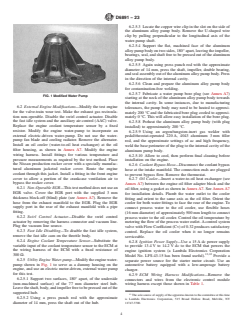
6.2.5.7 Fabricate a water pump bore plug (see Annex A7)
FIG. 1 Modified Water Pump
starting at the neck of the aluminum alloy pump body towards
the internal cavity. In some instances, due to manufacturing
6.2 External Engine Modifications—Modify the test engine
tolerances, the pump body may need to be heated to approxi-
for the valve-train wear test. Make the exhaust gas recircula-
mately 200 °C and the fabricated bore plug cooled to approxi-
tion non-operable. Disable the swirl control actuator. Disable
mately 0 °C. This will allow easy installation of the bore plug.
the fast idle system and the auxiliary air control (AAC) valve.
6.2.5.8 Preheat the aluminum alloy pump body (with plug
Replace the engine coolant temperature sensor by a fixed
installed) to approximately 200 °C.
resistor. Modify the engine water-pump to incorporate an
6.2.5.9 Using an argon/tungsten-inert gas welder with
external electric-driven water-pump. Do not use the water-
pedal/rheostat-operated 220 A, 4043 aluminum 3 mm filler
pump fan blade and cooling radiator. Remove the alternator.
rod, and the approximate settings of ac and high frequency,
Install an oil cooler (water-to-oil heat exchanger) at the oil
weld the base perimeter of the plug to the internal cavity of the
filter housing, as shown in Annex A7. Modify the engine
aluminum pump body.
wiring harness. Install fittings for various temperature and
6.2.5.10 Allow to cool, then perform final cleaning before
pressure measurements as required by the test method. Place
installation on the engine.
the Nissan production rocker cover with a specially manufac-
6.2.6 Coolant Bypass Hose—Disconnect the coolant bypass
tured aluminum jacketed rocker cover. Route the engine
hose at the intake manifold. The connection ends are plugged
coolant through this jacket. Install a fitting in the front engine
to prevent bypass flow. Remove the thermostat.
cover to allow a portion of the crankcase ventilation air to
6.2.7 Oil Cooler—Insert a water-to-oil heat exchanger (see
bypass the rocker cover.
Annex A7) between the engine oil filter adapter block and the
6.2.1 Non-Operable EGR—This test method does not use an
oil filter, using a gasket as shown in Annex A7. See Annex A7
EGR valve. Cover the EGR port with the supplied 3 mm
for installation details. Plumb the water outlet to the cooler
thickness block-off (blind) plate (see Annex A7). Remove the
fitting and orient to the same axis as the oil filter. Orient the
hose from the exhaust manifold to the EGR. Plug the EGR
cooler for both water fittings to face the rear of the engine. To
supply port in the rear of the exhaust manifold with a pipe
connect process water to the oil cooler, use flexible hoses
fitting.
(16 mm diameter) of approximately 500 mm length to connect
6.2.2 Swirl Control Actuator—Disable the swirl control
process water to the oil cooler. Control the oil temperature by
actuator by removing the harness connector and vacuum line.
metering the flow of the process water outlet. A control system
Plug the vacuum line source.
valve with Flow Coefficient (Cv) of 0.32 produces satisfactory
6.2.3 Fast Idle Disabling—To disable the fast idle system,
control. Replace the oil cooler when it no longer remains
remove the fast idle cam on the throttle body.
serviceable.
6.2.4 Engine Coolant Temperature Sensor—Substitute the
6.2.8 Ignition Power Supply—Use a 15 A dc power supply
variable input of the coolant temperature sensor to the ECM at
to provide 13.4 V to 14.2 V dc to the ECM that powers the
the wiring harness of the ECM with a fixed resistance of
engine ignition system (a Lambda Electronics Corporation
13,12
300 Ω.
Model No. LFS-43-15 has been found useful). Provide a
6.2.5 Utility Engine Water-pump—Modify the engine water-
separate power source for the starter motor circuit. Use an
pump shown in Fig. 1 to serve as a dummy housing on the
automotive battery equipped with a low-amperage battery
engine, and use an electric motor-driven, external water pump
charger.
for this test.
6.2.9 ECM Wiring Harness Modifications—Remove the
6.2.5.1 Support two surfaces, 180° apart, of the underside
connectors and wires from the electronic control module
(non-machined surface) of the 77 mm diameter steel hub.
wiring harness except those shown in Table 1.
Leave the shaft, body, and impeller free to be pressed out of the
supported hub.
The sole source of supply of the apparatus known to the committee at this time
6.2.5.2 Using a press punch rod with the approximate
is Lambda Electronics Corporation, 515 Broad Hollow Road, Melville, NY
diameter of 14 mm, press the shaft out of the hub. 11747-3700.
D6891 − 23
A
TABLE 1 ECM Wiring Harness Modifications TABLE 2 System Time Response
Connector Description Connector Number(s)
Time Response, max
Parameters
(one time constant)
Camshaft Position Sensor 30M
Power Transistor 44M
Temperatures 2.5 s
Distributor 46M
Pressures 1.6 s
Ignition Coil 47M, 97M
Coolant Flow 2.5 s
Oxygen Sensor 59M
Torque 2.0 s
Mass Air Flow Sensor 63M
Speed 1.8 s
Engine Coolant Temperature Sensor 65M (Install 300Ω
resistor)
Throttle Position Sensor 66M
Injectors 1–4 72M, 73M, 74M, 75M
Intake Air Temperature Sensor 18M
Body Ground 275M
changes. Computer log and plot the cycle 5 transient data. Log
Engine Ground 60M, 61M
Connector Description Connector Number(s)
the critical parameters (engine speed, torque, oil gallery
B
Fuel Pump Relay 5M
temperature, coolant out temperature) once per second or
C
ECCS Relay 6M
higher frequency. If cycle 5 transients are beyond the proce-
Resistor and Condenser 40M
Check Connector 208M
dural limits defined in 11.2.6, document and confirm the
Joint Connector A 259M
corrective action with the next available transition plot.
ECM (ECCS Control Module) 262M
6.3.1.3 System Time Response for Logged Data—Do not
Fuel Pump 2C
Joint Connector C 212M (jumper exceed the controlled operational parameters for system time
hardwired)
response for measurement shown in Table 2. The system time
Connector 260M (jumper
response includes the total system of sensor, transducer, analog
hardwired)
EGR Temperature sensor 17M (retain, do not
signal attenuation, and computer digital filtering. Use single-
connect)
pole type filters for attenuation.
EGRC solenoid valve 88M (retain, do not
6.3.1.4 Quality Index—The Quality Index (QI) is an overall
connect)
IACV-AAC Valve and 64M (retain, do not
statistical measure of the variation from test targets of the
connect)
steady-state operational controlled parameters. The Sequence
IACV-FICD Solenoid Valve
IVA Surveillance Panel has chosen the QI upper and lower
Ground Connector (retain, do not
connect)
control limits, shown in Table 3.
Check Engine Light add and utilize
n 2
30 A fuse holder add and utilize
1 U1L 2 2X
i
D
QI 5 1 2 (1)
Ground add and utilize S D
(
n U 2 L
i51
Keep-Alive wire add and utilize
Ignition wire add and utilize
where:
D
Ground wire add and utilize
X = values of the parameter measured,
A
i
See modified wiring diagram in Annex A7.
B
U = allowable upper limit of X,
Modify the fuel pump relay connector (5M) to provide a nominal 13 V to the fuel
pump only when turning on the ignition power switch. See Annex A7 for the wiring L = allowable lower limit of X, and
details.
n = number of data points used to calculate QI.
C
The ECCS relay uses the 6M connector. Connect it to the battery through a
fusible link.
Where missing data or Bad Quality Data (BQD), or both, are
D
Attach the wiring harness grounds to the front engine-lifting bracket.
encountered, calculate the adjusted Quality Index (QI )
ADJ
using the following equation:
n n N 2 n
QI 5 QI 1QI × (2)
S D S D S D
6.3 Test Stand and Laboratory Equipment—This engine- ADJ
N N N
dynamometer test is designed for operation using computer
where:
control instrumentation and computer data acquisition. Provide
Q = QI calculated without missing/BQD,
an intake air system for the precise control of engine intake air
I = points,
humidity, temperature, and cleanliness.
n = number of data points used to calculate QI, and
6.3.1 Computer Data Acquisition System—The procedure
N = number of data points for a complete data set.
shown in 6.3.1.1 – 6.3.1.3 details the test stand log operational
data with a computer data acquisition system using sensor If the QI calculation of a controlled parameter is less than
configurations, and is in compliance with Data Acquisition and zero, investigate the reason, assess its impact on test opera-
Control Automation II. Consider a test that has greater than tional validity, and document such finding in the final test
2 h without data acquisition on any controlled parameter to be report. For calibration tests, review the operational validity
operationally invalid. assessment with the TMC.
6.3.1.1 Frequency of Logged Steady-State Data—Log the 6.3.2 Test Stand Configuration—Mount the engine on the
Stage I steady-state (last 45 min of stage) operational condi- test stand similar to its vehicle orientation (tilted up 5.5° in
tions every 2 min or more frequently. Log the Stage II front; sideways 10° up on intake manifold side; bottom of oil
steady-state (last 5 min of stage) operational conditions every sump horizontal). This orientation is important to the return
30 s or more frequently. flow of oil in the cylinder head, and ensures reproducible oil
6.3.1.2 Frequency of Logged Transient Data—Define the levels. Directly couple the engine flywheel to an eddy-current
transient time as the first 5 min following operational stage dynamometer through a driveshaft. The driveshaft design shall
D6891 − 23
TABLE 3 Upper and Lower Control Limits
If using a main system duct dew point temperature reading to
Parameter L U calculate the specific humidity, verify the dew point periodi-
Coolant Flow 29.8 30.2 cally at the test stand. Maintain the duct surface temperature
Coolant Out Temperature, 49.81 50.19
above the dew point temperature at all points downstream of
Stage I and II 54.81 55.19
the humidity measurement point to prevent condensation and
Exhaust Back-pressure 103.34 103.66
Intake Air Humidity 10.8 12.2 loss of humidity level.
Intake Air Pressure 0.047 0.053
6.3.4.2 Intake Air Filtering—Use the production intake air
Intake Air Temperature 31.71 32.29
cleaner assembly (Annex A6), with filter, at the engine. Use a
Oil Cylinder Head Temperature, 48.7 49.3
Stage I and II 58.7 59.3 snorkel adapter, functionally equivalent to that shown in Annex
Speed, 793.5 806.5
A7, to connect the controlled air duct to the air cleaner. Modify
Stage I and II 1493.5 1506.5
the top of the air cleaner assembly for the installation of the
Torque 24.5 25.5
Rocker Cover Air Flow 9.5 10.5
intake temperature sensor and for the intake pressure sensor
line. Refer to 6.3.4.5.
6.3.4.3 Intake Air Flow—Do not measure for intake airflow.
6.3.4.4 Intake Air Temperature—For final control of the
minimize vibration at the test operating conditions. The dyna-
2 2
inlet air temperature, install an electric air heater strip within
mometer system shall have inertia of 0.75 kg·m 6 0.15 kg·m
the air supply duct. The duct material and heater elements
to ensure satisfactory control of engine speed at 800 r/min,
design shall not generate corrosion debris that could be
stable air-to-fuel ratio control, and enable reproducible tran-
ingested by the engine. To provide sufficient duct flow for
sient control of engine speed and torque during stage changes.
adequate air temperature control, it is recommended that
Do not use hydraulic type dynamometers, as they exhibit
excess air be dumped just prior to the air cleaner snorkel. An
residual torques at low speed operation. Do not use the engine
air dump area of approximately 60 mm will provide sufficient
to drive any external engine accessory. Recommend the area
above and to the left of the rocker arm cover be left unob- flow without stagnation. If additional airflow is required to
stabilize air temperature, it is permissible to install a nominal
structed to allow for easier on-site replacement of valve-train
wear parts while the engine rests on the test stand. See Annex 10 mm bleed hole in the air filter housing. Install the inlet
temperature sensor in the air cleaner, centered at the inlet to the
A8 for Safety Precautions.
6.3.3 Dynamometer Speed and Torque Control System—To air cleaner (see Annex A7). Attach a support brace to the air
cleaner assembly mounting stud and wing nut, if vibration of
improve laboratory reproducibility for transient control of
engine speed and torque, the driveline system inertia, exclud- the temperature sensor is a problem.
2 2
6.3.4.5 Intake Air Supply Pressure—Install a disc type valve
ing engine, shall be 0.75 kg·m 6 0.15 kg·m . Control the
engine power for evaluating the lubricant in a repeatable in the controlled air system supply duct to control the engine
inlet air gage pressure. Locate the sensing tube for inlet air
manner by:
6.3.3.1 Measuring and controlling engine speed and dyna- pressure in the topside of the air cleaner assembly
(50 mm 6 10 mm left and 80 mm 6 10 mm in front of the
mometer torque,
right rear corner of the assembly). This location senses the
6.3.3.2 Controlling exhaust absolute pressure by exhaust
pressure before the air enters the air cleaner element.
pipe throttling, and
6.3.5 Fuel Supply System—This test method requires ap-
6.3.3.3 Controlling the supply of intake air temperature,
proximately 200 L of unleaded Haltermann KA24E Green test
humidity, and pressure differential above barometer pressure.
14,12
fuel per test (100 cycles). Ensure a sufficient fuel supply at
NOTE 3—The dynamometer speed and torque control systems shall be
the start of test to conduct the test without a shutdown. Use the
capable of maintaining the steady state operating set points within the
production port fuel injection system, including fuel pump (see
performance envelope (that is, quality index established by the industry
matrix testing program).
Annex A7), fuel injector rail, and fuel pressure regulator. Ford
NOTE 4—Two types of full closed-loop speed and torque control
fuel pump, E7TZ-9C407-BA may also be used in this
systems have been successfully utilized. One typical closed-loop system
application. Use recirculated fuel within the system using a
maintains speed by varying dynamometer excitation and maintains torque
non-production heat exchanger to maintain fuel temperature
by varying the engine throttle. This arrangement may provide satisfactory
ranging from 15 °C to 30 °C. Measure fuel consumption using
steady-state control. Another closed-loop speed and torque control system
16,12
maintains torque by varying dynamometer excitation and controls speed
a mass flow meter (MicroMotion model D-6 is suitable).
using the engine throttle. This arrangement may provide satisfactory
Install a fuel filter assembly (see Annex A7) upstream of the
transient control during stage changes.
fuel pump. Ensure proper fuel filtration to maintain precise
6.3.4 Intake-air Supply System—The supply system shall be
air-fuel ratio control during the test.
capable of delivering a minimum of 600 L/min (2000 L/min
6.3.5.1 Fuel Temperature—Measure fuel temperature
preferred) of conditioned and filtered air to the test engine
through one of the ports in a cross fitting located in the line
during the 100 h test, while maintaining the intake-air param-
eters detailed in Annex A5. A humidifying chamber controls
the specific humidity and provides a positive air pressure to an
The sole source of supply of the apparatus known to the committee at this time
is Dowell Chemical Company, 1201 South Sheldon Road, Channelview, TX
intake air supply duct. Annex A7 shows a general schematic of
77530-0429.
the intake air system.
Can be purchased through Ford or Lincoln Mercury dealers.
6.3.4.1 Induction Air Humidity—Measure the intake air
The sole source of supply of the apparatus known to the committee at this time
specific humidity in the main system duct or at the test stand. is Micromotion, 7070 Winchester Circle, Boulder, CO 80301.
D6891 − 23
A
TABLE 4 AFR Analyzer Parameters
between the fuel pump and the fuel rail. Maintain the fuel
Fuel Properties Value
temperature to the fuel rail below 50 °C.
Hydrogen to Carbon ration of the fuel 1.800
6.3.5.2 Fuel Pressure—Measure the fuel pressure through
Oxygen Content 0.000
one of the ports in a cross fitting located in the line between the
A
Stochiometric air-to-fuel ratio for the test fuel is 14.4 to 1.
fuel pump and the fuel rail inlet.
6.3.5.3 Fuel Flow—Install a mass fuel flow meter for
measuring the fuel consumption rate in the fuel supply system,
prior to the fuel recirculating loop. A MicroMotion model D-6
the tube collector. Orient this fitting circumferentially 60° to
fuel flow meter has been found to be suitable. 90° from the exhaust temperature sensor.
6.3.6 Exhaust System—Use a production cast iron exhaust 6.3.6.9 Exhaust Sample Probe—It is optional to install an
exhaust sampling probe for emission analyses (percent O ,
manifold, without insulation, for the test.
CO , CO, HC). If used, locate the exhaust sampling probe
6.3.6.1 Plug the rear of the manifold (EGR supply) with a
100 mm downstream from the end of the collector on the
pipe fitting. Do not use an EGR for this test.
exhaust pipe. Extend the probe into the center of the exhaust
6.3.6.2 Use and install a production exhaust gas oxygen
pipe, with the tip of the probe cut to a 45° angle (longest
sensor (one-wire EGO) in the original location in the exhaust
portion facing upstream).
manifold.
6.3.7 Air-to-Fuel Ratio Control—Control the air-to-fuel ra-
6.3.6.3 Mount an industrial cooling blower with a nominal
tio (AFR) at a stoichiometric mixture (14.4 6 0.3) by the
air flow rating within 10 000 L/min to 14 000 L ⁄min to blow
engine ECM, using feedback from the production exhaust gas
air vertically over the cast iron exhaust manifold and the
oxygen sensor installed in the exhaust manifold.
manifold exhaust gas oxygen (EGO) sensor. This cooling air is
6.3.7.1 AFR Measurement—To monitor the reliability of the
essential to proper EGO operation. Ensure this cooling air is
AFR control, use an AFR analyzer with a separate wide
not directed to the engine oil pan or rocker arm cover. Use a
range-sensing element (UEGO) sensor to compute the AFR.
deflector shield to prevent air currents at the oil pan. See Annex
17,12
Use a Horiba model MEXA 110 lambda analyzer, or the
A8 for Safety Precautions.
18,12
ETAS Lambda Meter LA3. These analyzers are configured
6.3.6.4 Use the production exhaust pipe front length (mini-
to read directly the air-to-fuel ratio. Program the Mexa 110
mum 500 mm), including tube collector with shield, leading
AFR analyzer with the information shown in Table 4 for the
from the manifold. Route the exhaust from the test cell using
Haltermann KA24E Green test fuel. Input the Mexa 110
accepted laboratory practices. Install an exhaust pressure
analyzer with sensor calibration documentation received with
control valve at any point after the production exhaust pipe to
the sensor. It is recommended that a periodic verification of the
enable the exhaust to be controlled to an absolute pressure. Use
calibration be performed by exposing the sensor to a 4.0 % O ,
of a catalytic converter, or exhaust attenuator, or pipe cooling
N balance certified gas. Follow the manufacturer’s calibration
is optional, provided these devices are installed after the
procedures for the AFR analyzer used.
production exhaust pipe front length and specified absolute
6.3.8 Ignition System—Do not modify the ignition system
pressure is maintained. Remove the unused exhaust pipe
for this test method.
production fitting, and weld a plate over the opening (see
6.3.8.1 Monitoring Ignition Timing—Use an automotive
Annex A7).
timing light (strobe) to visually check the ignition timing.
6.3.6.5 Because this test method is continuously operated at
6.3.9 Engine Coolant System—A schematic diagram of the
low engine speeds and torque, the water vapor in the exhaust
external coolant system is shown in Annex A7. Use a 50 %
gas tends to condense in the exhaust piping. Install a low point
deionized water and antifreeze solution, using an extended life
drain in the exhaust piping to remove accumulated water
ethylene glycol based engine coolant. Texaco Havoline Dex-
before the start of each test. Depending on the exhaust piping
19,12
Cool has been found to meet this requirement. Configure
arrangement, if exhaust pressure fluctuations are observed,
the plumbing such that the total coolant system capacity,
remove water periodically throughout the 100 h test.
including engine and normal reservoir capacity, is 25 L to 30 L.
6.3.6.6 Air-To-Fuel-Ratio Sensor—Install a Universal Ex-
Regulate the system pressure by a 100 kPa radiator-type
haust Gas Oxygen (UEGO) sensor in the production exhaust
pressure cap onto the reservoir tank. Plumb the coolant to enter
pipe to monitor the air-to-fuel ratio. Make a port 30 mm 6
the engine at the thermostat housing (remove the thermostat).
10 mm downstream of the collector. Orient the UEGO to the
Coolant exits the engine at the front of the intake manifold.
front side of the exhaust pipe using the appropriate weld fitting.
Circulate a portion of the engine coolant through the specially
It is not necessary to direct cooling air over the UEGO sensor.
manufactured jacketed rocker cover (see Annex A7).
6.3.6.7 Exhaust Gas Temperature—Measure the exhaust gas
6.3.9.1 External Coolant Pump—Use an electric motor-
temperature using a 6 mm diameter thermocouple. Install the
driven centrifugal bronze body pump with a nominal minimum
thermocouple in a welded fitting attached to the exhaust pipe at
a location 50 mm 6 10 mm downstream from the end of the
collector. Insert the sensor tip to the center of the exhaust pipe
The sole source of supply of the apparatus known to the committee at this time
is Horiba Instruments, 17671 Armstrong Avenue, Irvine, CA 92714.
(see Annex A7).
The sole source of supply of the apparatus known to the committee at this time
6.3.6.8 Exhaust Absolute Pressure—Attach the exhaust
is ETAS, 2155 Jackson Avenue, Ann Arbor, MI 48103.
pressure sensor tube to a welded fitting installed on the exhaust
The sole source of supply of the apparatus known to the committee at this time
pipe at a location (50 6 10) mm downstream from the end of is Texaco Lubricants Company, P.O. Box 4427, Houston, TX 77210-4427.
D6891 − 23
FIG. 2 Jacketed Rocker Cover
rating of 150 L/min at 100 kPa head pressure. The actual flow circuit enters the front of the jacketed cover and exits the rear
range during the test (including break-in) is 20 L ⁄min to of the cover. Install an automatic air bleed vent near the front
70 L ⁄min. of the rocker cover. Limit the secondary circuit flow rate at the
6.3.9.2 Coolant Heater—Use a nominal 8 kW electric exit by installing a two-way control valve, 13 mm nominal
heater, or equivalent external heating source, in the coolant internal diameter size, with a flow coefficient rating (Cv) of
system. This allows engine coolant soak temperatures to be 1.25. Configure the control valve in the fail-safe open position.
maintained while the engine is not running. Because the ECM The secondary flow joins the primary flow at the suction of the
coolant temperature sensing system is non-operable, smooth coolant system-circulating pump. Refer to the schematic of the
running of the engine upon start-up depends on maintaining the cooling system located in Annex A7.
coolant soak temperature. 6.3.10 Crankcase Ventilation System (Fig. 3)—Alter the
6.3.9.3 Coolant Heat Exchanger—Use a conventional shell- Nissan production routing of the crankcase gasses to ensure
and-tube heat exchanger for cooling. Flow the engine coolant that a certain mass flow rate of fresh air is supplied to the
through the tube side, and use process water on the shell side. valve-train underneath the jacketed rocker cover. Take
A nominal 150 mm diameter by 1200 mm long exchanger has humidity-conditioned air from the bottom, left rear of the air
been found to be suitable. Position the heat exchanger cleaner housing and route to the rear right side of the rocker
vertically, and the coolant inlet at the top of the exchanger. arm cover and to the engine front cover.
Plumb the high point bleed to remove system air during initial 6.3.10.1 Draw the crankcase off-gas from the engine at the
circulation of coolant. Install a sight-glass in the coolant line production breather and oil separator. From the breather, the
upstream of the external coolant pump. Plumb a low point crankcase gas flows through the Positive Crankcase Ventilation
drain to allow complete coolant removal. (PCV) valve to the bottom plenum of the intake manifold (see
6.3.9.4 Coolant Control—For control of the coolant out Annex A7) for a drawing of the ventilation system plumbing.
temperature, install an automatic control valve in the process 6.3.10.2 Use a mass flow meter to measure the fresh airflow
water outlet of the heat exchanger. Use a control valve with a to the rocker cover of 10.0 L ⁄min (SLPM, Standard Litres per
Cv rating of 1.25 for the recommended heat exchanger size. Minute). This meter, corrected to standard conditions, shall
6.3.9.5 Coolant Flow Control—Measure the coolant flow have an accuracy of 6 0.25 L ⁄min (SLPM) at 10 L ⁄min
using a volumetric flow sensor installed in the coolant line (SLPM). Full scale of the meter shall be a minimum of
between the heat exchanger and the coolant inlet to the engine. 20 L ⁄min (SLPM). Time response of the measurement shall be
20,12
A Barco venturi metering element is recommended. Con- less than or equal to 1.0 s. One model that meets these
trol the flow by an automatic flow control valve on the specifications is Sierra Mass Flow Meter, model 730-N2-
21,12
discharge side of the external pump. A control valve with a Cv 1E0PV1V4 (air; 20 SLPM).
rating of 16 is recommended. 6.3.10.3 Prior to the meter, install a three-way control valve
6.3.9.6 Jacketed Rocker Cover Coolant System—Route a having a nominal size of 13 mm and a flow coefficient rating of
portion of total coolant system flow through the jacketed rocker 2.5 Cv. Configure the valve so that loss of control power routes
cover. Install a tee fitting at the exit of the coolant heat all air to the rocker cover. A Badger Meter ⁄2 in. research valve
22,12
exchanger to allow the coolant flow to split into two circuits with Trim A meets these requirements. Use a 20 L nominal
(main circuit to the engine thermostat housing and secondary surge at the exit of the flow meter.
circuit to the jacketed rocker cover (see Fig. 2). The secondary
The sole source of supply of the apparatus known to the committee at this time
is Sierra Instruments, 5 Harris Court, Monterey, CA 93940.
20 22
The sole source of supply of the apparatus known to the committee at this time The sole source of supply of the apparatus known to the committee at this time
is Barco, Hyspan Precision Products, 1685-T Brandwine Avenue, Chula Vista, CA is Badger Meter, Inc., Precision Products Division, 6116 East 15th Street, Tulsa, OK
91911. 74112.
D6891 − 23
FIG. 3 Typical Crankcase Ventilation
6.3.10.4 The plumbing from the 3-way valve to the engine require short immersion depths to prevent undesirable tempera-
front cover is a nominal diameter of 10 mm; see Fig. 4. The ture gradients. For exhaust gas temperature, the 6.4 mm
plumbing from the 3-way valve, through th
...
This document is not an ASTM standard and is intended only to provide the user of an ASTM standard an indication of what changes have been made to the previous version. Because
it may not be technically possible to adequately depict all changes accurately, ASTM recommends that users consult prior editions as appropriate. In all cases only the current version
of the standard as published by ASTM is to be considered the official document.
´1
Designation: D6891 − 21 D6891 − 23
Standard Test Method for
Evaluation of Automotive Engine Oils in the Sequence IVA
Spark-Ignition Engine
This standard is issued under the fixed designation D6891; the number immediately following the designation indicates the year of
original adoption or, in the case of revision, the year of last revision. A number in parentheses indicates the year of last reapproval. A
superscript epsilon (´) indicates an editorial change since the last revision or reapproval.
ε NOTE—Editorially updated TMC governance information in June 2022.
INTRODUCTION
Portions of this test method are written for use by laboratories that make use of ASTM Test
Monitoring Center (TMC) services (see Annex A1).
The TMC provides reference oils, and engineering and statistical services to laboratories that desire
to produce test results that are statistically similar to those produced by laboratories previously
calibrated by the TMC.
In general, the Test Purchaser decides if a calibrated test stand is to be used. Organizations such as
the American Chemistry Council require that a laboratory utilize the TMC services as part of their test
registration process. In addition, the American Petroleum Institute and the Gear Lubricant Review
Committee of the Lubricant Review Institute (SAE International) require that a laboratory use the
TMC services in seeking qualification of oils against their specifications.
The advantage of using the TMC services to calibrate test stands is that the test laboratory (and
hence the Test Purchaser) has an assurance that the test stand was operating at the proper level of test
severity. It should also be borne in mind that results obtained in a non-calibrated test stand may not
be the same as those obtained in a test stand participating in the ASTM TMC services process.
Laboratories that choose not to use the TMC services may simply disregard these portions.
1. Scope*
1.1 This test method measures the ability of crankcase oil to control camshaft lobe wear for spark-ignition engines equipped with
an overhead valve-train and sliding cam followers. This test method is designed to simulate extended engine idling vehicle
operation. The Sequence IVA Test Method uses a Nissan KA24E engine. The primary result is camshaft lobe wear (measured at
seven locations around each of the twelve lobes). Secondary results include cam lobe nose wear and measurement of iron wear
metal concentration in the used engine oil. Other determinations such as fuel dilution of crankcase oil, non-ferrous wear metal
concentrations, and total oil consumption, can be useful in the assessment of the validity of the test results.
1.2 The values stated in SI units are to be regarded as standard. No other units of measurement are included in this standard.
This test method is under the jurisdiction of ASTM Committee D02 on Petroleum Products, Liquid Fuels, and Lubricants and is the direct responsibility of Subcommittee
D02.B0 on Automotive Lubricants.
Current edition approved April 1, 2021July 1, 2023. Published April 2021July 2023. Originally approved in 2003. Last previous edition approved in 20152021 as
ɛ1
D6891 – 15.D6891 – 21 . DOI: 10.1520/D6891-21E01.10.1520/D6891-23.
The ASTM Test Monitoring Center will update changes in this test method by means of Information Letters. Information letters may be obtained from the ASTM Test
Monitoring Center (TMC), 203 Armstrong Drive, Freeport, PA 16229, Attention: Director. www.astmtmc.org. This edition incorporates all Information Letters through No.
20–1.23–1.
*A Summary of Changes section appears at the end of this standard
Copyright © ASTM International, 100 Barr Harbor Drive, PO Box C700, West Conshohocken, PA 19428-2959. United States
D6891 − 23
1.2.1 Exceptions—Where there is no direct SI equivalent such as pipe fittings, tubing, NPT screw threads/diameters, or single
source equipment specified.
1.3 This standard does not purport to address all of the safety concerns, if any, associated with its use. It is the responsibility
of the user of this standard to establish appropriate safety, health, and environmental practices and determine the applicability of
regulatory limitations prior to use. See Annex A8 for specific safety precautions.
1.4 This international standard was developed in accordance with internationally recognized principles on standardization
established in the Decision on Principles for the Development of International Standards, Guides and Recommendations issued
by the World Trade Organization Technical Barriers to Trade (TBT) Committee.
2. Referenced Documents
2.1 ASTM Standards:
D235 Specification for Mineral Spirits (Petroleum Spirits) (Hydrocarbon Dry Cleaning Solvent)
D287 Test Method for API Gravity of Crude Petroleum and Petroleum Products (Hydrometer/Method)
D323 Test Method for Vapor Pressure of Petroleum Products (Reid Method)
D381 Test Method for Gum Content in Fuels by Jet Evaporation
D445 Test Method for Kinematic Viscosity of Transparent and Opaque Liquids (and Calculation of Dynamic Viscosity)
D525 Test Method for Oxidation Stability of Gasoline (Induction Period Method)
D3525 Test Method for Gasoline Fuel Dilution in Used Gasoline Engine Oils by Wide-Bore Capillary Gas Chromatography
D4485 Specification for Performance of Active API Service Category Engine Oils
D5185 Test Method for Multielement Determination of Used and Unused Lubricating Oils and Base Oils by Inductively
Coupled Plasma Atomic Emission Spectrometry (ICP-AES)
D5844 Test Method for Evaluation of Automotive Engine Oils for Inhibition of Rusting (Sequence IID) (Withdrawn 2003)
E29 Practice for Using Significant Digits in Test Data to Determine Conformance with Specifications
E230 Specification for Temperature-Electromotive Force (emf) Tables for Standardized Thermocouples
2.2 API Standard:
API 1509 Engine Oil Licensing and Certification System
2.3 SAE Standards:
SAE J183 Engine Oil Performance and Engine Service Classification
SAE J254 Instrumentation and Techniques for Exhaust Gas Emissions Measurement
2.4 ASME Standard:
B46.1 Standard for Surface Texture (Surface Roughness, Waviness, and Lay)
2.5 JASO Standard:
M 328-95 Valve-train Wear Test Procedure for Evaluating Automobile Gasoline Engine Oils
2.6 CEC Standard:
CEC-L-38-A-94 Peugeot TU-3M/KDX Valve-train Scuffing Wear Test
3. Terminology
3.1 Definitions:
3.1.1 blowby, n—that portion of the combustion products and unburned air/fuel mixture that leaks past piston rings into the engine
crankcase during operation.
3.1.2 calibration test stand, n—a test stand on which the testing of reference material(s), conducted as specified in the standard,
provided acceptable results. Sub. B Glossary
For referenced ASTM standards, visit the ASTM website, www.astm.org, or contact ASTM Customer Service at service@astm.org. For Annual Book of ASTM Standards
volume information, refer to the standard’s Document Summary page on the ASTM website.
The last approved version of this historical standard is referenced on www.astm.org.
Available from The American Petroleum Institute (API), 1220 L. St., NW, Washington, DC 20005.
Available from Society of Automotive Engineers (SAE), 400 Commonwealth Dr., Warrendale, PA 15096-0001.
Available from American Society of Mechanical Engineers (ASME), ASME International Headquarters, Three Park Ave., New York, NY 10016-5990.
Available from Japanese Standards Organization (JSA), 4-1-24 Akasaka Minato-Ku, Tokyo, 107-8440, Japan.
Available from the Coordinating European Council for the Development of Performance Tests Transportation Fuels, Lubes, and other Fluids, Madou Plaza, 25 Floor
Place, Madou B-1210, Brussels, Belgium.
Available from ASTM Test Monitoring Center (TMC), 203 Armstrong Drive, Freeport, PA 16229, Attention: Director.
D6891 − 23
3.1.2.1 Discussion—
In several automotive lubricant standard test methods, the ASTM Test Monitoring Center provides testing guidance and determines
acceptability.
3.1.3 reference oil, n—an oil of known performance characteristics, used as a basis for comparison.
3.1.3.1 Discussion—
Reference oils are used to calibrate testing facilities, to compare the performance of other oils, or to evaluate other materials (such
as seals) that interact with oils. D5844
3.2 Definitions of Terms Specific to This Standard:
3.2.1 assessment length, n—the length of surface over which measurements are made.
3.2.2 break-in, n—initial engine operation to reach stabilization of the engine performance after new parts are installed in the
engine.
3.2.3 cam lobe wear, n—the sum of the wear determined at the following locations (nose is zero location): (1) 14 cam degrees
before the nose, (2) 10° before the nose, (3) 4° before the nose, (4) at the nose, (5) 4° after the nose, (6) 10° after the nose, (7)
14° after the nose.
3.2.4 cam nose wear, n—the maximum linear deviation of a worn nose profile from the unworn profile; the nose is the high lift
point on the particular cam lobe.
3.2.5 flushing, n—the installation of a fresh charge of lubricant and oil filter for the purpose of running the engine to reduce and
eliminate remnants of the previous oil charge.
3.2.5.1 Discussion—
Flushing may be carried out in an iterated process to ensure a more thorough process of reducing previous oil remnants.
3.2.6 reference line, n—a deduced, leveled, straight line drawn on the profilometer graph, from the front unworn average edge of
a cam lobe to the rear unworn average edge of that cam lobe.
3.2.7 valve-train, n—a mechanical engine subsystem comprised of the camshaft, the rocker arms, hydraulic lash adjusters, the
poppet valves, and valve-springs.
3.2.8 waveness ,n—the maximum excursion of the worn surface as graphically measured normal to the reference line.
total
4. Summary of Test Method
4.1 Test Numbering Scheme—Use the test numbering scheme shown below:
AAAAA–BBBBB–CCCCC
AAAAA represents the stand number. BBBBB represents the number of tests since the last calibration test on that stand. CCCCC
represents the total number of Sequence IVA tests conducted on that stand. For example, 6-10-175 represents the 175th Sequence
IVA test conducted on test stand 6 and the tenth test since the last calibration test. Consecutively number all tests. Number the stand
calibration tests beginning with zero for the BBBBB field. Multiple-length Sequence IVA tests are multiple runs for test numbering
purposes, such as double-length tests which are counted as two runs and triple-length tests which are counted as three runs. For
example, if test 1-3-28 is a doubled-length test, number the next test conducted on that stand 1-5-30.
4.2 Test Engine—This procedure uses a fired 1994 model Nissan KA24E, in-line 4-cylinder, 4-cycle, water-cooled, port
11,12
fuel-injected gasoline engine with a displacement of 2.389 L. The engine features a single overhead camshaft with sliding
follower rocker arms, with two intake valves and one exhaust valve per cylinder, and hydraulic lash adjusters. The camshaft is not
phosphate-coated or lubrited.
The sole source of supply of the apparatus known to the committee at this time is Nissan North American, Inc., P.O. Box 191, Gardena, CA 90248-0191.
If you are aware of alternative suppliers, please provide this information to ASTM International Headquarters. Your comments will receive careful consideration at a
meeting of the responsible technical committee, which you may attend.
D6891 − 23
4.3 Test Stand—Couple the test engine (devoid of alternator, cooling fan, water pump, clutch and transmission) to an eddy-current
dynamometer for precise control of engine speed and torque. Specify the combined inertia of the driveline and dynamometer to
ensure reproducible transient ramping of engine speed and torque. Control the intake air, provided to the engine air filter housing,
for temperature, pressure, and humidity. Mount the engine similar to its vehicle orientation (tilted up 5.5° in front; sideways 10°
up on intake manifold side; bottom of oil sump horizontal). Modify the engine ECM wiring harness, sensors, and actuators. The
test stand plumbing shall conform to the diagrams shown in Annex A7. Install the engine on a test stand equipped with computer
control of engine speed, torque, various temperatures, pressures, flows, and other parameters outlined in the test procedure (see
Section 11).
4.4 Test Sequence—After engine break-in or after the completion of a previous test, install a new test camshaft and rocker arms.
Charge the fresh test oil to the engine and conduct two flushes. After completing both flushes, drain the used oil, and weigh and
install the fresh test oil and filter. Conduct the test for a total of 100 h, with no scheduled shutdowns. There are two operating
conditions, Stage I and Stage II; Stage I for 50 min and Stage II for 10 min comprise one test cycle. The test length is 100 cycles.
4.5 Analyses Conducted—After test, measure the camshaft lobes using a surface profilometer. From these graphical profile
measurements, determine the maximum wear at seven locations on the cam lobe. Determine individual cam lobe wear by summing
the seven location wear measurements. Average the wear from the twelve cam lobes for the final, primary test result. After test
completion, determine the oil consumption by the mass of used oil versus the fresh oil charged to the engine (including oil filter).
Analyze the end of test used oil for fuel dilution, kinematic viscosity, and wear metals. Retain a final drain sample of 1 L for 90
days. Retain the camshaft and rocker arms for six months.
5. Significance and Use
5.1 This test method was developed to evaluate automotive lubricant’s effect on controlling cam lobe wear for overhead
valve-train equipped engines with sliding cam followers.
NOTE 1—This test method may be used for engine oil specifications, such as Specification D4485, API 1509, SAE J183, and ILSC GF 3.
6. Apparatus
NOTE 2—Coordination with the ASTM Committee D02, Subcommittee B, Sequence IVA Surveillance Panel is a prerequisite to the use of any equivalent
apparatus. However, the intent is to permit reasonable adaptation of existing laboratory facilities and equipment. Figures are provided throughout the test
method to suggest appropriate design details and depict some of the required apparatus.
6.1 Test Engine—This test method uses a fired 1994 model Nissan KA24E, in-line 4-cylinder, 4-cycle, water-cooled, port
11,12
fuel-injected gasoline engine with a displacement of 2.389 L. See Annex A6 for a parts lists. Nominal oil sump volume is
3.5 L. The cylinder block is constructed of cast iron, while the cylinder head is aluminum. The engine features a single overhead
camshaft with sliding follower rocker arms, with two intake valves and one exhaust valve per cylinder, and hydraulic lash adjusters.
The camshaft is not phosphate-coated or lubrited. The rocker arm contact pad material is powdered metal. The engine compression
ratio is 8.6 to 1. Rate the engine at 198 N·m torque at 4400 r ⁄min. The ignition timing and multi-port fuel injection system is ECM.
Fuel the engine with a specially blended, non-detergent unleaded reference gasoline. Make the EGR non-operable.
6.1.1 Engine Buildup and Measurement Area—The ambient atmosphere of the engine buildup and measurement areas shall be
reasonably free of contaminants and maintained at a uniform temperature. Maintain the specific humidity at a uniform level to
prevent the accumulation of rust on engine parts. Use uniform temperatures to ensure repeatable dimensional measurements. Use
a sensitive surface profilometer instrument to measure the wear of the cam lobes, and place the profilometer on a base-plate free
of external vibrations.
6.1.2 Engine Operating Area—The laboratory ambient atmosphere shall be reasonably free of contaminants and general wind
currents, especially if and when the valve-train parts are installed while the engine remains in the operating area. The temperature
and humidity level of the operating area is not specified.
6.1.3 Parts Cleaning Area—This test method does not specify the ambient atmosphere of the parts cleaning area (Warning—Use
adequate ventilation in areas while using solvents and cleansers).
6.2 External Engine Modifications—Modify the test engine for the valve-train wear test. Make the exhaust gas recirculation
non-operable. Disable the swirl control actuator. Disable the fast idle system and the auxiliary air control (AAC) valve. Replace
D6891 − 23
FIG. 1 Modified Water Pump
the engine coolant temperature sensor by a fixed resistor. Modify the engine water-pump to incorporate an external electric-driven
water-pump. Do not use the water-pump fan blade and cooling radiator. Remove the alternator. Install an oil cooler (water-to-oil
heat exchanger) at the oil filter housing, as shown in Annex A7. Modify the engine wiring harness. Install fittings for various
temperature and pressure measurements as required by the test method. Place the Nissan production rocker cover with a specially
manufactured aluminum jacketed rocker cover. Route the engine coolant through this jacket. Install a fitting in the front engine
cover to allow a portion of the crankcase ventilation air to bypass the rocker cover.
6.2.1 Non-Operable EGR—This test method does not use an EGR valve. Cover the EGR port with the supplied 3 mm thickness
block-off (blind) plate (see Annex A7). Remove the hose from the exhaust manifold to the EGR. Plug the EGR supply port in the
rear of the exhaust manifold with a pipe fitting.
6.2.2 Swirl Control Actuator—Disable the swirl control actuator by removing the harness connector and vacuum line. Plug the
vacuum line source.
6.2.3 Fast Idle Disabling—To disable the fast idle system, remove the fast idle cam on the throttle body.
6.2.4 Engine Coolant Temperature Sensor—Substitute the variable input of the coolant temperature sensor to the ECM at the
wiring harness of the ECM with a fixed resistance of 300 Ω.
6.2.5 Utility Engine Water-pump—Modify the engine water-pump shown in Fig. 1 to serve as a dummy housing on the engine,
and use an electric motor-driven, external water pump for this test.
6.2.5.1 Support two surfaces, 180° apart, of the underside (non-machined surface) of the 77 mm diameter steel hub. Leave the
shaft, body, and impeller free to be pressed out of the supported hub.
6.2.5.2 Using a press punch rod with the approximate diameter of 14 mm, press the shaft out of the hub.
6.2.5.3 Locate the copper wire clip in the slot on the side of the aluminum alloy pump body. Remove the U-shaped wire clip by
pulling perpendicular to the longitudinal axis of the water-pump shaft.
6.2.5.4 Support the flat, machined face of the aluminum alloy pump body on two sides, 180° apart, leaving the impeller, bearings,
seal, and shaft free to be pressed out of the aluminum alloy pump body.
6.2.5.5 Again using press punch rod with the approximate diameter of 14 mm, press the shaft, impeller, double bearing, and seal
assembly out of the aluminum alloy pump body. Press in the direction of the internal cavity.
6.2.5.6 Clean and prepare the aluminum alloy pump body for contamination-free welding.
6.2.5.7 Fabricate a water pump bore plug (see Annex A7) starting at the neck of the aluminum alloy pump body towards the
internal cavity. In some instances, due to manufacturing tolerances, the pump body may need to be heated to approximately 200 °C
and the fabricated bore plug cooled to approximately 0 °C. This will allow easy installation of the bore plug.
D6891 − 23
6.2.5.8 Preheat the aluminum alloy pump body (with plug installed) to approximately 200 °C.
6.2.5.9 Using an argon/tungsten-inert gas welder with pedal/rheostat-operated 220 A, 4043 aluminum 3 mm filler rod, and the
approximate settings of ac and high frequency, weld the base perimeter of the plug to the internal cavity of the aluminum pump
body.
6.2.5.10 Allow to cool, then perform final cleaning before installation on the engine.
6.2.6 Coolant Bypass Hose—Disconnect the coolant bypass hose at the intake manifold. The connection ends are plugged to
prevent bypass flow. Remove the thermostat.
6.2.7 Oil Cooler—Insert a water-to-oil heat exchanger (see Annex A7) between the engine oil filter adapter block and the oil filter,
using a gasket as shown in Annex A7. See Annex A7 for installation details. Plumb the water outlet to the cooler fitting and orient
to the same axis as the oil filter. Orient the cooler for both water fittings to face the rear of the engine. To connect process water
to the oil cooler, use flexible hoses (16 mm diameter) of approximately 500 mm length to connect process water to the oil cooler.
Control the oil temperature by metering the flow of the process water outlet. A control system valve with Flow Coefficient (Cv)
of 0.32 produces satisfactory control. Replace the oil cooler when it no longer remains serviceable.
6.2.8 Ignition Power Supply—Use a 15 A dc power supply to provide 13.4 V to 14.2 V dc to the ECM that powers the engine
13,12
ignition system (a Lambda Electronics Corporation Model No. LFS-43-15 has been found useful). Provide a separate power
source for the starter motor circuit. Use an automotive battery equipped with a low-amperage battery charger.
6.2.9 ECM Wiring Harness Modifications—Remove the connectors and wires from the electronic control module wiring harness
except those shown in Table 1.
6.3 Test Stand and Laboratory Equipment—This engine-dynamometer test is designed for operation using computer control
instrumentation and computer data acquisition. Provide an intake air system for the precise control of engine intake air humidity,
temperature, and cleanliness.
6.3.1 Computer Data Acquisition System—The procedure shown in 6.3.1.1 – 6.3.1.3 details the test stand log operational data with
a computer data acquisition system using sensor configurations, and is in compliance with Data Acquisition and Control
Automation II. Consider a test that has greater than 2 h without data acquisition on any controlled parameter to be operationally
invalid.
6.3.1.1 Frequency of Logged Steady-State Data—Log the Stage I steady-state (last 45 min of stage) operational conditions every
2 min or more frequently. Log the Stage II steady-state (last 5 min of stage) operational conditions every 30 s or more frequently.
6.3.1.2 Frequency of Logged Transient Data—Define the transient time as the first 5 min following operational stage changes.
Computer log and plot the cycle 5 transient data. Log the critical parameters (engine speed, torque, oil gallery temperature, coolant
out temperature) once per second or higher frequency. If cycle 5 transients are beyond the procedural limits defined in 11.2.6,
document and confirm the corrective action with the next available transition plot.
6.3.1.3 System Time Response for Logged Data—Do not exceed the controlled operational parameters for system time response
for measurement shown in Table 2. The system time response includes the total system of sensor, transducer, analog signal
attenuation, and computer digital filtering. Use single-pole type filters for attenuation.
6.3.1.4 Quality Index—The Quality Index (QI) is an overall statistical measure of the variation from test targets of the steady-state
operational controlled parameters. The Sequence IVA Surveillance Panel has chosen the QI upper and lower control limits, shown
in Table 3.
n 2
1 U1L 2 2X
i
QI 5 12 (1)
S D
(
n U 2 L
i51
where:
X = values of the parameter measured,
i
The sole source of supply of the apparatus known to the committee at this time is Lambda Electronics Corporation, 515 Broad Hollow Road, Melville, NY 11747-3700.
D6891 − 23
A
TABLE 1 ECM Wiring Harness Modifications
Connector Description Connector Number(s)
Camshaft Position Sensor 30M
Power Transistor 44M
Distributor 46M
Ignition Coil 47M, 97M
Oxygen Sensor 59M
Mass Air Flow Sensor 63M
Engine Coolant Temperature Sensor 65M (Install 300
resistor)
Throttle Position Sensor 66M
Injectors 1–4 72M, 73M, 74M, 75M
Intake Air Temperature Sensor 18M
Body Ground 275M
Engine Ground 60M, 61M
Connector Description Connector Number(s)
B
Fuel Pump Relay 5M
C
ECCS Relay 6M
Resistor and Condenser 40M
Check Connector 208M
Joint Connector A 259M
ECM (ECCS Control Module) 262M
Fuel Pump 2C
Joint Connector C 212M (jumper
hardwired)
Connector 260M (jumper
hardwired)
EGR Temperature sensor 17M (retain, do not
connect)
EGRC solenoid valve 88M (retain, do not
connect)
IACV-AAC Valve and 64M (retain, do not
connect)
IACV-FICD Solenoid Valve
Ground Connector (retain, do not
connect)
Check Engine Light add and utilize
30 A fuse holder add and utilize
D
Ground add and utilize
Keep-Alive wire add and utilize
Ignition wire add and utilize
D
Ground wire add and utilize
A
See modified wiring diagram in Annex A7.
B
Modify the fuel pump relay connector (5M) to provide a nominal 13 V to the fuel
pump only when turning on the ignition power switch. See Annex A7 for the wiring
details.
C
The ECCS relay uses the 6M connector. Connect it to the battery through a
fusible link.
D
Attach the wiring harness grounds to the front engine-lifting bracket.
TABLE 2 System Time Response
Time Response, max
Parameters
(one time constant)
Temperatures 2.5 s
Pressures 1.6 s
Coolant Flow 2.5 s
Torque 2.0 s
Speed 1.8 s
U = allowable upper limit of X,
L = allowable lower limit of X, and
n = number of data points used to calculate QI.
Where missing data or Bad Quality Data (BQD), or both, are encountered, calculate the adjusted Quality Index (QI ) using
ADJ
the following equation:
n n N 2 n
QI 5 QI 1QI × (2)
S D S D S D
ADJ
N N N
where:
D6891 − 23
TABLE 3 Upper and Lower Control Limits
Parameter L U
Coolant Flow 29.8 30.2
Coolant Out Temperature, 49.81 50.19
Stage I and II 54.81 55.19
Exhaust Back-pressure 103.34 103.66
Intake Air Humidity 10.8 12.2
Intake Air Pressure 0.047 0.053
Intake Air Temperature 31.71 32.29
Oil Cylinder Head Temperature, 48.7 49.3
Stage I and II 58.7 59.3
Speed, 793.5 806.5
Stage I and II 1493.5 1506.5
Torque 24.5 25.5
Rocker Cover Air Flow 9.5 10.5
Q = QI calculated without missing/BQD,
I = points,
n = number of data points used to calculate QI, and
N = number of data points for a complete data set.
If the QI calculation of a controlled parameter is less than zero, investigate the reason, assess its impact on test operational
validity, and document such finding in the final test report. For calibration tests, review the operational validity assessment with
the TMC.
6.3.2 Test Stand Configuration—Mount the engine on the test stand similar to its vehicle orientation (tilted up 5.5° in front;
sideways 10° up on intake manifold side; bottom of oil sump horizontal). This orientation is important to the return flow of oil
in the cylinder head, and ensures reproducible oil levels. Directly couple the engine flywheel to an eddy-current dynamometer
through a driveshaft. The driveshaft design shall minimize vibration at the test operating conditions. The dynamometer system shall
2 2
have inertia of 0.75 kg·m 6 0.15 kg·m to ensure satisfactory control of engine speed at 800 r/min, stable air-to-fuel ratio control,
and enable reproducible transient control of engine speed and torque during stage changes. Do not use hydraulic type
dynamometers, as they exhibit residual torques at low speed operation. Do not use the engine to drive any external engine
accessory. Recommend the area above and to the left of the rocker arm cover be left unobstructed to allow for easier on-site
replacement of valve-train wear parts while the engine rests on the test stand. See Annex A8 for Safety Precautions.
6.3.3 Dynamometer Speed and Torque Control System—To improve laboratory reproducibility for transient control of engine
2 2
speed and torque, the driveline system inertia, excluding engine, shall be 0.75 kg·m 6 0.15 kg·m . Control the engine power for
evaluating the lubricant in a repeatable manner by:
6.3.3.1 Measuring and controlling engine speed and dynamometer torque,
6.3.3.2 Controlling exhaust absolute pressure by exhaust pipe throttling, and
6.3.3.3 Controlling the supply of intake air temperature, humidity, and pressure differential above barometer pressure.
NOTE 3—The dynamometer speed and torque control systems shall be capable of maintaining the steady state operating set points within the performance
envelope (that is, quality index established by the industry matrix testing program).
NOTE 4—Two types of full closed-loop speed and torque control systems have been successfully utilized. One typical closed-loop system maintains speed
by varying dynamometer excitation and maintains torque by varying the engine throttle. This arrangement may provide satisfactory steady-state control.
Another closed-loop speed and torque control system maintains torque by varying dynamometer excitation and controls speed using the engine throttle.
This arrangement may provide satisfactory transient control during stage changes.
6.3.4 Intake-air Supply System—The supply system shall be capable of delivering a minimum of 600 L/min (2000 L/min
preferred) of conditioned and filtered air to the test engine during the 100 h test, while maintaining the intake-air parameters
detailed in Annex A5. A humidifying chamber controls the specific humidity and provides a positive air pressure to an intake air
supply duct. Annex A7 shows a general schematic of the intake air system.
6.3.4.1 Induction Air Humidity—Measure the intake air specific humidity in the main system duct or at the test stand. If using a
main system duct dew point temperature reading to calculate the specific humidity, verify the dew point periodically at the test
stand. Maintain the duct surface temperature above the dew point temperature at all points downstream of the humidity
measurement point to prevent condensation and loss of humidity level.
D6891 − 23
6.3.4.2 Intake Air Filtering—Use the production intake air cleaner assembly (Annex A6), with filter, at the engine. Use a snorkel
adapter, functionally equivalent to that shown in Annex A7, to connect the controlled air duct to the air cleaner. Modify the top
of the air cleaner assembly for the installation of the intake temperature sensor and for the intake pressure sensor line. Refer to
6.3.4.5.
6.3.4.3 Intake Air Flow—Do not measure for intake airflow.
6.3.4.4 Intake Air Temperature—For final control of the inlet air temperature, install an electric air heater strip within the air supply
duct. The duct material and heater elements design shall not generate corrosion debris that could be ingested by the engine. To
provide sufficient duct flow for adequate air temperature control, it is recommended that excess air be dumped just prior to the air
cleaner snorkel. An air dump area of approximately 60 mm will provide sufficient flow without stagnation. If additional airflow
is required to stabilize air temperature, it is permissible to install a nominal 10 mm bleed hole in the air filter housing. Install the
inlet temperature sensor in the air cleaner, centered at the inlet to the air cleaner (see Annex A7). Attach a support brace to the
air cleaner assembly mounting stud and wing nut, if vibration of the temperature sensor is a problem.
6.3.4.5 Intake Air Supply Pressure—Install a disc type valve in the controlled air system supply duct to control the engine inlet
air gage pressure. Locate the sensing tube for inlet air pressure in the topside of the air cleaner assembly (50 mm 6 10 mm left
and 80 mm 6 10 mm in front of the right rear corner of the assembly). This location senses the pressure before the air enters the
air cleaner element.
14,12
6.3.5 Fuel Supply System—This test method requires approximately 200 L of unleaded Haltermann KA24E Green test fuel
per test (100 cycles). Ensure a sufficient fuel supply at the start of test to conduct the test without a shutdown. Use the production
port fuel injection system, including fuel pump (see Annex A7), fuel injector rail, and fuel pressure regulator. Ford fuel pump,
E7TZ-9C407-BA may also be used in this application. Use recirculated fuel within the system using a non-production heat
exchanger to maintain fuel temperature ranging from 15 °C to 30 °C. Measure fuel consumption using a mass flow meter
16,12
(MicroMotion model D-6 is suitable). Install a fuel filter assembly (see Annex A7) upstream of the fuel pump. Ensure proper
fuel filtration to maintain precise air-fuel ratio control during the test.
6.3.5.1 Fuel Temperature—Measure fuel temperature through one of the ports in a cross fitting located in the line between the fuel
pump and the fuel rail. Maintain the fuel temperature to the fuel rail below 50 °C.
6.3.5.2 Fuel Pressure—Measure the fuel pressure through one of the ports in a cross fitting located in the line between the fuel
pump and the fuel rail inlet.
6.3.5.3 Fuel Flow—Install a mass fuel flow meter for measuring the fuel consumption rate in the fuel supply system, prior to the
fuel recirculating loop. A MicroMotion model D-6 fuel flow meter has been found to be suitable.
6.3.6 Exhaust System—Use a production cast iron exhaust manifold, without insulation, for the test.
6.3.6.1 Plug the rear of the manifold (EGR supply) with a pipe fitting. Do not use an EGR for this test.
6.3.6.2 Use and install a production exhaust gas oxygen sensor (one-wire EGO) in the original location in the exhaust manifold.
6.3.6.3 Mount an industrial cooling blower with a nominal air flow rating within 10 000 L/min to 14 000 L ⁄min to blow air
vertically over the cast iron exhaust manifold and the manifold exhaust gas oxygen (EGO) sensor. This cooling air is essential to
proper EGO operation. Ensure this cooling air is not directed to the engine oil pan or rocker arm cover. Use a deflector shield to
prevent air currents at the oil pan. See Annex A8 for Safety Precautions.
6.3.6.4 Use the production exhaust pipe front length (minimum 500 mm), including tube collector with shield, leading from the
manifold. Route the exhaust from the test cell using accepted laboratory practices. Install an exhaust pressure control valve at any
point after the production exhaust pipe to enable the exhaust to be controlled to an absolute pressure. Use of a catalytic converter,
or exhaust attenuator, or pipe cooling is optional, provided these devices are installed after the production exhaust pipe front length
and specified absolute pressure is maintained. Remove the unused exhaust pipe production fitting, and weld a plate over the
opening (see Annex A7).
The sole source of supply of the apparatus known to the committee at this time is Dowell Chemical Company, 1201 South Sheldon Road, Channelview, TX 77530-0429.
Can be purchased through Ford or Lincoln Mercury dealers.
The sole source of supply of the apparatus known to the committee at this time is Micromotion, 7070 Winchester Circle, Boulder, CO 80301.
D6891 − 23
A
TABLE 4 AFR Analyzer Parameters
Fuel Properties Value
Hydrogen to Carbon ration of the fuel 1.800
Oxygen Content 0.000
A
Stochiometric air-to-fuel ratio for the test fuel is 14.4 to 1.
6.3.6.5 Because this test method is continuously operated at low engine speeds and torque, the water vapor in the exhaust gas tends
to condense in the exhaust piping. Install a low point drain in the exhaust piping to remove accumulated water before the start of
each test. Depending on the exhaust piping arrangement, if exhaust pressure fluctuations are observed, remove water periodically
throughout the 100 h test.
6.3.6.6 Air-To-Fuel-Ratio Sensor—Install a Universal Exhaust Gas Oxygen (UEGO) sensor in the production exhaust pipe to
monitor the air-to-fuel ratio. Make a port 30 mm 6 10 mm downstream of the collector. Orient the UEGO to the front side of the
exhaust pipe using the appropriate weld fitting. It is not necessary to direct cooling air over the UEGO sensor.
6.3.6.7 Exhaust Gas Temperature—Measure the exhaust gas temperature using a 6 mm diameter thermocouple. Install the
thermocouple in a welded fitting attached to the exhaust pipe at a location 50 mm 6 10 mm downstream from the end of the
collector. Insert the sensor tip to the center of the exhaust pipe (see Annex A7).
6.3.6.8 Exhaust Absolute Pressure—Attach the exhaust pressure sensor tube to a welded fitting installed on the exhaust pipe at a
location (50 6 10) mm downstream from the end of the tube collector. Orient this fitting circumferentially 60° to 90° from the
exhaust temperature sensor.
6.3.6.9 Exhaust Sample Probe—It is optional to install an exhaust sampling probe for emission analyses (percent O , CO , CO,
2 2
HC). If used, locate the exhaust sampling probe 100 mm downstream from the end of the collector on the exhaust pipe. Extend
the probe into the center of the exhaust pipe, with the tip of the probe cut to a 45° angle (longest portion facing upstream).
6.3.7 Air-to-Fuel Ratio Control—Control the air-to-fuel ratio (AFR) at a stoichiometric mixture (14.4 6 0.3) by the engine ECM,
using feedback from the production exhaust gas oxygen sensor installed in the exhaust manifold.
6.3.7.1 AFR Measurement—To monitor the reliability of the AFR control, use an AFR analyzer with a separate wide range-sensing
17,12
element (UEGO) sensor to compute the AFR. Use a Horiba model MEXA 110 lambda analyzer, or the ETAS Lambda Meter
18,12
LA3. These analyzers are configured to read directly the air-to-fuel ratio. Program the Mexa 110 AFR analyzer with the
information shown in Table 4 for the Haltermann KA24E Green test fuel. Input the Mexa 110 analyzer with sensor calibration
documentation received with the sensor. It is recommended that a periodic verification of the calibration be performed by exposing
the sensor to a 4.0 % O , N balance certified gas. Follow the manufacturer’s calibration procedures for the AFR analyzer used.
2 2
6.3.8 Ignition System—Do not modify the ignition system for this test method.
6.3.8.1 Monitoring Ignition Timing—Use an automotive timing light (strobe) to visually check the ignition timing.
6.3.9 Engine Coolant System—A schematic diagram of the external coolant system is shown in Annex A7. Use a 50 % deionized
19,12
water and antifreeze solution, using an extended life ethylene glycol based engine coolant. Texaco Havoline Dex-Cool has
been found to meet this requirement. Configure the plumbing such that the total coolant system capacity, including engine and
normal reservoir capacity, is 25 L to 30 L. Regulate the system pressure by a 100 kPa radiator-type pressure cap onto the reservoir
tank. Plumb the coolant to enter the engine at the thermostat housing (remove the thermostat). Coolant exits the engine at the front
of the intake manifold. Circulate a portion of the engine coolant through the specially manufactured jacketed rocker cover (see
Annex A7).
6.3.9.1 External Coolant Pump—Use an electric motor-driven centrifugal bronze body pump with a nominal minimum rating of
150 L/min at 100 kPa head pressure. The actual flow range during the test (including break-in) is 20 L ⁄min to 70 L ⁄min.
The sole source of supply of the apparatus known to the committee at this time is Horiba Instruments, 17671 Armstrong Avenue, Irvine, CA 92714.
The sole source of supply of the apparatus known to the committee at this time is ETAS, 2155 Jackson Avenue, Ann Arbor, MI 48103.
The sole source of supply of the apparatus known to the committee at this time is Texaco Lubricants Company, P.O. Box 4427, Houston, TX 77210-4427.
D6891 − 23
FIG. 2 Jacketed Rocker Cover
6.3.9.2 Coolant Heater—Use a nominal 8 kW electric heater, or equivalent external heating source, in the coolant system. This
allows engine coolant soak temperatures to be maintained while the engine is not running. Because the ECM coolant temperature
sensing system is non-operable, smooth running of the engine upon start-up depends on maintaining the coolant soak temperature.
6.3.9.3 Coolant Heat Exchanger—Use a conventional shell-and-tube heat exchanger for cooling. Flow the engine coolant through
the tube side, and use process water on the shell side. A nominal 150 mm diameter by 1200 mm long exchanger has been found
to be suitable. Position the heat exchanger vertically, and the coolant inlet at the top of the exchanger. Plumb the high point bleed
to remove system air during initial circulation of coolant. Install a sight-glass in the coolant line upstream of the external coolant
pump. Plumb a low point drain to allow complete coolant removal.
6.3.9.4 Coolant Control—For control of the coolant out temperature, install an automatic control valve in the process water outlet
of the heat exchanger. Use a control valve with a Cv rating of 1.25 for the recommended heat exchanger size.
6.3.9.5 Coolant Flow Control—Measure the coolant flow using a volumetric flow sensor installed in the coolant line between the
20,12
heat exchanger and the coolant inlet to the engine. A Barco venturi metering element is recommended. Control the flow by
an automatic flow control valve on the discharge side of the external pump. A control valve with a Cv rating of 16 is recommended.
6.3.9.6 Jacketed Rocker Cover Coolant System—Route a portion of total coolant system flow through the jacketed rocker cover.
Install a tee fitting at the exit of the coolant heat exchanger to allow the coolant flow to split into two circuits (main circuit to the
engine thermostat housing and secondary circuit to the jacketed rocker cover (see Fig. 2). The secondary circuit enters the front
of the jacketed cover and exits the rear of the cover. Install an automatic air bleed vent near the front of the rocker cover. Limit
the secondary circuit flow rate at the exit by installing a two-way control valve, 13 mm nominal internal diameter size, with a flow
coefficient rating (Cv) of 1.25. Configure the control valve in the fail-safe open position. The secondary flow joins the primary flow
at the suction of the coolant system-circulating pump. Refer to the schematic of the cooling system located in Annex A7.
6.3.10 Crankcase Ventilation System (Fig. 3)—Alter the Nissan production routing of the crankcase gasses to ensure that a certain
mass flow rate of fresh air is supplied to the valve-train underneath the jacketed rocker cover. Take humidity-conditioned air from
the bottom, left rear of the air cleaner housing and route to the rear right side of the rocker arm cover and to the engine front cover.
6.3.10.1 Draw the crankcase off-gas from the engine at the production breather and oil separator. From the breather, the crankcase
gas flows through the Positive Crankcase Ventilation (PCV) valve to the bottom plenum of the intake manifold (see Annex A7)
for a drawing of the ventilation system plumbing.
6.3.10.2 Use a mass flow meter to measure the fresh airflow to the rocker cover of 10.0 L ⁄min (SLPM, Standard Litres per
Minute). This meter, corrected to standard conditions, shall have an accuracy of 6 0.25 L ⁄min (SLPM) at 10 L ⁄min (SLPM). Full
scale of the meter shall be a minimum of 20 L ⁄min (SLPM). Time response of the measurement shall be less than or equal to 1.0
21,12
s. One model that meets these specifications is Sierra Mass Flow Meter, model 730-N2-1E0PV1V4 (air; 20 SLPM).
The sole source of supply of the apparatus known to the committee at this time is Barco, Hyspan Precision Products, 1685-T Brandwine Avenue, Chula Vista, CA 91911.
The sole source of supply of the apparatus known to the committee at this time is Sierra Instruments, 5 Harris Court, Monterey, CA 93940.
D6891 − 23
FIG. 3 Typical Crankcase Ventilation
6.3.10.3 Prior to the meter, install a three-way control valve having a nominal size of 13 mm and a flow coefficient rating of 2.5
Cv. Configure the valve so that loss of control power routes all air to the rocker cover. A Badger Meter ⁄2 in. research valve with
22,12
Trim A meets these requirements. Use a 20 L nominal surge at the exit of the flow meter.
6.3.10.4 The plumbing from the 3-way valve to the e
...