

ASTM D6232-21
(Guide)Standard Guide for Selection of Sampling Equipment for Waste and Contaminated Media Data Collection Activities
General Information
- Abstract
SIGNIFICANCE AND USE
5.1 Although many technical papers address topics important to efficient and accurate sampling investigations (DQOs, study design, QA/QC, data assessment; see Guides D4687, D5730, D6009, D6051, and Practice D5283), the selection and use of appropriate sampling equipment is assumed or omitted.
5.2 The choice of sampling equipment can be crucial to the task of collecting a sample appropriate for the intended use.
5.3 When a sample is collected, all sources of potential bias should be considered, not only in the selection and use of the sampling device, but also in the interpretation and use of the data generated. Some major considerations in the selection of sampling equipment for the collection of a sample are listed below:
5.3.1 The ability to access and extract from every relevant location in the target population,
5.3.2 The ability to collect a sufficient mass of sample such that the distribution of particle sizes in the population are represented, and
5.3.3 The ability to collect a sample without the addition or loss of constituents of interest.
5.4 The characteristics discussed in 5.3 are particularly important in investigations when the target population is heterogeneous, such as when particle sizes vary, liquids are present in distinct phases, a gaseous phase exists, or materials from different sources are present in the population. The consideration of these characteristics during the equipment selection process will enable the data user to make appropriate statistical inferences about the target population based on the sampling results.
5.5 If samples are to be collected for the determination of per- and poly-fluorinated alkyl substances (PFAS), all sampling equipment should be made of fluorine-free materials. Other considerations for PFAS sampling may exist but are beyond the scope of this standard.
SCOPE
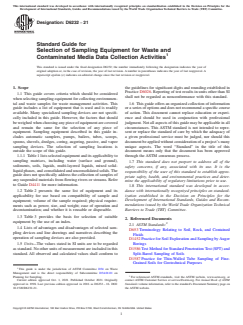
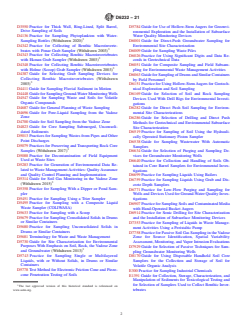
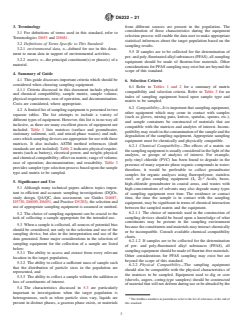
1.1 This guide covers criteria which should be considered when selecting sampling equipment for collecting environmental and waste samples for waste management activities. This guide includes a list of equipment that is used and is readily available. Many specialized sampling devices are not specifically included in this guide. However, the factors that should be weighed when choosing any piece of equipment are covered and remain the same for the selection of any piece of equipment. Sampling equipment described in this guide includes automatic samplers, pumps, bailers, tubes, scoops, spoons, shovels, dredges, coring, augering, passive, and vapor sampling devices. The selection of sampling locations is outside the scope of this guide.
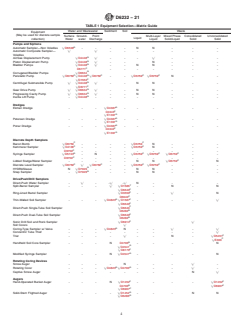
1.1.1 Table 1 lists selected equipment and its applicability to sampling matrices, including water (surface and ground), sediments, soils, liquids, multi-layered liquids, mixed solid-liquid phases, and consolidated and unconsolidated solids. The guide does not specifically address the collection of samples of any suspended materials from flowing rivers or streams. Refer to Guide D4411 for more information.
1.2 Table 2 presents the same list of equipment and its applicability for use based on compatibility of sample and equipment; volume of the sample required; physical requirements such as power, size, and weight; ease of operation and decontamination; and whether it is reusable or disposable.
1.3 Table 3 provides the basis for selection of suitable equipment by the use of an index.
1.4 Lists of advantages and disadvantages of selected sampling devices and line drawings and narratives describing the operation of sampling devices are also provided.
1.5 Units—The values stated in SI units are to be regarded as standard. No other units of measurement are included in this standard. All observed and calculated values shall conform to the guidelines for significant digits and rounding established in Practice D6026. Reporting of test results in units other than SI shall not be regarded as nonconformance with this standard. ...
- Status
- Published
- Publication Date
- 30-Sep-2021
- Technical Committee
- D34 - Waste Management
- Drafting Committee
- D34.01.01 - Planning for Sampling
Buy Documents
ASTM D6232-21 - Standard Guide for Selection of Sampling Equipment for Waste and Contaminated Media Data Collection Activities
REDLINE ASTM D6232-21 - Standard Guide for Selection of Sampling Equipment for Waste and Contaminated Media Data Collection Activities
Overview
ASTM D6232-21: Standard Guide for Selection of Sampling Equipment for Waste and Contaminated Media Data Collection Activities provides comprehensive guidance on selecting appropriate sampling equipment for environmental and waste management sampling activities. Published by ASTM International, this guide is designed to aid environmental professionals, laboratories, and site investigators in choosing equipment that best meets the demands of collecting representative samples from various media, including water, soils, sediments, and waste materials.
Ensuring high-quality, unbiased samples is critical for accurate data collection and regulatory compliance. The guide highlights key selection criteria for sampling equipment, addresses compatibility concerns, and supports sound decisions for waste characterization and contaminated media assessments.
Key Topics
Sampling Equipment Types
The guide covers a wide array of equipment types such as:- Automatic samplers
- Pumps and bailers
- Tubes, scoops, spoons, and shovels
- Dredges, coring, and augering devices
- Passive and vapor sampling devices
Selection Criteria
Major factors affecting equipment choice include:- Accessibility: Ability to collect samples from all relevant locations in the target population
- Sample Integrity: Collecting sufficient mass to account for variations in particle sizes and phases
- Constituent Preservation: Avoiding the loss or addition of analytes of interest
- Physical and Chemical Compatibility: Ensuring materials of construction do not contaminate or degrade during sampling
Representative Sampling
The guide emphasizes obtaining samples reflective of the population being studied. This is especially critical in heterogeneous environments, such as mixed solids/liquids or media with varying particle sizes.Quality Assurance and Quality Control (QA/QC) While focused on equipment, the guide references the importance of QA/QC and Data Quality Objectives (DQOs) as described in related ASTM guides.
Special Considerations
- For emerging contaminants like per- and poly-fluorinated alkyl substances (PFAS), only fluorine-free sampling equipment is recommended, due to contamination risks.
Applications
Environmental Site Assessment
- Selecting equipment for groundwater, surface water, soil, and sediment sampling at potentially contaminated sites.
Waste Characterization
- Collecting samples from waste streams, drums, containers, and mixed waste for regulatory or remediation purposes.
Remediation Monitoring
- Ongoing monitoring of environmental media before, during, and after site cleanup activities.
Regulatory Compliance
- Meeting federal, state, or local requirements for sample integrity, representativeness, and data verifiability.
Laboratory Support
- Laboratories advising field teams on equipment that will not compromise analytical results.
Typical users include environmental consultants, waste management professionals, laboratories, site managers, and regulators seeking to ensure credible environmental data through appropriate sampling protocol and equipment selection.
Related Standards
ASTM D6232-21 references several other standards to support effective sampling equipment selection and use:
- ASTM D4687 - Planning Waste Sampling
- ASTM D5730 - Site Characterization for Environmental Purposes
- ASTM D6009 - Sampling Waste Piles
- ASTM D6051 - Composite Sampling and Field Subsampling
- ASTM D5283 - Quality Assurance/Quality Control in Waste Management
- ASTM D4411 - Sampling Fluvial Sediment in Motion
- ASTM D6026 - Significant Digits and Data Rounding in Geotechnical Data
This guide should be used in conjunction with these and other applicable ASTM guides for comprehensive waste and environmental sampling programs.
With clear evaluation criteria and practical recommendations, ASTM D6232-21 assists in acquiring accurate, defensible environmental and waste management data through the proper selection and use of sampling equipment. This guide is an indispensable resource for optimizing sample collection in diverse and challenging field conditions.
Relations
- Effective Date
- 01-Nov-2023
- Effective Date
- 01-Jun-2020
- Effective Date
- 01-May-2020
- Effective Date
- 15-Feb-2020
- Effective Date
- 01-Nov-2019
- Effective Date
- 01-Nov-2019
- Effective Date
- 01-Oct-2019
- Effective Date
- 01-Sep-2019
- Effective Date
- 01-Sep-2019
- Effective Date
- 01-Feb-2019
- Effective Date
- 01-Feb-2019
- Effective Date
- 15-Nov-2018
- Effective Date
- 01-Nov-2018
- Effective Date
- 01-Sep-2018
- Refers
ASTM D6063-11(2018) - Standard Guide for Sampling of Drums and Similar Containers by Field Personnel - Effective Date
- 01-Sep-2018
Buy Documents
ASTM D6232-21 - Standard Guide for Selection of Sampling Equipment for Waste and Contaminated Media Data Collection Activities
REDLINE ASTM D6232-21 - Standard Guide for Selection of Sampling Equipment for Waste and Contaminated Media Data Collection Activities
Get Certified
Connect with accredited certification bodies for this standard

CIS Institut d.o.o.
Personal Protective Equipment (PPE) certification body. Notified Body NB-2890 for EU Regulation 2016/425 PPE.

Kiwa BDA Testing
Building and construction product certification.
Kmetijski inštitut Slovenije
Agricultural Institute of Slovenia. Soil testing, plant health, agricultural product analysis.
Sponsored listings
Frequently Asked Questions
ASTM D6232-21 is a guide published by ASTM International. Its full title is "Standard Guide for Selection of Sampling Equipment for Waste and Contaminated Media Data Collection Activities". This standard covers: SIGNIFICANCE AND USE 5.1 Although many technical papers address topics important to efficient and accurate sampling investigations (DQOs, study design, QA/QC, data assessment; see Guides D4687, D5730, D6009, D6051, and Practice D5283), the selection and use of appropriate sampling equipment is assumed or omitted. 5.2 The choice of sampling equipment can be crucial to the task of collecting a sample appropriate for the intended use. 5.3 When a sample is collected, all sources of potential bias should be considered, not only in the selection and use of the sampling device, but also in the interpretation and use of the data generated. Some major considerations in the selection of sampling equipment for the collection of a sample are listed below: 5.3.1 The ability to access and extract from every relevant location in the target population, 5.3.2 The ability to collect a sufficient mass of sample such that the distribution of particle sizes in the population are represented, and 5.3.3 The ability to collect a sample without the addition or loss of constituents of interest. 5.4 The characteristics discussed in 5.3 are particularly important in investigations when the target population is heterogeneous, such as when particle sizes vary, liquids are present in distinct phases, a gaseous phase exists, or materials from different sources are present in the population. The consideration of these characteristics during the equipment selection process will enable the data user to make appropriate statistical inferences about the target population based on the sampling results. 5.5 If samples are to be collected for the determination of per- and poly-fluorinated alkyl substances (PFAS), all sampling equipment should be made of fluorine-free materials. Other considerations for PFAS sampling may exist but are beyond the scope of this standard. SCOPE 1.1 This guide covers criteria which should be considered when selecting sampling equipment for collecting environmental and waste samples for waste management activities. This guide includes a list of equipment that is used and is readily available. Many specialized sampling devices are not specifically included in this guide. However, the factors that should be weighed when choosing any piece of equipment are covered and remain the same for the selection of any piece of equipment. Sampling equipment described in this guide includes automatic samplers, pumps, bailers, tubes, scoops, spoons, shovels, dredges, coring, augering, passive, and vapor sampling devices. The selection of sampling locations is outside the scope of this guide. 1.1.1 Table 1 lists selected equipment and its applicability to sampling matrices, including water (surface and ground), sediments, soils, liquids, multi-layered liquids, mixed solid-liquid phases, and consolidated and unconsolidated solids. The guide does not specifically address the collection of samples of any suspended materials from flowing rivers or streams. Refer to Guide D4411 for more information. 1.2 Table 2 presents the same list of equipment and its applicability for use based on compatibility of sample and equipment; volume of the sample required; physical requirements such as power, size, and weight; ease of operation and decontamination; and whether it is reusable or disposable. 1.3 Table 3 provides the basis for selection of suitable equipment by the use of an index. 1.4 Lists of advantages and disadvantages of selected sampling devices and line drawings and narratives describing the operation of sampling devices are also provided. 1.5 Units—The values stated in SI units are to be regarded as standard. No other units of measurement are included in this standard. All observed and calculated values shall conform to the guidelines for significant digits and rounding established in Practice D6026. Reporting of test results in units other than SI shall not be regarded as nonconformance with this standard. ...
SIGNIFICANCE AND USE 5.1 Although many technical papers address topics important to efficient and accurate sampling investigations (DQOs, study design, QA/QC, data assessment; see Guides D4687, D5730, D6009, D6051, and Practice D5283), the selection and use of appropriate sampling equipment is assumed or omitted. 5.2 The choice of sampling equipment can be crucial to the task of collecting a sample appropriate for the intended use. 5.3 When a sample is collected, all sources of potential bias should be considered, not only in the selection and use of the sampling device, but also in the interpretation and use of the data generated. Some major considerations in the selection of sampling equipment for the collection of a sample are listed below: 5.3.1 The ability to access and extract from every relevant location in the target population, 5.3.2 The ability to collect a sufficient mass of sample such that the distribution of particle sizes in the population are represented, and 5.3.3 The ability to collect a sample without the addition or loss of constituents of interest. 5.4 The characteristics discussed in 5.3 are particularly important in investigations when the target population is heterogeneous, such as when particle sizes vary, liquids are present in distinct phases, a gaseous phase exists, or materials from different sources are present in the population. The consideration of these characteristics during the equipment selection process will enable the data user to make appropriate statistical inferences about the target population based on the sampling results. 5.5 If samples are to be collected for the determination of per- and poly-fluorinated alkyl substances (PFAS), all sampling equipment should be made of fluorine-free materials. Other considerations for PFAS sampling may exist but are beyond the scope of this standard. SCOPE 1.1 This guide covers criteria which should be considered when selecting sampling equipment for collecting environmental and waste samples for waste management activities. This guide includes a list of equipment that is used and is readily available. Many specialized sampling devices are not specifically included in this guide. However, the factors that should be weighed when choosing any piece of equipment are covered and remain the same for the selection of any piece of equipment. Sampling equipment described in this guide includes automatic samplers, pumps, bailers, tubes, scoops, spoons, shovels, dredges, coring, augering, passive, and vapor sampling devices. The selection of sampling locations is outside the scope of this guide. 1.1.1 Table 1 lists selected equipment and its applicability to sampling matrices, including water (surface and ground), sediments, soils, liquids, multi-layered liquids, mixed solid-liquid phases, and consolidated and unconsolidated solids. The guide does not specifically address the collection of samples of any suspended materials from flowing rivers or streams. Refer to Guide D4411 for more information. 1.2 Table 2 presents the same list of equipment and its applicability for use based on compatibility of sample and equipment; volume of the sample required; physical requirements such as power, size, and weight; ease of operation and decontamination; and whether it is reusable or disposable. 1.3 Table 3 provides the basis for selection of suitable equipment by the use of an index. 1.4 Lists of advantages and disadvantages of selected sampling devices and line drawings and narratives describing the operation of sampling devices are also provided. 1.5 Units—The values stated in SI units are to be regarded as standard. No other units of measurement are included in this standard. All observed and calculated values shall conform to the guidelines for significant digits and rounding established in Practice D6026. Reporting of test results in units other than SI shall not be regarded as nonconformance with this standard. ...
ASTM D6232-21 is classified under the following ICS (International Classification for Standards) categories: 13.030.30 - Special wastes. The ICS classification helps identify the subject area and facilitates finding related standards.
ASTM D6232-21 has the following relationships with other standards: It is inter standard links to ASTM D5681-23, ASTM D5778-20, ASTM D5088-20, ASTM D7929-20, ASTM D4823-95(2019), ASTM D4411-03(2019), ASTM D6286-19, ASTM D6538-12(2019), ASTM D6009-19, ASTM D5358-93(2019), ASTM D4448-01(2019), ASTM D4696-18, ASTM D5681-18, ASTM D5013-18, ASTM D6063-11(2018). Understanding these relationships helps ensure you are using the most current and applicable version of the standard.
ASTM D6232-21 is available in PDF format for immediate download after purchase. The document can be added to your cart and obtained through the secure checkout process. Digital delivery ensures instant access to the complete standard document.
Standards Content (Sample)
This international standard was developed in accordance with internationally recognized principles on standardization established in the Decision on Principles for the
Development of International Standards, Guides and Recommendations issued by the World Trade Organization Technical Barriers to Trade (TBT) Committee.
Designation: D6232 − 21
Standard Guide for
Selection of Sampling Equipment for Waste and
Contaminated Media Data Collection Activities
This standard is issued under the fixed designation D6232; the number immediately following the designation indicates the year of
original adoption or, in the case of revision, the year of last revision. A number in parentheses indicates the year of last reapproval. A
superscript epsilon (´) indicates an editorial change since the last revision or reapproval.
1. Scope the guidelines for significant digits and rounding established in
Practice D6026. Reporting of test results in units other than SI
1.1 This guide covers criteria which should be considered
shall not be regarded as nonconformance with this standard.
whenselectingsamplingequipmentforcollectingenvironmen-
tal and waste samples for waste management activities. This 1.6 This guide offers an organized collection of information
guide includes a list of equipment that is used and is readily oraseriesofoptionsanddoesnotrecommendaspecificcourse
available. Many specialized sampling devices are not specifi- of action. This document cannot replace education or experi-
cally included in this guide. However, the factors that should ence and should be used in conjunction with professional
beweighedwhenchoosinganypieceofequipmentarecovered judgment. Not all aspects of this guide may be applicable in all
and remain the same for the selection of any piece of circumstances. This ASTM standard is not intended to repre-
equipment. Sampling equipment described in this guide in- sent or replace the standard of care by which the adequacy of
cludes automatic samplers, pumps, bailers, tubes, scoops, a given professional service must be judged, nor should this
spoons, shovels, dredges, coring, augering, passive, and vapor document be applied without consideration of a project’s many
sampling devices. The selection of sampling locations is unique aspects. The word “Standard” in the title of this
outside the scope of this guide. document means only that the document has been approved
1.1.1 Table 1listsselectedequipmentanditsapplicabilityto through the ASTM consensus process.
sampling matrices, including water (surface and ground),
1.7 This standard does not purport to address all of the
sediments, soils, liquids, multi-layered liquids, mixed solid-
safety concerns, if any, associated with its use. It is the
liquid phases, and consolidated and unconsolidated solids. The
responsibility of the user of this standard to establish appro-
guide does not specifically address the collection of samples of
priate safety, health, and environmental practices and deter-
any suspended materials from flowing rivers or streams. Refer
mine the applicability of regulatory limitations prior to use.
D4411 for more information.
to Guide
1.8 This international standard was developed in accor-
dance with internationally recognized principles on standard-
1.2 Table 2 presents the same list of equipment and its
ization established in the Decision on Principles for the
applicability for use based on compatibility of sample and
Development of International Standards, Guides and Recom-
equipment; volume of the sample required; physical require-
mendations issued by the World Trade Organization Technical
ments such as power, size, and weight; ease of operation and
Barriers to Trade (TBT) Committee.
decontamination; and whether it is reusable or disposable.
1.3 Table 3 provides the basis for selection of suitable
2. Referenced Documents
equipment by the use of an index.
2.1 ASTM Standards:
1.4 Lists of advantages and disadvantages of selected sam-
D653 Terminology Relating to Soil, Rock, and Contained
pling devices and line drawings and narratives describing the
Fluids
operation of sampling devices are also provided.
D1452 Practice for Soil Exploration and Sampling byAuger
1.5 Units—The values stated in SI units are to be regarded Borings
as standard. No other units of measurement are included in this
D1586 Test Method for Standard PenetrationTest (SPT) and
standard. All observed and calculated values shall conform to Split-Barrel Sampling of Soils
D1587 Practice for Thin-Walled Tube Sampling of Fine-
Grained Soils for Geotechnical Purposes
This guide is under the jurisdiction of ASTM Committee D34 on Waste
Management and is the direct responsibility of Subcommittee D34.01.01 on
Planning for Sampling. For referenced ASTM standards, visit the ASTM website, www.astm.org, or
Current edition approved Oct. 1, 2021. Published October 2021. Originally contact ASTM Customer Service at service@astm.org. For Annual Book of ASTM
approved in 1998. Last previous edition approved in 2016 as D6232 – 16. DOI: Standards volume information, refer to the standard’s Document Summary page on
10.1520/D6232-21. the ASTM website.
Copyright © ASTM International, 100 Barr Harbor Drive, PO Box C700, West Conshohocken, PA 19428-2959. United States
D6232 − 21
D3550 Practice for Thick Wall, Ring-Lined, Split Barrel, D5784 Guide for Use of Hollow-Stem Augers for Geoenvi-
Drive Sampling of Soils ronmental Exploration and the Installation of Subsurface
D4136 Practice for Sampling Phytoplankton with Water- Water Quality Monitoring Devices
Sampling Bottles (Withdrawn 2020) D6001 Guide for Direct-Push Groundwater Sampling for
D4342 Practice for Collecting of Benthic Macroinverte-
Environmental Site Characterization
brates with Ponar Grab Sampler (Withdrawn 2003) D6009 Guide for Sampling Waste Piles
D4343 Practice for Collecting Benthic Macroinvertebrates
D6026 Practice for Using Significant Digits and Data Re-
with Ekman Grab Sampler (Withdrawn 2003) cords in Geotechnical Data
D4348 Practice for Collecting Benthic Macroinvertebrates
D6051 Guide for Composite Sampling and Field Subsam-
with Holme (Scoop) Grab Sampler (Withdrawn 2003) pling for Environmental Waste Management Activities
D4387 Guide for Selecting Grab Sampling Devices for
D6063 GuideforSamplingofDrumsandSimilarContainers
Collecting Benthic Macroinvertebrates (Withdrawn
by Field Personnel
2003)
D6151 Practice for Using Hollow-StemAugers for Geotech-
D4411 Guide for Sampling Fluvial Sediment in Motion
nical Exploration and Soil Sampling
D4448 Guide for Sampling Ground-Water Monitoring Wells
D6169 Guide for Selection of Soil and Rock Sampling
D4547 Guide for Sampling Waste and Soils for Volatile
Devices Used With Drill Rigs for Environmental Investi-
Organic Compounds
gations
D4687 Guide for General Planning of Waste Sampling
D6282 Guide for Direct Push Soil Sampling for Environ-
D4696 Guide for Pore-Liquid Sampling from the Vadose
mental Site Characterizations
Zone
D6286 Guide for Selection of Drilling and Direct Push
D4700 Guide for Soil Sampling from the Vadose Zone
Methods for Geotechnical and Environmental Subsurface
D4823 Guide for Core Sampling Submerged, Unconsoli-
Site Characterization
dated Sediments
D6519 Practice for Sampling of Soil Using the Hydrauli-
D5013 Practices for Sampling Wastes from Pipes and Other
cally Operated Stationary Piston Sampler
Point Discharges
D6538 Guide for Sampling Wastewater With Automatic
D5079 Practices for Preserving and Transporting Rock Core
Samplers
Samples (Withdrawn 2017)
D6634 Guide for Selection of Purging and Sampling De-
D5088 Practice for Decontamination of Field Equipment
vices for Groundwater Monitoring Wells
Used at Waste Sites
D6640 Practice for Collection and Handling of Soils Ob-
D5283 Practice for Generation of Environmental Data Re-
tained in Core Barrel Samplers for Environmental Inves-
lated to Waste ManagementActivities: QualityAssurance
tigations
and Quality Control Planning and Implementation
D6699 Practice for Sampling Liquids Using Bailers
D5314 Guide for Soil Gas Monitoring in the Vadose Zone
D6759 Practice for Sampling Liquids Using Grab and Dis-
(Withdrawn 2015)
crete Depth Samplers
D5358 Practice for Sampling With a Dipper or Pond Sam-
D6771 Practice for Low-Flow Purging and Sampling for
pler
Wells and Devices Used for Ground-Water Quality Inves-
D5451 Practice for Sampling Using a Trier Sampler
tigations
D5495 Practice for Sampling with a Composite Liquid
D6907 Practice for Sampling Soils and Contaminated Media
Waste Sampler (COLIWASA)
with Hand-Operated Bucket Augers
D5633 Practice for Sampling with a Scoop
D6914 Practice for Sonic Drilling for Site Characterization
D5679 Practice for Sampling Consolidated Solids in Drums
and the Installation of Subsurface Monitoring Devices
or Similar Containers
D7353 Practice for Sampling of Liquids in Waste Manage-
D5680 Practice for Sampling Unconsolidated Solids in
ment Activities Using a Peristaltic Pump
Drums or Similar Containers
D7758 Practice for Passive Soil Gas Sampling in theVadose
D5681 Terminology for Waste and Waste Management
Zone for Source Identification, Spatial Variability
D5730 Guide for Site Characterization for Environmental
Assessment, Monitoring, and Vapor Intrusion Evaluations
Purposes With Emphasis on Soil, Rock, the Vadose Zone
D7929 Guide for Selection of Passive Techniques for Sam-
and Groundwater (Withdrawn 2013)
pling Groundwater Monitoring Wells
D5743 Practice for Sampling Single or Multilayered
D8170 Guide for Using Disposable Handheld Soil Core
Liquids, with or Without Solids, in Drums or Similar
Samplers for the Collection and Storage of Soil for
Containers
Volatile Organic Analysis
D5778 Test Method for Electronic Friction Cone and Piezo-
E300 Practice for Sampling Industrial Chemicals
cone Penetration Testing of Soils
E1391 Guide for Collection, Storage, Characterization, and
Manipulation of Sediments for Toxicological Testing and
3 for Selection of Samplers Used to Collect Benthic Inver-
The last approved version of this historical standard is referenced on
www.astm.org. tebrates
D6232 − 21
3. Terminology from different sources are present in the population. The
consideration of these characteristics during the equipment
3.1 For definitions of terms used in this standard, refer to
selection process will enable the data user to make appropriate
Terminologies D653 and D5681.
statistical inferences about the target population based on the
3.2 Definitions of Terms Specific to This Standard:
sampling results.
3.2.1 environmental data, n—defined for use in this docu-
5.5 If samples are to be collected for the determination of
ment to mean data in support of environmental activities.
per-andpoly-fluorinatedalkylsubstances(PFAS),allsampling
3.2.2 matrix, n—the principal constituent(s) or phase(s) of a
equipment should be made of fluorine-free materials. Other
material.
considerationsforPFASsamplingmayexistbutarebeyondthe
scope of this standard.
4. Summary of Guide
4.1 This guide discusses important criteria which should be
6. Selection Criteria
considered when choosing sampling equipment.
6.1 Refer to Tables 1 and 2 for a summary of matrix
4.1.1 Criteria discussed in this document include physical
compatibility and selection criteria. Refer to Table 3 for an
and chemical compatibility, sample matrix, sample volume,
index of sampling equipment based upon sample type and
physical requirements, ease of operation, and decontamination.
matrix to be sampled.
Costs are considered, where appropriate.
6.2 Compatibility—It is important that sampling equipment,
4.2 Alimited list of sampling equipment is presented in two
other equipment which may come in contact with samples
separate tables. The list attempts to include a variety of
(such as gloves, mixing pans, knives, spatulas, spoons, etc.),
different types of equipment. However, this list is in no way all
and sample containers be constructed of materials that are
inclusive, as there are many excellent pieces of equipment not
compatible with the matrices and analytes of interest. Incom-
included. Table 1 lists matrices (surface and groundwater,
patibilitymayresultinthecontaminationofthesampleandthe
stationary sediment, soil, and mixed-phase wastes) and indi-
degradation of the sampling equipment. Appropriate sampling
cateswhichsamplingdevicesareappropriateforusewiththese
equipment must be chemically and physically compatible.
matrices. It also includes ASTM method references (draft
6.2.1 Chemical Compatibility—The effects of a matrix on
standards are not included). Table 2 indicates physical require-
thesamplingequipmentisusuallyconsideredinthelightofthe
ments (such as battery), electrical power, and weight; physical
analytes, or groups of analytes of interest. For example,
and chemical compatibility; effect on matrix; range of volume;
poly-vinyl chloride (PVC) has been found to degrade in the
ease of operation; decontamination; and reusability. Table 3
presence of many separate phase organic compounds in water;
provides sampler type selection process based upon the sample
therefore, it would be preferable to collect groundwater
type and matrix to be sampled.
samples for organic analyses using fluoropolymer, stainless
steel, or glass sampling equipment (1, 2). Acids, bases,
5. Significance and Use
high-chloride groundwater in coastal areas, and wastes with
5.1 Although many technical papers address topics impor-
high concentrations of solvents may also degrade many types
tant to efficient and accurate sampling investigations (DQOs,
of sampling equipment over time. The residence or contact
study design, QA/QC, data assessment; see Guides D4687,
time, the time the sample is in contact with the sampling
D5730, D6009, D6051, and Practice D5283), the selection and
equipment, may be significant in terms of chemical interaction
use of appropriate sampling equipment is assumed or omitted.
between the sampled matrix and the equipment.
6.2.1.1 The choice of materials used in the construction of
5.2 The choice of sampling equipment can be crucial to the
sampling devices should be based upon a knowledge of what
task of collecting a sample appropriate for the intended use.
constituents may be present in the sampling environment
5.3 When a sample is collected, all sources of potential bias
because the constituents and materials may interact chemically
should be considered, not only in the selection and use of the
or be incompatible. Consult available chemical compatibility
sampling device, but also in the interpretation and use of the
charts.
data generated. Some major considerations in the selection of
6.2.1.2 If samples are to be collected for the determination
sampling equipment for the collection of a sample are listed
of per- and poly-fluorinated alkyl substances (PFAS), all
below:
sampling equipment should be made of fluorine-free materials.
5.3.1 The ability to access and extract from every relevant
Other considerations for PFAS sampling may exist but are
location in the target population,
beyond the scope of this standard.
5.3.2 The ability to collect a sufficient mass of sample such
6.2.2 Physical Compatibility—The sampling equipment
that the distribution of particle sizes in the population are
should also be compatible with the physical characteristics of
represented, and
the matrices to be sampled. Equipment used to dig or core
5.3.3 The ability to collect a sample without the addition or
(shovels, augers, coring-type samplers) should be constructed
loss of constituents of interest.
ofmaterialthatwillnotdeformduringuseorbeabradedbythe
5.4 The characteristics discussed in 5.3 are particularly
important in investigations when the target population is
heterogeneous, such as when particle sizes vary, liquids are
The boldface numbers in parentheses refer to the list of references at the end of
present in distinct phases, a gaseous phase exists, or materials this standard.
D6232 − 21
TABLE 1 Equipment Selection—Matrix Guide
Water and Wastewater Sediment Soil Waste
Equipment
(May be used for discrete sample
Surface Ground- Point Multi-Layer Mixed Phase Consolidated Unconsolidated
Liquid
collection)
Water water Discharge Liquid Solid/Liquid Solid Solid
Pumps and Siphons
G
Automatic Sampler—Non Volatiles =D6538 -- - - N N - - -
Automatic Composite Sampler—== -- - - - - -
Volatiles
G
Air/Gas Displacement Pump =D4448 = -- - = -- -
G
Piston Displacement Pump =D4448 = -- N - - -
G
Bladder Pumps =D4448 = -- N N - - -
P
D6771 -- - - - - -
G
Corrugated Bladder Pumps =D6634
P G P P P
Peristaltic Pump =D6759 =D4448 =D6759 -- =D6759 =D6759 N- -
P
=D7353
G
Centrifugal Submersible Pump ==D4448 = -- N N - - -
P
=D6771
G
Gear Drive Pump ==D6634 = -- N N - - -
G
Progressing Cavity Pump ==D6634 = -- N N - - -
G
Inertia Lift Pump - =D4448 -- - - - - - -
Dredges
G
Ekman Dredge - - - =D4387 -- - - - -
P
D4343
G
=E1391
G
Petersen Dredge - - - =D4387 -- - - - -
G
=E1391
G
Ponar Dredge - - - =D4387 -- - - - -
P
D4342
G
=E1391
Discrete Depth Samplers
P P
Bacon Bomb =D6759 -- - - =D6759 N- - -
P P
Kemmerer Sampler =D4136 -- - - =D6759 N- - -
P
D6759 -- - - - - - - -
G P P P
Syringe Sampler =D5743 -N - - =D6759 =D6759 =D6759 --
P
D6759 -- - - - - - - -
P
Lidded Sludge/Water Sampler - - - - - N N =D6759 -N
P P P P
Discrete Level Sampler =D6759 ==D6759 -- =D6759 =D6759 -- -
G
HYDRASleeve N =D7929 -- - N N - - -
G
Snap Sampler - =D7929 -- - N N - - -
Drive/Push/Drill Samplers
Direct-Push Water Sampler - = --= -= N- - - -
T
Split-Barrel Sampler - - - ==D1586-- N - N
P
=D6640
P
Ring-Lined Barrel Sampler =D3550-- = -N
P
D6640
G P
Thin-Walled Soil Sampler - - - =D4823 =D1587-- - - =
P
=D6640
P
Direct-Push Single-Tube Soil Sampler =D6640
G
D6282
P
Direct-Push Dual-Tube Soil Sampler =D6640
G
D6282
P
Sonic Drill Soil and Rock Sampler =D6914 =
Soil Corers =
G
Coring-Type Sampler w/ Valve - - - =D4823 N- - = - =
Concentric Tube Thief - - - - - - - - - =
P
Trier - - - - = -- N - =D5451
P
=E300
G
Handheld Soil Core Sampler - - - N D4700 -- - - N
G
=D4547
P
=D8170
G
Modified Syringe Sampler - - - N =D4547-- - - N
Rotating Coring Devices
Screw Auger - - - - N - - - = -
G G
Rotating Corer - - - =D4823 =D4700-- - = -
Captive Screw Auger - - - - - - - - N =
Augers
P P
Hand-Operated Bucket Auger - - - N =D1452-- - - =D1452
G P
D4700 =D6907
P
=D6907
G
Solid-Stem Flighted Auger - - - - =D1452-- - N N
G
=D6286
D6232 − 21
TABLE 1 Continued
Water and Wastewater Sediment Soil Waste
Equipment
(May be used for discrete sample
Surface Ground- Point Multi-Layer Mixed Phase Consolidated Unconsolidated
Liquid
collection)
Water water Discharge Liquid Solid/Liquid Solid Solid
G G
Hollow-Stem Flighted Auger - =D5784 -- =D6169-- - N N
G
=D6151
Peat Borer - - - == -- - - N
Liquid Profile Devices
P P
COLIWASA - - - - - =D5495 =D5495 --
G G
=D5743 D5743
G G
Reusable Point Sampler N - N - - =D5743 =D5743 = --
G G
Drum Thief - - - - - =D5743 =D5743 = --
G G
Valved Sampler - - - - - =D5743 =D5743 = --
G G G
Plunger-Type Sampler N - N - - =D5743 =D5743 =D5743 --
P P P
Liquid Profiler N - N - - =D6759 =D6759 =D6759 --
Surface Sampling Devices (Liquids)
G
Bailer N =D4448 -- - N N - - -
P
=D6699 -- - - - - - -
G
Point Sampling Bailer N =D4448 -- - N N - - -
P
=D6699 -- - - - - - -
P
Differential Pressure Bailer - =D6699 -- - N N - - -
P P P P
Dipper =D5358 - =D5013 -- =D5358 - =D5358 --
P P P
=D6759 =D6759 =D6759
P P P
Liquid Grab Sampler =D6759 -N - - =D6759 =D6759 --
P P
Swing Jar Sampler =D6759 -N N - =D6759 N- -
Passive Water Sampling Devices
G
Passive Sampler, Bag Type ==D7929 -- - - - - - -
G
Passive Sampler, Chamber Type - =D7929 -- - - - - - -
Multi-Level Sampling Devices
Dedicated Type 1 - = -- N - - - - -
Dedicated Type 2 - = -- N - - - - -
Portable - N - - = -- - - -
Surface Sampling Devices (Solids)
P
Impact Devices - - - - - - - - =D5679 -
Spoon N - N - N N N - - N
P
Scoops and Trowels - - - N =D5633N- N - =
Shovels - - - N N - - N - =
Vadose Zone Pore Sampling Devices
G
Vacuum Lysimeter - N - N =D4696-- - - -
G
Vacuum/Pressure Lysimeter - N - N =D4696-- - - -
P
Passive Soil Gas Sampler N N - N =D7758-- - - -
= = Equipment may be used with this matrix N = Not equipment of choice but use is possible - = Not recommended
G T P
= ASTM Guide = ASTM Test Method = ASTM Practice
material being sampled. Equipment abrasion may result in the significant percentage of some contaminants such as poly-
contributionofcontaminantstothesamplebeingcollected.For nuclear aromatic hydrocarbons (PAHs).
example, plastic or glass would not be appropriate for difficult- 6.3.2 Equipment Use—Inappropriateuseofsamplingequip-
to-access matrices, and stainless steel equipment may contrib- ment can influence analytical results (1, 3). For example, if a
ute small amounts of metals if significantly abraded by the pump is used to purge a well and the intake is placed below the
matrix. well screen, sediment in the sump can be put into suspension
and become part of the water sample (4). Excessive vacuum
NOTE 1—Information on sample containers and equipment used in
generated by sampling pumps can cause loss of volatile
sampling that is not used in the actual collection of the sample is not
constituents or change valence states of some ions. The use of
within the scope of this guide.
bailers for well purging and sample collection may also cause
6.3 Equipment Effects on the Matrix:
increased turbidity levels in groundwater samples and result in
6.3.1 Equipment Design—Samples collected using inappro-
elevated organic and inorganic target analyte concentrations in
priate sampling equipment may not provide representative
the sample. When sampling containerized liquids, insertion of
samples (1, 3). An example of equipment design influencing
a COLIWASA sampler at too fast a rate may prevent it from
sample results is a sampler which excludes certain sized
collecting a representative, depth integrated sample.
particles from a soil matrix or waste pile sample. The shape of
some scoops may influence the distribution of particle sizes 6.4 Sample Volume Capabilities—Most sampling devices
collected from a sample (1). Dredges used to collect river or will provide adequate sample volume. However, the sampling
estuarine stationary sediments may also exclude certain sized equipment volumes should be compared to the volume neces-
particles, particularly the fines fraction which may contain a sary for all required analyses including the additional amount
D6232 − 21
TABLE 2 Sampling Equipment Selection Guide
Effect on Volume Ease of Disposal or
Equipment Chemical Physical Physical Decon
Sample Range Operation Reuse
Pumps and Siphons
Automatic Sampler–Nonvolatiles X X = UB/P = XR
Automatic Composite Sampler–Volatiles X X = U B/P X X R
Air/Gas Displacement Pump = X X U P/S/W X X R
Piston Displacement Pump = X X U P/S/W X X R
Bladder Pumps = X = UP X X R
Corrugated Bladder Pump = X = UP = XR
Peristaltic Pump X X = U B/P X = R
Centrifugal Submersible Pump X X X U P/S/W = XR
Gear Drive Pump X X X U B/P = XD/R
Progressive Cavity Pump X X X U P = XR
Inertia Lift Pump X X X U B/N == R
Dredges
Ekman Dredge == X 0.5–3.0 N X X R
Petersen Dredge == X 0.5–3.0 W X X R
Ponar Dredge == X 0.5–3.0 W X X R
Discrete Depth Samplers
Bacon Bomb X X = 0.1–0.94 N = XR
Kemmerer Sampler X X X 1.0–2.0 N X X R
Syringe Sampler == = 0.2–0.5 N = XR
Lidded Sludge/Water Sampler = X X 1.0 S/W X X R
Discrete Level Sampler = X = 0.2–0.5 N == R
HYDRASleeve == = 0.6–3.1 N == D
Snap Sampler == = 0.04–0.35 N = XR
Drive/Push/Drill Samplers
Direct-Push Water Sampler == = 0.1–0.3 P/S/W X X R
Split-Barrel Sampler == X 0.5–30.0 S/W X = R
Ring-Lined Barrel Sampler == X 0.5–30.0 S/W X = R
Thin-Walled Tube Sampler == X 0.5–5.0 S/W == R
Direct-Push Single-Tube Sampler == X 0.5–30.0 S/W X = R
Direct-Push Dual-Tube Sampler == X 0.5–30.0 S/W X = R
Sonic Drill Soil and Rock Sampler == X 0.5–100 S/W/P X = R
Soil Corers == X 0.2–1 N == R
Coring-Type Sampler w/ Valve == = 0.2–1.5 N == R
Concentric Tube Thief == = 0.5–1.0 N == R
Trier == = 0.1–0.5 N == R
Handheld Core Sampler == = 0.01–0.05 N == D
Modified Syringe Sampler == = 0.01–0.05 N = XD
Rotating Coring Devices
Screw Auger = X X 0.1–0.3 N X = R
Rotating Corer == X 0.5–1.0 B/P == R
Captive Screw Auger X = X 1–2 P == R
Augers
Hand-Operated Bucket Auger = X X 0.2–1.0 N X = R
Solid-Stem Flighted Auger X = X U P/S/W X = R
Hollow-Stem Flighted Auger X = X U P/S/W X = R
Peat Borer X == 0.3 N = XR
Liquid Profile Devices
COLIWASA = X = 0.5–3.0 N = XD/R
Reusable Point Sampler == = 0.2–0.6 N == R
Drum Thief = X = 0.1–0.5 N = XD/R
Valved Sampler == = 0.3–1.6 N == D/R
Plunger-Type Sampler = X = 0.2–U N == D/R
Liquid Profiler X X = 1.3–4.0 N == R
Surface Sampling Devices (Liquids)
Bailer X = X 0.5–2.0 N == D/R
Point Sampling Bailer X == 0.5–2.0 N == R
Differential Pressure Bailer == = 0.04–1.0 N = XR
Dipper = X = 0.5–1.0 N == R
Liquid Grab Sampler == = 0.5–1.0 N == R
Swing Jar Sampler X == 0.5–1.0 N == R
Passive Water Sampling Devices
Passive Sampler, Bag Type == = 0.1–0.2 N == D/R
Passive Sampler, Chamber Type == = 1–4 W/S X X D/R
D6232 − 21
TABLE 2 Continued
Effect on Volume Ease of Disposal or
Equipment Chemical Physical Physical Decon
Sample Range Operation Reuse
Multi-Level Sampling Devices
Dedicated Type 1 == = U W/S X X D/R
Dedicated Type 2 == = U W/S X X D
Portable == = 0.01 N X X DR
Surface Sampling Devices (Solids)
Impact Devices X X X N/A B/P == R
Spoon == X N/A N == R
Scoops and Trowels == X 0.1–0.6 N == R
Shovels == X 1.0–5.0 N == R
Vadose Zone Pore Sampling Devices
Vacuum Lysimeter == = 0.1–0.5 N == D/R
Vacuum/Pressure Lysimeter == = 0.1–0.5 S/P == D
Passive Soil Gas Samplers == = N/A N == D
X = Significant operational consideration Range of Volume (liters): Physical Requirements: Disposal and Reuse:
= = Not a significant operational consideration U = Unlimited B = Battery W = Weight R = Reusable
N/A = Not applicable P = Power S = Size D = Single use
N = No limitations
necessary for quality control (QC), split, and replicate samples 6.7.2 Reuse—Due to the expense of materials associated
(4, 5). Sampling devices which may not provide an adequate with modern sampling equipment (stainless steel, PTFE), most
volume would be small-diameter glass tubes and triers. In this equipment is reusable following proper decontamination.
case, the investigator must consider the following options: Some equipment such as bailers may be disposed of after use
6.4.1 A similar device with an increased capacity, or dedicated to a sampling point to save time during extensive
6.4.2 An alternate device with an increased capacity, or field investigations. Drum thieves and COLIWASA samplers
6.4.3 Modification of an existing device (often difficult or are typically not reused, particularly when waste samples have
impractical). been collected.
6.4.4 If these alternatives are not acceptable or available,
6.8 Cost—Detailed information on the cost of sampling
then the investigator must consider the collection of multiple
equipment is not contained within this guide. Cost is usually a
aliquots to fulfill the sample volume requirement.The effect of
major consideration in the process of sampling equipment
multiple aliquots on the data quality objectives should be
selection. In general, the cost of PTFE and stainless steel
considered.
equipment will be greater than equipment made of glass, PVC,
6.5 Physical Requirements—Sampling equipment selection or other plastics. However, the life expectancy for PTFE or
should always consider factors such as the size and weight of stainless steel equipment is usually longer. In addition, labor
the equipment, power requirements (battery/110V), and ancil- costs for decontamination of reusable equipment versus the
lary equipment required (for example, drill rig for direct-push disposal costs of single-use equipment are also relevant con-
technologies such as split-barrel samplers and augers). Most siderations. Comments on costs are included in the “Advan-
sampling equipment used in the collection of environmental tages and Limitations” tables, where appropriate.
samples is relatively easy to transport and use in the field. The
use of equipment with significant physical requirements may 7. Sampling Equipment
impede the progress of a sampling investigation.
7.1 Presentedbelowarebriefdescriptionsofsomesampling
6.6 Ease of Operation—Much of the equipment used for equipment used in waste management and in the collection of
environmental sampling is rather simple to employ. Samples environmental samples as they relate to waste management
may be collected easily as long as properly selected equipment activities (6). This is by no means an inclusive list of the
is used with adequate consideration of the matrix of interest. sampling equipment which is available to investigators. There
Training requirements should focus on the proper use of are many pieces of equipment that have been designed for
equipment in varying environmental matrices. specific sampling needs. In addition, investigators may design
theirownpiecesofequipmentforaspecificproject.Inallthese
6.7 Decontamination and Reuse of Equipment:
instances, an investigator must keep in mind the criteria for
6.7.1 Decontamination (see Practice D5088)—Inadequate
sampling equipment selection which have been discussed
decontamination of sampling equipment can result in signifi-
previously in this guide.
cant errors in analytical results. When choosing sampling
equipment, ease of decontamination must be a consideration. 7.2 Pumps and Siphons (see Guide D4448)—Pumps used
Pumps, automatic samplers, Kemmerer samplers, and dredges for the collection of waste and environmental liquid samples
require more effort to decontaminate than does a bailer or for waste management include automatic samplers and
split-barrel sampler. The investigator should consider decon- displacement, bladder, peristaltic, and centrifugal pumps.
tamination requirements prior to the study to avoid significant 7.2.1 Automatic Samplers (see Guide D6538)—Automatic
delays. samplers may be used when samples are to be collected at
D6232 − 21
TABLE 3 Index of Sampling Equipment
Media Type Sampler Type Subsection Sample Type
Consolidated Solid Screw Auger (7.6.1) Surface, Disturbed
Rotating Corer (7.6.2) Surface, Undisturbed
Impact Devices (7.11.1) Surface, Disturbed
Unconsolidated Solid Lidded Sludge/Water Sampler (7.4.4) Discrete, Composite
Split-Barrel Sampler (7.5.2) Discrete, Undisturbed
Ring-Lined Barrel Sampler (7.5.3) Surface, Undisturbed
Thin-Walled Tube Sampler (7.5.4) Surface or Depth, Undisturbed
Direct-Push Single-Tube Sampler (7.5.5) Surface or Depth, Representative
Direct-Push Dual-Tube Sampler (7.5.6) Surface or Depth, Representative
Sonic Drill Coring (7.5.7) Continuous, Representative/Disturbed
Soil Corers (7.5.8) Surface, Undisturbed
Coring-Type Sampler w/ Valve (7.5.9) Surface or Depth, Disturbed
Concentric Tube Thief (7.5.10) Surface, Disturbed, Selective
Trier (7.5.10) Surface, Relatively Undisturbed, Selective
Handheld Core Sampler (7.5.11) Surface, Undisturbed
Modified Syringe (7.5.12) Surface, Undisturbed
Captive Screw Auger (7.6.3) Discrete, Disturbed
Hand-Operated Bucket Auger (7.7.1) Surface or Depth, Disturbed
Solid-Stem Flighted Auger (7.7.2.1) Surface or Depth, Disturbed
Hollow-Stem Flighted Auger (7.7.2.3) Surface or Depth, Disturbed (if from flights)
Peat Borer (7.7.3) Discrete, Relatively Undisturbed
Spoon (7.11.2) Surface, Disturbed, Selective
Scoops and Trowels (7.11.3) Surface, Disturbed, Selective
Shovels (7.11.4) Surface, Disturbed
Soil Split-Barrel Sampler (7.5.2) Discrete, Representative
Ring-Lined Barrel Sampler (7.5.3) Discrete, Representative
Thin-Walled Tube Sampler (7.5.4) Surface or Depth, Undisturbed
Direct-Push Single-Tube Sampler (7.5.5) Surface or Depth, Representative
Direct-Push Dual-Tube Sampler (7.5.6) Surface or Depth, Representative
Sonic Drill Coring (7.5.7) Subsurface, Representative/Disturbed
Soil Corers (7.5.8) Surface, Disturbed
Coring-Type Sampler w/ Valve (7.5.9) Surface or Depth, Disturbed
Trier (7.5.10) Surface, Relatively Undisturbed, Selective
Solid-Stem Flighted Auger (7.7.2.1) Surface or Depth, Disturbed
Hollow-Stem Flighted Auger (7.7.2.3) Surface or Depth, Disturbed (if from flights)
Peat Borer (7.7.3) Discrete, Relatively Undisturbed
Spoon (7.11.2) Surface, Disturbed, Selective
Scoops and Trowels (7.11.3) Surface, Disturbed, Selective
Shovels (7.11.4) Surface, Disturbed
Vacuum Lysimeter (7.12.1) Surface to Depth, Pore Liquid
Vacuum/Pressure Lysimeter (7.12.2) Depth, Pore Liquid
Passive Soil Gas Samplers (7.12.3) Surface to Depth, Soil Gas
Mixed Solid/Liquid Autosampler, Non-Volatiles (7.2.1) Shallow, Composite, Suspended solids only
Peristaltic Pump (7.2.5) Shallow, Discrete or Composite, Suspended solids only
Syringe Sampler (7.4.3) Shallow, Discrete, Disturbed
Lidded Sludge/Water (7.4.4) Discrete, Composite
Dipper (7.4.9) Shallow, Composite
Liquid Grab Sampler (7.4.10) Shallow, Composite, Suspended solids only
Swing Jar Sampler (7.4.11) Shallow, Composite
Split-Barrel Sampler (7.5.2) Depth, Discrete, Undisturbed
Ring-Lined Barrel Sampler (7.5.3) Depth, Discrete, Undisturbed
Soil Corers (7.5.8) Depth, Discrete, Undisturbed
Coring-Type Sampler w/ Valve (7.5.9) Depth, Disturbed
Trier (7.5.10) Surface, Semi-solid only, Selective
Peat Borer (7.7.3) Discrete, Relatively Undisturbed
COLIWASA (7.8.1) Shallow, Composite, Semi-liquid only
Reusable Point Sampler (7.8.1.3) Shallow, Discrete
Drum Thief (7.8.2) Shallow, Composite, Semi-liquid only
Valved Sampler (7.8.3) Shallow, Composite, Semi-liquid only
Plunger-Type Sampler (7.8.4) Shallow, Discrete
Liquid Profiler (7.8.5) Depth, Composite, Suspended solids only
Scoops and Trowels (7.11.3) Shallow, Composite, Semi-solid only
Shovels (7.11.4) Shallow, Composite, Semi-solid only
Sediment Ekman Dredge (7.3.1) Bottom, Surface, Soft only, Disturbed
Petersen Dredge (7.3.2) Bottom, Surface, Rocky or Soft, Disturbed
Ponar Dredge (7.3.3) Bottom, Surface, Rocky or Soft, Disturbed
Split-Barrel Sampler (7.5.2) Discrete, Undisturbed
Ring-Lined Barrel Sampler (7.5.3) Discrete, Undisturbed
Thin-Walled Tube Sampler (7.5.4) Surface or Depth, Undisturbed
Coring-Type Sampler w/ Valve (7.5.9) Surface or Depth, Disturbed
Handheld Core Sampler (7.5.11) Exposed Surface only, Undisturbed
Modified Syringe (7.5.12) Exposed Surface only, Undisturbed
Rotating Corer (7.6.2) Bottom, Surface, Undisturbed if solid
Hand-Operated Bucket Auger (7.7.1) Surface or Depth, Disturbed
Solid-Stem Flighted Auger (7.7.2.1) Surface or Depth, Disturbed
D6232 − 21
TABLE 3 Continued
Media Type Sampler Type Subsection Sample Type
Hollow-Stem Flighted Auger (7.7.2.3) Surface or Depth, Disturbed (if from flights)
Peat Borer (7.7.3) Discrete, Relatively Undisturbed
Scoops and Trowels (7.11.3) Exposed Surface only, Disturbed, Selective
Shovels (7.11.4) Exposed Surface only, Disturbed
Surface Water Autosampler, Non-Volatiles (7.2.1) 7.6 m (25 ft) Lift, Discrete or Composite
Autosampler, Volatiles (7.2.1) 7.6 m (25 ft) Lift, Discrete
Peristaltic Pump (7.2.5) Shallow, up to 7.6 m (25 ft) Lift, Discrete
Centrifugal Submersible Pump (7.2.6) Depth, Discrete
Gear Drive Pump (7.2.7) Depth, Discrete
Progressing Cavity Pump (7.2.8) Depth, Discrete
Bacon Bomb (7.4.1) Depth, Discrete
Kemmerer Sampler (7.4.2) Depth, Discrete
Discrete Level Sampler (7.4.5) Depth, Discrete
Dipper (7.4.9) Shallow, 3 m (10 ft), Composite
Liquid Grab Sampler (7.4.10) Shallow, 1.8 m (6 ft), Composite
Swing Jar Sampler (7.4.11) Shallow, 3 m (10 ft), Composite
Plunger-Type Sampler (7.8.4) Shallow, 3.65 m (12 ft), Discrete
Liquid Profiler (7.8.5) Shallow, Composite
Spoon (7.11.2) Shallow, 2.5 cm (1 in.), Composite
Groundwater Air/Gas Displacement Pump (7.2.2.1) Depth, Discrete
Piston Displacement Pump (7.2.2.2) Depth, Discrete
Bladder Pump (7.2.3) Depth, Discrete
Corrugated Bladder Pump (7.2.4) Depth, Discrete
Peristaltic Pump (7.2.5) 7.6 m (25 ft) Lift, Discrete
Centrifugal Submersible Pump (7.2.6) Depth, Discrete
Gear Drive Pump (7.2.7) Depth, Discrete
Progressing Cavity Pump (7.2.8) Depth, Discrete
Inertia Lift Pump (7.2.9) Depth, Discrete
Discrete Level Sampler (7.4.5) Depth, Discrete
Bailer (7.4.6) Depth, Composite
Point Sampling Bailer (7.4.7) Depth, Discrete
Differential Pressure Bailer (7.4.8) Depth, Discrete
Direct-Push Water Sampler (7.5.1) Depth, Discrete
Passive Sampler, Bag Type (7.9.1) Depth, Discrete
Passive Sampler, Chamber Type (7.9.2) Multiple Depths, Discrete
Dedicated Multi-Level Type 1 (7.10.1) Multiple Depths, Discrete
Dedicated Multi-Level Type 2 (7.10.1) Multiple Depths, Discrete
Portable Multi-Level (7.10.2) Multiple Depths, Discrete, Pore water
Liquid Effluent Autosampler, Non-Volatiles (7.2.1) 7.6 m (25 ft) Lift, Discrete or Composite
Autosampler, Volatiles (7.2.1) 7.6 m (25 ft) Lift, Discrete
Peristaltic Pump (7.2.5) Shallow, up to 7.6 m (25 ft) Lift, Discrete
Centrifugal Submersible Pump (7.2.6) Depth, Discrete
Gear Drive Pump (7.2.7) Depth, Discrete
Progressing Cavity Pump (7.2.8) Depth, Discrete
Bacon Bomb (7.4.1) Depth, Discrete
Kemmerer Sampler (7.4.2) Depth, Discrete
Syringe Sampler (7.4.3) Shallow, 2.4 m (8 ft), Discrete
Discrete Level Sampler (7.4.5) Depth, Discrete
Dipper (7.4.9) Shallow, 3 m (10 ft), Composite
Liquid Grab Sampler (7.4.10) Shallow, 1.8 m (6 ft), Composite
Swing Jar Sampler (7.4.11) Shallow, 3 m (10 ft), Composite
HYDRASleeve (7.4.12) Depth, Discrete
Snap Sampler (7.4.13) Depth, Discrete
Reusable Point Sampler (7.8.1.3) Shallow, 2.4 m (8 ft), Discrete
Valved Sampler (7.8.3) Shallow, Discrete
Plunger-Type Sampler (7.8.4) Shallow, 3.7 m (12 ft), Discrete
Liquid Profiler (7.8.5) Shallow, Composite
Spoon (7.11.2) Shallow, 2.5 cm (1 in.), Composite
Liquid Air/Gas Displacement Pump (7.2.2.1) Depth, Discrete
Piston Displacement Pump (7.2.2.2) Depth, Discrete
Bladder Pump (7.2.3) Depth, Discrete
Corrugated Bladder Pump (7.2.4) Depth, Discrete
Peristaltic Pump (7.2.5) Shallow, 7.6 m (25 ft), Discrete
Centrifugal Submersible Pump (7.2.6) Depth, Discrete
Gear Drive Pump (7.2.7) Depth, Discrete
Progressing Cavity Pump (7.2.8) Depth, Discrete
Syringe Sampler (7.4.3) Shallow, 2.4 m (8 ft), Discrete
Lidded Sludge/Water (7.4.4) Shallow, 2.4 m (8 ft), Discrete
Discrete Level Sampler (7.4.5) Depth, Discrete
Bailer (7.4.6) Depth, Discrete
Point Sampling Bailer (7.4.7) Depth, Discrete
Differential Pressure Bailer (7.4.8) Depth, Discrete
Dipper (7.4.9) Shallow, 3 m (10 ft), Composite
Liquid Grab Sampler (7.4.10) Shallow, 1.8 m (6 ft), Composite
Swing Jar Sampler (7.4.11) Shallow, 3 m (10 ft), Composite
D6232 − 21
TABLE 3 Continued
Media Type Sampler Type Subsection Sample Type
Direct-Push Water Sampler (7.5.1) Depth, Discrete
COLIWASA (7.8.1) Shallow, 1.2 m (4 -ft), Composite
Reusable Point Sampler (7.8.1.3) Shallow, 2.4 m (8- ft), Discrete
Drum Thief (7.8.2) Shallow, 0.9 m (3 ft), Composite
Valved Sampler (7.8.3) Shallow, 2.4 m (8 ft), Composite
Plunger-Type Sampler (7.8.4) Shallow, 3.7 m (12 ft), Discrete
Liquid Profiler (7.8.5) Shallow, Composite
Spoon (7.11.2) Shallow, 2.5 cm (1 in.), Composite
Scoops and Trowels (7.11.3) Shallow, 2.5 cm (1 in.), Composite
Multi-Layer Liquid Air/Gas Displacement Pump (7.2.2.1) Depth, Discrete
Piston Displacement Pump (7.2.2.2) Depth Discrete
Bladder Pump (7.2.3) Depth, Discrete
Corrugated Bladder Pump (7.2.4) Depth, Discrete
Peristaltic Pump (7.2.5) Shallow, 7.6 m (25 ft), Discrete
Centrifugal Submersible Pump (7.2.6) Depth, Discrete
Gear Drive Pump (7.2.7) Depth, Discrete
Progressing Cavity Pump (7.2.8) Depth, Discrete
Syringe Sampler (7.4.3) Shallow, 2.4 m (8 ft), Discrete
Discrete Level Sampler (7.4.5) Depth, Discrete
Bailer (7.4.6) Depth, Discrete
Point Sampling Bailer (7.4.7) Depth, Discrete
Differential Pressure Bailer (7.4.8) Depth, Discrete
Dipper (7.4.9) Shallow, 3 m (10 ft), Composite
Liquid Grab Sampler (7.4.10) Shallow, 1.8 m (6 ft), Composite
Swing Jar Sampler (7.4.11) Shallow, 3 m (10 ft), Composite
Direct-Push Water Sampler (7.5.1) Depth, Discrete
COLIWASA (7.8.1) Shallow, 1.2 m (4 ft), Composite
Reusable Point Sampler (7.8.1.3) Shallow, 2.4 m (8 ft), Discrete
Drum Thief (7.8.2) Shallow, 0.9 m (3 ft), Composite
Valved Sampler (7.8.3) Shallow, 2.4 m (8 ft), Composite
Plunger-Type Sampler (7.8.4) Shallow, 3.7 m (12 ft), Discrete
Liquid Profiler (7.8.5) Shallow, Composite
frequent intervals (see Figs. 1 and 2). They are frequently used
in wastewater collection systems and treatment plants, but they
can also be used during stream sampling investigations. They
may be used to collect time composite or flow proportional
samples. In the flow proportional sampling mode, the samplers
are activated by a compatible flow meter. Peristaltic and
vacuum pumps are commonly employed as the sampling
mechanism. Automatic samplers designed specifically for the
collection of samples for volatile organic analyses are avail-
able. See Table 4 for advantages and limitations.
NOTE 2—Flow proportional samples can also be collected using a
discrete sampler and a flow recorder and manually compositing the
FIG. 2 Automatic Composite Sampler—Volatiles
individual aliquots in flow proportional amounts.
7.2.2 Displacement Pumps (see Guide D4448, Practice
D6771)—Displacement pumps are designed for groundwater
sampling and mechanically force a discrete column of water to
the surface. The air displacement pump uses compressed air.
The piston displacement pump uses an actuating rod powered
either from the surface or from a separate sealed air or electric
actuator. See Table 5 for advantages and limitations.
7.2.2.1 The air displacement pump (see Fig. 3) operates by
applying a positive pressure to the gas line causing the inlet
check valve of the sampling device to close and the sample
FIG. 1 Automatic Sampler—Non Volatiles discharge line check valve to open, forcing the contents to the
D6232 − 21
TABLE 4 Automatic Samplers—Advantages and Limitations
Advantages Limitations
Can collect either grab samples May be unsuitable for samples
over time or a composite sample requiring volatile organic analysis
or samples containing dissolved
gases
Will operate unattended Need power source/battery
Versatile—can be programmed to May be difficult to decontaminate
sample proportional to flow due to design or construction
materials, or both
May be incompatible with liquid
streams containing a high
percentage of solids
TABLE 5 Displacement Pumps—Advantages and Limitations
Advantages Limitations
Commonly constructed of PVC, or Potential loss of dissolved gases
stainless steel, or both, but can and VOCs from the pumped
be constructed of fluoropolymer to sample or contamination from the
reduce risk of contamination driving gas
when trace levels of organics are
of interest
FIG. 4 Piston Displacement Pump
Easy to decontaminate (air Compressed gas or mechanical
displacement) actuation required for operation
surface at the same time as the chamber fills. It has a flexible
Flow rate is adjustable May be difficult to decontaminate
flap valve on the piston and an inlet check valve.
(piston displacement)
7.2.3 Bladder Pumps (see Guide D4448, Practice D6771)—
Bladder pumps are used for sampling groundwater and are
constructed with a flexible bladder inside a rigid sample
container. There are two types. The squeeze type (see Fig. 5)
has the bladder connected to the sample discharge line. The
chamber between the bladder and the sampler body is con-
nected to the gas line. The expanding type (see Fig. 6) has the
bladder connected to the gas line with the sample discharge
line connected to the chamber surrounding the bladder.
FIG. 3 Air/Gas Displacement Pump
surface. Cyclical removal of gas pressure will cause the flow to
stop, the discharge linecheckvalvetocloseandtheinletcheck
valve of the sampling device to open, allowing the sampling
device to fill.
7.2.2.2 The piston displacement pump (see Fig. 4) uses a
mechanically operated plunger to deliver the sample to the FIG. 5 Bladder Pump—Squeeze Type
D6232 − 21
7.2.5 Peristaltic Pump (4) (see Guide D4448, Practice
D6771)—A peristaltic pump is a suction lift pump which is
used at the ground surface (see Fig. 8(a)). A length of
fluoropolymer or other suitable tubing is placed in the liquid
and the other end is connected to the piece of flexible tubing
which has been threaded around the rotor of the peristaltic
pump.Asecondpieceoffluoropolymerorothersuitabletubing
isconnectedtothedischargeendoftheflexibletubin
...
This document is not an ASTM standard and is intended only to provide the user of an ASTM standard an indication of what changes have been made to the previous version. Because
it may not be technically possible to adequately depict all changes accurately, ASTM recommends that users consult prior editions as appropriate. In all cases only the current version
of the standard as published by ASTM is to be considered the official document.
Designation: D6232 − 16 D6232 − 21
Standard Guide for
Selection of Sampling Equipment for Waste and
Contaminated Media Data Collection Activities
This standard is issued under the fixed designation D6232; the number immediately following the designation indicates the year of
original adoption or, in the case of revision, the year of last revision. A number in parentheses indicates the year of last reapproval. A
superscript epsilon (´) indicates an editorial change since the last revision or reapproval.
1. Scope
1.1 This guide covers criteria which should be considered when selecting sampling equipment for collecting environmental and
waste samples for waste management activities. This guide includes a list of equipment that is used and is readily available. Many
specialized sampling devices are not specifically included in this guide. However, the factors that should be weighed when
choosing any piece of equipment are covered and remain the same for the selection of any piece of equipment. Sampling equipment
described in this guide includes automatic samplers, pumps, bailers, tubes, scoops, spoons, shovels, dredges, coring and augering
coring, augering, passive, and vapor sampling devices. The selection of sampling locations is outside the scope of this guide.
1.1.1 Table 1 lists selected equipment and its applicability to sampling matrices, including water (surface and ground), sediments,
soils, liquids, multi-layered liquids, mixed solid-liquid phases, and consolidated and unconsolidated solids. The guide does not
address specifically address the collection of samples of any suspended materials from flowing rivers or streams. Refer to Guide
D4411 for more information.
1.2 Table 2 presents the same list of equipment and its applicability for use based on compatibility of sample and equipment;
volume of the sample required; physical requirements such as power, size, and weight; ease of operation and decontamination; and
whether it is reusable or disposable.
1.3 Table 3 provides the basis for selection of suitable equipment by the use of an Index.index.
1.4 Lists of advantages and disadvantages of selected sampling devices and line drawings and narratives describing the operation
of sampling devices are also provided.
1.5 Units—The values stated in both inch-pound and SI units are to be regarded separately as the standard units. The values given
in parenthesesas standard. No other units of measurement are included in this standard. All observed and calculated values shall
conform to the guidelines for significant digits and rounding established in Practice D6026are for information only. Reporting of
test results in units other than SI shall not be regarded as nonconformance with this standard.
1.6 This guide offers an organized collection of information or a series of options and does not recommend a specific course of
action. This document cannot replace education or experience and should be used in conjunction with professional judgement-
.judgment. Not all aspects of this guide may be applicable in all circumstances. This ASTM standard is not intended to represent
or replace the standard of care by which the adequacy of a given professional service must be judged, nor should this document
This guide is under the jurisdiction of ASTM Committee D34 on Waste Management and is the direct responsibility of Subcommittee D34.01.01 on Planning for
Sampling.
Current edition approved Nov. 15, 2016Oct. 1, 2021. Published December 2016October 2021. Originally approved in 1998. Last previous edition approved in 20082016
as D6232 – 08.D6232 – 16. DOI: 10.1520/D6232-16.10.1520/D6232-21.
Copyright © ASTM International, 100 Barr Harbor Drive, PO Box C700, West Conshohocken, PA 19428-2959. United States
D6232 − 21
be applied without consideration of a project’s many unique aspects. The word “Standard” in the title of this document means only
that the document has been approved through the ASTM consensus process.
1.7 This standard does not purport to address all of the safety concerns, if any, associated with its use. It is the responsibility
of the user of this standard to establish appropriate safety safety, health, and healthenvironmental practices and determine the
applicability of regulatory limitations prior to use.
1.8 This international standard was developed in accordance with internationally recognized principles on standardization
established in the Decision on Principles for the Development of International Standards, Guides and Recommendations issued
by the World Trade Organization Technical Barriers to Trade (TBT) Committee.
2. Referenced Documents
2.1 ASTM Standards:
D653 Terminology Relating to Soil, Rock, and Contained Fluids
D1452 Practice for Soil Exploration and Sampling by Auger Borings
D1586 Test Method for Standard Penetration Test (SPT) and Split-Barrel Sampling of Soils
D1587 Practice for Thin-Walled Tube Sampling of Fine-Grained Soils for Geotechnical Purposes
D3550 Practice for Thick Wall, Ring-Lined, Split Barrel, Drive Sampling of Soils
D4136 Practice for Sampling Phytoplankton with Water-Sampling Bottles (Withdrawn 2020)
D4342 Practice for Collecting of Benthic Macroinvertebrates with Ponar Grab Sampler (Withdrawn 2003)
D4343 Practice for Collecting Benthic Macroinvertebrates with Ekman Grab Sampler (Withdrawn 2003)
D4348 Practice for Collecting Benthic Macroinvertebrates with Holme (Scoop) Grab Sampler (Withdrawn 2003)
D4387 Guide for Selecting Grab Sampling Devices for Collecting Benthic Macroinvertebrates (Withdrawn 2003)
D4411 Guide for Sampling Fluvial Sediment in Motion
D4448 Guide for Sampling Ground-Water Monitoring Wells
D4547 Guide for Sampling Waste and Soils for Volatile Organic Compounds
D4687 Guide for General Planning of Waste Sampling
D4696 Guide for Pore-Liquid Sampling from the Vadose Zone
D4700 Guide for Soil Sampling from the Vadose Zone
D4823 Guide for Core Sampling Submerged, Unconsolidated Sediments
D5013 Practices for Sampling Wastes from Pipes and Other Point Discharges
D5079 Practices for Preserving and Transporting Rock Core Samples (Withdrawn 2017)
D5088 Practice for Decontamination of Field Equipment Used at Waste Sites
D5283 Practice for Generation of Environmental Data Related to Waste Management Activities: Quality Assurance and Quality
Control Planning and Implementation
D5314 Guide for Soil Gas Monitoring in the Vadose Zone (Withdrawn 2015)
D5358 Practice for Sampling With a Dipper or Pond Sampler
D5451 Practice for Sampling Using a Trier Sampler
D5495 Practice for Sampling with a Composite Liquid Waste Sampler (COLIWASA)
D5633 Practice for Sampling with a Scoop
D5679 Practice for Sampling Consolidated Solids in Drums or Similar Containers
D5680 Practice for Sampling Unconsolidated Solids in Drums or Similar Containers
D5681 Terminology for Waste and Waste Management
D5730 Guide for Site Characterization for Environmental Purposes With Emphasis on Soil, Rock, the Vadose Zone and
Groundwater (Withdrawn 2013)
D5743 Practice for Sampling Single or Multilayered Liquids, with or Without Solids, in Drums or Similar Containers
D5778 Test Method for Electronic Friction Cone and Piezocone Penetration Testing of Soils
D5781 Guide for Use of Dual-Wall Reverse-Circulation Drilling for Geoenvironmental Exploration and the Installation of
Subsurface Water Quality Monitoring Devices
D5782 Guide for Use of Direct Air-Rotary Drilling for Geoenvironmental Exploration and the Installation of Subsurface
Water-Quality Monitoring Devices
D5783 Guide for Use of Direct Rotary Drilling with Water-Based Drilling Fluid for Geoenvironmental Exploration and the
Installation of Subsurface Water-Quality Monitoring Devices
D5784 Guide for Use of Hollow-Stem Augers for Geoenvironmental Exploration and the Installation of Subsurface Water
Quality Monitoring Devices
For referenced ASTM standards, visit the ASTM website, www.astm.org, or contact ASTM Customer Service at service@astm.org. For Annual Book of ASTM Standards
volume information, refer to the standard’s Document Summary page on the ASTM website.
The last approved version of this historical standard is referenced on www.astm.org.
D6232 − 21
D5875 Guide for Use of Cable-Tool Drilling and Sampling Methods for Geoenvironmental Exploration and Installation of
Subsurface Water Quality Monitoring Devices
D5876 Guide for Use of Direct Rotary Wireline Casing Advancement Drilling Methods for Geoenvironmental Exploration and
Installation of Subsurface Water-Quality Monitoring Devices
D6001 Guide for Direct-Push Groundwater Sampling for Environmental Site Characterization
D6009 Guide for Sampling Waste Piles
D6044D6026 Guide for Representative Sampling for Management of Waste and Contaminated MediaPractice for Using
Significant Digits and Data Records in Geotechnical Data
D6051 Guide for Composite Sampling and Field Subsampling for Environmental Waste Management Activities
D6063 Guide for Sampling of Drums and Similar Containers by Field Personnel
D6151 Practice for Using Hollow-Stem Augers for Geotechnical Exploration and Soil Sampling
D6169 Guide for Selection of Soil and Rock Sampling Devices Used With Drill Rigs for Environmental Investigations
D6282 Guide for Direct Push Soil Sampling for Environmental Site Characterizations
D6286 Guide for Selection of Drilling and Direct Push Methods for Geotechnical and Environmental Subsurface Site
Characterization
D6418D6519 Practice for Using the Disposable En Core Sampler for Sampling and Storing Soil for Volatile Organic
AnalysisSampling of Soil Using the Hydraulically Operated Stationary Piston Sampler
D6538 Guide for Sampling Wastewater With Automatic Samplers
D6634 Guide for Selection of Purging and Sampling Devices for Groundwater Monitoring Wells
D6640 Practice for Collection and Handling of Soils Obtained in Core Barrel Samplers for Environmental Investigations
D6699 Practice for Sampling Liquids Using Bailers
D6759 Practice for Sampling Liquids Using Grab and Discrete Depth Samplers
D6771 Practice for Low-Flow Purging and Sampling for Wells and Devices Used for Ground-Water Quality Investigations
D6907 Practice for Sampling Soils and Contaminated Media with Hand-Operated Bucket Augers
D6914 Practice for Sonic Drilling for Site Characterization and the Installation of Subsurface Monitoring Devices
D7353 Practice for Sampling of Liquids in Waste Management Activities Using a Peristaltic Pump
D7758 Practice for Passive Soil Gas Sampling in the Vadose Zone for Source Identification, Spatial Variability Assessment,
Monitoring, and Vapor Intrusion Evaluations
D7929 Guide for Selection of Passive Techniques for Sampling Groundwater Monitoring Wells
D8170 Guide for Using Disposable Handheld Soil Core Samplers for the Collection and Storage of Soil for Volatile Organic
Analysis
E300 Practice for Sampling Industrial Chemicals
E1391 Guide for Collection, Storage, Characterization, and Manipulation of Sediments for Toxicological Testing and for
Selection of Samplers Used to Collect Benthic Invertebrates
D6232 − 21
3. Terminology
3.1 For definitions of terms used in this standard, refer to Terminologies D653 and D5681.
3.2 Definitions of Terms Specific to This Standard:
3.1.1 consolidated, adj—a compact solid not easily compressed or broken into smaller particles.
3.1.2 decontamination, n—the process of removing or reducing to a known level undesirable physical or chemical constituents,
or both, from a sampling apparatus to maximize the representativeness of physical or chemical analyses proposed for a given
sample.
3.1.3 data quality objectives (DQOs), n—qualitative or quantitative statement(s) derived from the DQO process describing the
problem(s), the decision rule(s) and the uncertainties of the decision(s) stated in the con text of the problem.
3.2.1 environmental data, n—defined for use in this document to mean data in support of environmental activities.
3.2.2 matrix, n—the principal constituent(s) or phase(s) of a material.
3.1.6 unconsolidated, adj—defined for use in this document to mean uncemented or uncompacted material that is easily separated
into smaller portions.
3.1.7 representative sample, n—a sample collected in such a manner that it reflects one or more characteristics of interest (as
defined by the project objectives) of a population from which it was collected. (D6044)
4. Summary of Guide
4.1 This guide discusses important criteria which should be considered when choosing sampling equipment.
4.1.1 Criteria discussed in this document include physical and chemical compatibility, sample matrix, sample volume, physical
requirements, ease of operation, and decontamination. Costs are considered, where appropriate.
4.2 A limited list of sampling equipment is presented in two separate tables. The list attempts to include a variety of different types
of equipment. However, this list is in no way all inclusive, as there are many excellent pieces of equipment not included. Table
1 lists matrices (surface and ground water, groundwater, stationary sediment, soil, and mixed phase mixed-phase wastes) and
indicates which sampling devices are appropriate for use with these matrices. It also includes ASTM method references (draft
standards are not included). Table 2 indicates physical requirements (such as battery), electrical power, and weight; physical and
chemical compatibility; effect on matrix; range of volume; ease of operation; decontamination; and reusability. Table 3 provides
sampler type selection process based upon the sample type and matrix to be sampled.
5. Significance and Use
5.1 Although many technical papers address topics important to efficient and accurate sampling investigations (DQO’s,(DQOs,
study design, QA/QC, data assessment; see Guides D4687, D5730, D6009, D6051, and Practice D5283), the selection and use of
appropriate sampling equipment is assumed or omitted.
5.2 The choice of sampling equipment can be crucial to the task of collecting a sample appropriate for the intended use.
5.3 When a sample is collected, all sources of potential bias should be considered, not only in the selection and use of the sampling
device, but also in the interpretation and use of the data generated. Some major considerations in the selection of sampling
equipment for the collection of a sample are listed below.below:
5.3.1 The ability to access and extract from every relevant location in the target population,
5.3.2 The ability to collect a sufficient mass of sample such that the distribution of particle sizes in the population are represented,
and
D6232 − 21
TABLE 1 Equipment Selection—Matrix Guide
Water and Waste Sediment Soil
Waste
WaterWastewater
Equipment
(May be used for discrete sample
Ground
Surface Point Multi-Layer Mixed Phase Consolidated Unconsolidated
collectioncollection)
Ground- Liquid
Water Discharge Liquid Solid/Liquid Solid Solid
Waterwater
Pumps and Siphons
G G
Automatic Sampler—Non volatiles =D6538 =D6538 - - N N N - - -
G
Automatic Sampler—Non Volatiles =D6538 - - - - N N - - -
Automatic Composite Sampler— = = - - - - - - -
Volatiles
G
Air/Gas Displacement Pump =D4448 = - - - = - - -
G
Piston Displacement Pump =D4448 = - - N - - -
G
Bladder Pumps =D4448 = - - N N - - -
P
D6771 - - - - - - -
G
Corrugated Bladder Pumps =D6634
P G P P P
Peristaltic Pump =D6759 =D4448 =D6759 - - =D6759 =D6759 N - -
P
=D7353
G
Centrifugal Submersible Pump = =D4448 = - - N N - - -
P
=D6771
G
Gear Drive Pump = =D6634 = - - N N - - -
G
Progressing Cavity Pump = =D6634 = - - N N - - -
G
Inertia Lift Pump - =D4448 - - - - - - - -
Dredges
G
Ekman Dredge - - - =D4387 - - - - - -
P
D4343
G
=E1391
G
Petersen Dredge - - - =D4387 - - - - - -
G
=E1391
G
Ponar Dredge - - - =D4387 - - - - - -
P
D4342
G
=E1391
P
D4342
Discrete Depth Samplers
P P
Bacon Bomb =D6759 - - - - =D6759 N - - -
P P
Kemmerer Sampler =D4136 - - - - =D6759 N - - -
P
D6759 - - - - - - - - -
G P P P
Syringe Sampler =D5743 - N - - =D6759 =D6759 =D6759 - -
P
D6759 - - - - - - - - -
P G P P P
Peristaltic Pump =D6759 =D4448 =D6759 - - =D6759 =D6759 N - -
P
Lidded Sludge/Water Sampler - - - - - N N =D6759 - N
P P P P
Discrete Level Sampler =D6759 = =D6759 - - =D6759 =D6759 - - -
G
HYDRASleeve N =D4448 - - - N N - - -
G
HYDRASleeve N =D7929 - - - N N - - -
G
Snap Sampler - =D4448 - - - N N - - -
G
Snap Sampler - =D7929 - - - N N - - -
Drive Push Samplers
Drive/Push/Drill Samplers
Direct Push Water Sampler - = - - - N - - - -
Direct-Push Water Sampler - = - -= -= N - - - -
Probe Sampler, Hand Use - - - N = - - N - =
G
Probe Sampler, Rig Use - - - =D4823 = = = N - N
TM
Split Barrel Sampler - - - = =D1586 - - N - N
G
=D4700
T
Split-Barrel Sampler - - - = =D1586 - - N - N
P
=D6640
Continuous Core Sampler - - - = =D5784 - - = - N
P
Ring-Lined Barrel Sampler =D3550 - - = - N
P
D6640
G P
Thin Walled Tube - - - =D4823 =D1587 - - - - =
G
D4700
G P
Thin-Walled Soil Sampler - - - =D4823 =D1587 - - - - =
P
=D6640
P
Direct-Push Single-Tube Soil Sampler =D6640
G
D6282
P
Direct-Push Dual-Tube Soil Sampler =D6640
G
D6282
P
Sonic Drill Soil and Rock Sampler =D6914 =
Soil Corers =
G
Coring Type w/Valve (Hand Use) - - - N =D4823 - - = - =
G
Coring-Type Sampler w/ Valve - - - =D4823 N - - = - =
Concentric Tube Thief (Hand Use) - - - - - - - - - =
Concentric Tube Thief - - - - - - - - - =
D6232 − 21
TABLE 1 Continued
Water and Waste Sediment Soil
Waste
WaterWastewater
Equipment
(May be used for discrete sample
Ground
Surface Point Multi-Layer Mixed Phase Consolidated Unconsolidated
collectioncollection)
Ground- Liquid
Water Discharge Liquid Solid/Liquid Solid Solid
Waterwater
P
Trier (Hand Use) - - - - = - - N - =D5451
P
=E300
P
Trier - - - - = - - N - =D5451
P
=E300
G
Miniature Core Sampler (Hand Use) - - - N D4700 - - - - N
G
=D4547
P
D6418
G
Handheld Soil Core Sampler - - - N D4700 - - - - N
G
=D4547
P
=D8170
G
Modified Syringe Sampler (Hand Use) - - - N =D4547 - - - - N
G
Modified Syringe Sampler - - - N =D4547 - - - - N
Rotating Coring Devices
Screw Auger - - - - - - - - = -
Screw Auger - - - - N - - - = -
G G
Rotating Corer - - - =D4823 =D4700 - - - = -
Captive Screw Auger - - - - - - - - N =
Augers
P P
Hand Operated Bucket Auger - - - N =D1452 - - - - =D1452
D4700
G
P P
Hand-Operated Bucket Auger - - - N =D1452 - - - - =D1452
G P
D4700 =D6907
P
=D6907
P P
=D6907 =D6907
G
Solid Stem Flighted Auger - - - - =D1452 - - - N N
G
=D6286
G
Solid-Stem Flighted Auger - - - - =D1452 - - - N N
G
=D6286
G
Hollow Stem Flighted Auger - - - - =D5784 - - - N N
G
=D6151
G G
Hollow-Stem Flighted Auger - =D5784 - - =D6169 - - - N N
G
=D6151
Peat Borer - - - = = - - - - N
Liquid Profile Devices
P P
COLIWASA - - - - - =D5495 =D5495 - -
G G
=D5743 D5743
G G
Reuseable Point Sampler N - N - - =D5743 =D5743 = - -
G G
Reusable Point Sampler N - N - - =D5743 =D5743 = - -
G G
Drum Thief - - - - - =D5743 =D5743 = - -
G G
Valved Drum Sampler - - - - - =D5743 =D5743 = - -
G G
Valved Sampler - - - - - =D5743 =D5743 = - -
G G G
Plunger Type Sampler N - N - - =D5743 =D5743 =D5743 - -
G G G
Plunger-Type Sampler N - N - - =D5743 =D5743 =D5743 - -
P P P
Liquids Profiler N - N - - =D6759 =D6759 =D6759 - -
P P P
Liquid Profiler N - N - - =D6759 =D6759 =D6759 - -
Surface Sampling Devices (Liquids)
G
Bailer N =D4448 - - - N N - - -
P
=D6699 - - - - - - - -
G
Point Sampling Bailer N =D4448 - - - N N - - -
P
=D6699 - - - - - - - -
P
Differential Pressure Bailer - =D6699 - - - N N - - -
P P P P
Dipper =D5358 - =D5013 - - =D5358 - =D5358 - -
P P P
=D6759 =D6759 =D6759
Liquid Grab Sampler = - N - - = = = - -
P P P
Liquid Grab Sampler =D6759 - N - - =D6759 =D6759 - -
Swing Jar Sampler = - N N - = = N - -
P P
Swing Jar Sampler =D6759 - N N - =D6759 N - -
Passive Water Sampling Devices
G
Passive Sampler, Bag Type = =D7929 - - - - - - - -
G
Passive Sampler, Chamber Type - =D7929 - - - - - - - -
Surface Sampling Devices (Solids)
Multi-Level Sampling Devices
Impact Devices - - - - - - - - = -
Dedicated Type 1 - = - - N - - - - -
D6232 − 21
TABLE 1 Continued
Water and Waste Sediment Soil
Waste
WaterWastewater
Equipment
(May be used for discrete sample
Ground
Surface Point Multi-Layer Mixed Phase Consolidated Unconsolidated
collectioncollection)
Ground- Liquid
Water Discharge Liquid Solid/Liquid Solid Solid
Waterwater
G
Spoon N - N - =D4700 N N - - N
Dedicated Type 2 - = - - N - - - - -
G
Scoops and Trowel - - - N =D4700 N - N - =
G
Shovels - - - N =D4700 - - N - =
Portable - N - - = - - - - -
Multi-Level Sampling Devices
Surface Sampling Devices (Solids)
Dedicated Type 1 - = - - N - - - - -
P
Impact Devices - - - - - - - - =D5679 -
Spoon N - N - N N N - - N
Dedicated Type 2 - = - - N - - - - -
P
Scoops and Trowels - - - N =D5633 N - N - =
Portable - N - - = - - - - -
Shovels - - - N N - - N - =
Vadose Zone Pore Sampling Devices
G
Vacuum Lysimeter - N - N =D4696 - - - - -
G
Vacuum/Pressure Lysimeter - N - N =D4696 - - - - -
G
Gas Adsorber N N - N =D5314 - - - - -
P
Passive Soil Gas Sampler N N - N =D7758 - - - - -
= = Equipment may be used with this matrix N = Not equipment of choice but use is possible - = Not recommended
G TM P
= ASTM Guide = ASTM Test Method = ASTM Practice
= = Equipment may be used with this matrix N = Not equipment of choice but use is possible - = Not recommended
G T P
= ASTM Guide = ASTM Test Method = ASTM Practice
5.3.3 The ability to collect a sample without the addition or loss of constituents of interest.
5.4 The characteristics discussed in 5.3 are particularly important in investigations when the target population is heterogeneous,
such as when particle sizes vary, liquids are present in distinct phases, a gaseous phase exists, or materialmaterials from different
sources are present in the population. The consideration of these characteristics during the equipment selection process will enable
the data user to make appropriate statistical inferences about the target population based on the sampling results.
5.5 If samples are to be collected for the determination of per- and poly-fluorinated alkyl substances (PFAS), all sampling
equipment should be made of fluorine-free materials. Other considerations for PFAS sampling may exist but are beyond the scope
of this standard.
6. Selection Criteria
6.1 Refer to Tables 1 and 2 for a summary of matrix compatibility and selection criteria. Refer to Table 3 for an index of sampling
equipment based upon sample type and matrix to be sampled.
6.2 Compatibility—It is important that sampling equipment, other equipment which may come in contact with samples (such as
gloves, mixing pans, knives, spatulas, spoons, etc.)etc.), and sample containers be constructed of materials that are compatible with
the matrices and analytes of interest. Incompatibility may result in the contamination of the sample and the degradation of the
sampling equipment. Appropriate sampling equipment must be compatible chemically and physically.physically compatible.
6.2.1 Chemical Compatibility—The effects of a matrix on the sampling equipment is usually considered in the light of the analytes,
or groups of analytes of interest. For example, poly vinyl poly-vinyl chloride (PVC) has been found to degrade in the presence
of many separate phase organic compounds in water; therefore, it would be preferable to collect ground water groundwater samples
for organic analyses using polytetrafluoroethylene (PTFE), fluoropolymer, stainless steel, or glass sampling equipment (1, 2).
Acids, bases, and high chloride ground water high-chloride groundwater in coastal areas, and wastes with high concentrations of
The boldface numbers in parentheses refer to the list of references at the end of this standard.
D6232 − 21
TABLE 2 Sampling Equipment Selection Guide
Effect on Volume Ease of Disposal or
Equipment Chemical Physical Physical Decon
Sample Range Operation Reuse
Pumps and Siphon
Pumps and Siphons
Automatic Sampler–Nonvolatiles X X = U B/P = X R
Automatic Composite Sampler–Volatiles X X = U B/P X X R
Air/Gas Displacement Pump = X X U P/S/W X X R
Piston Displacement Pump = X X U P/S/W X X R
Bladder Pumps = X = U P X X R
Corrugated Bladder Pump = X = U P = X R
Peristaltic Pump X X = U B/P X = R
Centrifugal Submersible Pump X X X U P/S/W = X R
Gear Drive Pump X X X U B/P = X D/R
Progressive Cavity Pump X X X U P = X R
Inertia Lift Pump X X X U B/N = = R
Dredges
Ekman Dredge = = X 0.5-3.0 N X X R
Ekman Dredge = = X 0.5–3.0 N X X R
Petersen Dredge = = X 0.5-3.0 W X X R
Petersen Dredge = = X 0.5–3.0 W X X R
Ponar Dredge = = X 0.5-3.0 W X X R
Ponar Dredge = = X 0.5–3.0 W X X R
Discrete Depth Samplers
Bacon Bomb X X = 0.1-0.94 N = X R
Bacon Bomb X X = 0.1–0.94 N = X R
Kemmerer Sampler X X X 1.0-2.0 N X X R
Kemmerer Sampler X X X 1.0–2.0 N X X R
Syringe Sampler = = = 0.2-0.5 N = X R
Syringe Sampler = = = 0.2–0.5 N = X R
Lidded Sludge/Water Sampler = X X 1.0 S/W X X R
Discrete Level Sampler = X = 0.2-0.5 N = = R
Discrete Level Sampler = X = 0.2–0.5 N = = R
Bailer X = X 0.5-2.0 N = = D/R
Point Sampling Bailer X = = 0.5-2.0 N = = R
Differential Pressure Bailer = = = 0.04-1.0 N = X R
Dipper = X = 0.5-1.0 N = = R
Liquid Grab Sampler = = = 0.5-1.0 N = = R
Swing Jar Sampler X = = 0.5-1.0 N = = R
HYDRASleeve = = = 0.6-3.1 N = = D
HYDRASleeve = = = 0.6–3.1 N = = D
Snap Sampler = = = 0.04-0.35 N = X R
Snap Sampler = = = 0.04–0.35 N = X R
Drive/Push Samplers
Drive/Push/Drill Samplers
Direct Push Water Sampler = = = 0.1-0.3 P/S/W X X R
Direct-Push Water Sampler = = = 0.1–0.3 P/S/W X X R
Probe Sampler = = X 0.2-2.0 S/W X = R
Split-Barrel Sampler = = X 0.5–30.0 S/W X = R
Split Barrel Sampler = = X 0.5-30.0 S/W X = R
Ring-Lined Barrel Sampler = = X 0.5–30.0 S/W X = R
Thin Walled Tube = = X 0.5-5.0 S/W = = R
Thin-Walled Tube Sampler = = X 0.5–5.0 S/W = = R
Direct-Push Single-Tube Sampler = = X 0.5–30.0 S/W X = R
Direct-Push Dual-Tube Sampler = = X 0.5–30.0 S/W X = R
Sonic Drill Soil and Rock Sampler = = X 0.5–100 S/W/P X = R
Coring Type w/Valve = = = 0.2-1.5 N = = R
Soil Corers = = X 0.2–1 N = = R
Coring-Type Sampler w/ Valve = = = 0.2–1.5 N = = R
Concentric Tube Theif = = = 0.5-1.0 N = = R
Concentric Tube Thief = = = 0.5–1.0 N = = R
Trier = = = 0.1-0.5 N = = R
Trier = = = 0.1–0.5 N = = R
Miniature Core Sampler = = = 0.01-0.05 N = = D
Handheld Core Sampler = = = 0.01–0.05 N = = D
Modified Syringe Sampler = = = 0.01-0.05 N = X D
Modified Syringe Sampler = = = 0.01–0.05 N = X D
Rotating Coring Devices
Screw Auger = X X 0.1-0.3 N X = R
Screw Auger = X X 0.1–0.3 N X = R
Rotating Corer = = X 0.5-1.0 B/P = = R
Rotating Corer = = X 0.5–1.0 B/P = = R
Captive Screw Auger X = X 1-2 P = = R
D6232 − 21
TABLE 2 Continued
Effect on Volume Ease of Disposal or
Equipment Chemical Physical Physical Decon
Sample Range Operation Reuse
Captive Screw Auger X = X 1–2 P = = R
Augers
Bucket Auger = X X 0.2-1.0 N X = R
Hand-Operated Bucket Auger = X X 0.2–1.0 N X = R
Solid Stem Flighted Auger X = X U P/S/W X = R
Solid-Stem Flighted Auger X = X U P/S/W X = R
Hollow Stem Flighted Auger X = X U P/S/W X = R
Hollow-Stem Flighted Auger X = X U P/S/W X = R
Peat Borer X = = 0.3 S X X R
Peat Borer X = = 0.3 N = X R
Liquid Profile Devices
COLIWASA = X = 0.5-3.0 N = X D/R
COLIWASA = X = 0.5–3.0 N = X D/R
Reuseable Point Sampler = = = 0.2-0.6 N = = R
Reusable Point Sampler = = = 0.2–0.6 N = = R
Drum Thief = X = 0.1-0.5 N = X D/R
Drum Thief = X = 0.1–0.5 N = X D/R
Valved Sampler = = = 0.3-1.6 N = = D/R
Valved Sampler = = = 0.3–1.6 N = = D/R
Plunger Type Sampler = X = 0.2-U N = = D/R
Plunger-Type Sampler = X = 0.2–U N = = D/R
Liquids Profiler X X = 1.3-4.0 N = = R
Liquid Profiler X X = 1.3–4.0 N = = R
Surface Sampling Devices (Liquids)
Bailer X = X 0.5–2.0 N = = D/R
Point Sampling Bailer X = = 0.5–2.0 N = = R
Differential Pressure Bailer = = = 0.04–1.0 N = X R
Dipper = X = 0.5–1.0 N = = R
Liquid Grab Sampler = = = 0.5–1.0 N = = R
Swing Jar Sampler X = = 0.5–1.0 N = = R
Passive Water Sampling Devices
Passive Sampler, Bag Type = = = 0.1-0.2 N = = D/R
Passive Sampler, Bag Type = = = 0.1–0.2 N = = D/R
Passive Sampler, Chamber Type = = = 1-4 W/S X X D/R
Passive Sampler, Chamber Type = = = 1–4 W/S X X D/R
Multi-Level Sampling Devices
Dedicated Type 1 = = = U W/S X X D/R
Dedicated Type 2 = = = U W/S X X D
Portable = = = 0.01 N X X DR
Surface Sampling Devices (Solids)
Impact Devices X X X N/A B/P = = R
Spoon = = X N/A N = = R
Scoops and Trowel = = X 0.1-0.6 N = = R
Scoops and Trowels = = X 0.1–0.6 N = = R
Shovels = = X 1.0-5.0 N = = R
Shovels = = X 1.0–5.0 N = = R
Vadose Zone Pore Sampling Devices
Vacuum Lysimeter = = = 0.1-0.5 N = = D/R
Vacuum Lysimeter = = = 0.1–0.5 N = = D/R
Vacuum/Pressure Lysimeter = = = 0.1-0.5 S/P = = D
Vacuum/Pressure Lysimeter = = = 0.1–0.5 S/P = = D
Gas Adsorber = = = N/A N = = D
Passive Soil Gas Samplers = = = N/A N = = D
X = Significant operational consideration Range of Volume (liters) Physical Requirements: Disposal and Reuse:
= = Not a significant operational consideration U = Unlimited B = Battery W = Weight R = Reusable
N/A = Not Applicable P = Power S = Size D = Single-Use
N = No limitations
X = Significant operational consideration Range of Volume (liters): Physical Requirements: Disposal and Reuse:
= = Not a significant operational consideration U = Unlimited B = Battery W = Weight R = Reusable
N/A = Not applicable P = Power S = Size D = Single use
N = No limitations
solvents may also degrade many types of sampling equipment over time. The residence or contact time, the time the sample is in
contact with the sampling equipment, may be significant in terms of chemical interaction between the sampled matrix and the
equipment.
D6232 − 21
TABLE 3 Index of Sampling Equipment
Media Type Sampler Type SectionSubsection Sample Type
Consolidated Rotating Corer (7.6.2) Surface or Depth, Undisturbed
Consolidated Solid Screw Auger (7.6.1) Surface, Disturbed
Rotating Corer (7.6.2) Surface, Undisturbed
Impact Device (7.11.1) Surface, Disturbed
Impact Devices (7.11.1) Surface, Disturbed
Lidded Sludge (7.4.4) Discrete, Composite
Unconsolidated Solid Lidded Sludge/Water Sampler (7.4.4) Discrete, Composite
Probe Sampler (7.5.2) Discrete, Undisturbed
Split-Barrel Sampler (7.5.2) Discrete, Undisturbed
Split Barrel (7.5.3) Discrete, Undisturbed
Ring-Lined Barrel Sampler (7.5.3) Surface, Undisturbed
Thin-Walled Tube Sampler (7.5.4) Surface or Depth, Undisturbed
Direct-Push Single-Tube Sampler (7.5.5) Surface or Depth, Representative
Direct-Push Dual-Tube Sampler (7.5.6) Surface or Depth, Representative
Sonic Drill Coring (7.5.7) Continuous, Representative/Disturbed
Soil Corers (7.5.8) Surface, Undisturbed
Coring-Type Sampler w/ Valve (7.5.9) Surface or Depth, Disturbed
Concentric Tube Thief (7.5.7.1) Surface, Disturbed, Selective
Concentric Tube Thief (7.5.10) Surface, Disturbed, Selective
Trier (7.5.7.2) Surface, Relatively Undisturbed, Selective
Trier (7.5.10) Surface, Relatively Undisturbed, Selective
Unconsolidated Thin Walled Tube (7.5.5) Surface or Depth, Undisturbed
Handheld Core Sampler (7.5.11) Surface, Undisturbed
Solid Coring Type w/Valve (7.5.6) Surface or Depth, Disturbed
Modified Syringe (7.5.12) Surface, Undisturbed
Captive Screw Auger (7.6.3) Discrete, Disturbed
Hand-Operated Bucket Auger (7.7.1) Surface or Depth, Disturbed
Solid Stem Flighted Auger (7.7.2.1) Surface or Depth, Disturbed
Solid-Stem Flighted Auger (7.7.2.1) Surface or Depth, Disturbed
Hollow Stem Flighted Auger (7.7.2.2) Surface or Depth, Disturbed (if from flights)
Hollow-Stem Flighted Auger (7.7.2.3) Surface or Depth, Disturbed (if from flights)
Captive Screw Auger (7.6.3) Discrete, Disturbed
Peat Borer (7.7.3) Discrete, Relatively Undisturbed
Spoon (7.11.2) Surface, Disturbed, Selective
Scoops/Trowel (7.11.3) Surface, Disturbed, Selective
Scoops and Trowels (7.11.3) Surface, Disturbed, Selective
Shovel (7.11.4) Surface, Disturbed
Shovels (7.11.4) Surface, Disturbed
Miniature Core (7.5.8) Surface, Undisturbed
Modified Syringe (7.5.9) Surface, Undisturbed
Probe Sampler (7.5.2) Discrete, Undisturbed
Soil Split-Barrel Sampler (7.5.2) Discrete, Representative
Split Barrel (7.5.3) Discrete, Undisturbed
Ring-Lined Barrel Sampler (7.5.3) Discrete, Representative
Trier (7.5.7.2) Surface, Relatively Undisturbed, Selective
Thin Walled Tube (7.5.5) Surface or Depth, Undisturbed
Thin-Walled Tube Sampler (7.5.4) Surface or Depth, Undisturbed
Direct-Push Single-Tube Sampler (7.5.5) Surface or Depth, Representative
Direct-Push Dual-Tube Sampler (7.5.6) Surface or Depth, Representative
Sonic Drill Coring (7.5.7) Subsurface, Representative/Disturbed
Soil Corers (7.5.8) Surface, Disturbed
Coring Type w/Valve (7.5.6) Surface or Depth, Disturbed
Coring-Type Sampler w/ Valve (7.5.9) Surface or Depth, Disturbed
Hand-Operated Bucket Auger (7.7.1) Surface or Depth, Disturbed
Trier (7.5.10) Surface, Relatively Undisturbed, Selective
Solid Stem Flighted Auger (7.7.2.1) Surface or Depth, Disturbed
Solid-Stem Flighted Auger (7.7.2.1) Surface or Depth, Disturbed
Soil Hollow Stem Flighted Auger (7.7.2.2) Surface or Depth, Disturbed (if from flights)
Hollow-Stem Flighted Auger (7.7.2.3) Surface or Depth, Disturbed (if from flights)
Peat Borer (7.7.3) Discrete, Relatively Undisturbed
Spoon (7.11.2) Surface, Disturbed, Selective
Scoops/Trowel (7.11.3) Surface, Disturbed, Selective
Scoops and Trowels (7.11.3) Surface, Disturbed, Selective
Shovel (7.11.4) Surface, Disturbed
Shovels (7.11.4) Surface, Disturbed
Miniature Core (7.5.8) Surface, Undisturbed
Modified Syringe (7.5.9) Surface, Undisturbed
Vacuum Lysimeter (7.12.1) Surface to Depth, Pore Liquid
Vacuum/Pressure Lysimeter (7.12.2) Depth, Pore Liquid
Gas Adsorber (7.12.3) Surface to Depth, Soil Gas
Passive Soil Gas Samplers (7.12.3) Surface to Depth, Soil Gas
AutoSampler, Non V. (7.2.1) Shallow, Composite-Suspended Solids only
Mixed Solid/Liquid Autosampler, Non-Volatiles (7.2.1) Shallow, Composite, Suspended solids only
Peristaltic Pump (7.2.5) Shallow, Discrete or Composite-Suspended Solids Only
Peristaltic Pump (7.2.5) Shallow, Discrete or Composite, Suspended solids only
D6232 − 21
TABLE 3 Continued
Media Type Sampler Type SectionSubsection Sample Type
Syringe Sampler (7.4.3) Shallow, Discrete, Disturbed
Lidded Sludge/Water (7.4.4) Discrete, Composite
Dipper (7.4.9) Shallow, Composite
Liquid Grab Sampler (7.4.10) Shallow, Composite, Suspended solids only
Swing Jar Sampler (7.4.11) Shallow, Composite
Probe Sampler (7.5.2) Depth, Discrete, Undisturbed
Split-Barrel Sampler (7.5.2) Depth, Discrete, Undisturbed
Split Barrel (7.5.3) Depth, Discrete, Undisturbed
Ring-Lined Barrel Sampler (7.5.3) Depth, Discrete, Undisturbed
Peat Borer (7.7.3) Discrete, Relatively Undisturbed
Soil Corers (7.5.8) Depth, Discrete, Undisturbed
Coring-Type Sampler w/ Valve (7.5.9) Depth, Disturbed
Trier (7.5.7.2) Surface, Semi-solid only, Selective
Trier (7.5.10) Surface, Semi-solid only, Selective
Coring Type w/Valve (7.5.6) Depth, Disturbed
Peat Borer (7.7.3) Discrete, Relatively Undisturbed
Mixed Solid/Liquid COLIWASA (7.8.1) Shallow, Composite, Semi-liquid only
COLIWASA (7.8.1) Shallow, Composite, Semi-liquid only
Reuseable Point (7.8.1.2) Shallow, Discrete
Reusable Point Sampler (7.8.1.3) Shallow, Discrete
Plunger Type (7.8.4) Shallow, Discrete
Liquids Profiler (7.8.5) Depth, Composite-Suspended Solids only
Drum Thief (7.8.2) Shallow, Composite-Semi-Liquid only
Drum Thief (7.8.2) Shallow, Composite, Semi-liquid only
Valved (7.8.3) Shallow, Composite-Semi-Liquid only
Valved Sampler (7.8.3) Shallow, Composite, Semi-liquid only
Dipper (7.4.9) Shallow, Composite
Plunger-Type Sampler (7.8.4) Shallow, Discrete
Liquid Grab (7.4.10) Shallow, Composite-Suspended Solids only
Liquid Profiler (7.8.5) Depth, Composite, Suspended solids only
Swing Jar (7.4.11) Shallow, Composite
Scoops/Trowel (7.11.3) Shallow, Composite, Semi-solid only
Scoops and Trowels (7.11.3) Shallow, Composite, Semi-solid only
Shovel (7.11.4) Shallow, Composite, Semi-solid only
Shovels (7.11.4) Shallow, Composite, Semi-solid only
Sediment Ekman Dredge (7.3.1) Bottom, Surface, Soft only, Disturbed
Petersen Dredge (7.3.2) Bottom, Surface, Rocky or Soft, Disturbed
Ponar Dredge (7.3.3) Bottom, Surface, Rocky or Soft, Disturbed
Probe Sampler (7.5.2) Bottom Surface or Depth, Undisturbed
Split-Barrel Sampler (7.5.2) Discrete, Undisturbed
Ring-Lined Barrel Sampler (7.5.3) Discrete, Undisturbed
Thin-Walled Tube Sampler (7.5.4) Surface or Depth, Undisturbed
Split Barrel (7.5.3) Bottom Surface or Depth, Relatively Undisturbed
Coring-Type Sampler w/ Valve (7.5.9) Surface or Depth, Disturbed
Handheld Core Sampler (7.5.11) Exposed Surface only, Undisturbed
Sediments Thin Walled Tube (7.5.5) Bottom Surface or Depth, Undisturbed
Modified Syringe (7.5.12) Exposed Surface only, Undisturbed
Coring Type w/Valve (7.5.6) Bottom Surface or Depth, Disturbed
Rotating Corer (7.6.2) Bottom, Surface, Undisturbed if solid
Hand-Operated Bucket Auger (7.7.1) Bottom Surface, Disturbed
Hand-Operated Bucket Auger (7.7.1) Surface or Depth, Disturbed
Solid-Stem Flighted Auger (7.7.2.1) Surface or Depth, Disturbed
Hollow-Stem Flighted Auger (7.7.2.3) Surface or Depth, Disturbed (if from flights)
Peat Borer (7.7.3) Discrete, Relatively Undisturbed
Rotating Corer (7.6.2) Bottom Surface, Undisturbed if solid
Scoops, Trowel (7.11.3) Exposed Surface only, Disturbed, Selective
Scoops and Trowels (7.11.3) Exposed Surface only, Disturbed, Selective
Shovel (7.11.4) Exposed Surface only, Disturbed
Shovels (7.11.4) Exposed Surface only, Disturbed
Minature Core (7.5.8) Exposed Surface only, Undisturbed
Modified Syringe (7.5.9) Exposed Surface only, Undisturbed
Auto Splr. - Non Vols. (7.2.1) 25-ft Lift, Discrete or Composite
Surface Water Autosampler, Non-Volatiles (7.2.1) 7.6 m (25 ft) Lift, Discrete or Composite
Auto Splr. - Vols. (7.2.1) 25-ft Lift, Discrete
Autosampler, Volatiles (7.2.1) 7.6 m (25 ft) Lift, Discrete
Peristaltic Pump (7.2.5) Shallow(25-ft), Discrete
Peristaltic Pump (7.2.5) Shallow, up to 7.6 m (25 ft) Lift, Discrete
Centrifugal Sub. Pump (7.2.6) Depth, Discrete
Centrifugal Submersible Pump (7.2.6) Depth, Discrete
Gear Drive Pump (7.2.7) Depth, Discrete
Surface Water Progressing Cavity Pump (7.2.8) Depth, Discrete
Progressing Cavity Pump (7.2.8) Depth, Discrete
Bacon Bomb (7.4.1) Depth, Discrete
Kemmerer (7.4.2) Depth, Discrete
Kemmerer Sampler (7.4.2) Depth, Discrete
D6232 − 21
TABLE 3 Continued
Media Type Sampler Type SectionSubsection Sample Type
Discrete Level Sampler (7.4.5) Depth, Discrete
Plunger Type (7.8.4) Shallow (12-ft), Discrete
Liquids Profiler (7.8.5) Shallow, Composite
Dipper (7.4.9) Shallow (10-ft.), Composite
Dipper (7.4.9) Shallow, 3 m (10 ft), Composite
Liquid Grab (7.4.10) Shallow (6-ft), Composite
Liquid Grab Sampler (7.4.10) Shallow, 1.8 m (6 ft), Composite
Swing Jar (7.4.11) Shallow, (10-ft), Composite
Swing Jar Sampler (7.4.11) Shallow, 3 m (10 ft), Composite
Plunger-Type Sampler (7.8.4) Shallow, 3.65 m (12 ft), Discrete
Liquid Profiler (7.8.5) Shallow, Composite
Spoon (7.11.2) Shallow (1-in.), Composite
Spoon (7.11.2) Shallow, 2.5 cm (1 in.), Composite
Groundwater Air/Gas Displacement Pump (7.2.2.1) Depth, Discrete
Piston Displacement Pump (7.2.2.2) Depth, Discrete
Bladder Pump (7.2.3) Depth, Discrete
Corrugated Bladder Pump (7.2.4) Depth, Discrete
Peristaltic Pump (7.2.5) 25-ft Lift, Discrete
Peristaltic Pump (7.2.5) 7.6 m (25 ft) Lift, Discrete
Centrifugal Sub. Pump (7.2.6) Depth, Discrete
Centrifugal Submersible Pump (7.2.6) Depth, Discrete
Gear Drive Pump (7.2.7) Depth, Discrete
Progressing Cavity Pump (7.2.8) Depth, Discrete
Ground Water Inertia Lift Pump (7.2.9) Depth Discrete
Inertia Lift Pump (7.2.9) Depth, Discrete
Discrete Level Sampler (7.4.5) Depth, Discrete
Direct Push Water Sampler (7.5.1.1) Depth, Discrete
Bailer (7.4.6) Depth, Composite
Point Sampling Bailer (7.4.7) Depth, Discrete
Diff. Pressure Bailer (7.4.8) Depth, Discrete
Differential Pressure Bailer (7.4.8) Depth, Discrete
Direct-Push Water Sampler (7.5.1) Depth, Discrete
Bag Type Diffusion (7.9.1) Depth Discrete
Passive Sampler, Bag Type (7.9.1) Depth, Discrete
Chamber Type Diffusion (7.9.2) Multiple Depths, Discrete
Passive Sampler, Chamber Type (7.9.2) Multiple Depths, Discrete
Dedicated Multi-Level Type 1 (7.10.1) Multiple Depths, Discrete
Dedicated Multi-Level Type 2 (7.10.1) Multiple Depths, Discrete
Portable Multi-Level (7.10.2) Multiple Depths, Discrete, Pore water
AutoSplr. -Non Vols. (7.2.1) Shallow (25-ft), Discrete or Composite
Liquid Effluent Autosampler, Non-Volatiles (7.2.1) 7.6 m (25 ft) Lift, Discrete or Composite
Auto Splr. - Vols. (7.2.1) Shallow (25-ft), Discrete
Autosampler, Volatiles (7.2.1) 7.6 m (25 ft) Lift, Discrete
Peristaltic Pump (7.2.5) Shallow (25-ft), Discrete
Peristaltic Pump (7.2.5) Shallow, up to 7.6 m (25 ft) Lift, Discrete
Centrifugal Sub. Pump (7.2.6) Depth, Discrete
Centrifugal Submersible Pump (7.2.6) Depth, Discrete
Gear Drive Pump (7.2.7) Depth, Discrete
Progressing Cavity Pump (7.2.8) Depth, Discrete
Bacon Bomb (7.4.1) Depth, Discrete
Kemmerer Sampler (7.4.2) Depth, Discrete
Syringe Sampler (7.4.3) Shallow, 2.4 m (8 ft), Discrete
Discrete Level Sampler (7.4.5) Depth, Discrete
Dipper (7.4.9) Shallow, 3 m (10 ft), Composite
Liquid Grab Sampler (7.4.10) Shallow, 1.8 m (6 ft), Composite
Swing Jar Sampler (7.4.11) Shallow, 3 m (10 ft), Composite
HYDRASleeve (7.4.12) Depth, Discrete
Snap Sampler (7.4.13) Depth, Discrete
Liquid Effluent Syringe Sampler (7.4.3) Shallow (8-ft), Discrete
Reusable Point Sampler (7.8.1.3) Shallow, 2.4 m (8 ft), Discrete
Discrete Level (7.4.5) Depth, Discrete
Reuseable Point (7.8.1.2) Shallow (8-ft), Discrete
Valved Sampler (7.8.3) Shallow, Discrete
Plunger Type (7.8.4) Shallow (12-ft), Discrete
Plunger-Type Sampler (7.8.4) Shallow, 3.7 m (12 ft), Discrete
Liquids Profiler (7.8.5) Shallow, Composite
Liquid Profiler (7.8.5) Shallow, Composite
Dipper (7.4.9) Shallow (10-ft), Composite
Liquid Grab (7.4.10) Shallow ( 6-ft), Composite
Swing Jar (7.4.11) Shallow (10-ft), Composite
Spoon (7.11.2) Shallow (1-in.), Composite
Spoon (7.11.2) Shallow, 2.5 cm (1 in.), Composite
Air Displacement Pump (7.2.2.1) Depth, Discrete
Liquid Air/Gas Displacement Pump (7.2.2.1) Depth, Discrete
Piston Displacement Pump (7.2.2.2) Depth, Discrete
D6232 − 21
TABLE 3 Continued
Media Type Sampler Type SectionSubsection Sample Type
Bladder Pump (7.2.3) Depth, Discrete
Corrugated Bladder Pump (7.2.4) Depth, Discrete
Peristaltic Pump (7.2.5) Shallow (25-ft), Discrete
Peristaltic Pump (7.2.5) Shallow, 7.6 m (25 ft), Discrete
Centrifugal Sub. Pump (7.2.6) Depth, Discrete
Centrifugal Submersible Pump (7.2.6) Depth, Discrete
Gear Drive Pump (7.2.7) Depth, Discrete
Progressing Cavity Pump (7.2.8) Depth, Discrete
Syringe Sampler (7.4.3) Shallow (8-ft), Discrete
Syringe Sampler (7.4.3) Shallow, 2.4 m (8 ft), Discrete
Lidded Sludge/Water (7.4.4) Shallow (8-ft), Discrete
Lidded Sludge/Water (7.4.4) Shallow, 2.4 m (8 ft), Discrete
Discrete Level Sampler (7.4.5) Depth, Discrete
Bailer (7.4.6) Depth, Discrete
Point Sampling Bailer (7.4.7) Depth, Discrete
Differential Pressure Bailer (7.4.8) Depth, Discrete
Dipper (7.4.9) Shallow, 3 m (10 ft), Composite
Liquid Grab Sampler (7.4.10) Shallow, 1.8 m (6 ft), Composite
Swing Jar Sampler (7.4.11) Shallow, 3 m (10 ft), Composite
Liquid Direct Push Water Sampler (7.5.1.1) Depth, Discrete
Direct-Push Water Sampler (7.5.1) Depth, Discrete
COLIWASA (7.8.1) Shallow (4-ft), Composite
COLIWASA (7.8.1) Shallow, 1.2 m (4 -ft), Composite
Reuseable Point (7.8.1.2) Shallow (8-ft), Discrete
Reusable Point Sampler (7.8.1.3) Shallow, 2.4 m (8- ft), Discrete
Plunger Type (7.8.4) Shallow, (12-ft), Discrete
Liquids Profiler (7.8.5) Shallow, Composite
Drum Thief (7.8.2) Shallow (3-ft), Composite
Drum Thief (7.8.2) Shallow, 0.9 m (3 ft), Composite
Valved Sampler (7.8.3) Shallow (8-ft), Composite
Valved Sampler (7.8.3) Shallow, 2.4 m (8 ft), Composite
Bailer (7.4.6) Depth, Discrete
Plunger-Type Sampler (7.8.4) Shallow, 3.7 m (12 ft), Discrete
Point Sampling Bailer (7.4.7) Depth, Discrete
Diff
...