

ASTM D5778-20
(Test Method)Standard Test Method for Electronic Friction Cone and Piezocone Penetration Testing of Soils
General Information
- Abstract
SIGNIFICANCE AND USE
5.1 Tests performed using this test method provide a detailed record of cone tip resistance, which is useful for evaluation of site stratigraphy, engineering properties, homogeneity and depth to firm layers, voids or cavities, and other discontinuities. The use of a friction sleeve and pore water pressure element can provide an estimate of soil classification, and correlations with engineering properties of soils. When properly performed at suitable sites, the test provides a rapid means for determining subsurface conditions.
5.2 This test method provides data used for estimating engineering properties of soil intended to help with the design and construction of earthworks, the foundations for structures, and the behavior of soils under static and dynamic loads.
5.3 This method tests the soil in situ and soil samples are not obtained during the test. The interpretation of the results from this test method provides estimates of the types of soil penetrated. Engineers may obtain soil samples from parallel borings for correlation purposes but prior information or experience may preclude the need for borings.
Note 2: The quality of the results produced by this standard is dependent on the competence of the personal performing the test, and the suitability of the equipment and facilities used. Agencies that meet the criteria of Practice D3740 are generally considered capable of competent and objective testing/sampling/inspection/etc. Users of this standard are cautioned that compliance with Practice D3740 does not in itself assure reliable results. Reliable results depend on many factors and Practice D3740 provides a means of evaluating some of those factors.
SCOPE
1.1 This test method covers the procedure for determining the resistance of a friction cone or a piezocone as it is advanced into subsurface soils at a steady rate.
1.2 This test method applies to electronic friction cones and does not include hydraulic, pneumatic, or free-fall cones, although many of the procedural requirements herein could apply to those cones. Also, offshore/marine Cone Penetration Testing (CPT) systems may have procedural differences because of the difficulties of testing in those environments (for example, tidal variations, salt water and waves). Field tests using mechanical-type cones are covered elsewhere by Test Method D3441.
1.3 This test method can be used to determine pore water pressures developed during the penetration when using a properly saturated piezocone. Pore water pressure dissipation, after a push, can also be monitored for correlation to time rate of consolidation and permeability.
1.4 Additional sensors, such as inclinometer, seismic (Test Methods D7400), resistivity, electrical conductivity, dielectric, and temperature sensors, may be included in the cone to provide additional information. The use of an inclinometer is recommended since it will provide information on potentially damaging situations during the sounding process.
1.5 CPT data can be used to interpret subsurface stratigraphy, and through use of site specific correlations, they can provide data on engineering properties of soils intended for use in design and construction of earthworks and foundations for structures.
1.6 Units—The values stated in SI units are to be regarded as standard. No other units of measurement are included in this standard. Reporting of test results in units other than SI shall not be regarded as nonconformance with this test method
1.7 All observed and calculated values shall conform to the guidelines for significant digits and rounding established in Practice D6026, unless superseded by this test method.
1.7.1 The procedures used to specify how data are collected/recorded and calculated in the standard are regarded as the industry standard. In addition, they are representative of the significant digits that generally should be retained. The procedures used do not consider materi...
- Status
- Published
- Publication Date
- 31-May-2020
- Technical Committee
- D18 - Soil and Rock
- Drafting Committee
- D18.02 - Sampling and Related Field Testing for Soil Evaluations
Buy Documents
ASTM D5778-20 - Standard Test Method for Electronic Friction Cone and Piezocone Penetration Testing of Soils
REDLINE ASTM D5778-20 - Standard Test Method for Electronic Friction Cone and Piezocone Penetration Testing of Soils
Overview
ASTM D5778-20 is the Standard Test Method for Electronic Friction Cone and Piezocone Penetration Testing of Soils, developed by ASTM International. This widely referenced standard establishes procedures for in-situ evaluation of subsurface soil properties using electronic friction cone penetrometers and piezocones. The test method is recognized for efficiently capturing detailed records of cone tip resistance, sleeve friction, and pore water pressure as the device is advanced at a steady rate into the ground. The resulting data is instrumental in interpreting site stratigraphy and estimating soil engineering properties, supporting the design and construction of earthworks and structural foundations.
Key Topics
- Cone Penetration Test (CPT): Utilizes an electronic friction cone or piezocone penetrometer to measure point resistance (cone tip) and local side friction (sleeve) as the device is pushed into soil.
- Piezocone Penetration Test (CPTu): A CPT equipped with a pore water pressure sensor. It provides additional data for evaluating soil behavior, permeability, and consolidation characteristics.
- Electronic Data Collection: The method focuses on electronic sensors and transducers for accurate, high-resolution measurements of resistance and pore pressure at regular depth intervals.
- Supplementary Sensors: The standard accommodates integration of additional sensors such as inclinometers, seismic geophones, resistivity, electrical conductivity, dielectric, and temperature sensors to gather more comprehensive soil data.
- Soil Stratigraphy and Classification: CPT and CPTu data help determine soil layering, homogeneity, locations of firm strata, voids, or discontinuities, and aid in estimating soil classification and engineering properties through established correlations.
- Rapid In-Situ Testing: The method allows quick determination of key subsurface conditions without the need for soil sampling during the test, making it ideal for real-time or preliminary site investigations.
- Test Method Applicability: While the standard centers on electronic friction cones and piezocones, certain provisions may be applicable to other penetration testing systems. Mechanical and hydraulic systems are addressed by related standards.
Applications
ASTM D5778-20 is essential for geotechnical engineers, site investigators, and construction professionals working in:
- Foundation Design: Provides crucial data for designing building foundations, embankments, retaining structures, and earthworks by evaluating load-bearing capacity and identifying suitable strata.
- Site Characterization: Facilitates the assessment of soil stratigraphy, detection of weak or problematic layers, and identification of voids or buried hazards.
- Soil Property Evaluation: Assists in estimating engineering properties such as undrained shear strength, density, permeability, and consolidation rates using CPT/CPTu correlations.
- Construction Planning: Enables rapid evaluation of ground conditions for planning construction activities, minimizing risk and optimizing resource allocation.
- Ground Improvement Monitoring: Supports monitoring effectiveness of ground improvement measures over time.
Related Standards
For a comprehensive geotechnical assessment, ASTM D5778-20 is often used alongside:
- ASTM D3441: Standard Test Method for Mechanical Cone Penetration Testing of Soils - covers mechanical systems.
- ASTM D3740: Practice for Minimum Requirements for Agencies Engaged in Testing and/or Inspection of Soil and Rock.
- ASTM D653: Terminology Relating to Soil, Rock, and Contained Fluids - glossary for standard terms.
- ASTM D6026: Practice for Using Significant Digits in Geotechnical Data - guidance on reporting and rounding.
- ASTM D7400: Test Methods for Downhole Seismic Testing - for incorporating geophysical measurements with CPT.
- ASTM E4: Practices for Force Verification of Testing Machines.
By adhering to ASTM D5778-20, professionals ensure reliable, standardized, and high-quality subsurface investigation results, supporting informed decision-making for safe and effective infrastructure development.
Relations
- Effective Date
- 01-Jun-2020
- Effective Date
- 01-Nov-2023
- Effective Date
- 01-Oct-2019
- Effective Date
- 01-Nov-2017
- Effective Date
- 01-Nov-2014
- Effective Date
- 01-Aug-2014
- Effective Date
- 01-May-2012
- Effective Date
- 01-Mar-2012
- Effective Date
- 01-Sep-2011
- Effective Date
- 01-Sep-2011
- Effective Date
- 01-Mar-2010
- Effective Date
- 01-Jan-2009
- Effective Date
- 01-Dec-2008
- Effective Date
- 01-Nov-2008
- Effective Date
- 01-Jun-2008
Buy Documents
ASTM D5778-20 - Standard Test Method for Electronic Friction Cone and Piezocone Penetration Testing of Soils
REDLINE ASTM D5778-20 - Standard Test Method for Electronic Friction Cone and Piezocone Penetration Testing of Soils
Get Certified
Connect with accredited certification bodies for this standard

CIS Institut d.o.o.
Personal Protective Equipment (PPE) certification body. Notified Body NB-2890 for EU Regulation 2016/425 PPE.

Kiwa BDA Testing
Building and construction product certification.
Kmetijski inštitut Slovenije
Agricultural Institute of Slovenia. Soil testing, plant health, agricultural product analysis.
Sponsored listings
Frequently Asked Questions
ASTM D5778-20 is a standard published by ASTM International. Its full title is "Standard Test Method for Electronic Friction Cone and Piezocone Penetration Testing of Soils". This standard covers: SIGNIFICANCE AND USE 5.1 Tests performed using this test method provide a detailed record of cone tip resistance, which is useful for evaluation of site stratigraphy, engineering properties, homogeneity and depth to firm layers, voids or cavities, and other discontinuities. The use of a friction sleeve and pore water pressure element can provide an estimate of soil classification, and correlations with engineering properties of soils. When properly performed at suitable sites, the test provides a rapid means for determining subsurface conditions. 5.2 This test method provides data used for estimating engineering properties of soil intended to help with the design and construction of earthworks, the foundations for structures, and the behavior of soils under static and dynamic loads. 5.3 This method tests the soil in situ and soil samples are not obtained during the test. The interpretation of the results from this test method provides estimates of the types of soil penetrated. Engineers may obtain soil samples from parallel borings for correlation purposes but prior information or experience may preclude the need for borings. Note 2: The quality of the results produced by this standard is dependent on the competence of the personal performing the test, and the suitability of the equipment and facilities used. Agencies that meet the criteria of Practice D3740 are generally considered capable of competent and objective testing/sampling/inspection/etc. Users of this standard are cautioned that compliance with Practice D3740 does not in itself assure reliable results. Reliable results depend on many factors and Practice D3740 provides a means of evaluating some of those factors. SCOPE 1.1 This test method covers the procedure for determining the resistance of a friction cone or a piezocone as it is advanced into subsurface soils at a steady rate. 1.2 This test method applies to electronic friction cones and does not include hydraulic, pneumatic, or free-fall cones, although many of the procedural requirements herein could apply to those cones. Also, offshore/marine Cone Penetration Testing (CPT) systems may have procedural differences because of the difficulties of testing in those environments (for example, tidal variations, salt water and waves). Field tests using mechanical-type cones are covered elsewhere by Test Method D3441. 1.3 This test method can be used to determine pore water pressures developed during the penetration when using a properly saturated piezocone. Pore water pressure dissipation, after a push, can also be monitored for correlation to time rate of consolidation and permeability. 1.4 Additional sensors, such as inclinometer, seismic (Test Methods D7400), resistivity, electrical conductivity, dielectric, and temperature sensors, may be included in the cone to provide additional information. The use of an inclinometer is recommended since it will provide information on potentially damaging situations during the sounding process. 1.5 CPT data can be used to interpret subsurface stratigraphy, and through use of site specific correlations, they can provide data on engineering properties of soils intended for use in design and construction of earthworks and foundations for structures. 1.6 Units—The values stated in SI units are to be regarded as standard. No other units of measurement are included in this standard. Reporting of test results in units other than SI shall not be regarded as nonconformance with this test method 1.7 All observed and calculated values shall conform to the guidelines for significant digits and rounding established in Practice D6026, unless superseded by this test method. 1.7.1 The procedures used to specify how data are collected/recorded and calculated in the standard are regarded as the industry standard. In addition, they are representative of the significant digits that generally should be retained. The procedures used do not consider materi...
SIGNIFICANCE AND USE 5.1 Tests performed using this test method provide a detailed record of cone tip resistance, which is useful for evaluation of site stratigraphy, engineering properties, homogeneity and depth to firm layers, voids or cavities, and other discontinuities. The use of a friction sleeve and pore water pressure element can provide an estimate of soil classification, and correlations with engineering properties of soils. When properly performed at suitable sites, the test provides a rapid means for determining subsurface conditions. 5.2 This test method provides data used for estimating engineering properties of soil intended to help with the design and construction of earthworks, the foundations for structures, and the behavior of soils under static and dynamic loads. 5.3 This method tests the soil in situ and soil samples are not obtained during the test. The interpretation of the results from this test method provides estimates of the types of soil penetrated. Engineers may obtain soil samples from parallel borings for correlation purposes but prior information or experience may preclude the need for borings. Note 2: The quality of the results produced by this standard is dependent on the competence of the personal performing the test, and the suitability of the equipment and facilities used. Agencies that meet the criteria of Practice D3740 are generally considered capable of competent and objective testing/sampling/inspection/etc. Users of this standard are cautioned that compliance with Practice D3740 does not in itself assure reliable results. Reliable results depend on many factors and Practice D3740 provides a means of evaluating some of those factors. SCOPE 1.1 This test method covers the procedure for determining the resistance of a friction cone or a piezocone as it is advanced into subsurface soils at a steady rate. 1.2 This test method applies to electronic friction cones and does not include hydraulic, pneumatic, or free-fall cones, although many of the procedural requirements herein could apply to those cones. Also, offshore/marine Cone Penetration Testing (CPT) systems may have procedural differences because of the difficulties of testing in those environments (for example, tidal variations, salt water and waves). Field tests using mechanical-type cones are covered elsewhere by Test Method D3441. 1.3 This test method can be used to determine pore water pressures developed during the penetration when using a properly saturated piezocone. Pore water pressure dissipation, after a push, can also be monitored for correlation to time rate of consolidation and permeability. 1.4 Additional sensors, such as inclinometer, seismic (Test Methods D7400), resistivity, electrical conductivity, dielectric, and temperature sensors, may be included in the cone to provide additional information. The use of an inclinometer is recommended since it will provide information on potentially damaging situations during the sounding process. 1.5 CPT data can be used to interpret subsurface stratigraphy, and through use of site specific correlations, they can provide data on engineering properties of soils intended for use in design and construction of earthworks and foundations for structures. 1.6 Units—The values stated in SI units are to be regarded as standard. No other units of measurement are included in this standard. Reporting of test results in units other than SI shall not be regarded as nonconformance with this test method 1.7 All observed and calculated values shall conform to the guidelines for significant digits and rounding established in Practice D6026, unless superseded by this test method. 1.7.1 The procedures used to specify how data are collected/recorded and calculated in the standard are regarded as the industry standard. In addition, they are representative of the significant digits that generally should be retained. The procedures used do not consider materi...
ASTM D5778-20 is classified under the following ICS (International Classification for Standards) categories: 13.080.20 - Physical properties of soils. The ICS classification helps identify the subject area and facilitates finding related standards.
ASTM D5778-20 has the following relationships with other standards: It is inter standard links to ASTM D5778-12, ASTM D3740-23, ASTM D3740-19, ASTM D7400-17, ASTM D7400-14, ASTM D653-14, ASTM D3740-12a, ASTM D3740-12, ASTM D3740-11, ASTM D653-11, ASTM D3740-10, ASTM D653-09, ASTM D653-08a, ASTM D653-08, ASTM D7400-08. Understanding these relationships helps ensure you are using the most current and applicable version of the standard.
ASTM D5778-20 is available in PDF format for immediate download after purchase. The document can be added to your cart and obtained through the secure checkout process. Digital delivery ensures instant access to the complete standard document.
Standards Content (Sample)
This international standard was developed in accordance with internationally recognized principles on standardization established in the Decision on Principles for the
Development of International Standards, Guides and Recommendations issued by the World Trade Organization Technical Barriers to Trade (TBT) Committee.
Designation: D5778 − 20
Standard Test Method for
Electronic Friction Cone and Piezocone Penetration Testing
of Soils
This standard is issued under the fixed designation D5778; the number immediately following the designation indicates the year of
original adoption or, in the case of revision, the year of last revision.Anumber in parentheses indicates the year of last reapproval.A
superscript epsilon (´) indicates an editorial change since the last revision or reapproval.
1. Scope* 1.7 All observed and calculated values shall conform to the
guidelines for significant digits and rounding established in
1.1 This test method covers the procedure for determining
Practice D6026, unless superseded by this test method.
theresistanceofafrictionconeorapiezoconeasitisadvanced
1.7.1 Theproceduresusedtospecifyhowdataarecollected/
into subsurface soils at a steady rate.
recorded and calculated in the standard are regarded as the
1.2 This test method applies to electronic friction cones and
industry standard. In addition, they are representative of the
does not include hydraulic, pneumatic, or free-fall cones,
significant digits that generally should be retained. The proce-
although many of the procedural requirements herein could
dures used do not consider material variation, purpose for
apply to those cones. Also, offshore/marine Cone Penetration
obtaining the data, special purpose studies, or any consider-
Testing (CPT) systems may have procedural differences be-
ations for the user’s objectives; and it is common practice to
cause of the difficulties of testing in those environments (for
increase or reduce significant digits of reported data to be
example, tidal variations, salt water and waves). Field tests
commensuratewiththeseconsiderations.Itisbeyondthescope
using mechanical-type cones are covered elsewhere by Test
of these test methods to consider significant digits used in
Method D3441.
analysis methods for engineering data.
1.3 This test method can be used to determine pore water 1.8 This standard does not purport to address all of the
safety concerns, if any, associated with its use. It is the
pressures developed during the penetration when using a
properly saturated piezocone. Pore water pressure dissipation, responsibility of the user of this standard to establish appro-
priate safety, health, and environmental practices and deter-
after a push, can also be monitored for correlation to time rate
of consolidation and permeability. mine the applicability of regulatory limitations prior to use.
1.9 This international standard was developed in accor-
1.4 Additional sensors, such as inclinometer, seismic (Test
dance with internationally recognized principles on standard-
Methods D7400), resistivity, electrical conductivity, dielectric,
ization established in the Decision on Principles for the
and temperature sensors, may be included in the cone to
Development of International Standards, Guides and Recom-
provide additional information. The use of an inclinometer is
mendations issued by the World Trade Organization Technical
recommended since it will provide information on potentially
Barriers to Trade (TBT) Committee.
damaging situations during the sounding process.
1.5 CPT data can be used to interpret subsurface 2. Referenced Documents
stratigraphy, and through use of site specific correlations, they 2
2.1 ASTM Standards:
canprovidedataonengineeringpropertiesofsoilsintendedfor
D653Terminology Relating to Soil, Rock, and Contained
use in design and construction of earthworks and foundations
Fluids
for structures.
D3441Test Method for Mechanical Cone Penetration Test-
ing of Soils
1.6 Units—The values stated in SI units are to be regarded
D3740Practice for Minimum Requirements for Agencies
asstandard.Nootherunitsofmeasurementareincludedinthis
Engaged in Testing and/or Inspection of Soil and Rock as
standard. Reporting of test results in units other than SI shall
Used in Engineering Design and Construction
not be regarded as nonconformance with this test method
D6026Practice for Using Significant Digits in Geotechnical
Data
ThistestmethodisunderthejurisdictionofASTMCommitteeD18onSoiland
Rock and is the direct responsibility of Subcommittee D18.02 on Sampling and
Related Field Testing for Soil Evaluations. For referenced ASTM standards, visit the ASTM website, www.astm.org, or
CurrenteditionapprovedJune1,2020.PublishedJuly2020.Originallyapproved contact ASTM Customer Service at service@astm.org. For Annual Book of ASTM
in 1995. Last previous edition approved in 2012 as D5778–12. DOI: 10.1520/ Standards volume information, refer to the standard’s Document Summary page on
D5778-20. the ASTM website.
*A Summary of Changes section appears at the end of this standard
Copyright © ASTM International, 100 Barr Harbor Drive, PO Box C700, West Conshohocken, PA 19428-2959. United States
D5778 − 20
D7400Test Methods for Downhole Seismic Testing 3.2.13 friction reducer, n—local and symmetrical enlarge-
ment of the diameter of a push rod to obtain a reduction of the
friction along the push rods.
3. Terminology
3.2.14 friction sleeve, n—anisolatedcylindricalsectionofa
3.1 Definitions:
cone upon which the friction component of penetration resis-
3.1.1 Fordefinitionsofcommontechnicaltermsusedinthis
tance develops.
standard, see Terminology D653.
3.2.15 friction sleeve resistance, f,n—the friction compo-
s
3.2 Definitions of Terms Specific to This Standard:
nent of cone resistance developed on a friction sleeve, equal to
3.2.1 apparent load transfer, n—resistance measured on
the shear force applied to the friction sleeve divided by the
either the tip or friction sleeve of a friction cone while that
friction sleeve surface area. Also referred to as local side
element is in a no-load condition but the other element is
friction or sleeve friction.
loaded.
3.2.16 full-scale output, n—the output of an electronic
3.2.2 baseline, n—a set of zero load readings that are used
transducer when loaded to 100% rated capacity.
as reference values during performance of testing and calibra-
3.2.17 measuring system, n—all sensors and auxiliary parts
tion.
used to transfer and/or store the electrical signals generated
3.2.3 cone tip, n—the conical point of a cone on which the
during the cone penetration test.
end bearing resistance is developed.
3.2.17.1 Discussion—The measuring system normally in-
cludes components for measuring force (cone resistance,
3.2.4 cone penetration test, n—pushing of a cone at the end
sleeve friction), pressure (pore pressure), inclination, clock
ofaseriesofcylindricalpushrodsintothegroundataconstant
time and penetration length.
rate of penetration. Also referred to as a cone sounding.
3.2.18 penetration depth, n—vertical depth of the base of
3.2.5 cone, n—assembly containing the cone tip, friction
the cone, relative to a fixed point.
sleeve, any other sensors and measuring systems as well as the
3.2.19 penetration length, n—sumofthelengthsofthepush
connection to the push rods.
rods and the cone.
3.2.6 cone tip resistance, q ,n—the measured end-bearing
c
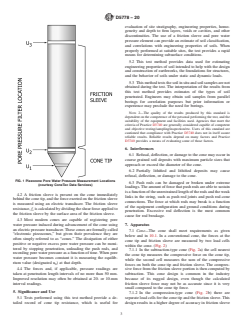
3.2.20 piezocone porewater pressure measurement location:
component of cone resistance, equal to the vertical force
u ,u ,u ,n—fluid pressure measured by the piezocone at
1 2 3
applied to the cone tip divided by the cone base area.
specific locations (2, 3, 4) : u —porous filter location on the
3.2.7 corrected total cone tip resistance, q,n—cone tip
t
midface or tip of the cone, u —porous filter location at the
resistance corrected for water pressure acting behind the cone
shoulder position in the cylindrical extension of the cone tip
tip (see 13.1.1).
(standard location) and, u —porous filter location behind the
3.2.7.1 Discussion—Correction for water pressure requires
friction sleeve.
measuring water pressures with a piezocone element posi-
3.2.21 pore water pressure, n—pore water pressure mea-
tioned behind the cone tip at location u (See section 3.2.20).
sured during penetration.
3.2.8 electronic cone, n—a cone that uses transducers to
3.2.22 pore water pressure ratio, B ,n—the ratio of excess
q
obtain the measurements.
pore water pressure, ∆u , measured with a piezocone element
positioned behind the cone tip at location u (see 3.2.20)to
3.2.9 electronic piezocone, n—an electronic cone that can
corrected total cone tip resistance q, minus the total vertical
measure the pore water pressure simultaneously with the cone
t
overburden stress, σ .
tip resistance and the friction sleeve resistance.
vo
3.2.23 push rods, n—the tubes or rods used to advance the
3.2.10 equilibrium pore water pressure, u ,n—at rest water
cone.
pressure at depth of interest. Also referred to as piezometric
pressure.
3.3 Abbreviations:
3.3.1 CPT—cone penetration test.
3.2.11 excess pore water pressure, ∆u, n—pore water pres-
3.3.2 FSO—full scale output.
sureinexcessoftheequilibriumporewaterpressurecausedby
the penetration of the cone into the ground.
3.3.3 MO—measured output.
3.2.11.1 Discussion—Excess pore water pressure can either
be positive or negative for filters with a piezocone element 4. Summary of Test Method
positioned behind the cone tip at location u (see 3.2.20).
4.1 Acone is advanced through the soil at a constant rate of
3.2.12 friction ratio, R,n—the ratio of the friction sleeve 20 mm/s. The force on the cone tip required to penetrate the
f
resistance, f , to the cone tip resistance, q , with the latter soil is measured using an electric transducer. The cone tip
s c
measured at the depth for the middle of the friction sleeve, resistance q iscalculatedbydividingtheverticalforceapplied
c
expressed as a percentage. to the cone tip by the cone base area.
NOTE 1—Some methods to interpret CPTdata use friction ratio defined
as the ratio of sleeve friction, f , to cone tip resistance corrected for pore
s
pressure effects q, (1). It is not within the scope of this standard to The boldface numbers given in parentheses refer to a list of references at the
t
recommend which methods of interpretation are to be used. end of the text.
D5778 − 20
evaluation of site stratigraphy, engineering properties, homo-
geneity and depth to firm layers, voids or cavities, and other
discontinuities. The use of a friction sleeve and pore water
pressure element can provide an estimate of soil classification,
and correlations with engineering properties of soils. When
properly performed at suitable sites, the test provides a rapid
means for determining subsurface conditions.
5.2 This test method provides data used for estimating
engineering properties of soil intended to help with the design
and construction of earthworks, the foundations for structures,
and the behavior of soils under static and dynamic loads.
5.3 Thismethodteststhesoilinsituandsoilsamplesarenot
obtained during the test. The interpretation of the results from
this test method provides estimates of the types of soil
penetrated. Engineers may obtain soil samples from parallel
borings for correlation purposes but prior information or
experience may preclude the need for borings.
NOTE 2—The quality of the results produced by this standard is
dependent on the competence of the personal performing the test, and the
suitability of the equipment and facilities used. Agencies that meet the
criteria of Practice D3740 are generally considered capable of competent
and objective testing/sampling/inspection/etc. Users of this standard are
cautioned that compliance with Practice D3740 does not in itself assure
reliable results. Reliable results depend on many factors and Practice
D3740 provides a means of evaluating some of those factors.
6. Interferences
6.1 Refusal, deflection, or damage to the cone may occur in
coarse grained soil deposits with maximum particle sizes that
approach or exceed the diameter of the cone.
6.2 Partially lithified and lithified deposits may cause
refusal, deflection, or damage to the cone.
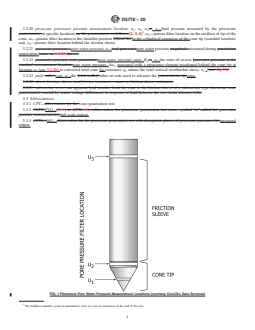
FIG. 1 Piezocone Pore Water Pressure Measurement Locations
6.3 Push rods can be damaged or broken under extreme
(courtesy ConeTec Data Services)
loadings.Theamountofforcethatpushrodsareabletosustain
isafunctionoftheunrestrainedlengthoftherodsandtheweak
4.2 A friction sleeve is present on the cone immediately
links in the string, such as push rod joints and push rod-cone
behindtheconetip,andtheforceexertedonthefrictionsleeve
connections. The force at which rods may break is a function
is measured using an electric transducer. The friction sleeve
of the equipment configuration and ground conditions during
resistance, f iscalculatedbydividingtheshearforceappliedto
s
penetration. Excessive rod deflection is the most common
the friction sleeve by the surface area of the friction sleeve.
cause for rod breakage.
4.3 Most modern cones are capable of registering pore
7. Apparatus
water pressure induced during advancement of the cone using
anelectricpressuretransducer.Theseconesareformallycalled
7.1 Cone—The cone shall meet requirements as given
“electronic piezocones,” but given their prevalence they are
below and in 10.1. In a conventional cone, the forces at the
often simply referred to as “cones.” The dissipation of either
cone tip and friction sleeve are measured by two load cells
positive or negative excess pore water pressure can be moni-
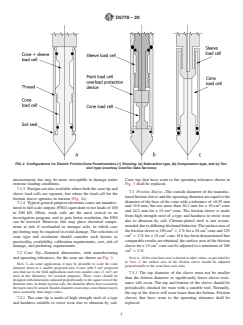
within the cone. (Fig. 2)
tored by stopping penetration, unloading the push rods, and
7.1.1 In the subtraction-type cone (Fig. 2a) the cell nearest
recordingporewaterpressureasafunctionoftime.Whenpore
the cone tip measures the compressive force on the cone tip,
water pressure becomes constant it is measuring the equilib-
while the second cell measures the sum of the compressive
rium value (designated u ) at that depth.
forces on both the cone tip and friction sleeve. The compres-
4.4 The forces and, if applicable, pressure readings are sive force from the friction sleeve portion is then computed by
taken at penetration length intervals of no more than 50 mm. subtraction. This cone design is common in the industry
Improved resolution may often be obtained at 20- or 10-mm because of its rugged design, even though the calculated
interval readings. friction sleeve force may not be as accurate since it is very
small compared to the cone tip force.
5. Significance and Use
7.1.2 In the compression-type cone (Fig. 2b) there are
5.1 Tests performed using this test method provide a de- separate load cells for the cone tip and the friction sleeve.This
tailed record of cone tip resistance, which is useful for design results in a higher degree of accuracy in friction sleeve
D5778 − 20
FIG. 2 Configurations for Electric Friction-Cone Penetrometers (1) Showing: (a) Subtraction type, (b) Compression type, and (c) Ten-
sion type (courtesy ConeTec Data Services)
measurement, but may be more susceptible to damage under Cone tips that have worn to the operating tolerance shown in
extreme loading conditions. Fig. 3 shall be replaced.
7.1.3 Designsarealsoavailablewhereboththeconetipand
7.3 Friction Sleeve—The outside diameter of the manufac-
sleeve load cells are separate, but where the load cell for the
turedfrictionsleeveandtheoperatingdiameterareequaltothe
friction sleeve operates in tension (Fig. 2c).
diameter of the base of the cone with a tolerance of+0.35 mm
7.1.4 Typicalgeneralpurposeelectronicconesaremanufac-
and−0.0 mm, but not more than 36.1 mm for a 10-cm cone
tured to full scale outputs (FSO) equivalent to net loads of 100
and 44.2 mm for a 15-cm cone. The friction sleeve is made
to 200 kN. Often, weak soils are the most critical in an
from high strength steel of a type and hardness to resist wear
investigation program, and to gain better resolution, the FSO
due to abrasion by soil. Chrome-plated steel is not recom-
can be lowered. However, this may place electrical compo-
mendedduetodifferingfrictionalbehavior.Thesurfaceareaof
nents at risk if overloaded in stronger soils, in which case
2 2
thefrictionsleeveis150cm 62%fora10-cm coneand225
pre-boring may be required to avoid damage. The selection of
2 2
cm 62% for a 15-cm cone. If it has been demonstrated that
cone type and resolution should consider such factors as
comparableresultsareobtained,thesurfaceareaofthefriction
practicality, availability, calibration requirements, cost, risk of
sleeve for a 15-cm cone can be adjusted to a minimum of 200
damage, and preboring requirements.
cm 62%.
7.2 Cone Tip—Nominal dimensions, with manufacturing
and operating tolerances, for the cone are shown on Fig. 3.
NOTE4—Iftheconebaseareaisalteredtoothervalues,asprovidedfor
in Note 2, the surface area of the friction sleeve should be adjusted
NOTE 3—In some applications it may be desirable to scale the cone
proportionally to the cone base area ratio.
diameter down to a smaller projected area. Cones with 5 cm projected
area find use in the field applications and even smaller sizes (1 cm ) are
7.3.1 The top diameter of the sleeve must not be smaller
used in the laboratory for research purposes. These cones should be
than the bottom diameter or significantly lower sleeve resis-
designedwithdimensionsadjustedproportionallytothesquarerootofthe
tance will occur. The top and bottom of the sleeve should be
diameter ratio. In thinly layered soils, the diameter affects how accurately
thelayersmaybesensed.Smallerdiameterconesmaysensethinnerlayers periodically checked for wear with a suitable tool. Normally,
more accurately than larger cones.
the top of the sleeve will wear faster than the bottom. Friction
sleeves that have worn to the operating tolerance shall be
7.2.1 The cone tip is made of high strength steel of a type
and hardness suitable to resist wear due to abrasion by soil. replaced.
D5778 − 20
FIG. 3 Manufacturing and Operating Tolerances of Cone Tips (5) (courtesy ConeTec Data Services)
NOTE5—Theeffectscausedbyconediameterchangesontipandsleeve
7.3.2 Friction sleeves must be designed with equal end
resistance are dependent on the magnitude of diameter increase, location,
areas,whichareexposedtowaterpressures (1, 5, 6, 7, 8).This
and soil conditions. If there is question regarding a specific design with
will remove the tendency for unbalanced end forces to act on
diameter increases, comparison studies can be made to a cone with
the sleeve. Sleeve design must be checked in accordance with
constant diameter. Most practitioners feel that diameter increases equiva-
A1.6 to ensure proper response. lent to addition of a friction reducer with area increases of 15 to 20%
should be restricted to a location at least eight to ten cone diameters
7.4 Gap—The gap (annular space) between the cylindrical
behind the friction sleeve.
extension of the cone tip base and the other elements of the
7.6 Cone Axis—The axis of the cone tip, the friction sleeve,
cone shall be kept to the minimum necessary for operation of
and the remainder of the cone must be coincident.
the sensing devices and shall be designed and constructed in
such a way to prevent the entry of soil particles. These gap 7.7 Force Sensing Devices—The typical force sensing de-
vice is a strain gauge load cell that contains temperature
requirements also apply to the gaps at either end of the friction
sleeve and to other elements of the cone. compensated bonded strain gauges. The configuration and
locationofstraingaugesshouldbesuchthatmeasurementsare
7.4.1 The gap between the cylindrical extension of the cone
tip and other elements of the cone must not be larger than 5 not influenced by possible eccentricity of loading.
7.7.1 The transducers shall have an accuracy of at least
mm.
7.4.2 If a seal is placed in the gap, it should be properly 6100 kPa or 5% of the reading (whichever is larger), except
if the transducer is dedicated to measuring the friction sleeve
designed and manufactured to prevent entry of soil particles. It
must have a deformability at least two orders of magnitude resistance, in which case the precision shall be at least 15 kPa
greater than the material comprising the load transferring or 15 % of the reading (whichever is larger).
components of the sensing devices in order to prevent load
7.8 Electronic Piezocone—A piezocone can contain porous
transfer from the cone tip to the sleeve.
filter element(s), pressure transducer(s), and fluid filled ports
7.5 Diameter Requirements—The cone shall have the same connecting the elements to the transducer to measure pore
diameter as the cone tip (that is, equal to the diameter of the water pressure. Fig. 4 shows some common design types used
2 2
base of the cone withatoleranceof+35mmand–0.0mm,but in practice for 10-cm and 15-cm piezocones (with ideal
not more than 36.1 mm for a 10-cm cone and 44.2 mm for a dimensions).
15-cm cone) for the complete length of the cone (5, 9, 10). 7.8.1 The pore water pressure measurement location of the
7.5.1 Forsomeconedesigns,itmaybedesirabletoincrease porous element shall be either in the cone tip (Type 1 or u ),
the diameter of the cone body to house additional sensors or immediately behind the cone tip (Type 2 or u ) or immediately
reduce friction along push rods. These diameter changes are behind the friction sleeve (Type 3 or u ). Some piezocones
acceptable if they do not have significant influence on tip and used for research purposes may have multiple measurement
sleeve data, and therefore these diameter changes shall be at locations. The Type 2 piezocone is preferred to allow correc-
least 400 mm from the cylindrical extension of the cone tip tion of tip resistances. Moreover, this type is less subject to
2 2
base for a 10-cm cone and 500 mm for a 15-cm cone. If the damage and abrasion, and shows fewer compressibility effects
cone diameter is not constant, information on diameters of the (1, 8). However, Type 2 cones may be subject to cavitation at
complete cone shall be reported. shallow depths in dense soils because the zone behind the
D5778 − 20
FIG. 4 Cone Design Configurations: (a) Electronic Friction-type, (b) Type 1 Piezocone, (c) Standard 10-cm Type 2 Piezocone, and (d)
15-cm Type 2 Version (7) (courtesy ConeTec Data Services)
height of cylindrical extension is a zone of dilation in drained or gravel), the pore water pressure will equalize the equilib-
soils. Similar response can occur in stiff fissured clays and rium pore pressure within seconds or minutes. In low perme-
crusts (1).Porewaterpressuremeasurementsobtainedatthe u ability materials such as high plasticity clays, equalization can
location are more effective for dissipation readings, compress- takemanyhours.Ifthegoaloftheexplorationprogramisonly
ibility determinations and layer detection, particularly in fis- to acquire equilibrium pore water pressures in sands, some of
sured soils and materials prone to cause cavitation of Type 2 the preparation procedures for pore water pressure measuring
piezocones, but are more subject to wear and damage (4, 11). can be relaxed, such as deairing fluids. However, such relax-
7.8.2 Numerous design and configuration aspects can affect ation shall be reported in detail, including on each pore
themeasurementofporewaterpressures.Variablessuchasthe pressure graph generated with such relaxed preparation proce-
element location, design and volume of ports, and the type and dures.
degreeofsaturationofthefluids,cavitationoftheelementfluid 7.8.4 The pressure transducer is normally housed near the
system and resaturation lag time, depth and saturation of soil cone tip. For dynamic pressure measurements, the filter and
during testing all affect the pore water pressure measured portsarefilledwithdeairedfluidandthevolumeofconnecting
during testing and dissipation tests of pore water pressures (2, ports to the transducer should be minimized. The transducer
3, 4, 8). It is beyond the scope of the procedure to address all shall have an accuracy of at least 25 kPa or 3% of the reading
of these variables. As a minimum, complete information shall (whichever is larger).
be reported as to the design, configuration, and the preparation 7.8.5 Element—The element is a fine porous filter made
of the piezocone system that is used for the particular sound- fromplastic,sinteredsteelorbronze,orceramic.Theporesize
ing. should be less than 100 micron. Different materials have
7.8.3 Measurement of equilibrium pore water pressures different advantages. Smearing of metallic element openings
during pauses in testing are more straightforward. The pres- by hard soil grains may reduce dynamic response of the
ence of air entrained in the system only affects dynamic system, thus these elements are normally not used for Type 1
response. In high permeability soils (for example, clean sands cones, but best suited for Type 2 or Type 3 cones. Ceramic
D5778 − 20
elements are very brittle and may crack when loaded, but (see 12.1.2) while the magnitude of thrust can fluctuate. The
perform well for Type 1 cones as they reduce compressibility thrust machine must be anchored or ballasted, or both, so that
concerns. Polypropylene plastic elements are most commonly it provides the necessary reaction for the cone and does not
used in practice, particularly for Type 2 and Type 3 cones, but move relative to the soil surface during thrust.
they may be inappropriate for environmental type CPTs where
NOTE6—Conepenetrationsoundingsusuallyrequirethrustcapabilities
contaminant detection is sought.
rangingfrom100to200kNforfullcapacity.Highmassballastedvehicles
7.8.6 Fluids for Saturation—Pureglycerineorsiliconeoilis
can cause soil surface deformations, which may affect cone resistance(s)
measured in near surface layers.Anchored or ballasted vehicles, or both,
most often applied for deairing elements that are used to
may induce changes in ground surface reference level. If these conditions
measure the dynamic response. These stiff viscous oils have
are evident, they should be noted in reports.
lesstendencytocavitate,althoughcavitationmaybecontrolled
7.13 Other Sensing Devices—Other sensing devices can be
by the effective pore size of the element mounting surfaces.
included in the cone to provide additional information during
Water or water mixtures can be used for the fluid if the entire
the sounding.These instruments are normally read at the same
sounding will be submerged, or if the dynamic response is not
continuous rate as tip, sleeve, and pore water pressure sensors,
important.Thefluidsaredeairedusingproceduresdescribedin
or alternatively, during pauses in the push (often at 1-m rod
11.1.
breaks). Typical sensors are inclinometer, temperature, resis-
7.9 Data Acquisition System—The signals from the cone
tivity (or its reciprocal, electrical conductivity), or seismic
transducers are to be displayed at the surface during testing as
sensors. The use of an inclinometer is highly recommended
a continuously updated plot against penetration length. The
since it will provide information on potentially damaging
data are also to be recorded electronically on the same data
situations during the sounding process. An inclinometer can
acquisition system for subsequent processing.
provide a useful depth reliability check because it provides
7.9.1 Theelectronicdatafilesshallincludeproject,location,
information on verticality. In addition, it will allow for correc-
operator, and data format information (for example, channel,
tion of the penetration length to the penetration depth during
units, corrected or uncorrected, etc.) so that the data can be
post-processing of the data.
understood when reading the file with a text editor.
7.10 Push Rods—Steel rods are required having a cross
8. Reagents and Materials
sectional area adequate to sustain, without buckling, the thrust
8.1 O-Ring Compound—A petroleum or silicon compound
required to advance the cone. For systems that use cables, the
for facilitating seals with O-rings. Use of silicon compounds
cable is prestrung through the rods prior to testing. Push rods
may impede repair of strain gages if the strain gauge surface is
are typically supplied in 1-meter lengths, although other
exposed to the compound.
lengths are used as well. The push rods must be secured
8.2 Silicone Oil, Glycerine, or water, for use in pore water
together to bear against each other at the joints and form a
pressure measurement systems.
rigid-jointedstringofpushrods.Beforeatestiscarriedout,the
NOTE 7—Detailed comparisons and discussions on the use of these
linearityofthepushrodsshouldbechecked.Ifanyindications
fluids can be found elsewhere (8, 11).
of bending appear, the use of the rods should be suspended.
7.10.1 For the 10-cm cone steel push rods are typically
9. Hazards
36-mm outside diameter, 16-mm inside diameter, and have a
mass per unit length of 6.65 kg/m. For 15-cm cones, the test 9.1 Technical Precautions—General:
is typically performed with 44.5-mm outside diameter rods or
9.1.1 Use of components that do not meet required toler-
with standard rods used for the 10-cm cones, although other
ances or show visible signs of non-symmetric wear can result
diameters are used as well.
in erroneous cone resistance data.
9.1.2 Theapplicationofthrustinexcessofratedcapacityof
7.11 Friction Reducer—Friction reducers are normally used
the equipment can result in damage to equipment (see Section
on the push rods to reduce rod friction. If a friction reducer is
6).
used, it shall be located on the push rods no closer than 400
9.1.3 A cone sounding must not be performed any closer
mm behind the cone tip base of the 10-cm cone and 500 mm
than 10 borehole diameters from any existing unbackfilled or
behind the cone tip base of a 15-cm cone. Friction reducers,
uncased bore hole.
that increase push rod outside diameter by approximately
2 2
9.1.4 Whenperformingconepenetrationtestinginprebored
25%, are typically used for 10-cm cones. If a 15-cm cone is
holes, the depth and diameter of the prebored hole shall be
advanced with 36-mm push rods there may be no need for
reported and shown on the sounding plot.
friction reducers since the cone itself will open a larger hole.
Thetype,size,amount,andlocationoffrictionreducer(s)used
NOTE 8—Usually it is assumed that the soil is disturbed at least three
during testing must be reported.
borehole diameters below the bottom of the borehole, and this should be
taken into account when evaluating the penetration resistance data.
7.12 Thrust Machine and Reaction—The thrust machine
9.1.5 Ifobstructionsareencounteredandnormaladvanceof
will provide a continuous stroke, preferably over a distance
the sounding is stopped to bore through the obstructions, the
greater than 1 m. The thrust machine should be capable of
depth and thickness of obstructions shall be recorded.
adjusting push direction through the use of a leveling system
such that push initiates in a vertical orientation. The machine 9.1.6 Significant bending of the push rods can influence
mustadvancetheconeandpushrodsatasmooth,constantrate penetration resistance data. The use of a tubular rod guide is
D5778 − 20
recommended at the base of the thrust machine and also in removed from the fluid-filled system or pore water pressure
prebored holes to help prevent push rod bending. fluctuation during cone advancement will be incorrect due to
9.1.7 Bent push rods may result in excessive directional response lag from compression of air bubbles.
penetrometer drift and possibly unreliable penetration resis-
tance values.
10. Calibration and Standardization
9.1.8 The cone may drift directionally from vertical align-
10.1 Electronic (Piezo) Cones:
mentandthesedeviationsininclinationcancreatenonuniform
10.1.1 Newly manufactured or repaired cones are to be
loading resulting in unreliable penetration resistance data as
checked to meet the minimum calibration requirements de-
well as damage. Passing through or alongside obstructions
scribed in the annex. These calibrations include load tests,
(suchasboulders,cobbles,coarsegravel,soilconcretions,thin
thermal tests, and mechanical tests for effects of imbalanced
rock layers, or inclined dense layers) may deflect the cone and
hydrostatic forces. The calibration records must be certified as
also induce directional drift. Therefore, limitations on inclina-
correct by a registered professional engineer or other respon-
tion in the system should be imposed. Generally, a 1° change
sible engineer with knowledge and experience in materials
in inclination over 1 m of penetration can impose detrimental
testing for quality assurance.
push rod bending, while a total drift of over 15° imposes
10.1.2 Baseline Readings—Baseline or zero-load readings
non-symetricloadingandpossibleunreliablepenetrationresis-
for the load cells and pore water pressure transducers must be
tance data.
taken before and after each sounding. The baseline reading is
9.1.9 If the proper rate of advance of the cone is not
a reliable indicator of output stability, temperature-induced
maintained for the entire stroke through the measurement
apparent load, soil ingress, internal friction, threshold
interval, penetration resistance data may be erroneous.
sensitivity, and unknown loading during zero setting.
9.2 Technical Precautions—Electronic Friction Cone:
10.1.2.1 The initial baseline reading shall be taken in a
9.2.1 Failure of seals can result in damage to or inaccurate
temperature environment as close as possible to that of the
readings from electronic transducers. The seals should be
material to be sounded. If temperature is a concern, the cone
inspectedregularlyforoverallcondition,cleanliness,andwater
shall be immersed in a bucket of fresh tap water or inserted in
tightness, and replaced when necessary.
the ground to stabilize its temperature and then extracted for
9.2.2 Soil ingress between different elements of a cone can
rapid determination of initial baseline. The change in initial
result in unreliable data. Specifically, soil ingress will detri-
baseline and calibration values shall not exceed 5% FSO for
mentally affect sleeve resistance data. Seals should be in-
the load cells and pressure transducer.
spected and maintained regularly, and replaced when neces-
10.1.2.2 After a sounding is completed, a final baseline
sary. If very accurate sleeve resistance data is required, it is
reading shall be taken. The change in initial and final baseline
recommended to clean all seals after each sounding.
values shall not exceed 2% FSO for the load cells and pore
9.2.3 Electronic cones shall be temperature compensated. If
water pressure transducers.
extreme temperatures outside of the range established in
10.1.2.3 A continuous record of initial and final baselines
A1.3.1aretobeencountered,theconeshallbecheckedforthe
readings shall be kept during production testing.
required temperature range to establish it can meet the calibra-
tion requirements. Also, harsh environments may severely 10.1.2.4 Ifabaselinereadingexceedstheabovecriteria,the
affect the data acquisition system or power supplies, notebook cone shall be inspected for damage. If there is apparent
damage,theconeshallbecleanedandanydamagedpartsshall
or field computers, and other electronics.
9.2.4 Iftheshiftinbaselinereadingafterextractingthecone be replaced, after which a new baseline shall be obtained. If
this value agrees with the initial baseline within the above
from the soil is so large that the conditions of accuracy as
defined in 10.1.2.3 are no longer met, penetration resistance criteria,recalibrationisnotrequired.However,iftheinitialand
final baselines are still not within the above criteria then it is
data shall be noted as unreliable. If baseline readings do not
conform to allowable limits established by accuracy require- likely that the shift was caused by an obstacle or obstruction,
and the cone shall no longer be used until it has been repaired
ments in 10.1.2.3, the cone must be repaired, and recalibrated
or replaced. and recalibrated.
9.2.5 Friction sleeve design shall be checked in accordance
10.1.2.5 Data for a sounding where unacceptable final
with A1.6 to ensure balanced response. The response is also
baseline shift has occurred shall be reported as unreliable. In
dependent on location of water seals. If water seals are
some cases, it may be obvious where the damage occurred and
damaged during testing, and sleeve data appear affected, the
datapriortothatpointmaybeconsideredreliable.Inthatcase,
soundingdatashallbenotedasunreliableandthesealsshallbe
the location where obvious damage occurred must be clearly
repaired.
noted in the sounding logs and duly reported.
10.1.3 Cone Wear and Usage:
9.3 Technical Precautions—Piezocone:
9.3.1 The electronic piezocone measures pore water pres- 10.1.3.1 For cones used regularly, periodic calibrations
sures on the exterior of the cone by transferring the pressure should be performed. The calibration period can be based on
through a de-aired fluid system to a pressure transducer in the production footage, such as once every 3000 m of soundings,
cone interior. For proper dynamic response, the measurement or time period. If calibration equipment is not available in the
system (consisting of fluid ports and porous element) must be field, the cone may be checked in the laboratory at the end of
completely saturated prior to testing. Entrained air must be the project during which the calibration period ended.
D5778 − 20
10.1.3.2 Cones that are used infrequently should be cali- pureglycerineorsiliconemaybestoredforlongerperiods,but
brated based on a time period. If a cone has not been used for not to exceed one month after storage containers are opened
a long period of time, checking it before use is advisable. and exposed to air.
10.1.3.3 For projects requiring a high level of quality
assurance, it may be required to do a calibration before the 12. Procedure
project.
12.1 General Requirements:
10.1.3.4 Calibrations are required if an initial or a final
12.1.1 Prior to beginning a sounding, site surveys shall be
baseline reading does not meet the requirements given in
performed to ensure hazards such as overhead and under-
10.1.2.3 and whenever a cone has been repaired.
ground utilities will not be encountered. Next, the thrust
10.1.3.5 Records documenting the history of an individual
machine shall be positioned over the location of the sounding,
cone shall be maintained for evaluation of performance.
and either the leveling jacks shall be lowered to raise the
10.1.3.6 If it appears from a track record or the baseline
machine mass off the suspension system (in case the dead
readings that no significant deviations are registered, a longer
weight of the thrust machine is used to generate the required
period between calibrations can be applicable.
reaction)orthegroundanchorsshallbeplaced(incasetheyare
10.2 Calibrations of Other Sensing Devices—Other sensors used to generate the required reaction). Afterwards it shall be
ensured that the hydraulic rams of the penetrometer thrust
intheconemayrequirecalibrationsusingproceduressimilarto
those given in the annex for load cells and pressure transduc- system are set as near vertical as possible.
12.1.2 The hydraulic ram feed rate shall be set to advance
ers. The need for calibration depends on the requirements of
theindividualinvestigationprogram.Fornoncriticalprograms, theconeatarateof20 65mm/s.Thisratemustbemaintained
during the entire stroke during downward advance of the rods
the occurrence of reasonable readings may be sufficient. In
critical programs, it may be necessary to load the sensor while taking readings.
throughtherangeofinterestwithreferencestandardstoensure
NOTE 9—In practice the penetration speed is reduced whenever the
accurate readings.
recordeddataimplyaprecarioussituation(suddendramaticincreaseintip
resistance, bending, or overall inclination). Those deviations must be
clearly indicated in the report.
11. Conditioning
12.1.3 The push rods shall be checked for straightness and
11.1 Piezocones used for pore water pressure readings
permanent bending (See Section 7.10). Push rods are as-
require special preparation such that entrained air is removed
sembled and tightened by hand or by an automatic tightening
from the system. In addition the filter element should be
device, but care must be taken and threads may need cleaning
replaced after every sounding and the ports should be flushed
to ensure that the shoulders are tightly butted to prevent
after every sounding. However, for soundings where dynamic
damage to the push rods. For cones using cables, the cable is
response is important, the prepared filter elements shall be
prestrung through the push rods. A friction reducer shall be
replaced after every sounding.
added to the string of push rods as required, usually as the first
11.1.1 Fieldorlaboratorytestscanbeperformedtoevaluate
push rod behind the cone.
assembled system response, if desired by placing the cone tip
12.1.4 The cone shall be inspected before and after sound-
and the filter element in a pressurized chamber and subject
ings for damage, soil ingress, and wear. In very soft and
them to rapid pressure change. If the responses match, the
sensitive soils where accurate sleeve data is required, the cone
system is properly prepared.
shall be cleaned and lubricated in accordance with the manu-
11.1.2 To condition the filter elements, they shall be placed
facturer’s recommendations after each sounding. If damage is
in a pure glycerine or silicone oil bath under a vacuum of at
found after a sounding, this information shall be recorded.
least 90% of one atmosphere (–90 kPa). Vacuum shall be
maintained until air bubble generation is reduced to a mini- 12.2 Electronic Cones:
mum. Application of ultrasonic vibration and low heat (T < 12.2.1 The cone and the data acquisition system shall be
50°C) will assist in removal of air. Generally with use of poweredupaccordingtothemanufacturer’srecommendations.
combined vacuum, ultrasonic vibration, and low heat, filter 12.2.2 An initial baseline reading shall be obtained for the
elements can be deaired in about 4 h, although it is best to
cone in an unloaded condition at a temperature as close as
allow for 24 h to ensure best performance. Results will depend possible to ground conditions. This baseline reading shall be
upon the viscosity of the fluid and pore size of the filter
compared with the calibration values for the requirements
element. given in 10.1.2.1. If thermal stability needs to be assured, the
11.1.3 Alternatively, elements can be prepared in water by cone shall be submerged in water at temperature close to
boiling the elements while submerged in water for at least 4 h, ground; or an initial short penetration test hole shall be
although damage may result from prolongued exposure in this performed to allow the cone to reach soil temperature.
approach (4), or commercially-purchsed pre-saturated filter 12.2.3 The depth at which readings were taken shall be
elements may be used.
measured with an accuracy of at least 625 mm or 1% of the
11.1.4 Prepared elements must be kept submerged in the reading (whichever is larger) from the ground surface.
preparedfluidinclosedcontainersuntilreadyforuse,whereby 12.2.4 The cone tip resistance and friction sleeve resistance
the allowable storage length depends on the fluid. If elements shall be measured continuously with depth, and recorded at
arepreparedinwater,theymustbedeairedagainonedayafter depthintervalsnotexceeding50mm.Improvedresolutionmay
containers are opened and exposed to air. Elements stored in often be obtained at 20- or 10-mm interval readings.
D5778 − 20
12.2.5 During the sounding, the cone tip and friction sleeve deeper, the saturation levels may recover as air bubbles are
resistance shall be monitored continuously for signs of proper driven back into solution according to Boyles Law. Evaluation
operations.Itishelpfultomonitorotherindicatorssuchasram of proper interpretation of dynamic response requires experi-
pressure or inclination to ensure that damage may not occur if ence (4, 5, 8, 12). Pre-punching or pre-boring with a two-level
highly resistant layers or obstructions are encountered. Incli- phase approach to soundings may help alleviate desaturation
nation is a particularly useful indicator of imminent danger to problems.
the system (see 12.4).
12.3.4 Procedures similar
...
This document is not an ASTM standard and is intended only to provide the user of an ASTM standard an indication of what changes have been made to the previous version. Because
it may not be technically possible to adequately depict all changes accurately, ASTM recommends that users consult prior editions as appropriate. In all cases only the current version
of the standard as published by ASTM is to be considered the official document.
Designation: D5778 − 12 D5778 − 20
Standard Test Method for
Electronic Friction Cone and Piezocone Penetration Testing
of Soils
This standard is issued under the fixed designation D5778; the number immediately following the designation indicates the year of
original adoption or, in the case of revision, the year of last revision. A number in parentheses indicates the year of last reapproval. A
superscript epsilon (´) indicates an editorial change since the last revision or reapproval.
1. Scope*
1.1 This test method covers the procedure for determining the point resistance during penetration of a conical-shaped
penetrometer friction cone or a piezocone as it is advanced into subsurface soils at a steady rate.
1.2 This test method is also used to determine the frictional resistance of a cylindrical sleeve located behind the conical point
as it is advanced through subsurface soils at a steady rate.
1.2 This test method applies to friction-cone penetrometers of the electric and electronic type. electronic friction cones and does
not include hydraulic, pneumatic, or free-fall cones, although many of the procedural requirements herein could apply to those
cones. Also, offshore/marine Cone Penetration Testing (CPT) systems may have procedural differences because of the difficulties
of testing in those environments (for example, tidal variations, salt water and waves). Field tests using mechanical-type
penetrometerscones are covered elsewhere by Test Method D3441.
1.3 This test method can be used to determine porewater pore water pressures developed during the penetration, thus termed
piezocone. Porewater penetration when using a properly saturated piezocone. Pore water pressure dissipation, after a push, can also
be monitored for correlation to time rate of consolidation and permeability.
1.4 Additional sensors, such as inclinometer, seismic geophones (Test Methods D7400), resistivity, electrical conductivity,
dielectric, and temperature sensors, may be included in the penetrometercone to provide usefuladditional information. The use of
an inclinometer is highly recommended since it will provide information on potentially damaging situations during the sounding
process.
1.5 Cone penetration test CPT data can be used to interpret subsurface stratigraphy, and through use of site specific correlations,
they can provide data on engineering properties of soils intended for use in design and construction of earthworks and foundations
for structures.
1.6 Units—The values stated in SI units are to be regarded as standard. Within Section 13 on Calculations, SI units are
considered the standard. Other commonly used units such as the inch-pound system are shown in brackets. The various data
reported should be displayed in mutually compatible units as agreed to by the client or user. Cone tip projected area is commonly
referred to in square centimetres for convenience. The values stated in each system are not equivalents; therefore, each system shall
be used independently of the other. No other units of measurement are included in this standard. Reporting of test results in units
other than SI shall not be regarded as nonconformance with this test method
NOTE 1—This test method does not include hydraulic or pneumatic penetrometers. However, many of the procedural requirements herein could apply
to those penetrometers. Also, offshore/marine CPT systems may have procedural differences because of the difficulties of testing in those environments
(for example, tidal variations, salt water, waves). Mechanical CPT systems are covered under Test Method D3441.
1.7 All observed and calculated values shall conform to the guidelines for significant digits and rounding established in Practice
D6026, unless superseded by this test method.
1.7.1 The procedures used to specify how data are collected/recorded and calculated in the standard are regarded as the industry
standard. In addition, they are representative of the significant digits that generally should be retained. The procedures used do not
consider material variation, purpose for obtaining the data, special purpose studies, or any considerations for the user’s objectives;
and it is common practice to increase or reduce significant digits of reported data to be commensurate with these considerations.
It is beyond the scope of these test methods to consider significant digits used in analysis methods for engineering data.
This test method is under the jurisdiction of ASTM Committee D18 on Soil and Rock and is the direct responsibility of Subcommittee D18.02 on Sampling and Related
Field Testing for Soil Evaluations.
Current edition approved Jan. 1, 2012June 1, 2020. Published February 2012July 2020. Originally approved in 1995. Last previous edition approved in 20072012 as
D5778–07.–12. DOI: 10.1520/D5778-12.10.1520/D5778-20.
*A Summary of Changes section appears at the end of this standard
Copyright © ASTM International, 100 Barr Harbor Drive, PO Box C700, West Conshohocken, PA 19428-2959. United States
D5778 − 20
1.8 This standard does not purport to address all of the safety concerns, if any, associated with its use. It is the responsibility
of the user of this standard to establish appropriate safety safety, health, and healthenvironmental practices and determine the
applicability of regulatory limitations prior to use.
1.9 This international standard was developed in accordance with internationally recognized principles on standardization
established in the Decision on Principles for the Development of International Standards, Guides and Recommendations issued
by the World Trade Organization Technical Barriers to Trade (TBT) Committee.
2. Referenced Documents
2.1 ASTM Standards:
D653 Terminology Relating to Soil, Rock, and Contained Fluids
D3441 Test Method for Mechanical Cone Penetration Testing of Soils
D3740 Practice for Minimum Requirements for Agencies Engaged in Testing and/or Inspection of Soil and Rock as Used in
Engineering Design and Construction
D6026 Practice for Using Significant Digits in Geotechnical Data
D7400 Test Methods for Downhole Seismic Testing
E4 Practices for Force Verification of Testing Machines
3. Terminology
3.1 Definitions:
3.1.1 Definitions are in accordance with Terminology Convention (D653).
3.1 Definitions:
3.1.1 For definitions of common technical terms used in this standard, see Terminology D653.
3.2 Definitions of Terms Specific to This Standard:
3.2.1 apparent load transfer—transfer, n—apparent resistance measured on either the conetip or friction sleeve of an electronica
friction cone penetrometer while that element is in a no-load condition but the other element is loaded. Apparent load transfer is
the sum of cross talk, subtraction error, and mechanical load transfer.
3.2.2 baseline—baseline, n—a set of zero load readings, expressed in terms of apparent resistance, readings that are used as
reference values during performance of testing and calibration.
3.2.3 cone tip—tip, n—the conical point of a cone penetrometer on which the end bearing component of penetration resistance
is developed. The cone has a 60° apex angle, a diameter of 35.7 mm, and a corresponding projected (horizontal plane) surface area
2 2
or cone base area of 10 cm . Also, enlarged cones of 43.7 mm diameter (base area = 15 cm ) are utilized.
3.2.4 cone penetration test—test, n—a series of penetration readings performed at one location over the entire vertical depth
when using a cone penetrometer. pushing of a cone at the end of a series of cylindrical push rods into the ground at a constant
rate of penetration. Also referred to as a cone sounding.
3.2.5 cone, penetrometer—n—a penetrometer in which the leading end of the penetrometer tip is a conical point designed for
penetrating soil and for measuring the end-bearing component of penetration resistance. assembly containing the cone tip, friction
sleeve, any other sensors and measuring systems as well as the connection to the push rods.
3.2.6 cone tip resistance, q —, n—the measured end-bearing component of penetration resistance. The resistance to penetration
c
developed on the cone iscone resistance, equal to the vertical force applied to the cone tip divided by the cone base area.
3.2.7 corrected total cone tip resistance, q —, n—cone tip resistance corrected for water pressure acting behind the cone tip (see
t
13.2.113.1.1). Correction for water pressure requires measuring water pressures with a piezocone element positioned behind the
tip at location u (See section 3.2.26). The correction results in estimated total tip resistance, q .
2 t
3.2.7.1 Discussion—
Correction for water pressure requires measuring water pressures with a piezocone element positioned behind the cone tip at
location u (See section 3.2.20).
3.2.8 cross talk—an apparent load transfer between the cone and the friction sleeve caused by interference between the separate
signal channels.
3.2.8 electronic cone, penetrometer—n—a friction cone penetrometer that uses force transducers, such as strain gauge load cells,
built into a non-telescoping penetrometer tip for measuring, within the penetrometer tip, the components of penetration
resistance.that uses transducers to obtain the measurements.
For referenced ASTM standards, visit the ASTM website, www.astm.org, or contact ASTM Customer Service at service@astm.org. For Annual Book of ASTM Standards
volume information, refer to the standard’s Document Summary page on the ASTM website.
D5778 − 20
3.2.9 electronic piezocone, penetrometer—n—an electronic cone penetrometer equipped with a low volume fluid chamber,
porous element, and pressure transducer for determination of porewater pressure at the porous element soil interface measured
simultaneously with end bearing and frictional components of penetration that can measure the pore water pressure simultaneously
with the cone tip resistance and the friction sleeve resistance.
3.2.11 end bearing resistance—same as cone resistance or tip resistance, q .
c
3.2.10 equilibrium pore water pressure, u —, n—at rest water pressure at depth of interest. Also referred to as piezometric
pressure.
3.2.11 excess pore water pressure, Δu—Δu, n—the difference between porewater pressure measured as the penetration occurs
(pore water pressure in excess of the equilibrium pore water pressure caused by the penetration of theu), and estimated equilibrium
porewater pressure (u cone into the ground. ), or: Δu = (u – u ). Excess porewater pressure can either be positive or negative for
0 0
shoulder position filters.
3.2.11.1 Discussion—
Excess pore water pressure can either be positive or negative for filters with a piezocone element positioned behind the cone tip
at location u (see 3.2.20).
3.2.14 friction cone penetrometer—a cone penetrometer with the capability of measuring the friction component of penetration
resistance.
3.2.12 friction ratio, R —, n—the ratio of the friction sleeve resistance, f , to the cone tip resistance, q , with the latter measured
f s c
at where the the depth for the middle of the friction sleeve and cone point are at the same depth, sleeve, expressed as a percentage.
NOTE 1—Some methods to interpret CPT data use friction ratio defined as the ratio of sleeve friction, f , to cone tip resistance corrected for pore
s
pressure effects q , (1). It is not within the scope of this standard to recommend which methods of interpretation are to be used.
t
3.2.13 friction reducer—reducer, n—a narrow local protuberance on the outside of the push rod surface, placed at a certain
distance above the penetrometer tip, that is provided to reduce the total side friction on the push rods and allow for greater
penetration depths for a given push capacity. local and symmetrical enlargement of the diameter of a push rod to obtain a reduction
of the friction along the push rods.
3.2.14 friction sleeve—sleeve, n—an isolated cylindrical sleeve section onof a penetrometer tip cone upon which the friction
2 2 2
component of penetration resistance develops. The friction sleeve has a surface area of 150 cm for 10-cm cone tips or 225 cm
for 15-cm tips.
3.2.15 friction sleeve resistance, f —, n—the friction component of penetrationcone resistance developed on a friction sleeve,
s
equal to the shear force applied to the friction sleeve divided by its surface area.the friction sleeve surface area. Also referred to
as local side friction or sleeve friction.
3.2.16 FSO—full-scale output, n—abbreviation for full-scale output. The the output of an electronic force transducer when
loaded to 100 % rated capacity.
3.2.17 local sidemeasuring system, friction—n—same as friction sleeve resistance, fall sensors and auxiliary parts used (see
s
3.2.18).to transfer and/or store the electrical signals generated during the cone penetration test.
3.2.17.1 Discussion—
The measuring system normally includes components for measuring force (cone resistance, sleeve friction), pressure (pore
pressure), inclination, clock time and penetration length.
3.2.21 penetration resistance measuring system—a measuring system that provides the means for transmitting information from
the penetrometer tip and displaying the data at the surface where it can be seen or recorded.
3.2.18 penetrometer—penetration depth, n—an apparatus consisting of a series of cylindrical push rods with a terminal body
(end section), called the penetrometer tip, and measuring devices for determination of the components of penetration resistance.
vertical depth of the base of the cone, relative to a fixed point.
3.2.19 penetrometer tip—penetration length, n—the terminal body (end section) of the penetrometer which contains the active
elements that sense the components of penetration resistance. The penetrometer tip may include additional electronic
instrumentation for signal conditioning and amplification. sum of the lengths of the push rods and the cone.
3.2.24 piezocone—same as electronic piezocone penetrometer (see 3.2.10).
3.2.25 piezocone porewater pressure, u—fluid pressure measured using the piezocone penetration test.
D5778 − 20
3.2.20 piezocone porewater pressure measurement location: u , u , u —, n—fluid pressure measured by the piezocone
1 2 3
penetrometer at specific locations on the penetrometer as follows (2, 3, 4) : u —porous filter location on the midface or tip of the
cone, u —porous filter location at the shoulder position behind the in the cylindrical extension of the cone tip (standard location)
and, u —porous filter location behind the friction sleeve.
3.2.21 porewater pressure—pore water pressure, n—total porewaterpore water pressure magnitude measured during penetration
penetration.(same as 3.2.25 above).
3.2.22 porewater pressure ratio parameter, pore water pressure ratio, B —, n—the ratio of excess porewater pressure at the
q
standard measurement location pore water pressure, Δu , measured with a piezocone element positioned behind the cone tip at
location u (see 3.2.20) to corrected total cone tip resistance q , minus the total vertical overburden stress, σ . (see Eq 10).
2 t vo
3.2.23 push rods—rods, n—the thick-walled tubes or rods used to advance the penetrometer tip.cone.
3.2.30 sleeve friction, sleeve, and friction resistance—same as friction sleeve resistance.
3.2.31 subtraction error—an apparent load transfer from the cone to the friction sleeve of a subtraction type electronic cone
penetrometer caused by minor voltage differences in response to load between the two strain element cells.
3.3 Abbreviations:
3.3.1 CPT—abbreviation for the cone penetration test.
3.3.2 PCPT FSO—(2, 3) or CPTu (4)—abbreviation for piezocone penetration test (note: symbol “u” added for porewater
pressure measurements).full scale output.
3.3.3 CPTù—MO—abbreviation for the piezocone penetration test with dissipation phases of porewater pressures (ù).measured
output.
FIG. 1 Piezocone Pore Water Pressure Measurement Locations (courtesy ConeTec Data Services)
The boldface numbers given in parentheses refer to a list of references at the end of the text.
D5778 − 20
3.3.4 SCPTu—abbreviation for seismic piezocone test Test Methods D7400 (includes one or more geophones to allow downhole
geophysical wave velocity measurements).
3.3.5 RCPTu—abbreviation for resistivity piezocone (includes electrical conductivity or resistivity module).
4. Summary of Test Method
4.1 A penetrometer tip with a conical point having a 60° apex angle and a cone base area of 10 or 15 cmcone is advanced
through the soil at a constant rate of 20 mm/s. The force on the conical point (cone) cone tip required to penetrate the soil is
measured by electrical methods, at a minimum of every 50 mm of penetration. Improved resolution may often be obtained at 20-
or 10-mm interval readings. Stress is calculated by dividing the measured force (total cone force) byusing an electric transducer.
The cone tip resistance theq cone base area to obtain cone resistance,is calculated by dividing the vertical force qapplied . to the
c c
cone tip by the cone base area.
4.2 A friction sleeve is present on the penetrometercone immediately behind the cone tip, and the force exerted on the friction
sleeve is measured by electrical methods at a minimum of everyusing an electric transducer. The friction sleeve resistance, 50f
s
mm of penetration. Stress is calculated by dividing the measured axial forceis calculated by dividing the shear force applied to the
friction sleeve by the surface area of the friction sleeve to determine sleeve resistance, sleeve. f .
s
4.3 Most modern penetrometerscones are capable of registering pore water pressure induced during advancement of the
penetrometer tip cone using an electronicelectric pressure transducer. These penetrometerscones are called “piezocones.” The
piezocone is advanced at a rate of 20 mm/s, and readings are taken at a minimum of every 50 mm of penetration. formally called
“electronic piezocones,” but given their prevalence they are often simply referred to as “cones.” The dissipation of either positive
or negative excess porewater pore water pressure can be monitored by stopping penetration, unloading the push rod,rods, and
recording porewater pore water pressure as a function of time. When porewater pore water pressure becomes constant it is
measuring the equilibrium value (designated u ) or piezometric level at that depth.
4.4 The forces and, if applicable, pressure readings are taken at penetration length intervals of no more than 50 mm. Improved
resolution may often be obtained at 20- or 10-mm interval readings.
5. Significance and Use
5.1 Tests performed using this test method provide a detailed record of cone resistance tip resistance, which is useful for
evaluation of site stratigraphy, engineering properties, homogeneity and depth to firm layers, voids or cavities, and other
discontinuities. The use of a friction sleeve and porewater pore water pressure element can provide an estimate of soil
classification, and correlations with engineering properties of soils. When properly performed at suitable sites, the test provides
a rapid means for determining subsurface conditions.
5.2 This test method provides data used for estimating engineering properties of soil intended to help with the design and
construction of earthworks, the foundations for structures, and the behavior of soils under static and dynamic loads.
5.3 This method tests the soil in-situ in situ and soil samples are not obtained. obtained during the test. The interpretation of
the results from this test method provides estimates of the types of soil penetrated. Engineers may obtain soil samples from parallel
borings for correlation purposes but prior information or experience may preclude the need for borings.
NOTE 2—The quality of the results produced by this standard is dependent on the competence of the personal performing the test, and the suitability
of the equipment and facilities used. Agencies that meet the criteria of Practice D3740 are generally considered capable of competent and objective
testing/sampling/inspection/etc. Users of this standard are cautioned that compliance with Practice D3740 does not in itself assure reliable results. Reliable
results depend on many factors and Practice D3740 provides a means of evaluating some of those factors.
6. Interferences
6.1 Refusal, deflection, or damage to the penetrometercone may occur in coarse grained soil deposits with maximum particle
sizes that approach or exceed the diameter of the cone.
6.2 Partially lithified and lithified deposits may cause refusal, deflection, or damage to the penetrometer.cone.
6.3 Standard push Push rods can be damaged or broken under extreme loadings. The amount of force that push rods are able
to sustain is a function of the unrestrained length of the rods and the weak links in the push rod-penetrometer tip string string, such
as push rod joints and push rod-penetrometer tip rod-cone connections. The force at which rods may break is a function of the
equipment configuration and ground conditions during penetration. Excessive rod deflection is the most common cause for rod
breakage.
7. Apparatus
7.1 Cone—The cone shall meet requirements as given below and in 10.1. In a conventional cone, the forces at the cone tip and
friction sleeve are measured by two load cells within the cone. (Fig. 2)
7.1.1 In the subtraction-type cone (Fig. 2a) the cell nearest the cone tip measures the compressive force on the cone tip, while
the second cell measures the sum of the compressive forces on both the cone tip and friction sleeve. The compressive force from
D5778 − 20
FIG. 12 Common Configurations for Electric Friction-Cone Penetrometers (1) Showing: (a) Compression-type Tip and Sleeve Load
Cells, (b) Tension-type Sleeve Design, and (c) Subtraction-type PenetrometerSubtraction type, (b) Compression type, and (c) Tension
type (courtesy ConeTec Data Services)
the friction sleeve portion is then computed by subtraction. This cone design is common in the industry because of its rugged
design, even though the calculated friction sleeve force may not be as accurate since it is very small compared to the cone tip force.
7.1.2 In the compression-type cone (Fig. 2b) there are separate load cells for the cone tip and the friction sleeve. This design
results in a higher degree of accuracy in friction sleeve measurement, but may be more susceptible to damage under extreme
loading conditions.
7.1.3 Designs are also available where both the cone tip and sleeve load cells are separate, but where the load cell for the friction
sleeve operates in tension (Fig. 2c).
7.1.4 Typical general purpose electronic cones are manufactured to full scale outputs (FSO) equivalent to net loads of 100 to
200 kN. Often, weak soils are the most critical in an investigation program, and to gain better resolution, the FSO can be lowered.
However, this may place electrical components at risk if overloaded in stronger soils, in which case pre-boring may be required
to avoid damage. The selection of cone type and resolution should consider such factors as practicality, availability, calibration
requirements, cost, risk of damage, and preboring requirements.
7.2 Cone Tip—Nominal dimensions, with manufacturing and operating tolerances, for the cone are shown on Fig. 3.
NOTE 3—In some applications it may be desirable to scale the cone diameter down to a smaller projected area. Cones with 5 cm projected area find
use in the field applications and even smaller sizes (1 cm ) are used in the laboratory for research purposes. These cones should be designed with
dimensions adjusted proportionally to the square root of the diameter ratio. In thinly layered soils, the diameter affects how accurately the layers may
be sensed. Smaller diameter cones may sense thinner layers more accurately than larger cones.
7.2.1 The cone tip is made of high strength steel of a type and hardness suitable to resist wear due to abrasion by soil. Cone
tips that have worn to the operating tolerance shown in Fig. 3 shall be replaced.
7.3 Friction Sleeve—The outside diameter of the manufactured friction sleeve and the operating diameter are equal to the
diameter of the base of the cone with a tolerance of +0.35 mm and −0.0 mm, but not more than 36.1 mm for a 10-cm cone and
44.2 mm for a 15-cm cone. The friction sleeve is made from high strength steel of a type and hardness to resist wear due to
abrasion by soil. Chrome-plated steel is not recommended due to differing frictional behavior. The surface area of the friction
2 2 2 2
sleeve is 150 cm 6 2 % for a 10-cm cone and 225 cm 6 2 % for a 15-cm cone. If it has been demonstrated that comparable
2 2
results are obtained, the surface area of the friction sleeve for a 15-cm cone can be adjusted to a minimum of 200 cm 6 2 %.
D5778 − 20
FIG. 23 Manufacturing and Operating Tolerances of Cones Cone Tips (5) (courtesy ConeTec Data Services)
NOTE 4—If the cone base area is altered to other values, as provided for in Note 2, the surface area of the friction sleeve should be adjusted
proportionally to the cone base area ratio.
7.3.1 The top diameter of the sleeve must not be smaller than the bottom diameter or significantly lower sleeve resistance will
occur. The top and bottom of the sleeve should be periodically checked for wear with a suitable tool. Normally, the top of the sleeve
will wear faster than the bottom. Friction sleeves that have worn to the operating tolerance shall be replaced.
7.3.2 Friction sleeves must be designed with equal end areas, which are exposed to water pressures (1, 5, 6, 7, 8). This will
remove the tendency for unbalanced end forces to act on the sleeve. Sleeve design must be checked in accordance with A1.6 to
ensure proper response.
7.4 Gap—The gap (annular space) between the cylindrical extension of the cone tip base and the other elements of the cone shall
be kept to the minimum necessary for operation of the sensing devices and shall be designed and constructed in such a way to
prevent the entry of soil particles. These gap requirements also apply to the gaps at either end of the friction sleeve and to other
elements of the cone.
7.4.1 The gap between the cylindrical extension of the cone tip and other elements of the cone must not be larger than 5 mm.
7.4.2 If a seal is placed in the gap, it should be properly designed and manufactured to prevent entry of soil particles. It must
have a deformability at least two orders of magnitude greater than the material comprising the load transferring components of the
sensing devices in order to prevent load transfer from the cone tip to the sleeve.
7.5 Diameter Requirements—The cone shall have the same diameter as the cone tip (that is, equal to the diameter of the base
2 2
of the cone with a tolerance of +35 mm and –0.0 mm, but not more than 36.1 mm for a 10-cm cone and 44.2 mm for a 15-cm
cone) for the complete length of the cone (5, 9, 10).
7.5.1 For some cone designs, it may be desirable to increase the diameter of the cone body to house additional sensors or reduce
friction along push rods. These diameter changes are acceptable if they do not have significant influence on tip and sleeve data,
and therefore these diameter changes shall be at least 400 mm from the cylindrical extension of the cone tip base for a 10-cm cone
and 500 mm for a 15-cm cone. If the cone diameter is not constant, information on diameters of the complete cone shall be
reported.
NOTE 5—The effects caused by cone diameter changes on tip and sleeve resistance are dependent on the magnitude of diameter increase, location, and
soil conditions. If there is question regarding a specific design with diameter increases, comparison studies can be made to a cone with constant diameter.
Most practitioners feel that diameter increases equivalent to addition of a friction reducer with area increases of 15 to 20 % should be restricted to a
location at least eight to ten cone diameters behind the friction sleeve.
7.6 Cone Axis—The axis of the cone tip, the friction sleeve, and the remainder of the cone must be coincident.
7.7 Force Sensing Devices—The typical force sensing device is a strain gauge load cell that contains temperature compensated
bonded strain gauges. The configuration and location of strain gauges should be such that measurements are not influenced by
possible eccentricity of loading.
7.7.1 The transducers shall have an accuracy of at least 6100 kPa or 5 % of the reading (whichever is larger), except if the
transducer is dedicated to measuring the friction sleeve resistance, in which case the precision shall be at least 15 kPa or 15 % of
the reading (whichever is larger).
D5778 − 20
7.8 Friction Cone Penetrometer—Electronic Piezocone—The penetrometer tip should meet requirements as given below and
inA piezocone can contain porous filter element(s), pressure transducer(s), and fluid 10.1. In a conventional friction-type cone
penetrometer, the forces at the cone tip and friction sleeve are measuredfilled ports connecting the elements to the transducer to
measure pore water pressure. Fig. 4 by two load cells within the penetrometer. Either independent loadshows some common design
2 2
types used in practice for 10-cm cells orand 15-cm subtraction-type penetrometers are acceptable for use (piezocones (with ideal
dimensions). Fig. 1).
7.8.1 In the subtraction-type penetrometer, the cone and sleeve both produceThe pore water pressure measurement location of
the porous element shall be either in the cone tip (Type 1 or compressiveu forces on the load cells. The load cells), immediately
behind the cone tip (Type 2 or areu joined together in such a manner that the cell) or immediately behind the friction sleeve (Type
3 or nearestu the cone (the “C” cell in). Some piezocones used for research purposes Fig. 1bmay) measures the compressive force
on have multiple measurement locations. The Type 2 piezocone is preferred to allow correction of tip resistances. Moreover, this
type is less subject to damage and abrasion, and shows fewer compressibility effects (1, 8).the cone while the second cell (the
“C + S” cell However, Type 2 cones may be subject to cavitation at shallow depths in dense soils because the zone behind the
height of cylindrical extension is a zone of dilation in Fig. 1drained soils. Similar response can occur in stiff fissured clays and
crusts b(1).) measures Pore water pressure measurements obtained at the sumu of the compressive forces on both the cone and
friction sleeve. The compressive force from the friction sleeve portion is computed then by subtraction. This cone design is
common in industry because of its rugged design. This design forms the basis for minimum performancelocation are more effective
for dissipation readings, compressibility determinations and layer detection, particularly in fissured soils and materials prone to
cause cavitation of Type 2 piezocones, but are more subject to wear and damage requirements(4, 11for ).electronic penetrometers.
7.1.1.1 Alternative designs have separate and non-dependent load cells separate for tip and sleeve. For instance, in Fig. 1a, the
cone penetrometer tip produces a compression force on the cone load cell (the “C” cell in Fig. 1a) while the friction sleeve
produces a tensile force on the independent friction sleeve load cell (the “S” cell). Designs are also available where both the tip
FIG. 34 PenetrometerCone Design Configurations: (a) Electronic Friction-type, (b) Type 1 Piezocone, (c) Standard 10-cm Type 2
Piezocone, and (d) 15-cm Type 2 Version (7) (courtesy ConeTec Data Services)
D5778 − 20
and sleeve load cells are independent and operate in compression (1). These penetrometer designs result in a higher degree of
accuracy in friction sleeve measurement, however, may be more susceptible to damage under extreme loading conditions.
7.1.1.2 Typical general purpose cone penetrometers are manufactured to full scale outputs (FSO) equivalent to net loads of 10
to 20 tons. Often, weak soils are the most critical in an investigation program, and in some cases, very accurate friction sleeve data
may be required. To gain better resolution, the FSO can be lowered or the independent type penetrometer design can be selected.
A low FSO subtraction cone may provide more accurate data than a standard FSO independent type cone depending on such factors
as system design and thermal compensation. If the FSO is lowered, this may place electrical components at risk if overloaded in
stronger soils. Expensive preboring efforts may be required to avoid damage in these cases. The selection of penetrometer type and
resolution should consider such factors as practicality, availability, calibration requirements, cost, risk of damage, and preboring
requirements.
7.1.1.3 The user or client should select the cone design requirements by consulting with experienced users or manufacturers.
The need for a specific cone design depends on the design data requirements outlined in the exploration program.
7.1.1.4 Regardless of penetrometer type, the friction sleeve load cell system must operate in such a way that the system is
sensitive to only shear stresses applied to the friction sleeve and not to normal stresses.
7.1.2 Cone—Nominal dimensions, with manufacturing and operating tolerances, for the cone are shown on Fig. 2. The cone has
a diameter d = 35.7 mm, projected base area A = 1000 mm , + 2 %–5 % with an apex angle of 60°. A cylindrical extension, h ,
c e
of 5 mm should be located behind the base of the cone to protect the outer edges of the cone base from excessive wear. The 10
cm cone is considered the reference standard for which results of other penetrometers with proportionally scaled dimensions can
be compared.
7.1.2.1 In certain cases, it may be desirable to increase the cone diameter in order to add room for sensors or increase ruggedness
of the penetrometer. The standard increase is to a base diameter of 43.7 mm which provides a projected cone base area of 1500
2 2
mm while maintaining a 60° apex angle. Nominal dimensions, with manufacturing and operating tolerances for the 15 cm cone,
are shown in Fig. 2, based on the international guides (5).
7.1.2.2 The cone is made of high strength steel of a type and hardness suitable to resist wear due to abrasion by soil. Cone tips
which have worn to the operating tolerance shown in Fig. 2 should be replaced. Piezocone tips should be replaced when the tip
has worn appreciably (as shown) and the height of the cylindrical extension has reduced considerably (as shown).
NOTE 4—In some applications it may be desirable to scale the cone diameter down to a smaller projected area. Cone penetrometers with 5 cm projected
area find use in the field applications and even smaller sizes (1 cm ) are used in the laboratory for research purposes. These cones should be designed
with dimensions scaled in direct proportion to standard 10-cm penetrometers. In thinly layered soils, the diameter affects how accurately the layers may
be sensed. Smaller diameter cones may sense thinner layers more accurately than larger cones. If there are questions as to the effect of scaling the
penetrometer to either larger or smaller size, results can be compared in the field to the 10-cm penetrometer for soils under consideration. This is because
the 10-cm cone is considered the reference penetrometer for field testing.
7.1.3 Friction Sleeve—The outside diameter of the manufactured friction sleeve and the operating diameter are equal to the
diameter of the base of the cone with a tolerance of +0.35 mm and −0.0 mm. The friction sleeve is made from high strength steel
of a type and hardness to resist wear due to abrasion by soil. Chrome-plated steel is not recommended due to differing frictional
2 2 2
behavior. The surface area of the friction sleeve is 150 cm 6 2 %, for a 10-cm cone. If the cone base area is increased to 15 cm ,
as provided for in 7.1.2.1, the surface area of the friction sleeve should be adjusted proportionally, with the same length to diameter
2 2 2
ratio as the 10-cm cone. With the 15-cm tip, a sleeve area of 225 cm is similar in scale.
7.1.3.1 The top diameter of the sleeve must not be smaller than the bottom diameter or significantly lower sleeve resistance will
occur. During testing, the top and bottom of the sleeve should be periodically checked for wear with a micrometer. Normally, the
top of the sleeve will wear faster than the bottom.
7.1.3.2 Friction sleeves must be designed with equal end areas which are exposed to water pressures (1, 5, 6, 7, 8). This will
remove the tendency for unbalanced end forces to act on the sleeve. Sleeve design must be checked in accordance with A1.7 to
ensure proper response.
7.1.4 Gap—The gap (annular space) between the cylindrical extension of the cone base and the other elements of the
penetrometer tip should be kept to the minimum necessary for operation of the sensing devices and should be designed and
constructed in such a way to prevent the entry of soil particles. Gap requirements apply to the gaps at either end of the friction
sleeve and to other elements of the penetrometer tip.
7.1.4.1 The gap between the cylindrical extension of the cone base and other elements of the penetrometer tip, e , must not be
c
larger than 5 mm for the friction cone penetrometer.
7.1.4.2 If a seal is placed in the gap, it should be properly designed and manufactured to prevent entry of soil particles into the
penetrometer tip. It must have a deformability at least two orders of magnitude greater than the material comprising the load
transferring components of the sensing devices in order to prevent load transfer from the tip to the sleeve.
7.1.4.3 Filter Element in the Gap—If a filter element for a piezocone is placed in the gap between cone and sleeve the sum of
the height of cylindrical extension, h , plus element thickness filling the gap, e , can range from 8 to 20 mm (see 7.1.8 for
e c
explanation).
7.1.5 Diameter Requirements—The friction sleeve should be situated within 5 to 15 mm behind the base of the cone tip. The
annular spaces and seals between the friction sleeve and other portions of the penetrometer tip must conform to the same
specifications as described in 7.1.4. Changes in the diameter of the penetrometer body above the friction sleeve should be such
D5778 − 20
that tip or sleeve measurements are not influenced by increases in diameter. International reference test procedures require that the
penetrometer body have the same diameter as the cone for the complete length of the penetrometer body (5, 9, 10).
7.1.5.1 For some penetrometer designs, it may be desirable to increase the diameter of the penetrometer body to house
additional sensors or reduce friction along push rods. These diameter changes are acceptable if they do not have significant
influence on tip and sleeve data. If there is question regarding a specific design with diameter increases, comparison studies can
be made to a penetrometer with constant diameter. Information on diameters of the complete penetrometer body should be
reported.
NOTE 5—The effects caused by diameter changes of the penetrometer on tip and sleeve resistance are dependent on the magnitude of diameter increase
and location on the penetrometer body. Most practitioners feel that diameter increases equivalent to addition of a friction reducer with area increases of
15 to 20 % should be restricted to a location at least eight to ten cone diameters behind the friction sleeve.
7.1.6 The axis of the cone, the friction sleeve (if included), and the body of the penetrometer tip must be coincident.
7.1.7 Force Sensing Devices—The typical force sensing device is a strain gauge load cell that contains temperature compensated
bonded strain gages. The configuration and location of strain gages should be such that measurements are not influenced by
possible eccentricity of loading.
7.8.2 Electronic Piezocone Penetrometer—A piezocone penetrometer can contain porous filter element(s), pressure
transducer(s), and fluid filled ports connecting the elements to the transducer to measure pore water pressure. Fig. 3 shows the
2 2
common design types used in practice including: 10-cm friction-type, type 1 and type 2 piezocone, and 15-cm size. The standard
2 2
penetrometer should be the type 2 piezocone with filter located at the shoulder (both 10-cm and 15-cm ) to allow correction of
tip resistances. The electric friction penetrometer without porewater transducers can be used in soils with minor porewater pressure
development, such as clean sands, granular soils, as well as soils and fills well above the groundwater table. The type 1 with face
filter element finds use in fissured geomaterials and materials prone to desaturation, as well as dissipation readings. Numerous
design and configuration aspects can affect the measurement of dynamicpore water pressures. Variables such as the element
location, design and volume of ports, and the type and degree of saturation of the fluids, cavitation of the element fluid system and
resaturation lag time, depth and saturation of soil during testing all affect the dynamic porewaterpore water pressure measured
during testing and dissipation tests of dynamic pore water pressures (2, 3, 4, 8). It is beyond the scope of the procedure to address
all of these variables. As a minimum, complete information shouldshall be reported as to the design, configuration, and the
preparation of the piezocone system that is used for the particular sounding.
7.1.8.1 Measurement of hydrostatic water pressures during pauses in testing are more straightforward. The presence of air
entrained in the system only affects dynamic response. In high permeability soils (that is, clean sands), hydrostatic pressures will
equalize within seconds or minutes. In low permeability materials such as high plasticity clays, equalization can take many hours.
If the goal of the exploration program is only to acquire hydrostatic pressures in sands, some of the preparation procedures for
dynamic pressure measuring can be relaxed, such as deairing fluids.
7.1.8.2 The porewater pressure measurement locations of the porous element are limited to the face or tip of the cone, u ,
directly behind the cylindrical extension of the base of the cone, u , or behind the sleeve, u . Some penetrometers used for research
2 3
purposes may have multiple measurement locations.
7.1.8.3 There are several advantages to locating the porous element immediately behind the tip of the cone in location u ,
primarily the required correction of measured q to total tip stress, q , as detailed extensively (4-8). Also, the element is less subject
c t
to damage and abrasion, as well as fewer compressibility effects (4, 8). Elements located in the u location may be subject to
cavitation at shallow depths in dense sands because the zone behind the height of cylindrical extension is a zone of dilation in
drained soils. Similar response can occur in stiff fissured clays and crusts (4). Porewater pressure measurements obtained at the
u face location are more effective for compressibility determinations and layer detection, particularly in fissured soils, but are more
subject to wear (3, 11). At the u location, a minimum 2-mm cylindrical extension of the cone tip (h ) should be maintained for
2 e
protection of the cone. Typical filter element thickness at all locations in the horizontal plane ranges from 5 to 10 mm.
7.1.8.4 The miniature diaphragm-type electronic pressure transducer is normally housed near the tip of the cone. For dynamic
pressure measurements, the filter and ports are filled with deaired fluid to measure dynamic porewater pressure response. The
volume of connecting ports to the transducer should be minimized to facilitate dynamic pressure response. These electronic
transducers are normally very reliable, accurate, and linear in response. The transducer shall have a precision of at least 614 kPa
(62 psi). The porewater pressure transducer must meet requirements give
...