

ASTM D5830-22
(Test Method)Standard Test Method for Solvents Analysis in Hazardous Waste Using Gas Chromatography
General Information
- Abstract
SIGNIFICANCE AND USE
5.1 This test method is useful in identifying the common solvent constituents in hazardous waste samples. This test method is designed to support field or site assessments, recycling operations, plant operations, or pollution control programs.
SCOPE
1.1 This test method is used to determine qualitatively and quantitatively the presence of the following compounds in waste samples using gas chromatography. This test method is intended for use as a screening method with a typical reporting level of 0.1 %.
Dichodifluoromethane
Tetrahydrofuran
Trichlorofluoromethane
Acetone
1,1,2-Trichloro-1,2,2-
trifluoroethane
Methyl Ethyl Ketone
MIBK
Methanol
Cyclohexanone
Ethanol
Ethyl Acetate
Isopropanol
Propyl Acetate
n-Propanol
Butyl Acetate
Isobutanol
Benzene
n-Butanol
Toluene
tert-Butanol
Ethylbenzene
Methylene Chloride
Xylenes
Chloroform
Styrene
Carbon Tetrachloride
Chlorobenzene
1,1-Dichloroethane
Dichlorobenzenes
1,2-Dichloroethane
Nitrobenzene
1,2-Dichloropropane
Fluorobenzene
1,1-Dichloroethylene
n-Propyl Benzene
1,2-Dichloroethene
Isopropyl Benzene
1,1,1-Trichloroethane
Isobutyl Benzene
Tetrachloroethylene
n-Butyl Benzene
Trichloroethylene
2-Ethoxyethanol
Tetrachloroethane
2-Butoxyethanol
Cyclopentane
2-Ethoxyethanol Acetate
Pentane
2-Methoxyethanol
Hexane
Bromoform
Heptane
Carbitol
Cyclohexane
Ethyl Ether
Isooctane
1,4-Dioxane
Nitropropane
Diacetone Alcohol
Ethanolamine
Acetonitrile
Nitromethane
Pyridine
Ethylene Chloride
Toluidine
Benzyl Chloride
Ethylene Glycol
Propylene Glycol
1.1.1 This compound list is a compilation of hazardous solvents and other constituents that are commonly seen in hazardous waste samples.
1.2 The scope of this test method may be expanded to include other volatile and semivolatile organic constituents such as but not limited to those described below, provided the intended use data quality objectives including sampling, recovery, and analytic data quality are demonstrated as satisfied by the user.
1.2.1 Hydrocarbon mixtures such as kerosene and mineral spirits.
1.2.2 High-boiling organics, defined here as compounds which boil above n-Hexadecane.
1.2.3 Other organics that the analyst is able to identify, either through retention time data or gas chromatography/mass spectrometric (GC/MS) analysis.
1.3 This standard does not purport to address all of the safety concerns, if any, associated with its use. It is the responsibility of the user of this standard to establish appropriate safety, health, and environmental practices and determine the applicability of regulatory limitations prior to use.
1.4 This international standard was developed in accordance with internationally recognized principles on standardization established in the Decision on Principles for the Development of International Standards, Guides and Recommendations issued by the World Trade Organization Technical Barriers to Trade (TBT) Committee.
- Status
- Published
- Publication Date
- 28-Feb-2022
- Technical Committee
- D34 - Waste Management
- Drafting Committee
- D34.01.06 - Analytical Methods
Buy Documents
ASTM D5830-22 - Standard Test Method for Solvents Analysis in Hazardous Waste Using Gas Chromatography
REDLINE ASTM D5830-22 - Standard Test Method for Solvents Analysis in Hazardous Waste Using Gas Chromatography
Overview
ASTM D5830-22: Standard Test Method for Solvents Analysis in Hazardous Waste Using Gas Chromatography is a key standard developed by ASTM International. This method specifies procedures for qualitatively and quantitatively determining solvent constituents in hazardous waste matrices. Widely used in environmental management, it provides clear guidance for screening waste samples for a broad range of volatile and semi-volatile organic compounds using gas chromatography (GC).
The standard supports applications such as field assessments, recycling operations, industrial plant control, and pollution monitoring. By establishing standardized analytic techniques, ASTM D5830-22 ensures reliable, reproducible results that aid compliance with regulatory requirements and enhance environmental protection.
Key Topics
Scope of Analysis
- Screening method for common hazardous waste solvents (e.g., acetone, methylene chloride, benzene, toluene, xylene, methanol, methyl ethyl ketone, and many others)
- Typical reporting level as low as 0.1%
- Capacity to expand scope for additional volatile and semi-volatile organics as required
Analytical Procedure
- Involves direct injection or solvent extraction followed by gas chromatographic analysis
- Multiple detector types supported: flame ionization detector (FID), electron capture detector (ECD), thermal conductivity detector (TCD), photoionization detector (PID), and mass selective detector (MSD)
- Calibration, quality control, and linear range establishment are emphasized for data integrity
Sample Handling and Collection
- Guidance on collection of waste samples includes protocols to minimize contamination and preserve analyte integrity
- Emphasizes safety considerations and regulatory compliance during handling, transport, and disposal
Interferences and Quality Assurance
- Identification and mitigation of potential analytic interferences
- Routine use of blanks, duplicates, spiked samples, and method verification
Applications
ASTM D5830-22 serves a wide range of industries and regulatory bodies by enabling the identification and quantification of hazardous waste solvents. Practical applications include:
- Environmental Site Assessments: Rapid screening of contaminated soil, groundwater, or waste for volatile organic compound (VOC) content to inform remediation steps.
- Recycling and Waste Processing: Ensuring materials destined for recycling or disposal are characterized for solvent content to meet regulatory thresholds.
- Industrial Plant Operations: Monitoring process waste streams for solvent residues to optimize pollution prevention and regulatory compliance.
- Regulatory Compliance: Supporting legislation requirements for hazardous waste identification, reporting, and safe management.
- Pollution Control Programs: Providing detailed data on solvent constituents in waste, facilitating effective treatment and pollution mitigation strategies.
Related Standards
ASTM D5830-22 references several important standards and methods to support its implementation:
- ASTM D1193: Specification for Reagent Water
- ASTM D4547: Guide for Sampling Waste and Soils for Volatile Organic Compounds
- ASTM D4687: Guide for General Planning of Waste Sampling
- ASTM D5013: Practices for Sampling Wastes from Pipes and Other Point Discharges
- ASTM D5743: Practice for Sampling Single or Multilayered Liquids in Containers
- EPA SW-846 Test Methods: Including Methods 8000D, 8015D, 8021B, and 8260D for chromatographic separations and analysis
By following ASTM D5830-22 along with these related protocols, laboratories and waste managers can ensure robust, standardized, and internationally recognized solvent analysis in hazardous waste. This supports both regulatory compliance and effective environmental management.
Keywords: gas chromatography, hazardous waste, solvent analysis, volatile organic compounds, ASTM D5830, environmental analysis, regulatory compliance, waste characterization.
Relations
- Effective Date
- 01-Nov-2023
- Effective Date
- 01-Nov-2018
- Effective Date
- 01-Sep-2018
- Effective Date
- 01-Sep-2017
- Effective Date
- 01-Nov-2016
- Effective Date
- 01-Sep-2016
- Effective Date
- 01-Feb-2016
- Effective Date
- 01-Sep-2015
- Effective Date
- 01-Feb-2013
- Effective Date
- 01-Jul-2009
- Effective Date
- 01-Jul-2009
- Refers
ASTM D5013-89(2009) - Standard Practices for Sampling Wastes from Pipes and Other Point Discharges - Effective Date
- 01-Feb-2009
- Effective Date
- 01-Oct-2008
- Effective Date
- 01-Sep-2008
- Effective Date
- 01-Mar-2006
Buy Documents
ASTM D5830-22 - Standard Test Method for Solvents Analysis in Hazardous Waste Using Gas Chromatography
REDLINE ASTM D5830-22 - Standard Test Method for Solvents Analysis in Hazardous Waste Using Gas Chromatography
Get Certified
Connect with accredited certification bodies for this standard

CIS Institut d.o.o.
Personal Protective Equipment (PPE) certification body. Notified Body NB-2890 for EU Regulation 2016/425 PPE.

Kiwa BDA Testing
Building and construction product certification.
Kmetijski inštitut Slovenije
Agricultural Institute of Slovenia. Soil testing, plant health, agricultural product analysis.
Sponsored listings
Frequently Asked Questions
ASTM D5830-22 is a standard published by ASTM International. Its full title is "Standard Test Method for Solvents Analysis in Hazardous Waste Using Gas Chromatography". This standard covers: SIGNIFICANCE AND USE 5.1 This test method is useful in identifying the common solvent constituents in hazardous waste samples. This test method is designed to support field or site assessments, recycling operations, plant operations, or pollution control programs. SCOPE 1.1 This test method is used to determine qualitatively and quantitatively the presence of the following compounds in waste samples using gas chromatography. This test method is intended for use as a screening method with a typical reporting level of 0.1 %. Dichodifluoromethane Tetrahydrofuran Trichlorofluoromethane Acetone 1,1,2-Trichloro-1,2,2- trifluoroethane Methyl Ethyl Ketone MIBK Methanol Cyclohexanone Ethanol Ethyl Acetate Isopropanol Propyl Acetate n-Propanol Butyl Acetate Isobutanol Benzene n-Butanol Toluene tert-Butanol Ethylbenzene Methylene Chloride Xylenes Chloroform Styrene Carbon Tetrachloride Chlorobenzene 1,1-Dichloroethane Dichlorobenzenes 1,2-Dichloroethane Nitrobenzene 1,2-Dichloropropane Fluorobenzene 1,1-Dichloroethylene n-Propyl Benzene 1,2-Dichloroethene Isopropyl Benzene 1,1,1-Trichloroethane Isobutyl Benzene Tetrachloroethylene n-Butyl Benzene Trichloroethylene 2-Ethoxyethanol Tetrachloroethane 2-Butoxyethanol Cyclopentane 2-Ethoxyethanol Acetate Pentane 2-Methoxyethanol Hexane Bromoform Heptane Carbitol Cyclohexane Ethyl Ether Isooctane 1,4-Dioxane Nitropropane Diacetone Alcohol Ethanolamine Acetonitrile Nitromethane Pyridine Ethylene Chloride Toluidine Benzyl Chloride Ethylene Glycol Propylene Glycol 1.1.1 This compound list is a compilation of hazardous solvents and other constituents that are commonly seen in hazardous waste samples. 1.2 The scope of this test method may be expanded to include other volatile and semivolatile organic constituents such as but not limited to those described below, provided the intended use data quality objectives including sampling, recovery, and analytic data quality are demonstrated as satisfied by the user. 1.2.1 Hydrocarbon mixtures such as kerosene and mineral spirits. 1.2.2 High-boiling organics, defined here as compounds which boil above n-Hexadecane. 1.2.3 Other organics that the analyst is able to identify, either through retention time data or gas chromatography/mass spectrometric (GC/MS) analysis. 1.3 This standard does not purport to address all of the safety concerns, if any, associated with its use. It is the responsibility of the user of this standard to establish appropriate safety, health, and environmental practices and determine the applicability of regulatory limitations prior to use. 1.4 This international standard was developed in accordance with internationally recognized principles on standardization established in the Decision on Principles for the Development of International Standards, Guides and Recommendations issued by the World Trade Organization Technical Barriers to Trade (TBT) Committee.
SIGNIFICANCE AND USE 5.1 This test method is useful in identifying the common solvent constituents in hazardous waste samples. This test method is designed to support field or site assessments, recycling operations, plant operations, or pollution control programs. SCOPE 1.1 This test method is used to determine qualitatively and quantitatively the presence of the following compounds in waste samples using gas chromatography. This test method is intended for use as a screening method with a typical reporting level of 0.1 %. Dichodifluoromethane Tetrahydrofuran Trichlorofluoromethane Acetone 1,1,2-Trichloro-1,2,2- trifluoroethane Methyl Ethyl Ketone MIBK Methanol Cyclohexanone Ethanol Ethyl Acetate Isopropanol Propyl Acetate n-Propanol Butyl Acetate Isobutanol Benzene n-Butanol Toluene tert-Butanol Ethylbenzene Methylene Chloride Xylenes Chloroform Styrene Carbon Tetrachloride Chlorobenzene 1,1-Dichloroethane Dichlorobenzenes 1,2-Dichloroethane Nitrobenzene 1,2-Dichloropropane Fluorobenzene 1,1-Dichloroethylene n-Propyl Benzene 1,2-Dichloroethene Isopropyl Benzene 1,1,1-Trichloroethane Isobutyl Benzene Tetrachloroethylene n-Butyl Benzene Trichloroethylene 2-Ethoxyethanol Tetrachloroethane 2-Butoxyethanol Cyclopentane 2-Ethoxyethanol Acetate Pentane 2-Methoxyethanol Hexane Bromoform Heptane Carbitol Cyclohexane Ethyl Ether Isooctane 1,4-Dioxane Nitropropane Diacetone Alcohol Ethanolamine Acetonitrile Nitromethane Pyridine Ethylene Chloride Toluidine Benzyl Chloride Ethylene Glycol Propylene Glycol 1.1.1 This compound list is a compilation of hazardous solvents and other constituents that are commonly seen in hazardous waste samples. 1.2 The scope of this test method may be expanded to include other volatile and semivolatile organic constituents such as but not limited to those described below, provided the intended use data quality objectives including sampling, recovery, and analytic data quality are demonstrated as satisfied by the user. 1.2.1 Hydrocarbon mixtures such as kerosene and mineral spirits. 1.2.2 High-boiling organics, defined here as compounds which boil above n-Hexadecane. 1.2.3 Other organics that the analyst is able to identify, either through retention time data or gas chromatography/mass spectrometric (GC/MS) analysis. 1.3 This standard does not purport to address all of the safety concerns, if any, associated with its use. It is the responsibility of the user of this standard to establish appropriate safety, health, and environmental practices and determine the applicability of regulatory limitations prior to use. 1.4 This international standard was developed in accordance with internationally recognized principles on standardization established in the Decision on Principles for the Development of International Standards, Guides and Recommendations issued by the World Trade Organization Technical Barriers to Trade (TBT) Committee.
ASTM D5830-22 is classified under the following ICS (International Classification for Standards) categories: 13.030.30 - Special wastes. The ICS classification helps identify the subject area and facilitates finding related standards.
ASTM D5830-22 has the following relationships with other standards: It is inter standard links to ASTM D5681-23, ASTM D5681-18, ASTM D5013-18, ASTM D5681-17, ASTM D5681-16a, ASTM D5013-16, ASTM D5681-16, ASTM D4547-15, ASTM D5681-13, ASTM D4547-09, ASTM D5681-09, ASTM D5013-89(2009), ASTM D5743-97(2008), ASTM D5681-08, ASTM D1193-06. Understanding these relationships helps ensure you are using the most current and applicable version of the standard.
ASTM D5830-22 is available in PDF format for immediate download after purchase. The document can be added to your cart and obtained through the secure checkout process. Digital delivery ensures instant access to the complete standard document.
Standards Content (Sample)
This international standard was developed in accordance with internationally recognized principles on standardization established in the Decision on Principles for the
Development of International Standards, Guides and Recommendations issued by the World Trade Organization Technical Barriers to Trade (TBT) Committee.
Designation: D5830 − 22
Standard Test Method for
Solvents Analysis in Hazardous Waste Using Gas
Chromatography
This standard is issued under the fixed designation D5830; the number immediately following the designation indicates the year of
original adoption or, in the case of revision, the year of last revision. A number in parentheses indicates the year of last reapproval. A
superscript epsilon (´) indicates an editorial change since the last revision or reapproval.
1. Scope 1.2 The scope of this test method may be expanded to
include other volatile and semivolatile organic constituents
1.1 This test method is used to determine qualitatively and
such as but not limited to those described below, provided the
quantitatively the presence of the following compounds in
intended use data quality objectives including sampling,
waste samples using gas chromatography. This test method is
recovery, and analytic data quality are demonstrated as satis-
intended for use as a screening method with a typical reporting
fied by the user.
level of 0.1 %.
1.2.1 Hydrocarbon mixtures such as kerosene and mineral
Dichodifluoromethane Tetrahydrofuran
spirits.
Trichlorofluoromethane Acetone
1,1,2-Trichloro-1,2,2- Methyl Ethyl Ketone 1.2.2 High-boiling organics, defined here as compounds
trifluoroethane MIBK
which boil above n-Hexadecane.
Methanol Cyclohexanone
1.2.3 Other organics that the analyst is able to identify,
Ethanol Ethyl Acetate
Isopropanol Propyl Acetate either through retention time data or gas chromatography/mass
n-Propanol Butyl Acetate
spectrometric (GC/MS) analysis.
Isobutanol Benzene
n-Butanol Toluene 1.3 This standard does not purport to address all of the
tert-Butanol Ethylbenzene
safety concerns, if any, associated with its use. It is the
Methylene Chloride Xylenes
responsibility of the user of this standard to establish appro-
Chloroform Styrene
Carbon Tetrachloride Chlorobenzene
priate safety, health, and environmental practices and deter-
1,1-Dichloroethane Dichlorobenzenes
mine the applicability of regulatory limitations prior to use.
1,2-Dichloroethane Nitrobenzene
1.4 This international standard was developed in accor-
1,2-Dichloropropane Fluorobenzene
1,1-Dichloroethylene n-Propyl Benzene
dance with internationally recognized principles on standard-
1,2-Dichloroethene Isopropyl Benzene
ization established in the Decision on Principles for the
1,1,1-Trichloroethane Isobutyl Benzene
Development of International Standards, Guides and Recom-
Tetrachloroethylene n-Butyl Benzene
Trichloroethylene 2-Ethoxyethanol mendations issued by the World Trade Organization Technical
Tetrachloroethane 2-Butoxyethanol
Barriers to Trade (TBT) Committee.
Cyclopentane 2-Ethoxyethanol Acetate
Pentane 2-Methoxyethanol
Hexane Bromoform 2. Referenced Documents
Heptane Carbitol
2.1 ASTM Standards:
Cyclohexane Ethyl Ether
Isooctane 1,4-Dioxane
D1193 Specification for Reagent Water
Nitropropane Diacetone Alcohol
D4547 Guide for Sampling Waste and Soils for Volatile
Ethanolamine Acetonitrile
Organic Compounds
Nitromethane Pyridine
Ethylene Chloride Toluidine
D4687 Guide for General Planning of Waste Sampling
Benzyl Chloride Ethylene Glycol
D5013 Practices for Sampling Wastes from Pipes and Other
Propylene Glycol
Point Discharges
1.1.1 This compound list is a compilation of hazardous
D5681 Terminology for Waste and Waste Management
solvents and other constituents that are commonly seen in
D5743 Practice for Sampling Single or Multilayered
hazardous waste samples.
Liquids, with or Without Solids, in Drums or Similar
Containers
This test method is under the jurisdiction of ASTM Committee D34 on Waste
Management and is the direct responsibility of Subcommittee D34.01.06 on
Analytical Methods. For referenced ASTM standards, visit the ASTM website, www.astm.org, or
Current edition approved March 1, 2022. Published March 2022. Originally contact ASTM Customer Service at service@astm.org. For Annual Book of ASTM
approved in 1995. Last previous edition approved in 2014 as D5830 – 14. DOI: Standards volume information, refer to the standard’s Document Summary page on
10.1520/D5830-22. the ASTM website.
Copyright © ASTM International, 100 Barr Harbor Drive, PO Box C700, West Conshohocken, PA 19428-2959. United States
D5830 − 22
2.2 EPA Documents: tory column or detector, or both. EPAMethod 8000D provides
Test Method 8000D Determinative Chromatographic useful guidance on calibration and QC requirements applicable
Separations, SW-846, Revision 5, 2018 to this activity.
Test Method 8015D Nonhalogenated Organics Using GC/ 6.1.4 Use of varying temperature programs or standard
FID, SW-846, Revision 4, 2003 comparison, or both.
Test Method 8021B Aromatic and Halogenated Volatiles By 6.1.4.1 Use of varying analytical programs will also require
Gas Chromatography Using Photoionization and/or Elec- the use of three solvent standards and QC daily check for each
trolytic Conductivity Detectors, SW-846, Revision 3, variation.
2014 6.1.5 Sample history, for example, any information avail-
Test Method 8260D Volatile Organic Compounds by Gas able from the waste generator.
Chromatography/Mass Spectrometry (GC/MS), SW-846, 6.1.6 Physical characteristics, for example, flammability,
Revision 4, 2018 specific gravity, or miscibility with water.
6.2 Interferences may also be encountered from syringe
3. Terminology
carryover. Immediately following each injection, the syringe is
3.1 Definitions—For definitions of terms used in this
thoroughly rinsed with carbon disulfide or M-Pyrol. Other
standard, refer to Terminology D5681. solvents such as methanol may be used as rinse solvents if
sample types necessitate their use, but carryover and possible
4. Summary of Test Method
interferences may occur if rinse solvent is still present in the
syringe at reuse. Before each injection the syringe is rinsed
4.1 Waste samples are analyzed by direct injection, or by
with the sample to be injected, where the first two pumps are
carbon disulfide, M-Pyrol, or other suitable solvent extraction
flushed into a waste receptacle.
and injection of the extract into a gas chromatograph. Detec-
tion is achieved using a detector which is specific for the
6.3 When carbon disulfide (CS ) is used to extract solids or
needed application, for example, flame ionization detector
sludges that contain significant amounts of water, low recovery
(FID), electron capture detector (ECD), thermal conductivity
of the water-miscible solvents may result.
detector (TCD), photoionization detector (PID), or mass selec-
6.4 Some grades of CS may contain trace amounts of
tive detector (MSD). This test method may be expanded to
benzene.
utilize other detector types not previously mentioned.
6.5 M-Pyrol degrades with time. The degradation products
interfere with some late eluting compounds on some columns
5. Significance and Use
(approximately five small peaks).
5.1 This test method is useful in identifying the common
6.6 Interference from the CS solvent peak may occur if
solvent constituents in hazardous waste samples. This test 2
using a TCD.
method is designed to support field or site assessments,
recycling operations, plant operations, or pollution control
6.7 When using a TCD, water as well as oxygenated
programs.
compounds such as MEK, MIBK, or both, may suppress
detector response.
6. Interferences
6.8 If an ELCD or ECD is used, CS , M-Pyrol (required for
6.1 Interferences may be encountered from any number of
an ELCD), and high concentrations of halogenated compounds
organiccompoundstowhichaspecificdetectorresponds.Also,
may overload and damage these detectors. It is recommended
closely eluting components may complicate identification
that these detectors be used only when very low detection
based solely on retention time. When these types of interfer-
levels of halogenated compounds are expected and direct
ences are encountered, the analyst must rely on other sources
injection of the sample is possible.
of information for positive identification, such as:
7. Apparatus
6.1.1 GC/MS confirmation; see EPA Method 8260D, direct
injection technique.
7.1 Gas Chromatograph System—Equipped with capillary
6.1.2 Gas chromatography with an analyte class selective
or packed column injection ports, or both, detector, and data
detector such as PID or electrolytic conductivity (ELCD)
system.
detectors or both; see EPA Method 8021B.
7.2 Suggested Chromatographic Columns:
6.1.3 Use of confirmation column, or confirmatory detector.
7.2.1 Capillary, microbore or megabore.
6.1.3.1 This method identifies one column (DB-1701) and
7.2.1.1 DB-1701, 30M by 0.25 mm inside diameter,
one detector (FID) and utilizes three solvent standards and one
0.25 µm film thickness.
QC daily check. Use of confirmatory columns or detectors, or
7.2.1.2 DB-624, 30M by 0.3 mm inside diameter, 1.8 µm
both, will also require the use of the three solvent standards
film thickness.
(see Note 2, 9.1) and QC daily check, one for each confirma-
7.2.2 Packed: Stainless Steel or Glass.
7.2.2.1 1 %SP-1000,60/80CarbopakB,8ftby ⁄8in.inside
diameter.
AvailablefromUnitedStatesEnvironmentalProtectionAgency(EPA),William
7.2.2.2 10 % SP-2100, 100/120 Chromosorb WHP,
Jefferson Clinton Bldg., 1200 Pennsylvania Ave., NW, Washington, DC 20460,
http://www.epa.gov. 2M by 2 mm ID.
D5830 − 22
NOTE 1—These columns are recommended as they have demonstrated as immiscible substances, or when a large number of compounds are
acceptable results in many applications. Operating conditions for each are determined, it is advisable to prepare three or four standard solutions each
listed in Section 11. Equivalent or alternative columns may be used when composed of ten to 15 compatible compounds. In addition, a set of
they are demonstrated as fulfilling the needs of a particular application. standardchromatogramsandaretentiontimetablearetypicallyretainedas
references.
7.3 Glass Screw-Cap Vials or Equivalent—To collect
9.2 Secondary Working Standards—These are prepared
samples and store standards. Polytetrafluoroethylene or other
from stock standard solutions using the appropriate solvent.
inert material should be used for the cap liner.
Secondary standards should encompass the linear range of the
7.4 Microsyringes, 1.0, 10, and 100 µL.
GC system.
7.5 Analytical Balance, accurate to 0.0001 g.
NOTE 3—Linear response and range shall be established with all
7.6 Pipettes, glass, disposable, or volumetric micropipettor detectors and chromatography systems used for quantitation. All calibra-
tion and sample analysis shall be done within the established linear range.
or equivalent.
9.3 Calibration Check Standard—A calibration check stan-
7.7 Microdisk Filters, 0.45, 1.0, or 5.0 µm, optional.
dard is prepared. The standard mixture should provide a good
7.8 Centrifuge, optional.
overall check of the GC/detector system with respect to
7.9 Vortex-Type Mixer.
analytic accuracy and precision. These criteria are established
prior to commencing sample analysis and are based upon the
8. Reagents and Materials
data quality needs of the investigation. The compounds se-
lected should cover the major compound types, for example,
8.1 Purity of Reagents—Reagent grade chemicals shall be
alcohols, aromatics, aliphatics, ketones, and halogenates. A
used in all tests. Unless otherwise indicated, it is intended that
typical calibration check standard FID chromatogram is shown
all reagents conform to the specifications of the Committee on
in Fig. 1.
Analytical Reagents of theAmerican Chemical Society, where
such specifications are available. Other grades may be used,
10. Sample Collection, Preservation, and Handling
provided it is determined that the reagent is of sufficiently high
purity to retain an acceptable accuracy for the determination.
10.1 Sample collection should be in accordance with appro-
priate sampling protocols. Sampling procedure guidance for
8.2 Purity of Water—Unless otherwise indicated, references
common waste sources can be found in Guides D4547 and
to water shall be understood to mean reagent water as defined
D4687, and in Practices D5013 and D5743.
by Type II of Specification D1193.
10.2 Samples should be collected in glass containers that
8.3 Nitrogen or Helium (UHP)—For carrier and makeup
have tightly sealing caps. If very volatile organics are of
gases. Air and hydrogen (UHP) for fuel gases. Gases may be
particular interest, the headspace in the container should be
obtained from a gas generator providing gases of sufficient
kept to a minimum.
purity, or from commercially available high-purity gas cylin-
ders.
10.3 SampleTransferImplements—Implementsarerequired
to transfer portions of waste samples from the sample contain-
8.4 Carbon Disulfide, CS —Chromatography grade.
ers to the laboratory containers. Liquid samples may be
8.5 M-Pyrol, C H NO—Available through chemical suppli-
5 9
transferred using disposable pipets. Solids and semisolids may
ers and sources as 1-methyl-2-pyrrolidone.
be transferred using a conventional laboratory spatula.
8.6 Individual Standards for Each Component of Interest—
10.4 Samples shall be handled maintaining safe laboratory
99 % purity, available from many vendors.
practices.Any samples with special hazards must be appropri-
ately labeled.
9. Standard Preparation
10.5 Unused sample material, laboratory dilutions, and
9.1 Stock Standard Solutions—Stock standards are prepared
waste
...
This document is not an ASTM standard and is intended only to provide the user of an ASTM standard an indication of what changes have been made to the previous version. Because
it may not be technically possible to adequately depict all changes accurately, ASTM recommends that users consult prior editions as appropriate. In all cases only the current version
of the standard as published by ASTM is to be considered the official document.
Designation: D5830 − 14 D5830 − 22
Standard Test Method for
Solvents Analysis in Hazardous Waste Using Gas
Chromatography
This standard is issued under the fixed designation D5830; the number immediately following the designation indicates the year of
original adoption or, in the case of revision, the year of last revision. A number in parentheses indicates the year of last reapproval. A
superscript epsilon (´) indicates an editorial change since the last revision or reapproval.
1. Scope
1.1 This test method is used to determine qualitatively and quantitatively the presence of the following compounds in waste
samples using gas chromatography. This test method is designedintended for use as a screening method with a typical reporting
level of 0.1 %.
Dichodifluoromethane Tetrahydrofuran
Trichlorofluoromethane Acetone
1,1,2-Trichloro-1,2,2- Methyl Ethyl Ketone
trifluoroethane MIBK
Methanol Cyclohexanone
Ethanol Ethyl Acetate
Isopropanol Propyl Acetate
n-Propanol Butyl Acetate
Isobutanol Benzene
n-Butanol Toluene
tert-Butanol Ethylbenzene
Methylene Chloride Xylenes
Chloroform Styrene
Carbon Tetrachloride Chlorobenzene
1,1-Dichloroethane Dichlorobenzenes
1,2-Dichloroethane Nitrobenzene
1,2-Dichloropropane Fluorobenzene
1,1-Dichloroethylene n-Propyl Benzene
1,2-Dichloroethene Isopropyl Benzene
1,1,1-Trichloroethane Isobutyl Benzene
Tetrachloroethylene n-Butyl Benzene
Trichloroethylene 2-Ethoxyethanol
Tetrachloroethane 2-Butoxyethanol
Cyclopentane 2-Ethoxyethanol Acetate
Pentane 2-Methoxyethanol
Hexane Bromoform
Heptane Carbitol
Cyclohexane Ethyl Ether
Isooctane 1,4-Dioxane
Nitropropane Diacetone Alcohol
Ethanolamine Acetonitrile
Nitromethane Pyridine
Ethylene Chloride Toluidine
Benzyl Chloride Ethylene Glycol
Propylene Glycol
This test method is under the jurisdiction of ASTM Committee D34 on Waste Management and is the direct responsibility of Subcommittee D34.01.06 on Analytical
Methods.
Current edition approved May 1, 2014March 1, 2022. Published June 2014March 2022. Originally approved in 1995. Last previous edition approved in 20062014 as
D5830 – 95D5830 – 14.(2006). DOI: 10.1520/D5830-14.10.1520/D5830-22.
Copyright © ASTM International, 100 Barr Harbor Drive, PO Box C700, West Conshohocken, PA 19428-2959. United States
D5830 − 22
Dichodifluoromethane Tetrahydrofuran
Trichlorofluoromethane Acetone
1,1,2-Trichloro-1,2,2- Methyl Ethyl Ketone
trifluoroethane MIBK
Methanol Cyclohexanone
Ethanol Ethyl Acetate
Isopropanol Propyl Acetate
n-Propanol Butyl Acetate
Isobutanol Benzene
n-Butanol Toluene
tert-Butanol Ethylbenzene
Methylene Chloride Xylenes
Chloroform Styrene
Carbon Tetrachloride Chlorobenzene
1,1-Dichloroethane Dichlorobenzenes
1,2-Dichloroethane Nitrobenzene
1,2-Dichloropropane Fluorobenzene
1,1-Dichloroethylene n-Propyl Benzene
1,2-Dichloroethene Isopropyl Benzene
1,1,1-Trichloroethane Isobutyl Benzene
Tetrachloroethylene n-Butyl Benzene
Trichloroethylene 2-Ethoxyethanol
Tetrachloroethane 2-Butoxyethanol
Cyclopentane 2-Ethoxyethanol Acetate
Pentane 2-Methoxyethanol
Hexane Bromoform
Heptane Carbitol
Cyclohexane Ethyl Ether
Isooctane 1,4-Dioxane
Nitropropane Diacetone Alcohol
Ethanolamine Acetonitrile
Nitromethane Pyridine
Ethylene Chloride Toluidine
Benzyl Chloride Ethylene Glycol
Propylene Glycol
1.1.1 This compound list is a compilation of hazardous solvents and other constituents that are routinelycommonly seen in
hazardous waste samples.
1.2 The scope of this test method may be expanded to include other volatile and semivolatile organic constituents.constituents
such as but not limited to those described below, provided the intended use data quality objectives including sampling, recovery,
and analytic data quality are demonstrated as satisfied by the user.
1.2.1 Hydrocarbon mixtures such as kerosene and mineral spirits.
1.2.2 High-boiling organics, defined here as compounds which boil above n-Hexadecane.
1.2.3 Other organics that the analyst is able to identify, either through retention time data or gas chromatography/mass
spectrometric (GC/MS) analysis.
1.3 Gas chromatographic methods are recommended for use only by, or under close supervision of, an experienced analyst.
1.3 This standard does not purport to address all of the safety concerns, if any, associated with its use. It is the responsibility
of the user of this standard to establish appropriate safety safety, health, and healthenvironmental practices and determine the
applicability of regulatory limitations prior to use.
1.4 This international standard was developed in accordance with internationally recognized principles on standardization
established in the Decision on Principles for the Development of International Standards, Guides and Recommendations issued
by the World Trade Organization Technical Barriers to Trade (TBT) Committee.
2. Referenced Documents
2.1 ASTM Standards:
D1193 Specification for Reagent Water
For referenced ASTM standards, visit the ASTM website, www.astm.org, or contact ASTM Customer Service at service@astm.org. For Annual Book of ASTM Standards
volume information, refer to the standard’s Document Summary page on the ASTM website.
D5830 − 22
D4547 Guide for Sampling Waste and Soils for Volatile Organic Compounds
D4687 Guide for General Planning of Waste Sampling
D5013 Practices for Sampling Wastes from Pipes and Other Point Discharges
D5681 Terminology for Waste and Waste Management
D5743 Practice for Sampling Single or Multilayered Liquids, with or Without Solids, in Drums or Similar Containers
2.2 EPA Document:Documents:
Test Method 8000D Determinative Chromatographic Separations, SW-846, Revision 5, 2018
Test Method 8015D Nonhalogenated Organics Using GC/FID, SW-846, Revision 4, 2003
Test Method 8021B Aromatic and Halogenated Volatiles By Gas Chromatography Using Photoionization and/or Electrolytic
Conductivity Detectors, SW-846, Revision 3, 2014
Gas Chromatography/Mass Spectrometry Method 8260,Test Method 8260D Test Methods for Evaluating Solid Waste
Physical/Chemical Methods, SW-846, Third Edition, Final Update 1, July 1992Volatile Organic Compounds by Gas
Chromatography/Mass Spectrometry (GC/MS), SW-846, Revision 4, 2018
3. Terminology
3.1 Definitions—For definitions of terms used in this standard, refer to Terminology D5681.
4. Summary of Test Method
4.1 Waste samples are analyzed by direct injection, or by carbon disulfide, M-Pyrol, or other suitable solvent extraction and
injection of the extract into a gas chromatograph. Detection is achieved using a detector which is specific for the needed
application, for example, flame ionization detector (FID), electron capture detector (ECD), thermal conductivity detector (TCD),
photoionization detector (PID), or mass selective detector (MSD). This test method may be expanded to utilize other detector types
not previously mentioned.
5. Significance and Use
5.1 This test method is useful in identifying the majorcommon solvent constituents in hazardous waste samples. This test method
is designed to support field or site assessments, recycling operations, plant operations, or pollution control programs.
6. Interferences
6.1 Interferences may be encountered from any number of organic compounds that respond in the detector. to which a specific
detector responds. Also, closely eluting components may complicate identification based solely on retention time. When these
types of interferences are encountered, the analyst must rely on other sources of information for positive identification, such as:
6.1.1 Gas chromatography/mass spectrometric (GC/MS) confirmation, GC/MS confirmation; see EPA Method 8260,
Method 8260D, direct injection technique; technique.
6.1.2 Gas chromatography with an analyte class selective detector such as PID or electrolytic conductivity (ELCD) detectors or
both; see EPA Method 8021B.
6.1.3 Use of confirmation column, or confirmatory detector; detector.
6.1.3.1 This method identifies one column (DB1701)(DB-1701) and one detector (FID) and utilizes three solvent standards and
one QC daily check. Use of confirmatory columns or detectors, or both, will also require the use of the three solvent standards (see
Note 2, 8.19.1) and QC daily check, one for each confirmatory column or detector, or both. EPA Method 8000D provides useful
guidance on calibration and QC requirements applicable to this activity.
6.1.4 Use of varying temperature programs or standard comparison, or both;both.
6.1.4.1 Use of varying analytical programs will also require the use of three solvent standards and QC daily check for each
variation.
Available from the Superintendent of Documents, U.S. Government Printing Office, Washington, DC 20402.United States Environmental Protection Agency (EPA),
William Jefferson Clinton Bldg., 1200 Pennsylvania Ave., NW, Washington, DC 20460, http://www.epa.gov.
D5830 − 22
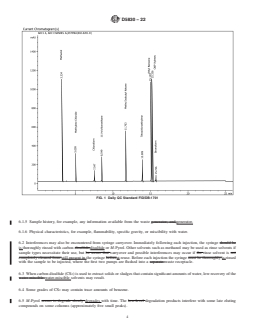
FIG. 1 Daily QC Standard FID/DB-1701
6.1.5 Sample history, for example, any information available from the waste generator; and,generator.
6.1.6 Physical characteristics, for example, flammability, specific gravity, or miscibility with water.
6.2 Interferences may also be encountered from syringe carryover. Immediately following each injection, the syringe should be
is thoroughly rinsed with carbon disulfide,disulfide or M-Pyrol. Other solvents such as methanol may be used as rinse solvents if
sample types necessitate their use, but be aware that carryover and possible interferences may occur if the rinse solvent is not
completely cleaned from still present in the syringe beforeat reuse. Before each injection the syringe must be thoroughly is rinsed
with the sample to be injected, where the first two pumps are flushed into a separate waste receptacle.
6.3 When carbon disulfide (CS ) is used to extract solids or sludges that contain significant amounts of water, low recovery of the
water miscible water-miscible solvents may result.
6.4 Some grades of CS may contain trace amounts of benzene.
6.5 M-Pyrol seems to degrade slowly degrades with time. The low-level degradation products interfere with some late eluting
compounds on some columns (approximately five small peaks).
D5830 − 22
6.6 Interference from the CS solvent peak may occur if using a TCD.
6.7 When using a TCD, be aware that water, water as well as oxygenated compounds, for example,compounds such as MEK,
MIBK, or both, may suppress detector response.
6.8 If an electrolytic conductivity detector (ELCD) or electron capture detector (ECD) must be used, be aware that ELCD or ECD
is used, CS , M-Pyrol (required for an ELCD), and high concentrations of halogenated compounds may overload and possibly
damage boththese detectors. It is recommended that these detectors be used only when very low detection levels of halogenated
compounds are expected and direct injection of the sample is possible.
7. Apparatus
7.1 Gas Chromatograph System—Equipped with capillary or packed column injection ports, or both, detector, and data system.
7.2 RecommendedSuggested Chromatographic Columns:
7.2.1 Capillary; Microbore or Megabore. Capillary, microbore or megabore.
7.2.1.1 DB-1701, 30M × 0.25-mm30M by 0.25 mm inside diameter, 0.25-μm0.25 μm film thickness.
7.2.1.2 DB-624, 30M × 0.3-mm 30M by 0.3 mm inside diameter, 1.8-μm 1.8 μm film thickness.
7.2.2 Packed: Stainless Steel or Glass.
7.2.2.1 1 % SP-1000, 60/80 Carbopak B, 8-ft 8 ft by ⁄8-in. in. inside diameter.
7.2.2.2 10 % SP-2100, 100/120 Chromosorb WHP, 2M × 2 mm 2M by 2 mm ID.
NOTE 1—These columns are recommended and have shown to give good results. as they have demonstrated acceptable results in many applications.
Operating conditions for each isare listed in Section 1011. Equivalent or alternative columns, or both, columns may be used depending on when they are
demonstrated as fulfilling the needs of a particular application.
7.3 Glass Screw-Cap Vials or Equivalent—To collect samples and store standards. Polytetrafluoroethylene or other inert material
should be used for the cap liner.
7.4 Microsyringes, 1.0, 10, and 100 μL.
7.5 Analytical Balance, accurate to 0.0001 g.
7.6 Pipettes, glass, disposable, or volumetric micropipettor or equivalent.
7.7 Microdisk Filters, 0.45, 1.0, or 5.0 μm, optional.
7.8 Centrifuge, optional.
7.9 Vortex-Type Mixer.
8. Reagents and Materials
8.1 Purity of Reagents—Reagent grade chemicals shall be used in all tests. Unless otherwise indicated, it is intended that all
reagents conform to the specifications of the Committee on Analytical Reagents of the American Chemical Society, where such
D5830 − 22
specifications are available. Other grades may be used, provided it is first ascertained determined that the reagent is of sufficiently
high purity to permit its use without lessening the accuracy ofretain an acceptable accuracy for the determination.
8.2 Purity of Water—Unless otherwise indicated, references to water shall be understood to mean reagent water as defined by Type
II of Specification D1193.
8.3 Nitrogen or Helium (High Purity)—(UHP)—For carrier and makeup gases. Air and hydrogen (high purity) (UHP) for fuel
gases. Gases may be obtained from a gas generator if available, through purification of a lower grade, or from a high-purity tank
supply.providing gases of sufficient purity, or from commercially available high-purity gas cylinders.
8.4 Carbon Disulfide, CS —Chromatography grade.
8.5 M-Pyrol, C H NO—Available through several chemical suppliers and sources as 1-methyl-2-pyrrolidone.
5 9
8.6 Individual Standards for Each Component of Interest—99 % purity, available from many vendors.
9. Standard Preparation
9.1 Stock Standard Solutions—Stock standards are prepared from pure standard materials. It is recommended that the standards
be prepared so that each component is 5 to 10 % by weight. The stock standards must be prepared by directly weighing each
component. For extremely volatile components,components such as ether and freons, it is recommended that a new stock standard
be prepared daily or as needed. If a dilution solvent is needed when preparing the stock standards, use the same solvent used for
sample extraction or dilution in Section 711.
NOTE 2—Due to the incompatibility of some standard compounds, that is, some compounds are not miscible with each other, and also because of the such
as immiscible substances, or when a large number of compounds typically looked for in a single chromatographic run, are determined, it is advisable to
prepare 3three or 4four standard solutions each composed of 10ten to 15 compounds. A compatible compounds. In addition, a set of standard
chromatograms and a retention timetable should be available for reference.are typically retained as references.
9.2 Secondary Working Standards—These are prepared from stock standard solutions using the appropriate solvent. Secondary
standards should encompass the linear range of the GC system.
NOTE 3—Linear response and range mustshall be established with all detectors and chromatography systems used for quantitation. All calibration and
sample analysis mustshall be done within the established linear range.
9.3 Calibration Check Standard—A calibration check standard should be is prepared. The standard mixture should provide a good
overall check of the GC/detector system. The compounds system with respect to analytic accuracy and precision. These criteria
are established prior to commencing sample analysis and are based upon the data quality needs of the investigation. The
compounds selected should cover the major compound types, for example, alcohols, aromatics, aliphatics, ketones, and
halogenates. A typical calibration check standard flame ionization detector (FID) FID chromatogram is shown in Fig. 1.
10. Sample Collection, Preservation, and Handling
10.1 Sample collect
...