

ASTM A945/A945M-16(2021)
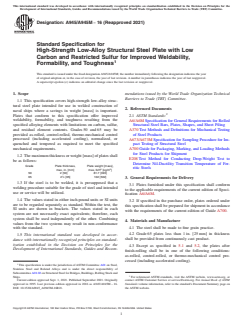
(Specification)Standard Specification for High-Strength Low-Alloy Structural Steel Plate with Low Carbon and Restricted Sulfur for Improved Weldability, Formability, and Toughness
General Information
- Abstract
ABSTRACT
This specification covers high-strength low-alloy structural steel plates intended for use in welded construction of naval ships where a savings in weight (mass) is important. The steel shall be made to fine grain practice. The plates shall optionally undergo heat treatment such as quenching or tempering to meet the requirements on mechanical properties such as yield point, yield strength, elongation, and Charpy V-notch impact, provided that the treatment be reported on the test report. The specimen shall undergo heat and product analyses and conform to the chemical composition values of carbon, manganese, phosphorus, sulfur, silicon, nickel, chromium, molybdenum, copper, vanadium, columbium, aluminum, titanium, and nitrogen.
SCOPE
1.1 This specification covers high-strength low-alloy structural steel plate intended for use in welded construction of naval ships where a savings in weight [mass] is important. Plates that conform to this specification offer improved weldability, formability, and toughness resulting from the specified alloying elements with limitations on carbon, sulfur, and residual element contents. Grades 50 and 65 may be provided as-rolled, control-rolled, thermo-mechanical control processed (including accelerated cooling), normalized, or quenched and tempered as required to meet the specified mechanical requirements.
1.2 The maximum thickness or weight [mass] of plates shall be as follows:
Grade
Plate thickness,
max, in. [mm]
Plate weight [mass],
max, lb/ft2 [kg/m2]
50
2 [50]
81.7 [393]
65
21/2 [65]
102 [502]
1.3 If the steel is to be welded, it is presupposed that a welding procedure suitable for the grade of steel and intended use or service will be utilized.
1.4 The values stated in either inch-pound units or SI units are to be regarded separately as standard. Within the text, the SI units are shown in brackets. The values stated in each system are not necessarily exact equivalents; therefore, each system shall be used independently of the other. Combining values from the two systems may result in non-conformance with the standard.
1.5 This international standard was developed in accordance with internationally recognized principles on standardization established in the Decision on Principles for the Development of International Standards, Guides and Recommendations issued by the World Trade Organization Technical Barriers to Trade (TBT) Committee.
- Status
- Published
- Publication Date
- 31-Aug-2021
- Technical Committee
- A01 - Steel, Stainless Steel and Related Alloys


Overview
ASTM A945/A945M-16(2021) is the standard specification published by ASTM International for high-strength, low-alloy structural steel plates. These steel plates are specifically developed for welded construction applications where significant weight savings are critical, such as in naval shipbuilding. The specification emphasizes improved weldability, formability, and toughness, achieved by controlling carbon and sulfur content and restricting residual elements.
Key Topics
1. Material Grades and Properties
- Covers two strength grades: 50 (50 ksi [345 MPa] minimum yield strength) and 65 (65 ksi [450 MPa] minimum yield strength).
- Plates can be supplied as-rolled, control-rolled, thermo-mechanical control processed (TMCP), normalized, or quenched and tempered.
- Fine grain practice is mandated for superior mechanical properties.
2. Chemical Composition
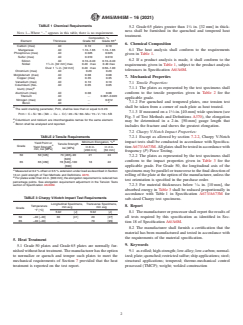
- Strict limits on carbon (max 0.10%) and sulfur (max 0.010%) for all grades.
- Controlled amounts of manganese, silicon, nickel, chromium, molybdenum, copper, vanadium, columbium (niobium), aluminum, titanium, and nitrogen to optimize performance.
- Alloy content ensures high weldability and toughness.
3. Mechanical Requirements
- Essential mechanical properties include specified minimum yield strength, tensile strength, and elongation values.
- Charpy V-notch impact tests are required to guarantee plate toughness, especially at low temperatures (down to -40°F/-40°C).
- Test frequency and orientation requirements ensure consistent product quality across supplied plates.
4. Plate Dimensions
- Maximum thickness for Grade 50: 2 inches [50 mm]; for Grade 65: 2.5 inches [65 mm].
- Maximum weight per area is also prescribed for both grades.
5. Supplementary and Optional Requirements
- First Article Inspection and weldability testing can be specified by purchasers for quality assurance.
- Options for heat treatment or other supplementary requirements are provided for in the standard.
Applications
High-strength, low-alloy structural steel plates as specified in ASTM A945/A945M are ideal for:
- Naval Shipbuilding: The low carbon and restricted sulfur content significantly enhance weldability and toughness, making the material suitable for the fabrication of critical ship structures.
- Welded Construction: These plates are particularly valuable where junctions and seams demand uniform, reliable welding performance.
- Weight-Sensitive Structures: Their high strength-to-weight ratio allows for the construction of lighter, yet stronger hulls and frameworks, facilitating improved efficiency and fuel savings.
- Other Heavy Industries: While targeted at naval applications, these plates are also utilized in demanding structural environments where high strength, ductility, and toughness are necessary, such as offshore platforms, bridges, and defense equipment.
Related Standards
For those implementing ASTM A945/A945M, familiarity with the following ASTM specifications is recommended:
- ASTM A6/A6M: General requirements for rolled structural steel bars, plates, shapes, and sheet piling.
- ASTM A370: Test methods and definitions for mechanical testing of steel products.
- ASTM A673/A673M: Sampling procedure for impact testing of structural steel.
- ASTM A700: Guidelines for packaging, marking, and loading methods for steel products for shipment.
- ASTM E208: Test method for conducting drop-weight tests to determine the nil-ductility transition temperature of ferritic steels.
These related standards ensure comprehensive material, testing, processing, and handling requirements for users of high-strength, low-alloy structural steel plates.
Practical Value
ASTM A945/A945M-16(2021) provides manufacturers, engineers, and fabricators with a trusted framework for specifying high-strength, low-alloy structural steel plates with improved weldability and toughness. The strict control of chemical composition and mechanical properties enables safer and more efficient design and construction practices, especially in industries where weight reduction and structural integrity are paramount. Adherence to this standard helps ensure product consistency and compliance with internationally recognized best practices.
Relations
- Effective Date
- 01-Mar-2024
- Effective Date
- 01-Mar-2024
- Effective Date
- 01-Nov-2023
- Effective Date
- 01-Nov-2019
- Effective Date
- 01-Jul-2019
- Effective Date
- 01-Dec-2017
- Effective Date
- 15-Nov-2017
- Refers
ASTM A370-17a - Standard Test Methods and Definitions for Mechanical Testing of Steel Products - Effective Date
- 15-Nov-2017
- Effective Date
- 01-Nov-2017
- Effective Date
- 01-Jan-2017
- Effective Date
- 15-Nov-2016
- Effective Date
- 01-May-2016
- Effective Date
- 01-Nov-2015
- Effective Date
- 01-Nov-2014
- Effective Date
- 15-May-2014
Get Certified
Connect with accredited certification bodies for this standard

DNV
DNV is an independent assurance and risk management provider.

Lloyd's Register
Lloyd's Register is a global professional services organisation specialising in engineering and technology.

FSC International
Forest Stewardship Council certification.
Sponsored listings
Frequently Asked Questions
ASTM A945/A945M-16(2021) is a technical specification published by ASTM International. Its full title is "Standard Specification for High-Strength Low-Alloy Structural Steel Plate with Low Carbon and Restricted Sulfur for Improved Weldability, Formability, and Toughness". This standard covers: ABSTRACT This specification covers high-strength low-alloy structural steel plates intended for use in welded construction of naval ships where a savings in weight (mass) is important. The steel shall be made to fine grain practice. The plates shall optionally undergo heat treatment such as quenching or tempering to meet the requirements on mechanical properties such as yield point, yield strength, elongation, and Charpy V-notch impact, provided that the treatment be reported on the test report. The specimen shall undergo heat and product analyses and conform to the chemical composition values of carbon, manganese, phosphorus, sulfur, silicon, nickel, chromium, molybdenum, copper, vanadium, columbium, aluminum, titanium, and nitrogen. SCOPE 1.1 This specification covers high-strength low-alloy structural steel plate intended for use in welded construction of naval ships where a savings in weight [mass] is important. Plates that conform to this specification offer improved weldability, formability, and toughness resulting from the specified alloying elements with limitations on carbon, sulfur, and residual element contents. Grades 50 and 65 may be provided as-rolled, control-rolled, thermo-mechanical control processed (including accelerated cooling), normalized, or quenched and tempered as required to meet the specified mechanical requirements. 1.2 The maximum thickness or weight [mass] of plates shall be as follows: Grade Plate thickness, max, in. [mm] Plate weight [mass], max, lb/ft2 [kg/m2] 50 2 [50] 81.7 [393] 65 21/2 [65] 102 [502] 1.3 If the steel is to be welded, it is presupposed that a welding procedure suitable for the grade of steel and intended use or service will be utilized. 1.4 The values stated in either inch-pound units or SI units are to be regarded separately as standard. Within the text, the SI units are shown in brackets. The values stated in each system are not necessarily exact equivalents; therefore, each system shall be used independently of the other. Combining values from the two systems may result in non-conformance with the standard. 1.5 This international standard was developed in accordance with internationally recognized principles on standardization established in the Decision on Principles for the Development of International Standards, Guides and Recommendations issued by the World Trade Organization Technical Barriers to Trade (TBT) Committee.
ABSTRACT This specification covers high-strength low-alloy structural steel plates intended for use in welded construction of naval ships where a savings in weight (mass) is important. The steel shall be made to fine grain practice. The plates shall optionally undergo heat treatment such as quenching or tempering to meet the requirements on mechanical properties such as yield point, yield strength, elongation, and Charpy V-notch impact, provided that the treatment be reported on the test report. The specimen shall undergo heat and product analyses and conform to the chemical composition values of carbon, manganese, phosphorus, sulfur, silicon, nickel, chromium, molybdenum, copper, vanadium, columbium, aluminum, titanium, and nitrogen. SCOPE 1.1 This specification covers high-strength low-alloy structural steel plate intended for use in welded construction of naval ships where a savings in weight [mass] is important. Plates that conform to this specification offer improved weldability, formability, and toughness resulting from the specified alloying elements with limitations on carbon, sulfur, and residual element contents. Grades 50 and 65 may be provided as-rolled, control-rolled, thermo-mechanical control processed (including accelerated cooling), normalized, or quenched and tempered as required to meet the specified mechanical requirements. 1.2 The maximum thickness or weight [mass] of plates shall be as follows: Grade Plate thickness, max, in. [mm] Plate weight [mass], max, lb/ft2 [kg/m2] 50 2 [50] 81.7 [393] 65 21/2 [65] 102 [502] 1.3 If the steel is to be welded, it is presupposed that a welding procedure suitable for the grade of steel and intended use or service will be utilized. 1.4 The values stated in either inch-pound units or SI units are to be regarded separately as standard. Within the text, the SI units are shown in brackets. The values stated in each system are not necessarily exact equivalents; therefore, each system shall be used independently of the other. Combining values from the two systems may result in non-conformance with the standard. 1.5 This international standard was developed in accordance with internationally recognized principles on standardization established in the Decision on Principles for the Development of International Standards, Guides and Recommendations issued by the World Trade Organization Technical Barriers to Trade (TBT) Committee.
ASTM A945/A945M-16(2021) is classified under the following ICS (International Classification for Standards) categories: 47.020.05 - Materials and components for shipbuilding. The ICS classification helps identify the subject area and facilitates finding related standards.
ASTM A945/A945M-16(2021) has the following relationships with other standards: It is inter standard links to ASTM A370-24, ASTM A6/A6M-24, ASTM A6/A6M-23, ASTM A700-14(2019), ASTM A370-19, ASTM E208-17, ASTM A673/A673M-17, ASTM A370-17a, ASTM A6/A6M-17a, ASTM A370-17, ASTM A6/A6M-16a, ASTM A6/A6M-16, ASTM A370-15, ASTM A700-14, ASTM A370-14. Understanding these relationships helps ensure you are using the most current and applicable version of the standard.
ASTM A945/A945M-16(2021) is available in PDF format for immediate download after purchase. The document can be added to your cart and obtained through the secure checkout process. Digital delivery ensures instant access to the complete standard document.
Standards Content (Sample)
This international standard was developed in accordance with internationally recognized principles on standardization established in the Decision on Principles for the
Development of International Standards, Guides and Recommendations issued by the World Trade Organization Technical Barriers to Trade (TBT) Committee.
Designation:A945/A945M −16 (Reapproved 2021)
Standard Specification for
High-Strength Low-Alloy Structural Steel Plate with Low
Carbon and Restricted Sulfur for Improved Weldability,
Formability, and Toughness
This standard is issued under the fixed designationA945/A945M; the number immediately following the designation indicates the year
of original adoption or, in the case of revision, the year of last revision.Anumber in parentheses indicates the year of last reapproval.
A superscript epsilon (´) indicates an editorial change since the last revision or reapproval.
1. Scope mendations issued by the World Trade Organization Technical
Barriers to Trade (TBT) Committee.
1.1 This specification covers high-strength low-alloy struc-
tural steel plate intended for use in welded construction of
2. Referenced Documents
naval ships where a savings in weight [mass] is important.
Plates that conform to this specification offer improved 2.1 ASTM Standards:
weldability, formability, and toughness resulting from the A6/A6MSpecification for General Requirements for Rolled
specified alloying elements with limitations on carbon, sulfur, Structural Steel Bars, Plates, Shapes, and Sheet Piling
and residual element contents. Grades 50 and 65 may be
A370Test Methods and Definitions for Mechanical Testing
provided as-rolled, control-rolled, thermo-mechanical control of Steel Products
processed (including accelerated cooling), normalized, or
A673/A673MSpecification for Sampling Procedure for Im-
quenched and tempered as required to meet the specified pact Testing of Structural Steel
mechanical requirements.
A700Guide for Packaging, Marking, and Loading Methods
for Steel Products for Shipment
1.2 Themaximumthicknessorweight[mass]ofplatesshall
E208Test Method for Conducting Drop-Weight Test to
be as follows:
Determine Nil-Ductility Transition Temperature of Fer-
Grade Plate thickness, Plate weight [mass],
ritic Steels
2 2
max, in. [mm] max, lb/ft [kg/m ]
50 2 [50] 81.7 [393]
65 2 ⁄2 [65] 102 [502]
3. General Requirements for Delivery
1.3 If the steel is to be welded, it is presupposed that a
3.1 Plates furnished under this specification shall conform
welding procedure suitable for the grade of steel and intended
to the applicable requirements of the current edition of Speci-
use or service will be utilized.
fication A6/A6M.
1.4 The values stated in either inch-pound units or SI units
3.2 If specified in the purchase order, plates ordered under
are to be regarded separately as standard. Within the text, the
this specification shall be prepared for shipment in accordance
SI units are shown in brackets. The values stated in each
with the requirements of the current edition of Guide A700.
system are not necessarily exact equivalents; therefore, each
system shall be used independently of the other. Combining
4. Materials and Manufacture
values from the two systems may result in non-conformance
4.1 The steel shall be made to fine grain practice.
with the standard.
4.2 Grade65 plates less than 1in. [25mm] in thickness
1.5 This international standard was developed in accor-
shall be provided from continuously cast product.
dance with internationally recognized principles on standard-
ization established in the Decision on Principles for the
4.3 Except as specified in 5.1 and 5.2, the plates after
Development of International Standards, Guides and Recom-
finish-rolling shall be in one of the following conditions:
as-rolled, control-rolled, or thermo-mechanical control pro-
cessed (including accelerated cooling).
This specification is under the jurisdiction ofASTM Committee A01 on Steel,
Stainless Steel and Related Alloys and is under the direct responsibility of
Subcommittee A01.02 on Structural Steel for Bridges, Buildings, Rolling Stock and
Ships. For referenced ASTM standards, visit the ASTM website, www.astm.org, or
Current edition approved Sept. 1, 2021. Published September 2021. Originally contact ASTM Customer Service at service@astm.org. For Annual Book of ASTM
approved in 1995. Last previous edition approved in 2016 as A945/A945M–16. Standards volume information, refer to the standard’s Document Summary page on
DOI: 10.1520/A0945_A0945M-16R21. the ASTM website.
Copyright © ASTM International, 100 Barr Harbor Drive, PO Box C700, West Conshohocken, PA 19428-2959. United States
A945/A945M−16 (2021)
TABLE 1 Chemical Requirements
5.2 Grade65 plates greater than 1 ⁄4 in. [32 mm] in thick-
ness shall be furnished in the quenched and tempered heat
NOTE 1—Where “.” appears in this table, there is no requirement.
treatment.
Composition, %
A
Element Thickness Grade 50 Grade 65
6. Chemical Composition
Carbon (max) All 0.10 0.10
6.1 The heat analysis shall conform to the requirements
Manganese All 1.10–1.65 1.10–1.65
Phosphorus (max) All 0.025 0.025
given in Table 1.
Sulfur (max) All 0.010 0.010
6.2 If a product analysis is made, it shall conform to the
Silicon All 0.10–0.40 0.10–0.40
Nickel 1 ⁄4 in. [32 mm] max. 0.40 max 0.40 max
requirements given in Table 1, subject to the product analysis
Over 1 ⁄4 in. [32 mm] 0.40 max 0.50–1.00
tolerances in Specification A6/A6M.
Chromium (max) All 0.20 0.20
Molybdenum (max) All 0.08 0.08
7. Mechanical Properties
Copper (max) All 0.35 0.35
Vanadium (max) All 0.10 0.10
7.1 Tensile Properties:
Columbium (Nio- All 0.05 0.05
B
7.1.1 The plates as represented by the test specimens shall
bium) (max)
Aluminum (max) All 0.08 0.08 conform to the tensile properties given in Table 2 for the
Titanium All . 0.007–0.020
applicable grade.
Nitrogen (max) All . 0.012
C 7.1.2 For quenched and tempered plates, one tension test
Boron All .
A shall be taken from a corner of each plate as heat treated.
The weld cracking parameter, Pcm, shall be less than or equal to 0.23:
7.1.3 If measured on a 1 ⁄2-in. [40-m
...