

ASTM E1990-22
(Guide)Standard Guide for Performing Evaluations of Underground Storage Tank Systems for Operational Conformance with 40 CFR, Part 280 Regulations
General Information
- Abstract
SIGNIFICANCE AND USE
4.1 This guide is an educational tool for tank owners, operators, and other users and is not intended for use in certifying compliance with the Federal technical standards for underground storage tanks.
4.2 The intent of this guide is to provide an overview of the general requirements. This guide is intended for users who are generally familiar with the requirements of 40 CFR Part 280. The user is advised that this guide does not contain the level of detail necessary to make the determination of whether specific equipment or services meet the detailed technical performance requirements of 40 CFR Part 280.
4.3 This guide does not cover state and local requirements, that can be more stringent than the federal rules. Owners and operators are responsible for meeting federal, state, and, in some circumstances, local requirements. It is recommended that owners and operators familiarize themselves with these requirements as well.
4.4 Owners or operators may use the sample checklist in Appendix X1 to assist them in determining operational conformance or they may develop their own checklist based upon this guide.
4.5 This guide and accompanying appendixes are not intended to be used by state or local UST program authorities as a regulatory or administrative requirement for owners or operators. Use of this guide and appendixes by owners and operators is intended to be a voluntary educational tool for the purposes described in 4.1.
SCOPE
1.1 This guide covers information for evaluating tank systems for operational conformance with the Federal technical standards (including the financial responsibility requirements) for underground storage tanks (USTs) found at 40 Code of Federal Register (CFR) Part 280.
1.2 This guide does not address the corrective action requirements of 40 CFR Part 280.
1.3 To the extent that a tank system is excluded or deferred from the federal regulations under Subpart A of 40 CFR Part 280, it is not covered by this guide.
1.4 Local regulations may be more stringent than federal regulation and the reader should refer to the implementing agency to determine compliance.
1.5 This standard does not purport to address all of the safety concerns, if any, associated with its use. It is the responsibility of the user of this standard to establish appropriate safety, health, and environmental practices and determine the applicability of regulatory limitations prior to use.
1.6 This international standard was developed in accordance with internationally recognized principles on standardization established in the Decision on Principles for the Development of International Standards, Guides and Recommendations issued by the World Trade Organization Technical Barriers to Trade (TBT) Committee.
- Status
- Published
- Publication Date
- 31-Mar-2022
- Technical Committee
- E50 - Environmental Assessment, Risk Management and Corrective Action
- Drafting Committee
- E50.01 - Storage Tanks
Buy Documents
ASTM E1990-22 - Standard Guide for Performing Evaluations of Underground Storage Tank Systems for Operational Conformance with 40 CFR, Part 280 Regulations
REDLINE ASTM E1990-22 - Standard Guide for Performing Evaluations of Underground Storage Tank Systems for Operational Conformance with 40 CFR, Part 280 Regulations
Overview
ASTM E1990-22 is the Standard Guide for Performing Evaluations of Underground Storage Tank (UST) Systems for Operational Conformance with 40 CFR, Part 280 Regulations, developed by ASTM International. This guide serves as a comprehensive educational resource for UST owners, operators, and other stakeholders, providing an overview of federal requirements for operational compliance with technical standards set by the U.S. Environmental Protection Agency (EPA) in 40 CFR Part 280. While not a tool for legal certification of regulatory compliance, it offers users clarity and assists with self-evaluation of underground storage tank systems.
Key Topics
- Applicability: The guide focuses on evaluating operational conformance with federal UST standards, including financial responsibility requirements. It does not address corrective actions or state and local regulations, which can be more stringent than federal standards.
- Release Detection: Procedures and requirements for detecting leaks from tanks and piping, including methods such as interstitial monitoring, automatic tank gauging, statistical inventory reconciliation, and more.
- Corrosion Protection: Criteria for minimizing corrosion in metal tanks and piping, including approaches like cathodic protection and the use of corrosion-resistant materials.
- Spill and Overfill Prevention: Equipment and practices to prevent accidental releases and overfilling, such as catchment basins, automatic shut-off devices, and alarms.
- Compatibility: Assessment to ensure UST system materials are suitable for the substances stored, especially important for biofuels or other alternative fuels.
- Periodic Testing and Inspections: Guidelines for routine testing and visually-based walkthrough inspections to ensure ongoing operational integrity.
- Financial Responsibility: Overview of federal requirements to demonstrate financial capability for addressing leaks or releases, including insurance, trust funds, and other mechanisms.
- Reporting and Recordkeeping: Explanation of federal notifications, reporting procedures, and documentation standards necessary for UST system operations.
Applications
ASTM E1990-22 is most beneficial for:
- UST Owners and Operators: Assists in understanding and evaluating ongoing operational conformance with federal technical requirements. It provides sample checklists for self-assessment and helps prepare for regulatory inspections.
- Environmental Consultants: Serves as a framework to guide the evaluation and due diligence processes when assessing client UST facilities.
- Facility Managers and Compliance Officers: Offers a practical resource for designing internal compliance programs and conducting routine maintenance checks.
- Training Purposes: Acts as an educational tool to enhance awareness of UST operational requirements among new staff or those unfamiliar with federal regulations.
- Documentation and Recordkeeping: Streamlines the creation of records related to leak detection, corrosion protection, equipment maintenance, and financial responsibility.
This guide encourages the use of checklists and structured evaluation processes to track compliance with core operational elements like spill and overfill protection, release detection, regular inspections, and notification/reporting procedures.
Related Standards
When working with or referencing ASTM E1990-22, the following standards and guidance documents are also pertinent:
- 40 CFR Part 280: EPA’s Technical Standards and Corrective Action Requirements for USTs (primary federal regulation).
- 40 CFR Part 302: Designation of hazardous substance quantities and reporting requirements relevant to UST systems.
- US EPA Publications:
- 510-B-00-003: Financial Responsibility for Underground Storage Tanks
- 510-K-15-001: Musts for USTs - A Summary of Federal Regulations
- 510-K-20-001: UST System Compatibility with Biofuels
- 510-K-20-002: Release Detection for Underground Storage Tanks and Piping
- 510-K-18-001: Dollars and Sense - Financial Responsibility Requirements
- 510-B-19-002 through 510-B19-006: Standard Test Procedures for Leak Detection
- ASTM Committee E50: Environmental Assessment, Risk Management, and Corrective Action guidance documents.
Note: Users should always verify applicable state and local UST regulations, which may exceed federal requirements, and ensure all safety and environmental considerations are met before applying the guidance in this standard.
Keywords: ASTM E1990-22, underground storage tank evaluation, UST systems, 40 CFR Part 280, release detection, corrosion protection, spill prevention, overfill protection, financial responsibility, EPA UST compliance, recordkeeping, environmental standards.
Buy Documents
ASTM E1990-22 - Standard Guide for Performing Evaluations of Underground Storage Tank Systems for Operational Conformance with 40 CFR, Part 280 Regulations
REDLINE ASTM E1990-22 - Standard Guide for Performing Evaluations of Underground Storage Tank Systems for Operational Conformance with 40 CFR, Part 280 Regulations
Get Certified
Connect with accredited certification bodies for this standard

Institut za varilstvo d.o.o. (Welding Institute)
Slovenia's leading welding institute since 1952. ISO 3834, EN 1090, pressure equipment certification, NDT personnel, welder qualification. Only IIW Au
Sponsored listings
Frequently Asked Questions
ASTM E1990-22 is a guide published by ASTM International. Its full title is "Standard Guide for Performing Evaluations of Underground Storage Tank Systems for Operational Conformance with 40 CFR, Part 280 Regulations". This standard covers: SIGNIFICANCE AND USE 4.1 This guide is an educational tool for tank owners, operators, and other users and is not intended for use in certifying compliance with the Federal technical standards for underground storage tanks. 4.2 The intent of this guide is to provide an overview of the general requirements. This guide is intended for users who are generally familiar with the requirements of 40 CFR Part 280. The user is advised that this guide does not contain the level of detail necessary to make the determination of whether specific equipment or services meet the detailed technical performance requirements of 40 CFR Part 280. 4.3 This guide does not cover state and local requirements, that can be more stringent than the federal rules. Owners and operators are responsible for meeting federal, state, and, in some circumstances, local requirements. It is recommended that owners and operators familiarize themselves with these requirements as well. 4.4 Owners or operators may use the sample checklist in Appendix X1 to assist them in determining operational conformance or they may develop their own checklist based upon this guide. 4.5 This guide and accompanying appendixes are not intended to be used by state or local UST program authorities as a regulatory or administrative requirement for owners or operators. Use of this guide and appendixes by owners and operators is intended to be a voluntary educational tool for the purposes described in 4.1. SCOPE 1.1 This guide covers information for evaluating tank systems for operational conformance with the Federal technical standards (including the financial responsibility requirements) for underground storage tanks (USTs) found at 40 Code of Federal Register (CFR) Part 280. 1.2 This guide does not address the corrective action requirements of 40 CFR Part 280. 1.3 To the extent that a tank system is excluded or deferred from the federal regulations under Subpart A of 40 CFR Part 280, it is not covered by this guide. 1.4 Local regulations may be more stringent than federal regulation and the reader should refer to the implementing agency to determine compliance. 1.5 This standard does not purport to address all of the safety concerns, if any, associated with its use. It is the responsibility of the user of this standard to establish appropriate safety, health, and environmental practices and determine the applicability of regulatory limitations prior to use. 1.6 This international standard was developed in accordance with internationally recognized principles on standardization established in the Decision on Principles for the Development of International Standards, Guides and Recommendations issued by the World Trade Organization Technical Barriers to Trade (TBT) Committee.
SIGNIFICANCE AND USE 4.1 This guide is an educational tool for tank owners, operators, and other users and is not intended for use in certifying compliance with the Federal technical standards for underground storage tanks. 4.2 The intent of this guide is to provide an overview of the general requirements. This guide is intended for users who are generally familiar with the requirements of 40 CFR Part 280. The user is advised that this guide does not contain the level of detail necessary to make the determination of whether specific equipment or services meet the detailed technical performance requirements of 40 CFR Part 280. 4.3 This guide does not cover state and local requirements, that can be more stringent than the federal rules. Owners and operators are responsible for meeting federal, state, and, in some circumstances, local requirements. It is recommended that owners and operators familiarize themselves with these requirements as well. 4.4 Owners or operators may use the sample checklist in Appendix X1 to assist them in determining operational conformance or they may develop their own checklist based upon this guide. 4.5 This guide and accompanying appendixes are not intended to be used by state or local UST program authorities as a regulatory or administrative requirement for owners or operators. Use of this guide and appendixes by owners and operators is intended to be a voluntary educational tool for the purposes described in 4.1. SCOPE 1.1 This guide covers information for evaluating tank systems for operational conformance with the Federal technical standards (including the financial responsibility requirements) for underground storage tanks (USTs) found at 40 Code of Federal Register (CFR) Part 280. 1.2 This guide does not address the corrective action requirements of 40 CFR Part 280. 1.3 To the extent that a tank system is excluded or deferred from the federal regulations under Subpart A of 40 CFR Part 280, it is not covered by this guide. 1.4 Local regulations may be more stringent than federal regulation and the reader should refer to the implementing agency to determine compliance. 1.5 This standard does not purport to address all of the safety concerns, if any, associated with its use. It is the responsibility of the user of this standard to establish appropriate safety, health, and environmental practices and determine the applicability of regulatory limitations prior to use. 1.6 This international standard was developed in accordance with internationally recognized principles on standardization established in the Decision on Principles for the Development of International Standards, Guides and Recommendations issued by the World Trade Organization Technical Barriers to Trade (TBT) Committee.
ASTM E1990-22 is classified under the following ICS (International Classification for Standards) categories: 23.020.10 - Stationary containers and tanks. The ICS classification helps identify the subject area and facilitates finding related standards.
ASTM E1990-22 is available in PDF format for immediate download after purchase. The document can be added to your cart and obtained through the secure checkout process. Digital delivery ensures instant access to the complete standard document.
Standards Content (Sample)
This international standard was developed in accordance with internationally recognized principles on standardization established in the Decision on Principles for the
Development of International Standards, Guides and Recommendations issued by the World Trade Organization Technical Barriers to Trade (TBT) Committee.
Designation: E1990 − 22
Standard Guide for
Performing Evaluations of Underground Storage Tank
Systems for Operational Conformance with 40 CFR, Part
280 Regulations
This standard is issued under the fixed designation E1990; the number immediately following the designation indicates the year of
original adoption or, in the case of revision, the year of last revision. A number in parentheses indicates the year of last reapproval. A
superscript epsilon (´) indicates an editorial change since the last revision or reapproval.
1. Scope tors of Underground Storage Tanks (UST)
Title 40 Code of Federal Regulations (CFR), Environmental
1.1 This guide covers information for evaluating tank sys-
Protection Agency, Part 302, Designation, Reportable
tems for operational conformance with the Federal technical
Quantities, and Notification
standards (including the financial responsibility requirements)
2.2 United States Environmental Protection Agency (US
for underground storage tanks (USTs) found at 40 Code of
EPA) Standards:
Federal Register (CFR) Part 280.
510-B-00-003 Financial Responsibility for Underground
1.2 This guide does not address the corrective action re-
Storage Tanks:AReference Manual (EPA). January 2000.
quirements of 40 CFR Part 280.
510-K-15-001 Musts for USTs: A Summary of the Federal
1.3 To the extent that a tank system is excluded or deferred
Regulations for Underground Storage Tank Systems. No-
from the federal regulations under Subpart A of 40 CFR Part
vember 2015.
280, it is not covered by this guide.
510-K-20-001 UST System Compatibility with Biofuels.
July 2020.
1.4 Local regulations may be more stringent than federal
510-K-20-002 Release Detection for Underground Storage
regulation and the reader should refer to the implementing
Tanks and Piping: Straight Talk on Tanks. August 2020.
agency to determine compliance.
510-K-18-001 Dollars and Sense: Financial Responsibility
1.5 This standard does not purport to address all of the
Requirements for Underground Storage Tanks. July 2018.
safety concerns, if any, associated with its use. It is the
510-B-19-002 through 510-B19-006 Standard Test Proce-
responsibility of the user of this standard to establish appro-
dures for Evaluating Various Leak Detection Methods.
priate safety, health, and environmental practices and deter-
May 2019.
mine the applicability of regulatory limitations prior to use.
1.6 This international standard was developed in accor-
3. Terminology
dance with internationally recognized principles on standard-
3.1 Definitions of Terms Specific to This Standard:
ization established in the Decision on Principles for the
3.1.1 airport hydrant system, n—an UST system which
Development of International Standards, Guides and Recom-
fuels aircraft and operates under high pressure with large
mendations issued by the World Trade Organization Technical
diameter piping that typically terminates into one or more
Barriers to Trade (TBT) Committee.
hydrants (fill stands).
2. Referenced Documents
3.1.1.1 Discussion—The airport hydrant system begins
where fuel enters one or more tanks from an external source
2.1 Federal Standards:
such as a pipeline, barge, rail car, or other motor fuel carrier.
Title 40 Code of Federal Regulations (CFR), Environmental
3.1.2 corrosion protection, v—to prevent the degradation of
Protection Agency, Part 280, Technical Standards and
a material due to a reaction between the material and its
Corrective Action Requirements for Owners and Opera-
environment.
3.1.3 field-constructed tank, n—a tank constructed in the
ThisguideisunderthejurisdictionofASTMCommitteeE50onEnvironmental
field.
Assessment, Risk Management and CorrectiveAction and is the direct responsibil-
ity of Subcommittee E50.01 on Storage Tanks.
3.1.3.1 Discussion—For example, a tank constructed of
Current edition approved April 1, 2022. Published June 2022. Originally
approved in 1998. Last previous edition approved in 2021 as E1990-21. DOI:
10.1520/E1990-22.
2 3
Available from U.S. Government Printing Office, Superintendent of AvailablefromUnitedStatesEnvironmentalProtectionAgency(EPA),William
Documents, 732 N. Capitol St., NW, Washington, DC 20401-0001, http:// Jefferson Clinton Bldg., 1200 Pennsylvania Ave., NW, Washington, DC 20460,
www.access.gpo.gov. http://www.epa.gov.
Copyright © ASTM International, 100 Barr Harbor Drive, PO Box C700, West Conshohocken, PA 19428-2959. United States
E1990 − 22
concrete that is poured in the field, or a steel or fiberglass tank permanently closed except previously deferred UST systems
primarily fabricated in the field is considered field-constructed. with field-constructed tanks, airport hydrant systems, or where
an upgrade is determined appropriate by the implementing
3.1.4 implementing agency, n—Environmental Protection
agency.
Agency (EPA), or, in the case of a State with program approval
3.1.16 UST system, n—an underground storage tank, con-
(or pursuant to a memorandum of agreement with EPA), the
designated State or Local agency responsible for carrying out nected underground piping, underground ancillary equipment,
and containment system, if any.
the UST program.
3.1.5 overfill, n—exceeding the capacity of the tank. 3.2 Additional Terminology—The following definitions and
discussions, taken directly from the publication “Form and
3.1.6 overfill protection, n—a device used to prevent a tank
Style for ASTM Standards” shall be included in full in every
from being overfilled when product is being added to the tank.
standard guide or practice produced and passed by Committee
3.1.7 release detection, n—a method to determine whether a
E-50 or any of its technical subcommittees, approvedApril 16,
release of a regulated substance has occurred from the UST
1997.
system into the environment or into the interstitial space
3.2.1 guide, n—a compendium of information or series of
betweentheUSTsystemanditssecondarybarrierorsecondary
optionsorinstructionsthatdonotrecommendaspecificcourse
containment around it.
of action.
3.1.8 replaced tank, n—to remove a tank and install another
3.2.1.1 Discussion—Whereasapracticeprescribesageneral
tank.
usageprinciple,aguideonlysuggestanapproach.Thepurpose
of a guide is to offer guidance, based on a consensus of
3.1.9 replaced piping, n—this means to remove 50 percent
viewpoints, but not to establish a fixed procedure. A guide is
or more of piping excluding connectors, and install other
intended to increase the awareness of the user to available
piping, connected to a single tank.
techniques in a given subject area and to provide information
3.1.9.1 Discussion—For tanks with multiple piping runs,
from which subsequent evaluation and standardization can be
replaced piping applies independently to each piping run.
derived.
3.1.10 secondary containment or secondarily contained,
3.2.2 practice, n—a definitive set of instructions procedure
n—a release prevention and release detection system for a tank
for performing one or more specific operations or functions
or piping utilizing an inner and outer barrier with an interstitial
that does not produce a test result.
space that is monitored for leaks.
3.2.2.1 Discussion—A practice is not a downgraded test
3.1.10.1 Discussion—This term includes containment
method.Examplesofpracticesincludeproceduresofinterlabo-
sumps when used for interstitial monitoring of piping.
ratory testing programs or other statistical procedures; for
3.1.11 spill, n—a release of a regulated substance which
writing statements on sampling or precision and accuracy; and
results during the filling, placement, removal, or transfer of
for selection, preparation, application, inspection, and neces-
regulated substances to, or from, a UST system.
sary precautions for the use, disposal, installation,
3.1.12 spill prevention, n—a device used to prevent or
maintenance, and operation of testing equipment. Further
contain a spill associated with removing the fill hose from the examples of practices include but are not limited to:
tank fill pipe.
application, assessment, cleaning, collection, decontamination,
inspection, installation, preparation, sampling, screening, and
3.1.13 suspected release, n—released product discovered at
training.
or near the UST site, observed unusual operating conditions,
such as apparent loss of product; or results from a release 3.2.3 standard, n—as used in ASTM International, a nomi-
detection method that indicates a release. native document that has been developed and established
within the consensus principles of the Society and that meets
3.1.13.1 Discussion—Suspected release does not include
situations where a method or equipment is found to be the approval requirements of ASTM procedures and regula-
tions.
defective, is immediately corrected, and then indicates no
release. 3.2.3.1 Discussion—The term “standard” serves in ASTM
International as a nominative in the title of documents such as
3.1.14 underground storage tank (UST), n—any one or
test methods or specifications, to connote specified consensus
combination of tanks (including underground pipes connected
and approval. The various types of standard documents are
thereto) that is used to contain an accumulation of regulated
based on the needs and usages as prescribed by the technical
substances, and the volume of which (including connected
committees of the Society.
undergroundpiping)is10 %ormorebeneaththesurfaceofthe
ground.
4. Significance and Use
3.1.15 upgrade, v—the addition or retrofit of the UST
4.1 This guide is an educational tool for tank owners,
system or some system components such as release detection,
operators, and other users and is not intended for use in
corrosion protection, spill prevention, or overfill protection to
certifying compliance with the Federal technical standards for
improve the ability of an UST system to prevent the release of
underground storage tanks.
product and meet the requirements of 40 CFR Part 280.
3.1.15.1 Discussion—Steel tanks not upgraded by October 4.2 The intent of this guide is to provide an overview of the
13, 2015 to be protected in accordance with 5.3, must be general requirements. This guide is intended for users who are
E1990 − 22
TABLE 1 Guide for Owners and Operators
generally familiar with the requirements of 40 CFR Part 280.
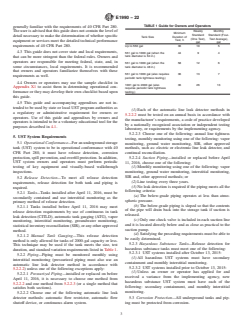
The user is advised that this guide does not contain the level of Weekly Monthly
Minimum
Standard Standard (Four-
detail necessary to make the determination of whether specific
Tank Size Duration of
(One Test), Test Average),
Test, h
equipment or services meet the detailed technical performance
gal gal
requirements of 40 CFR Part 280. Up to 550 gal 36 10 5
4.3 This guide does not cover state and local requirements,
551 gal to 1000 gal (when the 44 9 4
tank diameter is 64 in.)
that can be more stringent than the federal rules. Owners and
operators are responsible for meeting federal, state, and, in
551 gal to 1000 gal (when the 58 12 6
some circumstances, local requirements. It is recommended
tank diameter is 48 in.)
that owners and operators familiarize themselves with these
551 gal to 1000 gal (also requires 36 13 7
requirements as well.
periodic tank tightness testing.)
4.4 Owners or operators may use the sample checklist in
1001 gal to 2000 gal (also 36 26 13
Appendix X1 to assist them in determining operational con-
requires periodic tank tightness
formance or they may develop their own checklist based upon testing.)
this guide.
4.5 This guide and accompanying appendixes are not in-
tended to be used by state or local UST program authorities as
(1) Each of the automatic line leak detector methods in
a regulatory or administrative requirement for owners or
5.2.2.2 must be tested on an annual basis in accordance with
operators. Use of this guide and appendixes by owners and
the manufacturer’s requirements, a code of practice developed
operators is intended to be a voluntary educational tool for the
by a nationally recognized association or independent testing
purposes described in 4.1.
laboratory, or requirements by the implementing agency.
5.2.2.3 Choose one of the following: annual line tightness
5. UST System Requirements
testing, monthly monitoring using one of the following: vapor
5.1 Operational Conformance—For an underground storage monitoring, ground water monitoring, SIR, other approved
tank (UST) system to be in operational conformance with 40
methods, such as: electric or electronic line leak detector, and
CFR Part 280, it must have release detection, corrosion continual reconciliation.
protection,spillprevention,andoverfillprotection.Inaddition,
5.2.2.4 Suction Piping—installed or replaced before April
UST system owners and operators must perform periodic 11, 2016, choose one of the following:
testing of key equipment and visually-based walkthrough
(1) Monthly monitoring using one of the following: vapor
inspections. monitoring, ground water monitoring, interstitial monitoring,
SIR and, other approved methods; or
5.2 Release Detection—To meet all release detection
(2) Line testing every three years.
requirements, release detection for both tank and piping is
(3) No leak detection is required if the piping meets all the
required.
following criteria:
5.2.1 Tanks—Tanks installed after April 11, 2016, must be
(a) The below-grade piping operates at less than atmo-
secondarily contained and use interstitial monitoring as the
spheric pressure.
primary method of release detection.
(b) The below-grade piping is sloped so that the contents
5.2.1.1 Tanks installed before April 11, 2016 may meet
of the pipe will drain back into the storage tank if suction is
release detection requirements by use of continuous in tank
released.
leak detection (CITLD), automatic tank gauging (ATG), vapor
(c) Only one check valve is included in each suction line
monitoring, interstitial monitoring, groundwater monitoring,
and it is located directly below and as close as practical to the
statisticalinventoryreconciliation(SIR),oranyotherapproved
suction pump.
method.
(d) Satisfying the preceding requirements must be able to
5.2.1.2 Manual Tank Gauging—This release detection
be easily determined.
method is only allowed for tanks of 2000-gal capacity or less.
5.2.3 Hazardous Substance Tanks—Release detection for
This technique may be used if the tank meets the size, test
hazardous substance tanks must meet one of the following:
duration, and standard variation requirements listed in Table 1.
5.2.3.1 UST systems installed after October 13, 2015:
5.2.2 Piping—Piping must be monitored monthly using
(1) All hazardous UST systems must have secondary
interstitial monitoring (pressurized piping must also use an
containment and monthly interstitial monitoring.
automatic line leak detector method in accordance with
5.2.3.2 UST systems installed prior to October 13, 2015:
5.2.2.2) unless one of the following exceptions apply:
(1) Unless an owner or operator has applied for and
5.2.2.1 Pressurized Piping—installed or replaced on before
received a variance from the implementing agency, new
April 11, 2016, it is necessary to choose one method from
hazardous substance UST system must have each of the
5.2.2.2 and one method from 5.2.2.3 (or a single method that
following: secondary containment, and monthly interstitial
satisfies both sections).
monitoring.
5.2.2.2 Choose one of the following automatic line leak
detector methods: automatic flow restrictor, automatic flow 5.3 Corrosion Protection—All underground tanks and pip-
shutoff device, or continuous alarm system. ing must be protected from corrosion.
E1990 − 22
5.3.1 Tanks—Any portion of the tank that is underground 5.6.3.4 Vacuum pumps and pressure gauges, and
and routinely contains product must have corrosion protection.
5.6.3.5 Hand-held electronic sampling equipment.
The following may be used to meet corrosion protection
5.7 Visually-based Walkthrough Inspections—At least
requirements for tanks:
monthly,unlessotherwisenoted,thefollowingequipmentmust
5.3.1.1 Coated and cathodically protected steel,
be inspected as indicated or in accordance with a code of
5.3.1.2 Cathodic protection added,
practice developed by a nationally recognized association or
5.3.1.3 Interior lining added,
independent testing laboratory that checks equipment in a
5.3.1.4 Cathodic protection and interior lining added,
comparable manner as indicated.
5.3.1.5 Fiberglass reinforced plastic,
5.7.1 Spill Prevention Equipment—Should be checked for
5.3.1.6 Steel tank clad with a noncorrodible material, and
damage, to remove liquid and debris and obstructions in fill
5.3.1.7 Other construction accepted by the implementing
pipe, ill cap is securely on the fill pipe, and if the spill
agency.
prevention equipment is double walled, check for leaks in the
5.3.1.8 Corrosion expert’s determination that the site is not
interstitial space.
corrosive enough to cause it to have a release during the
5.7.2 Release Detection Equipment—Should be operating
operating life of the tank.
with no alarms or other unusual operating conditions, and
5.3.2 Piping—Piping that routinely contains regulated sub-
records are current.
stances and is in contact with the ground must be protected
5.7.3 Containment sumps should be inspected annually for
from corrosion. The following may be used to meet corrosion
damage, to remove liquid and debris, and if the sump is double
protection requirements for piping:
wall, check for leaks in the interstitial space.
5.3.2.1 Coated and cathodically protected steel,
5.3.2.2 Cathodic protection added, 5.7.4 Hand-held release detection equipment such as tank
gauge sticks and groundwater bailers should be checked
5.3.2.3 Fiberglass reinforced plastic,
annually to ensure operability and serviceability.
5.3.2.4 Other construction accepted by the implementing
agency, and
6. Financial Responsibility
5.3.2.5 Corrosion expert’s determination that the site is not
corrosive enough to cause it to have a release during the
6.1 Financial Responsibility—Owners or operators of USTs
operating life of the piping.
which hold petroleum must demonstrate financial responsibil-
5.4 Spill Prevention and Overfill Protection—Tanks that
ity. These requirements are designed to ensure that someone
receive regulated substances in quantities greater than 25 gal at
can pay the costs of cleaning up leaks and compensating
one filling need to have spill prevention and overfill protection. third-parties for bodily injury and property damage caused by
5.4.1 To meet the spill prevention requirement, equipment
leaking USTs.The total amount of coverage required under the
that will contain the product in the transfer hose when the federal rule is determined by the type of business, the amount
transfer hose is detached from the fill pipe (for example, a
of throughput of the tanks at a facility, and the number of tanks
catchment basin) should be used to prevent release of product ownednationwide.Petroleumrefinersormarketersmustmain-
to the environment.
tain $1 000 000 coverage per occurrence. Nonmarketers with
5.4.2 To meet overfill protection requirements, one of the throughput of 10 000 gallons or less per month must maintain
following must be used:
$500 000 coverage per occurrence. Owners or operators of 100
5.4.2.1 Automatic shutoff device, or fewer tanks must maintain $1 000 000 annual aggregate
5.4.2.2 Overfill alarm, or coverage while those with over 100 tanks must maintain
$2 000 000 annual aggregate coverage. The following
5.4.2.3 Ball float valve.
mechanisms, alone or in combination, may be used to meet the
5.5 Compatibility—owners and operators of USTs are re-
financial responsibility requirements:
quired to use USTsystems made of or lined with materials that
6.1.1 Insurance policy,
arecompatiblewiththesubstancestoredintheUSTsystem(40
6.1.2 Guarantee,
CFR 280.32).
6.1.3 Letter of credit,
5.6 Periodic Testing—At least once every three years, un-
6.1.4 Self insurance.
lessotherwisenoted,thefollowingequipmentmustbetestedin
6.1.5 State financial assurance fund,
accordance with either the manufacturer’s instructions, a code
of practice developed by a nationally recognized association or
6.1.6 Surety bond,
independent testing laboratory, or requirements by the imple-
6.1.7 Dedicated trust fund, and
menting agency.
6.1.8 State approved method.
5.6.1 Spill prevention equipment;
6.1.9 The following four additional mechanisms may be
5.6.2 Containment sumps used for interstitial monitoring of
used by local governments to demonstrate compliance:
piping;
6.1.9.1 Bond rating test,
5.6.3 Leak detection equipment must be tested annually:
6.1.9.2 Passing a financial test,
5.6.3.1 Automatic tank gauge and other controllers,
6.1.9.3 Guarantee, and
5.6.3.2 Probes and sensors,
5.6.3.3 Automatic line leak detector, 6.1.9.4 Dedicated fund.
E1990 − 22
7. Notification, Reporting, and Recordkeeping 7.3.2.2 Results from the last three inspections for UST
systems having an impressed current cathodic protection sys-
7.1 Notification—The following are notification require-
tem. These inspections must be conducted every 60 days to
ments listed in the underground storage tank technical require-
ensure that the equipment is running properly. This inspection
ments at 40 CFR Part 280.This information must be submitted
may be performed by the owner or operator of the system.
to the implementing agency.
7.3.3 Release Detection—Records showing conformance
7.1.1 Notification forAll USTSystems—If an USTsystem is
with release detection requirements are required. This includes
brought into use after May 8, 1986, within 30 days of being
the following:
brought into use a notification form must be submitted. If an
7.3.3.1 All written performance claims pertaining to the
UST system was in the ground on or after May 8, 1986, unless
release detection system used and the manner in which these
taken out of operation on or before Jan. 1, 1974, a notification
claims have been justified or tested by the vendor or by the
form must be submitted. If an UST system was installed after
equipment manufacturer or installer. These records need to be
Dec. 22, 1988, a certification of installation must also be
maintained for five years from the date of installation.
submitted for that system.
7.3.3.2 The results of any sampling, testing, or monitoring.
7.1.2 Notification Before Permanent Closure or Change in
These results must be maintained for one year. In the case of
Service—Owners and operators must notify the implementing
tank tightness testing, the result must be maintained until the
agency at least 30 days before storing greater than 10 %
next tightness test is conducted.
ethanol, 20 % biodiesel, or any other regulated substance
7.3.3.3 Written documentation of all calibrations,
identified by the implementing agency.
maintenance, and repair of release detection permanently
7.1.3 Notification Before Permanent Closure or Change in
located on-site.This documentation needs to be maintained for
Service—Owners or operators must notify the implementation
at least one year after the servicing work is completed. In
agency at least 30 days before permanent closure or change in
addition, any schedules of required calibration and mainte-
service begins.
nance provided by the release detection equipment manufac-
7.2 Reporting—The following are reporting requirements
turer must be retained for five years from the date of installa-
listedintheundergroundstoragetanktechnicalrequirementsat
tion.
40 CFR Part 280. This information must be submitted to the
7.3.4 UST System Repairs—Documentation of UST System
implementing agency.
Repairs must be maintained for each repair for the remaining
7.2.1 Reports of All Releases—Within 24 h or another
operating life of the UST system.
reasonable time period established by the implementing
7.3.5 Permanent Closure Site Assessment—Results of the
agency, the following must be reported:
site assessment conducted at permanent closure must be
7.2.1.1 Suspected releases,
maintained for at least three years after completion of the
7.2.1.2 Spills and overfills (if not cleaned up within 24 h, if
permanent closure or change-in-service.
petroleum over 25 gal or if a hazardous substance over its
7.3.6 Evidence of Financial Assurance—The following is
reportable quantity under 40 CFR Part 302), and
needed to demonstrate financial assurance:
NOTE 1—State or local jurisdictions may have released reporting
7.3.6.1 Acurrent “Certification of Financial Responsibility”
requirements with much shorter time frames (for example, 15 min.).
and
7.2.1.3 Confirmed releases. 7.3.6.2 Any additional documentation that shows the finan-
cial responsibility method is valid and provides details on the
7.2.2 Corrective Actions Planned or Taken—This includes:
7.2.2.1 Initial abatement measures, method’s coverage such as signed copies of official letters or
newsletters, policies, and state fund agreements.
7.2.2.2 Initial site characterization,
7.3.7 Compatibility Storing Certain Regulated
7.2.2.3 Free product removal,
7.2.2.4 Investigation of soil and ground water cleanup, and Substances—In accordance with the EPA Office of Under-
ground Storage Tanks July 2020 guidance – UST System
7.2.2.5 Corrective action plan.
Compatibility with Biofuels, tank owners may demonstrate
7.3 Recordkeeping— The following are recordkeeping re-
compatibility of UST system equipment by using components
quirements listed in the underground storage tank technical
that are certified by the manufacturer or listed by a nationally
requirements at 40 CFR Part 280.
recognized,independenttestinglaboratoryforusewiththefuel
7.3.1 Corrosion Expert’s Analysis—A corrosion expert’s
stored.
analysis of site corrosion potential if corrosion protection
7.4 Availability and Maintenance of Records—Records
equipment is not used.
listed in 7.3 must be kept in accordance with one of the
7.3.2 Corrosion Protection—Documentation of operation of
following:
corrosion protection equipment is required. This includes the
7.4.1 Records may be kept at the UST site and be immedi-
following:
ately available for inspection.
7.3.2.1 Results from the last two tests for proper operation
for all cathodic
...
This document is not an ASTM standard and is intended only to provide the user of an ASTM standard an indication of what changes have been made to the previous version. Because
it may not be technically possible to adequately depict all changes accurately, ASTM recommends that users consult prior editions as appropriate. In all cases only the current version
of the standard as published by ASTM is to be considered the official document.
Designation: E1990 − 21 E1990 − 22
Standard Guide for
Performing Evaluations of Underground Storage Tank
Systems for Operational Conformance with 40 CFR, Part
280 Regulations
This standard is issued under the fixed designation E1990; the number immediately following the designation indicates the year of
original adoption or, in the case of revision, the year of last revision. A number in parentheses indicates the year of last reapproval. A
superscript epsilon (´) indicates an editorial change since the last revision or reapproval.
1. Scope
1.1 This guide covers information for evaluating tank systems for operational conformance with the Federal technical standards
(including the financial responsibility requirements) for underground storage tanks (USTs) found at 40 Code of Federal Register
(CFR) Part 280.
1.2 This guide does not address the corrective action requirements of 40 CFR Part 280.
1.3 To the extent that a tank system is excluded or deferred from the federal regulations under Subpart A of 40 CFR Part 280, it
is not covered by this guide.
1.4 Local regulations may be more stringent than federal regulation and the reader should refer to the implementing agency to
determine compliance.
1.5 This standard does not purport to address all of the safety concerns, if any, associated with its use. It is the responsibility
of the user of this standard to establish appropriate safety, health, and environmental practices and determine the applicability of
regulatory limitations prior to use.
1.6 This international standard was developed in accordance with internationally recognized principles on standardization
established in the Decision on Principles for the Development of International Standards, Guides and Recommendations issued
by the World Trade Organization Technical Barriers to Trade (TBT) Committee.
2. Referenced Documents
2.1 Federal Standards:
Title 40 Code of Federal Regulations (CFR), Environmental Protection Agency, Part 280, Technical Standards and Corrective
Action Requirements for Owners and Operators of Underground Storage Tanks (UST)
Title 40 Code of Federal Regulations (CFR), Environmental Protection Agency, Part 302, Designation, Reportable Quantities,
and Notification
2.2 United States Environmental Protection Agency (US EPA) Standards:
510-B-00-003 Financial Responsibility for Underground Storage Tanks: A Reference Manual (EPA). January 2000.
510-K-15-001 Musts for USTs: A Summary of the Federal Regulations for Underground Storage Tank Systems. November 2015.
This guide is under the jurisdiction of ASTM Committee E50 on Environmental Assessment, Risk Management and Corrective Action and is the direct responsibility
of Subcommittee E50.01 on Storage Tanks.
Current edition approved Sept. 1, 2021April 1, 2022. Published September 2021June 2022. Originally approved in 1998. Last previous edition approved in 20162021 as
E1990-16.-21. DOI: 10.1520/E1990-21.10.1520/E1990-22.
Available from U.S. Government Printing Office, Superintendent of Documents, 732 N. Capitol St., NW, Washington, DC 20401-0001, http://www.access.gpo.gov.
Available from United States Environmental Protection Agency (EPA), William Jefferson Clinton Bldg., 1200 Pennsylvania Ave., NW, Washington, DC 20460,
http://www.epa.gov.
Copyright © ASTM International, 100 Barr Harbor Drive, PO Box C700, West Conshohocken, PA 19428-2959. United States
E1990 − 22
510-K-20-001 UST System Compatibility with Biofuels. July 2020.
510-K-20-002 Release Detection for Underground Storage Tanks and Piping: Straight Talk on Tanks. August 2020.
510-K-18-001 Dollars and Sense: Financial Responsibility Requirements for Underground Storage Tanks. July 2018.
510-B-19-002 through 510-B19-006 Standard Test Procedures for Evaluating Various Leak Detection Methods. May 2019.
3. Terminology
3.1 Definitions of Terms Specific to This Standard:
3.1.1 airport hydrant system, n—an UST system which fuels aircraft and operates under high pressure with large diameter piping
that typically terminates into one or more hydrants (fill stands).
3.1.1.1 Discussion—
The airport hydrant system begins where fuel enters one or more tanks from an external source such as a pipeline, barge, rail car,
or other motor fuel carrier.
3.1.2 corrosion protection, v—to prevent the degradation of a material due to a reaction between the material and its environment.
3.1.3 field-constructed tank, n—a tank constructed in the field.
3.1.3.1 Discussion—
For example, a tank constructed of concrete that is poured in the field, or a steel or fiberglass tank primarily fabricated in the field
is considered field-constructed.
3.1.4 implementing agency, n—Environmental Protection Agency (EPA), or, in the case of a State with program approval (or
pursuant to a memorandum of agreement with EPA), the designated State or Local agency responsible for carrying out the UST
program.
3.1.5 overfill, n—exceeding the capacity of the tank.
3.1.6 overfill protection, n—a device used to prevent a tank from being overfilled when product is being added to the tank.
3.1.7 release detection, n—a method to determine whether a release of a regulated substance has occurred from the UST system
into the environment or into the interstitial space between the UST system and its secondary barrier or secondary containment
around it.
3.1.8 replaced tank, n—to remove a tank and install another tank.
3.1.9 replaced piping, n—this means to remove 50 percent or more of piping excluding connectors, and install other piping,
connected to a single tank.
3.1.9.1 Discussion—
For tanks with multiple piping runs, replaced piping applies independently to each piping run.
3.1.10 secondary containment or secondarily contained, n—a release prevention and release detection system for a tank or piping
utilizing an inner and outer barrier with an interstitial space that is monitored for leaks.
3.1.10.1 Discussion—
This term includes containment sumps when used for interstitial monitoring of piping.
3.1.11 spill, n—a release of a regulated substance which results during the filling, placement, removal, or transfer of regulated
substances to, or from, a UST system.
3.1.12 spill prevention, n—a device used to prevent or contain a spill associated with removing the fill hose from the tank fill pipe.
3.1.13 suspected release, n—released product discovered at or near the UST site, observed unusual operating conditions, such as
apparent loss of product; or results from a release detection method that indicates a release.
3.1.13.1 Discussion—
Suspected release does not include situations where a method or equipment is found to be defective, is immediately corrected, and
then indicates no release.
E1990 − 22
3.1.14 underground storage tank (UST), n—any one or combination of tanks (including underground pipes connected thereto) that
is used to contain an accumulation of regulated substances, and the volume of which (including connected underground piping)
is 10 % or more beneath the surface of the ground.
3.1.15 upgrade, v—the addition or retrofit of the UST system or some system components such as release detection, corrosion
protection, spill prevention, or overfill protection to improve the ability of an UST system to prevent the release of product and
meet the requirements of 40 CFR Part 280.
3.1.15.1 Discussion—
Steel tanks not upgraded by October 13, 2015 to be protected in accordance with 5.3, must be permanently closed except
previously deferred UST systems with field-constructed tanks, airport hydrant systems, or where an upgrade is determined
appropriate by the implementing agency.
3.1.16 UST system, n—an underground storage tank, connected underground piping, underground ancillary equipment, and
containment system, if any.
3.2 Additional Terminology—The following definitions and discussions, taken directly from the publication “Form and Style for
ASTM Standards” shall be included in full in every standard guide or practice produced and passed by Committee E-50 or any
of its technical subcommittees, approved April 16, 1997.
3.2.1 guide, n—a compendium of information or series of options or instructions that do not recommend a specific course of
action.
3.2.1.1 Discussion—
Whereas a practice prescribes a general usage principle, a guide only suggest an approach. The purpose of a guide is to offer
guidance, based on a consensus of viewpoints, but not to establish a fixed procedure. A guide is intended to increase the awareness
of the user to available techniques in a given subject area and to provide information from which subsequent evaluation and
standardization can be derived.
3.2.2 practice, n—a definitive set of instructions procedure for performing one or more specific operations or functions that does
not produce a test result.
3.2.2.1 Discussion—
A practice is not a downgraded test method. Examples of practices include procedures of interlaboratory testing programs or other
statistical procedures; for writing statements on sampling or precision and accuracy; and for selection, preparation, application,
inspection, and necessary precautions for the use, disposal, installation, maintenance, and operation of testing equipment. Further
examples of practices include but are not limited to: application, assessment, cleaning, collection, decontamination, inspection,
installation, preparation, sampling, screening, and training.
3.2.3 standard, n—as used in ASTM International, a nominative document that has been developed and established within the
consensus principles of the Society and that meets the approval requirements of ASTM procedures and regulations.
3.2.3.1 Discussion—
The term “standard” serves in ASTM International as a nominative in the title of documents such as test methods or specifications,
to connote specified consensus and approval. The various types of standard documents are based on the needs and usages as
prescribed by the technical committees of the Society.
4. Significance and Use
4.1 This guide is an educational tool for tank owners, operators, and other users and is not intended for use in certifying
compliance with the Federal technical standards for underground storage tanks.
4.2 The intent of this guide is to provide an overview of the general requirements. This guide is intended for users who are
generally familiar with the requirements of 40 CFR Part 280. The user is advised that this guide does not contain the level of detail
necessary to make the determination of whether specific equipment or services meet the detailed technical performance
requirements of 40 CFR Part 280.
4.3 This guide does not cover state and local requirements, that can be more stringent than the federal rules. Owners and operators
are responsible for meeting federal, state, and, in some circumstances, local requirements. It is recommended that owners and
operators familiarize themselves with these requirements as well.
E1990 − 22
4.4 Owners or operators may use the sample checklist in Appendix X1 to assist them in determining operational conformance or
they may develop their own checklist based upon this guide.
4.5 This guide and accompanying appendixes are not intended to be used by state or local UST program authorities as a regulatory
or administrative requirement for owners or operators. Use of this guide and appendixes by owners and operators is intended to
be a voluntary educational tool for the purposes described in 4.1.
5. UST System Requirements
5.1 Operational Conformance—For an underground storage tank (UST) system to be in operational conformance with 40 CFR
Part 280, it must have release detection, corrosion protection, spill prevention, and overfill protection. In addition, UST system
owners and operators must perform periodic testing of key equipment and visually-based walkthrough inspections.
5.2 Release Detection—To meet all release detection requirements, release detection for both tank and piping is required.
5.2.1 Tanks—Tanks installed after April 11, 2016, must be secondarily contained and use interstitial monitoring as the primary
method of release detection.
5.2.1.1 Tanks installed before April 11, 2016 may meet release detection requirements by use of continuous in tank leak detection
(CITLD), automatic tank gauging (ATG), vapor monitoring, interstitial monitoring, groundwater monitoring, statistical inventory
reconciliation (SIR), or any other approved method.
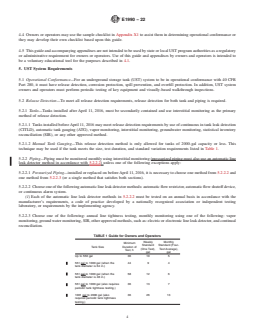
5.2.1.2 Manual Tank Gauging—This release detection method is only allowed for tanks of 2000-gal capacity or less. This
technique may be used if the tank meets the size, test duration, and standard variation requirements listed in Table 1.
5.2.2 Piping—Piping must be monitored monthly using interstitial monitoring (pressurized piping must also use an automatic line
leak detector method in accordance with 5.2.2.2) unless one of the following exceptions apply:
5.2.2.1 Pressurized Piping—installed or replaced on before April 11, 2016, it is necessary to choose one method from 5.2.2.2 and
one method from 5.2.2.3 (or a single method that satisfies both sections).
5.2.2.2 Choose one of the following automatic line leak detector methods: automatic flow restrictor, automatic flow shutoff device,
or continuous alarm system.
(1) Each of the automatic line leak detector methods in 5.2.2.2 must be tested on an annual basis in accordance with the
manufacturer’s requirements, a code of practice developed by a nationally recognized association or independent testing
laboratory, or requirements by the implementing agency.
5.2.2.3 Choose one of the following: annual line tightness testing, monthly monitoring using one of the following: vapor
monitoring, ground water monitoring, SIR, other approved methods, such as: electric or electronic line leak detector, and continual
reconciliation.
TABLE 1 Guide for Owners and Operators
Weekly Monthly
Minimum
Standard Standard (Four-
Tank Size Duration of
(One Test), Test Average),
Test, h
gal gal
Up to 550 gal 36 10 5
551 gal to 1000 gal (when the 44 9 4
tank diameter is 64 in.)
551 gal to 1000 gal (when the 58 12 6
tank diameter is 48 in.)
551 gal to 1000 gal (also requires 36 13 7
periodic tank tightness testing.)
1001 gal to 2000 gal (also 36 26 13
requires periodic tank tightness
testing.)
E1990 − 22
5.2.2.4 Suction Piping—installed or replaced before April 11, 2016, choose one of the following:
(1) Monthly monitoring using one of the following: vapor monitoring, ground water monitoring, interstitial monitoring, SIR
and, other approved methods; or
(2) Line testing every three years.
(3) No leak detection is required if the piping meets all the following criteria:
(a) The below-grade piping operates at less than atmospheric pressure.
(b) The below-grade piping is sloped so that the contents of the pipe will drain back into the storage tank if suction is released.
(c) Only one check valve is included in each suction line and it is located directly below and as close as practical to the suction
pump.
(d) Satisfying the preceding requirements must be able to be easily determined.
5.2.3 Hazardous Substance Tanks—Release detection for hazardous substance tanks must meet one of the following:
5.2.3.1 UST systems installed after October 13, 2015:
(1) All hazardous UST systems must have secondary containment and monthly interstitial monitoring.
5.2.3.2 UST systems installed prior to October 13, 2015:
(1) Unless an owner or operator has applied for and received a variance from the implementing agency, new hazardous
substance UST system must have each of the following: secondary containment, and monthly interstitial monitoring.
5.3 Corrosion Protection—All underground tanks and piping must be protected from corrosion.
5.3.1 Tanks—Any portion of the tank that is underground and routinely contains product must have corrosion protection. The
following may be used to meet corrosion protection requirements for tanks:
5.3.1.1 Coated and cathodically protected steel,
5.3.1.2 Cathodic protection added,
5.3.1.3 Interior lining added,
5.3.1.4 Cathodic protection and interior lining added,
5.3.1.5 Fiberglass reinforced plastic,
5.3.1.6 Steel tank clad with a noncorrodible material, and
5.3.1.7 Other construction accepted by the implementing agency.
5.3.1.8 Corrosion expert’s determination that the site is not corrosive enough to cause it to have a release during the operating life
of the tank.
5.3.2 Piping—Piping that routinely contains regulated substances and is in contact with the ground must be protected from
corrosion. The following may be used to meet corrosion protection requirements for piping:
5.3.2.1 Coated and cathodically protected steel,
5.3.2.2 Cathodic protection added,
5.3.2.3 Fiberglass reinforced plastic,
5.3.2.4 Other construction accepted by the implementing agency, and
5.3.2.5 Corrosion expert’s determination that the site is not corrosive enough to cause it to have a release during the operating life
of the piping.
E1990 − 22
5.4 Spill Prevention and Overfill Protection—Tanks that receive regulated substances in quantities greater than 25 gal at one filling
need to have spill prevention and overfill protection.
5.4.1 To meet the spill prevention requirement, equipment that will contain the product in the transfer hose when the transfer hose
is detached from the fill pipe (for example, a catchment basin) should be used to prevent release of product to the environment.
5.4.2 To meet overfill protection requirements, one of the following must be used:
5.4.2.1 Automatic shutoff device,
5.4.2.2 Overfill alarm, or
5.4.2.3 Ball float valve.
5.5 Compatibility—owners and operators of USTs are required to use UST systems made of or lined with materials that are
compatible with the substance stored in the UST system (40 CFR 280.32).
5.6 Periodic Testing—At least once every three years, unless otherwise noted, the following equipment must be tested in
accordance with either the manufacturer’s instructions, a code of practice developed by a nationally recognized association or
independent testing laboratory, or requirements by the implementing agency.
5.6.1 Spill prevention equipment;
5.6.2 Containment sumps used for interstitial monitoring of piping;
5.6.3 Leak detection equipment must be tested annually:
5.6.3.1 Automatic tank gauge and other controllers,
5.6.3.2 Probes and sensors,
5.6.3.3 Automatic line leak detector,
5.6.3.4 Vacuum pumps and pressure gauges, and
5.6.3.5 Hand-held electronic sampling equipment.
5.7 Visually-based Walkthrough Inspections—At least monthly, unless otherwise noted, the following equipment must be
inspected as indicated or in accordance with a code of practice developed by a nationally recognized association or independent
testing laboratory that checks equipment in a comparable manner as indicated.
5.7.1 Spill Prevention Equipment—Should be checked for damage, to remove liquid and debris and obstructions in fill pipe, ill cap
is securely on the fill pipe, and if the spill prevention equipment is double walled, check for leaks in the interstitial space.
5.7.2 Release Detection Equipment—Should be operating with no alarms or other unusual operating conditions, and records are
current.
5.7.3 Containment sumps should be inspected annually for damage, to remove liquid and debris, and if the sump is double wall,
check for leaks in the interstitial space.
5.7.4 Hand-held release detection equipment such as tank gauge sticks and groundwater bailers should be checked annually to
ensure operability and serviceability.
6. Financial Responsibility
6.1 Financial Responsibility—Owners or operators of USTs which hold petroleum must demonstrate financial responsibility.
E1990 − 22
These requirements are designed to ensure that someone can pay the costs of cleaning up leaks and compensating third-parties for
bodily injury and property damage caused by leaking USTs. The total amount of coverage required under the federal rule is
determined by the type of business, the amount of throughput of the tanks at a facility, and the number of tanks owned nationwide.
Petroleum refiners or marketers must maintain $1 000 000 coverage per occurrence. Nonmarketers with throughput of 10 000
gallons or less per month must maintain $500 000 coverage per occurrence. Owners or operators of 100 or fewer tanks must
maintain $1 000 000 annual aggregate coverage while those with over 100 tanks must maintain $2 000 000 annual aggregate
coverage. The following mechanisms, alone or in combination, may be used to meet the financial responsibility requirements:
6.1.1 Insurance policy,
6.1.2 Guarantee,
6.1.3 Letter of credit,
6.1.4 Self insurance.
6.1.5 State financial assurance fund,
6.1.6 Surety bond,
6.1.7 Dedicated trust fund, and
6.1.8 State approved method.
6.1.9 The following four additional mechanisms may be used by local governments to demonstrate compliance:
6.1.9.1 Bond rating test,
6.1.9.2 Passing a financial test,
6.1.9.3 Guarantee, and
6.1.9.4 Dedicated fund.
7. Notification, Reporting, and Recordkeeping
7.1 Notification—The following are notification requirements listed in the underground storage tank technical requirements at 40
CFR Part 280. This information must be submitted to the implementing agency.
7.1.1 Notification for All UST Systems—If an UST system is brought into use after May 8, 1986, within 30 days of being brought
into use a notification form must be submitted. If an UST system was in the ground on or after May 8, 1986, unless taken out of
operation on or before Jan. 1, 1974, a notification form must be submitted. If an UST system was installed after Dec. 22, 1988,
a certification of installation must also be submitted for that system.
7.1.2 Notification Before Permanent Closure or Change in Service—Owners and operators must notify the implementing agency
at least 30 days before storing greater than 10 % ethanol, 20 % biodiesel, or any other regulated substance identified by the
implementing agency.
7.1.3 Notification Before Permanent Closure or Change in Service—Owners or operators must notify the implementation agency
at least 30 days before permanent closure or change in service begins.
7.2 Reporting—The following are reporting requirements listed in the underground storage tank technical requirements at 40 CFR
Part 280. This information must be submitted to the implementing agency.
7.2.1 Reports of All Releases—Within 24 h or another reasonable time period established by the implementing agency, the
following must be reported:
7.2.1.1 Suspected releases,
E1990 − 22
7.2.1.2 Spills and overfills (if not cleaned up within 24 h, if petroleum over 25 gal or if a hazardous substance over its reportable
quantity under 40 CFR Part 302), and
NOTE 1—State or local jurisdictions may have released reporting requirements with much shorter time frames (for example, 15 min.).
7.2.1.3 Confirmed releases.
7.2.2 Corrective Actions Planned or Taken—This includes:
7.2.2.1 Initial abatement measures,
7.2.2.2 Initial site characterization,
7.2.2.3 Free product removal,
7.2.2.4 Investigation of soil and ground water cleanup, and
7.2.2.5 Corrective action plan.
7.3 Recordkeeping— The following are recordkeeping requirements listed in the underground storage tank technical requirements
at 40 CFR Part 280.
7.3.1 Corrosion Expert’s Analysis—A corrosion expert’s analysis of site corrosion potential if corrosion protection equipment is
not used.
7.3.2 Corrosion Protection—Documentation of operation of corrosion protection equipment is required. This includes the
following:
7.3.2.1 Results from the last two tests for proper operation for all cathodic protection systems. These tests are required within six
months of installation and every three years thereafter. In addition, this test must be conducted within six months following the
repair of any cathodically protected UST system. The test must be done by a qualified cathodic protection tester.
7.3.2.2 Results from the last three inspections for UST systems having an impressed current cathodic protection system. These
inspections must be conducted every 60 days to ensure that the equipment is running properly. This inspection may be performed
by the owner or operator of the system.
7.3.3 Release Detection—Records showing conformance with release detection requirements are required. This includes the
following:
7.3.3.1 All written performance claims pertaining to the release detection system used and the manner in which these claims have
been justified or tested by the vendor or by the equipment manufacturer or installer. These records need to be maintained for five
years from the date of installation.
7.3.3.2 The results of any sampling, testing, or monitoring. These results must be maintained for one year. In the case of tank
tightness testing, the result must be maintained until the next tightness test is conducted.
7.3.3.3 Written documentation of all calibrations, maintenance, and repair of release detection permanently located on-site. This
documentation needs to be maintained for at least one year after the servicing work is completed. In addition, any schedules of
required calibration and maintenance provided by the release detection equipment manufacturer must be retained for five years
from the date of installation.
7.3.4 UST System Repairs—Documentation of UST System Repairs must be maintained for each repair for the remaining
operating life of the UST system.
7.3.5 Permanent Closure Site Assessment—Results of the site assessment conducted at permanent closure must be maintained for
at least three years after completion of the permanent closure or change-in-service.
E1990 − 22
7.3.6 Evidence of Financial Assurance—The following is needed to demonstrate financial assurance:
7.3.6.1 A current “Certification of Financial Responsibility” and
7.3.6.2 Any additional documentation that shows the financial responsibility method is valid and provides details on the method’s
coverage such as signed copies of official letters or newsletters, policies, and state fund agreements.
7.3.7 Compatibility Storing Certain Regulated Substances—In accordance with the EPA Office of Underground Storage Tanks July
2020 guidance – UST System Compatibility with Biof
...