

ASTM D1998-21
(Specification)Standard Specification for Polyethylene Upright Storage Tanks
General Information
- Abstract
ABSTRACT
This specification covers flat-bottom, upright, cylindrical tanks molded in one-piece seamless construction by rotational molding. The tanks are molded from polyethylene for above ground, vertical installation and are capable of containing aggressive chemicals at atmospheric pressure. This specification does not cover the design of vessels intended for use at pressures other than atmospheric pressure. Furthermore, this specification does not cover the design of portable tanks and is not for vessels intended for use with liquids heated above their flash points in continuous service. Special design considerations not covered in this specification shall be given to vessels subject to superimposed mechanical forces, such as seismic forces, wind load or agitation; to vessels subject to service above specified temperature; and vessels subject to specified superimposed pressure of water. Low-temperature impact test shall be performed on rotational-molded polyethylene tanks. The test method is used on tanks molded from both the crosslinked and non-crosslinked polyethylenes. Dart drop impact test shall be performed to determine the quality of the tank. O-xylene-insoluble fraction or gel test shall be performed on crosslinked polyethylene. Visual inspection and water test shall also be performed on the samples.
SCOPE
1.1 This specification covers flat-bottom, upright, cylindrical tanks molded in one-piece seamless construction by rotational molding. The tanks are molded from polyethylene for above ground, vertical installation and are capable of containing aggressive chemicals at atmospheric pressure. Included are requirements for materials, properties, design, construction, dimensions, tolerances, workmanship and appearance. Tank capacities are from 1900 L (500 gal) up.
1.2 This specification covers the design of stationery vessels for use at atmospheric pressure intended for use with liquids heated below their flash points and continuous service temperatures below 66°C (150°F) for Type I tanks and below 60°C (140°F) for Type II tanks.
1.2.1 NFPA Standards 30 and NFPA 31 shall be consulted for installations that are subject to the requirements of these standards.
1.3 For service requirements beyond the scope of this specification (1.2), such as externally imposed mechanical forces, internal pressure or vacuum, higher temperature service, etc., other relevant sources of standards, for example, local and state building codes, NFPA, ASME, ARM, etc., shall be consulted.
1.4 The values stated in SI units are to be regarded as the standard. The values given in parentheses are for information only.
Note 1: ISO 13341:2005+A1:2011 and ISO 13575:2012 are similar, but not equivalent to this standard.
1.5 The following precautionary caveat pertains only to the test methods portion, Section 11, of this specification: This standard does not purport to address all of the safety concerns, if any, associated with its use. It is the responsibility of the user of this standard to establish appropriate safety, health, and environmental practices and determine the applicability of regulatory limitations prior to use.
1.6 This international standard was developed in accordance with internationally recognized principles on standardization established in the Decision on Principles for the Development of International Standards, Guides and Recommendations issued by the World Trade Organization Technical Barriers to Trade (TBT) Committee.
- Status
- Published
- Publication Date
- 14-Jul-2021
- Technical Committee
- D20 - Plastics
- Drafting Committee
- D20.19 - Film, Sheeting, and Molded Products
Overview
ASTM D1998-21: Standard Specification for Polyethylene Upright Storage Tanks outlines requirements for the design, materials, construction, and testing of flat-bottom, upright, cylindrical storage tanks made from polyethylene via rotational molding. These tanks are intended for above-ground, vertical installation and are capable of storing aggressive chemicals at atmospheric pressure. The standard establishes minimum criteria for materials, wall thickness, dimensions, tolerances, performance, and workmanship to ensure safe and reliable storage solutions.
The specification covers tanks with capacities starting at 1900 liters (500 gallons) and is relevant for stationary installations not intended for pressure vessels, portable tanks, or the storage of liquids above their flash points. Compliance with ASTM D1998 supports proper material handling and chemical storage in industrial, commercial, and agricultural applications.
Key Topics
Material Requirements
- 100% virgin polyethylene suitable for rotational molding
- Distinction between Type I (cross-linkable) and Type II (non-cross-linkable) polyethylene tanks
- Requirements for stress-cracking resistance, UV stabilization, and compatibility of additives or pigments
Design and Construction
- One-piece, seamless, rotationally molded construction
- Specifications for wall thickness, head design, and bottom knuckle radius
- Reinforcement of open-top tanks and design of fittings, openings, and vents
- Appropriate sizing and placement of manways, connectors, and hold-down provisions for outdoor tanks
Performance and Testing
- Low-temperature impact resistance using dart drop impact testing
- O-xylene-insoluble fraction (gel test) for crosslinked polyethylene tanks
- Visual inspection and hydrostatic (water) testing to ensure structural integrity
- Strict tolerance limits for dimensions and wall thickness
Workmanship and Marking
- Requirements to prevent defects impacting tank integrity or performance
- Permanent marking indicating manufacturer, date, capacity, max specific gravity, type, and safety warnings
- Packing and shipping provisions to avoid transit damage
Applications
ASTM D1998-21 is critical for specifying polyethylene upright storage tanks used in:
- Chemical Processing: Storage of corrosive and aggressive chemicals at atmospheric pressure in industrial facilities
- Agriculture: Holding fertilizers, pesticides, or other process liquids requiring durable containment
- Water and Wastewater Treatment: Bulk storage of treatment chemicals or process water
- Commercial and Institutional Use: Facilities needing large, corrosion-resistant storage for routine processes
This standard ensures storage tanks meet safety, durability, and compliance requirements, safeguarding property and personnel, and supporting regulatory compliance, especially when installations must also follow NFPA, OSHA, and relevant building codes.
Related Standards
Organizations implementing or specifying ASTM D1998-21 should also consider:
- ASTM D618: Conditioning plastics for testing
- ASTM D1693: Environmental stress-cracking of ethylene plastics
- ASTM D2837: Hydrostatic design basis for thermoplastic pipe materials
- ASTM D3892: Packaging/packing of plastics
- NFPA 30 & NFPA 31: Flammable and combustible liquid codes for facility installations
- ISO 13341 and ISO 13575: Similar standards for thermoplastic tanks (not fully equivalent)
- ANSI/ASME B-16.5: Flange and fitting requirements
By referencing ASTM D1998-21 alongside these standards, organizations ensure a comprehensive approach to polyethylene storage tank safety, quality, and performance.
Relations
- Effective Date
- 01-Feb-2024
- Effective Date
- 01-Nov-2023
- Effective Date
- 01-Apr-2020
- Effective Date
- 01-Jan-2020
- Effective Date
- 01-Aug-2019
- Effective Date
- 15-Apr-2019
- Effective Date
- 01-Feb-2019
- Effective Date
- 01-Jan-2019
- Effective Date
- 01-Dec-2018
- Effective Date
- 01-Nov-2018
- Effective Date
- 15-Aug-2017
- Effective Date
- 01-Aug-2017
- Effective Date
- 01-Feb-2017
- Effective Date
- 15-Nov-2016
- Effective Date
- 01-Aug-2016
Get Certified
Connect with accredited certification bodies for this standard

Institut za varilstvo d.o.o. (Welding Institute)
Slovenia's leading welding institute since 1952. ISO 3834, EN 1090, pressure equipment certification, NDT personnel, welder qualification. Only IIW Au
Sponsored listings
Frequently Asked Questions
ASTM D1998-21 is a technical specification published by ASTM International. Its full title is "Standard Specification for Polyethylene Upright Storage Tanks". This standard covers: ABSTRACT This specification covers flat-bottom, upright, cylindrical tanks molded in one-piece seamless construction by rotational molding. The tanks are molded from polyethylene for above ground, vertical installation and are capable of containing aggressive chemicals at atmospheric pressure. This specification does not cover the design of vessels intended for use at pressures other than atmospheric pressure. Furthermore, this specification does not cover the design of portable tanks and is not for vessels intended for use with liquids heated above their flash points in continuous service. Special design considerations not covered in this specification shall be given to vessels subject to superimposed mechanical forces, such as seismic forces, wind load or agitation; to vessels subject to service above specified temperature; and vessels subject to specified superimposed pressure of water. Low-temperature impact test shall be performed on rotational-molded polyethylene tanks. The test method is used on tanks molded from both the crosslinked and non-crosslinked polyethylenes. Dart drop impact test shall be performed to determine the quality of the tank. O-xylene-insoluble fraction or gel test shall be performed on crosslinked polyethylene. Visual inspection and water test shall also be performed on the samples. SCOPE 1.1 This specification covers flat-bottom, upright, cylindrical tanks molded in one-piece seamless construction by rotational molding. The tanks are molded from polyethylene for above ground, vertical installation and are capable of containing aggressive chemicals at atmospheric pressure. Included are requirements for materials, properties, design, construction, dimensions, tolerances, workmanship and appearance. Tank capacities are from 1900 L (500 gal) up. 1.2 This specification covers the design of stationery vessels for use at atmospheric pressure intended for use with liquids heated below their flash points and continuous service temperatures below 66°C (150°F) for Type I tanks and below 60°C (140°F) for Type II tanks. 1.2.1 NFPA Standards 30 and NFPA 31 shall be consulted for installations that are subject to the requirements of these standards. 1.3 For service requirements beyond the scope of this specification (1.2), such as externally imposed mechanical forces, internal pressure or vacuum, higher temperature service, etc., other relevant sources of standards, for example, local and state building codes, NFPA, ASME, ARM, etc., shall be consulted. 1.4 The values stated in SI units are to be regarded as the standard. The values given in parentheses are for information only. Note 1: ISO 13341:2005+A1:2011 and ISO 13575:2012 are similar, but not equivalent to this standard. 1.5 The following precautionary caveat pertains only to the test methods portion, Section 11, of this specification: This standard does not purport to address all of the safety concerns, if any, associated with its use. It is the responsibility of the user of this standard to establish appropriate safety, health, and environmental practices and determine the applicability of regulatory limitations prior to use. 1.6 This international standard was developed in accordance with internationally recognized principles on standardization established in the Decision on Principles for the Development of International Standards, Guides and Recommendations issued by the World Trade Organization Technical Barriers to Trade (TBT) Committee.
ABSTRACT This specification covers flat-bottom, upright, cylindrical tanks molded in one-piece seamless construction by rotational molding. The tanks are molded from polyethylene for above ground, vertical installation and are capable of containing aggressive chemicals at atmospheric pressure. This specification does not cover the design of vessels intended for use at pressures other than atmospheric pressure. Furthermore, this specification does not cover the design of portable tanks and is not for vessels intended for use with liquids heated above their flash points in continuous service. Special design considerations not covered in this specification shall be given to vessels subject to superimposed mechanical forces, such as seismic forces, wind load or agitation; to vessels subject to service above specified temperature; and vessels subject to specified superimposed pressure of water. Low-temperature impact test shall be performed on rotational-molded polyethylene tanks. The test method is used on tanks molded from both the crosslinked and non-crosslinked polyethylenes. Dart drop impact test shall be performed to determine the quality of the tank. O-xylene-insoluble fraction or gel test shall be performed on crosslinked polyethylene. Visual inspection and water test shall also be performed on the samples. SCOPE 1.1 This specification covers flat-bottom, upright, cylindrical tanks molded in one-piece seamless construction by rotational molding. The tanks are molded from polyethylene for above ground, vertical installation and are capable of containing aggressive chemicals at atmospheric pressure. Included are requirements for materials, properties, design, construction, dimensions, tolerances, workmanship and appearance. Tank capacities are from 1900 L (500 gal) up. 1.2 This specification covers the design of stationery vessels for use at atmospheric pressure intended for use with liquids heated below their flash points and continuous service temperatures below 66°C (150°F) for Type I tanks and below 60°C (140°F) for Type II tanks. 1.2.1 NFPA Standards 30 and NFPA 31 shall be consulted for installations that are subject to the requirements of these standards. 1.3 For service requirements beyond the scope of this specification (1.2), such as externally imposed mechanical forces, internal pressure or vacuum, higher temperature service, etc., other relevant sources of standards, for example, local and state building codes, NFPA, ASME, ARM, etc., shall be consulted. 1.4 The values stated in SI units are to be regarded as the standard. The values given in parentheses are for information only. Note 1: ISO 13341:2005+A1:2011 and ISO 13575:2012 are similar, but not equivalent to this standard. 1.5 The following precautionary caveat pertains only to the test methods portion, Section 11, of this specification: This standard does not purport to address all of the safety concerns, if any, associated with its use. It is the responsibility of the user of this standard to establish appropriate safety, health, and environmental practices and determine the applicability of regulatory limitations prior to use. 1.6 This international standard was developed in accordance with internationally recognized principles on standardization established in the Decision on Principles for the Development of International Standards, Guides and Recommendations issued by the World Trade Organization Technical Barriers to Trade (TBT) Committee.
ASTM D1998-21 is classified under the following ICS (International Classification for Standards) categories: 23.020.10 - Stationary containers and tanks. The ICS classification helps identify the subject area and facilitates finding related standards.
ASTM D1998-21 has the following relationships with other standards: It is inter standard links to ASTM D883-24, ASTM D883-23, ASTM F412-20, ASTM D883-20, ASTM D883-19c, ASTM D883-19a, ASTM D883-19, ASTM F412-19, ASTM D883-18a, ASTM D883-18, ASTM D883-17, ASTM F412-17a, ASTM F412-17, ASTM F412-16a, ASTM F412-16. Understanding these relationships helps ensure you are using the most current and applicable version of the standard.
ASTM D1998-21 is available in PDF format for immediate download after purchase. The document can be added to your cart and obtained through the secure checkout process. Digital delivery ensures instant access to the complete standard document.
Standards Content (Sample)
This international standard was developed in accordance with internationally recognized principles on standardization established in the Decision on Principles for the
Development of International Standards, Guides and Recommendations issued by the World Trade Organization Technical Barriers to Trade (TBT) Committee.
Designation:D1998 −21
Standard Specification for
Polyethylene Upright Storage Tanks
This standard is issued under the fixed designation D1998; the number immediately following the designation indicates the year of
original adoption or, in the case of revision, the year of last revision.Anumber in parentheses indicates the year of last reapproval.A
superscript epsilon (´) indicates an editorial change since the last revision or reapproval.
1. Scope* 1.6 This international standard was developed in accor-
dance with internationally recognized principles on standard-
1.1 This specification covers flat-bottom, upright, cylindri-
ization established in the Decision on Principles for the
cal tanks molded in one-piece seamless construction by rota-
Development of International Standards, Guides and Recom-
tional molding. The tanks are molded from polyethylene for
mendations issued by the World Trade Organization Technical
above ground, vertical installation and are capable of contain-
Barriers to Trade (TBT) Committee.
ingaggressivechemicalsatatmosphericpressure.Includedare
requirements for materials, properties, design, construction,
2. Referenced Documents
dimensions, tolerances, workmanship and appearance. Tank
2.1 ASTM Standards:
capacities are from 1900 L (500 gal) up.
D618Practice for Conditioning Plastics for Testing
1.2 Thisspecificationcoversthedesignofstationeryvessels
D883Terminology Relating to Plastics
for use at atmospheric pressure intended for use with liquids
D1693Test Method for Environmental Stress-Cracking of
heated below their flash points and continuous service tem-
Ethylene Plastics
peraturesbelow66°C(150°F)forTypeItanksandbelow60°C
D2837Test Method for Obtaining Hydrostatic Design Basis
(140°F) for Type II tanks.
forThermoplasticPipeMaterialsorPressureDesignBasis
1.2.1 NFPA Standards30 and NFPA 31 shall be consulted
for Thermoplastic Pipe Products
for installations that are subject to the requirements of these
D3892Practice for Packaging/Packing of Plastics
standards.
D4703Practice for Compression Molding Thermoplastic
Materials into Test Specimens, Plaques, or Sheets
1.3 For service requirements beyond the scope of this
E691Practice for Conducting an Interlaboratory Study to
specification (1.2), such as externally imposed mechanical
Determine the Precision of a Test Method
forces, internal pressure or vacuum, higher temperature
F412Terminology Relating to Plastic Piping Systems
service, etc., other relevant sources of standards, for example,
local and state building codes, NFPA,ASME,ARM, etc., shall 2.2 OSHA Standard:
29 CFR 1910.106 Occupational Safety and Health
be consulted.
Administration, Flammable and Combustible Liquids
1.4 The values stated in SI units are to be regarded as the
2.3 ANSI Standard:
standard. The values given in parentheses are for information
B-16.5Pipe Flanges and Flanged Fittings
only.
2.4 NFPA Standards:
NOTE 1—ISO 13341:2005+A1:2011 and ISO 13575:2012 are similar,
30Flammable and Combustible Liquid Code
but not equivalent to this standard. 5
31Installation of Oil Burning Equipment
1.5 The following precautionary caveat pertains only to the
2.5 ISO Standards:
test methods portion, Section 11, of this specification: This
ISO 13341:2005+A1:2011Static Thermoplastic Tanks for
standard does not purport to address all of the safety concerns,
theAboveGroundStorageofChemicals–BlowMoulded
if any, associated with its use. It is the responsibility of the user
of this standard to establish appropriate safety, health, and
For referenced ASTM standards, visit the ASTM website, www.astm.org, or
environmental practices and determine the applicability of
contact ASTM Customer Service at service@astm.org. For Annual Book of ASTM
regulatory limitations prior to use.
Standards volume information, refer to the standard’s Document Summary page on
the ASTM website.
Available from Occupational Safety and Health Administration (OSHA), 200
Constitution Ave., NW, Washington, DC 20210.
1 4
This specification is under the jurisdiction of ASTM Committee D20 on Available fromAmerican National Standards Institute (ANSI), 25 W. 43rd St.,
Plastics and is the direct responsibility of Subcommittee D20.19 on Film, Sheeting, 4th Floor, New York, NY 10036, http://www.ansi.org.
and Molded Products (Section D20.15.01). Available from National Fire Protection Association (NFPA), 1 Batterymarch
Current edition approved July 15, 2021. Published August 2021. Originally Park, Quincy, MA 02169-7471, http://www.nfpa.org.
approved in 1991. Last previous edition approved in 2015 as D1998-15. DOI: Available fromAmerican National Standards Institute (ANSI), 25 W. 43rd St.,
10.1520/D1998-21. 4th Floor, New York, NY 10036, http://www.ansi.org.
*A Summary of Changes section appears at the end of this standard
Copyright © ASTM International, 100 Barr Harbor Drive, PO Box C700, West Conshohocken, PA 19428-2959. United States
D1998−21
or Rotationally Moulded Polyethylene Tanks – Require- polyethylene shall be 197°C (390°F) and the platen shall be
ments and Test Methods keptclosedunderfullpressureforfiveminutesatthespecified
ISO 13575:2012Static Thermoplastic Tanks for Above temperatureinordertobringaboutthecrosslinkingreaction.If
Ground Storage of Domestic Heating Oils, Kerosene and the test specimens are rotational molded, the conditions for
Diesel Fuels – Blow Moulded and Rotationally Moulded rotational molding shall be similar to the conditions used for
Polyethylene Tanks and Rotationally Moulded Tanks molding a tank from this polyethylene.
MadeofAnionicallyPolymerizedPolyamide6–Require-
NOTE 2—The stress-cracking test is not used as an indicator of general
ments and Test Methods
chemicalresistanceofapolyethylene.Refertothepolyethylenesupplier’s
or molder’s chemical-resistance chart for information on the resistance of
3. Terminology
the polyethylene to specific chemicals or products, or test specific
products or chemicals prior to use.
3.1 Definitions—For definitions of terms used in this speci-
fication and associated with plastics issues, refer to the termi- 5.2 All tanks used for outdoor installation shall contain an
nology contained in Terminologies D883 and F412 and the ultraviolet stabilizer at a level adequate to give protection for
AssociationofRotationalMolders(ARM)GlossaryofTerms, the intended service life of the tanks. This stabilizer shall be
unless otherwise indicated. compounded into the polyethylene.
3.2 Definitions of Terms Specific to This Standard: 5.3 Any pigments added must be compatible with the
3.2.1 bottom knuckle radius, n—the outside corner radius.
polyethylene and shall not exceed 0.5% dry blended, and 2%
compounded in, of the total weight.
3.2.2 impact failure, n—any crack in the test specimen
resulting from the impact and visible in normal room lighting
NOTE 3—The use of dry-blended pigments can have an effect on
to a person with normal eyesight.
physical properties, that is, impact strength.
3.2.3 rotational molding, n—a three-stage commercial pro-
5.4 Each resin used in designing tanks covered by this
cess consisting of loading the mold with powdered resin,
specification shall have hydrostatic-hoop-stress data available.
fusing the resin by heating while rotating the mold about more
than one axis, and cooling and removing the molded article.
6. Design Requirements for Both Type I and Type II
Tanks
3.2.4 service factor, n—a number less than 1.0 (that takes
into consideration all the variables and degrees of safety
6.1 Cylinder Shell (Unsupported Portion of Tanks)—The
involved in a polyethylene storage tank installation) that is
minimumrequiredwallthicknessofthecylindricalshellatany
multiplied by the hydrostatic design basis to give the design
fluid level (F) shall be determined by the following equations,
hoop stress.
but shall not be less than 4.7 mm (0.187 in.) thick. The
tolerance indicated in 9.1.2 applies to these dimensions.
4. Classification
HL 5HM 2 F (1)
4.1 Tanksmeetingthisspecificationareclassifiedaccording
to type as follows, and it is the responsibility of the purchaser where:
to specify Type I or Type II:
HL = head at level F, m (ft),
4.1.1 Type I—Tanks molded from cross-linkable polyethyl-
HM = maximum fluid head, m (ft), and
ene. F = any fluid level, m (ft).
4.1.2 TypeII—Tanksmoldedfromnon-cross-linkablepoly-
For illustration, see Fig. 1.
ethylene.
T 5 P 3OD/2 SD (2)
5. Materials
where:
5.1 This specification is based upon the use of 100% virgin
T = wall thickness, mm (in.),
polyethylene intended for the rotational molding process.Any
P = pressure, MPa (0.0098 MPa/m-H O×SG×HL (m)),
use of regrind, recycled or reprocessed materials, or combina-
or psi (0.433 psi/ft-H O×SG×HL (ft)),
tions of such materials, shall not rely upon the performance
SG = specific gravity of fluid,
data of their original constituents, but must meet the require-
HL = head at level F, m (ft),
ments of this specification in its own right. OD = outside diameter of tank, mm (in.), and
SD = hydrostatic design stress, MPa (psi).
5.1.1 The polyethylene shall have a stress-cracking resis-
tance of 500 h minimum F50 in accordance with Test Method
6.1.1 The hydrostatic design stress that is used to determine
D1693, Condition A, full-strength stress-cracking agent. The
theminimumwallthicknessatanyfluidlevelmustbebasedon
test specimens shall be compression molded or rotational
hoopstressdatafortheresin.Thehoopstressdata,obtainedin
molded. If compression molded, Procedure C ofAnnexA1 of
accordance with the procedures of Test Method D2837, pro-
Practice D4703 shall be followed for both types of polyethyl-
vide a hydrostatic-design-basis for the resin. The hydrostatic-
ene with a minimum platen temperature of 177°C (350°F) for
design-basis must be reduced by a service factor to determine
Type II materials. The temperature for Type I (cross-linkable)
the actual hydrostatic design stress. The maximum service
factorshallbe0.5forwallthicknesseslessthan9.5mm(0.375
in.). For thicknesses equal to or greater than 9.5 mm (0.375
AvailablefromAssociationofRotationalMolders,800RooseveltRoad,C-312,
Glen Ellyn, IL 60137, tel: 630-942-6589. in.), the maximum service factor shall be 0.475. For example,
D1998−21
FIG. 1Illustration of Cylinder Shell
if the hydrostatic-design-basis for the resin is 8.7 MPa (1260 7. Fittings
psi),thehydrostaticdesignstressforatankwithwallthickness
7.1 Fabricatednozzles,gaskets,andotherfittingaccessories
greater than 9.5 mm (0.375 in.) is 0.475×8.7=4.1 MPa (or
must be chemically compatible with the materials to be
0.475×1260=600 psi).
handled in the tanks.
6.1.2 Tank hoop stresses shall be derated for service above
7.2 Openingsthatarecutintankstoinstallfittingsmustnot
23°C (73.4°F).
have sharp corners. Holes shall have minimum clearance to
6.2 CylinderShell(ExternallySupportedTanks)—Themini-
insure best performance of fittings.
mum required wall thickness for the cylinder straight shell
7.3 The size, location, and specification, and so forth, for
must be sufficient to support its own weight in an upright
manways and fittings shall be agreed upon between the
positionwithoutanyexternalsupport,butshallnotbelessthan
purchaser and the manufacturer.
4.7 mm (0.187 in.) thick. The tolerance indicated in 9.1.2
7.4 The vents must comply with OSHA 1910.106 (F) (iii)
applies to these dimensions.
(2) (IV) (9) normal venting for atmospheric tanks, or other
6.3 Top Head—Must be integrally molded with the cylinder
accepted standard, or shall be at least as large as the filling or
shell.The minimum thickness of the top head shall be equal to
withdrawal connection, whichever is larger but in no case less
the top of the straight wall.
than 25.4 mm (1 in.) nominal inside diameter.
6.4 Bottom Head—Must be integrally molded with the
7.5 Fittings installed in tanks shall be of appropriate
cylinder shell. The minimum thickness for a full-supported
strength to meet manufacturer and purchaser specifications.
flat-bottom head shall be 4.7 mm (0.187 in.).The radius of the
7.6 Bolts securing mechanical fittings must be manufac-
bottomknuckleofaflat-bottomtankshallnotbelessthan25.4
tured of materials compatible with tank contents.
mm (1 in.) for tanks with a diameter less than 1.8 m (6 ft) and
7.7 Provisionsshallbemadetoattachhold-downdevicesto
38.1 mm (1.5 in.) for a diameter greater than 1.8 m (6 ft). The
minimum thickness of the radius shall not be less than the the tanks for outdoor service.
maximum thickness of the cylinder wall.
7.8 For all flanged connectors, the flange drilling and
bolting shall be in accordance with ANSI/ASME B-16.5 for
6.5 Bottom Knuckle Radius—Theminimumthicknessofthe
150 psi (1 MPa) pressure class straddling the principal center-
outer radius shall not be less than the maximum thickness of
line of the vessel.
the cylinder wall.
NOTE 4—Since it is difficult to control the absolute radius dimension
8. Performance Requirements
and, in the absence of any FEA or scientific analysis, it is recommended
that the outside radius of the bottom knuckle of a flat-bottom tank not be 8.1 The following performance requirements shall be met
less than 25.4 mm (1 in.) for tanks with a diameter less than 1.8 m (6 ft)
by Type I and Type II tanks:
and 38.1 mm (1.5 in.) for a diameter greater than 1.8 (6 ft).
8.1.1 Low-Temperature Impact—Low-temperature impact
6.6 Open-Top Tanks—The top edge of open tanks shall be shall be determined using the test method described in 11.3.
reinforced by design to maintain its shape after installation. The requirements for Type I and Type II tanks are as follows:
D1998−21
11.3.1 Scope—This test method is for the determination of
Impact energy,
Wall thickness, mm (in.)
min. J (ft-lb)
the impact property of rotational-molded polyethylene tanks at
lowtemperature.Thetestmethodisusedontanksmoldedfrom
4.7 mm (0.187 in.) to and including 6.4 mm (0.25 in.) 122.0 (90)
both crosslinked and non-crosslinked polyethylenes.
6.6 mm (0.26 in.) to and including 12.9 mm (0.50 in.) 135.5 (100)
12.9 mm (0.51 in.) to and including 19.3 mm (0.75 in.) 203.2 (150)
11.3.2 Summary of Test Method—Test specimens are cut
19.3 mm (0.76 in.) to and including 25.4 mm (1.00 in.) 271.0 (200)
from available areas on the tank and conditioned at −29°C
Greater than 25.4 mm (1.00 in.) 271.0 (200)
(−20°F) for a specified time. A suitable type of test apparatus
8.1.2 Percent Gel, for Type I Tanks Only—The percent gel
is shown in Fig. 2 and Fig. 3. The specimens are placed,
level shall be determined using the test method described in
inside-surface down, in the sample holder and immediately
11.4. The percent gel level for Type I tanks on the inside 3.2
impacted from a prescribed height with a dart of specified
mm (0.125 in.) of the wall shall be a minimum of 60%.
weight and tip radius. The specimen is observed for failure on
bothsurfaces.Thetestprescribesaminimumimpactvaluethat
9. Dimensions and Tolerances
the specimen must pass.
9.1 General—All dimensions will be taken with the tank in
11.3.3 Significance and Use:
the vertical position, unfilled. Tank dimensions will represent
11.3.3.1 The dart impact test at−29°C (−20°F) produces a
the exterior measurements.
value that is used as an indication of the quality of the tank. If
9.1.1 Outside Diameter—The tolerance for the outside
the molding conditions were inadequate and a homogenous
diameter, including out of roundness, shall be 63%.
melt was not obtained, the impact will likely be low. Higher
9.1.2 Shell Wall and Head Thickness—The tolerance for
impact values are obtained with ideal molding conditions
average thickness at each elevation shall be −10% of the
indicating that a quality part with good impact resistance has
design thickness on the low side and shall be unlimited on the
been molded.
high side. The tolerance for individual audit readings shall be
11.3.3.2 The impact test gives a true indication of how well
limited to −20% of the design thickness.The total amount of
the tank was molded.
surface area on the low side of the tolerance shall not exceed
11.3.4 Procedure:
10% of the total surface area.
11.3.4.1 Cut specimens to loosely fit the 127 mm by 127
9.1.3 Placement of Fittings—Thetoleranceforfittingplace-
mm(5in.by5in.)sampleholder(SeeFig.3).Specimensshall
ments shall be 12.7 mm (0.5 in.) in elevation and 2° radial at
be approximately 127 mm by 127 mm (5 in. by 5 in.), or the
ambient temperature.
maximumsizeavailable.Inthosetankswherespecimensofthe
abovesizearenotavailable,thesuppliermustshowcorrelation
10. Workmanship data between the smaller size and the recommended size.
10.1 Type I finished tank walls shall be free, as commer-
cially practicable, of visual defects such as foreign inclusions,
air bubbles, pinholes, pimples, crazing, cracking and delami-
nations that will impair the serviceability of the vessel. Fine
bubbles are acceptable with Type II tanks to the degree to
whichtheydonotinterferewithproperfusionoftheresinmelt.
10.2 The acceptable finish shall be predetermined by agree-
ment between the molder and the buyer.
11. Test Methods
11.1 Test Specimens—Testspecimensshallbetakenfroman
area that is representative of the bottom side wall. If no
representative sample cut-out area in the tank is available, test
specimens shall be molded in a test mold. In either case, prior
testing shall verify that the tank wall and the test specimen
have equal impact resistance.
11.1.1 The test mold shall be constructed of the same type
material and have the same wall thickness as the t
...
This document is not an ASTM standard and is intended only to provide the user of an ASTM standard an indication of what changes have been made to the previous version. Because
it may not be technically possible to adequately depict all changes accurately, ASTM recommends that users consult prior editions as appropriate. In all cases only the current version
of the standard as published by ASTM is to be considered the official document.
Designation: D1998 − 15 D1998 − 21
Standard Specification for
Polyethylene Upright Storage Tanks
This standard is issued under the fixed designation D1998; the number immediately following the designation indicates the year of
original adoption or, in the case of revision, the year of last revision. A number in parentheses indicates the year of last reapproval. A
superscript epsilon (´) indicates an editorial change since the last revision or reapproval.
1. Scope*
1.1 This specification covers flat-bottom, upright, cylindrical tanks molded in one-piece seamless construction by rotational
molding. The tanks are molded from polyethylene for above ground, vertical installation and are capable of containing aggressive
chemicals at atmospheric pressure. Included are requirements for materials, properties, design, construction, dimensions,
tolerances, workmanship and appearance. Tank capacities are from 1900 L (500 gal) up.
1.2 This specification covers the design of stationery vessels for use at atmospheric pressure intended for use with liquids heated
below their flash points and continuous service temperatures below 66°C (150°F) for Type I tanks and below 60°C (140°F) for
Type II tanks.
1.2.1 NFPA Standards 30 and NFPA 31 shall be consulted for installations that are subject to the requirements of these standards.
1.3 For service requirements beyond the scope of this specification (1.2), such as externally imposed mechanical forces, internal
pressure or vacuum, higher temperature service, etc., other relevant sources of standards, for example, local and state building
codes, NFPA, ASME, ARM, etc., shall be consulted.
1.4 The values stated in SI units are to be regarded as the standard. The values given in parentheses are for information only.
NOTE 1—ISO 13341:2005+A1:2011 and ISO 13575:2012 are similar, but not equivalent to this standard.
1.5 The following precautionary caveat pertains only to the test methods portion, Section 11, of this specification: This standard
does not purport to address all of the safety concerns, if any, associated with its use. It is the responsibility of the user of this
standard to establish appropriate safety safety, health, and healthenvironmental practices and determine the applicability of
regulatory limitations prior to use.
1.6 This international standard was developed in accordance with internationally recognized principles on standardization
established in the Decision on Principles for the Development of International Standards, Guides and Recommendations issued
by the World Trade Organization Technical Barriers to Trade (TBT) Committee.
2. Referenced Documents
2.1 ASTM Standards:
D618 Practice for Conditioning Plastics for Testing
This specification is under the jurisdiction of ASTM Committee D20 on Plastics and is the direct responsibility of Subcommittee D20.19 on Film, Sheeting, and Molded
Products (Section D20.15.01).
Current edition approved Sept. 15, 2015July 15, 2021. Published October 2015August 2021. Originally approved in 1991. Last previous edition approved in 20132015
as D1998 - 13.D1998 - 15. DOI: 10.1520/D1998-15.10.1520/D1998-21.
For referenced ASTM standards, visit the ASTM website, www.astm.org, or contact ASTM Customer Service at service@astm.org. For Annual Book of ASTM Standards
volume information, refer to the standard’s Document Summary page on the ASTM website.
*A Summary of Changes section appears at the end of this standard
Copyright © ASTM International, 100 Barr Harbor Drive, PO Box C700, West Conshohocken, PA 19428-2959. United States
D1998 − 21
D883 Terminology Relating to Plastics
D1693 Test Method for Environmental Stress-Cracking of Ethylene Plastics
D2837 Test Method for Obtaining Hydrostatic Design Basis for Thermoplastic Pipe Materials or Pressure Design Basis for
Thermoplastic Pipe Products
D3892 Practice for Packaging/Packing of Plastics
D4703 Practice for Compression Molding Thermoplastic Materials into Test Specimens, Plaques, or Sheets
E691 Practice for Conducting an Interlaboratory Study to Determine the Precision of a Test Method
F412 Terminology Relating to Plastic Piping Systems
2.2 OSHA Standard:
29 CFR 1910.106 Occupational Safety and Health Administration, Flammable and Combustible Liquids
2.3 ANSI Standard:
B-16.5 Pipe Flanges and Flanged Fittings
2.4 NFPA Standards:
30 Flammable and Combustible Liquid Code
31 Installation of Oil Burning Equipment
2.5 ISO Standards:
ISO 13341:2005+A1:2011 Static Thermoplastic Tanks for the Above Ground Storage of Chemicals – Blow Moulded or
Rotationally Moulded Polyethylene Tanks – Requirements and Test Methods
ISO 13575:2012 Static Thermoplastic Tanks for Above Ground Storage of Domestic Heating Oils, Kerosene and Diesel Fuels
– Blow Moulded and Rotationally Moulded Polyethylene Tanks and Rotationally Moulded Tanks Made of Anionically
Polymerized Polyamide 6 – Requirements and Test Methods
3. Terminology
3.1 Definitions—Definitions are in accordance with For definitions of terms used in this specification and associated with plastics
issues, refer to the terminology contained in Terminologies D883 and F412 and the Association of Rotational Molders (ARM)
Glossary of Terms, unless otherwise indicated.
3.2 Definitions of Terms Specific to This Standard:
3.2.1 bottom knuckle radius, n—the outside corner radius.
3.2.2 impact failure, n—any crack in the test specimen resulting from the impact and visible in normal room lighting to a person
with normal eyesight.
3.2.3 rotational molding, n—a three-stage commercial process consisting of loading the mold with powdered resin, fusing the resin
by heating while rotating the mold about more than one axis, and cooling and removing the molded article.
3.2.4 service factor, n—a number less than 1.0 (that takes into consideration all the variables and degrees of safety involved in
a polyethylene storage tank installation) that is multiplied by the hydrostatic design basis to give the design hoop stress.
4. Classification
4.1 Tanks meeting this specification are classified according to type as follows, and it is the responsibility of the purchaser to
specify Type I or Type II:
4.1.1 Type I—Tanks molded from cross-linkable polyethylene.
4.1.2 Type II—Tanks molded from non-cross-linkable polyethylene.
5. Materials
5.1 This specification is based upon the use of 100 % virgin polyethylene intended for the rotational molding process. Any use
Available from Occupational Safety and Health Administration (OSHA), 200 Constitution Ave., NW, Washington, DC 20210.
Available from American National Standards Institute (ANSI), 25 W. 43rd St., 4th Floor, New York, NY 10036.10036, http://www.ansi.org.
Available from National Fire Protection Association (NFPA), 1 Batterymarch Park, Quincy, MA 02269-9101.02169-7471, http://www.nfpa.org.
Available from American National Standards Institute (ANSI), 25 W. 43rd St., 4th Floor, New York, NY 10036, http://www.ansi.org.
Available from Association of Rotational Molders, 800 Roosevelt Road, C-312, Glen Ellyn, IL 60137, tel: 630-942-6589.
D1998 − 21
of regrind, recycled or reprocessed materials, or combinations of such materials, shall not rely upon the performance data of their
original constituents, but must meet the requirements of this specification in its own right.
5.1.1 The polyethylene shall have a stress-cracking resistance of 500 h minimum F50 in accordance with Test Method D1693,
Condition A, full-strength stress-cracking agent. The test specimens shall be compression molded or rotational molded. If
compression molded, Procedure C of Annex A1 of Practice D4703 shall be followed for both types of polyethylene with a
minimum platen temperature of 177°C (350°F) for Type II materials. The temperature for Type I (cross-linkable) polyethylene shall
be 197°C (390°F) and the platen shall be kept closed under full pressure for five minutes at the specified temperature in order to
bring about the crosslinking reaction. If the test specimens are rotational molded, the conditions for rotational molding shall be
similar to the conditions used for molding a tank from this polyethylene.
NOTE 2—The stress-cracking test is not used as an indicator of general chemical resistance of a polyethylene. Refer to the polyethylene supplier’s or
molder’s chemical-resistance chart for information on the resistance of the polyethylene to specific chemicals or products, or test specific products or
chemicals prior to use.
5.2 All tanks used for outdoor installation shall contain an ultraviolet stabilizer at a level adequate to give protection for the
intended service life of the tanks. This stabilizer shall be compounded into the polyethylene.
5.3 Any pigments added must be compatible with the polyethylene and shall not exceed 0.5 % dry blended, and 2 % compounded
in, of the total weight.
NOTE 3—The use of dry-blended pigments maycan have an effect on physical properties, that is, impact strength.
5.4 Each resin used in designing tanks covered by this specification shall have hydrostatic-hoop-stress data available.
6. Design Requirements for Both Type I and Type II Tanks
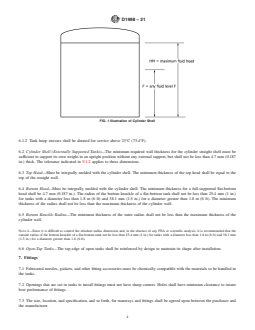
6.1 Cylinder Shell (Unsupported Portion of Tanks)—The minimum required wall thickness of the cylindrical shell at any fluid
level (F) shall be determined by the following equations, but shall not be less than 4.7 mm (0.187 in.) thick. The tolerance indicated
in 9.1.2 applies to these dimensions.
HL 5 HM 2 F (1)
where:
HL = head at level F, m (ft),
HM = maximum fluid head, m (ft), and
F = any fluid level, m (ft).
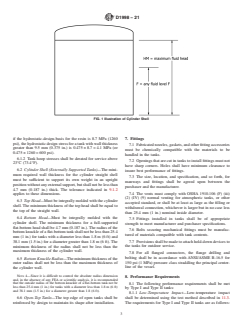
For illustration, see Fig. 1.
T 5 P 3OD/2 SD (2)
where:
T = wall thickness, mm (in.),
P = pressure, MPa (0.0098 MPa/m-H O × SG × HL (m)), or psi (0.433 psi/ft-H O × SG × HL (ft)),
2 2
SG = specific gravity of fluid,
HL = head at level F, m (ft),
OD = outside diameter of tank, mm (in.), and
SD = hydrostatic design stress, MPa (psi).
6.1.1 The hydrostatic design stress that is used to determine the minimum wall thickness at any fluid level must be based on hoop
stress data for the resin. The hoop stress data, obtained in accordance with the procedures of Test Method D2837, provide a
hydrostatic-design-basis for the resin. The hydrostatic-design-basis must be reduced by a service factor to determine the actual
hydrostatic design stress. The maximum service factor shall be 0.5 for wall thicknesses less than 9.5 mm (0.375 in.). For
thicknesses equal to or greater than 9.5 mm (0.375 in.), the maximum service factor shall be 0.475. For example, if the
hydrostatic-design-basis for the resin is 8.7 MPa (1260 psi), the hydrostatic design stress for a tank with wall thickness greater than
9.5 mm (0.375 in.) is 0.475 × 8.7 = 4.1 MPa (or 0.475 × 1260 = 600 psi).
D1998 − 21
FIG. 1 Illustration of Cylinder Shell
6.1.2 Tank hoop stresses shall be derated for service above 23°C (73.4°F).
6.2 Cylinder Shell (Externally Supported Tanks)—The minimum required wall thickness for the cylinder straight shell must be
sufficient to support its own weight in an upright position without any external support, but shall not be less than 4.7 mm (0.187
in.) thick. The tolerance indicated in 9.1.2 applies to these dimensions.
6.3 Top Head—Must be integrally molded with the cylinder shell. The minimum thickness of the top head shall be equal to the
top of the straight wall.
6.4 Bottom Head—Must be integrally molded with the cylinder shell. The minimum thickness for a full-supported flat-bottom
head shall be 4.7 mm (0.187 in.). The radius of the bottom knuckle of a flat-bottom tank shall not be less than 25.4 mm (1 in.)
for tanks with a diameter less than 1.8 m (6 ft) and 38.1 mm (1.5 in.) for a diameter greater than 1.8 m (6 ft). The minimum
thickness of the radius shall not be less than the maximum thickness of the cylinder wall.
6.5 Bottom Knuckle Radius—The minimum thickness of the outer radius shall not be less than the maximum thickness of the
cylinder wall.
NOTE 4—Since it is difficult to control the absolute radius dimension and, in the absence of any FEA or scientific analysis, it is recommended that the
outside radius of the bottom knuckle of a flat-bottom tank not be less than 25.4 mm (1 in.) for tanks with a diameter less than 1.8 m (6 ft) and 38.1 mm
(1.5 in.) for a diameter greater than 1.8 (6 ft).
6.6 Open-Top Tanks—The top edge of open tanks shall be reinforced by design to maintain its shape after installation.
7. Fittings
7.1 Fabricated nozzles, gaskets, and other fitting accessories must be chemically compatible with the materials to be handled in
the tanks.
7.2 Openings that are cut in tanks to install fittings must not have sharp corners. Holes shall have minimum clearance to insure
best performance of fittings.
7.3 The size, location, and specification, and so forth, for manways and fittings shall be agreed upon between the purchaser and
the manufacturer.
D1998 − 21
7.4 The vents must comply with OSHA 1910.106 (F) (iii) (2) (IV) (9) normal venting for atmospheric tanks, or other accepted
standard, or shall be at least as large as the filling or withdrawal connection, whichever is larger but in no case less than 25.4 mm
(1 in.) nominal inside diameter.
7.5 Fittings installed in tanks shall be of appropriate strength to meet manufacturer and purchaser specifications.
7.6 Bolts securing mechanical fittings must be manufactured of materials compatible with tank contents.
7.7 Provisions shall be made to attach hold-down devices to the tanks for outdoor service.
7.8 For all flanged connectors, the flange drilling and bolting shall be in accordance with ANSI/ASME B-16.5 for 150 psi (1 MPa)
pressure class straddling the principal centerline of the vessel.
8. Performance Requirements
8.1 The following performance requirements shall be met by Type I and Type II tanks:
8.1.1 Low-Temperature Impact—Low-temperature impact shall be determined using the test method described in 11.3. The
requirements for Type I and Type II tanks are as follows:
Impact energy,
Wall thickness, mm (in.)
min. J (ft-lb)
4.7 mm (0.187 in.) to and including 6.4 mm (0.25 in.) 122.0 (90)
6.6 mm (0.26 in.) to and including 12.9 mm (0.50 in.) 135.5 (100)
12.9 mm (0.51 in.) to and including 19.3 mm (0.75 in.) 203.2 (150)
19.3 mm (0.76 in.) to and including 25.4 mm (1.00 in.) 271.0 (200)
Greater than 25.4 mm (1.00 in.) 271.0 (200)
8.1.2 Percent Gel, for Type I Tanks Only—The percent gel level shall be determined using the test method described in 11.4. The
percent gel level for Type I tanks on the inside 3.2 mm (0.125 in.) of the wall shall be a minimum of 60 %.
9. Dimensions and Tolerances
9.1 General—All dimensions will be taken with the tank in the vertical position, unfilled. Tank dimensions will represent the
exterior measurements.
9.1.1 Outside Diameter—The tolerance for the outside diameter, including out of roundness, shall be 63 %.
9.1.2 Shell Wall and Head Thickness—The tolerance for average thickness at each elevation shall be − 10 % of the design
thickness on the low side and shall be unlimited on the high side. The tolerance for individual audit readings shall be limited to
− 20 % of the design thickness. The total amount of surface area on the low side of the tolerance shall not exceed 10 % of the
total surface area.
9.1.3 Placement of Fittings—The tolerance for fitting placements shall be 12.7 mm (0.5 in.) in elevation and 2° radial at ambient
temperature.
10. Workmanship
10.1 Type I finished tank walls shall be free, as commercially practicable, of visual defects such as foreign inclusions, air bubbles,
pinholes, pimples, crazing, cracking and delaminations that will impair the serviceability of the vessel. Fine bubbles are acceptable
with Type II tanks to the degree to which they do not interfere with proper fusion of the resin melt.
10.2 The acceptable finish shall be predetermined by agreement between the molder and the buyer.
D1998 − 21
11. Test Methods
11.1 Test Specimens—Test specimens shall be taken from an area that is representative of the bottom side wall. If no representative
sample cut-out area in the tank is available, test specimens shall be molded in a test mold. In either case, prior testing shall verify
that the tank wall and the test specimen have equal impact resistance.
11.1.1 The test mold shall be constructed of the same type material and have the same wall thickness as the tank mold. The
thickness of the specimen from a test mold shall be the same as the thickness of the bottom sidewall within the tolerances as defined
in 9.1.2. The test mold shall be molded with each tank.
11.2 Conditioning—If requested, test specimens shall be conditioned at 23 6 2°C (73.4 6 3.6°F) and 50 6 10 % relative humidity
for not less than 40 h prior to testing in accordance with Procedure A of Practice D618.
11.3 Low-Temperature Impact Test:
11.3.1 Scope—This test method is for the determination of the impact property of rotational-molded polyethylene tanks at low
temperature. The test method is used on tanks molded from both crosslinked and non-crosslinked polyethylenes.
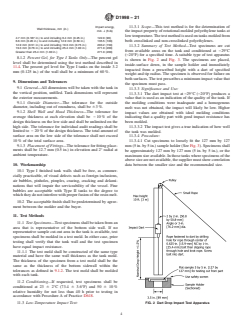
11.3.2 Summary of Test Method—Test specimens are cut from available areas on the tank and conditioned at − 29°C −29°C
(−20°F) for a specified time. A suitable type of test apparatus is shown in Fig. 2 and Fig. 3. The specimens are placed,
inside-surface down, in the sample holder and immediately impacted from a prescribed height with a dart of specified weight and
tip radius. The specimen is observed for failure on both surfaces. The test prescribes a minimum impact value that the specimen
must pass.
11.3.3 Significance and Use:
11.3.3.1 The dart impact test at −29°C (−20°F) produces a value that is used as an indication of the quality of the tank. If the
molding conditions were inadequate and a homogenous melt was not obtained, the impact will likely be low. Higher impact values
are obtained with ideal molding conditions indicating that a quality part with good impact resistance has been molded.
FIG. 2 Dart Drop Impact Test Apparatus
D1998 − 21
FIG. 3 Dart Drop Impact Test Apparat
...