

ASTM D2657-07(2023)
(Practice)Standard Practice for Heat Fusion Joining of Polyolefin Pipe and Fittings
General Information
- Abstract
SIGNIFICANCE AND USE
4.1 The procedures described in Sections 7, 8, and 9, when implemented using suitable equipment and procedures in either a shop or field environment, produce strong pressure-tight joints equal to the strength of the piping material. Some materials are more adaptable to one technique than another. Melt characteristics, average molecular weight and molecular weight distribution are influential factors in establishing suitable fusion parameters; therefore, consider the manufacturer's instructions in the use or development of a specific fusion procedure.
SCOPE
1.1 This practice describes general procedures for making joints with polyolefin pipe and fittings (excluding polyethylene pipe and fittings) by means of heat fusion joining techniques in either a shop or field environment. These procedures are general ones. Specific instructions for heat fusion joining are obtained from product manufacturers. See Practice F2620 for heat fusion joining of polyethylene pipe and fittings.
1.2 The techniques covered are applicable only to joining polyolefin pipe and fittings of related polymer chemistry, for example, polypropylenes to polypropylenes, or polybutylenes to polybutylenes. Material, density, and flow rate shall be taken into consideration in order to develop uniform melt viscosities and formation of a good fusion bond when joining the same material to itself or to other materials of related polymer chemistry.
1.3 Parts that are within the dimensional tolerances given in present ASTM specifications are required to produce sound joints between polyolefin pipe and fittings when using the joining techniques described in this practice.
1.4 The values stated in inch-pound units are to be regarded as standard. The values given in parentheses are mathematical conversions to SI units that are provided for information only and are not considered standard.
1.5 The text of this practice references notes, footnotes, and appendixes which provide explanatory material. These notes and footnotes (excluding those in tables and figures) shall not be considered as requirements of the practice.
1.6 This standard does not purport to address all of the safety concerns, if any, associated with its use. It is the responsibility of the user of this standard to establish appropriate safety, health, and environmental practices and determine the applicability of regulatory limitations prior to use. See specific safety precautions in 3.1.1, 5.2, 8.2.3.1, Note 8 and Note 9, and A1.1.
1.7 This international standard was developed in accordance with internationally recognized principles on standardization established in the Decision on Principles for the Development of International Standards, Guides and Recommendations issued by the World Trade Organization Technical Barriers to Trade (TBT) Committee.
- Status
- Published
- Publication Date
- 31-Jan-2023
- Technical Committee
- F17 - Plastic Piping Systems
- Drafting Committee
- F17.20 - Joining
Overview
ASTM D2657-07(2023), Standard Practice for Heat Fusion Joining of Polyolefin Pipe and Fittings, provides foundational procedures for joining polyolefin (excluding polyethylene) pipes and fittings using various heat fusion methods. Developed by ASTM International, this standard guides professionals in achieving pressure-tight, mechanically strong joints for polyolefin piping systems both in field and workshop settings. The practice aims to ensure that fusion joints are at least as robust as the pipe material itself, enhancing system reliability for critical applications.
Fusion joining is crucial across many industries, as it affects the integrity and safety of piping used in water, gas, chemical, and industrial conveyance systems. ASTM D2657 draws attention to variables such as material chemistry, density, and flow rate, and emphasizes adherence to manufacturer instructions for specific fusion procedures.
Key Topics
Heat Fusion Techniques: The standard specifies three primary fusion methods: socket fusion, butt fusion, and saddle fusion. Each technique is appropriate for joining pipes and fittings of the same or related polymer chemistry (e.g., polypropylene with polypropylene).
Material Considerations: Success in fusion joining depends on matching pipe and fitting material properties, particularly melt characteristics and molecular structure. Proper fusion parameters are essential to achieve uniform melt viscosity and strong bonds.
Equipment and Tools: Key apparatus include electrically or gas-heated fusion tools, alignment jigs, fitting pullers, temperature indicators, and cleaning materials. Maintenance and cleanliness of fusion equipment are highlighted to avoid contamination and weak joints.
Operator Skill: Operator proficiency is vital. The standard recommends hands-on training and joint testing (including destructive and non-destructive methods) to ensure operators consistently produce strong, reliable fusions.
Safety and Environmental Practices: Users must establish safety, health, and environmental protocols. This includes equipment precautions in combustible environments and directions for handling materials under varying weather conditions.
Dimensional Tolerance: Only parts within ASTM-specified tolerances will ensure reliable joints using these fusion procedures.
Applicability: Procedures are general; users should always consult the pipe and fitting manufacturer’s guidance and consider relevant regulations.
Applications
This ASTM fusion standard is widely applied in:
- Infrastructure Projects: Water, gas, and industrial fluid transport systems where reliability and pressure-tightness are paramount.
- Industrial Facilities: Chemical conveyance, process piping, and HVAC systems using polyolefin pipes.
- Utility Maintenance and Expansion: Installation and repair of pipelines in the utility sector.
- Shop and Field Fabrication: Both controlled workshop and varied field environments benefit from the guidelines ensuring uniform joint quality.
The standard applies exclusively to polyolefin pipes and fittings excluding polyethylene; for polyethylene, practitioners should reference ASTM F2620.
Related Standards
Professionals implementing ASTM D2657-07(2023) should be aware of related documents, including:
- ASTM F2620: Practice for Heat Fusion Joining of Polyethylene Pipe and Fittings - details fusion of polyethylene systems.
- ASTM F1056: Specification for Socket Fusion Tools for Use in Socket Fusion Joining Polyethylene Pipes and Fittings.
When working on heat fusion joint construction or inspection, referencing these standards ensures proper alignment with industry best practices and regulatory requirements.
Keywords: ASTM D2657, heat fusion, polyolefin pipe, fusion joining, butt fusion, saddle fusion, socket fusion, fusion equipment, piping system standards, ASTM International.
Relations
- Effective Date
- 01-Nov-2013
- Effective Date
- 01-Aug-2012
- Effective Date
- 01-Nov-2011
- Effective Date
- 01-Feb-2011
- Effective Date
- 01-Dec-2009
- Effective Date
- 01-Dec-2006
- Effective Date
- 01-Apr-2004
- Effective Date
- 10-Apr-1997
Get Certified
Connect with accredited certification bodies for this standard

DVS-ZERT GmbH
German welding certification society.
CARES (UK Certification Authority for Reinforcing Steels)
UK certification for reinforcing steels and construction.
EWF/IIW (European/International Welding Federation)
International welding personnel certification.
Sponsored listings
Frequently Asked Questions
ASTM D2657-07(2023) is a standard published by ASTM International. Its full title is "Standard Practice for Heat Fusion Joining of Polyolefin Pipe and Fittings". This standard covers: SIGNIFICANCE AND USE 4.1 The procedures described in Sections 7, 8, and 9, when implemented using suitable equipment and procedures in either a shop or field environment, produce strong pressure-tight joints equal to the strength of the piping material. Some materials are more adaptable to one technique than another. Melt characteristics, average molecular weight and molecular weight distribution are influential factors in establishing suitable fusion parameters; therefore, consider the manufacturer's instructions in the use or development of a specific fusion procedure. SCOPE 1.1 This practice describes general procedures for making joints with polyolefin pipe and fittings (excluding polyethylene pipe and fittings) by means of heat fusion joining techniques in either a shop or field environment. These procedures are general ones. Specific instructions for heat fusion joining are obtained from product manufacturers. See Practice F2620 for heat fusion joining of polyethylene pipe and fittings. 1.2 The techniques covered are applicable only to joining polyolefin pipe and fittings of related polymer chemistry, for example, polypropylenes to polypropylenes, or polybutylenes to polybutylenes. Material, density, and flow rate shall be taken into consideration in order to develop uniform melt viscosities and formation of a good fusion bond when joining the same material to itself or to other materials of related polymer chemistry. 1.3 Parts that are within the dimensional tolerances given in present ASTM specifications are required to produce sound joints between polyolefin pipe and fittings when using the joining techniques described in this practice. 1.4 The values stated in inch-pound units are to be regarded as standard. The values given in parentheses are mathematical conversions to SI units that are provided for information only and are not considered standard. 1.5 The text of this practice references notes, footnotes, and appendixes which provide explanatory material. These notes and footnotes (excluding those in tables and figures) shall not be considered as requirements of the practice. 1.6 This standard does not purport to address all of the safety concerns, if any, associated with its use. It is the responsibility of the user of this standard to establish appropriate safety, health, and environmental practices and determine the applicability of regulatory limitations prior to use. See specific safety precautions in 3.1.1, 5.2, 8.2.3.1, Note 8 and Note 9, and A1.1. 1.7 This international standard was developed in accordance with internationally recognized principles on standardization established in the Decision on Principles for the Development of International Standards, Guides and Recommendations issued by the World Trade Organization Technical Barriers to Trade (TBT) Committee.
SIGNIFICANCE AND USE 4.1 The procedures described in Sections 7, 8, and 9, when implemented using suitable equipment and procedures in either a shop or field environment, produce strong pressure-tight joints equal to the strength of the piping material. Some materials are more adaptable to one technique than another. Melt characteristics, average molecular weight and molecular weight distribution are influential factors in establishing suitable fusion parameters; therefore, consider the manufacturer's instructions in the use or development of a specific fusion procedure. SCOPE 1.1 This practice describes general procedures for making joints with polyolefin pipe and fittings (excluding polyethylene pipe and fittings) by means of heat fusion joining techniques in either a shop or field environment. These procedures are general ones. Specific instructions for heat fusion joining are obtained from product manufacturers. See Practice F2620 for heat fusion joining of polyethylene pipe and fittings. 1.2 The techniques covered are applicable only to joining polyolefin pipe and fittings of related polymer chemistry, for example, polypropylenes to polypropylenes, or polybutylenes to polybutylenes. Material, density, and flow rate shall be taken into consideration in order to develop uniform melt viscosities and formation of a good fusion bond when joining the same material to itself or to other materials of related polymer chemistry. 1.3 Parts that are within the dimensional tolerances given in present ASTM specifications are required to produce sound joints between polyolefin pipe and fittings when using the joining techniques described in this practice. 1.4 The values stated in inch-pound units are to be regarded as standard. The values given in parentheses are mathematical conversions to SI units that are provided for information only and are not considered standard. 1.5 The text of this practice references notes, footnotes, and appendixes which provide explanatory material. These notes and footnotes (excluding those in tables and figures) shall not be considered as requirements of the practice. 1.6 This standard does not purport to address all of the safety concerns, if any, associated with its use. It is the responsibility of the user of this standard to establish appropriate safety, health, and environmental practices and determine the applicability of regulatory limitations prior to use. See specific safety precautions in 3.1.1, 5.2, 8.2.3.1, Note 8 and Note 9, and A1.1. 1.7 This international standard was developed in accordance with internationally recognized principles on standardization established in the Decision on Principles for the Development of International Standards, Guides and Recommendations issued by the World Trade Organization Technical Barriers to Trade (TBT) Committee.
ASTM D2657-07(2023) is classified under the following ICS (International Classification for Standards) categories: 25.160.40 - Welded joints and welds. The ICS classification helps identify the subject area and facilitates finding related standards.
ASTM D2657-07(2023) has the following relationships with other standards: It is inter standard links to ASTM F2620-13, ASTM F2620-12, ASTM F2620-11, ASTM F1056-04(2011), ASTM F2620-09, ASTM F2620-06, ASTM F1056-04, ASTM F1056-97. Understanding these relationships helps ensure you are using the most current and applicable version of the standard.
ASTM D2657-07(2023) is available in PDF format for immediate download after purchase. The document can be added to your cart and obtained through the secure checkout process. Digital delivery ensures instant access to the complete standard document.
Standards Content (Sample)
This international standard was developed in accordance with internationally recognized principles on standardization established in the Decision on Principles for the
Development of International Standards, Guides and Recommendations issued by the World Trade Organization Technical Barriers to Trade (TBT) Committee.
Designation: D2657 − 07 (Reapproved 2023) An American National Standard
Standard Practice for
Heat Fusion Joining of Polyolefin Pipe and Fittings
This standard is issued under the fixed designation D2657; the number immediately following the designation indicates the year of
original adoption or, in the case of revision, the year of last revision. A number in parentheses indicates the year of last reapproval. A
superscript epsilon (´) indicates an editorial change since the last revision or reapproval.
This standard has been approved for use by agencies of the U.S. Department of Defense.
1. Scope 1.7 This international standard was developed in accor-
dance with internationally recognized principles on standard-
1.1 This practice describes general procedures for making
ization established in the Decision on Principles for the
joints with polyolefin pipe and fittings (excluding polyethylene
Development of International Standards, Guides and Recom-
pipe and fittings) by means of heat fusion joining techniques in
mendations issued by the World Trade Organization Technical
either a shop or field environment. These procedures are
Barriers to Trade (TBT) Committee.
general ones. Specific instructions for heat fusion joining are
obtained from product manufacturers. See Practice F2620 for
2. Referenced Documents
heat fusion joining of polyethylene pipe and fittings.
2.1 ASTM Standards:
1.2 The techniques covered are applicable only to joining
F1056 Specification for Socket Fusion Tools for Use in
polyolefin pipe and fittings of related polymer chemistry, for
Socket Fusion Joining Polyethylene Pipe or Tubing and
example, polypropylenes to polypropylenes, or polybutylenes
Fittings
to polybutylenes. Material, density, and flow rate shall be taken
F2620 Practice for Heat Fusion Joining of Polyethylene Pipe
into consideration in order to develop uniform melt viscosities
and Fittings
and formation of a good fusion bond when joining the same
material to itself or to other materials of related polymer
3. Summary of Practice
chemistry.
3.1 Heat-fusion joining uses a combination of heat and force
1.3 Parts that are within the dimensional tolerances given in
resulting in two melted surfaces flowing together to produce a
present ASTM specifications are required to produce sound
joint. Fusion bonding occurs when the joint cools below the
joints between polyolefin pipe and fittings when using the
melt temperature of the material. There is a temperature range
joining techniques described in this practice.
within which any particular material is satisfactorily joined.
The specific temperature used requires consideration of the
1.4 The values stated in inch-pound units are to be regarded
properties of the specific material, and the joining environment.
as standard. The values given in parentheses are mathematical
With Techniques II or III (3.3.2 or 3.3.3), there is also an
conversions to SI units that are provided for information only
appropriate force to be applied which depends upon the
and are not considered standard.
material, the fusion equipment being used, and fusion tempera-
1.5 The text of this practice references notes, footnotes, and
ture. See Practice F2620 for heat fusion procedure for poly-
appendixes which provide explanatory material. These notes
ethylene pipe and fittings.
and footnotes (excluding those in tables and figures) shall not
3.1.1 Electrically powered heat fusion tools and equipment
be considered as requirements of the practice.
are usually not explosion proof. When performing heat fusion
1.6 This standard does not purport to address all of the
in a potentially combustible atmosphere such as in an excava-
safety concerns, if any, associated with its use. It is the
tion where gas is present, all electrically powered tools and
responsibility of the user of this standard to establish appro-
equipment that will be used in the combustible atmosphere
priate safety, health, and environmental practices and deter-
shall be disconnected from the electrical power source and
mine the applicability of regulatory limitations prior to use.
operated manually to prevent explosion and fire. For the
See specific safety precautions in 3.1.1, 5.2, 8.2.3.1, Note 8 and
heating tool, this requires bringing the heating tool up to or
Note 9, and A1.1.
slightly above temperature in a safe area, then disconnecting it
from electrical power immediately before use. This procedure
This practice is under the jurisdiction of ASTM Committee F17 on Plastic
Piping Systems and is the direct responsibility of Subcommittee F17.20 on Joining. For referenced ASTM standards, visit the ASTM website, www.astm.org, or
Current edition approved Feb. 1, 2023. Published February 2023. Originally contact ASTM Customer Service at service@astm.org. For Annual Book of ASTM
approved in 1967. Last previous edition approved in 2015 as D2657 – 07(2015). Standards volume information, refer to the standard’s Document Summary page on
DOI: 10.1520/D2657-07R23. the ASTM website.
Copyright © ASTM International, 100 Barr Harbor Drive, PO Box C700, West Conshohocken, PA 19428-2959. United States
D2657 − 07 (2023)
FIG. 1 Socket Fusion
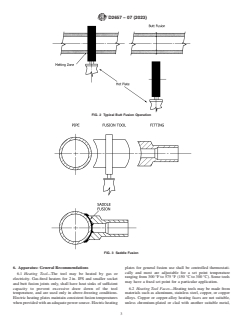
is limited to smaller sizes where heating is accomplished force. See Fig. 2. An alignment jig shall be used to obtain and
before the heating tool drops below acceptable temperature. maintain suitable alignment of the ends during the fusion
operation.
3.2 Adequate joint strength for testing is attained when all
3.3.3 Procedure 3, Saddle Fusion—The saddle-fusion tech-
of the joint material cools to ambient temperature. The joint
nique involves melting the concave surface of the base of a
shall not be disturbed or moved until it has cooled. See Practice
saddle fitting, while simultaneously melting a matching pattern
F2620 for heat fusion procedure for polyethylene pipe and
on the surface of the pipe, bringing the two melted surfaces
fittings.
together and allowing the joint to cool while maintaining the
NOTE 1—Polybutylene undergoes a crystalline transformation for
appropriate applied force. See Fig. 3.
several days after cooling below its melt temperature. Although this
phenomenon has an effect on the ultimate physical properties of the
4. Significance and Use
material, its effect on testing of joints has not been found to be significant.
If there is any question of its effect, a comparison should be made between
4.1 The procedures described in Sections 7, 8, and 9, when
joints that have been conditioned for different periods of time in order to
implemented using suitable equipment and procedures in either
establish the conditioning-time relationship.
a shop or field environment, produce strong pressure-tight
3.3 Three fusion techniques are covered in this practice as
joints equal to the strength of the piping material. Some
follows: See Practice F2620 for heat fusion procedure for
materials are more adaptable to one technique than another.
polyethylene pipe and fittings.
Melt characteristics, average molecular weight and molecular
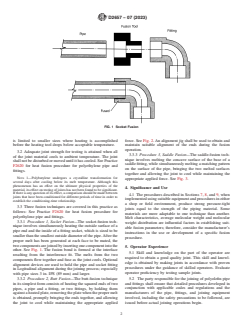
3.3.1 Procedure 1, Socket Fusion—The socket-fusion tech-
weight distribution are influential factors in establishing suit-
nique involves simultaneously heating the outside surface of a
able fusion parameters; therefore, consider the manufacturer’s
pipe end and the inside of a fitting socket, which is sized to be
instructions in the use or development of a specific fusion
smaller than the smallest outside diameter of the pipe. After the
procedure.
proper melt has been generated at each face to be mated, the
two components are joined by inserting one component into the
5. Operator Experience
other. See Fig. 1. The fusion bond is formed at the interface
5.1 Skill and knowledge on the part of the operator are
resulting from the interference fit. The melts from the two
required to obtain a good quality joint. This skill and knowl-
components flow together and fuse as the joint cools. Optional
edge is obtained by making joints in accordance with proven
alignment devices are used to hold the pipe and socket fitting
procedures under the guidance of skilled operators. Evaluate
in Logitudinal alignment during the joining process; especially
operator proficiency by testing sample joints.
with pipe sizes 3 in. IPS (89 mm) and larger.
3.3.2 Procedure 2, Butt Fusion—The butt-fusion technique 5.2 The party responsible for the joining of polyolefin pipe
in its simplest form consists of heating the squared ends of two and fittings shall ensure that detailed procedures developed in
pipes, a pipe and a fitting, or two fittings, by holding them conjunction with applicable codes and regulations and the
against a heated plate, removing the plate when the proper melt manufacturers of the pipe, fittings, and joining equipment
is obtained, promptly bringing the ends together, and allowing involved, including the safety precautions to be followed, are
the joint to cool while maintaining the appropriate applied issued before actual joining operations begin.
D2657 − 07 (2023)
FIG. 2 Typical Butt Fusion Operation
FIG. 3 Saddle Fusion
6. Apparatus: General Recommendations plates for general fusion use shall be controlled thermostati-
cally and most are adjustable for a set point temperature
6.1 Heating Tool—The tool may be heated by gas or
ranging from 300 °F to 575 °F (150 °C to 300 °C). Some tools
electricity. Gas-fired heaters for 2 in. IPS and smaller socket
may have a fixed set point for a particular application.
and butt fusion joints only, shall have heat sinks of sufficient
capacity to prevent excessive draw down of the tool 6.2 Heating Tool Faces—Heating tools may be made from
temperature, and are used only in above-freezing conditions. materials such as aluminum, stainless steel, copper, or copper
Electric heating plates maintain consistent fusion temperatures alloys. Copper or copper-alloy heating faces are not suitable,
when provided with an adequate power source. Electric heating unless chromium-plated or clad with another suitable metal,
D2657 − 07 (2023)
NOTE 3—The depth gage and chamfering tool may be combined into a
because some polyolefins react with copper. Plastic materials
single tool.
may stick to hot metal heating surfaces. This sticking may be
minimized by applying a non-stick coating to the heating
7.1.7 Tubing Cutter, to obtain a square end cut on the pipe.
surfaces or by fitting a high-temperature, non-stick fabric over
7.1.8 Fitting Puller, an optional tool to assist in the removal
the heating surfaces. The heating plate surfaces, coated or
of the fitting from the heating tool and to hold the fitting during
uncoated, shall be kept clean and free of contaminants such as
assembly.
dirt, grease and plastic build-up, which may cause excessive
7.2 Procedure:
sticking and create unsatisfactory joints. Most of these con-
7.2.1 Attach the proper size heater faces to the heating tool,
taminants are removed from the hot tool surfaces using a clean,
and heat the tool to the fusion temperature for the material.
dry, oil-free lint-free cloth. Do not use synthetic fabrics which
7.2.2 Cut the pipe end squarely, and clean the pipe end and
may char and stick to the fusion surface. Some pigments, such
fitting, both inside and outside, by wiping with a clean, dry,
as carbon black, may stain a heating surface and probably
oil-free, lint-free cloth.
cannot be removed; such stains will not contaminate the joint
7.2.3 Chamfer the outside edge of the pipe end slightly and
interface.
fix the rounding clamp about the pipe as determined from the
6.2.1 After a period of time in service, non-stick coatings or
depth gage.
fabrics will deteriorate and become less effective. Deteriorated
fabrics should be replaced, and worn, scratched, or gouged
NOTE 4—Chamfering may not be required by some procedures or some
fusion tools. Pipe sizes 1 in. (25.4 mm) and smaller are not usually
non-stick coatings should be re-coated when they lose effec-
chamfered, regardless of tooling design.
tiveness. Heat fusion quality may be adversely affected by
NOTE 5—Some recommend using a 50 to 60-grit emery or garnet cloth
deteriorated non-stick surfaces. Spray-on chemicals, such as
to roughen the outside of the pipe and inside of the fitting as a means of
non-stick lubricants or oils shall not be applied to heating iron
minimizing any possible skin interface when making the fusion. Sandpa-
surfaces as they will contaminate the joint.
per is not recommended for this purpose, as it might disintegrate and
contaminate the joint interface. If roughening is performed, first clean the
6.3 Temperature Indicator—Heating tools shall be equipped
surfaces before roughening. Clean dust and particles from the roughened
with a thermometer or other built-in temperature indicating
surfaces afterwards by wiping with a clean, dry, oil-free, lint-free cloth.
device. This device indicates the internal temperature of the
7.2.4 Bring the preheated tool faces into contact with the
heating iron which is usually higher than temperature of the
outside surface of the end of the pipe and the inside surface of
fusion surfaces. Use a pyrometer periodically to verify the
the socket.
temperature of the tool surfaces within the pipe or fitting
7.2.5 Heat the pipe end and the fitting socket for the time
contact area. Select multiple checkpoints to ensure uniform
required to obtain a proper melt. Proper melt is a function of
surface temperature.
material, time, tool temperature, and the size of the parts. Pipe
NOTE 2—A significant temperature variation, that is, cold spots, on the
and fittings of larger diameters require more time to reach the
fusion surfaces may indicate a faulty heating iron which may need to be
proper melt consistency than those of smaller diameters.
serviced before it can be used.
Underheated or overheated materials will not form a good
bond.
7. Procedure 1—Socket Fusion
7.2.6 At the end of the heating time, simultaneously remove
7.1 Apparatus—Socket fusion tools manufactured in accor-
the pipe and fitting straight out from the tool, using a snap
dance with Specification F1056 are used for joining polyolefin
action. Immediately insert the pipe straight into the socket of
pipe, tubing, and fittings.
the fitting so the rounding clamp is flush against the end of the
7.1.1 Heating Tool—In order to obtain a proper melt, it is fitting socket. Hold or block the joint in place until the melts of
the mating surfaces have solidified. The exact cooling time
necessary for a uniform temperature to be maintained across
the heating surface. Therefore, gas-fired tools are generally depends on the size of the pipe and the material being fused.
restricted to use with pipe sizes of 2 in. IPS (63 mm) or less. 7.2.7 Remove the rounding clamp, and inspect the melt
7.1.2 Heating Tool Faces—Consisting of two parts, a male pattern at the end of the socket for a complete impression of the
rounding clamp in the melt surface. There shall no gaps, voids,
end for the interior socket surface and a female end for the
exterior pipe surface. Both parts shall be made to such or unbonded areas. Clean the heating tool of any residual
material using a wood stick or a clean, dry, oil-free, lint-free,
tolerances as to cause an interference fit.
non-synthetic cloth. Take care not to damage the heating
7.1.3 Alignment Jig—The alignment jig is an optional tool
surfaces. Plastic left on the tool tends to char when reheated,
which consists of two sets of devices holding the components
causing a loss of heater efficiency and joint contamination.
in alignment to each other. One set of holding devices is fixed,
7.2.8 Allow for extremes in weather when making field
and the other allows longitudinal movement for making the
joints. Heating times, operation of alignment jig, dimensional
joint.
changes, and the like, are affected by extreme conditions.
7.1.4 Rounding Clamps, (cold ring) to maintain roundness
of the pipe and control the depth of pipe insertion into the
7.3 Testing—Evaluate sample joints in order to verify the
socket during the joining operation.
skill and knowledge of the fusion operator. Cut joints into
7.1.5 Depth Gage, for proper positioning of the rounding
straps, (see Fig. 4) and visually examine and test for bond
clamp.
continuity and strength. Bending, peeling, and elongation tests
7.1.6 Chamfering Tool, to bevel the en
...