

ASTM E1961-16(2021)
(Practice)Standard Practice for Mechanized Ultrasonic Testing of Girth Welds Using Zonal Discrimination with Focused Search Units
General Information
- Abstract
SIGNIFICANCE AND USE
4.1 This practice is intended primarily for the mechanized ultrasonic examination of pipe girth welds used in the construction of gas and oil pipelines. This practice, with appropriate modifications due to changes in weld profile, may also be used to examine repaired welds. Manual techniques such as described in Practice E164 may also be used to examine production or repaired welds. This practice, with appropriate modifications, may also be used to examine other forms of butt welds including long seams.
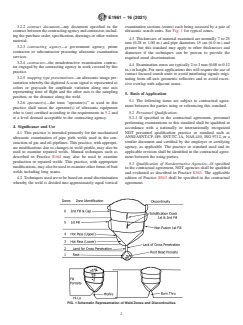
4.2 Techniques used are to be based on zonal discrimination whereby the weld is divided into approximately equal vertical examination sections (zones) each being assessed by a pair of ultrasonic search units. See Fig. 1 for typical zones.
FIG. 1 Schematic Representation of Weld Zones and Discontinuities
4.3 Thicknesses of material examined are normally 7 to 25 mm (0.28 to 1.00 in.) and pipe diameters 15 cm (6.0 in.) and greater but this standard may apply to other thicknesses and diameters if the techniques can be proven to provide the required zonal discrimination.
4.4 Examination zones are typically 2 to 3 mm (0.08 to 0.12 in.) in height. For most applications this will require the use of contact focused search units to avoid interfering signals originating from off-axis geometric reflectors and to avoid excessive overlap with adjacent zones.
SCOPE
1.1 This practice covers the requirements for mechanized ultrasonic examination of girth welds. Evaluation is based upon the results of mechanized ultrasonic examination. Acceptance criteria are based upon flaw limits defined by an Engineering Critical Assessment (ECA) or other accept/reject criteria defined by the Contracting Agency.
1.2 This practice shall be applicable to the development of an examination procedure agreed upon between the users of this practice.
1.3 The values stated in SI units are to be regarded as the standard. The inch-pound units given in parentheses are for information only.
1.4 This standard does not purport to address all of the safety concerns, if any, associated with its use. It is the responsibility of the user of this standard to establish appropriate safety, health, and environmental practices and determine the applicability of regulatory limitations prior to use.
1.5 This international standard was developed in accordance with internationally recognized principles on standardization established in the Decision on Principles for the Development of International Standards, Guides and Recommendations issued by the World Trade Organization Technical Barriers to Trade (TBT) Committee.
- Status
- Published
- Publication Date
- 31-Oct-2021
- Technical Committee
- E07 - Nondestructive Testing
- Drafting Committee
- E07.06 - Ultrasonic Method
Overview
ASTM E1961-16(2021), Standard Practice for Mechanized Ultrasonic Testing of Girth Welds Using Zonal Discrimination with Focused Search Units, is an internationally recognized standard developed by ASTM. The primary focus of this standard is the mechanized ultrasonic examination of pipe girth welds, which are integral to the construction and maintenance of gas and oil pipelines. The practice outlines comprehensive methods for applying mechanized ultrasonic testing (UT) with zonal discrimination, ensuring a thorough and systematic approach to identifying weld discontinuities and ensuring pipeline integrity.
This standard is designed to facilitate high-reliability non-destructive testing (NDT) by specifying requirements for equipment, procedures, and personnel qualification. Its application is especially critical where safety, regulatory compliance, and asset longevity are paramount.
Key Topics
- Zonal Discrimination: The technique involves dividing the weld into vertical zones, each scrutinized with focused ultrasonic search units. This approach increases flaw detectability by narrowing the examination area and reducing interference from adjacent zones.
- Mechanized Ultrasonic Testing: The practice emphasizes automated or mechanized UT systems for consistent, repeatable scanning of girth welds, minimizing human error and maximizing coverage.
- Applicable Weld Types: While intended for pipeline girth welds, the practice can be adapted for repaired welds, long seams, and other butt welds with modifications according to weld geometry.
- Material and Size Range: Typically applied to materials 7–25 mm thick and pipe diameters 15 cm or greater, with provisions for use beyond these dimensions if proven effective.
- Personnel and Agency Qualification: The standard addresses the importance of personnel certification, referencing international qualification schemes such as ISO 9712, SNT-TC-1A, and contract-specific criteria.
- Examination and Reporting: It outlines comprehensive methods for examination, result reporting, systematic standardization (calibration), and documentation to facilitate auditability and traceability.
- Surface Preparation and Scan Requirements: The document underscores the necessity of proper pipe surface preparation and precise scan setup to achieve reliable results.
- Acceptance Criteria: While the standard references Engineering Critical Assessment (ECA) and contractual accept/reject criteria, it does not mandate specific flaw limits, allowing flexibility based on project requirements.
Applications
This ASTM standard serves as a cornerstone in quality assurance for industries reliant on welded pipelines, particularly:
- Oil and Gas Pipelines: Ensures the integrity of critical infrastructure by detecting weld flaws that could lead to leaks, ruptures, or failures.
- Pipeline Construction and Maintenance: Provides standardized protocols for initial weld quality validation as well as post-repair inspection.
- Regulatory Compliance: Helps project stakeholders demonstrate adherence to international codes and local regulatory requirements for pipeline safety.
- Contractual Quality Assurance: Offers a reference point in contracts for evaluating weld acceptability using objective, recognized practices.
- Butt Welds and Long Seams in Pressure Systems: With proper adaptation, the standard can be used for other critical welds in various pressure-retaining systems, expanding its utility beyond pipelines.
By using mechanized ultrasonic testing with zonal discrimination, organizations can achieve thorough weld assessments, support predictive maintenance programs, and reduce the likelihood of in-service failures.
Related Standards
For a holistic approach to nondestructive testing and pipeline quality, consider the following related standards:
- ASTM E164: Contact Ultrasonic Testing of Weldments
- ASTM E317: Evaluating Performance Characteristics of Ultrasonic Pulse-Echo Testing Instruments and Systems
- ASTM E543: Specification for Agencies Performing Nondestructive Testing
- ASTM E1316: Terminology for Nondestructive Examinations
- ASNT SNT-TC-1A & ANSI/ASNT-CP-189: Personnel Qualification and Certification in Nondestructive Testing
- API STD-1104: Welding of Pipeline and Related Facilities
- CSA Z-662: Oil and Gas Pipeline Systems
- ISO 9712: Nondestructive Testing - Qualification and Certification of NDT Personnel
Implementing ASTM E1961-16(2021) ensures best practices in mechanized ultrasonic weld inspection and supports safe, reliable pipeline operation, meeting both industry and regulatory expectations.
Relations
- Effective Date
- 01-Feb-2024
- Effective Date
- 01-Dec-2019
- Effective Date
- 01-Mar-2019
- Effective Date
- 01-Jan-2018
- Effective Date
- 15-Jun-2017
- Effective Date
- 01-Feb-2017
- Effective Date
- 01-Aug-2016
- Effective Date
- 01-Feb-2016
- Effective Date
- 01-Dec-2015
- Effective Date
- 01-Sep-2015
- Effective Date
- 01-Jun-2014
- Effective Date
- 01-Jun-2014
- Effective Date
- 01-Dec-2013
- Effective Date
- 15-Jun-2013
- Effective Date
- 01-Jun-2013
Get Certified
Connect with accredited certification bodies for this standard

DVS-ZERT GmbH
German welding certification society.
CARES (UK Certification Authority for Reinforcing Steels)
UK certification for reinforcing steels and construction.
EWF/IIW (European/International Welding Federation)
International welding personnel certification.
Sponsored listings
Frequently Asked Questions
ASTM E1961-16(2021) is a standard published by ASTM International. Its full title is "Standard Practice for Mechanized Ultrasonic Testing of Girth Welds Using Zonal Discrimination with Focused Search Units". This standard covers: SIGNIFICANCE AND USE 4.1 This practice is intended primarily for the mechanized ultrasonic examination of pipe girth welds used in the construction of gas and oil pipelines. This practice, with appropriate modifications due to changes in weld profile, may also be used to examine repaired welds. Manual techniques such as described in Practice E164 may also be used to examine production or repaired welds. This practice, with appropriate modifications, may also be used to examine other forms of butt welds including long seams. 4.2 Techniques used are to be based on zonal discrimination whereby the weld is divided into approximately equal vertical examination sections (zones) each being assessed by a pair of ultrasonic search units. See Fig. 1 for typical zones. FIG. 1 Schematic Representation of Weld Zones and Discontinuities 4.3 Thicknesses of material examined are normally 7 to 25 mm (0.28 to 1.00 in.) and pipe diameters 15 cm (6.0 in.) and greater but this standard may apply to other thicknesses and diameters if the techniques can be proven to provide the required zonal discrimination. 4.4 Examination zones are typically 2 to 3 mm (0.08 to 0.12 in.) in height. For most applications this will require the use of contact focused search units to avoid interfering signals originating from off-axis geometric reflectors and to avoid excessive overlap with adjacent zones. SCOPE 1.1 This practice covers the requirements for mechanized ultrasonic examination of girth welds. Evaluation is based upon the results of mechanized ultrasonic examination. Acceptance criteria are based upon flaw limits defined by an Engineering Critical Assessment (ECA) or other accept/reject criteria defined by the Contracting Agency. 1.2 This practice shall be applicable to the development of an examination procedure agreed upon between the users of this practice. 1.3 The values stated in SI units are to be regarded as the standard. The inch-pound units given in parentheses are for information only. 1.4 This standard does not purport to address all of the safety concerns, if any, associated with its use. It is the responsibility of the user of this standard to establish appropriate safety, health, and environmental practices and determine the applicability of regulatory limitations prior to use. 1.5 This international standard was developed in accordance with internationally recognized principles on standardization established in the Decision on Principles for the Development of International Standards, Guides and Recommendations issued by the World Trade Organization Technical Barriers to Trade (TBT) Committee.
SIGNIFICANCE AND USE 4.1 This practice is intended primarily for the mechanized ultrasonic examination of pipe girth welds used in the construction of gas and oil pipelines. This practice, with appropriate modifications due to changes in weld profile, may also be used to examine repaired welds. Manual techniques such as described in Practice E164 may also be used to examine production or repaired welds. This practice, with appropriate modifications, may also be used to examine other forms of butt welds including long seams. 4.2 Techniques used are to be based on zonal discrimination whereby the weld is divided into approximately equal vertical examination sections (zones) each being assessed by a pair of ultrasonic search units. See Fig. 1 for typical zones. FIG. 1 Schematic Representation of Weld Zones and Discontinuities 4.3 Thicknesses of material examined are normally 7 to 25 mm (0.28 to 1.00 in.) and pipe diameters 15 cm (6.0 in.) and greater but this standard may apply to other thicknesses and diameters if the techniques can be proven to provide the required zonal discrimination. 4.4 Examination zones are typically 2 to 3 mm (0.08 to 0.12 in.) in height. For most applications this will require the use of contact focused search units to avoid interfering signals originating from off-axis geometric reflectors and to avoid excessive overlap with adjacent zones. SCOPE 1.1 This practice covers the requirements for mechanized ultrasonic examination of girth welds. Evaluation is based upon the results of mechanized ultrasonic examination. Acceptance criteria are based upon flaw limits defined by an Engineering Critical Assessment (ECA) or other accept/reject criteria defined by the Contracting Agency. 1.2 This practice shall be applicable to the development of an examination procedure agreed upon between the users of this practice. 1.3 The values stated in SI units are to be regarded as the standard. The inch-pound units given in parentheses are for information only. 1.4 This standard does not purport to address all of the safety concerns, if any, associated with its use. It is the responsibility of the user of this standard to establish appropriate safety, health, and environmental practices and determine the applicability of regulatory limitations prior to use. 1.5 This international standard was developed in accordance with internationally recognized principles on standardization established in the Decision on Principles for the Development of International Standards, Guides and Recommendations issued by the World Trade Organization Technical Barriers to Trade (TBT) Committee.
ASTM E1961-16(2021) is classified under the following ICS (International Classification for Standards) categories: 25.160.40 - Welded joints and welds. The ICS classification helps identify the subject area and facilitates finding related standards.
ASTM E1961-16(2021) has the following relationships with other standards: It is inter standard links to ASTM E1316-24, ASTM E1316-19b, ASTM E1316-19, ASTM E1316-18, ASTM E1316-17a, ASTM E1316-17, ASTM E1316-16a, ASTM E1316-16, ASTM E1316-15a, ASTM E1316-15, ASTM E1316-14, ASTM E1316-14e1, ASTM E1316-13d, ASTM E1316-13c, ASTM E1316-13b. Understanding these relationships helps ensure you are using the most current and applicable version of the standard.
ASTM E1961-16(2021) is available in PDF format for immediate download after purchase. The document can be added to your cart and obtained through the secure checkout process. Digital delivery ensures instant access to the complete standard document.
Standards Content (Sample)
This international standard was developed in accordance with internationally recognized principles on standardization established in the Decision on Principles for the
Development of International Standards, Guides and Recommendations issued by the World Trade Organization Technical Barriers to Trade (TBT) Committee.
Designation: E1961 − 16 (Reapproved 2021)
Standard Practice for
Mechanized Ultrasonic Testing of Girth Welds Using Zonal
Discrimination with Focused Search Units
This standard is issued under the fixed designation E1961; the number immediately following the designation indicates the year of
original adoption or, in the case of revision, the year of last revision. A number in parentheses indicates the year of last reapproval. A
superscript epsilon (´) indicates an editorial change since the last revision or reapproval.
1. Scope* Ultrasonic Pulse-Echo Testing Instruments and Systems
without the Use of Electronic Measurement Instruments
1.1 This practice covers the requirements for mechanized
E543 Specification for Agencies Performing Nondestructive
ultrasonic examination of girth welds. Evaluation is based
Testing
upon the results of mechanized ultrasonic examination.Accep-
E1316 Terminology for Nondestructive Examinations
tance criteria are based upon flaw limits defined by an
2.3 ASNT Standards:
Engineering Critical Assessment (ECA) or other accept/reject
ASNT Practice SNT-TC-1A Personnel Qualification and
criteria defined by the Contracting Agency.
Certification in Nondestructive Testing
1.2 This practice shall be applicable to the development of
ANSI/ASNT-CP-189 Standard for Qualification and Certifi-
an examination procedure agreed upon between the users of
cation of Nondestructive Testing Personnel
this practice.
2.4 AIA Standard:
1.3 The values stated in SI units are to be regarded as the
NAS-410 Nondestructive Testing Personnel Qualification
standard. The inch-pound units given in parentheses are for
and Certification
information only. 5
2.5 API Standard:
1.4 This standard does not purport to address all of the
API STD–1104 Welding of Pipeline and Related Facilities
safety concerns, if any, associated with its use. It is the
2.6 CSA Standard:
responsibility of the user of this standard to establish appro-
CSA Z-662 Oil and Gas Pipelines Systems
priate safety, health, and environmental practices and deter- 7
2.7 ISO Standard:
mine the applicability of regulatory limitations prior to use.
ISO 9712 Nondestructive Testing—Qualification and Certi-
1.5 This international standard was developed in accor-
fication of NDT Personnel
dance with internationally recognized principles on standard-
ization established in the Decision on Principles for the
3. Terminology
Development of International Standards, Guides and Recom-
3.1 Definitions:
mendations issued by the World Trade Organization Technical
3.1.1 Definitions relating to ultrasonic examination, that
Barriers to Trade (TBT) Committee.
appear in Terminology E1316 shall apply to the terms used in
this practice.
2. Referenced Documents
3.2 Definitions of Terms Specific to This Standard:
2.1 The following documents form a part of this practice to
3.2.1 acceptance criteria—definition of acceptable/
the extent specified herein:
rejectable flaws as defined by an Engineering Critical Assess-
2.2 ASTM Standards:
ment (ECA), such as defined in CSA-Z662 or API 1104, or
E164 Practice for Contact Ultrasonic Testing of Weldments
workmanship criteria as defined by the contracting agency.
E317 Practice for Evaluating Performance Characteristics of
AvailablefromAmericanSocietyforNondestructiveTesting(ASNT),P.O.Box
This practice is under the jurisdiction of ASTM Committee E07 on Nonde- 28518, 1711 Arlingate Ln., Columbus, OH 43228-0518, http://www.asnt.org.
structive Testing and is the direct responsibility of Subcommittee E07.06 on Available fromAerospace IndustriesAssociation ofAmerica, Inc. (AIA), 1000
Ultrasonic Method. WilsonBlvd.,Suite1700,Arlington,VA22209-3928,http://www.aia-aerospace.org.
Current edition approved Nov. 1, 2021. Published November 2021. Originally Available from American Petroleum Institute (API), 1220 L. St., NW,
approved in 1998. Last previous edition approved in 2016 as E1961 – 16. DOI: Washington, DC 20005-4070, http://www.api.org.
10.1520/E1961-16R21. Available from Canadian Standards Association (CSA), 5060 Spectrum Way,
For referenced ASTM standards, visit the ASTM website, www.astm.org, or Mississauga, ON L4W 5N6, Canada, http://www.csa.ca.
contact ASTM Customer Service at service@astm.org. For Annual Book of ASTM Available from International Organization for Standardization (ISO), ISO
Standards volume information, refer to the standard’s Document Summary page on Central Secretariat, BIBC II, Chemin de Blandonnet 8, CP 401, 1214 Vernier,
the ASTM website. Geneva, Switzerland, http://www.iso.org.
*A Summary of Changes section appears at the end of this standard
Copyright © ASTM International, 100 Barr Harbor Drive, PO Box C700, West Conshohocken, PA 19428-2959. United States
E1961 − 16 (2021)
3.2.2 contract document—any document specified in the examination sections (zones) each being assessed by a pair of
contractbetweenthecontractingagencyandcontractor,includ- ultrasonic search units. See Fig. 1 for typical zones.
ing the purchase order, specification, drawings or other written
4.3 Thicknesses of material examined are normally 7 to 25
material.
mm (0.28 to 1.00 in.) and pipe diameters 15 cm (6.0 in.) and
3.2.3 contracting agency—a government agency, prime
greater but this standard may apply to other thicknesses and
contractor or subcontractor procuring ultrasonic examination
diameters if the techniques can be proven to provide the
services.
required zonal discrimination.
3.2.4 contractor—the nondestructive examination contrac-
4.4 Examination zones are typically 2 to 3 mm (0.08 to 0.12
tor engaged by the contracting agency in work covered by this
in.) in height. For most applications this will require the use of
practice.
contact focused search units to avoid interfering signals origi-
3.2.5 mapping type presentations—an ultrasonic image pre-
nating from off-axis geometric reflectors and to avoid exces-
sentation whereby the digitizedA-scan signal is represented as
sive overlap with adjacent zones.
colors or grayscale for amplitude variation along one axis
representing time of flight and the other axis is the sampling
5. Basis of Application
position, or the distance along the weld.
5.1 The following items are subject to contractual agree-
3.2.6 operator(s)—the term “operator(s)” as used in this
ment between the parties using or referencing this standard.
practice shall mean the operator(s) of ultrasonic equipment
who is (are) certified according to the requirements in 5.2 and 5.2 Personnel Qualification:
at a level deemed acceptable to the contracting agency.
5.2.1 If specified in the contractual agreement, personnel
performing examinations to this standard shall be qualified in
4. Significance and Use
accordance with a nationally or internationally recognized
NDT personnel qualification practice or standard such as
4.1 This practice is intended primarily for the mechanized
ANSI/ASNT-CP-189, SNT-TC-1A, NAS-410, ISO 9712, or a
ultrasonic examination of pipe girth welds used in the con-
similar document and certified by the employer or certifying
struction of gas and oil pipelines. This practice, with appropri-
agency, as applicable. The practice or standard used and its
ate modifications due to changes in weld profile, may also be
applicable revision shall be identified in the contractual agree-
used to examine repaired welds. Manual techniques such as
ment between the using parties.
described in Practice E164 may also be used to examine
production or repaired welds. This practice, with appropriate
5.3 Qualification of Nondestructive Agencies—If specified
modifications, may also be used to examine other forms of butt
in the contractual agreement, NDT agencies shall be qualified
welds including long seams.
and evaluated as described in Practice E543. The applicable
4.2 Techniques used are to be based on zonal discrimination edition of Practice E543 shall be specified in the contractual
whereby the weld is divided into approximately equal vertical
agreement.
FIG. 1 Schematic Representation of Weld Zones and Discontinuities
E1961 − 16 (2021)
5.4 Procedures and Techniques—The procedures and tech- simple amplitude and transit time recording and shall be from
niques to be used shall be as specified in the contractual 0 to 100 % for B-scan or “mapping” type recording of data.
agreement. Tworecordablesignaloutputspergateshallbeavailable,being
either analog or digital and representative of signal height and
5.5 Surface Preparation—The pre-examination surface
time of flight. These will be suitable for recording on a
preparation criteria shall be in accordance with 10.2, unless
multi-channel recorder or computer data acquisition software
otherwise specified.
display.
5.6 Timing of Examination—The timing of examination
7.2 Recording System:
shall be in accordance with 10.3, unless otherwise specified.
7.2.1 A distance measuring circuit or device suitable for
5.7 Extent of Examination—The extent of examination shall
connection to the recorder or acquisition system shall provide
be in accordance with Section 8, unless otherwise specified.
a means of electronically determining circumferential weld
5.8 Reporting Criteria/Acceptance Criteria—Reporting cri- distance to an accuracy of typically 61 cm (0.4 in.) or better,
as required by the contracting agency, over the circumference
teria for the examination results shall be in accordance with
of the weld (an optical encoder is typically used for such
Section 11, unless otherwise specified. Since acceptance crite-
ria are not specified in this standard, they shall be specified in distance measurement). Programmed scan lengths shall be
sufficient to ensure all probes will travel the maximum circum-
the contractual agreement.
ferentialdistancerequiredforapipehavingadiameterwiththe
5.9 Reexamination of Repaired/Reworked Items—
maximumtoleranceallowedbythecontractingagency’sspeci-
Reexamination of repaired/reworked items is not addressed in
fication. For equipment with encoders traveling on a track or
this standard and if required shall be specified in the contrac-
welding guide-band a correction factor will be incorporated to
tual agreement.
ensure the circumferential distance recorded on the chart
corresponds to the search unit position on the pipe outer
6. Examination Methods
surface.The recording or marking system shall clearly indicate
6.1 Visual Examination—All welds shall be visually exam-
the location of discontinuities relative to the marked starting
ined after completion and assessed in accordance with the
position of the scan, with a 61 cm (0.4 in.) accuracy. There
requirements of surface conditions for ultrasonic examination.
shall be recordings from each search unit for weld discontinui-
6.2 All bevels shall be examined immediately after machin-
ties and confirmation of the acoustic coupling arranged on the
ing to ensure compliance with the applicable welding proce-
chart or display in a manner acceptable to the contracting
dure. This examination should be combined with scribing the
agency.
reference line as described in 10.4.
7.2.2 B-scan or other form of “mapping” displays will be
used for volumetric flaw detection and characterizations and
6.3 Any items of non-compliance shall be referred to the
Time of Flight Diffraction (TOFD) techniques may be added to
contracting agency representative for corrective action.
improve characterization and sizing. TOFD techniques may
6.4 Ultrasonic Examination—All girth welds identified for
augment pulse-echo techniques but shall not replace pulse-
mechanized ultrasonic examination shall be examined for
echo techniques.
100 % of their circumference and assessed in accordance with
7.2.3 Where TOFD techniques are employed the recording
the contracting agency’s acceptance criteria. Examination
system shall be capable of a 256-level grayscale display and be
should be conducted in accordance with procedures approved
capable of recording full R-F wave forms for the TOFD search
by the contracting agency.
unit pairs.
7. Ultrasonic Equipment
7.3 Coupling—The coupling shall be obtained by using a
medium suitable for the purpose. An environmentally safe
7.1 Ultrasonic System—The system shall provide an ad-
wetting agent may be required to enhance acoustic coupling.
equate number of examination channels to ensure the complete
No residue should remain on the pipe surface after the liquid
volumetric examination of the weld through thickness in one
has evaporated. For examination where ambient temperatures
circumferential scan.The instrument shall provide a linear “A”
arebelow0°C(32°F)amethylalcoholwasherfluidorasimilar
scan presentation for each channel selected. The examination
medium may be used. This liquid medium may be recovered
channels will allow the volume of the weld scanned to be
and filtered for re-use. For examination where pipe cool-down
assessed in accordance with the examination zones as typically
mayberequiredafterwelding,watersprayorotheragentsmay
defined in Fig. 1. Instrument linearity shall be determined
be used with contracting agency approval.
according to the procedures detailed in Practice E317, within
six months of the intended end use date. The contractor shall
7.4 Search Units:
retain a copy of the calibration certificate. Instrument linearity
7.4.1 Each search unit shall be marked with a method to
shall be such that the accuracy of any indicated amplitude is
identify the manufacturer’s name, search unit type, exit point,
within 5 % of the actual full scale amplitude. This shall apply
incident beam angle or refracted beam angle for a specific
to both linear and logarithmic amplifiers. Each examination
wedge/steel velocity ratio, frequency, and crystal size.
channel shall be selective for: pulse-echo or through-
transmission mode, gate position and length for a minimum of
two gates, and gain. Recording thresholds shall be selectable to
For phased array and EMAT probes, not all of the listed items may be
display signals between 0 and 100 % of full screen height for applicable.
E1961 − 16 (2021)
7.4.2 The search unit array design shall be specific to the 8. Ultrasonic Examination Set-Up
project where the examination is to be performed.
8.1 Search Unit Positioning and Primary Reference
7.4.3 All search units shall be contoured to match the
Sensitivity—The system shall be optimized for field examina-
curvature of the pipe surface.
tion using the reference standard. Each search unit shall be
positioned at its operating distance from the simulated weld
7.5 ReferenceStandards—Referencestandardsshallbeused
centerline on the reference standard and adjusted to provide a
to establish sensitivity and qualify the examination system for
peak signal from its target reference reflector in the search
field examination and to monitor the system’s performance on
unit’s examination zone. The peak signal response shall be
an ongoing basis. Reference standards shall be manufactured
adjusted to 80 % full-screen height (FSH) for each channel.
from a section of unflawed project-specific line pipe supplied
The gain level determined for each search unit shall be the
by the contracting agency.The contracting agency will provide
primary reference.
the contractor with details of project-specific weld geometries
and the reference reflectors required in specific areas. The
8.2 Gate Settings:
contractor shall then provide a reference standard design that
8.2.1 Fusion-Zone Search Units—Using the reference
must be submitted to the contracting agency for approval
standard, each detection gate shall be set to cover a sound path
before manufacturing. No design changes to the reference
distance that starts at least 3 mm (0.12 in.) before the weld
standard shall be made without prior approval of the contract-
preparation and ends at least 1 mm (0.04 in.) past the weld
ing agency. Annex A3 provides an example of a typical
centerline. The gate start position with respect to the weld
reference standard.
preparation and gate length for each channel shall be recorded
in the procedure.
7.6 Ultrasonic Examination Procedure—The contractor
8.2.2 Porosity Detection Search Units (Fill Region)—
shall provide a procedure that will provide examination criteria
Porosity provides a weak and characteristically different re-
for the ultrasonic examination of the weld in a single pass. It
flected signal compared to specular reflection from nonfusion
must allow for characteristic Hi/Lo fit-ups (edge
discontinuities. Dedicated channels using B-scan or mapping
misalignment), weld shrinkage and be pipe-size specific. Pro-
type presentations are recommended for detecting and charac-
cedures submitted will allow zonal flaw characterization that
terizing porosity and other volumetric flaws. One of the
permits use of the contracting agency’s engineering critical
fusion-zone search units can be used for porosity detection or
assessment acceptance criteria. It shall include but not be
(an) extra search unit(s) may be added to the array. Using the
limited to describing the following requirements:
reference standard, each mapping gate should be set to cover a
7.6.1 The mechanized variable speed scanner mountable on
sound path distance which starts at least 1 mm (0.04 in.) before
mechanical welding bands or other tracking mechanism,
the weld preparation and long enough to encompass the weld
7.6.2 The encoder capable of accurately indicating any flaw
bevel on the opposite side of the weld centerline. For test piece
location about the girth weld,
thickness greater than about 12 mm (0.5 in.), beam character-
7.6.3 Independently loaded ultrasonic search units mounted
istics may require the use of more than one search unit for
in an array that provides independent examination of the weld
porosity detection in the fill regions. Scanning sensitivity
from both sides,
should be typically 8 to 14 dB over that required to achieve an
80 % FSH signal from a flat-bottom hole (FBH) typically 1.5
7.6.4 Provisions for adjusting and maintaining the align-
to 2.0 mm (0.060 to 0.080 in.) diameter, but should not be so
ment of these search units,
great as to cause interfering electrical or geometric noise that
7.6.5 Provisions for recording the continuity of the
could be misinterpreted.
coupling,
8.2.3 Porosity Detection Search Units (Root Region)—
7.6.6 Provisions for ensuring the mechanical reliability of
Using the reference standard each detection gate shall be set to
the equipment,
cover a sound path distance which starts at least 1 mm (0.04
7.6.7 A technique summary stating beam angles, wave
in.) before the weld preparation and long enough to ensure
types, search unit frequencies, beam sizes and profiles with
coverage of the weld root area. Fusion-zone search units in the
sketches for each geometry to be examined,
lowest examination zone(s) can be used for porosity detection
7.6.8 Record analog or digital signals from the multi-
in the root region or (an) extra search unit(s) may be added to
channels to a common distance of rotation,
the array. Scanning sensitivity requirements for porosity detec-
7.6.9 Provide permanent copy of the scans in an easily
tion in the root region shall be adequate to ensure detection of
interpretable format to meet archival and audit needs,
porosity in this region. Scanning sensitivity should be typically
4 to 14dB over that required to achieve an 80 % FSH signal
7.6.10 Provide construction and accuracy details of the
from a FBH typically 1.5 to 2.0 mm (0.060 to 0.080 in.)
reference standard,
diameter but should not be so great as to cause interfering
7.6.11 Provide the standardization procedures to be used in
electrical or geometric noise that could be misinterpreted.
the field, and
7.6.12 Standardization checks shall be established and veri-
8.3 Evaluation Threshold—The evaluation threshold for
fied on a time or weld cycle defined by the contracting agency. each detection channel shall be typically 20 % of full screen
System performance between standardization checks shall be
height or greater for fusion zones. All signals above this
continually monitored for degradation. amplitude will be evaluated in accordance with the contracting
E1961 − 16 (2021)
agency’s acceptance criteria. Porosity detection channels may other conditions which may interfere with the movement of the
use a threshold for evaluation or patterns in mapping type search units, the coupling liquid, or the transmission of
channels and transit time may be used to characterize porosity.
acoustic energy into the material. Any surface condition such
asgeometry,coating,etc.,impedingtheultrasonicexamination
8.4 Recording Set-Up—Channel output signals shall be
shall be noted for corrective action prior to scanning.
arranged on the recording display in a manner that allows the
weld to be presented symmetrically on either side of the weld
10.3 Time of Inspection—Unless otherwise detailed in the
centerline. In addition, delays shall be applied to the signals
contract, examination may begin anytime after welding and
from each search unit to compensate for the various circum-
when the surface temperature is low enough to allow the
ferential positions relative to the circumferential zero point.
application of couplant.
Detailsofthedelaysappliedandthechartarrangementshallbe
10.4 Reference Line—Prior to welding the Contractor
recorded in the procedure.
should scribe a reference line on the pipe surface at a distance
8.5 Circumferential Scanning Velocity—For asynchronous
of 40 mm (1.60 in.) 6 0.5 mm (0.020 in.) from the centerline
system, the circumferential scanning vel
...