

ASTM E2261/E2261M-17(2021)
(Practice)Standard Practice for Examination of Welds Using the Alternating Current Field Measurement Technique
General Information
- Abstract
SIGNIFICANCE AND USE
5.1 The purpose of the alternating current field measurement method is to evaluate welds for surface breaking discontinuities such as fabrication and fatigue cracks. The examination results may then be used by qualified organizations to assess weld service life or other engineering characteristics (beyond the scope of this practice). This practice is not intended for the examination of welds for non-surface breaking discontinuities.
SCOPE
1.1 This practice describes procedures to be followed during alternating current field measurement examination of welds for baseline and service-induced surface breaking discontinuities.
1.2 This practice is intended for use on welds in any metallic material.
1.3 This practice does not establish weld acceptance criteria.
1.4 Units—The values stated in either inch-pound units or SI units are to be regarded separately as standard. The values stated in each system might not be exact equivalents; therefore, each system shall be used independently of the other. Combining values from the two systems may result in nonconformance with the standard.
1.5 This standard does not purport to address all of the safety concerns, if any, associated with its use. It is the responsibility of the user of this standard to establish appropriate safety, health, and environmental practices and determine the applicability of regulatory limitations prior to use.
1.6 This international standard was developed in accordance with internationally recognized principles on standardization established in the Decision on Principles for the Development of International Standards, Guides and Recommendations issued by the World Trade Organization Technical Barriers to Trade (TBT) Committee.
- Status
- Published
- Publication Date
- 31-Oct-2021
- Technical Committee
- E07 - Nondestructive Testing
- Drafting Committee
- E07.07 - Electromagnetic Method
Overview
ASTM E2261/E2261M-17(2021) is the Standard Practice for Examination of Welds Using the Alternating Current Field Measurement Technique developed by ASTM International. This standard defines procedures for inspecting welds in metallic materials for surface-breaking discontinuities-such as fabrication defects and fatigue cracks-using alternating current field measurement (ACFM). The results obtained from this non-destructive examination (NDE) method can be used to assess weld integrity and service life, although setting acceptance criteria is beyond the scope of this practice.
This standard applies internationally and supports compliance with recognized principles and guidelines from organizations such as ASTM, ISO, and the World Trade Organization's TBT Committee.
Key Topics
- Surface-breaking Discontinuities: The ACFM technique is specifically intended for detecting cracks and defects that break the surface of welds. It is not suitable for sub-surface or internal indications.
- Applicability to All Metals: The method can be used on any metallic weld regardless of alloy or composition.
- Instrumentation and Probes: Describes requirements for electronic ACFM instruments, probe types, and software for data collection, display, storage, and analysis.
- Reference Standards and Standardization: Details the use of reference standards with artificial slots to verify system sensitivity, check equipment operation, and, for non-magnetic materials, perform standardization.
- Personnel and Agency Qualification: Recommends that personnel and agencies follow recognized qualification standards (such as ISO 9712 or ASNT SNT-TC-1A) to ensure competence in ACFM inspection.
- Data Interpretation: Emphasizes procedures for identifying, recording, sizing, and reporting discontinuities based on magnetic field signal analysis.
- Safety and Units: The standard makes clear that users must establish appropriate safety, health, and environmental practices when applying the technique, and that SI and inch-pound units must not be mixed.
Applications
The alternating current field measurement technique is widely used in industries where weld integrity is critical, including:
- Oil and gas pipelines: To detect fatigue cracks and fabrication defects in welded joints, ensuring operational safety and regulatory compliance.
- Power generation: For evaluation and life extension studies of welded components in nuclear, thermal, and hydroelectric plants.
- Shipbuilding and marine: Inspection of hull and structural welds for early detection of cracks that may compromise vessel integrity.
- Construction and infrastructure: Examination of structural steel welds in bridges, buildings, and civil works for maintenance and quality assurance.
- Aerospace and transportation: Routine inspection of aircraft and rail vehicle welds, where safety and fatigue performance are vital.
The practical value of this standard lies in its clear guidance for performing reliable, repeatable non-destructive evaluation of surface integrity in welds. Thanks to its adaptability, ACFM inspection can be applied to complex weld geometries, coated surfaces, or locations where traditional methods (such as liquid penetrant or magnetic particle inspection) may be impractical.
Related Standards
For broader context or complementary requirements, users of ASTM E2261/E2261M-17(2021) should be aware of the following standards:
- ASNT SNT-TC-1A: Personnel Qualification and Certification in Nondestructive Testing
- ANSI/ASNT CP-189: Standard for Qualification and Certification of Nondestructive Testing Personnel
- ISO 9712: Nondestructive Testing – Qualification and Certification of NDT Personnel
- ASTM E543: Specification for Agencies Performing Nondestructive Testing
- ASTM E1316: Terminology for Nondestructive Examinations
Adhering to ASTM E2261/E2261M helps ensure that weld inspections are conducted following the latest industry practices, supporting the safety, reliability, and longevity of metallic structures in critical applications.
Relations
- Effective Date
- 01-Feb-2024
- Effective Date
- 01-Dec-2019
- Effective Date
- 01-Mar-2019
- Effective Date
- 01-Jan-2018
- Effective Date
- 15-Jun-2017
- Effective Date
- 01-Feb-2017
- Effective Date
- 01-Aug-2016
- Effective Date
- 01-Feb-2016
- Effective Date
- 01-Dec-2015
- Effective Date
- 01-Sep-2015
- Effective Date
- 01-Jun-2014
- Effective Date
- 01-Jun-2014
- Effective Date
- 01-Dec-2013
- Effective Date
- 15-Jun-2013
- Effective Date
- 01-Jun-2013
Get Certified
Connect with accredited certification bodies for this standard

DVS-ZERT GmbH
German welding certification society.
CARES (UK Certification Authority for Reinforcing Steels)
UK certification for reinforcing steels and construction.
EWF/IIW (European/International Welding Federation)
International welding personnel certification.
Sponsored listings
Frequently Asked Questions
ASTM E2261/E2261M-17(2021) is a standard published by ASTM International. Its full title is "Standard Practice for Examination of Welds Using the Alternating Current Field Measurement Technique". This standard covers: SIGNIFICANCE AND USE 5.1 The purpose of the alternating current field measurement method is to evaluate welds for surface breaking discontinuities such as fabrication and fatigue cracks. The examination results may then be used by qualified organizations to assess weld service life or other engineering characteristics (beyond the scope of this practice). This practice is not intended for the examination of welds for non-surface breaking discontinuities. SCOPE 1.1 This practice describes procedures to be followed during alternating current field measurement examination of welds for baseline and service-induced surface breaking discontinuities. 1.2 This practice is intended for use on welds in any metallic material. 1.3 This practice does not establish weld acceptance criteria. 1.4 Units—The values stated in either inch-pound units or SI units are to be regarded separately as standard. The values stated in each system might not be exact equivalents; therefore, each system shall be used independently of the other. Combining values from the two systems may result in nonconformance with the standard. 1.5 This standard does not purport to address all of the safety concerns, if any, associated with its use. It is the responsibility of the user of this standard to establish appropriate safety, health, and environmental practices and determine the applicability of regulatory limitations prior to use. 1.6 This international standard was developed in accordance with internationally recognized principles on standardization established in the Decision on Principles for the Development of International Standards, Guides and Recommendations issued by the World Trade Organization Technical Barriers to Trade (TBT) Committee.
SIGNIFICANCE AND USE 5.1 The purpose of the alternating current field measurement method is to evaluate welds for surface breaking discontinuities such as fabrication and fatigue cracks. The examination results may then be used by qualified organizations to assess weld service life or other engineering characteristics (beyond the scope of this practice). This practice is not intended for the examination of welds for non-surface breaking discontinuities. SCOPE 1.1 This practice describes procedures to be followed during alternating current field measurement examination of welds for baseline and service-induced surface breaking discontinuities. 1.2 This practice is intended for use on welds in any metallic material. 1.3 This practice does not establish weld acceptance criteria. 1.4 Units—The values stated in either inch-pound units or SI units are to be regarded separately as standard. The values stated in each system might not be exact equivalents; therefore, each system shall be used independently of the other. Combining values from the two systems may result in nonconformance with the standard. 1.5 This standard does not purport to address all of the safety concerns, if any, associated with its use. It is the responsibility of the user of this standard to establish appropriate safety, health, and environmental practices and determine the applicability of regulatory limitations prior to use. 1.6 This international standard was developed in accordance with internationally recognized principles on standardization established in the Decision on Principles for the Development of International Standards, Guides and Recommendations issued by the World Trade Organization Technical Barriers to Trade (TBT) Committee.
ASTM E2261/E2261M-17(2021) is classified under the following ICS (International Classification for Standards) categories: 25.160.40 - Welded joints and welds. The ICS classification helps identify the subject area and facilitates finding related standards.
ASTM E2261/E2261M-17(2021) has the following relationships with other standards: It is inter standard links to ASTM E1316-24, ASTM E1316-19b, ASTM E1316-19, ASTM E1316-18, ASTM E1316-17a, ASTM E1316-17, ASTM E1316-16a, ASTM E1316-16, ASTM E1316-15a, ASTM E1316-15, ASTM E1316-14e1, ASTM E1316-14, ASTM E1316-13d, ASTM E1316-13c, ASTM E1316-13b. Understanding these relationships helps ensure you are using the most current and applicable version of the standard.
ASTM E2261/E2261M-17(2021) is available in PDF format for immediate download after purchase. The document can be added to your cart and obtained through the secure checkout process. Digital delivery ensures instant access to the complete standard document.
Standards Content (Sample)
This international standard was developed in accordance with internationally recognized principles on standardization established in the Decision on Principles for the
Development of International Standards, Guides and Recommendations issued by the World Trade Organization Technical Barriers to Trade (TBT) Committee.
Designation: E2261/E2261M − 17 (Reapproved 2021)
Standard Practice for
Examination of Welds Using the Alternating Current Field
Measurement Technique
ThisstandardisissuedunderthefixeddesignationE2261/E2261M;thenumberimmediatelyfollowingthedesignationindicatestheyear
of original adoption or, in the case of revision, the year of last revision.Anumber in parentheses indicates the year of last reapproval.
A superscript epsilon (´) indicates an editorial change since the last revision or reapproval.
1. Scope* 2.2 ASNT Standard:
SNT-TC-1APersonnel Qualification and Certification in
1.1 Thispracticedescribesprocedurestobefollowedduring
Nondestructive Testing
alternatingcurrentfieldmeasurementexaminationofweldsfor
ANSI/ASNT-CP-189Standard for Qualification and Certifi-
baseline and service-induced surface breaking discontinuities.
cation of Nondestructive Testing Personnel
1.2 This practice is intended for use on welds in any
2.3 ISO Standard:
metallic material.
ISO 9712Nondestructive Testing—Qualification and Certi-
fication of Nondestructive Testing Personnel
1.3 This practice does not establish weld acceptance crite-
ria.
3. Terminology
1.4 Units—The values stated in either inch-pound units or
3.1 Definitions—For definitions of terms relating to this
SI units are to be regarded separately as standard. The values
practice refer to Terminology E1316, Section A, Common
statedineachsystemmightnotbeexactequivalents;therefore,
NDT terms, and Section C, Electromagnetic testing. The
each system shall be used independently of the other. Combin-
followingdefinitionsarespecifictothealternatingcurrentfield
ingvaluesfromthetwosystemsmayresultinnonconformance
measurement technique:
with the standard.
3.2 Definitions:
1.5 This standard does not purport to address all of the
3.2.1 exciter—a device that generates a time varying elec-
safety concerns, if any, associated with its use. It is the
tromagnetic field, usually a coil energized with alternating
responsibility of the user of this standard to establish appro-
current (AC); also known as a transmitter.
priate safety, health, and environmental practices and deter-
3.2.2 detector—one or more coils or elements used to sense
mine the applicability of regulatory limitations prior to use.
1.6 This international standard was developed in accor- or measure a magnetic field; also known as a receiver.
dance with internationally recognized principles on standard-
3.2.3 uniform field—as applied to nondestructive testing
ization established in the Decision on Principles for the
with magnetic fields, the area of uniform magnetic field over
Development of International Standards, Guides and Recom-
the surface of the material under examination produced by a
mendations issued by the World Trade Organization Technical
parallel induced alternating current, which has been passed
Barriers to Trade (TBT) Committee.
through the weld and is observable beyond the direct coupling
of the exciting coil.
2. Referenced Documents
3.2.4 graduated field—as applied to nondestructive testing
2.1 ASTM Standards:
with magnetic fields, a magnetic field having a controlled
E543Specification forAgencies Performing Nondestructive
gradient in its intensity.
Testing
3.3 Definitions of Terms Specific to This Standard:
E1316Terminology for Nondestructive Examinations
3.3.1 alternating current field measurement system—the
electronic instrumentation, software, probes, and all associated
components and cables required for performing weld exami-
This practice is under the jurisdiction of ASTM Committee E07 on Nonde-
nation using the alternating current field measurement tech-
structive Testing and is the direct responsibility of Subcommittee E07.07 on
Electromagnetic Method.
nique.
Current edition approved Nov. 1, 2021. Published November 2021. Originally
approved in 2003. Last previous edition approved in 2017 as E2261/E2261M–17.
DOI: 10.1520/E2261_E2261M-17R21. Available fromAmerican National Standards Institute (ANSI), 25 W. 43rd St.,
For referenced ASTM standards, visit the ASTM website, www.astm.org, or 4th Floor, New York, NY 10036, http://www.ansi.org.
contact ASTM Customer Service at service@astm.org. For Annual Book of ASTM Available from International Organization for Standardization (ISO), ISO
Standards volume information, refer to the standard’s Document Summary page on Central Secretariat, BIBC II, Chemin de Blandonnet 8, CP 401, 1214 Vernier,
the ASTM website. Geneva, Switzerland, http://www.iso.org.
*A Summary of Changes section appears at the end of this standard
Copyright © ASTM International, 100 Barr Harbor Drive, PO Box C700, West Conshohocken, PA 19428-2959. United States
E2261/E2261M − 17 (2021)
3.3.2 operational reference standard—a reference standard
with specified artificial slots, used to confirm the operation of
the system.
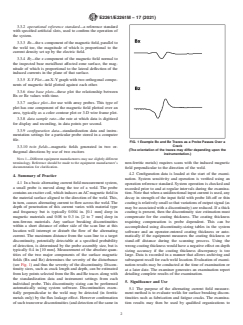
3.3.3 Bx—the x component of the magnetic field, parallel to
the weld toe, the magnitude of which is proportional to the
current density set up by the electric field.
3.3.4 Bz—the z component of the magnetic field normal to
the inspected base metal/heat affected zone surface, the mag-
nitude of which is proportional to the lateral deflection of the
induced currents in the plane of that surface.
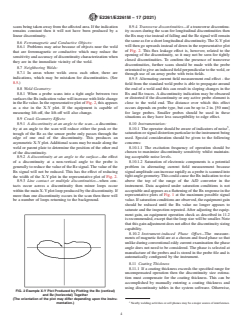
3.3.5 X-Y Plot—an X-Ygraph with two orthogonal compo-
nents of magnetic field plotted against each other.
3.3.6 time base plots—these plot the relationship between
Bx or Bz values with time.
3.3.7 surface plot—for use with array probes. This type of
plot has one component of the magnetic field plotted over an
area, typically as a color contour plot or 3-D wire frame plot.
3.3.8 data sample rate—the rate at which data is digitized
for display and recording, in data points per second.
3.3.9 configuration data—standardization data and instru-
mentation settings for a particular probe stored in a computer
file.
FIG. 1 Example Bx and Bz Traces as a Probe Passes Over a
Crack
3.3.10 twin fields—magnetic fields generated in two or-
(The orientation of the traces may differ depending upon the
thogonal directions by use of two exciters
instrumentation.)
NOTE 1—Different equipment manufacturers may use slightly different
terminology. Reference should be made to the equipment manufacturer’s non-ferritic metals) requires scans with the induced magnetic
documentation for clarification.
field perpendicular to the direction of the weld.
4.2 Configuration data is loaded at the start of the exami-
4. Summary of Practice
nation. System sensitivity and operation is verified using an
4.1 In a basic alternating current field measurement system,
operation reference standard. System operation is checked and
a small probe is moved along the toe of a weld. The probe recorded prior to and at regular intervals during the examina-
containsanexcitercoil,whichinducesanACmagneticfieldin
tion. Note that when a unidirectional input current is used, any
the material surface aligned to the direction of the weld. This, decay in strength of the input field with probe lift-off or thin
in turn, causes alternating current to flow across the weld. The
coatingisrelativelysmallsothatvariationsofoutputsignal(as
depth of penetration of this current varies with material type may be associated with a discontinuity) are reduced. If a thick
and frequency but is typically 0.004 in. [0.1 mm] deep in
coating is present, then the discontinuity size estimation must
magnetic materials and 0.08 to 0.3 in. [2 to 7 mm] deep in compensate for the coating thickness. The coating thickness
non-ferrous materials. Any surface breaking discontinuities
requiring compensation is probe dependent. This can be
within a short distance of either side of the scan line at this
accomplished using discontinuity-sizing tables in the system
location will interrupt or disturb the flow of the alternating
software and an operator-entered coating thickness or auto-
current. The maximum distance from the scan line to a target
matically if the equipment measures the coating thickness or
discontinuity, potentially detectable at a specified probability
stand-off distance during the scanning process. Using the
of detection, is determined by the probe assembly size, but is
wrongcoatingthicknesswouldhaveanegativeeffectondepth
typically 0.4 in [10 mm]. Measurement of the absolute quan-
sizing accuracy if the coating thickness discrepancy is too
tities of the two major components of the surface magnetic
large. Data is recorded in a manner that allows archiving and
fields (Bx and Bz) determines the severity of the disturbance
subsequent recall for each weld location. Evaluation of exami-
(see Fig. 1) and thus the severity of the discontinuity. Discon-
nation results may be conducted at the time of examination or
tinuity sizes, such as crack length and depth, can be estimated at a later date. The examiner generates an examination report
from key points selected from the Bx and Bz traces along with
detailing complete results of the examination.
the standardization data and instrument settings from each
5. Significance and Use
individual probe. This discontinuity sizing can be performed
automatically using system software. Discontinuities essen- 5.1 The purpose of the alternating current field measure-
tially perpendicular to the weld may be detected (in ferritic ment method is to evaluate welds for surface breaking discon-
metals only) by the flux leakage effect. However confirmation tinuities such as fabrication and fatigue cracks. The examina-
ofsuchtransversediscontinuities(anddetectionofthesamein tion results may then be used by qualified organizations to
E2261/E2261M − 17 (2021)
assess weld service life or other engineering characteristics 7.1.13 Disposition of examination records and reference
(beyond the scope of this practice). This practice is not standards.
intendedfortheexaminationofweldsfornon-surfacebreaking 7.1.14 Format and outline contents of the examination
discontinuities. report.
6. Basis of Application 8. Interferences
6.1 Personnel Qualification: 8.1 This section describes items and conditions, which may
compromise the alternating current field measurement tech-
6.1.1 If specified in the contractual agreement, personnel
nique.
performing examinations to this practice shall be qualified in
accordance with a nationally or internationally recognized
8.2 Material Properties:
NDT personnel qualification practice or standard such as
8.2.1 Although there are permeability differences in a fer-
ANSI/ASNT-CP-189, SNT-TC-1A, ISO 9712, or a similar
romagnetic material between weld metal, heat affected zone
document and certified by the employer or certifying agent, as
and parent plate, the probe is normally scanned along a weld
applicable. The practice or standard used and its applicable
toe and so passes along a line of relatively constant permeabil-
revision shall be identified in the contractual agreement be-
ity. If a probe is scanned across a weld then the permeability
tween the using parties.
changes may produce indications, which could be similar to
thosefromadiscontinuity.Differentiationbetweenatransverse
6.2 Qualification of Nondestructive Evaluation Agencies—if
discontinuity signal and the weld signal can be achieved by
specified in the contractual agreement, NDT agencies shall be
takingfurtherscansparalleltotheindication,orusinganarray
qualified and evaluated as described in Practice E543, with
probe.Thesignalfromadiscontinuitywilldieawayquickly.If
reference to sections on electromagnetic examination. The
there is no significant change in indication amplitude at 0.8 in.
applicable edition of Practice E543 shall be specified in the
[20 mm] distance from the weld then the indication is likely
contractual agreement.
due to the permeability changes in the weld.
7. Job Scope and Requirements
8.3 Magnetic State:
8.3.1 Demagnetization—It must be ensured that the surface
7.1 The following items may require agreement by the
being examined is in the non-magnetized state. Therefore the
examining party and their client and should be specified in the
procedure followed with any previous magnetic technique
purchase document or elsewhere:
deployed must include demagnetization of the surface. This is
7.1.1 Location and type of welded component to be
becauseareasofremnantmagnetization,particularlywherethe
examined, design specifications, degradation history, previous
leg of a magnetic particle examination yoke was sited, can
nondestructive examination results, maintenance history, pro-
produce loops in the X-Y plot, which may sometimes be
cess conditions, and specific types of discontinuities that are
confused with a discontinuity indication.
required to be detected, if known.
8.3.2 Grinding marks—magnetic permeability can also be
7.1.2 The maximum window of opportunity for work.
affected by surface treatments such as grinding. These can
(Detection of small discontinuities may require a slower probe
cause localized areas of altered permeability across the line of
scan speed, or cleaning of surface, or both, which will affect
scan direction. The extent and pressure of any grinding marks
productivity.)
should always be reported by the probe operator, since these
7.1.3 Size, material grade and type, and configuration of
can give rise to strong indications in both Bx and Bz, which
weldstobeexamined.Ifrequiredbytypeofequipmentchosen,
may be confused with a discontinuity indication. If a discon-
thickness of coating and variation of coating thickness.
tinuityissuspectedinaregionofgrinding,furtherscansshould
7.1.4 A weld numbering or identification system.
betakenparallelbutawayfromtheweldtoeandperpendicular
7.1.5 Extent of examination, for example: complete or
across the region of grinding. The indication from a linear
partial coverage, which welds and to what length, whether
discontinuity will die away quickly away from the location of
straight sections only and the minimum surface curvature.
the discontinuity so that the scan away from the weld toe will
7.1.6 Meansofaccesstowelds,andareaswhereaccessmay
be flatter. If there is no significant change in indication
be restricted.
amplitude at 0.80 in. [20 mm] distance from the weld then the
7.1.7 Type of alternating current field measurement instru-
indication is likely due to the effect of the grinding. The
ment and probe; and description of operations referece stan-
indication from a region of grinding will be the same for the
dard used, including such details as dimensions and material.
perpendicular scan.
7.1.8 Required operator qualifications and certification.
8.4 Residual stress, with accompanying permeability
7.1.9 Required weld cleanliness.
variations, may be present with effects similar to those due to
7.1.10 Environmental conditions, equipment and prepara-
grinding, but are much smaller.
tions that are the responsibility of the client; common sources
of noise that may interfere with the examination.
8.5 Seam Welds:
7.1.11 Complementary methods or techniques may be used
8.5.1 Seam welds running across the line of scanning also
to obtain additional information. produce strong indications in the Bx and Bz, which can
7.1.12 Acceptance criteria to be used in evaluating discon- sometimes be confused, with a discontinuity indication. The
tinuities. same procedure is used as for grinding marks with further
E2261/E2261M − 17 (2021)
scansbeingtakenawayfromtheaffectedarea.Iftheindication 8.9.4 Transverse discontinuities—ifatransversediscontinu-
remains constant then it will not have been produced by a ity occurs during the scan for longitudinal discontinuities then
linear discontinuity. theBxmayriseinsteadoffallingandtheBzsignalwillremain
thesameasforashortlongitudinaldiscontinuity.TheX-Yplot
8.6 Ferromagnetic and Conductive Objects:
willthengoupwardsinsteadofdownintherepresentativeplot
8.6.1 Problems may arise because of objects near the weld
of Fig. 2. This flux leakage effect is, however, related to the
that are ferromagnetic or conductive which may reduce the
opening of the discontinuity, so it may not be seen for tightly
sensitivityandaccuracyofdiscontinuitycharacterizationwhen
closed discontinuities. To confirm the presence of transverse
they are in the immediate vicinity of the weld.
discontinuities, further scans should be made with the probe
8.7 Neighboring Welds:
orientatedtogiveaninducedfieldperpendiculartotheweld,or
8.7.1 In areas where welds cross each other, there are
through use of an array probe with twin fields.
indications, which may be mistaken for discontinuities. (See
8.9.5 Alternating current field measurement end effect - the
8.5.)
field from the standard weld probe is able to propagate around
8.8 Weld Geometry: the end of a weld and this can result in sloping changes in the
8.8.1 When a probe scans into a tight angle between two Bx and Bz traces.Adiscontinuity indication may be obscured
or distorted if the discontinuity or any active probe element is
surfacestheBxindicationvaluewillincreasewithlittlechange
intheBzvalue.IntherepresentativeplotofFig.2,thisappears close to the weld end. The distance over which this effect
occurs depends on probe type, but can be up to 2 in. [50 mm]
as a rise in the X-Y plot. If the equipment is capable of
measuring lift-off, the lift-off will also change. for large probes. Smaller probes should be used in these
situations as they have less susceptibility to edge effect.
8.9 Crack Geometry Effects:
8.9.1 A discontinuity at an angle to the scan—a discontinu- 8.10 Instrumentation:
8.10.1 Theoperatorshouldbeawareofindicatorsofnoise ,
ity at an angle to the scan will reduce either the peak or the
trough of the Bz as the sensor probe only passes through the saturationorsignaldistortionparticulartotheinstrumentbeing
used. Special consideration should be given to the following
edge of one end of the discontinuity. This produces an
asymmetricX-Yplot.Additionalscansmaybemadealongthe concerns:
8.10.1.1 The excitation frequency of operation should be
weld or parent plate to determine the position of the other end
of the discontinuity. chosen to maximize discontinuity sensitivity whilst maintain-
ing acceptable noise levels.
8.9.2 A discontinuity at an angle to the surface—the effect
of a discontinuity at a non-vertical angle to the probe is 8.10.1.2 Saturation of electronic components is a potential
problem in alternating current field measurement because
generallytoreducethevalueoftheBzsignal.Thevalueofthe
Bx signal will not be reduced. This has the effect of reducing signalamplitudecanincreaserapidlyasaprobeisscannedinto
tightanglegeometry.ThiscouldcausetheBxindicationtorise
the width of the X-Y plot in the representative plot of Fig. 2.
8.9.3 Line contact or multiple discontinuities—when con- above the top of the range of the A/D converter in the
tacts occur across a discontinuity then minor loops occur instrument. Data acquired under saturation conditions is not
acceptableandappearsasaflatteningoftheBxresponseinthe
withinthemainX-Yplotloopproducedbythediscontinuity.If
more than one discontinuity occurs in the scan then there will representative plots of Fig. 1 at the maximum possible signal
value.Ifsaturationconditionsareobserved,theequipmentgain
be a number of loops returning to the background.
should be reduced until the Bx value no longer appears to
saturate and the inspection repeated.After adjusting the equip-
ment gain, an equipment operation check as described in 11.2
isrecommended,exceptthattheloopsizewillbesmaller.Note
thatthisgainadjustmentdoesnotaffectthediscontinuitysizing
capability.
8.10.2 Instrument-induced Phase Offset—The measure-
ments of magnetic field are at a chosen and fixed phase so that
unlikeduringconventionaleddycurrentexaminationthephase
angle does not need to be considered. The phase is selected at
manufacture of the probes and is stored in the probe file and is
automatically configured by the instrument.
8.11 Coating Thickness
8.11.1 If a coating thickness exceeds the specified range for
uncompensated operation then the discontinuity size estima-
tion must compensate for the coating thickness. This can be
accomplished by manually entering a coating thickness and
using discontinuity tables in the system software. Otherwise,
FIG. 2 Example X-Y Plot Produced by Plotting the Bx (vertical)
and Bz (horizontal) Together
(The orientation of the plot may differ depending upon the instru-
mentation.) Nearbyweldingactivitiesorcellphonesmaybeamajorsourceofinterference.
E2261/E2261M − 17 (2021)
using the wrong coating thickness would reduce the depth 9.3.1.1 Standard weld probe—commonly used for weld
sizing accuracy. Alternatively, the compensation may be per- examination whenever possible as it has its coils positioned
formed automatically if the equipment measures the stand-off ideally for discontinuity sizing.
distance or coating thickness during the scanning process. 9.3.1.2 Tight access probe—designed specifically for occa-
sions where the area under examination is not accessible with
9. Alternating Current Field Measurement System the standard weld probe. It is not as accurate as the weld probe
for sizing in open geometries such as butt welds.
9.1 Instrumentation
9.3.1.3 Grind repair probe—designed for the examination
9.1.1 The electronic instrumentation shall be capable of
of deep repair grinds. It has the same basic geometry as a
energizingtheexciteratoneormorefrequenciesappropriateto
standard probe but is more susceptible to produce indications
theweldmaterial.Theapparatusshallbecapableofmeasuring
from vertical probe movement.
the Bx and Bz magnetic field amplitudes at each frequency.
9.3.1.4 Mini-probe—designed for restricted access areas
The instrument will be supplied with a processor, either
such as cut outs and cruciforms and has a reduced edge effect.
internally,orintheformofaportablepersonalcomputer(PC),
It may be limited to shallow discontinuities only and is more
that has sufficient system capabilities to support the alternating
sensitive to lift off.This probe may be in the form of a straight
current field measurement software, which will be suitable for
entry or 90°.
the instrument and probes in use and the examination require-
9.3.1.5 Micro-probe—designed for high-sensitivity discon-
ments. The software provides control of the instrumentation
tinuity detection in restricted access areas and has the same
including set-up, data acquisition, data display, data analysis
limitations as a mini-probe. This probe may be in the form of
and data storage. The software provides algorithms for sizing
a straight entry or 90°.
the discontinuities (see 11.2.2). The software runs on the
9.3.1.6 Array probe—made up of a number of elements;
processor and, on start up, all communications between the
each element is sensitive to a discrete section of the weld
processor and the instrument are automatically checked.When
width. The elements may be oriented with their axes aligned
the software starts up it automatically sets up the instrument
longitudinally or transversely with respect to the weld toe.The
connected in the correct mode for alternating current field
array probe may have two orthogonal field exciters to allow
measurement examination. Configuration data for each probe
examinationforlongitudinalandtransversediscontinuitiesina
is stored either on the processor or on the probe and is
single scan. The array probe is generally used either for
transmitted to the instrument whenever a probe is selected or
scanning a weld cap in one pass or for covering a section of
changed. For non-magnetic materials, if configuration data is
plate.
not available from the equipment manufacturer, a standardiza-
9.3.1.7 Edge effect probe—designed to reduce the edge
tionmaybeperformedonreferenceblockspriortothematerial
effect when carrying out examination only near the ends of
examination.Equipmentoperationisalsocheckedbyscanning
welds. (Amini probe may also be used for the same examina-
over a reference standard (see 11.2.2). Once the instrumenta-
tion.)
tionissetupforaparticularprobe,thesoftwarecanbeusedto
9.4 Data Displays:
start and stop data acquisition. During data acquisition at least
9.4.1 ThedatadisplayshouldincludeBxandBzindications
two presentations of the data are presented on the display
as well as an X-Y plot.
screen in real time (see 4.1). Data from the probe is displayed
9.4.2 When multi-element array probes are being used, the
against time (with Fig. 1 as an example) and also as an X-Y
facility to produce color contour maps or 3D-wire frame plots
plot (with Fig. 2 as an example). The data from the probe can
representing peaks and troughs should be available.
also be displayed against position (see Fig. 1) if an encoder is
used with the probe. Depending upon equipment type, manual
9.5 Excitation Mechanism:
or automatic position markers may be incorporated with the 9.5.1 Thedegreeofuniformityofthemagneticfieldapplied
data. Once collected the data can be further analyzed offline
to the material under examination is determined by the
using the software to allow, for example, discontinuity sizing equipment manufacturer. Representative magnetic field distri-
(see 11.2.2) or annotation for transfer to examination reports.
butions are a uniform magnetic field and a graduated magnetic
Thesoftwarealsoprovidesfacilitiesforalldatacollectedtobe
field.The geometry of the slots used in the operation reference
electronically stored for subsequent review or reanalysis,
standard and the discontinuity sizing model must be consistent
printing or archiving.
with the excitation field.
9.2 Driving Mechanism:
10. Alterna
...