

ASTM E190-21
(Test Method)Standard Test Method for Guided Bend Test for Ductility of Welds
General Information
- Abstract
SIGNIFICANCE AND USE
5.1 The guided bend test as described in this test method is used to evaluate the quality of welds as a function of ductility as evidenced by their ability to resist cracking during bending.
SCOPE
1.1 This test method covers a guided bend test for the determination of soundness and ductility of welds in ferrous and nonferrous products. Flaws, not shown by X rays, can appear in the surface of a specimen when it is subjected to progressive localized overstressing.
1.2 The values stated in inch-pound units are to be regarded as standard. The values given in parentheses are mathematical conversions to SI units that are provided for information only and are not considered standard.
1.3 This standard does not purport to address all of the safety concerns, if any, associated with its use. It is the responsibility of the user of this standard to establish appropriate safety, health, and environmental practices and determine the applicability of regulatory limitations prior to use.
1.4 This international standard was developed in accordance with internationally recognized principles on standardization established in the Decision on Principles for the Development of International Standards, Guides and Recommendations issued by the World Trade Organization Technical Barriers to Trade (TBT) Committee.
- Status
- Published
- Publication Date
- 30-Jun-2021
- Technical Committee
- E28 - Mechanical Testing
- Drafting Committee
- E28.02 - Ductility and Formability

Overview
ASTM E190-21: Standard Test Method for Guided Bend Test for Ductility of Welds establishes a method for assessing the soundness and ductility of welds in ferrous and nonferrous materials. The guided bend test identifies cracks or flaws in welds that may not be detected by other non-destructive methods, such as radiography, by subjecting specimens to progressive localized overstressing. This standard is widely utilized across industries to evaluate weld quality, ensuring the integrity of welded structures and components.
Key Topics
Scope of the Standard
- Applies to welds in both ferrous and nonferrous products
- Primarily developed for plate specimens
- Evaluates the ductility and soundness of weld joints
Test Method Overview
- The weld specimen is shaped and bent in a jig, creating a U-form under controlled force
- The convex surface of the specimen is closely examined for cracks or open flaws
- Flaws or imperfections not visible via X-ray or other non-destructive tests may be revealed
Types of Bend Tests
- Transverse side bend
- Transverse face bend
- Transverse root bend
- Longitudinal face bend
- Longitudinal root bend
Interpretation of Results
- Acceptance determined by absence or allowable size of cracks, as specified in governing codes
- Results are typically reported as pass or fail, based on visual inspection following the bend
Safety and Practice
- Users are responsible for ensuring appropriate safety, health, and environmental practices
- The standard aligns with international standardization principles from the WTO TBT Committee
Applications
ASTM E190-21 is an indispensable tool for a range of quality assurance and control applications:
Weld Qualification and Certification
- Verifies compliance with industry codes and project specifications
- Used by welding inspectors to qualify welders and welding procedures
Manufacturing and Construction
- Ensures the performance and durability of welded joints in critical infrastructure, pressure vessels, pipelines, and structural steel
- Provides assurance that welds possess adequate ductility to serve their function safely
Failure Analysis and Research
- Uncovers welding defects that could potentially compromise integrity
- Utilized in research and development for improving welding processes and materials
Related Standards
For comprehensive weld testing and mechanical evaluation, consideration of the following standards is recommended:
ASTM E6 - Terminology Relating to Methods of Mechanical Testing
Provides definitions of key terms used in mechanical testing, including those essential for the guided bend test.AWS A3.0M/A3.0 - Standard Welding Terms and Definitions
Reference for weld-related terminology, supporting consistent interpretation and application of weld test methods.Relevant Specifications & Codes
- Refer to applicable welding codes that specify acceptance criteria for bend tests
- Related ASTM and ASME standards for weld destructive testing and mechanical testing procedures
Practical Value
Employing ASTM E190-21 for guided bend testing delivers measurable advantages:
- Confirms weld ductility and resistance to cracking, vital for safety-critical structures
- Detects surface flaws and weld discontinuities not always observable by other non-destructive test methods
- Supports compliance and certification processes required in various regulated industries
For manufacturers, inspectors, and engineers, ASTM E190-21 provides a reliable, widely recognized method for verifying weld quality and enhancing product reliability. Integrating this standard into your quality assurance program helps ensure the structural soundness and longevity of welded components.
Keywords: ASTM E190-21, guided bend test, weld ductility, weld quality, weld testing standard, mechanical testing, welding inspection, nonferrous welds, ferrous welds, weld qualification, destructive testing.
Relations
- Effective Date
- 15-May-2009
- Effective Date
- 15-May-2009
- Effective Date
- 01-Apr-2009
- Effective Date
- 01-Jan-2009
- Effective Date
- 01-Oct-2008
- Effective Date
- 01-Feb-2008
- Effective Date
- 01-Nov-2007
- Effective Date
- 01-Jun-2007
- Effective Date
- 01-Mar-2007
- Effective Date
- 01-Apr-2006
- Effective Date
- 10-Jun-2003
- Effective Date
- 10-Jun-2003
- Effective Date
- 10-Aug-2002
- Effective Date
- 10-Jul-1999
Get Certified
Connect with accredited certification bodies for this standard

DVS-ZERT GmbH
German welding certification society.
CARES (UK Certification Authority for Reinforcing Steels)
UK certification for reinforcing steels and construction.
EWF/IIW (European/International Welding Federation)
International welding personnel certification.
Sponsored listings
Frequently Asked Questions
ASTM E190-21 is a standard published by ASTM International. Its full title is "Standard Test Method for Guided Bend Test for Ductility of Welds". This standard covers: SIGNIFICANCE AND USE 5.1 The guided bend test as described in this test method is used to evaluate the quality of welds as a function of ductility as evidenced by their ability to resist cracking during bending. SCOPE 1.1 This test method covers a guided bend test for the determination of soundness and ductility of welds in ferrous and nonferrous products. Flaws, not shown by X rays, can appear in the surface of a specimen when it is subjected to progressive localized overstressing. 1.2 The values stated in inch-pound units are to be regarded as standard. The values given in parentheses are mathematical conversions to SI units that are provided for information only and are not considered standard. 1.3 This standard does not purport to address all of the safety concerns, if any, associated with its use. It is the responsibility of the user of this standard to establish appropriate safety, health, and environmental practices and determine the applicability of regulatory limitations prior to use. 1.4 This international standard was developed in accordance with internationally recognized principles on standardization established in the Decision on Principles for the Development of International Standards, Guides and Recommendations issued by the World Trade Organization Technical Barriers to Trade (TBT) Committee.
SIGNIFICANCE AND USE 5.1 The guided bend test as described in this test method is used to evaluate the quality of welds as a function of ductility as evidenced by their ability to resist cracking during bending. SCOPE 1.1 This test method covers a guided bend test for the determination of soundness and ductility of welds in ferrous and nonferrous products. Flaws, not shown by X rays, can appear in the surface of a specimen when it is subjected to progressive localized overstressing. 1.2 The values stated in inch-pound units are to be regarded as standard. The values given in parentheses are mathematical conversions to SI units that are provided for information only and are not considered standard. 1.3 This standard does not purport to address all of the safety concerns, if any, associated with its use. It is the responsibility of the user of this standard to establish appropriate safety, health, and environmental practices and determine the applicability of regulatory limitations prior to use. 1.4 This international standard was developed in accordance with internationally recognized principles on standardization established in the Decision on Principles for the Development of International Standards, Guides and Recommendations issued by the World Trade Organization Technical Barriers to Trade (TBT) Committee.
ASTM E190-21 is classified under the following ICS (International Classification for Standards) categories: 25.160.40 - Welded joints and welds. The ICS classification helps identify the subject area and facilitates finding related standards.
ASTM E190-21 has the following relationships with other standards: It is inter standard links to ASTM E6-09b, ASTM E6-09be1, ASTM E6-09a, ASTM E6-09, ASTM E6-08a, ASTM E6-08, ASTM E6-07b, ASTM E6-07a, ASTM E6-07, ASTM E6-06, ASTM E6-03, ASTM E6-03e1, ASTM E6-02a, ASTM E6-99e1. Understanding these relationships helps ensure you are using the most current and applicable version of the standard.
ASTM E190-21 is available in PDF format for immediate download after purchase. The document can be added to your cart and obtained through the secure checkout process. Digital delivery ensures instant access to the complete standard document.
Standards Content (Sample)
This international standard was developed in accordance with internationally recognized principles on standardization established in the Decision on Principles for the
Development of International Standards, Guides and Recommendations issued by the World Trade Organization Technical Barriers to Trade (TBT) Committee.
Designation: E190 − 21
Standard Test Method for
Guided Bend Test for Ductility of Welds
This standard is issued under the fixed designation E190; the number immediately following the designation indicates the year of
original adoption or, in the case of revision, the year of last revision. A number in parentheses indicates the year of last reapproval. A
superscript epsilon (´) indicates an editorial change since the last revision or reapproval.
This standard has been approved for use by agencies of the U.S. Department of Defense.
1. Scope 3. Terminology
1.1 This test method covers a guided bend test for the
3.1 Terms in this standard are defined in E6 Terminology
determination of soundness and ductility of welds in ferrous
Relating to Methods of Mechanical Testing. These terms
and nonferrous products. Flaws, not shown by X rays, can
include bend test, ductility, guided bend, and testing machine.
appear in the surface of a specimen when it is subjected to
3.2 Additional welding terms including defect,
progressive localized overstressing.
discontinuity, flaw, thermal cutting, weld root, weld face, and
1.2 The values stated in inch-pound units are to be regarded
weldment are defined in AWS A3.0M/A3.0.
as standard. The values given in parentheses are mathematical
conversions to SI units that are provided for information only
4. Summary of Test Method
and are not considered standard.
4.1 The specimen is bent in a U-shaped die by means of a
1.3 This standard does not purport to address all of the
centrally applied force to the weldment in a flat specimen
safety concerns, if any, associated with its use. It is the
supported at two positions equidistant from the line of force
responsibility of the user of this standard to establish appro-
application. The specimen is forced into the die by a plunger
priate safety, health, and environmental practices and deter-
having the shape necessary to produce the desired contour.The
mine the applicability of regulatory limitations prior to use.
convex surface of the bent specimen is examined for cracks or
1.4 This international standard was developed in accor-
other open flaws.
dance with internationally recognized principles on standard-
ization established in the Decision on Principles for the
5. Significance and Use
Development of International Standards, Guides and Recom-
5.1 The guided bend test as described in this test method is
mendations issued by the World Trade Organization Technical
Barriers to Trade (TBT) Committee. used to evaluate the quality of welds as a function of ductility
as evidenced by their ability to resist cracking during bending.
2. Referenced Documents
6. Apparatus
2.1 ASTM Standards:
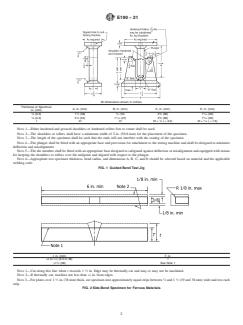
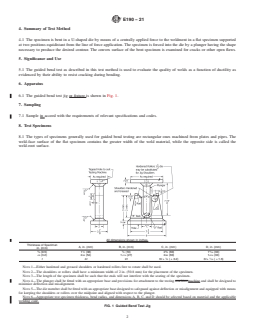
E6 Terminology Relating to Methods of Mechanical Testing 6.1 The guided bend test jig or fixture is shown in Fig. 1.
2.2 AWS Standard:
7. Sampling
AWSA3.0M/A3.0 Standard Welding Terms and Definitions;
Including Terms for Adhesive Bonding, Brazing,
7.1 Sample in accord with the requirements of relevant
Soldering, Thermal Cutting, and Thermal Spraying
specifications and codes.
8. Test Specimens
This test method is under the jurisdiction of ASTM Committee E28 on
8.1 The types of specimens generally used for guided bend
Mechanical Testing and is the direct responsibility of Subcommittee E28.02 on
testing are rectangular ones machined from plates and pipes.
Ductility and Formability.
Current edition approved July 1, 2021. Published August 2021. Originally
The weld-face surface of the flat specimen contains the greater
approved in 1961. Last previous edition approved in 2014 as E190 – 14. DOI:
width of the weld material, while the opposite side is called the
10.1520/E0190-21.
weld-root surface.
For referenced ASTM standards, visit the ASTM website, www.astm.org, or
contact ASTM Customer Service at service@astm.org. For Annual Book of ASTM
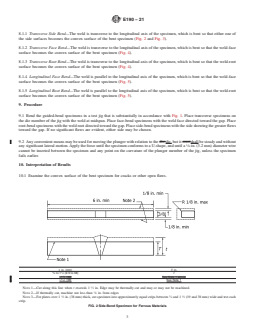
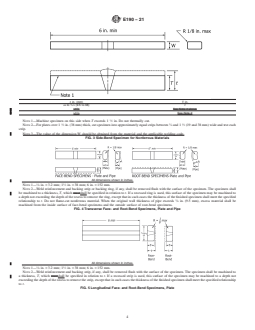
8.1.1 Transverse Side Bend—The weld is transverse to the
Standards volume information, refer to the standard’s Document Summary page on
longitudinal axis of the specimen, which is bent so that either
the ASTM website.
oneofthesidesurfacesbecomestheconvexsurfaceofthebent
Available from American Welding Society (AWS), 8669 NW 36 Street, #130,
Miami, FL 33166-6672, http://www.aws.org. specimen (Fig. 2 and Fig. 3).
Copyright © ASTM International, 100 Barr Harbor Drive, PO Box C700, West Conshohocken, PA 19428-2959. United States
E190 − 21
All dimensions shown in inches.
Thickness of Specimen
A, in. (mm) B, in. (mm) C, in. (mm) D, in. (mm)
in. (mm)
3 1 3 3 3
⁄8 (9.5) 1 ⁄2 (38) ⁄4 (19) 2 ⁄8 (60) 1 ⁄16 (30)
1 1 1 3 3
⁄8 (3.2) 2 ⁄8 (54) 1 ⁄16 (27) 2 ⁄8 (60) 1 ⁄16 (30)
1 1
t 4t 2t 6t + ⁄8 ( + 3.2) 3t + ⁄16(+1.6)
NOTE 1—Either hardened and greased shoulders or hardened rollers free to rotate shall be used.
NOTE 2—The shoulders or rollers shall have a minimum width of 2 in. (50.8 mm) for the placement of the specimen.
NOTE 3—The length of the specimen shall be such that the ends will not interfere with the seating of the specimen.
NOTE 4—The plunger shall be fitted with an appropriate base and provisions for attachment to the testing machine and shall be designed to minimize
deflection and misalignment.
NOTE 5—The die member shall be fitted with an appropriate base designed to safeguard against deflection or misalignment and equipped with means
for keeping the shoulders or rollers over the midpoint and aligned with respect to the plunger.
NOTE 6—Appropriate test specimen thickness, bend radius, and dimensions A, B, C, and D should be selected based on material and the applicable
welding code.
FIG. 1 Guided Bend Test Jig
t, in. (mm) T,in.
3 1
⁄8 to 1 ⁄2 (9.5 to 38) t
>1 ⁄2 (38) See Note 1
NOTE 1—Cut along this line when t exceeds 1 ⁄2 in. Edge may be thermally cut and may or may not be machined.
NOTE 2—If thermall
...
This document is not an ASTM standard and is intended only to provide the user of an ASTM standard an indication of what changes have been made to the previous version. Because
it may not be technically possible to adequately depict all changes accurately, ASTM recommends that users consult prior editions as appropriate. In all cases only the current version
of the standard as published by ASTM is to be considered the official document.
Designation: E190 − 14 E190 − 21
Standard Test Method for
Guided Bend Test for Ductility of Welds
This standard is issued under the fixed designation E190; the number immediately following the designation indicates the year of
original adoption or, in the case of revision, the year of last revision. A number in parentheses indicates the year of last reapproval. A
superscript epsilon (´) indicates an editorial change since the last revision or reapproval.
This standard has been approved for use by agencies of the U.S. Department of Defense.
1. Scope
1.1 This test method covers a guided bend test for the determination of soundness and ductility of welds in ferrous and nonferrous
products. Flaws, not shown by X rays, maycan appear in the surface of a specimen when it is subjected to progressive localized
overstressing. This guided bend test has been developed primarily for plates and is not intended to be substituted for other methods
of bend testing.
1.2 The values stated in inch-pound units are to be regarded as standard. The values given in parentheses are mathematical
conversions to SI units that are provided for information only and are not considered standard.
1.3 This standard does not purport to address all of the safety concerns, if any, associated with its use. It is the responsibility
of the user of this standard to establish appropriate safety safety, health, and healthenvironmental practices and determine the
applicability of regulatory limitations prior to use.
1.4 This international standard was developed in accordance with internationally recognized principles on standardization
established in the Decision on Principles for the Development of International Standards, Guides and Recommendations issued
by the World Trade Organization Technical Barriers to Trade (TBT) Committee.
2. Referenced Documents
2.1 ASTM Standards:
E6 Terminology Relating to Methods of Mechanical Testing
2.2 AWS Standard:
AWS A3.0M/A3.0 Standard Welding Terms and Definitions; Including Terms for Adhesive Bonding, Brazing, Soldering,
Thermal Cutting, and Thermal Spraying
3. Terminology
3.1 Terms in this standard are defined in E6 Terminology Relating to Methods of Mechanical Testing. These terms include bend
test, ductility, guided bend, and testing machine.
3.2 Additional welding terms including defect, discontinuity, flaw, thermal cutting, weld root, weld face, and weldment are defined
in AWS A3.0M/A3.0:2010.A3.0M/A3.0.
This test method is under the jurisdiction of ASTM Committee E28 on Mechanical Testing and is the direct responsibility of Subcommittee E28.02 on Ductility and
Formability.
Current edition approved May 1, 2014July 1, 2021. Published September 2014August 2021. Originally approved in 1961. Last previous edition approved in 20082014
as E190 – 92 (2008).E190 – 14. DOI: 10.1520/E0190-14.10.1520/E0190-21.
For referenced ASTM standards, visit the ASTM website, www.astm.org, or contact ASTM Customer Service at service@astm.org. For Annual Book of ASTM Standards
volume information, refer to the standard’s Document Summary page on the ASTM website.
Available from American Welding Society (AWS), 8669 NW 36 Street, #130, Miami, FL 33166-6672, http://www.aws.org.
Copyright © ASTM International, 100 Barr Harbor Drive, PO Box C700, West Conshohocken, PA 19428-2959. United States
E190 − 21
4. Summary of Test Method
4.1 The specimen is bent in a U-shaped die by means of a centrally applied force to the weldment in a flat specimen supported
at two positions equidistant from the line of force application. The specimen is forced into the die by a plunger having the shape
necessary to produce the desired contour. The convex surface of the bent specimen is examined for cracks or other open flaws.
5. Significance and Use
5.1 The guided bend test as described in this test method is used to evaluate the quality of welds as a function of ductility as
evidenced by their ability to resist cracking during bending.
6. Apparatus
6.1 The guided bend test jig or fixture is shown in Fig. 1.
7. Sampling
7.1 Sample in accord with the requirements of relevant specifications and codes.
8. Test Specimens
8.1 The types of specimens generally used for guided bend testing are rectangular ones machined from plates and pipes. The
weld-face surface of the flat specimen contains the greater width of the weld material, while the opposite side is called the
weld-root surface.
All dimensions shown in inches.
Thickness of Specimen
A, in. (mm) B, in. (mm) C, in. (mm) D, in. (mm)
in. (mm)
3 1 3 3 3
⁄8 (9.5) 1 ⁄2 (38) ⁄4 (19) 2 ⁄8 (60) 1 ⁄16 (30)
1 1 1 3 3
⁄8 (3.2) 2 ⁄8 (54) 1 ⁄16 (27) 2 ⁄8 (60) 1 ⁄16 (30)
1 1
t 4t 2t 6t + ⁄8 ( + 3.2) 3t + ⁄16 ( + 1.6)
NOTE 1—Either hardened and greased shoulders or hardened rollers free to rotate shall be used.
NOTE 2—The shoulders or rollers shall have a minimum width of 2 in. (50.8 mm) for the placement of the specimen.
NOTE 3—The length of the specimen shall be such that the ends will not interfere with the seating of the specimen.
NOTE 4—The plunger shall be fitted with an appropriate base and provisions for attachment to the testing machine;machine and shall be designed to
minimize deflection and misalignment.
NOTE 5—The die member shall be fitted with an appropriate base designed to safeguard against deflection or misalignment and equipped with means
for keeping the shoulders or rollers over the midpoint and aligned with respect to the plunger.
NOTE 6—Appropriate test specimen thickness, bend radius, and dimensions A, B, C, and D should be selected based on material and the applicable
welding code.
FIG. 1 Guided Bend Test Jig
E190 − 21
8.1.1 Transverse Side Bend—The weld is transverse to the longitudinal axis of the specimen, which is bent so that either one of
the side surfaces becomes the convex surface of the bent specimen (Fig. 2 and Fig. 3).
8.1.2 Transverse Face Bend—The weld is
...