

ASTM F3183-21
(Practice)Standard Practice for Guided Side Bend Evaluation of Polyethylene Pipe Butt Fusion Joint
General Information
- Abstract
SIGNIFICANCE AND USE
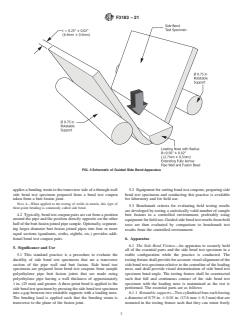
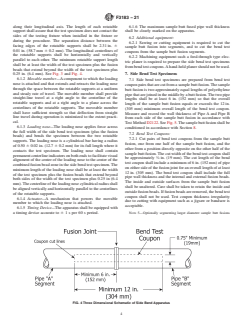
5.1 This standard practice is a procedure to evaluate the ductility of side bend test specimens that are a transverse section of the pipe wall and butt fusion. Side bend test specimens are prepared from bend test coupons from sample polyethylene pipe butt fusion joints that are made using polyethylene pipe having a wall thickness of approximately 1 in. (25 mm) and greater. A three-point bend is applied to the side bend test specimen by pressing the side bend test specimen into a gap between two rotatable supports with a loading nose. The bending load is applied such that the bending strain is transverse to the plane of the fusion joint.
5.2 Equipment for cutting bend test coupons, preparing side bend test specimens and conducting this practice is available for laboratory and for field use.
5.3 Benchmark criteria for evaluating field testing results are developed by testing a statistically valid number of sample butt fusions in a controlled environment, preferably using equipment for field use. Guided side bend test results from field tests are then evaluated by comparison to benchmark test results from the controlled environment.
SCOPE
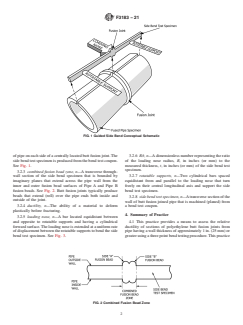
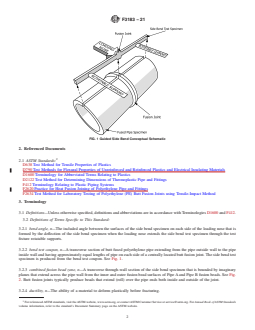
1.1 This practice provides information on apparatus, specimen preparation and procedure for conducting a guided three point side bend evaluation of a transverse specimen cut from a coupon removed from a butt fusion joint in polyethylene pipe having a wall thickness of approximately 1 in. (25 mm) and thicker. See Fig. 1. This practice provides a means to assess ductility of a butt fusion joint by applying a lateral (side) bending strain across a specimen taken from the full butt fusion cross-section, from outside diameter to inside diameter.
Note 1: For wall thicknesses less than 1 in. the user is referred to Practice F2620, Appendix X4.1 for bend back testing.
FIG. 1 Guided Side Bend Conceptual Schematic
1.2 No test values are provided by this practice. The result is a non-numerical report. Criteria for test result evaluation are provided in standards or codes that specify the use of this practice by comparison to benchmark laboratory results as described in 5.3 or by comparison to example results presented in Appendix X1 to this practice.
1.3 Units—The values stated in inch-pound units are to be regarded as standard. The values given in parentheses are mathematical conversions to SI units that are provided for information only and are not considered standard.
1.4 This standard does not purport to address all of the safety concerns, if any, associated with its use. It is the responsibility of the user of this standard to establish appropriate safety, health, and environmental practices and determine the applicability of regulatory limitations prior to use.
Note 2: Laboratory methods that are commonly used for testing polyethylene butt fusion joints include Test Method D638, Test Method D790 and Test Method F2634.
Note 3: This practice has been developed for use on butt fusion joints in polyethylene pipe with a wall thickness of 1.00 in. or greater. The practice may be used on butt fusion joints in polyethylene pipe with thinner wall thicknesses. However, the applicability of the practice should be determined by the user of the practice.
1.5 This international standard was developed in accordance with internationally recognized principles on standardization established in the Decision on Principles for the Development of International Standards, Guides and Recommendations issued by the World Trade Organization Technical Barriers to Trade (TBT) Committee.
- Status
- Published
- Publication Date
- 31-Oct-2021
- Technical Committee
- F17 - Plastic Piping Systems
- Drafting Committee
- F17.40 - Test Methods
Buy Documents
ASTM F3183-21 - Standard Practice for Guided Side Bend Evaluation of Polyethylene Pipe Butt Fusion Joint
REDLINE ASTM F3183-21 - Standard Practice for Guided Side Bend Evaluation of Polyethylene Pipe Butt Fusion Joint
Overview
ASTM F3183-21: Standard Practice for Guided Side Bend Evaluation of Polyethylene Pipe Butt Fusion Joint provides a systematic approach for assessing the ductility of butt fusion joints in polyethylene (PE) pipes using a guided side bend test. This method is applicable to PE pipes with a wall thickness of approximately 1 inch (25 mm) and greater. The side bend evaluation is especially significant in verifying the quality and toughness of fused joints, as ductility is critical for long-term pipe integrity in plastic piping systems.
The procedure specifies apparatus, specimen preparation, and guided three-point side bend testing of a specimen cut transversely from the fused joint. Rather than generating numerical output, the result is a qualitative, non-numerical report evaluated against benchmarks established in controlled settings. This practice is suitable for both laboratory and field conditions, ensuring comprehensive evaluation practices are available across diverse operational contexts.
Key Topics
- Ductility Assessment: Evaluates the ability of a butt fusion joint to deform plastically before failure, ensuring the joint exhibits adequate flexibility and structural integrity.
- Specimen Preparation: Specifies detailed steps for cutting, machining, and conditioning test specimens from the full wall thickness of PE pipe, including retention of internal and external fusion beads.
- Three-point Side Bend Testing: Uses a side bend fixture with rotatable supports and a loading nose to apply lateral bending force perpendicular to the joint plane.
- Field and Laboratory Testing: Equipment and procedures are designed for use both in controlled laboratory environments and in the field, increasing the applicability for pipeline installation and quality control.
- Benchmark Evaluation: Field test results are compared against benchmark results established through controlled, statistically significant laboratory tests.
- Qualitative Reporting: Test outcomes are non-numerical and reported as pass/fail based on visual inspection and benchmark comparison.
Applications
This standard is of high practical value for:
- Quality Assurance in Pipe Fusion: Ensures that polyethylene butt fusion joints, especially in critical systems like gas, water, and industrial pipelines, meet required ductility and performance standards.
- Operator Qualification: Used in operator training and certification to validate proper fusion technique.
- Field Assessments: Offers a robust method for on-site evaluation of joint quality during pipeline installation projects, minimizing the risk of premature joint failure in service.
- Material Comparisons: Supports comparative studies between different PE pipe materials and fusion techniques, informing best practices.
- Compliance and Inspection: Helps pipeline owners and inspectors demonstrate compliance with industry codes that reference ASTM F3183-21 for guided side bend evaluation.
For wall thicknesses less than 1 inch, the standard refers users to ASTM F2620, Appendix X4.1 for alternative bend testing procedures.
Related Standards
ASTM F3183-21 is closely aligned with several other ASTM standards on plastic piping systems and testing, including:
- ASTM D638 - Test Method for Tensile Properties of Plastics
- ASTM D790 - Methods for Flexural Properties of Unreinforced and Reinforced Plastics
- ASTM F2620 - Practice for Heat Fusion Joining of Polyethylene Pipe and Fittings
- ASTM F2634 - Test Method for Laboratory Testing of Polyethylene Butt Fusion Joints using Tensile-Impact Method
- ASTM D2122 - Measuring Dimensions of Thermoplastic Pipe and Fittings
- ASTM F412 & D1600 - Terminology relating to plastics and piping
These supporting standards provide additional definitions, test methods, and terminology relevant for comprehensive plastic pipe testing and documentation.
Keywords: ASTM F3183-21, guided side bend, polyethylene pipe, butt fusion joint, ductility, three-point bend test, field testing, fusion joint evaluation, plastic piping systems, pipeline integrity, quality control.
Relations
- Effective Date
- 01-Apr-2020
- Effective Date
- 01-Jan-2019
- Refers
ASTM D1600-18 - Standard Terminology for Abbreviated Terms Relating to Plastics (Withdrawn 2024) - Effective Date
- 01-Jan-2018
- Effective Date
- 01-Aug-2017
- Effective Date
- 01-Jul-2017
- Effective Date
- 01-Feb-2017
- Effective Date
- 15-Nov-2016
- Effective Date
- 01-Aug-2016
- Effective Date
- 01-Dec-2015
- Effective Date
- 01-Dec-2015
- Effective Date
- 01-Jun-2015
- Refers
ASTM D2122-15 - Standard Test Method for Determining Dimensions of Thermoplastic Pipe and Fittings - Effective Date
- 15-Mar-2015
- Effective Date
- 01-Feb-2014
- Effective Date
- 01-Nov-2013
- Effective Date
- 15-Apr-2013
Buy Documents
ASTM F3183-21 - Standard Practice for Guided Side Bend Evaluation of Polyethylene Pipe Butt Fusion Joint
REDLINE ASTM F3183-21 - Standard Practice for Guided Side Bend Evaluation of Polyethylene Pipe Butt Fusion Joint
Get Certified
Connect with accredited certification bodies for this standard

DVS-ZERT GmbH
German welding certification society.
CARES (UK Certification Authority for Reinforcing Steels)
UK certification for reinforcing steels and construction.
EWF/IIW (European/International Welding Federation)
International welding personnel certification.
Sponsored listings
Frequently Asked Questions
ASTM F3183-21 is a standard published by ASTM International. Its full title is "Standard Practice for Guided Side Bend Evaluation of Polyethylene Pipe Butt Fusion Joint". This standard covers: SIGNIFICANCE AND USE 5.1 This standard practice is a procedure to evaluate the ductility of side bend test specimens that are a transverse section of the pipe wall and butt fusion. Side bend test specimens are prepared from bend test coupons from sample polyethylene pipe butt fusion joints that are made using polyethylene pipe having a wall thickness of approximately 1 in. (25 mm) and greater. A three-point bend is applied to the side bend test specimen by pressing the side bend test specimen into a gap between two rotatable supports with a loading nose. The bending load is applied such that the bending strain is transverse to the plane of the fusion joint. 5.2 Equipment for cutting bend test coupons, preparing side bend test specimens and conducting this practice is available for laboratory and for field use. 5.3 Benchmark criteria for evaluating field testing results are developed by testing a statistically valid number of sample butt fusions in a controlled environment, preferably using equipment for field use. Guided side bend test results from field tests are then evaluated by comparison to benchmark test results from the controlled environment. SCOPE 1.1 This practice provides information on apparatus, specimen preparation and procedure for conducting a guided three point side bend evaluation of a transverse specimen cut from a coupon removed from a butt fusion joint in polyethylene pipe having a wall thickness of approximately 1 in. (25 mm) and thicker. See Fig. 1. This practice provides a means to assess ductility of a butt fusion joint by applying a lateral (side) bending strain across a specimen taken from the full butt fusion cross-section, from outside diameter to inside diameter. Note 1: For wall thicknesses less than 1 in. the user is referred to Practice F2620, Appendix X4.1 for bend back testing. FIG. 1 Guided Side Bend Conceptual Schematic 1.2 No test values are provided by this practice. The result is a non-numerical report. Criteria for test result evaluation are provided in standards or codes that specify the use of this practice by comparison to benchmark laboratory results as described in 5.3 or by comparison to example results presented in Appendix X1 to this practice. 1.3 Units—The values stated in inch-pound units are to be regarded as standard. The values given in parentheses are mathematical conversions to SI units that are provided for information only and are not considered standard. 1.4 This standard does not purport to address all of the safety concerns, if any, associated with its use. It is the responsibility of the user of this standard to establish appropriate safety, health, and environmental practices and determine the applicability of regulatory limitations prior to use. Note 2: Laboratory methods that are commonly used for testing polyethylene butt fusion joints include Test Method D638, Test Method D790 and Test Method F2634. Note 3: This practice has been developed for use on butt fusion joints in polyethylene pipe with a wall thickness of 1.00 in. or greater. The practice may be used on butt fusion joints in polyethylene pipe with thinner wall thicknesses. However, the applicability of the practice should be determined by the user of the practice. 1.5 This international standard was developed in accordance with internationally recognized principles on standardization established in the Decision on Principles for the Development of International Standards, Guides and Recommendations issued by the World Trade Organization Technical Barriers to Trade (TBT) Committee.
SIGNIFICANCE AND USE 5.1 This standard practice is a procedure to evaluate the ductility of side bend test specimens that are a transverse section of the pipe wall and butt fusion. Side bend test specimens are prepared from bend test coupons from sample polyethylene pipe butt fusion joints that are made using polyethylene pipe having a wall thickness of approximately 1 in. (25 mm) and greater. A three-point bend is applied to the side bend test specimen by pressing the side bend test specimen into a gap between two rotatable supports with a loading nose. The bending load is applied such that the bending strain is transverse to the plane of the fusion joint. 5.2 Equipment for cutting bend test coupons, preparing side bend test specimens and conducting this practice is available for laboratory and for field use. 5.3 Benchmark criteria for evaluating field testing results are developed by testing a statistically valid number of sample butt fusions in a controlled environment, preferably using equipment for field use. Guided side bend test results from field tests are then evaluated by comparison to benchmark test results from the controlled environment. SCOPE 1.1 This practice provides information on apparatus, specimen preparation and procedure for conducting a guided three point side bend evaluation of a transverse specimen cut from a coupon removed from a butt fusion joint in polyethylene pipe having a wall thickness of approximately 1 in. (25 mm) and thicker. See Fig. 1. This practice provides a means to assess ductility of a butt fusion joint by applying a lateral (side) bending strain across a specimen taken from the full butt fusion cross-section, from outside diameter to inside diameter. Note 1: For wall thicknesses less than 1 in. the user is referred to Practice F2620, Appendix X4.1 for bend back testing. FIG. 1 Guided Side Bend Conceptual Schematic 1.2 No test values are provided by this practice. The result is a non-numerical report. Criteria for test result evaluation are provided in standards or codes that specify the use of this practice by comparison to benchmark laboratory results as described in 5.3 or by comparison to example results presented in Appendix X1 to this practice. 1.3 Units—The values stated in inch-pound units are to be regarded as standard. The values given in parentheses are mathematical conversions to SI units that are provided for information only and are not considered standard. 1.4 This standard does not purport to address all of the safety concerns, if any, associated with its use. It is the responsibility of the user of this standard to establish appropriate safety, health, and environmental practices and determine the applicability of regulatory limitations prior to use. Note 2: Laboratory methods that are commonly used for testing polyethylene butt fusion joints include Test Method D638, Test Method D790 and Test Method F2634. Note 3: This practice has been developed for use on butt fusion joints in polyethylene pipe with a wall thickness of 1.00 in. or greater. The practice may be used on butt fusion joints in polyethylene pipe with thinner wall thicknesses. However, the applicability of the practice should be determined by the user of the practice. 1.5 This international standard was developed in accordance with internationally recognized principles on standardization established in the Decision on Principles for the Development of International Standards, Guides and Recommendations issued by the World Trade Organization Technical Barriers to Trade (TBT) Committee.
ASTM F3183-21 is classified under the following ICS (International Classification for Standards) categories: 25.160.40 - Welded joints and welds. The ICS classification helps identify the subject area and facilitates finding related standards.
ASTM F3183-21 has the following relationships with other standards: It is inter standard links to ASTM F412-20, ASTM F412-19, ASTM D1600-18, ASTM F412-17a, ASTM D790-17, ASTM F412-17, ASTM F412-16a, ASTM F412-16, ASTM D790-15, ASTM D790-15e1, ASTM F412-15, ASTM D2122-15, ASTM D1600-14, ASTM F2620-13, ASTM D1600-13. Understanding these relationships helps ensure you are using the most current and applicable version of the standard.
ASTM F3183-21 is available in PDF format for immediate download after purchase. The document can be added to your cart and obtained through the secure checkout process. Digital delivery ensures instant access to the complete standard document.
Standards Content (Sample)
This international standard was developed in accordance with internationally recognized principles on standardization established in the Decision on Principles for the
Development of International Standards, Guides and Recommendations issued by the World Trade Organization Technical Barriers to Trade (TBT) Committee.
Designation: F3183 − 21
Standard Practice for
Guided Side Bend Evaluation of Polyethylene Pipe Butt
Fusion Joint
This standard is issued under the fixed designation F3183; the number immediately following the designation indicates the year of
original adoption or, in the case of revision, the year of last revision. A number in parentheses indicates the year of last reapproval. A
superscript epsilon (´) indicates an editorial change since the last revision or reapproval.
1. Scope 1.5 This international standard was developed in accor-
dance with internationally recognized principles on standard-
1.1 This practice provides information on apparatus, speci-
ization established in the Decision on Principles for the
men preparation and procedure for conducting a guided three
Development of International Standards, Guides and Recom-
point side bend evaluation of a transverse specimen cut from a
mendations issued by the World Trade Organization Technical
coupon removed from a butt fusion joint in polyethylene pipe
Barriers to Trade (TBT) Committee.
having a wall thickness of approximately 1 in. (25 mm) and
thicker. See Fig. 1. This practice provides a means to assess
2. Referenced Documents
ductility of a butt fusion joint by applying a lateral (side)
bendingstrainacrossaspecimentakenfromthefullbuttfusion 2.1 ASTM Standards:
cross-section, from outside diameter to inside diameter. D638 Test Method for Tensile Properties of Plastics
D790 Test Methods for Flexural Properties of Unreinforced
NOTE 1— For wall thicknesses less than 1 in. the user is referred to
and Reinforced Plastics and Electrical Insulating Materi-
Practice F2620, Appendix X4.1 for bend back testing.
als
1.2 No test values are provided by this practice. The result
D1600 Terminology forAbbreviatedTerms Relating to Plas-
is a non-numerical report. Criteria for test result evaluation are
tics
provided in standards or codes that specify the use of this
D2122 Test Method for Determining Dimensions of Ther-
practice by comparison to benchmark laboratory results as
moplastic Pipe and Fittings
described in 5.3 or by comparison to example results presented
F412 Terminology Relating to Plastic Piping Systems
in Appendix X1 to this practice.
F2620 Practice for Heat Fusion Joining of Polyethylene Pipe
1.3 Units—The values stated in inch-pound units are to be
and Fittings
regarded as standard. The values given in parentheses are
F2634 Test Method for Laboratory Testing of Polyethylene
mathematical conversions to SI units that are provided for
(PE) Butt Fusion Joints using Tensile-Impact Method
information only and are not considered standard.
3. Terminology
1.4 This standard does not purport to address all of the
safety concerns, if any, associated with its use. It is the
3.1 Definitions—Unless otherwise specified, definitions and
responsibility of the user of this standard to establish appro-
abbreviationsareinaccordancewithTerminologiesD1600and
priate safety, health, and environmental practices and deter-
F412.
mine the applicability of regulatory limitations prior to use.
3.2 Definitions of Terms Specific to This Standard:
NOTE 2—Laboratory methods that are commonly used for testing
3.2.1 bend angle, n—The included angle between the sur-
polyethylene butt fusion joints include Test Method D638, Test Method
faces of the side bend specimen on each side of the loading
D790 and Test Method F2634.
nose that is formed by the deflection of the side bend specimen
NOTE 3—This practice has been developed for use on butt fusion joints
when the loading nose extends the side bend test specimen
in polyethylene pipe with a wall thickness of 1.00 in. or greater. The
practice may be used on butt fusion joints in polyethylene pipe with through the test fixture rotatable supports.
thinner wall thicknesses. However, the applicability of the practice should
3.2.2 bend test coupon, n—A transverse section of butt
be determined by the user of the practice.
fused polyethylene pipe extending from the pipe outside wall
to the pipe inside wall and having approximately equal lengths
This test method is under the jurisdiction of ASTM Committee F17 on Plastic
Piping Systems and is the direct responsibility of Subcommittee F17.40 on Test
Methods. For referenced ASTM standards, visit the ASTM website, www.astm.org, or
Current edition approved Nov. 1, 2021. Published January 2022. Originally contact ASTM Customer Service at service@astm.org. For Annual Book of ASTM
approved in 2016. Last previous edition approved in 2016 as F3183–16. DOI: Standards volume information, refer to the standard’s Document Summary page on
10.1520/F3183–21 the ASTM website.
Copyright © ASTM International, 100 Barr Harbor Drive, PO Box C700, West Conshohocken, PA 19428-2959. United States
F3183 − 21
FIG. 1 Guided Side Bend Conceptual Schematic
of pipe on each side of a centrally located butt fusion joint.The 3.2.6 R/t, n—Adimensionless number representing the ratio
side bend test specimen is produced from the bend test coupon. of the loading nose radius, R, in inches (or mm) to the
See Fig. 1. measured thickness, t, in inches (or mm) of the side bend test
specimen.
3.2.3 combined fusion bead zone, n—A transverse through-
wall section of the side bend specimen that is bounded by 3.2.7 rotatable supports, n—Two cylindrical bars spaced
imaginary planes that extend across the pipe wall from the equidistant from and parallel to the loading nose that turn
inner and outer fusion bead surfaces of Pipe A and Pipe B freely on their central longitudinal axis and support the side
fusion beads. See Fig. 2. Butt fusion joints typically produce bend test specimen.
beads that extend (roll) over the pipe ends both inside and
3.2.8 side bend test specimen, n—Atransversesectionofthe
outside of the joint.
wall of butt fusion joined pipe that is machined (planed) from
3.2.4 ductility, n—The ability of a material to deform a bend test coupon.
plastically before fracturing.
4. Summary of Practice
3.2.5 loading nose, n—A bar located equidistant between
and opposite to rotatable supports and having a cylindrical 4.1 This practice provides a means to assess the relative
forwardsurface.Theloadingnoseisextendedatauniformrate ductility of sections of polyethylene butt fusion joints from
pipe having a wall thickness of approximately 1 in. (25 mm) or
ofdisplacementbetweentherotatablesupportstobendtheside
bend test specimen. See Fig. 3. greaterusingathreepointbendtestingprocedure.Thispractice
FIG. 2 Combined Fusion Bead Zone
F3183 − 21
FIG. 3 Schematic of Guided Side Bend Apparatus
applies a bending strain to the transverse side of a through-wall 5.2 Equipment for cutting bend test coupons, preparing side
side bend test specimen prepared from a bend test coupon bend test specimens and conducting this practice is available
taken from a butt fusion joint. for laboratory and for field use.
NOTE 4—When applied to the testing of welds in metals, this type of
5.3 Benchmark criteria for evaluating field testing results
three-point bending is commonly called side bend.
are developed by testing a statistically valid number of sample
4.2 Typically, bend test coupon pairs are cut from a position
butt fusions in a controlled environment, preferably using
around the pipe and the position directly opposite on the other
equipmentforfielduse.Guidedsidebendtestresultsfromfield
halfofthebuttfusionjoinedpipesample.Optionally,segment-
tests are then evaluated by comparison to benchmark test
ing larger diameter butt fusion joined pipes into four or more
results from the controlled environment.
equal sections (quadrants, sixths, eighths, etc.) provides addi-
tional bend test coupon pairs.
6. Apparatus
6.1 The Side Bend Fixture—An apparatus to securely hold
5. Significance and Use
all of the essential parts and the side bend test specimen in a
5.1 This standard practice is a procedure to evaluate the stable configuration while the practice is conducted. The
ductility of side bend test specimens that are a transverse testingfixtureshallprovideforaccuratevisualalignmentofthe
section of the pipe wall and butt fusion. Side bend test side bend test specimen relative to the centerline of the loading
specimens are prepared from bend test coupons from sample nose, and shall provide visual determination of side bend test
polyethylene pipe butt fusion joints that are made using specimen bend angle. The testing fixture shall be constructed
polyethylene pipe having a wall thickness of approximately such that full and continuous contact of the side bend test
1 in. (25 mm) and greater. A three-point bend is applied to the specimen with the loading nose is maintained as the test is
sidebendtestspecimenbypressingthesidebendtestspecimen performed. The essential parts are as follows:
into a gap between two rotatable supports with a loading nose. 6.1.1 Rotatable supports—Two cylindrical bars each having
The bending load is applied such that the bending strain is a diameter of 0.75 in. 6 0.01 in. (17.6 mm 6 0.3 mm) that are
transverse to the plane of the fusion joint. mounted in the testing fixture such that they can rotate freely
F3183 − 21
along their longitudinal axis. The length of each rotatable 6.1.6 The maximum sample butt fused pipe wall thickness
support shall assure that the test specimen does not contact the shall be clearly marked on the apparatus.
sides of the testing fixture when installed in the fixture or
6.2 Additional equipment:
during the procedure. The separation distance between the
6.2.1 Sawing or cutting equipment is required to cut the
facing edges of the rotatable supports shall be 2.31 in. 6
sample butt fusion into segments, and to cut the bend test
0.01 in. (58.7 mm 6 0.2 mm). The longitudinal centerlines of
coupons from the sample butt fusion segments.
the rotatable supports shall be horizontally and vertically
6.2.2 Machining equipment such a feed-through type elec-
parallel to each other. The minimum rotatable support length
tric planer is required to prepare the side bend test specimens
shall be at least the width of the test specimen plus the fusion
frombendtestcoupons.Ahand-heldplanershouldnotbeused.
beads that extend beyond the width of the test specimen plus
7. Side Bend Test Specimens
0.25 in. (6.4 mm). See Fig. 3 and Fig. 4.
6.1.2 Movable member—Acomponent to which the loading
7.1 Side bend test specimens are prepared from bend test
nose is attached and that extends and retracts the loading nose
couponpairsthatarecutfromasamplebuttfusion.Thesample
through the space between the rotatable supports at a uniform
butt fusion is two approximately equal lengths of polyethylene
and steady rate of travel. The movable member shall provide
pipethatarejoinedinthemiddlebyabuttfusion.Thetwopipe
straight-line travel at a right angle to the centerline of the
lengths shall be at least 6 in. (152 mm) so that the overall
rotatable supports and at a right angle to a plane across the
length of the sample butt fusion equals or exceeds the 12 in.
centerlines of the rotatable supports. The moveable member
(305 mm) minimum overall length of the bend test coupon.
shall have sufficient strength so that deflection from straight
Measure and record the wall thickness of Pipe A and Pipe B
line travel during operation is minimized to the extent practi-
from each side of the sample butt fusion in accordance with
cal.
TestMethodD2122.SeeFig.5.Thesamplebuttfusionshallbe
6.1.3 Loading nose—The loading nose applies force across
conditioned in accordance with Section 8.
the full width of the side bend test specimen (plus the fusion
7.2 Bend Test Coupons:
beads) and bends the specimen between the two rotatable
7.2.1 Cut pairs of bend test coupons from the sample butt
supports. The loading nose is a cylindrical bar having a radius
fusion, one from one half of the sample butt fusion, and the
of 0.50 6 0.02 in. (12.7 6 0.2 mm) for its full length where it
other from a position directly opposite on the other half of the
contacts the test specimen. The loading nose shall contain
sample butt fusion. The cut width of the bend test coupon shall
permanentcenterlineindicatorsonbothendstofacilitatevisual
be approximately ⁄4 in. (19 mm). The cut length of the bend
alignment of the center of the loading nose to the center of the
test coupon shall include a minimum of 6 in. (152 mm) of pipe
combined fusion bead zone in the side bend test specimen.The
on either side of the fusion joint for an overall length of at least
minimum length of the loading nose shall be at least the width
12 in. (305 mm). The bend test coupon shall include the full
of the test specimen plus the fusion beads that extend beyond
pipe wall thickness and the internal and external fusion beads.
both sides of the width of the test specimen plus 0.25 in (6.4
The inside and outside surfaces from the sample butt fusion
mm).Thecenterlineoftheloadingnosecylindricalradiusshall
shall be unaltered. Care shall be taken to retain the inside and
be aligned vertically and horizontally parallel to the centerlines
outsidefusionbeads.Iffusionbeadsareremoved,thebendtest
of the rotatable supports.
coupon shall not be used. Test coupon thickness irregularity
6.1.4 Actuator—A mechanism that powers the movable
due to cutting with equipment such as a jigsaw or bandsaw is
member to which the loading nose is attached.
acceptable.
6.1.5 Timing Device—The apparatus shall be equipped with
a timing device accurate to 6 1 s per 60 s period. NOTE 5—Optionally segmenting larger diameter sample butt fusions
FIG. 4 Three Dimensional Schematic of Side Bend Apparatus
F3183 − 21
FIG. 5 Side Bend Coupon from Pipe
intofourormoreequalsegments(quadrants,sixths,eighths,etc.)provides
pipe being joined shall be designated 3:00 o’clock. The point
additional bend test coupon pairs.
furthest from the fusion machine operator on the horizontal
7.2.2 Each bend test coupon shall be marked, labeled, across the butt fusion joint and perpendicular to the axis of the
tagged or otherwise identified so that information relating to pipe being joined shall be designated 9:00 o’clock.
the sample butt fusion joint such as date, time, operator,
7.3 Side Bend Test Specimens:
location relative to its position within the fusion machine,
7.3.1 A single side bend specimen shall be machined from
joining procedure, pipe material, pipe size, etc., are cross-
each side bend coupon. See Fig. 6.
referenced and documented. For purposes of this practice,
7.3.2 Each side bend test specimen is machined from the
location relative to position within the fusion machine shall
bend test coupon by removing equal amounts from the ⁄4 in.
mean that the upper most point in the butt fusion joint while
(19 mm) width of the bend test coupon to achieve a uniform
still in the butt fusion machine shall be considered 12:00
thickness of 0.25 in. 6 0.02 in. (6.
...
This document is not an ASTM standard and is intended only to provide the user of an ASTM standard an indication of what changes have been made to the previous version. Because
it may not be technically possible to adequately depict all changes accurately, ASTM recommends that users consult prior editions as appropriate. In all cases only the current version
of the standard as published by ASTM is to be considered the official document.
Designation: F3183 − 16 F3183 − 21
Standard Practice for
Guided Side Bend Evaluation of Polyethylene Pipe Butt
Fusion Joint
This standard is issued under the fixed designation F3183; the number immediately following the designation indicates the year of
original adoption or, in the case of revision, the year of last revision. A number in parentheses indicates the year of last reapproval. A
superscript epsilon (´) indicates an editorial change since the last revision or reapproval.
1. Scope
1.1 This practice provides information on apparatus, specimen preparation and procedure for conducting a guided three point side
bend evaluation of a transverse specimen cut from a coupon removed from a butt fusion joint in polyethylene pipe having a wall
thickness 1.00 in. (25.4 of approximately 1 in. (25 mm) and thicker. See Fig. 1. This practice provides a means to assess ductility
of a butt fusion joint by applying a lateral (side) bending strain across a specimen taken from the full butt fusion cross-section,
from outside diameter to inside diameter.
NOTE 1— For wall thicknesses less than 1 in. the user is referred to Practice F2620, Appendix X4.1 for bend back testing.
1.2 No test values are provided by this practice. The result is a non-numerical report. Criteria for test result evaluation are provided
in standards or codes that specify the use of this practice by comparison to benchmark laboratory results, results as described in
5.3 or by comparison to example results presented in Appendix X1 to this practice.
1.3 Units—The values stated in inch-pound units are to be regarded as standard. The values given in parentheses are mathematical
conversions to SI units that are provided for information only and are not considered standard.
1.4 This standard does not purport to address all of the safety concerns, if any, associated with its use. It is the responsibility
of the user of this standard to establish appropriate safety safety, health, and healthenvironmental practices and determine the
applicability of regulatory limitations prior to use.
NOTE 1—Laboratory methods that are commonly used for testing polyethylene butt fusion joints include Test Method D638 and Test Method F2634.
NOTE 2—This practice has been developed for use on butt fusion joints in polyethylene pipe with a wall thickness of 1.00 in. or greater. The practice may
be used on butt fusion joints in polyethylene pipe with thinner wall thicknesses. However, the applicability of the practice should be determined by the
user of the practice.
NOTE 2—Laboratory methods that are commonly used for testing polyethylene butt fusion joints include Test Method D638, Test Method D790 and Test
Method F2634.
NOTE 3—This practice has been developed for use on butt fusion joints in polyethylene pipe with a wall thickness of 1.00 in. or greater. The practice may
be used on butt fusion joints in polyethylene pipe with thinner wall thicknesses. However, the applicability of the practice should be determined by the
user of the practice.
1.5 This international standard was developed in accordance with internationally recognized principles on standardization
established in the Decision on Principles for the Development of International Standards, Guides and Recommendations issued
by the World Trade Organization Technical Barriers to Trade (TBT) Committee.
This test method is under the jurisdiction of ASTM Committee F17 on Plastic Piping Systems and is the direct responsibility of Subcommittee F17.40 on Test Methods.
Current edition approved May 1, 2016Nov. 1, 2021. Published July 2016January 2022. Originally approved in 2016. Last previous edition approved in 2016 as F3183–16.
DOI: 10.1520/F3183–1610.1520/F3183–21
Copyright © ASTM International, 100 Barr Harbor Drive, PO Box C700, West Conshohocken, PA 19428-2959. United States
F3183 − 21
FIG. 1 Guided Side Bend Conceptual Schematic
2. Referenced Documents
2.1 ASTM Standards:
D638 Test Method for Tensile Properties of Plastics
D790 Test Methods for Flexural Properties of Unreinforced and Reinforced Plastics and Electrical Insulating Materials
D1600 Terminology for Abbreviated Terms Relating to Plastics
D2122 Test Method for Determining Dimensions of Thermoplastic Pipe and Fittings
F412 Terminology Relating to Plastic Piping Systems
F2620 Practice for Heat Fusion Joining of Polyethylene Pipe and Fittings
F2634 Test Method for Laboratory Testing of Polyethylene (PE) Butt Fusion Joints using Tensile-Impact Method
3. Terminology
3.1 Definitions—Unless otherwise specified, definitions and abbreviations are in accordance with Terminologies D1600 and F412.
3.2 Definitions of Terms Specific to This Standard:
3.2.1 bend angle, n—The included angle between the surfaces of the side bend specimen on each side of the loading nose that is
formed by the deflection of the side bend specimen when the loading nose extends the side bend test specimen through the test
fixture rotatable supports.
3.2.2 bend test coupon, n—A transverse section of butt fused polyethylene pipe extending from the pipe outside wall to the pipe
inside wall and having approximately equal lengths of pipe on each side of a centrally located butt fusion joint. The side bend test
specimen is produced from the bend test coupon. See Fig. 1.
3.2.3 combined fusion bead zone, n—A transverse through-wall section of the side bend specimen that is bounded by imaginary
planes that extend across the pipe wall from the inner and outer fusion bead surfaces of Pipe A and Pipe B fusion beads. See Fig.
2. Butt fusion joints typically produce beads that extend (roll) over the pipe ends both inside and outside of the joint.
3.2.4 ductility, n—The ability of a material to deform plastically before fracturing.
For referenced ASTM standards, visit the ASTM website, www.astm.org, or contact ASTM Customer Service at service@astm.org. For Annual Book of ASTM Standards
volume information, refer to the standard’s Document Summary page on the ASTM website.
F3183 − 21
FIG. 2 Combined Fusion Bead Zone
3.2.5 loading nose, n—A bar located equidistant between and opposite to rotatable supports and having a cylindrical forward
surface. The loading nose is extended at a uniform rate of displacement in between the rotatable supports to bend the side bend
test specimen. See Fig. 3.
3.2.6 R/t, n—A dimensionless number representing the ratio of the loading nose radius, R, in inches (or mm) to the measured
thickness, t, in inches (or mm) of the side bend test specimen.
3.2.7 rotatable supports, n—Two cylindrical bars spaced equidistant from and parallel to the loading nose that turn freely on their
central longitudinal axis and support the side bend test specimen.
3.2.8 side bend test specimen, n—A transverse section of the wall of butt fusion joined pipe that is machined (planed) from a bend
test coupon.
FIG. 3 Schematic of Guided Side Bend Apparatus
F3183 − 21
4. Summary of Practice
4.1 This practice provides a means to assess the relative ductility of sections of polyethylene butt fusion joints from pipe having
a wall thickness of aboutapproximately 1 in. (25.4(25 mm) or greater using a three point bend testing procedure. This practice
applies a bending strain to the transverse side of a through-wall side bend test specimen prepared from a bend test coupon taken
from a butt fusion joint.
NOTE 4—When applied to the testing of welds in metals, this type of three-point bending is commonly called side bend.
4.2 Typically, bend test coupon pairs are cut from a position around the pipe and the position directly opposite on the other half
of the butt fusion joined pipe sample. Optionally, segmenting larger diameter butt fusion joined pipes into four or more equal
sections (quadrants, sixths, eighths, etc.) provides additional bend test coupon pairs.
5. Significance and Use
5.1 This standard practice is a procedure to evaluate the ductility of side bend test specimens that are a transverse section of the
pipe wall and butt fusion. Side bend test specimens are prepared from bend test coupons from sample polyethylene pipe butt fusion
joints that are made using polyethylene pipe having a wall thickness of about 1 inch (25.4 approximately 1 in. (25 mm) and greater.
A three-point bend is applied to the side bend test specimen by pressing the side bend test specimen into a gap between two
rotatable supports with a loading nose. The bending load is applied such that the bending strain is transverse to the plane of the
fusion joint.
5.2 Equipment for cutting bend test coupons, preparing side bend test specimens and conducting this practice is available for
laboratory and for field use.
5.3 Benchmark criteria for evaluating field testing results are developed by testing a statistically valid number of sample butt
fusions in a controlled environment, preferably using equipment for field use. Guided side bend test results from field tests are then
evaluated by comparison to benchmark test results from the controlled environment.
6. Apparatus
6.1 The Side Bend Fixture—An apparatus to securely hold all of the essential parts and the side bend test specimen in a stable
configuration while the practice is conducted. The testing fixture shall provide for accurate visual alignment of the side bend test
specimen relative to the centerline of the loading nose, and shall provide visual determination of side bend test specimen bend
angle. The testing fixture shall be constructed such that full and continuous contact of the side bend test specimen with the loading
nose is maintained as the test is performed. The essential parts are as follows:
6.1.1 Rotatable supports—Two cylindrical bars each having a diameter of 0.750.75 in. 6 0.01 in. (17.6(17.6 mm 6 0.3 mm) that
are mounted in the testing fixture such that they can rotate freely along their longitudinal axis. The length of each rotatable support
shall assure that the test specimen does not contact the sides of the testing fixture when installed in the fixture or during the
procedure. The separation distance between the facing edges of the rotatable supports shall be 2.31 6 0.01 in. (58.7 2.31 in. 6
0.01 in. (58.7 mm 6 0.2 mm). The longitudinal centerlines of the rotatable supports shall be horizontally and vertically parallel
to each other. The minimum rotatable support length shall be at least the width of the test specimen plus the fusion beads that
extend beyond the width of the test specimen plus 0.25 in. (6.4 mm). See Fig. 3 and Fig. 4.
6.1.2 Movable member—A component to which the loading nose is attached and that extends and retracts the loading nose through
the space between the rotatable supports at a uniform and steady rate of travel. The movable member shall provide straight-line
travel at a right angle to the centerline of the rotatable supports and at a right angle to a plane across the centerlines of the rotatable
supports. The moveable member shall have sufficient strength so that deflection from straight line travel during operation is
minimized to the extent practical. The rate of travel in extension shall be 3.0 6 1.0 in./min (76.2 6 25.4 mm/min)
6.1.3 Loading nose—The loading nose applies force across the full width of the side bend test specimen (plus the fusion beads)
and bends the specimen between the two rotatable supports. The loading nose is a cylindrical bar having a radius of 0.50 6 0.02
in. (12.7 6 0.2 mm) for its full length where it contacts the test specimen. The loading nose shall contain permanent centerline
indicators on both ends to facilitate visual alignment of the center of the loading nose to the center of the combined fusion bead
zone in the side bend test specimen. The minimum length of the loading nose shall be at least the width of the test specimen plus
the fusion beads that extend beyond both sides of the width of the test specimen plus 0.25 in (6.4 mm). The centerline of the loading
nose cylindrical radius shall be aligned vertically and horizontally parallel to the centerlines of the rotatable supports.
F3183 − 21
FIG. 4 Three Dimensional Schematic of Side Bend Apparatus
6.1.4 Actuator—A mechanism that powers the movable member to which the loading nose is attached.
6.1.5 Timing Device—The apparatus shall be equipped with a timing device accurate to 6 1 s per 60 s period.
6.1.6 The maximum sample butt fused pipe wall thickness shall be clearly marked on the apparatus.
6.2 Additional equipment:
6.2.1 Sawing or cutting equipment is required to cut the sample butt fusion into segments, and to cut the bend test coupons from
the sample butt fusion segments.
6.2.2 Machining equipment such a feed-through type electric planer is required to prepare the side bend test specimens from bend
test coupons. A hand-held planer should not be used.
7. Side Bend Test Specimens
7.1 Side bend test specimens are prepared from bend test coupon pairs that are cut from a sample butt fusion. The sample butt
fusion is two approximately equal lengths of polyethylene pipe that are joined in the middle by a butt fusion. The two pipe lengths
shall be at least 6.0 in (152.46 in. (152 mm) so that the overall length of the sample butt fusion equals or exceeds the 12.0 in. 12 in.
(305 mm) minimum overall length of the bend test coupon. Measure and record the wall thickness of Pipe A and Pipe B from each
side of the sample butt fusion in accordance with Test Method D2122. TheSee Fig. 5sample butt fusion shall be conditioned at
65° to 75° F (18°. The sample butt fusion shall be conditioned in accordance with Section 8to 24° C) in air for not less than four
hours, or in water for not less than one hour before cutting the test coupons. See . Fig. 5.
FIG. 5 Side Bend Coupon from Pipe
F3183 − 21
7.2 Bend Test Coupons:
7.2.1 Cut pairs of bend test coupons from the sample butt fusion, one from one half of the sample butt fusion, and the other from
a position directly opposite on the other half of the sample butt fusion. The cut width of the bend test coupon shall be approximately
⁄40.75 in. (17.6 in. (19 mm). The cut length of the bend test coupon shall include 6.00 to 8.50 in. (152.4 to 216 mm) of a minimum
of 6 in. (152 mm) of pipe on either side of the fusion joint for an overall length of 12 to 17 in. (305 to 432 at least 12 in. (305
mm). The bend test coupon shall include the full pipe wall thickness and the internal and external fusion beads. The inside and
outside surfaces from the sample butt fusion shall be unaltered. Care shall be taken to retain the inside and outside fusion beads.
If fusion beads are removed, the bend test coupon shall not be used. Test coupon thickness irregularity due to cutting with
equipment such as a jigsaw or bandsaw is acceptable.
NOTE 5—Optionally segmenting larger diameter sample butt fusions into four or more equal segments (quadrants, sixths, eighths, etc.) provides additional
bend test coupon pairs.
7.2.2 Each bend test coupon shall be marked, labeled, tagged or otherwise identified so that information relating to the sample butt
fusion joint such as date, time, operator, location relative to its position within the fusion machine, joining procedure, pipe material,
pipe size, etc., are cross-referenced and documented. For purposes of this practice, location relative to position within the fusion
machine shall mean that the upper most point in the butt fusion joint while still in the butt fusion machine shall be considered 12:00
o’clock. The lowest point in the butt fusion joint while still in the butt fusion machine shall be designated 6:00 o’clock. The point
closest to the fusion machine operator on the horizontal across the butt fusion face and perpendicular to the axis of the pipe being
joined shall be designated 3:00 o’clock. The point furthest from the fusion machine operator on the horizontal across the butt fusion
joint and perpendicular to the axis of the pipe being joined shall be designated 9:00 o’clock.
7.3 Side B
...