

ASTM C611-21
(Test Method)Standard Test Method for Electrical Resistivity of Manufactured Carbon and Graphite Articles at Room Temperature
General Information
- Abstract
SIGNIFICANCE AND USE
3.1 This test method provides a means of determining the electrical resistivity of carbon or graphite specimens. The use of specimens that do not conform to the specimen size limitations described in the test method may result in an alteration of test method accuracy.
SCOPE
1.1 This test method covers the determination of the electrical resistivity of manufactured carbon and graphite articles at room temperature.
1.2 The values stated in SI units are to be regarded as standard. No other units of measurement are included in this standard.
1.3 This standard does not purport to address all of the safety concerns, if any, associated with its use. It is the responsibility of the user of this standard to establish appropriate safety, health, and environmental practices and determine the applicability of regulatory limitations prior to use.
1.4 This international standard was developed in accordance with internationally recognized principles on standardization established in the Decision on Principles for the Development of International Standards, Guides and Recommendations issued by the World Trade Organization Technical Barriers to Trade (TBT) Committee.
- Status
- Published
- Publication Date
- 30-Apr-2021
- Technical Committee
- D02 - Petroleum Products, Liquid Fuels, and Lubricants
- Drafting Committee
- D02.F0 - Manufactured Carbon and Graphite Products
Buy Documents
ASTM C611-21 - Standard Test Method for Electrical Resistivity of Manufactured Carbon and Graphite Articles at Room Temperature
REDLINE ASTM C611-21 - Standard Test Method for Electrical Resistivity of Manufactured Carbon and Graphite Articles at Room Temperature
Overview
ASTM C611-21 is the internationally recognized standard test method developed by ASTM for determining the electrical resistivity of manufactured carbon and graphite articles at room temperature. Electrical resistivity is a critical property for many industrial and engineering applications where carbon and graphite materials are used for their conductive or resistive characteristics. This standard outlines a consistent procedure for specimen preparation, measurement, and calculation of resistivity, ensuring reliable and comparable results across different laboratories and industries.
By specifying rigorous parameters for specimen quality, measurement accuracy, and reporting, ASTM C611-21 helps maintain the integrity of test data that is essential for quality control, material selection, and compliance with international trade requirements.
Key Topics
Scope and Applicability
- Covers determination of electrical resistivity for carbon and graphite articles at room temperature.
- Applies exclusively to SI units for all measurements.
- Developed in line with WTO principles for internationally aligned standards.
Test Equipment and Setup
- Calls for a suitable current and potential contact system for specimen testing.
- Uses precise resistance measurement instruments, such as bridges, potentiometers, or digital voltmeters, with error limits below 0.5%.
- Provides guidance for specimen sizing, handling, and conditioning to avoid measurement bias.
Specimen Preparation
- Test specimens must be free from defects, have uniform cross-sectional areas, and be properly machined to specified tolerances.
- Conditioning requires drying, cooling, and storage in a desiccator to standardize moisture content.
Measurement Procedure
- Detailed steps for cleaning, mounting, and measuring resistance.
- Multiple readings are taken, including reversals and end-for-end mounting, to minimize measurement error.
- Emphasizes the importance of minimizing sample temperature rise during measurement.
Reporting and Quality Assurance
- Specifies information to be included in test reports, such as specimen identification, orientation, environmental conditions, and resistance data.
- Addresses precision and bias, including within-lab and between-lab comparisons.
Applications
ASTM C611-21 is widely used in industries that manufacture or utilize carbon and graphite components, such as:
- Battery and fuel cell manufacturing - for electrode material characterization.
- Metallurgical processes - for carbon and graphite linings and electrodes.
- Electrical and electronic industries - where controlled resistivity is required in components and contacts.
- Research & Development - assessing material suitability and consistency.
- Quality control and material validation - for suppliers and purchasers to ensure product performance and regulatory compliance.
Consistent testing per ASTM C611-21 supports procurement, R&D, and manufacturing processes by ensuring data reliability and comparability, which are essential for product certification and acceptance in global markets.
Related Standards
- ASTM C749 - Standard Test Method for Measuring Electrical Conductivity and Resistivity of Liquid Materials.
- ASTM D257 - Standard Test Methods for DC Resistance or Conductance of Insulating Materials.
- ISO 1094 - International standard for measuring resistivity in carbon and graphite materials.
- ASTM C1170 - Test methods for determining density and related properties of carbon and graphite.
These and other ASTM and ISO standards provide a comprehensive approach for evaluating electrical, physical, and mechanical properties of carbon and graphite products, ensuring safety, consistency, and international market access.
Keywords: ASTM C611-21, electrical resistivity, carbon and graphite, standard test method, resistivity measurement, international standard, material testing, quality control, conductive materials.
Buy Documents
ASTM C611-21 - Standard Test Method for Electrical Resistivity of Manufactured Carbon and Graphite Articles at Room Temperature
REDLINE ASTM C611-21 - Standard Test Method for Electrical Resistivity of Manufactured Carbon and Graphite Articles at Room Temperature
Get Certified
Connect with accredited certification bodies for this standard

ECOCERT
Organic and sustainability certification.

Eurofins Food Testing Global
Global leader in food, environment, and pharmaceutical product testing.

Intertek Bangladesh
Intertek certification and testing services in Bangladesh.
Sponsored listings
Frequently Asked Questions
ASTM C611-21 is a standard published by ASTM International. Its full title is "Standard Test Method for Electrical Resistivity of Manufactured Carbon and Graphite Articles at Room Temperature". This standard covers: SIGNIFICANCE AND USE 3.1 This test method provides a means of determining the electrical resistivity of carbon or graphite specimens. The use of specimens that do not conform to the specimen size limitations described in the test method may result in an alteration of test method accuracy. SCOPE 1.1 This test method covers the determination of the electrical resistivity of manufactured carbon and graphite articles at room temperature. 1.2 The values stated in SI units are to be regarded as standard. No other units of measurement are included in this standard. 1.3 This standard does not purport to address all of the safety concerns, if any, associated with its use. It is the responsibility of the user of this standard to establish appropriate safety, health, and environmental practices and determine the applicability of regulatory limitations prior to use. 1.4 This international standard was developed in accordance with internationally recognized principles on standardization established in the Decision on Principles for the Development of International Standards, Guides and Recommendations issued by the World Trade Organization Technical Barriers to Trade (TBT) Committee.
SIGNIFICANCE AND USE 3.1 This test method provides a means of determining the electrical resistivity of carbon or graphite specimens. The use of specimens that do not conform to the specimen size limitations described in the test method may result in an alteration of test method accuracy. SCOPE 1.1 This test method covers the determination of the electrical resistivity of manufactured carbon and graphite articles at room temperature. 1.2 The values stated in SI units are to be regarded as standard. No other units of measurement are included in this standard. 1.3 This standard does not purport to address all of the safety concerns, if any, associated with its use. It is the responsibility of the user of this standard to establish appropriate safety, health, and environmental practices and determine the applicability of regulatory limitations prior to use. 1.4 This international standard was developed in accordance with internationally recognized principles on standardization established in the Decision on Principles for the Development of International Standards, Guides and Recommendations issued by the World Trade Organization Technical Barriers to Trade (TBT) Committee.
ASTM C611-21 is classified under the following ICS (International Classification for Standards) categories: 71.100.99 - Other products of the chemical industry. The ICS classification helps identify the subject area and facilitates finding related standards.
ASTM C611-21 is available in PDF format for immediate download after purchase. The document can be added to your cart and obtained through the secure checkout process. Digital delivery ensures instant access to the complete standard document.
Standards Content (Sample)
This international standard was developed in accordance with internationally recognized principles on standardization established in the Decision on Principles for the
Development of International Standards, Guides and Recommendations issued by the World Trade Organization Technical Barriers to Trade (TBT) Committee.
Designation: C611 − 21
Standard Test Method for
Electrical Resistivity of Manufactured Carbon and Graphite
Articles at Room Temperature
This standard is issued under the fixed designation C611; the number immediately following the designation indicates the year of
original adoption or, in the case of revision, the year of last revision. A number in parentheses indicates the year of last reapproval. A
superscript epsilon (´) indicates an editorial change since the last revision or reapproval.
1. Scope* of specimens that do not conform to the specimen size
limitations described in the test method may result in an
1.1 This test method covers the determination of the elec-
alteration of test method accuracy.
tricalresistivityofmanufacturedcarbonandgraphitearticlesat
room temperature.
4. Apparatus
1.2 The values stated in SI units are to be regarded as
4.1 The means for applying current and potential terminals
standard. No other units of measurement are included in this
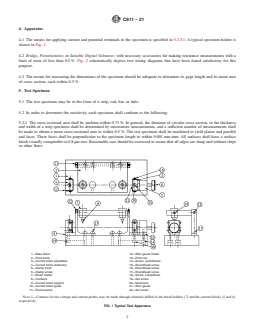
to the specimen is specified in 5.2.3.1. A typical specimen
standard.
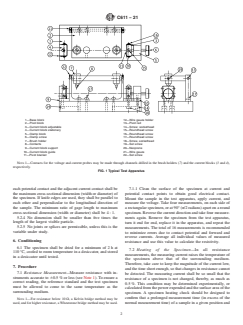
holder is shown in Fig. 1.
1.3 This standard does not purport to address all of the
4.2 Bridge, Potentiometer, or Suitable Digital Voltmeter,
safety concerns, if any, associated with its use. It is the
with necessary accessories for making resistance measure-
responsibility of the user of this standard to establish appro-
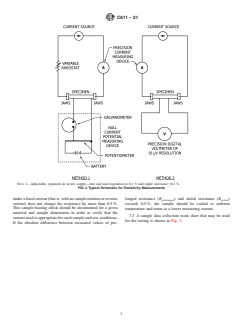
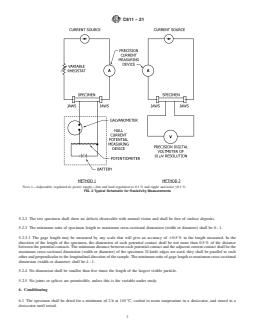
ments with a limit of error of less than 0.5 %. Fig. 2
priate safety, health, and environmental practices and deter-
schematically depicts two wiring diagrams that have been
mine the applicability of regulatory limitations prior to use.
found satisfactory for this purpose.
1.4 This international standard was developed in accor-
4.3 The means for measuring the dimensions of the speci-
dance with internationally recognized principles on standard-
men should be adequate to determine its gage length and its
ization established in the Decision on Principles for the
mean area of cross section, each within 0.5 %.
Development of International Standards, Guides and Recom-
mendations issued by the World Trade Organization Technical
5. Test Specimen
Barriers to Trade (TBT) Committee.
5.1 Thetestspecimenmaybeintheformofastrip,rod,bar,
or tube.
2. Terminology
5.2 In order to determine the resistivity, each specimen shall
2.1 Definitions:
conform to the following:
2.1.1 resistivity, n—the property of a material that deter-
5.2.1 The cross-sectional area shall be uniform within
mines its resistance to the flow of an electrical current. It is
0.75 %.Ingeneral,thediameterofcircularcrosssection,orthe
defined as the value of ρ, in milliohm metres, as follows:
thickness and width of a strip specimen shall be determined by
ρ 5 R·A /L
~ !
micrometer measurements, and a sufficient number of mea-
where: surements shall be made to obtain a mean cross-sectional area
to within 0.5 %. The test specimen shall be machined to yield
R = resistanceofaspecimenofthematerialofuniformcross
planar and parallel end faces. These faces shall be perpendicu-
section, ohms,
lar to the specimen length to within 0.001 mm⁄mm. All
A = uniform cross section, mm , and
surfaces shall have a surface finish visually comparable to
L = distance between potential contacts, mm.
0.8 µm rms. Reasonable care should be exercised to assure that
3. Significance and Use
all edges are sharp and without chips or other flaws.
5.2.2 The test specimen shall show no defects observable
3.1 This test method provides a means of determining the
with normal vision and shall be free of surface deposits.
electrical resistivity of carbon or graphite specimens. The use
5.2.3 The minimum ratio of specimen length to maximum
cross-sectional dimension (width or diameter) shall be 6 : 1.
5.2.3.1 The gage length may be measured by any scale that
This test method is under the jurisdiction of ASTM Committee D02 on
Petroleum Products, Liquid Fuels, and Lubricants and is the direct responsibility of
will give an accuracy of 60.5 % in the length measured. In the
Subcommittee D02.F0 on Manufactured Carbon and Graphite Products.
direction of the length of the specimen, the dimension of each
Current edition approved May 1, 2021. Published May 2021. Originally
potential contact shall be not more than 0.5 % of the distance
approved in 2005. Last previous edition approved in 2016 as C611 – 98 (2016).
DOI:10.1520/C0611-21. betweenthepotentialcontacts.Theminimumdistancebetween
*A Summary of Changes section appears at the end of this standard
Copyright ©ASTM International, 100 Barr Harbor Drive, PO Box C700, West Conshohocken, PA19428-2959. United States
C611 − 21
1—Base block 12—Wire gauze holder
2—Pivot block 13—Pivot red
3—Current block adjustable 14—Screw: sockethead
4—Current block stationary 15—Roundhead screw
5—Clamp block 16—Roundhead screw
6—Clamp screw 17—Roundhead screw
7—Brush holder 18—Screw, sockethead
8—Contacts 19—Set screw
9—Current block support 20—Neoprene
10—Current block guide 21—Wire gauze
11—Pivot bracket 22—Set screw
NOTE 1—Contacts for the voltage and current probes may be made through channels drilled in the brush holders (7) and the current blocks (3 and 4),
respectively.
FIG. 1 Typical Test Apparatus
each potential contact and the adjacent current contact shall be 7.1.1 Clean the surface of the specimen at current and
the maximum cross-sectional dimension (width or diameter) of potential contact points to obtain good electrical contact.
the specimen. If knife edges are used, they shall be parallel to
Mount the sample in the test apparatus, apply current, and
each other and perpendicular to the longitudinal direction of measure the voltage. Take four measurements, on each side of
the sample. The minimum ratio of gage length to maximum
a rectangular specimen, or at 90° (π/2 radians) apart on a round
cross-sectional dimension (width or diameter) shall be 4 : 1.
specimen. Reverse the current direction and take four measure-
5.2.4 No dimension shall be smaller than five times the
ments again. Remove the specimen from the test apparatus,
length of the largest visible particle.
turn it end for end, replace it in the apparatus, and repeat the
5.2.5 No joints or splices are permissible, unless this is the
measurements. The total of 16 measurements is recommended
variable under study.
to minimize errors due to contact potential and forward and
reverse currents. Average all individual values of measured
6. Conditioning
resistance and use this value to calculate the resistivity.
6.1 The specimen shall be dried for a minimum of 2
...
This document is not an ASTM standard and is intended only to provide the user of an ASTM standard an indication of what changes have been made to the previous version. Because
it may not be technically possible to adequately depict all changes accurately, ASTM recommends that users consult prior editions as appropriate. In all cases only the current version
of the standard as published by ASTM is to be considered the official document.
Designation: C611 − 98 (Reapproved 2016) C611 − 21
Standard Test Method for
Electrical Resistivity of Manufactured Carbon and Graphite
Articles at Room Temperature
This standard is issued under the fixed designation C611; the number immediately following the designation indicates the year of
original adoption or, in the case of revision, the year of last revision. A number in parentheses indicates the year of last reapproval. A
superscript epsilon (´) indicates an editorial change since the last revision or reapproval.
1. Scope Scope*
1.1 This test method covers the determination of the electrical resistivity of manufactured carbon and graphite articles at room
temperature.
1.2 The values stated in SI units are to be regarded as standard. No other units of measurement are included in this standard.
1.3 This standard does not purport to address all of the safety concerns, if any, associated with its use. It is the responsibility
of the user of this standard to establish appropriate safety safety, health, and healthenvironmental practices and determine the
applicability of regulatory limitations prior to use.
1.4 This international standard was developed in accordance with internationally recognized principles on standardization
established in the Decision on Principles for the Development of International Standards, Guides and Recommendations issued
by the World Trade Organization Technical Barriers to Trade (TBT) Committee.
2. Terminology
2.1 Definitions:
2.1.1 resistivity—resistivity, n—the property of a material that determines its resistance to the flow of an electrical current. It is
defined as the value of ρ, in milliohm metres, as follows:
ρ5 ~R·A!/L
where:
R = resistance of a specimen of the material of uniform cross section, ohms,
A = uniform cross section, mm , and
L = distance between potential contacts, mm.
3. Significance and Use
3.1 This test method provides a means of determining the electrical resistivity of carbon or graphite specimens. The use of
specimens that do not conform to the specimen size limitations described in the test method may result in an alteration of test
method accuracy.
This test method is under the jurisdiction of ASTM Committee D02 on Petroleum Products, Liquid Fuels, and Lubricants and is the direct responsibility of Subcommittee
D02.F0 on Manufactured Carbon and Graphite Products.
Current edition approved Oct. 1, 2016May 1, 2021. Published November 2016May 2021. Originally approved in 2005. Last previous edition approved in 20102016 as
ε1
C611 – 98 (2010)(2016). . DOI:10.1520/C0611-98R16. DOI:10.1520/C0611-21.
*A Summary of Changes section appears at the end of this standard
Copyright © ASTM International, 100 Barr Harbor Drive, PO Box C700, West Conshohocken, PA 19428-2959. United States
C611 − 21
4. Apparatus
4.1 The means for applying current and potential terminals to the specimen is specified in 5.2.3.1. A typical specimen holder is
shown in Fig. 1.
4.2 Bridge, Potentiometer, or Suitable Digital Voltmeter, with necessary accessories for making resistance measurements with a
limit of error of less than 0.5 %. Fig. 2 schematically depicts two wiring diagrams that have been found satisfactory for this
purpose.
4.3 The means for measuring the dimensions of the specimen should be adequate to determine its gage length and its mean area
of cross section, each within 0.5 %.
5. Test Specimen
5.1 The test specimen may be in the form of a strip, rod, bar, or tube.
5.2 In order to determine the resistivity, each specimen shall conform to the following:
5.2.1 The cross-sectional area shall be uniform within 0.75 %. In general, the diameter of circular cross section, or the thickness
and width of a strip specimen shall be determined by micrometer measurements, and a sufficient number of measurements shall
be made to obtain a mean cross-sectional area to within 0.5 %. The test specimen shall be machined to yield planar and parallel
end faces. These faces shall be perpendicular to the specimen length to within 0.001 mm ⁄mm. All surfaces shall have a surface
finish visually comparable to 0.8 μm rms. Reasonable care should be exercised to assure that all edges are sharp and without chips
or other flaws.
1—Base block 12—Wire gauze holder
2—Pivot block 13—Pivot red
3—Current block adjustable 14—Screw: sockethead
4—Current block stationary 15—Roundhead screw
5—Clamp block 16—Roundhead screw
6—Clamp screw 17—Roundhead screw
7—Brush holder 18—Screw, sockethead
8—Contacts 19—Set screw
9—Current block support 20—Neoprene
10—Current block guide 21—Wire gauze
11—Pivot bracket 22—Set screw
NOTE 1—Contacts for the voltage and current probes may be made through channels drilled in the brush holders (7) and the current blocks (3 and 4),
respectively.
FIG. 1 Typical Test Apparatus
C611 − 21
NOTE 1—Adjustable, regulated dc power supply—line and load regulation to 0.1 % and ripple and noise ≤0.1 %.
FIG. 2 Typical Schematic for Resistivity Measurements
5.2.2 The test specimen shall show no defects observable with normal vision and shall be free of surface deposits.
5.2.3 The minimum ratio of specimen length to maximum cross-sectional dimension (width or diameter) shall be 6 : 1.
5.2.3.1 The gage length may be measured by any scale that will give an accuracy of 60.5 % in the length measured. In the
direction of the length of the specimen, the dimension of each potential contact shall be not more than 0.5 % of the distance
between the potential contacts. The minimum distance between each potential contact and the adjacent current contact shall be the
maximum cross-sectional dimension (width or diameter) of the specimen. If knife edges are used, they shall be parallel to each
other and perpendicular to the longitudinal direction of the sample. The minimum ratio of gage length to maximum cross-sectional
dimension (width or diameter) shall be 4 : 1.
5.2.4 No dimension shall be smaller than five times the length of the largest visible particle.
5.2.5 No joints or splices are permissible, unless this is the variable under study.
6. Conditioning
6.1 The specimen shall be dried for a minimum of 2 h at 110 °C, cooled to room temperature in a desiccator, and stored in a
desiccator until tested.
C611 − 21
7. Procedure
7.1 Resistance Measurement—Measure resistance with instruments accurate to 60.5 % or less (see Note 1). To ensure a correct
reading, the reference standard and the test specimen must be allowed to come to the same temperature as the surrounding medium.
NOTE 1—For resistance below 10 Ω, a Kelvin bridge meth
...