

ASTM D3732-23
(Practice)Standard Practice for Reporting Cure Times of Ultraviolet-Cured Coatings
General Information
- Abstract
SIGNIFICANCE AND USE
4.1 This practice provides a guide whereby all pertinent variables relating to the ultraviolet cure of a coating are described.
SCOPE
1.1 This practice applies to all coatings cured by ultraviolet energy.
1.2 The values stated in SI units are to be regarded as standard. No other units of measurement are included in this standard.
1.3 This standard does not purport to address all of the safety concerns, if any, associated with its use. It is the responsibility of the user of this standard to establish appropriate safety, health, and environmental practices and determine the applicability of regulatory limitations prior to use.
1.4 This international standard was developed in accordance with internationally recognized principles on standardization established in the Decision on Principles for the Development of International Standards, Guides and Recommendations issued by the World Trade Organization Technical Barriers to Trade (TBT) Committee.
- Status
- Published
- Publication Date
- 30-Jun-2023
- Technical Committee
- D01 - Paint and Related Coatings, Materials, and Applications
- Drafting Committee
- D01.55 - Factory Applied Coatings on Preformed Products




Overview
ASTM D3732-23: Standard Practice for Reporting Cure Times of Ultraviolet-Cured Coatings provides a comprehensive guide for documenting the cure times of coatings that are cured using ultraviolet (UV) energy. Issued by ASTM International, this standard is designed to promote consistency and accuracy in reporting all critical variables associated with UV-curing of coatings, helping manufacturers, suppliers, and customers ensure reliable performance and quality control. The practice applies to all UV-cured coatings and adheres to internationally recognized principles for developing standards.
Key Topics
Pertinent Variables for UV Cure Reporting
- Number and Type of Bulbs: Specify the number, type (including intensity, spectral distribution, and composition), and age of UV bulbs used.
- Equipment Configuration: Report bulb location, reflector design, and conveyor speed or exposure time necessary to achieve cure.
- Substrate and Coating Data: Document the substrate, coating identification, sample age, and wet film thickness.
- Environmental Conditions: Include curing unit temperatures and surrounding atmosphere (e.g., air, nitrogen).
- Cure Testing Methods: Identify which test methods were used for performance assessment.
- Time Considerations: State the age of the cured film when tests were performed.
Cure and Testing Methodology
- Application Process: Coatings must be applied with typical film thicknesses and cured using standard production delays.
- Performance Tests: The standard references widely recognized ASTM test methods to assess properties such as impact resistance, film hardness, solvent resistance, sandability, abrasion resistance, indentation hardness, adhesion, and stain resistance.
Applications
UV-Cured Coatings in Industry
- Manufacturing Quality Control: ASTM D3732-23 allows manufacturers of UV-cured coatings to consistently evaluate and report cure times, improving process optimization and product reliability.
- Product Performance Validation: By following this standard, suppliers and purchasers can agree on cure definitions and verify that coatings meet performance criteria through recognized test methods.
- Regulatory Compliance: Adhering to a recognized reporting practice helps organizations demonstrate due diligence in safety, health, and environmental practices, as well as international compliance.
- R&D and Process Development: Product developers and researchers use ASTM D3732-23 to document the impact of cure variables, facilitating innovation with new coating formulations and curing technologies.
- Customer Assurance: Consistent reporting builds customer confidence by providing clear, reliable data about the curing process and end-use performance of UV-cured coatings.
Related Standards
ASTM D3732-23 references several relevant ASTM test methods and practices to ensure a comprehensive approach to evaluating UV-cured coatings:
- ASTM D2794: Test Method for Resistance of Organic Coatings to the Effects of Rapid Deformation (Impact)
- ASTM D3363: Test Method for Film Hardness by Pencil Test
- ASTM D3359: Test Methods for Rating Adhesion by Tape Test
- ASTM D968: Test Methods for Abrasion Resistance of Organic Coatings by Falling Abrasive
- ASTM D1474: Test Methods for Indentation Hardness of Organic Coatings
- ASTM D2197: Test Method for Adhesion of Organic Coatings by Scrape Adhesion
- ASTM D2793: Test Method for Block Resistance of Organic Coatings on Wood Panel Substrates
- ASTM D3023: Practice for Determination of Resistance of Factory-Applied Coatings on Wood Products to Stains and Reagents
For further detail and the official documentation, visit the ASTM International website.
Keywords: ASTM D3732-23, ultraviolet-cured coatings, cure time, UV curing, coatings reporting, test methods, manufacturing quality, performance testing.
Relations
- Effective Date
- 01-Feb-2024
- Effective Date
- 01-Feb-2024
- Effective Date
- 15-Jan-2024
- Effective Date
- 01-Jul-2017
- Effective Date
- 01-Jul-2017
- Effective Date
- 15-May-2013
- Effective Date
- 01-Nov-2011
- Effective Date
- 01-Jun-2011
- Effective Date
- 01-Jun-2011
- Effective Date
- 01-Jun-2011
- Refers
ASTM D3363-05(2011)e2 - Standard Test Method for Film Hardness by Pencil Test (Withdrawn 2020) - Effective Date
- 01-Jun-2011
- Effective Date
- 01-Dec-2010
- Effective Date
- 01-Dec-2010
- Effective Date
- 01-Jul-2010
- Effective Date
- 01-Jun-2009
Frequently Asked Questions
ASTM D3732-23 is a standard published by ASTM International. Its full title is "Standard Practice for Reporting Cure Times of Ultraviolet-Cured Coatings". This standard covers: SIGNIFICANCE AND USE 4.1 This practice provides a guide whereby all pertinent variables relating to the ultraviolet cure of a coating are described. SCOPE 1.1 This practice applies to all coatings cured by ultraviolet energy. 1.2 The values stated in SI units are to be regarded as standard. No other units of measurement are included in this standard. 1.3 This standard does not purport to address all of the safety concerns, if any, associated with its use. It is the responsibility of the user of this standard to establish appropriate safety, health, and environmental practices and determine the applicability of regulatory limitations prior to use. 1.4 This international standard was developed in accordance with internationally recognized principles on standardization established in the Decision on Principles for the Development of International Standards, Guides and Recommendations issued by the World Trade Organization Technical Barriers to Trade (TBT) Committee.
SIGNIFICANCE AND USE 4.1 This practice provides a guide whereby all pertinent variables relating to the ultraviolet cure of a coating are described. SCOPE 1.1 This practice applies to all coatings cured by ultraviolet energy. 1.2 The values stated in SI units are to be regarded as standard. No other units of measurement are included in this standard. 1.3 This standard does not purport to address all of the safety concerns, if any, associated with its use. It is the responsibility of the user of this standard to establish appropriate safety, health, and environmental practices and determine the applicability of regulatory limitations prior to use. 1.4 This international standard was developed in accordance with internationally recognized principles on standardization established in the Decision on Principles for the Development of International Standards, Guides and Recommendations issued by the World Trade Organization Technical Barriers to Trade (TBT) Committee.
ASTM D3732-23 is classified under the following ICS (International Classification for Standards) categories: 87.040 - Paints and varnishes. The ICS classification helps identify the subject area and facilitates finding related standards.
ASTM D3732-23 has the following relationships with other standards: It is inter standard links to ASTM D3023-98(2024), ASTM D2793-99(2024), ASTM D2794-93(2024), ASTM D3023-98(2017), ASTM D2793-99(2017), ASTM D2197-13, ASTM D3023-98(2011), ASTM D3363-05(2011), ASTM D2793-99(2011), ASTM D3363-05(2011)e1, ASTM D3363-05(2011)e2, ASTM D968-05(2010), ASTM D2794-93(2010), ASTM D2197-10, ASTM D3359-09e1. Understanding these relationships helps ensure you are using the most current and applicable version of the standard.
ASTM D3732-23 is available in PDF format for immediate download after purchase. The document can be added to your cart and obtained through the secure checkout process. Digital delivery ensures instant access to the complete standard document.
Standards Content (Sample)
This international standard was developed in accordance with internationally recognized principles on standardization established in the Decision on Principles for the
Development of International Standards, Guides and Recommendations issued by the World Trade Organization Technical Barriers to Trade (TBT) Committee.
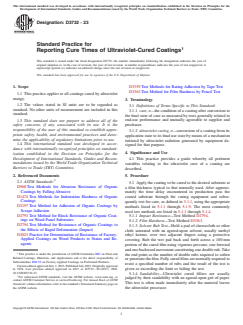
Designation: D3732 − 23
Standard Practice for
Reporting Cure Times of Ultraviolet-Cured Coatings
This standard is issued under the fixed designation D3732; the number immediately following the designation indicates the year of
original adoption or, in the case of revision, the year of last revision. A number in parentheses indicates the year of last reapproval. A
superscript epsilon (´) indicates an editorial change since the last revision or reapproval.
This standard has been approved for use by agencies of the U.S. Department of Defense.
1. Scope D3359 Test Methods for Rating Adhesion by Tape Test
D3363 Test Method for Film Hardness by Pencil Test
1.1 This practice applies to all coatings cured by ultraviolet
energy.
3. Terminology
1.2 The values stated in SI units are to be regarded as
3.1 Definitions of Terms Specific to This Standard:
standard. No other units of measurement are included in this
3.1.1 cure, n—the condition of a coating after conversion to
standard.
the final state of cure as measured by tests generally related to
end-use performance and mutually agreeable to supplier and
1.3 This standard does not purport to address all of the
safety concerns, if any, associated with its use. It is the purchaser.
responsibility of the user of this standard to establish appro-
3.1.2 ultraviolet curing, n—conversion of a coating from its
priate safety, health, and environmental practices and deter-
application state to its final use state by means of a mechanism
mine the applicability of regulatory limitations prior to use.
initiated by ultraviolet radiation generated by equipment de-
1.4 This international standard was developed in accor-
signed for that purpose.
dance with internationally recognized principles on standard-
4. Significance and Use
ization established in the Decision on Principles for the
Development of International Standards, Guides and Recom-
4.1 This practice provides a guide whereby all pertinent
mendations issued by the World Trade Organization Technical
variables relating to the ultraviolet cure of a coating are
Barriers to Trade (TBT) Committee.
described.
2. Referenced Documents
5. Procedure
2.1 ASTM Standards:
5.1 Apply the coating to be cured to the desired substrate at
D968 Test Methods for Abrasion Resistance of Organic
a film thickness typical to that normally used. After approxi-
Coatings by Falling Abrasive
mately the time delay encountered in production pass the
D1474 Test Methods for Indentation Hardness of Organic
coated substrate through the curing equipment and subse-
Coatings
quently test for cure, as defined in 3.1.1, using the appropriate
D2197 Test Method for Adhesion of Organic Coatings by
methods listed in 5.1.1 through 5.1.9. The most commonly
Scrape Adhesion
used test methods are listed in 5.1.1 through 5.1.4.
D2793 Test Method for Block Resistance of Organic Coat-
5.1.1 Impact Resistance—Test Method D2794.
ings on Wood Panel Substrates
5.1.2 Film Hardness—Test Method D3363.
D2794 Test Method for Resistance of Organic Coatings to
5.1.3 Solvent Rub Test—Hold a pad of cheesecloth or other
the Effects of Rapid Deformation (Impact)
cloth saturated with an agreed-upon solvent, usually methyl
D3023 Practice for Determination of Resistance of Factory-
ethyl ketone, over two adjacent fingers using a protective
Applied Coatings on Wood Products to Stains and Re-
covering. Rub the wet pad back and forth across a 100 mm
agents
portion of the cured film using vigorous pressure, one forward
and one backward movement constituting one double rub. Take
This practice is under the jurisdiction of ASTM Committee D01 on Paint a
...
This document is not an ASTM standard and is intended only to provide the user of an ASTM standard an indication of what changes have been made to the previous version. Because
it may not be technically possible to adequately depict all changes accurately, ASTM recommends that users consult prior editions as appropriate. In all cases only the current version
of the standard as published by ASTM is to be considered the official document.
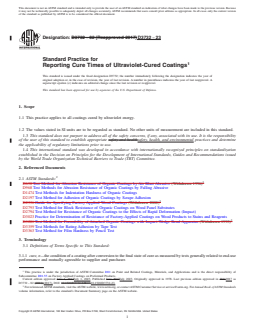
Designation: D3732 − 82 (Reapproved 2017) D3732 − 23
Standard Practice for
Reporting Cure Times of Ultraviolet-Cured Coatings
This standard is issued under the fixed designation D3732; the number immediately following the designation indicates the year of
original adoption or, in the case of revision, the year of last revision. A number in parentheses indicates the year of last reapproval. A
superscript epsilon (´) indicates an editorial change since the last revision or reapproval.
This standard has been approved for use by agencies of the U.S. Department of Defense.
1. Scope
1.1 This practice applies to all coatings cured by ultraviolet energy.
1.2 The values stated in SI units are to be regarded as standard. No other units of measurement are included in this standard.
1.3 This standard does not purport to address all of the safety concerns, if any, associated with its use. It is the responsibility
of the user of this standard to establish appropriate safety and healthsafety, health, and environmental practices and determine
the applicability of regulatory limitations prior to use.
1.4 This international standard was developed in accordance with internationally recognized principles on standardization
established in the Decision on Principles for the Development of International Standards, Guides and Recommendations issued
by the World Trade Organization Technical Barriers to Trade (TBT) Committee.
2. Referenced Documents
2.1 ASTM Standards:
D658 Test Method for Abrasion Resistance of Organic Coatings by Air Blast Abrasive (Withdrawn 1996)
D968 Test Methods for Abrasion Resistance of Organic Coatings by Falling Abrasive
D1474 Test Methods for Indentation Hardness of Organic Coatings
D2197 Test Method for Adhesion of Organic Coatings by Scrape Adhesion
D2336 Guide for Specifying Factory Applied Wood Coatings (Withdrawn 2008)
D2793 Test Method for Block Resistance of Organic Coatings on Wood Panel Substrates
D2794 Test Method for Resistance of Organic Coatings to the Effects of Rapid Deformation (Impact)
D3023 Practice for Determination of Resistance of Factory-Applied Coatings on Wood Products to Stains and Reagents
D3281 Test Method for Formability of Attached Organic Coatings with Impact-Wedge Bend Apparatus (Withdrawn 1995)
D3359 Test Methods for Rating Adhesion by Tape Test
D3363 Test Method for Film Hardness by Pencil Test
3. Terminology
3.1 Definitions of Terms Specific to This Standard:
3.1.1 cure, n—the condition of a coating after conversion to the final state of cure as measured by tests generally related to end-use
performance and mutually agreeable to supplier and purchaser.
This practice is under the jurisdiction of ASTM Committee D01 on Paint and Related Coatings, Materials, and Applications and is the direct responsibility of
Subcommittee D01.55 on Factory Applied Coatings on Preformed Products.
Current edition approved June 1, 2017July 1, 2023. Published June 2017July 2023. Originally approved in 1978. Last previous edition approved in 20112017 as
D3732 – 82 (2011).(2017). DOI: 10.1520/D3732-82R17.10.1520/D3732-23.
For referenced ASTM standards, visit the ASTM website, www.astm.org, or contact ASTM Customer Service at service@astm.org. For Annual Book of ASTM Standards
volume information, refer to the standard’s Document Summary page on the ASTM website.
Copyright © ASTM International, 100 Barr Harbor Drive, PO Box C700, West Conshohocken, PA 19428-2959. United States
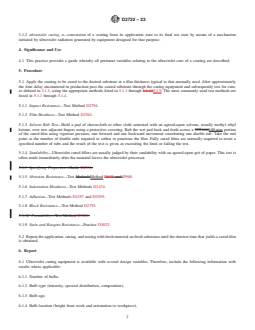
D3732 − 23
3.1.2 ultraviolet curing, n—conversion of a coating from its application state to its final use state by means of a mechanism
initiated by ultraviolet radiation generated by equipment designed for that purpose.
4. Significance and Use
4.1 This practice provides a guide whereby all pertinent variables relating to the ultraviolet cure of a coatin
...