

ASTM D4493-20
(Test Method)Standard Test Method for Solidification Point of Bisphenol A(4,4′-Isopropylidenediphenol)
General Information
- Abstract
SIGNIFICANCE AND USE
5.1 The solidification point of bisphenol A is a direct indication of its purity, although it gives no information as to the nature of any impurities present.
5.2 High purity bisphenol A has a solidification point of approximately 157°C.
5.3 This test method can be used for internal quality control or for setting specifications.
SCOPE
1.1 This test method describes the procedure for determination of the solidification point of bisphenol A (4,4′-isopropylidene diphenol).
1.2 The test method has been found applicable for determination of the solidification point between 150 and 157°C.
1.3 In determining conformance of the test results using this method to applicable specifications, results shall be rounded off in accordance with the rounding-off method of Practice E29.
1.4 The values stated in SI units are to be regarded as standard. No other units of measurement are included in this standard.
1.5 Warning—Mercury has been designated by many regulatory agencies as a hazardous substance that can cause serious medical issues. Mercury, or its vapor, has been demonstrated to be hazardous to health and corrosive to materials. Use caution when handling mercury and mercury-containing products. See the applicable product Safety Data Sheet (SDS) for additional information. The potential exists that selling mercury or mercury-containing products, or both, is prohibited by local or national law. Users must determine legality of sales in their location.
1.6 This standard does not purport to address all of the safety concerns, if any, associated with its use. It is the responsibility of the user of this standard to establish appropriate safety, health, and environmental practices and determine the applicability of regulatory limitations prior to use. For specific hazard statements, see Section 9.
1.7 This international standard was developed in accordance with internationally recognized principles on standardization established in the Decision on Principles for the Development of International Standards, Guides and Recommendations issued by the World Trade Organization Technical Barriers to Trade (TBT) Committee.
- Status
- Published
- Publication Date
- 31-May-2020
- Technical Committee
- D16 - Aromatic, Industrial, Specialty and Related Chemicals
- Drafting Committee
- D16.02 - Oxygenated Aromatics
Buy Documents

ASTM D4493-20 - Standard Test Method for Solidification Point of Bisphenol A<brk/>(4,4<emph type="ital" >′</emph>-Isopropylidenediphenol)
REDLINE ASTM D4493-20 - Standard Test Method for Solidification Point of Bisphenol A<brk/>(4,4<emph type="ital" >′</emph>-Isopropylidenediphenol)
Overview
ASTM D4493-20: Standard Test Method for Solidification Point of Bisphenol A (4,4′-Isopropylidenediphenol) provides a precise procedure for determining the solidification point of bisphenol A, an important industrial organic compound. The method serves as a critical quality control tool, ensuring that manufacturers and laboratories can assess the purity of bisphenol A-a common precursor used in the production of polycarbonate plastics and epoxy resins.
This ASTM standard is applicable for the solidification point range between 150°C and 157°C, with results to be reported and rounded in accordance with ASTM Practice E29 (Significant Digits). Use of this method enables organizations to meet quality standards, conduct internal assessments, and verify conformance to regulatory and product specifications.
Key Topics
Solidification Point as an Indicator of Purity
The solidification temperature directly reflects the chemical purity of bisphenol A. High-purity material typically solidifies at around 157°C. However, the test does not identify the specific impurities present, only their cumulative effect on the freezing point.Quality Control and Specification Compliance
The standard is suitable for regular in-process quality control and setting product specifications. Consistency in results helps reinforce product reliability and compliance with customer or industry requirements.Sampling and Methodology
- The recommended sampling and handling procedures follow ASTM D4297.
- Key apparatus includes Nessler tubes, calibrated thermometers, thermostatically controlled hot blocks, and magnetic stirrers.
- The process involves melting bisphenol A, controlled cooling with agitation, and detecting the temperature at which solidification (crystallization) occurs.
- Results are to be reported to the nearest 0.1°C.
Safety and Environmental Considerations
- Mercury thermometers are traditionally used but are recognized as a health hazard. Appropriate precautions and regulatory compliance are emphasized, especially for mercury handling.
- All work should adhere to relevant OSHA regulations and be performed with proper personal protection, preferably within a fume hood.
Applications
Polycarbonate and Epoxy Resin Manufacturing
Determining the solidification point aids producers of polycarbonate plastics and epoxy resins by verifying that the bisphenol A input meets required purity levels for optimal product performance.Internal Quality Assurance
Routine testing allows organizations to monitor material quality and consistency within production batches, minimizing process variability and ensuring that products meet or exceed set specifications.Supplier and Customer Assurance
Laboratories and manufacturers can use ASTM D4493-20 test results for documentation, reinforcing confidence in delivered material and facilitating acceptance in competitive markets.Regulatory and Contractual Compliance
The method provides a recognized approach for fulfilling regulatory documentation and for use in contracts that specify bisphenol A quality requirements.
Related Standards
- ASTM D4297 - Practice for Sampling and Handling Bisphenol A (4,4'-Isopropylidenediphenol)
- ASTM D6809 - Guide for Quality Control and Quality Assurance Procedures for Aromatic Hydrocarbons and Related Materials
- ASTM E1 - Specification for ASTM Liquid-in-Glass Thermometers
- ASTM E29 - Practice for Using Significant Digits in Test Data to Determine Conformance with Specifications
- ASTM E77 - Test Method for Inspection and Verification of Thermometers
- ASTM E691 - Practice for Conducting an Interlaboratory Study to Determine the Precision of a Test Method
Keywords: ASTM D4493-20, bisphenol A solidification point, 4,4'-isopropylidenediphenol, bisphenol A purity test, polycarbonate manufacturing quality control, chemical purity testing standard, solidification point test method, industrial organic chemicals testing.
Relations
- Effective Date
- 01-Jan-2020
- Effective Date
- 01-Nov-2016
- Effective Date
- 01-Jun-2015
- Effective Date
- 01-May-2014
- Effective Date
- 01-May-2013
- Effective Date
- 01-May-2013
- Effective Date
- 01-Nov-2011
- Effective Date
- 01-Jun-2010
- Effective Date
- 01-Jun-2009
- Effective Date
- 01-Oct-2008
- Effective Date
- 01-Oct-2008
- Effective Date
- 01-Dec-2007
- Effective Date
- 01-Nov-2007
- Effective Date
- 01-Jun-2007
- Effective Date
- 15-Nov-2006
Buy Documents
ASTM D4493-20 - Standard Test Method for Solidification Point of Bisphenol A<brk/>(4,4<emph type="ital" >′</emph>-Isopropylidenediphenol)
REDLINE ASTM D4493-20 - Standard Test Method for Solidification Point of Bisphenol A<brk/>(4,4<emph type="ital" >′</emph>-Isopropylidenediphenol)
Get Certified
Connect with accredited certification bodies for this standard

ECOCERT
Organic and sustainability certification.

Eurofins Food Testing Global
Global leader in food, environment, and pharmaceutical product testing.

Intertek Bangladesh
Intertek certification and testing services in Bangladesh.
Sponsored listings
Frequently Asked Questions
ASTM D4493-20 is a standard published by ASTM International. Its full title is "Standard Test Method for Solidification Point of Bisphenol A<brk/>(4,4<emph type="ital" >′</emph>-Isopropylidenediphenol)". This standard covers: SIGNIFICANCE AND USE 5.1 The solidification point of bisphenol A is a direct indication of its purity, although it gives no information as to the nature of any impurities present. 5.2 High purity bisphenol A has a solidification point of approximately 157°C. 5.3 This test method can be used for internal quality control or for setting specifications. SCOPE 1.1 This test method describes the procedure for determination of the solidification point of bisphenol A (4,4′-isopropylidene diphenol). 1.2 The test method has been found applicable for determination of the solidification point between 150 and 157°C. 1.3 In determining conformance of the test results using this method to applicable specifications, results shall be rounded off in accordance with the rounding-off method of Practice E29. 1.4 The values stated in SI units are to be regarded as standard. No other units of measurement are included in this standard. 1.5 Warning—Mercury has been designated by many regulatory agencies as a hazardous substance that can cause serious medical issues. Mercury, or its vapor, has been demonstrated to be hazardous to health and corrosive to materials. Use caution when handling mercury and mercury-containing products. See the applicable product Safety Data Sheet (SDS) for additional information. The potential exists that selling mercury or mercury-containing products, or both, is prohibited by local or national law. Users must determine legality of sales in their location. 1.6 This standard does not purport to address all of the safety concerns, if any, associated with its use. It is the responsibility of the user of this standard to establish appropriate safety, health, and environmental practices and determine the applicability of regulatory limitations prior to use. For specific hazard statements, see Section 9. 1.7 This international standard was developed in accordance with internationally recognized principles on standardization established in the Decision on Principles for the Development of International Standards, Guides and Recommendations issued by the World Trade Organization Technical Barriers to Trade (TBT) Committee.
SIGNIFICANCE AND USE 5.1 The solidification point of bisphenol A is a direct indication of its purity, although it gives no information as to the nature of any impurities present. 5.2 High purity bisphenol A has a solidification point of approximately 157°C. 5.3 This test method can be used for internal quality control or for setting specifications. SCOPE 1.1 This test method describes the procedure for determination of the solidification point of bisphenol A (4,4′-isopropylidene diphenol). 1.2 The test method has been found applicable for determination of the solidification point between 150 and 157°C. 1.3 In determining conformance of the test results using this method to applicable specifications, results shall be rounded off in accordance with the rounding-off method of Practice E29. 1.4 The values stated in SI units are to be regarded as standard. No other units of measurement are included in this standard. 1.5 Warning—Mercury has been designated by many regulatory agencies as a hazardous substance that can cause serious medical issues. Mercury, or its vapor, has been demonstrated to be hazardous to health and corrosive to materials. Use caution when handling mercury and mercury-containing products. See the applicable product Safety Data Sheet (SDS) for additional information. The potential exists that selling mercury or mercury-containing products, or both, is prohibited by local or national law. Users must determine legality of sales in their location. 1.6 This standard does not purport to address all of the safety concerns, if any, associated with its use. It is the responsibility of the user of this standard to establish appropriate safety, health, and environmental practices and determine the applicability of regulatory limitations prior to use. For specific hazard statements, see Section 9. 1.7 This international standard was developed in accordance with internationally recognized principles on standardization established in the Decision on Principles for the Development of International Standards, Guides and Recommendations issued by the World Trade Organization Technical Barriers to Trade (TBT) Committee.
ASTM D4493-20 is classified under the following ICS (International Classification for Standards) categories: 71.080.90 - Phenols. The ICS classification helps identify the subject area and facilitates finding related standards.
ASTM D4493-20 has the following relationships with other standards: It is inter standard links to ASTM D4297-15(2020), ASTM D6809-02(2016), ASTM D4297-15, ASTM E77-14, ASTM E691-13, ASTM E1-13, ASTM E691-11, ASTM D4297-10, ASTM D4297-05(2009), ASTM E29-08, ASTM E691-08, ASTM E77-07, ASTM E1-07, ASTM D6809-02(2007), ASTM E29-06b. Understanding these relationships helps ensure you are using the most current and applicable version of the standard.
ASTM D4493-20 is available in PDF format for immediate download after purchase. The document can be added to your cart and obtained through the secure checkout process. Digital delivery ensures instant access to the complete standard document.
Standards Content (Sample)
This international standard was developed in accordance with internationally recognized principles on standardization established in the Decision on Principles for the
Development of International Standards, Guides and Recommendations issued by the World Trade Organization Technical Barriers to Trade (TBT) Committee.
Designation: D4493 −20
Standard Test Method for
Solidification Point of Bisphenol A
(4,4'-Isopropylidenediphenol)
This standard is issued under the fixed designation D4493; the number immediately following the designation indicates the year of
original adoption or, in the case of revision, the year of last revision. A number in parentheses indicates the year of last reapproval. A
superscript epsilon (´) indicates an editorial change since the last revision or reapproval.
1. Scope* 2. Referenced Documents
1.1 This test method describes the procedure for determina- 2.1 ASTM Standards:
tion of the solidification point of bisphenol A (4,4'- D1493 Test Method for Solidification Point of Industrial
isopropylidene diphenol). Organic Chemicals (Withdrawn 2004)
D4297 PracticeforSamplingandHandlingBisphenolA(4,4'
1.2 The test method has been found applicable for determi-
-Isopropylidinediphenol)
nation of the solidification point between 150 and 157°C.
D6809 Guide for Quality Control and Quality Assurance
1.3 In determining conformance of the test results using this
Procedures for Aromatic Hydrocarbons and Related Ma-
methodtoapplicablespecifications,resultsshallberoundedoff
terials
in accordance with the rounding-off method of Practice E29.
E1 Specification for ASTM Liquid-in-Glass Thermometers
1.4 The values stated in SI units are to be regarded as E29 Practice for Using Significant Digits in Test Data to
Determine Conformance with Specifications
standard. No other units of measurement are included in this
standard. E77 Test Method for Inspection and Verification of Ther-
mometers
1.5 Warning—Mercury has been designated by many regu-
E691 Practice for Conducting an Interlaboratory Study to
latory agencies as a hazardous substance that can cause serious
Determine the Precision of a Test Method
medicalissues.Mercury,oritsvapor,hasbeendemonstratedto
2.2 Other Documents:
be hazardous to health and corrosive to materials. Use caution
OSHA Regulations, 29 CFR paragraphs 1910.1000 and
when handling mercury and mercury-containing products. See
1910.1200
the applicable product Safety Data Sheet (SDS) for additional
information. The potential exists that selling mercury or
3. Terminology
mercury-containing products, or both, is prohibited by local or
3.1 Definitions:
national law. Users must determine legality of sales in their
3.1.1 solidification point, n—the temperature at which the
location.
liquid phase of a substance is in approximate equilibrium with
1.6 This standard does not purport to address all of the
a relatively small amount of the same substance in its solid
safety concerns, if any, associated with its use. It is the
phase.
responsibility of the user of this standard to establish appro-
priate safety, health, and environmental practices and deter- 4. Summary of Test Method
mine the applicability of regulatory limitations prior to use.
4.1 Bisphenol A is melted, and then cooled slowly with
For specific hazard statements, see Section 9.
constant agitation. When crystallization begins, and super-
1.7 This international standard was developed in accor-
cooling occurs, the temperature falls to a minimum, rises to a
dance with internationally recognized principles on standard-
maximum, and then falls again. The maximum temperature
ization established in the Decision on Principles for the
attained after crystallization begins is the solidification point of
Development of International Standards, Guides and Recom-
bisphenol A.
mendations issued by the World Trade Organization Technical
Barriers to Trade (TBT) Committee.
For referenced ASTM standards, visit the ASTM website, www.astm.org, or
contact ASTM Customer Service at service@astm.org. For Annual Book of ASTM
Standards volume information, refer to the standard’s Document Summary page on
This test method is under the jurisdiction of ASTM Committee D16 on the ASTM website.
Aromatic, Industrial, Specialty and Related Chemicals and is the direct responsi- The last approved version of this historical standard is referenced on
bility of Subcommittee D16.02 on Oxygenated Aromatics. www.astm.org.
Current edition approved June 1, 2020. Published June 2020. Originally AvailablefromU.S.GovernmentPrintingOfficeSuperintendentofDocuments,
approved in 1985. Last previous edition approved in 2016 as D4493 – 16. DOI: 732 N. Capitol St., NW, Mail Stop: SDE, Washington, DC 20401, http://
10.1520/D4493-20. www.access.gpo.gov.
*A Summary of Changes section appears at the end of this standard
Copyright © ASTM International, 100 Barr Harbor Drive, PO Box C700, West Conshohocken, PA 19428-2959. United States
D4493 − 20
5. Significance and Use therefore can cause serious medical issues. Mercury has been
designated by many regulatory agencies as a hazardous sub-
5.1 The solidification point of bisphenol A is a direct
stance that can cause serious medical issues. See the applicable
indication of its purity, although it gives no information as to
product Safety Data Sheet (SDS) for additional information.
the nature of any impurities present.
Users should be aware that selling mercury and/or mercury
5.2 High purity bisphenol A has a solidification point of
containing products into your state or country may be prohib-
approximately 157°C.
ited by law.
5.3 This test method can be used for internal quality control
10. Sampling
or for setting specifications.
10.1 Sample the material in accordance with Practice
6. Interference
D4297.
6.1 BisphenolAthat is not stored or packaged properly may
11. Procedure
absorb moisture. Absorbed moisture will lower the solidifica-
11.1 Place a Nessler tube, filled with bisphenol A, and
tion point.
containing the magnetic spinner, the stopper, and thermometer,
in an electric heat block, preheated to 170 6 5°C, to melt
7. Apparatus
bisphenol A. The solidification point is determined on the
7.1 Nessler Tubes, borosilicate, 100 mL, short form, 32-mm
specimen as received, with no drying procedure.
diameter.
11.2 AsthebisphenolAmelts,addmoretotheNesslertube,
7.2 Electric Heat Block, thermostatically controlled, ca-
if necessary, so that the immersion requirement of the ther-
pable of reaching 170°C; having flat-bottom holes 34 mm in
mometer will be met. It takes approximately 30 to 45 min to
diameter by 172 mm deep. A suitable block is 100 by 110 by
melt enough bisphenol A to run the test. In order to minimize
175 mm high, and made of aluminum. Alternatively, a ther-
the loss of volatile components, it is advisable to begin the
mostatically controlled hot oil bath may be used.
solidification point determination within 5 min after the bis-
7.3 Thermometer—ASTM 102C, having a range from 123
phenol A is molten.
to 177°C and conforming to the requirements for thermometer
11.3 After the bisphenol A has melted, remove the Nessler
102C as prescribed in Specification E1. Thermometers should
tube from the heat block and place in a 500 mL Erlenmeyer
be calibrated in accordance withTest Method E77 or calibrated
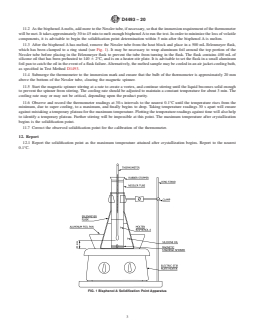
flask, which has been clamped to a ring stand (see Fig. 1). It
from 154 to 157°C versus an NBS thermometer or platinum
maybenecessarytowrapaluminumfoilaroundthetopportion
resistance thermometer. Preferably, thermometers should be
of the Nessler tube before placing in the Erlenmeyer flask to
calibrated and certified by a thermometer manufacturer. An
prevent the tube from turning in the flask. The flask contains
alternative thermomete
...
This document is not an ASTM standard and is intended only to provide the user of an ASTM standard an indication of what changes have been made to the previous version. Because
it may not be technically possible to adequately depict all changes accurately, ASTM recommends that users consult prior editions as appropriate. In all cases only the current version
of the standard as published by ASTM is to be considered the official document.
Designation: D4493 − 16 D4493 − 20
Standard Test Method for
Solidification Point of Bisphenol A
(4,4'-Isopropylidenediphenol)
This standard is issued under the fixed designation D4493; the number immediately following the designation indicates the year of
original adoption or, in the case of revision, the year of last revision. A number in parentheses indicates the year of last reapproval. A
superscript epsilon (´) indicates an editorial change since the last revision or reapproval.
1. Scope*
1.1 This test method describes the procedure for determination of the solidification point of bisphenol A (4,4'-isopropylidene
diphenol).
1.2 The test method has been found applicable for determination of the solidification point between 150 and 157°C.
1.3 In determining conformance of the test results using this method to applicable specifications, results shall be rounded off
in accordance with the rounding-off method of Practice E29.
1.4 The values stated in SI units are to be regarded as standard. No other units of measurement are included in this standard.
1.5 Warning—Mercury has been designated by many regulatory agencies as a hazardous substance that can cause serious
medical issues. Mercury, or its vapor, has been demonstrated to be hazardous to health and corrosive to materials. Use caution
when handling mercury and mercury-containing products. See the applicable product Safety Data Sheet (SDS) for additional
information. The potential exists that selling mercury or mercury-containing products, or both, is prohibited by local or national
law. Users must determine legality of sales in their location.
1.6 This standard does not purport to address all of the safety concerns, if any, associated with its use. It is the responsibility
of the user of this standard to establish appropriate safety safety, health, and healthenvironmental practices and determine the
applicability of regulatory limitations prior to use. For specific hazard statements, see Section 9.
1.7 This international standard was developed in accordance with internationally recognized principles on standardization
established in the Decision on Principles for the Development of International Standards, Guides and Recommendations issued
by the World Trade Organization Technical Barriers to Trade (TBT) Committee.
2. Referenced Documents
2.1 ASTM Standards:
D1493 Test Method for Solidification Point of Industrial Organic Chemicals (Withdrawn 2004)
D4297 Practice for Sampling and Handling Bisphenol A(4,4' -Isopropylidinediphenol)
D6809 Guide for Quality Control and Quality Assurance Procedures for Aromatic Hydrocarbons and Related Materials
E1 Specification for ASTM Liquid-in-Glass Thermometers
E29 Practice for Using Significant Digits in Test Data to Determine Conformance with Specifications
E77 Test Method for Inspection and Verification of Thermometers
E691 Practice for Conducting an Interlaboratory Study to Determine the Precision of a Test Method
2.2 Other Documents:
OSHA Regulations, 29 CFR paragraphs 1910.1000 and 1910.1200
3. Terminology
3.1 Definitions:
This test method is under the jurisdiction of ASTM Committee D16 on Aromatic Hydrocarbons Aromatic, Industrial, Specialty and Related Chemicals and is the direct
responsibility of Subcommittee D16.02 on Oxygenated Aromatics.
Current edition approved June 1, 2016June 1, 2020. Published June 2016June 2020. Originally approved in 1985. Last previous edition approved in 20122016 as
D4493 – 12.D4493 – 16. DOI: 10.1520/D4493-16.10.1520/D4493-20.
For referenced ASTM standards, visit the ASTM website, www.astm.org, or contact ASTM Customer Service at service@astm.org. For Annual Book of ASTM Standards
volume information, refer to the standard’s Document Summary page on the ASTM website.
The last approved version of this historical standard is referenced on www.astm.org.
Available from U.S. Government Printing Office Superintendent of Documents, 732 N. Capitol St., NW, Mail Stop: SDE, Washington, DC 20401, http://
www.access.gpo.gov.
*A Summary of Changes section appears at the end of this standard
Copyright © ASTM International, 100 Barr Harbor Drive, PO Box C700, West Conshohocken, PA 19428-2959. United States
D4493 − 20
3.1.1 solidification point, n—the temperature at which the liquid phase of a substance is in approximate equilibrium with a
relatively small amount of the same substance in its solid phase.
4. Summary of Test Method
4.1 Bisphenol A is melted, and then cooled slowly with constant agitation. When crystallization begins, and super-cooling
occurs, the temperature falls to a minimum, rises to a maximum, and then falls again. The maximum temperature attained after
crystallization begins is the solidification point of bisphenol A.
5. Significance and Use
5.1 The solidification point of bisphenol A is a direct indication of its purity, although it gives no information as to the nature
of any impurities present.
5.2 High purity bisphenol A has a solidification point of approximately 157°C.
5.3 This test method can be used for internal quality control or for setting specifications.
6. Interference
6.1 Bisphenol A that is not stored or packaged properly may absorb moisture. Absorbed moisture will lower the solidification
point.
7. Apparatus
7.1 Nessler Tubes, borosilicate, 100 mL, short form, 32-mm diameter.
7.2 Electric Heat Block, thermostatically controlled, capable of reaching 170°C; having flat-bottom holes 34 mm in diameter
by 172 mm deep. A suitable block is 100 by 110 by 175 mm high, and made of aluminum. Alternatively, a thermostatically
controlled hot oil bath may be used.
7.3 Thermometer—ASTM 102C, having a range from 123 to 177°C and conforming to the requirements for thermometer 102C
as prescribed in Specification E1. Thermometers should be calibrated in accordance with Test Method E77 or calibrated from 154
to 157°C versus an NBS thermometer or platinum resistance thermometer. Preferably, thermometers should be calibrated and
certified by a thermometer manufacturer. An alternative thermometer is a platinum resistance thermometer with digital read-out.
7.4 Electric Heater, stir plate, capable of reaching 150°C.
7.5 Magnetic Spinner, starhead. A wire stirrer, as specified in Test Method D1493, may be used as well.
7.6 Chloroprene Rubber Stopper, number 6, with hole to fit thermometer. If wire stirrer is used, an additional hole is needed.
Stoppers made of cork or other materials should not be used.
8. Reagents and Materials
8.1 Methyl Silicone Oil, suitable for continuous use at 200°C.
9. Hazards
9.1 Consult current OSHA Regulations, supplier’s Safety Data Sheets, and local regulations for all materials used in this test
method.
9.2 When handling molten solids in open tubes, adequate ventilation must be provided and proper protection should be used
to prevent thermal burns. It is preferable to perform this test in a fume hood.
9.3 Warning—Caution should be taken when cleaning up mercury from broken thermometers. Mercury or its vapor has been
designated as a hazardous substance which has demonstrated to be hazardous to health, corrosive to materials, and therefore can
cause serious medical issues. Mercury has been designated by many regulatory agencies as a hazardous substance that can cause
serious medical issues. See the applicable product Safety Data Sheet (SDS) for additional information. Users should be aware that
selling mercury and/or mercury containing products into your state or country may be prohibited by law.
10. Sampling
...