

ASTM G10-10(2019)
(Test Method)Standard Test Method for Specific Bendability of Pipeline Coatings
General Information
- Abstract
SIGNIFICANCE AND USE
4.1 This test will provide information on the ability of coatings applied to pipe to resist cracking, disbonding, or other mechanical damage as a result of bending. Because the test is applied to coated pipe from commercial production, the results can be directly used in the selection of similar materials for service. The test also has application as a quality control method when variations in coating application or material formulation will affect bending performance.
SCOPE
1.1 This test method covers the specific determination of the effect of short-radius bends on coatings applied to 33.4-mm (1-in. nominal) diameter pipe.
1.2 The values stated in SI units to three significant decimals are to be regarded as the standard. The values given in parentheses are for information only.
1.3 This standard does not purport to address all of the safety concerns, if any, associated with its use. It is the responsibility of the user of this standard to establish appropriate safety, health, and environmental practices and determine the applicability of regulatory limitations prior to use.
1.4 This international standard was developed in accordance with internationally recognized principles on standardization established in the Decision on Principles for the Development of International Standards, Guides and Recommendations issued by the World Trade Organization Technical Barriers to Trade (TBT) Committee.
- Status
- Published
- Publication Date
- 30-Sep-2019
- Technical Committee
- D01 - Paint and Related Coatings, Materials, and Applications
- Drafting Committee
- D01.48 - Durability of Pipeline Coating and Linings


Overview
ASTM G10-10(2019), titled Standard Test Method for Specific Bendability of Pipeline Coatings, defines a methodology for evaluating the resistance of pipeline coatings to mechanical damage resulting from bending. This standard is specifically designed for coatings applied to 33.4-mm (1-in. nominal) diameter pipe and is widely recognized for its application in both production quality control and material selection for pipeline service.
By providing a standardized approach to measuring coating performance under short-radius bending, ASTM G10 helps the oil, gas, and water industries ensure their pipelines remain protected from cracking, disbonding, and other mechanical failures during handling and installation.
Key Topics
Purpose of the Test
- Determines the ability of pipe coatings to withstand mechanical stress, such as bending, without cracking or disbonding.
- Results guide both quality control and the selection of coatings for commercial pipeline installations.
Test Method Summary
- Involves bending a coated pipe specimen of specified dimensions using a variable-radius mandrel.
- The test systematically reduces the bend radius and visually inspects for coating failure.
- Uses electrical (holiday detector) and thickness measurement tools to identify coating defects.
Test Conditions
- Conducted at room temperature (typically 21–25°C).
- Specimens are brought to thermal equilibrium before testing to ensure repeatability and accuracy.
Reporting Results
- Requires comprehensive documentation, including coating identification, material specifications, test temperatures, observed failure points, types of coating damage, and post-bend evaluations.
Quality Assurance
- Supports manufacturers and pipeline operators by providing consistent evaluation criteria for coating application and formulation changes.
Applications
Pipeline Construction and Maintenance
- Ensures pipeline coatings selected for field use will resist damage from bending during transportation, handling, and installation.
- Used as a quality control method for ongoing production of coated pipes.
Coating Material Evaluation
- Provides comparative data for selecting pipeline coating systems, ensuring the best-suited material is chosen for intended field conditions.
Regulatory and Compliance Testing
- Fulfills the need for an internationally recognized test method, aiding compliance with industry and regulatory requirements.
- Developed in alignment with World Trade Organization (WTO) principles for international standards.
R&D and Product Improvement
- Useful for research and development teams in the coatings industry seeking to improve bendability and mechanical performance of new formulations.
Related Standards
- ASTM G6 - Test Method for Abrasion Resistance of Pipeline Coatings
- ASTM G12 - Test Method for Nondestructive Measurement of Film Thickness of Pipeline Coatings on Steel (Withdrawn 2013)
These related ASTM standards provide complementary test methods, including abrasion resistance and coating thickness, which are critical for a comprehensive pipeline coating evaluation program.
By following ASTM G10-10(2019), organizations in the pipeline industry can enhance their quality assurance procedures, minimize the risk of coating failures, and ensure their products meet both domestic and international performance standards. This standard remains a vital tool for anyone involved in the application, assessment, or selection of pipeline coatings.
Relations
- Effective Date
- 01-Oct-2019
- Effective Date
- 01-Aug-2020
- Effective Date
- 01-Jun-2013
- Effective Date
- 01-Jul-2007
- Effective Date
- 01-Jul-2007
- Effective Date
- 10-Jul-1998
- Effective Date
- 10-Jul-1998
- Effective Date
- 01-Oct-2019
Frequently Asked Questions
ASTM G10-10(2019) is a standard published by ASTM International. Its full title is "Standard Test Method for Specific Bendability of Pipeline Coatings". This standard covers: SIGNIFICANCE AND USE 4.1 This test will provide information on the ability of coatings applied to pipe to resist cracking, disbonding, or other mechanical damage as a result of bending. Because the test is applied to coated pipe from commercial production, the results can be directly used in the selection of similar materials for service. The test also has application as a quality control method when variations in coating application or material formulation will affect bending performance. SCOPE 1.1 This test method covers the specific determination of the effect of short-radius bends on coatings applied to 33.4-mm (1-in. nominal) diameter pipe. 1.2 The values stated in SI units to three significant decimals are to be regarded as the standard. The values given in parentheses are for information only. 1.3 This standard does not purport to address all of the safety concerns, if any, associated with its use. It is the responsibility of the user of this standard to establish appropriate safety, health, and environmental practices and determine the applicability of regulatory limitations prior to use. 1.4 This international standard was developed in accordance with internationally recognized principles on standardization established in the Decision on Principles for the Development of International Standards, Guides and Recommendations issued by the World Trade Organization Technical Barriers to Trade (TBT) Committee.
SIGNIFICANCE AND USE 4.1 This test will provide information on the ability of coatings applied to pipe to resist cracking, disbonding, or other mechanical damage as a result of bending. Because the test is applied to coated pipe from commercial production, the results can be directly used in the selection of similar materials for service. The test also has application as a quality control method when variations in coating application or material formulation will affect bending performance. SCOPE 1.1 This test method covers the specific determination of the effect of short-radius bends on coatings applied to 33.4-mm (1-in. nominal) diameter pipe. 1.2 The values stated in SI units to three significant decimals are to be regarded as the standard. The values given in parentheses are for information only. 1.3 This standard does not purport to address all of the safety concerns, if any, associated with its use. It is the responsibility of the user of this standard to establish appropriate safety, health, and environmental practices and determine the applicability of regulatory limitations prior to use. 1.4 This international standard was developed in accordance with internationally recognized principles on standardization established in the Decision on Principles for the Development of International Standards, Guides and Recommendations issued by the World Trade Organization Technical Barriers to Trade (TBT) Committee.
ASTM G10-10(2019) is classified under the following ICS (International Classification for Standards) categories: 87.040 - Paints and varnishes. The ICS classification helps identify the subject area and facilitates finding related standards.
ASTM G10-10(2019) has the following relationships with other standards: It is inter standard links to ASTM G10-10(2015), ASTM G6-07(2020), ASTM G12-07(2013), ASTM G12-07, ASTM G6-07, ASTM G12-83(1998), ASTM G6-88(1998), ASTM G11-19. Understanding these relationships helps ensure you are using the most current and applicable version of the standard.
ASTM G10-10(2019) is available in PDF format for immediate download after purchase. The document can be added to your cart and obtained through the secure checkout process. Digital delivery ensures instant access to the complete standard document.
Standards Content (Sample)
This international standard was developed in accordance with internationally recognized principles on standardization established in the Decision on Principles for the
Development of International Standards, Guides and Recommendations issued by the World Trade Organization Technical Barriers to Trade (TBT) Committee.
Designation: G10 −10 (Reapproved 2019)
Standard Test Method for
Specific Bendability of Pipeline Coatings
This standard is issued under the fixed designation G10; the number immediately following the designation indicates the year of original
adoption or, in the case of revision, the year of last revision.Anumber in parentheses indicates the year of last reapproval.Asuperscript
epsilon (´) indicates an editorial change since the last revision or reapproval.
1. Scope form of cracking or loss of adhesion is detected through visual
and electrical inspection of the bent specimen.
1.1 Thistestmethodcoversthespecificdeterminationofthe
effect of short-radius bends on coatings applied to 33.4-mm
4. Significance and Use
(1-in. nominal) diameter pipe.
4.1 This test will provide information on the ability of
1.2 The values stated in SI units to three significant deci-
coatings applied to pipe to resist cracking, disbonding, or other
mals are to be regarded as the standard. The values given in
mechanical damage as a result of bending. Because the test is
parentheses are for information only.
applied to coated pipe from commercial production, the results
can be directly used in the selection of similar materials for
1.3 This standard does not purport to address all of the
service. The test also has application as a quality control
safety concerns, if any, associated with its use. It is the
method when variations in coating application or material
responsibility of the user of this standard to establish appro-
formulation will affect bending performance.
priate safety, health, and environmental practices and deter-
mine the applicability of regulatory limitations prior to use.
5. Apparatus
1.4 This international standard was developed in accor-
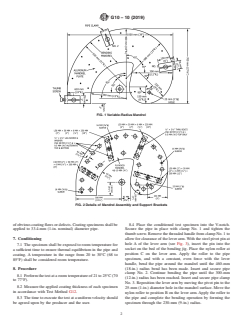
5.1 The bending apparatus shall be essentially as shown in
dance with internationally recognized principles on standard-
Figs. 1-3 and shall include the following:
ization established in the Decision on Principles for the
5.1.1 Variable-Radius Mandrel, constructed from four
Development of International Standards, Guides and Recom-
19-mm (0.75-in.) thick pieces of plywood, bolted together and
mendations issued by the World Trade Organization Technical
conforming to the geometric shape shown in Fig. 1. The
Barriers to Trade (TBT) Committee.
geometricconstructionisaccomplishedbylayingoutalongthe
outer edge of the mandrel a series of seven consecutive arcs at
2. Referenced Documents
decreasing radii of 610, 530, 460, 380, 300, and 230 mm (24,
2.1 ASTM Standards:
21, 18, 15, 12, and 9 in.). The first five arcs shall be carried
G6 Test Method for Abrasion Resistance of Pipeline Coat-
through a 45-deg angle to the next point of tangency.A45-deg
ings
V-notchshallbecutintotheedgeofthemandrelforseatingthe
G12 Test Method for Nondestructive Measurement of Film
pipespecimen.Holesshallbedrilledatappropriatelocationsin
Thickness of Pipeline Coatings on Steel (Withdrawn
the mandrel face for positioning the lever arm and fastening
2013)
pipe clamps.
5.1.2 Lever Arm-Roller Assembly—A 1.83-m (72-in.) lever
3. Summary of Method
arm with nylon roller supplies the mechanical advantage
3.1 The method consists of bending a 33.4-mm (1-in.
necessary to bend the pipe specimen. The lever arm shall
nominal) diameter specimen of coated pipe around a mandrel
contain a series of holes which are used to maintain proper
to produce a range of short-radius bends. Coating failure in the
clearance between the roller and pipe sample during the
bending operation.
5.2 Thickness Gage—Measurements of coating thickness
This test method is under the jurisdiction of ASTM Committee D01 on Paint
will be required for this test. This shall be done in accordance
and Related Coatings, Materials, andApplications and is the direct responsibility of
with Test Method G12.
Subcommittee D01.48 on Durability of Pipeline Coating and Linings.
Current edition approved Oct. 1, 2019. Published October 2019. Originally
5.3 Holiday Detector—A low-voltage d-c holiday detector
approved in 1969. Last previous edition approved in 2015 as G10 – 10(2015). DOI:
of the wet-sponge type, specified in Test Method G6, shall be
10.1520/G0010-10R19.
For referenced ASTM standards, visit the ASTM website, www.astm.org, or
used to locate breaks in the coating film.
contact ASTM Customer Service at service@astm.org. For Annual Book of ASTM
Standards volume information, refer to the standard’s Document Summary page on 6. Test Specimens
the ASTM website.
6.1 The test specimen should be 2.5 m (100 in.) in length. It
The last approved version of this historical standard is referenced on
www.astm.org. should be representative of production-coated pipe and be free
Copyright © AS
...