

ASTM D8206-18
(Test Method)Standard Test Method for Oxidation Stability of Lubricating Greases—Rapid Small-Scale Oxidation Test (RSSOT)
General Information
- Abstract
SIGNIFICANCE AND USE
5.1 This test method measures the net change in pressure resulting from consumption of oxygen by oxidation and gain in pressure due to formation of volatile oxidation by-products. This test method may be used for quality control to indicate batch-to-batch uniformity. It predicts neither the stability of greases stored in containers for long periods, nor the stability of films of greases on bearings and motor parts.
5.2 Induction period as determined under the conditions of this test method can be used as an indication of oxidation stability. This test method can be used for research and development, quality control, and specification purposes. However, no correlation has been determined between the results of this test method and service performance.
SCOPE
1.1 This test method covers the quantitative determination of the oxidation stability of lubricating greases with a dropping point above the test temperature.
1.2 This test method determines the resistance of lubricating greases to oxidation when stored statically in an oxygen atmosphere in a sealed system at an elevated temperature under conditions of test.
1.3 The values stated in SI units are to be regarded as the standard. No other units of measurement are included in this standard.
1.4 This standard does not purport to address all of the safety concerns, if any, associated with its use. It is the responsibility of the user of this standard to establish appropriate safety, health, and environmental practices and determine the applicability of regulatory limitations prior to use.
1.5 This international standard was developed in accordance with internationally recognized principles on standardization established in the Decision on Principles for the Development of International Standards, Guides and Recommendations issued by the World Trade Organization Technical Barriers to Trade (TBT) Committee.
- Status
- Published
- Publication Date
- 31-May-2018
- Technical Committee
- D02 - Petroleum Products, Liquid Fuels, and Lubricants
- Drafting Committee
- D02.09.0E - Oxidation of Greases
Overview
ASTM D8206-18 is the Standard Test Method for Oxidation Stability of Lubricating Greases-Rapid Small-Scale Oxidation Test (RSSOT). Developed by ASTM International, this standard outlines a method for quantitatively determining the oxidation stability of lubricating greases when exposed to oxygen at elevated temperatures in a sealed system. The test helps evaluate batch uniformity and supports research, development, and quality control processes in the lubricating grease industry.
Oxidation stability is critical for lubricating greases as it affects their performance, longevity, and ability to protect machinery from wear and corrosion. The RSSOT procedure provides rapid results using small sample sizes, enabling efficient analysis.
Key Topics
- Oxidation Stability Testing: The RSSOT method measures the resistance of lubricating greases to oxidation by continuously monitoring the pressure inside a sealed vessel exposed to oxygen and heat.
- Induction Period: The test determines the induction period, defined as the time elapsed before the pressure drops 10% below the maximum, indicating the onset of significant oxidation.
- Quality Control: Results from this test may indicate batch-to-batch uniformity but do not predict long-term storage stability or performance in service applications.
- Laboratory Safety: The procedure involves handling high-pressure oxygen and elevated temperatures, necessitating stringent safety, health, and environmental protocols.
Applications
- Quality Assurance: Manufacturers use the RSSOT method for routine quality control, ensuring the uniformity of lubricant grease batches.
- Research and Development: The test aids in developing new grease formulations with improved oxidation stability by providing comparative performance data.
- Specification Testing: Results can be referenced in procurement and technical specifications, enabling consistent product quality and compliance.
- Suitability Assessment: While the method provides valuable oxidation stability data, it should be complemented by further testing to assess real-world grease performance and service life.
Related Standards
- ASTM D942 – Test Method for Oxidation Stability of Lubricating Greases by the Oxygen Pressure Vessel Method
A commonly referenced, alternative test for grease oxidation stability. - ASTM D4057 – Practice for Manual Sampling of Petroleum and Petroleum Products
Provides best practices for obtaining representative samples of greases and lubricants. - ASTM D6300 – Practice for Determination of Precision and Bias Data for Use in Test Methods for Petroleum Products and Lubricants
Ensures analytical consistency and validates the precision of results. - EN 60751:2008 – Industrial Platinum Resistance Thermometers
Specifies requirements for temperature sensors critical for accurate measurement in the RSSOT.
Practical Value
Implementing ASTM D8206-18 helps lubricant manufacturers and laboratories:
- Assess and compare the oxidation stability of different grease batches efficiently.
- Support continuous quality improvement through consistent testing protocols.
- Reduce development time for new products by providing quick feedback on oxidation resistance.
- Enhance customer confidence by citing compliance with recognized international standards.
This standard supports manufacturers, researchers, and quality assurance professionals seeking reliable, repeatable methods for evaluating the oxidation stability of lubricating greases in a controlled laboratory environment.
Keywords: ASTM D8206-18, oxidation stability, lubricating grease, RSSOT, quality control, induction period, lubricant testing, ASTM standards, grease performance, pressure vessel test
Relations
- Effective Date
- 01-Mar-2024
- Effective Date
- 01-Dec-2023
- Effective Date
- 01-Dec-2023
- Effective Date
- 01-Nov-2023
- Effective Date
- 01-Dec-2019
- Effective Date
- 01-Nov-2019
- Effective Date
- 01-Apr-2016
- Effective Date
- 01-Jun-2015
- Effective Date
- 01-Apr-2015
- Effective Date
- 01-Jun-2014
- Effective Date
- 01-Jun-2014
- Effective Date
- 01-May-2014
- Effective Date
- 01-Dec-2013
- Effective Date
- 15-Jul-2013
- Refers
ASTM D4057-06(2011) - Standard Practice for Manual Sampling of Petroleum and Petroleum Products - Effective Date
- 01-Jun-2011
Get Certified
Connect with accredited certification bodies for this standard

Element Materials Technology
Materials testing and product certification.

ABS Group Brazil
ABS Group certification services in Brazil.

ABS Quality Evaluations Inc.
American Bureau of Shipping quality certification.
Sponsored listings
Frequently Asked Questions
ASTM D8206-18 is a standard published by ASTM International. Its full title is "Standard Test Method for Oxidation Stability of Lubricating Greases—Rapid Small-Scale Oxidation Test (RSSOT)". This standard covers: SIGNIFICANCE AND USE 5.1 This test method measures the net change in pressure resulting from consumption of oxygen by oxidation and gain in pressure due to formation of volatile oxidation by-products. This test method may be used for quality control to indicate batch-to-batch uniformity. It predicts neither the stability of greases stored in containers for long periods, nor the stability of films of greases on bearings and motor parts. 5.2 Induction period as determined under the conditions of this test method can be used as an indication of oxidation stability. This test method can be used for research and development, quality control, and specification purposes. However, no correlation has been determined between the results of this test method and service performance. SCOPE 1.1 This test method covers the quantitative determination of the oxidation stability of lubricating greases with a dropping point above the test temperature. 1.2 This test method determines the resistance of lubricating greases to oxidation when stored statically in an oxygen atmosphere in a sealed system at an elevated temperature under conditions of test. 1.3 The values stated in SI units are to be regarded as the standard. No other units of measurement are included in this standard. 1.4 This standard does not purport to address all of the safety concerns, if any, associated with its use. It is the responsibility of the user of this standard to establish appropriate safety, health, and environmental practices and determine the applicability of regulatory limitations prior to use. 1.5 This international standard was developed in accordance with internationally recognized principles on standardization established in the Decision on Principles for the Development of International Standards, Guides and Recommendations issued by the World Trade Organization Technical Barriers to Trade (TBT) Committee.
SIGNIFICANCE AND USE 5.1 This test method measures the net change in pressure resulting from consumption of oxygen by oxidation and gain in pressure due to formation of volatile oxidation by-products. This test method may be used for quality control to indicate batch-to-batch uniformity. It predicts neither the stability of greases stored in containers for long periods, nor the stability of films of greases on bearings and motor parts. 5.2 Induction period as determined under the conditions of this test method can be used as an indication of oxidation stability. This test method can be used for research and development, quality control, and specification purposes. However, no correlation has been determined between the results of this test method and service performance. SCOPE 1.1 This test method covers the quantitative determination of the oxidation stability of lubricating greases with a dropping point above the test temperature. 1.2 This test method determines the resistance of lubricating greases to oxidation when stored statically in an oxygen atmosphere in a sealed system at an elevated temperature under conditions of test. 1.3 The values stated in SI units are to be regarded as the standard. No other units of measurement are included in this standard. 1.4 This standard does not purport to address all of the safety concerns, if any, associated with its use. It is the responsibility of the user of this standard to establish appropriate safety, health, and environmental practices and determine the applicability of regulatory limitations prior to use. 1.5 This international standard was developed in accordance with internationally recognized principles on standardization established in the Decision on Principles for the Development of International Standards, Guides and Recommendations issued by the World Trade Organization Technical Barriers to Trade (TBT) Committee.
ASTM D8206-18 is classified under the following ICS (International Classification for Standards) categories: 75.100 - Lubricants, industrial oils and related products. The ICS classification helps identify the subject area and facilitates finding related standards.
ASTM D8206-18 has the following relationships with other standards: It is inter standard links to ASTM D6300-24, ASTM D6300-23a, ASTM D942-23a, ASTM D942-23, ASTM D6300-19a, ASTM D942-19, ASTM D6300-16, ASTM D6300-15, ASTM D942-15, ASTM D6300-14a, ASTM D6300-14ae1, ASTM D6300-14, ASTM D6300-13a, ASTM D6300-13, ASTM D4057-06(2011). Understanding these relationships helps ensure you are using the most current and applicable version of the standard.
ASTM D8206-18 is available in PDF format for immediate download after purchase. The document can be added to your cart and obtained through the secure checkout process. Digital delivery ensures instant access to the complete standard document.
Standards Content (Sample)
This international standard was developed in accordance with internationally recognized principles on standardization established in the Decision on Principles for the
Development of International Standards, Guides and Recommendations issued by the World Trade Organization Technical Barriers to Trade (TBT) Committee.
Designation: D8206 − 18
Standard Test Method for
Oxidation Stability of Lubricating Greases—Rapid Small-
Scale Oxidation Test (RSSOT)
This standard is issued under the fixed designation D8206; the number immediately following the designation indicates the year of
original adoption or, in the case of revision, the year of last revision. A number in parentheses indicates the year of last reapproval. A
superscript epsilon (´) indicates an editorial change since the last revision or reapproval.
1. Scope 2.2 ISO Standard:
EN 60751:2008 Industrial platinum resistance thermometers
1.1 This test method covers the quantitative determination
and platinum temperature
of the oxidation stability of lubricating greases with a dropping
point above the test temperature.
3. Terminology
1.2 Thistestmethoddeterminestheresistanceoflubricating
3.1 Definitions of Terms Specific to This Standard:
greases to oxidation when stored statically in an oxygen
3.1.1 break point, n—pressure in the test instrument, which
atmosphereinasealedsystematanelevatedtemperatureunder
is 10 % below the maximum pressure of the actual test run.
conditions of test.
3.1.2 induction period, n—timeelapsedbetweenstartingthe
1.3 The values stated in SI units are to be regarded as the
heating procedure of the pressure vessel and the break point,
standard. No other units of measurement are included in this
measured in minutes.
standard.
1.4 This standard does not purport to address all of the
4. Summary of Test Method
safety concerns, if any, associated with its use. It is the
4.1 For this test, 4.00 g 6 0.01 g of sample is weighed in a
responsibility of the user of this standard to establish appro-
glass dish at a temperature of 20 °C 6 5 °C and then
priate safety, health, and environmental practices and deter-
introduced into a pressure vessel, which is subsequently
mine the applicability of regulatory limitations prior to use.
charged with oxygen to 700 kPa 6 5 kPa.
1.5 This international standard was developed in accor-
4.1.1 The test is initiated by heating the pressure vessel to a
dance with internationally recognized principles on standard-
temperatureof140°C 60.5°Cor160°C 60.5°C,depending
ization established in the Decision on Principles for the
on the selected test.
Development of International Standards, Guides and Recom-
mendations issued by the World Trade Organization Technical 4.2 The pressure is recorded continuously until the break
Barriers to Trade (TBT) Committee. point is reached.
2. Referenced Documents 5. Significance and Use
2.1 ASTM Standards: 5.1 This test method measures the net change in pressure
D942 Test Method for Oxidation Stability of Lubricating resultingfromconsumptionofoxygenbyoxidationandgainin
Greases by the Oxygen Pressure Vessel Method pressure due to formation of volatile oxidation by-products.
D4057 Practice for Manual Sampling of Petroleum and This test method may be used for quality control to indicate
Petroleum Products batch-to-batch uniformity. It predicts neither the stability of
D6300 Practice for Determination of Precision and Bias greases stored in containers for long periods, nor the stability
Data for Use in Test Methods for Petroleum Products and
of films of greases on bearings and motor parts.
Lubricants
5.2 Induction period as determined under the conditions of
this test method can be used as an indication of oxidation
stability. This test method can be used for research and
This test method is under the jurisdiction of ASTM Committee D02 on
development, quality control, and specification purposes.
Petroleum Products, Liquid Fuels, and Lubricants and is the direct responsibility of
However, no correlation has been determined between the
Subcommittee D02.09.0E on Oxidation of Greases.
results of this test method and service performance.
Current edition approved June 1, 2018. Published July 2018. DOI: 10.1520/
D8206-18.
For referenced ASTM standards, visit the ASTM website, www.astm.org, or
contact ASTM Customer Service at service@astm.org. For Annual Book of ASTM
Standards volume information, refer to the standard’s Document Summary page on Available fromAmerican National Standards Institute (ANSI), 25 W. 43rd St.,
the ASTM website. 4th Floor, New York, NY 10036, http://www.ansi.org.
Copyright © ASTM International, 100 Barr Harbor Drive, PO Box C700, West Conshohocken, PA 19428-2959. United States
D8206 − 18
6. Apparatus 0.5 mm. The temperature sensor is calibrated to the nearest
0.1 °C by an approved calibration service, such as one that is
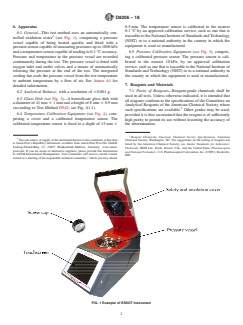
6.1 General—This test method uses an automatically con-
4 traceable to the National Institute of Standards andTechnology
trolled oxidation tester (see Fig. 1), comprising a pressure
(NIST) or to a national authority in the country in which the
vessel capable of being heated quickly and fitted with a
equipment is used or manufactured.
pressure sensor capable of measuring pressures up to 1800 kPa
andatemperaturesensorcapableofreadingto0.1 °Caccuracy. 6.5 Pressure Calibration Equipment (see Fig. 5), compris-
Pressure and temperature in the pressure vessel are recorded ing a calibrated pressure sensor. The pressure sensor is cali-
continuously during the test. The pressure vessel is fitted with brated to the nearest 10 kPa, by an approved calibration
oxygen inlet and outlet valves and a means of automatically service, such as one that is traceable to the National Institute of
releasing the pressure at the end of the test. The integrated Standards and Technology (NIST) or to a national authority in
cooling fan cools the pressure vessel from the test temperature the country in which the equipment is used or manufactured.
to ambient temperature by a flow of air. See Annex A1 for
7. Reagents and Materials
detailed information.
7.1 Purity of Reagents—Reagent-grade chemicals shall be
6.2 Analytical Balance, with a resolution of 60.001 g.
used in all tests. Unless otherwise indicated, it is intended that
6.3 Glass Dish (see Fig. 3)—A borosilicate glass dish with
all reagents conform to the specifications of the Committee on
a diameter of 41 mm 6 1 mm and a height of 8 mm 6 0.9 mm
Analytical Reagents of the American Chemical Society where
(according to Test Method D942; see Fig. A1.1). 5
such specifications are available. Other grades may be used,
6.4 Temperature Calibration Equipment (see Fig. 4), com-
provided it is first ascertained that the reagent is of sufficiently
prising a cover and a calibrated temperature sensor. The
high purity to permit its use without lessening the accuracy of
calibrated temperature sensor is fixed to a depth of 15 mm 6
the determination.
Reagent Chemicals, American Chemical Society Specifications, American
Thesolesourceofsupplyoftheinstrumentknowntothecommitteeatthistime
Chemical Society, Washington, DC. For suggestions on the testing of reagents not
isAnton Paar’s RapidOxy instrument, available fromAnton Paar ProveTec GmbH,
listed by the American Chemical Society, see Analar Standards for Laboratory
Ludwig-Erhard-Ring 13, 15827 Blankenfelde-Mahlow, Germany, www.anton-
Chemicals, BDH Ltd., Poole, Dorset, U.K., and the United States Pharmacopeia
paar.com. If you are aware of alternative suppliers, please provide this information
and National Formulary, U.S. Pharmacopeial Convention, Inc. (USPC), Rockville,
to ASTM International Headquarters. Your comments will receive careful consid-
MD.
eration at a meeting of the responsible technical committee, which you may attend.
FIG. 1 Example of RSSOT Instrument
D8206 − 18
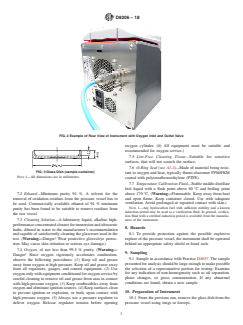
FIG. 2 Example of Rear View of Instrument with Oxygen Inlet and Outlet Valve
oxygen cylinder. (6) All equipment must be suitable and
recommended for oxygen service.)
7.5 Lint-Free Cleaning Tissue—Suitable for sensitive
surfaces, that will not scratch the surface.
7.6 O-Ring Seal (see A1.2)—Made of material being resis-
FIG. 3 Glass Dish (sample container)
tant to oxygen and heat, typically fluoro-elastomer FPM/FKM
NOTE 1—All dimensions are in millimetres.
coated with polytetrafluoroethylene (PTFE).
7.7 Temperature Calibration Fluid—Stable middle distillate
fuel liquid with a flash point above 60 °C and boiling point
above 170 °C. (Warning—Flammable. Keep away from heat
7.2 Ethanol—Minimum purity 94 %. A solvent for the
and open flame. Keep container closed. Use with adequate
removal of oxidation residues from the pressure vessel has to
ventilation. Avoid prolonged or repeated contact with skin.)
be used. Commercially available ethanol of 94 % minimum
NOTE 1—Any hydrocarbon fuel with sufficient stability and a known
purity has been found to be suitable to remove residues from
induction period may be used as a verification fluid. In general, verifica-
the test vessel.
tion fluid with a certified induction period is available from the manufac-
turer of the instrument.
7.3 Cleaning Solution—A laboratory liquid, alkaline high-
performanceconcentratedcleanerforimmersionandultrasonic
8. Hazards
baths, diluted in water to the manufacturer’s recommendation
and capable of satisfactorily cleaning the glassware used in the 8.1 To provide protection against the possible explosive
test. (Warning—Danger! Wear protective gloves/eye protec- rupture of the pressure vessel, the instrument shall be operated
tion. May cause skin irritation or serious eye damage.) behind an appropriate safety shield or hood sash.
7.4 Oxygen, of not less than 99.5 % purity. (Warning—
9. Sampling
Danger! Since oxygen vigorously accelerates combustion,
9.1 Sample in accordance with Practice D4057. The sample
observe the following procedures: (1) Keep oil and grease
presented for analysis should be large enough to make possible
away from oxygen at high pressure. Keep oil and grease away
the selection of a representative portion for testing. Examine
from all regulators, gauges, and control equipment. (2) Use
for any indication of non-homogeneity such as oil separation,
oxygenonlywithequipmentconditionedforoxygenserviceby
phase changes, or gross contamination. If any abnormal
careful cleaning to remove oil and grease from area in contact
conditions are found, obtain a new sample.
with high-pressure oxygen. (3) Keep combustibles away from
oxygen and eliminate ignition sources. (4) Keep surfaces clean
10. Preparation of Instrument
to prevent ignition or explosion, or both, upon contact with
high pressure oxygen. (5) Always use a pressure regulator to 10.1 From the previous run, remove the glass dish from the
deliver oxygen. Release regulator tension before opening pressure vessel using tongs or forceps.
D8206 − 18
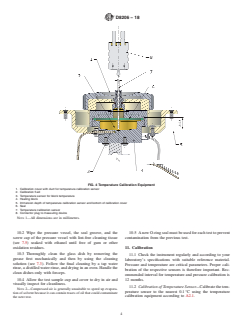
FIG. 4 Temperature Calibration Equipment
1. Calibration cover with duct for temperature calibration sensor
2. Calibration fluid
3. Temperature sensor for block temperature
4. Heating block
5. Immersion depth of temperature calibration sensor and bottom of calibration cover
6. Seal
7. Temperature calibration sensor
8. Connector plug to measuring device
NOTE 1—All dimensions are in millimetres.
10.2 Wipe the pressure vessel, the seal groove, and the 10.5 AnewO-ringsealmustbeusedforeachtesttoprevent
screw cap of the pressure vessel with lint-free cleaning tissue contamination from t
...